IMPRISON TRAITOR, PEDOPHILE, AND CONVICTED FELON TRUMP.
Showing posts with label Elizabeth Taylor. Show all posts
Thursday, April 21, 2011
Life with Father - 1947
Oh, GAD! It is with only a little tongue in cheek that I wish those who celebrate Easter a pleasant holiday by discussing a movie about a man who refuses to get baptized.
From the first glimpse in the stereopticon images to the opening theme swelling with a rhythm that suggests the clip-clop of trotting horses, “Life with Father” (1947) sweeps us back to a simpler time that is part history, and part parody.
One could categorize this film along with some of the others in the post-War era that seemed to soothe our raw nerves from the experiences of wartime with gentle nostalgia, a family of films that would include “I Remember Mama” (1948), “Good News” (1947), “Cheaper by the Dozen” (1950). But, “Life with Father” has its own pedigree.
The film is based on the famous stage play that, at the time, had been the longest running show on Broadway. On my New England Travels blog this week, we have a look at the Lakewood Theater in Skowhegan, Maine, where this premiered in 1939. A young Teresa Wright, before she came to Hollywood, played the role taken by Elizabeth Taylor in the film.
Like “Mama” and “Cheaper by the Dozen”, “Life with Father” began as a book. In each case, the authors wrote humorous and heartwarming reminisces about their parents. Opposite of the angst-filled, vitriolic, tell-all books popular today, it’s interesting to think that Mama, and Frank Gilbreth, and Clarence Day could be manufactured by their children into characters in American literature.
Perhaps they are not so well known characters these days, but there was a time when at least a couple of generations of readers claimed familiarity with them. Have a look at this post where we discussed popular novels turned into films.
The movie, with sets painted in those pleasing, soft colors we’ve noted in some other post-War color films, takes us back to 1883 New York City, where irascible Clarence Day, a Wall Street financier, domineers his family not so much with sternness as with overpowering confidence that his own judgment is unfailingly right. The first glimpse we get of the great man is of his shadow on an upstairs hall landing. It's a great entrance.
William Powell plays Mr. Day in a performance that deservedly earned him an Oscar nomination. His tolerant wife is played by Irene Dunne. These two, at the sunset of their film careers, are charming in their roles. She would earn her own Oscar nomination the following year for “I Remember Mama”.
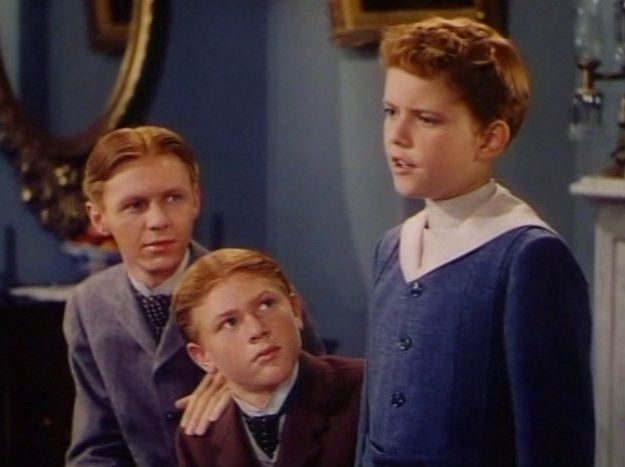
They have a family of four sons, played by Jimmy Lydon, best known for his portrayal of Henry Aldrich (“Coming, Mother!”) in a series of B-movies; a tall 15-year-old Martin Milner in his first film. We last saw Martin here in “I Want You” (1951). Johnny Calkins is next in line, and little Derek Scott plays the youngest. All the boys, like their father, are redheads. Martin Milner reportedly mused that of all the cast, he was the only natural redhead of the bunch.
Monte Blue, from silent film days, gets a brief role as the cop. Zasu Pitts, like Mr. Powell and Miss Dunne, a veteran of Hollywood’s heyday, plays a visiting cousin, but though her role is chipper and chatty, she does not get to display here her tremendous gift for slapstick comedy that we noted in this post on “Bargain of the Century” (1933). It is almost something of a shock to see her act like a regular person, and not that lovable but almost tragically obtuse comic character she created so many years before in Mack Sennett shorts. There’s something vaguely disappointing about Zasu Pitts being normal. I miss the Olive Oyl warble in her voice, and those hysterical expressions that despite their goofiness seemed to indicate a superior knowledge of the human condition.
Miss Pitts comes to town with a young Elizabeth Taylor. With a handful of films already under her belt, Elizabeth plays her ingenue role with confidence. Much has been written lately in the aftermath of Miss Taylor’s passing about her beauty, her iconic image, and her power as an actress. I can’t refute any of that, but I would note that one scene in this film has always stood out for me, and perhaps it’s because it shows the possibility of an alternate future for Elizabeth Taylor.
I mean the scene where she and oldest boy, the Yale-bound Jimmy Lydon attempt a violin-piano duet on “Ye Servants of God”. She does not recognize the tune, though she is familiar with the words of the hymn on the sheet music. The Day family are Episcopalian, and Elizabeth confesses that she was raised a Methodist. The tune is different in the Methodist church. They make several false starts and struggle badly through the piece.
“It was my fault,” Mr. Lydon gallantly states, but Elizabeth, like a 19th Century Juliet unable to socially bond with her Victorian Romeo:
“No, you’re the Episcopalian.” She then remembers that her father had been baptized in the Episcopal church, but joined the Methodist church when he married her mother.
“She was the Methodist,” Elizabeth says, as if she is calling her mother something vile, and it is a sparkling moment of deft comedy. It makes one wonder if Elizabeth Taylor could handle comedic timing so well, so young, what would her career have been like had she not also been so beautiful? Her chirpy voice is an affectation of the moment, but might she have blossomed into a less iconic leading lady, but with a larger range of roles had audiences been allowed to identify with her more and deify her less.
The question of religious affiliation drives a good part of the film, beginning with third son Johnny Calkins constantly seeking help to practice his catechism for his upcoming Confirmation. Still troubled by the “mixed marriage” of her parents, Elizabeth Taylor asks William Powell if he had been baptized Episcopalian, and Mr. Powell jovially confesses he was never baptized at all.
Irene Dunne nearly pops her corset in shock, deeply upset both by Powell’s cavalier insistence that it’s not important, and by the thought that he will not join her in heaven, that they are not really married in the eyes of the church, and that her children are quite possibly illegitimate.
Though she has taken great pains to accommodate the master of the house in all things from scaring away nervous Irish servants, to banishing her new rubber plant, to maintaining accurate household accounts (mostly), she is unrelenting about the horror of his not being baptized and insists he get the ceremony done immediately.
He insists, with what we might consider a quite modern outlook, that he will be a Christian in his own way.
“They can’t keep me out of heaven on a technicality!”
Of course, among Christians, the idea of being a Christian in one’s own way is nothing new. If this were not the case, there would never have been any Methodists or Episcopalians, Lutherans, Quakers, or Baptists, etc. Re-defining, honing perhaps, the essentials of religious practices seems to be part and parcel of what it is to be a Christian.
The movie has a lighthearted grip on this irony, as well as on the elements of Victorian society that also pit tradition versus change. In a scene where Jimmy Lydon asks his father about women, we have William Powell sitting down to tell his son the facts of life, only to sputter about wrong his mother is over her stubborn beliefs. When Lydon wants clarification on men’s relationships with women, Powell turns back into the Victorian father and sternly remarks, “Gentlemen don’t discuss such things.”
Edmund Gwenn plays the gentle minister who makes Powell squirm in his pew (which Powell informs his wife has lost property value in two years - “If the market ever goes up, I’m going to unload that pew.”), by sermonizing on the perils of not being baptized.
“I don’t go to church to be preached at as if I’m some lost sheep!” Powell blusters.
Eventually, Mr. Powell takes his troubles directly to God when Irene Dunne becomes ill. Powell, in a funny, but moving prayer, hollers at the Deity, “Have mercy, I say!” and promises to become baptized if she is spared.
She gets well. It’s time for Powell to pay up, but he still refuses, and it takes a bit more cajoling to get him to the font. It’s another humorous touch that one of the motivating factors that makes him decide to proceed with getting baptized is that the cab Irene Dunne has hired for that purpose is costing him $2 an hour just waiting outside.
One of the sweetest moments in the film is a scene of domestic bliss between Mr. Powell and Miss Dunne, when they sit together, their discussion fading off into a soft duet of “Sweet Marie”. We knew Dunne could sing, but Powell is charming. The camera pans back and we see the stillness, the orderliness of the drawing room with the only movement a slight billowing of the lacy curtains at the window, sifted by the summer breeze. It is a cameo image of the 19th Century.
Michael Curtiz directs this film with his customary economy, but moments like these make one think of Vincente Minnelli.
Another memorable moment is when Jimmy Lydon, wearing one of his father’s old cut-down suits, is unable to kneel in church, or sit with a girl on his lap, or do anything his father wouldn’t do in this suit. The suit seems to control him. When Elizabeth curls up to him, he growls helplessly, “Get up! Get up!” What bigger insult can a young lady have?
The boys try to raise money, and Jimmy Lydon offers his “piece of John Wilkes Booth’s finger” to Martin Milner.
When Irene Dunne laments the newspaper article about a wreck on the old New Haven railroad line because it would disturb Wall Street and therefore her husband: “I do wish the New Haven would stop having wrecks. If only they knew how it upset your father.”
There is, above all, the glorious, just short of scene chewing mastery of William Powell, with his pince-nez glasses on a ribbon, his colossal ranting, and his clear, helpless devotion to his wife. His flirty, “Shall I leave the room?” when Zasu Pitts wants to show Irene Dunne her purchases of intimate apparel.
The horse-drawn streetcar, the quiet country lane that once was Madison Avenue in New York City, and the stereopticon pictures. It’s a feast for the eyes.
And could be a better visual feast if only the film was restored, but it is now in public domain and has become an orphan. (Oh, GAD!) If you’d like to see it right now, here’s a link where you can watch the whole thing, interrupted by a few commercials. It’s not the best way to see this delightful movie, but even Clarence Day couldn’t argue about the price.
Thursday, June 24, 2010
Callaway Went Thataway - 1951
“Callaway Went Thataway” (1951), continues our look at old movies as filler for programming on early TV, and on the “Hopalong” Cassidy phenomenon in particular. Not that Hoppy is actually mentioned, in fact the film ends with a careful disclaimer to that effect.
Fred MacMurray and Dorothy McGuire play ad executives who are making money hand over fist with their latest property, the redistribution of old “Smokey Callaway” B-movies to the hungry TV market. Even more, the merchandizing of Smokey Callaway toys, etc. But, the network execs decide this is such a good thing, they want to hire the cowpoke to make some brand new films. The problem is, Callaway is nowhere to be found. Enter a young look-alike, played by Howard Keel.
We are first introduced to the Hoppy, er, that is, Callaway phenomenon, through the montage of small children glued to the TV, watching their hero’s every move. This includes a couple of poker-faced young African-American kids, who, as discussed in this previous post on Herb Jeffries, were given little by either Hollywood or TV in the way of a black hero to emulate. Clearly, we are shown that Callaway appeals to everybody in this democratic republic. It’s a cute shot, that can’t help but ring hollow. Grownups love him, too, including a fawning Natalie Schafer, who plays the wife of the big TV boss. You may remember her as Lovey in “Gilligan’s Island.”
The team of MacMurray and McGuire are now up a creek, because the real Callaway disappeared to a life of dissipation years ago, and the look-alike cowboy they hire to play him wants nothing to do with TV. He is sincere, honest, naïve, and gentle. Howard Keel, with his choir boy haircut and soft speech, is adorable, and it’s kind of amazing to see him later on in the film playing the real Callaway, an obnoxious, womanizing boozer, with the same face, the same clothes, and yet actually appearing different. His voice booms and his face actually looks puffier, his hard, dim eyes glaring with suspicion and resentment.
But, until they find the real Callaway, they must utilize his erstwhile double, and on a coast to coast train trip, McGuire tries to impress upon Mr. Keel how important Smokey Callaway is as a role model to children. Along the way, he falls in love with her, but she is reluctant to submit to his aw-shucks charm.
She and MacMurray have that 1930s screwball comedy rapport with each other, but it’s somewhat forced and we are given to understand there is no romantic involvement between them. She undergoes a conversion when she falls in love with Howard Keel and decides the ad racket has gotten too deceitful for her. Mr. MacMurray never undergoes such a conversion, remaining a likeable, but undependable trickster to the end. MacMurray was so good playing guys on the knife edge of good and bad.
On their coast-to-coast trip we get some rear screen project of Niagara Falls, a lot of train interior shots, which is always lovely, but their stop in San Francisco appears to be really filmed there. There is also a bit at the end filmed at the Los Angeles Coliseum, so we might wonder what kind of build-up this movie had and what expense went into making it.
There are even a few star cameos. Esther Williams and her sons accost Keel in a hotel lobby, and later he meets Elizabeth Taylor and Clark Gable at the Mocambo, both of whom he greets effusively and neither of whom he recognizes.
Mr. Keel, who fairly hero-worships the (he thinks) saintly character he is playing, decides to set up a charitable foundation for children with his salary. But then, the real Smokey shows up like an evil twin, and wants all the moolah and all the swag that the team of MacMurray and McGuire have been generating. There is the inevitable fight scene between the good and evil Smokeys, and because they are wearing the same clothes, we don’t know who is who.
Finally, the real one learns of the charitable foundation set up by his look-alike, and bails out of the whole Smokey Callaway franchise. He doesn’t want any part of it if he can’t keep the money himself. The look-alike gets to keep the job.
Fred MacMurray tosses off a funny line with all seriousness, “What’s the Smokey Callaway Foundation? Have we got a girdle tie-in?”
We end with a rousing appearance at the Coliseum, and Miss McGuire’s 11th-hour commitment to being the sweetheart of a TV cowboy.
Both these films, “Dreamboat” and “Callaway Went Thataway” harken back to the screwball comedies of a previous generation, but they land squarely in the present, using it as surely as any socially conscious dramatic film of that era did to bring reality to the movies. “Callaway” ends with the interesting disclaimer, as much a signpost to the era as the fake signpost it was printed on. (The opening screen titles on a similar signpost remind me of “My Darling Clementine.”)
“This picture was made in the spirit of fun, and was meant in no way to detract from the wholesome influence, civic mindedness and the many charitable contributions of Western idols of our American youth, or to be a portrayal of any of them.”
A case of methinks they doth protest too much?
Actually, Hopalong Cassidy, is the real hero on whom this movie is based. You might remember his showing up Boris Karloff in the 1950 Macy’s Thanksgiving Parade, as discussed in this previous post. From the book “Total Television” by Alex M. Neal (Penguin Books, NY, 1996, 4th edition), we have a few stats on our hero. Hoppy made 66 B-movies from 1935 to 1948. William Boyd, who played Hoppy, cannily acquired the TV rights to his films, and re-edited them to fit 30 and 60-minute timeslots. According to author Mr. Neal, “thus, he was in a position to offer a readily available source of action programming to the rapidly expanding postwar television station market.”
Hopalong Cassidy merchandise on display at the Autry Musuem of the American West, Los Angeles (author photo)
His show ran from 1949 to 1951 on NBC, and then continued in syndication from 1952 to 1954. Hoppy was perfect for the new medium and the black and white sets: he dressed in black, and rode a white horse. Anybody remember Hoppy’s horse’s name?
Thursday, May 15, 2008
Now Playing - 1950

Forgive the unannounced intermission between this and my last post of two weeks ago. We’re back with another magazine ad, this time for “Father of the Bride” (1950). Directed by Vincente Minnelli, starring Spencer Tracy, Elizabeth Taylor, and Joan Bennett, we see that the ad mentions some names, but does not flood the graphics with paragraphs of superlatives or critics’ “thumbs up” the way a lot of modern ads do.
Here we have what was usual for those days; an artist’s rendering to capture the essence of the movie. No actual photographed images of the stars, but a stylized drawing. The film, appropriately, was released in June of that year.
Wednesday, April 18, 2007
Clarence Brown - From Cars to Film
Clarence Brown became a Hollywood director in the days when being a Hollywood director had nothing to do with film school. An extraordinary industry in its early days; if a man purchased a camera he could be a director.
Born in 1890, with the turn of the Twentieth Century fast approaching, he came along in a period when a menagerie of new innovations in science and art burst forth in such a stream of applied imagination that many inventions, and many qualities of life in the next century would find their prelude in this decade. Both autos and motion pictures had their impetus in this frenetic period. Both would change the country and the world, and both were very important to Clarence Brown.
Brown grew up in Massachusetts and Tennessee, and his first profession was automobile manufacturing. He studied engineering at the University of Tennessee while only 15 years old. He graduated in 1910 with two degrees, and headed for western Massachusetts where the Stevens-Duryea company was building its own line of cars. After a couple of years with them, he left for Birmingham, Alabama to establish his own car plant, called the Brown Motor Company.
Only a few years later, he saw a movie being filmed in New Jersey, where a new interest, and a new career was born. He wrote, produced, acted in minor roles in a few early films, edited, and by the 1920s, began a long career as a film director.
Brown directed Greta Garbo in “Anna Christie,” “Anna Karenina” and other films. She reportedly called him her favorite director. His film “A Free Soul” made a star of Clark Gable, and his “National Velvet” introduced Elizabeth Taylor.
Brown gave us “The Yearling,” “The White Cliffs of Dover,” and “Plymouth Adventure” before retiring in 1953. He had been nominated for the Best Director Academy Award five times. The film industry seemed to be an arena of self-made men, and women, who remade themselves in one way or another, from their appearances, their names, their goals, and their destinies. Clarence Brown, whose intelligence and ambition could have marked him for success in manufacturing or any field, chose film. It’s quite a leap from manufacturing to the artistry of film, but perhaps there was something more than fascination with a new toy that drew Brown. Certainly the early days of film were equally entrepreneurial as artistic, and more than one businessman was lured by the prospect of getting in on something completely new. In his case, it was life changing.
Subscribe to:
Posts (Atom)