IMPRISON TRAITOR, PEDOPHILE, AND CONVICTED FELON TRUMP.
Showing posts with label Ann Todd. Show all posts

Thursday, March 28, 2024

Margie - 1946


Margie
(1946) is a sweet paean to the 1920s, and though not a musical, is sprinkled here and there with tinny renditions of popular 1920s hits from gramophones, radios, pianos, and even a little bit from star Jeanne Crain (not tinny at all), who plays the title character.
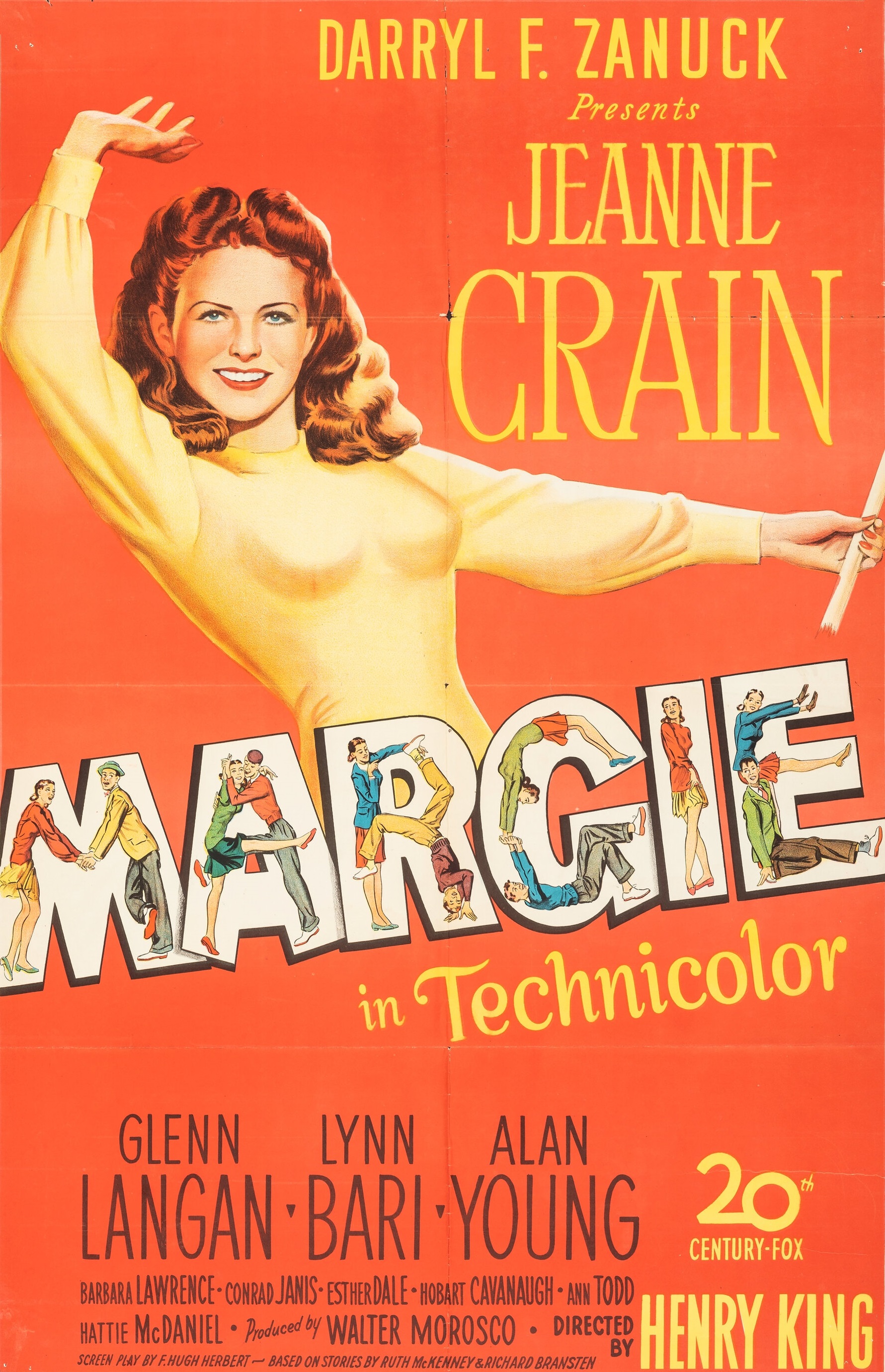

There was a string of post-World War II movies harkening back to a simpler, more innocent (or so we thought) time, and we add Margie to movies like I Remember Mama (1948), Good News (1947) which we covered here, Cheaper by the Dozen (1950) which also starred Jeanne Crain, and Life with Father (1947), which we covered here.

Margie follows a misfit high school girl and her friends in a series of episodes on the ups and downs of Margie’s social life, and the unfortunate repeated collapsing of her bloomers around her ankles when the waistband gives out.  A mortifying experience for an ungainly girl who is desperate to fit in with the glamorous kids.  Margie longs to be popular, especially with the school’s most popular boy, but her only claim to fame is being a champion on the high school debate team.  Her theme: “Get the Marines Out of Nicaragua!” 

We Ruth McKenney fans will instantly recognize the rallying cry from her nostalgic short stories.  The movie storyline is by author Ruth McKenney and her husband Richard Bransten, based on some of the stories she published in The New Yorker magazine (the script was written by F. Hugh Herbert).  These short stories were published in a few book collections, most notably My Sister Eileen, which of course, lent its title and a couple episodes in the book to a successful stage play, then a successful musical; and two movies, one a comedy and one a musical.  Also, a short-lived TV show. 

The real-life hijinks of Ruth and her sister Eileen as they (tried to) conquer New York City are lively and funny, but my favorites are actually the adventures of Ruth and Eileen as small children going to the movies.  Their impressions of silent movies, the horror of Lon Chaney, and the even more vivid horror of a train speeding directly at the camera and therefore, the audience, that sent an entire theater of children at the Saturday matinee running for their lives never fails to crack me up no matter how many times I read it.  And I’ve read them a lot.

I’m still waiting for someone to make a movie or TV show from little Ruth and Eileen’s moviegoing experiences.  To be sure, there is something warm and familiar, and yet Homeric with humorous exaggeration, in personal memoir; think of Ralphie and the Red Ryder BB gun of Jean Shepherd’s memoirs in a later generation.  The movies from the post-World War II era mentioned above were all based on personal memoirs, except Good News, which at the time the musical played on Broadway in 1927 was not nostalgic, but rather, current events.

Margie falls somewhere in between the grade-school Ruth and Eileen in the Midwest around the First World War and early Twenties, and the adult Ruth and Eileen of New York, and while Margie’s sweet innocence is quite the opposite of young Ruth and Eileen, who may have been stumblebums but told with Ruth’s wry and unsentimental narration, came off more like the Katzenjammer kids than a lovely girl in a coming-of-age story.


Margie
is told in flashback.  We begin in the present day, with Jeanne Crain as an older, more mature Margie rummaging through items, and memories, in the attic while her teenage daughter gawks at the old gramophone, the old photos in an album, and her mother’s famous faulty bloomers, which Miss Crain looks upon now without an ounce of her old embarrassment, but with wise humor.  Since the flashback takes place only about twenty years earlier, we may assume she is only in her late thirties, but she seems middle-aged with her upsweep hairdo and glasses.

Her daughter is played by winsome Ann Todd (aka Ann E. Todd), who appeared in several movies in the late 1940s, always in small, supporting roles.  Some of her films we’ve covered here are Cover Up (1949), On the Sunny Side (1942), and My Reputation (1946).


The daughter wants to know about the good old days, and Margie calls forth several incidents from her teens.  Barbara Lawrence plays her next-door neighbor and best friend, who is also the most glamorous girl in school and therefore has the best boyfriend, “Johnikins” played by Conrad Janis, who with his porkpie hat, racoon coat, snazzy red jalopy and disdain for everyone but himself, is really kind of a drip.


Alan Young, in his first movie role, is the nice misfit boy who follows Margie around like a puppy dog.  Hattie McDaniel is Cynthia, the family housekeeper, but unfortunately, she doesn’t get to shine much in this movie. 


Esther Dale has a fine role as Margie’s blunt and outspoken grandmother, with whom she lives.  She is a former suffragette, who has the chains she was bound to the White House fence with on her mantle in pride of place.  “A woman’s place is wherever she makes it!”


Margie’s father, played by Hobart Cavanaugh, is a widower, and lives in bachelor’s digs in another part of town, leaving his daughter to be raised, as was often the custom of the day, by a female relative.  He visits her once a week, and this is a poignant, even sad thread to the story.  She loves her father and looks forward to his visits, but he is shy and awkward with her.  Making matters more uncomfortable for Margie among friends who have both parents, is that her father is a mortician.  He will provide two of the loveliest moments in the film: first, when he escorts her to her high school prom and she beams at having him as her special date.  “I’ve waited sixteen years for the privilege,” he remarks gallantly. 

When they dance a waltz, she notes that it is the first time they’ve ever danced together, but he says it is the second.  The first was “one time in your room when you were about three months old.”  I love Papa.


When she delivers her rousing, theatric debating team resolution to “Take the Marines out of Nicaragua!” he is filled with pride at her presence at the podium but is also spellbound by her message.  He broods on it through the rest of the movie, and believes his daughter is right.  The Marines should be removed from Nicaragua, it is “rank imperialism.”  At the end of the movie, in a nice jest, we see a headline that he has just accepted an appointment as ambassador to Nicaragua.


Though Margie is captivated by Johnikins and jealous of his attention to her friend, she nevertheless has also developed quite a crush on the new French teacher in school, Mr. Fontayne.   Played by Glenn Langan, he will also prove to be a gallant figure in Margie’s life, helping hide the evidence when she loses her bloomers again at a skating party, and returns them to her later in a most delicate and tactful manner.  Through his interactions with Margie through the course of the movie, he will become smitten with her, and it is revealed by another teacher that he is not much older than his students.  


At the end of the film, Margie’s husband comes up to the attic to see what has become of his wife and daughter, and yes, it’s Mr. Fontayne.

A good part of the movie appears to be filmed outside on location, with real snow in the neighborhoods.  


The ice-skating party scene is particularly fun to watch for the constant movement of the skaters and the camera.  The soft Technicolor and the nostalgic themes make it a warm and pleasant movie.  A flaw one might pick at is that none of the girls’ hair styles resemble 1920s hairdos, but rather reflect the post-War 1940s – a similar complaint about Good News, actually.

But see for yourself.  Here’s a link to Margie on YouTube.  Catch it while you can.

For those who celebrate, a very blessed and Happy Easter this coming weekend!

*******************


Our greatest gift from the Greatest Generation was freedom from fascism. Relive, and celebrate, how evil was faced, discussed, dramatized...and fought. Classic films were Hollywood's weapon.

Get your copy of my book Hollywood Fights Fascism here at Amazon in print or eBook, or FREE here for a limited time at Barnes & Noble, Apple, Kobo, and a variety of other online shops.

  ************

Jacqueline T. Lynch is the author of Ann Blyth: Actress. Singer. Star. and Movies in Our Time - Hollywood Mirrors and Mimics the Twentieth Century and Hollywood Fights Fascism and Christmas in Classic Films. TO JOIN HER READERS' GROUP - follow this link for a free book as a thank-you for joining.

Thursday, November 11, 2021

Cover Up - 1949


Cover Up (1949) is a quite enjoyable example of Christmas Noir—if we can play with calling it a subgenre.  It has some lighthearted aspects like Lady on a Train (1944), which we’ll discuss in weeks to come, and a grim mystery that toys with symbols of Christmas as its backdrop not unlike Lady in the Lake (1947), which we covered here in this previous post.


Though I’m usually content to experience each season in its turn and prefer not to rush the holidays—Thanksgiving does not deserve to be given the bum’s rush—this year I’m hoping to tackle a roster of yuletide-related movies as early as—now—to lead up to a new book for the new year: Christmas in Classic Films, which will be a collection of essays from this blog.  More on that in weeks to come.


Cover Up can also be likened to Alfred Hitchcock’s Shadow of a Doubt (1943) with its mysterious murderer casting a sinister shadow over a homey small town.  However, in Cover Up, the murderer is not an outsider like Uncle Charlie come to town; murder is already afoot when the dogged insurance investigator arrives on the train.  He is played by Dennis O’Keefe, and he meets a nice girl here, too, who like Teresa Wright, will grow chillingly aware of danger to her family.  She is Barbara Britton, lovely and understated, with a little more polish than “Young Charlie.”


Though the film has elements similar to all these movies, it is still its own unique creation.  It manages to be both an intriguing and unsettling mystery and a charming, even wistful, tribute to Christmas. 


It begins lightheartedly enough, with Dennis O’Keefe and Barbara Britton in a “meet-cute” aboard a train as they arrive at the same small town.  It is her town, and she arrives home to spend Christmas with her family. She carries the requisite armload of wrapped presents, which she repeatedly drops, and Mr. O’Keefe, who has already eyed her approvingly on the train, rushes to lend a hand.  They next board a bus from the train station to go downtown and the bus driver, a townie whom Britton knows, sets up the story for us by sharing with her the big news: one of the town’s most prominent citizens has committed suicide. The camera lingers only slightly on O’Keefe’s expression at the news, and we assume he knows something about it. 


We don’t know if Miss Britton has been away at college, or has just taken an extended trip.  Her family meets her at the bus stop with enthusiasm: Mother, Dad, and kid sister Ann E. Todd, a fresh-faced child actress in one of her last film roles.  We saw her in Roughly Speaking (1945) and My Reputation (1946) discussed in these previous posts.


Miss Britton introduces O’Keefe to them, and when he says he is staying at the hotel on business and will be in town only a short while, Dad invites him to come to their house in the evening to visit.  An extraordinarily friendly invitation to a stranger, but we are meant to see them as an all-American family with small-town virtues.


There is, however, a degree of small-town vice here as well.  The bus driver has intimated that the man who committed suicide was not well liked.  As the movie progresses, we learn that everybody hated his guts.  When Mr. O’Keefe checks in at the sheriff’s office – we learn then that he is an insurance investigator, not unlike my hero, Johnny Dollar—he has no suspicion that the death was anything more than a suicide, but his company has sent him here to fill out the proper paperwork on the insurance with the coroner’s report.  His first inkling, and ours, that there might be more to this death is the deliberately and glibly stonewalling attitude of the sheriff, played by William Bendix.  Bendix is great in the role, with a knife-edge of sinister smugness and wry humor. We discussed Bendix’s work here in The Blue Dahlia (1946).


Sheriff Bendix is coyly uncooperative about the details of the death and it takes O’Keefe’s stubborn cleverness to ferret out that the victim was shot with a Luger, which is obviously a pistol that not too many people in a small town would have.  It is also missing.  Though, as it happens, the sheriff pulls one out of his desk drawer.  When O’Keefe asks the smart aleck but not just hypothetical question to Bendix, “I don’t suppose you killed Phillips, did you?” he gets no direct answer and we wonder if perhaps the aloof sheriff is a murderer.


The hints and clues begin to unwind, accompanied by the trappings of Christmas.  Bendix is wrapping presents at his desk when O’Keefe’s routine filling out of forms turns into suspicious interrogation.  Bendix rarely meets O’Keefe’s eye, he just puffs on his pipe and his sausage fingers delicately and patiently seal wrapping paper around a small box.  Over by the window is a spindly table-top tree.  O’Keefe moves toward it, fingers a small present on the table under the tree absently, as if he is thinking of something else.  Bendix remarks, “Why don’t you forget about it?  Go on home, visit your folks for Christmas.”


O’Keefe replies, slipping from his confident tough guy mode, “Sounds great, Sheriff, only I don’t have any folks and my home is wherever I happen to hang my hat.”  There is a brief, rather pained look on his face.  He puts the present back under the tree, as if he is refusing a place at the table at Christmas, as if he doesn’t belong.  Then through the film noir blinds at the window he spies Barbara Britton come out of a shop across the street, and tells the sheriff he has a reason to stay.  The sheriff thinks he means the murder case, but we see that is only half of it.


He buys a compact at the jewelry store, has it wrapped, but is there also to question the jeweler, who found the body.  The jeweler and his wife are uncomfortable with the interrogation, and we see that everyone O’Keefe talks to is on edge but thoroughly pushing the party line that the death was a suicide. There appears to be a great conspiracy afoot.


O’Keefe’s next stop is the town undertaker—a dour fellow in typical comedy relief, who tells him that there were no powder burns on the body.  The suicide is looking more and more like murder.


O’Keefe takes up the invitation to stop at the house where Barbara Britton’s family lives, and surprisingly, the compact is a gift not for Britton, but for the younger sister, Ann E. Todd.  It’s a cheery home with a fireplace, Mother and Dad, played by Helen Spring and Art Baker, in easy chairs, and a comically more-dour-than-the-undertaker maid played by Doro Merande.  O’Keefe gives sleuthing the night off, he thinks, and takes the already smitten Miss Britton to the movies.


We learn gradually, as happens in small towns, that most people not only know each other, but are in some way connected.  Barbara’s good friend, played by Virginia Christine, is the niece of the dead man.  She was to inherit his wealth as his only relative.  She was away the night of the killing as that was the evening she eloped against his wishes.  Russell Arms plays her new husband, of whom the uncle disapproved.  Arms had minor roles in several films until he eventually found work in television and became familiar in living rooms across the country as one of the stars of Your Hit Parade.


It looks like Russell, who has a bit of a temper and a chip on his shoulder, could have killed Uncle, and Virginia certainly looks uncomfortable, as if she is covering for him.


Barbara Britton drives O’Keefe around on his errands—like scouting out the murder scene at Uncle’s house, and when O’Keefe mentions his quest for a Luger, she innocently and happily blurts out that her father would lend him his Luger.


Daddy’s got a Luger pistol?


O’Keefe, who has come to like the family, and love Barbara, is anguished that it might be her father whom he is tracking, and slowly, her eyes on the road as she is driving, we see cold realization on her face that she just implicated her father in a murder.


They are being tailed everywhere by the sheriff, who seems to emerge from the shadows and remains, if only by his teasing attempts to thwart O’Keefe and send him down the wrong paths, to be the main suspect.


Christmas enters again in a climactic scene as the town prepares to light an enormous tree in the town square, an annual event.  The town’s beloved doctor does the honors every year, and the family bustles off, amongst gently falling snowflakes to take part.  O’Keefe tags along, part of him succumbing to the nostalgic joy of celebrating Christmas with others in a town he confesses he has grown to like, a frank nod to the fact that Christmas is as lonely for some people as it is happy for others.  But something else plays on his mind: all around him are suspects and he grows uncomfortable that the idyllic community has dirty secrets and nefarious doings.


They wait for Doc to arrive, and the bustle and hum of the crowd grows louder in anticipation, but at the last moment, word arrives that the old Doc, who has retired and moved to another town, has passed away this evening.


Dad gives the announcement at the tinny microphone, and there is shock and sadness.  But Doc would have wanted them to continue with the tradition, so the tree is lighted and Christmas goes on, whether or not anyone feels like it.  We all know that even the Grinch could not stop Christmas from coming.


At home, Barbara finds Dad’s Luger pistol and hides it in her purse.  When ferrying O’Keefe on another errand, he asks for a match (he chain smokes throughout the movie), and is comfortable enough in their relationship to reach for her purse, which she grabs defensively, saying she has no matches in there.  He knows she is hiding something—oh, great, another suspect.  She will eventually plead with him to drop the case, but Dad, who refuses to be protected, is stoic and prefers to let things play out.  He is a lucky man to have not only his daughter try to cover for him, but is maid as well.  Doro Merande burns his easily identifiable old beaver coat, an eerie holocaust in the snow, when it seems to be implicated in the murder, at least according to a phony trap O’Keefe planted in the local paper to smoke out the murderer.


Small clues are dropped for us here and there so that, unlike in many other mystery films and books we are not meant to know what the investigator is thinking or doing behind the scenes, it is enjoyable to be able to view the case playing out while we look over Dennis O’Keefe’s shoulder, knowing as much as he does. 


There taut moments, and warmhearted ones.  Christmas not only appears as a backdrop like the street corner Santa Claus in some scenes, or as a prop, like William Bendix’s “business” with wrapping presents, but is ultimately the reason for the “cover up,” which actually is larger than O’Keefe has anticipated.  The conspirators knew the murderer would be revealed, they just wanted to delay it until after the holiday, as O’Keefe incredulously discovers, “so that a town could have a Merry Christmas.”


It sounds corny, but when O’Keefe and Barbara Britton walk off, with the sheriff and Dad looking after them, and “O, Come All Ye Faithful” swelling up before the end credits, it seems like an actually satisfying ending.  It’s delightful to note that Dennis O’Keefe, with a childhood training in vaudeville and writing skits, co-wrote the screenplay.  Less happily, we might also recall that, like his character in this movie, he really was a chain smoker and died too young at 60 years old of lung cancer.


The biggest mystery in the story is actually why the family’s living room Christmas tree is fully decorated when O’Keefe first visits the home, and then on a later visit is in the process of being decorated.  Perhaps the person in charge of continuity had a little too much eggnog.


For more on Cover Up, have a look here at these posts by your friends and mine, Paddy Nolan Hall aka the Caftan Woman, and Laura at Laura’s MiscellaneousMusings, and Vienna at Vienna’s Classic Hollywood.

********************

Jacqueline T. Lynch is the author of Ann Blyth: Actress. Singer. Star. and Memories in Our Time - Hollywood Mirrors and Mimics the Twentieth Century. Her newspaper column on classic films, Silver Screen, Golden Memories is syndicated nationally.  Her new book, a collection of posts from this blog - Hollywood Fights Fascism - is available here on Amazon.


Thursday, May 25, 2017

On the Sunny Side (1942) and You, John Jones! (1943)


On the Sunny Side (1942) and You, John Jones! (1943) give us a look at the wartime experience of children, as the movies viewed it, during World War II, particularly acknowledging how fortunate American children were compared to their counterparts in war zones.  We were encouraged to be both grateful as well as compassionate.  If there was also sometimes a sense of pride thrown into the mix, well, genuine humility is unfortunately not always our strong suit as a nation.  Still, we might imagine that much of the pride in our relative safety was borne of overwhelming relief.

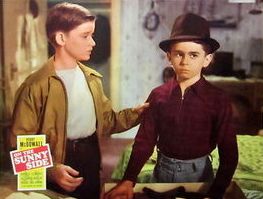
This is our second entry in our series on childhood during World War II.  Roddy McDowall, whom we saw last week in The Pied Piper (1942), stars as well in On the Sunny Side, made in the same year.  Roddy had made a great impression on audiences in How Green Was My Valley (1941), and became one of the most recognizable, certainly one of the youngest, members of Hollywood’s “British Colony.”  He, his mother, and sister left Great Britain in 1940, an era when Dunkirk, the Blitzkrieg, and what appeared to be imminent invasion by the Nazis brought many Brits to the conclusion that London was no longer safe for their children.  Roddy knew something about the role he was going to play next.


In On the Sunny Side, Master Roddy is an English boy sent to live with a family in the United States for the duration of the war.  In the company of a group of other child evacuees, all traveling without their parents, he arrives on a ship to New York, bound for the Midwest home of husband and wife Donald Douglas and Katharine Alexander, and their boy played by Freddie Mercer, who is nearly the same age as Roddy.  Their parents were acquainted from a previous trip to England, good enough friends to be trusted with the care of their child.  His father is an RAF officer, and his mother is played by Jill Esmond, who also played his mum in The Pied Piper.  Jane Darwell is their housekeeper.

Much of the story is a fairly routine plot of a boy in strange surroundings who makes friends and becomes part of the family/community.  Freddie Mercer lets Roddy into his gang, which, with a clubhouse in the woods that is an old abandoned bus, seems a lot like the kids from the Our Gang series, but less scruffy, and not as funny.  Indeed, they are a rather serious and doleful group of youngsters, but the grownups writing and producing this story are perhaps projecting their own seriousness on the nice American squeaky clean world they’ve set up for the kids.  But, like the Our Gang kids, they even have a bully to fear: Stanley Clements, whose tough wise-guy talk made him the leader of the pack in Going My Way (1945) and in future Bowery Boys films.   Ann Todd plays a classmate who, like most of the girls in the class, fancies gallant Roddy.  A guy with an English accent can really clean up in this town.


The climax occurs when Freddie gets fed up with everybody’s fussing over the new kid, so much so that he becomes jealous and wants to run away from home.  Freddie, who came to Hollywood on his singing talents as a noted symphony and choir soloist, also had a bit part in Going My Way.  Here he’s funny as he sputters about the tea-drinking English kid ruining his life, but he draws our sympathy, and Roddy’s.


Though the grownups are firmly in charge, the story is really presented from the viewpoint of the kids, and they have the most screen time.  Though we might wish for a deeper story less focused on report cards, bullies, and gosh-gee-whiz dialogue, it is true that the prosaic troubles faced by the kids in the story really do reflect what’s important to children.  The adults may be reading the war headlines, but the kids—at least in the U.S.—are more driven by the realities of their world of making friends, doing chores, and worrying about what others think of them.  We might note that the boys’ teaming up and eventually conquering the bully is a parallel to the U.S. and Britain teaming up to fight the fascists.


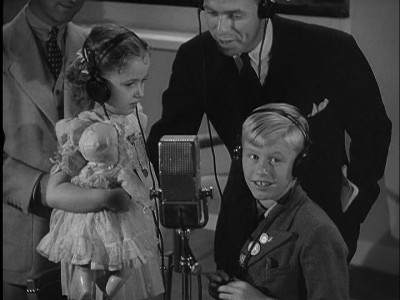
The movie does give us a few quite poignant scenes that hit on the broader crisis: The British kids on board ship, gathering at the rail to watch the Statue of Liberty slide by as they enter New York.  Roddy’s panic and nightmares when he hears a police siren, as it reminds him of the air raid sirens and emergency vehicles of the Blitz back home.  Most especially, the scene where a group of British kids are gathered in a New York radio studio, Roddy among them, to speak to their parents in a London studio via short wave.  The anxiety on the faces of the separate shots of kids and parents, their hesitancy to be too personal on the radio, their brave front of trying to give cheerful messages, and the cruel brevity of the time they are allowed create an image of both tenderness and anguish.  Tears are fought back.  Roddy, who even from a very young age was so good working before a camera, shows a myriad of feelings with the just the slight flickering of expressions on his face, in his lovely dark eyes.  He is nervous, then he warms up and excitedly tells his mother about his new life and friends, comically using American expressions he has learned that he must translate to her.  When his time is up, he realizes he has forgotten to use the notes he made beforehand of all the things he really wanted to say.


The evacuation of children from the London area had them seeking refuge in other parts of the U.K., in many dominion nations, including Canada, and also in the U.S., and involved children of every class.  Vera Brittain, noted British writer whose memoir of World War I, Testament of Youth, perhaps is more well known, at least in this country, than her other works, sent her two children away from their London home to stay with friends in Minnesota during the war.  Her son John was twelve at the time, the age of the boys in On the Sunny Side, and her daughter Shirley (a future member of Parliament), was not quite ten years old.

In excerpts from her diary, published as Wartime Chronicle – Vera Brittain’s Diary1939-1945, Brittain notes that the decision to send her children was a difficult one, “There seemed no right decision to be made, whichever course I took would involve bitter regrets.”

Her children left from Liverpool after Dunkirk, just missing the start of the Blitzkrieg and bombing of London by a matter of weeks.  They remained in the U.S. for three years, coming home, separately, in 1943.  She writes in her diary of the anguish of not receiving letters, then receiving them and learning her son has grown taller than she, and they are changing, experiencing new adventures in summer camp and in school where the curriculum is different.  Missing birthdays and Christmas.  At one point, Vera Brittain notes that her husband urged her to go to the movies to take her mind off their troubles.

“G. persuaded me to go to the new Disney film Dumbo, but it depressed me very much by reminding me of the children.”

Her children became teenagers while they were away.  Their mother drilling in firefighting practice to help after the bombing raids.  “One of the odd incongruities of this war to think that John—who must now be a fairly vigorous boy on the verge of 15—is safely in America while his middle-aged mother scrambles round in trousers fighting fires (or learning to).”

She remarks of her son’s return, “I did not recognize him, but it will take time to get to know him again.”  Her daughter arrived home, after a delay in the Atlantic due to perilous naval battle action, near the end of the year.  (Brittain’s husband, who was a university lecturer, had traveled to the U.S. for a part-year post and on returning, was on a ship that was actually torpedoed.  Twenty died, but he and some others made it to lifeboats and were afterwards picked up by a freighter and returned to England.)

When the family was reunited, a visit to Grandmother brings a comic conclusion to the adventure:

“Children uproarious over tea, Mother blames their manners on America.”


The children who remained in war zones with no avenue of safety were the subject of You, John Jones! (1943) a short subject about ten minutes long, directed by Mervyn LeRoy, starring James Cagney as an All-American dad who works as a supervisor in an airplane factory during the war, and also does his bit at night as a volunteer air raid warden.  Ann Sothern plays his wife, and their daughter is Margaret O’Brien.  When he arrives home from work, little Margaret is practicing her speech for an elocution contest, soberly delivering President Abraham Lincoln’s Gettysburg Address while perched on the living room window seat.  There are politicians who can’t deliver a speech as well as Margaret.  Perhaps they never “stumped” on a window seat.

Cagney leaves for his night watch, dressed in his trench coat with the Civil Defense armband and his helmet.  He sits on a park bench for a little plane spotting and considers how lucky he is to be living in a land where he is not likely to see an enemy bomber tonight.  The omniscient narrator, presumably his conscience, and ours, addresses Cagney (or John Jones), reminding him that if they were in other lands, his little Margaret, “Your baby, John Jones, your baby!” would be in danger.

Then we have a montage of scenes of Margaret as an English girl in the Blitz; as a Greek girl, her leg amputated, trudging with an amputation along a line of refugees; of a girl from Yugoslavia sobbing over a dead mother; from “Australasia” – quite a stunning image of Margaret looking hollow-eyed and shell shocked, then as the camera pans back, we see she is a prisoner of war behind barbed wire.  Margaret, as a Russian girl, lies dead in the ruins of a bombed out house.

To perhaps remind us not only of our good fortune in being spared these experiences in our own country (with the exception of the Americans of Japanese descent being held behind barbed wire in concentration camps), we are reminded, too, of the debt we owe our allies who are carrying the brunt of the war.  The narrator remarks, “If conquered people collaborated, your side couldn’t win this cruel war—did I say your side?  Our side.”

Then an attack occurs, but Cagney realizes it is only a dream.  (Sleeping on duty!)  He returns home, and Margaret finishes her speech with earnest, one may say almost fanatical delivery.   You can have a look at You, John Jones! here.


Kids here in the U.S. may have largely been spared the scenes little Margaret faced, but they were not without trauma caused by the war.  Come back next Thursday when we discuss the March of Time documentary Youth in Crisis (1943), and the Youth Runs Wild (1944) starring Bonita Granville.
**********
Wartime Chronicle - Vera Brittain's Diary 1939-1945, eds. Alan Bishop & Y. Aleksandra Bennett, Victor Gollancz Ltd, 1989.
*********************
The audio book for Ann Blyth: Actress. Singer. Star. is now for sale on Audible.com, and on Amazon and iTunes.

Also in paperback and eBook from Amazon, CreateSpace, and my Etsy shop: LynchTwinsPublishing.


Related Products