IMPRISON TRAITOR, PEDOPHILE, AND CONVICTED FELON TRUMP.
Showing posts with label Otto Hulett. Show all posts

Thursday, September 27, 2018

1930s Then and Now Part 4 - One Third of the Nation (1939)


One Third of the Nation (1939) is a window on the world of the late 1930s where the view is clear only because some of the grime has been rubbed off the pane with our fist, allowing us to look out. Some of what we saw then, we see today. The clothes and the speech may be out of date, but the problem isn’t, and neither is the desperation.

Classic film buffs recall 1939 as a marvelous extravaganza, an abundance of well-made and well-loved films, running the gamut between The Wizard of Oz and Gone with the Wind and a list as long as your arm of other Oscar nominees. One Third of the Nation is far down in the pack; it doesn’t sparkle much as a social message film with its lukewarm hero and a pat ending and the heroine that seems to drift emotionally (which may echo our national malaise after a decade of Depression). It is not as well-remembered, perhaps, as the giants that the studios produced in that year, but its roots are legitimate and its theme has lasted and it is more relevant today than most of the most beloved films of 1939.
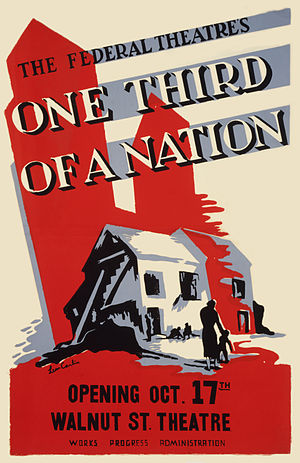

It began as a stage play, one of the experimental works produced by the Federal Theater Project in 1938. Written by Arthur Arent, it was part of the Living Newspaper series which dramatized conditions of the day, this one with a message of the common man versus the big men, including the landlords, about the slum conditions in New York City, how they came to be, how they are maintained, and who profits from them.

Along with its New York run, the play was produced in several other cities across the nation and garnered a great deal of publicity and praise, except by congressional conservatives who were offended by its message. Conservatives were not fond of funding the Federal Theater Project as they regarded it as an incubator of left-wing ideas and dangerous messages—dangerous to them, one presumes—but though it’s been reckoned that actually something like less than 10 percent of its play productions had a left-wing message, nevertheless, Congress decided to quit funding the Federal Theater Project in 1939, and that exciting experiment that kept writers, actors, and directors working during those terrible years in the Depression and that spawned such important works, was killed.

The title of the play, adapted for the movie in 1939, comes directly from the line in President Franklin Delano Roosevelt’s Second Inaugural address in January 1937: “I see one-third of the nation ill-house, ill-clad, ill-nourished... The test for progress is not whether we add more to the abundance of those who have much; it is whether we provide enough for those who have too little.”

We’re still grappling with that idea.

The movie’s plot diverges a little from the stage play in that it has a less experimental presentation (except for a few scenes when the boy has a conversation with the firetrap tenement that he lives in, but we’ll get to that in a minute). Instead, it follows a more conventional line of the damsel in distress, a hero who comes to her aid, and a happy ending.


The film opens on the East Side of New York with kids playing in the streets, turning on fire hydrants and being chased away by the cops, overshadowed by tenements. We get inside views of one particular building with the walls falling apart so that we are able to see the exposed lathing, of trash in hallways, of railings that need to be repaired. A fire starts in the basement of this tenement building. It quickly spreads and its residents attempt to escape in all directions, stumbling out of doors, scrambling out of windows, from fire escapes that will not hold their weight, screaming. A crowd gathers in the street, the fire department arrives, and we see a line of dead bodies already covered on the sidewalk waiting for the morgue.

As the fire rages, at the top of the building we see a boy climbing a fire escape to try to reach the roof because he is blocked from getting to the ground. The ladder on which he is clinging breaks and he falls to the ground. It is a sickening scene, and through the crowd his sister rushes forward in horror. She is played by Sylvia Sidney, fresh off her gig in a similar environment in Dead End (1937).  Miss Sidney had the chops to play fearless dames, but her sophisticated appearance, maybe just her distinctive beautiful eyes set wide in her porcelain face, left her an aura of glamour no matter what setting.


In the back of the crowd, we see a man in an automobile and his snide, wisecracking best friend, rubbernecking at the tragedy. Leif Erickson plays the hero of the piece, and Hiram Sherman is his pal who, not even before the movie is half over, we want to strangle for his smug, sophomoric arrogance. It was Sherman’s only film, then he went on to a lot of TV and theatre. It’s interesting to note that a lot of players in this movie had few movie credits, but had more career traction in TV and theatre.

Leif Erickson reaches Sylvia Sidney as supposedly helpful people are picking up her brother, who is unconscious, probably suffering from head and neck injuries, and handle him like he was a sack of potatoes.  If nothing else, our ideas about first aid have certainly changed for the better over the decades.

Erickson offers to drive him to the hospital and Sidney is very grateful and goes along. She thinks he means that they will take her brother to City Hospital which is for poor people, but he is taking him to the better Surgeons Hospital. Appalled, she asks “Isn’t that just for swells?”


Leif Erickson is rich. He tells her not to worry, and it is not until after the operation when they find out that her brother will survive but will be crippled that she discovers that Erickson has paid all the bills. She is grateful, of course, but intends to pay him back, though she has no idea how.

She is furious at the slumlord who owns the building but will not repair it or keep it maintained. She asks Erickson “Isn’t that murder? Shouldn’t a man like that be in jail?” Erickson agrees, but he will soon learn from his trusted family business manager that he owns the firetrap building. A large slum area of New York has been in his family’s possession for decades.


Mr. Erickson is not the only man in Sylvia Sidney’s life these days; Myron McCormick plays Sam, her longtime beau she cannot marry yet because they have no money. She says of him smiling, “He's sort of left, if you know what I mean.” Sam does not appear to be an agitator or an anarchist, but he is an intelligent and fearless thorn in the side of Erickson and anyone will he thinks makes a profit off other people’s misery.  Miss Sidney’s remark tells us that, like many of the poor, she has no political convictions, and is only concerned with the landlord that won’t fix the light in the hall or the boss that won’t offer a raise; her social concerns are largely about herself.  McCormick seems airy to her because he sees the big picture; Sylvia’s driven by her own personal needs.  The very rich and the very poor aren’t always too far apart in ideology.

There is a brief inquiry with Otto Hulett playing the assistant DA, and Erickson manfully stands up and takes responsibility, against the expressed wishes of his business manager played by Percy Waram and his obnoxious sister, played by Muriel Hutchison. They are intent on protecting the family name and the family dough.

At one point in the hearing, one of the tenants is questioned about the conditions of the building, but it is difficult for him to give an objective report because he lost his wife and children in the fire and he is too shocked, too broken up to want to even discuss the matter. He is an immigrant and whimpers “My little babies.” He is gently told that he can go now.

He looks up astonished, “Where?”

It seems that the rich family of Leif Erickson is legally off the hook because this tenement was built before 1901 and therefore it does not need to adhere to new safety regulations. We are given an insight to the inefficient and bungling bureaucracy which allows this system and we get facts and figures almost like a docudrama in parts. We are told that such firetraps where low-income people live are not rare in the city, that there are over 67,000 of them.

Sylvia Sidney is angry and wants Leif Erickson interrogated on the stand, and he is only too happy to discuss the situation because he has thus far been ignorant about what kind of property his family owns. He has never really been involved in the business. His business manager, Mr. Waram, explains that Sylvia Sidney’s family would have to pay more – mother, father, younger brother, and herself all live in a one-room apartment – which goes for $10 a month rent. If Erickson did all the repairs and upkeep that she demands, they would have to be charged at least $25 a month rent.

Such rents for 1939 actually seem remarkably low for a city like New York. Other towns certainly, but I would’ve thought New York, even its most rundown apartments, would have charged at least $30 a month.

Nevertheless, we see that Sylvia Sidney’s situation is compounded by the fact that she is kind of the Winnie Winkle the Breadwinner of the group. (For those of you familiar with the old comic strip, Winnie supported her mother, her younger brother, and her shiftless father, which is why she was called the Breadwinner.)

I have a Winnie Winkle coffee mug on my desk that I keep pens in. It was a gift. I always had a soft spot for Winnie Winkle the Breadwinner.

Her father played, by Charles Dingle, whom most probably remember as the conniving elder brother in The Little Foxes (1941), is not working and it seems inferred that he is not looking too hard, either.

Erickson comes to Sylvia Sidney’s tenement to see what conditions are like for himself, runs into her boyfriend Myron McCormick, who slugs him and when Erickson falls through a rotten railing, it occurs to him that the place really is a rattrap.

The film takes an interesting turn when her young brother is released from the hospital. He looks hale and hearty, but he walks with crutches and he will for the rest of his life. He is played by Sidney Lumet.

This was young Sidney Lumet’s only movie, though he did small roles in one TV show and a bit part in a movie many decades later, but we know him best as the director of over eighty films. He was certainly a talented filmmaker, but just from this one film he seems a very talented child actor.


We see the slum through Lumet’s eyes more than anyone’s. His friends welcome him home but then they are cruel to him because he is a "cripple." They tease him, they won’t let them play their games; he is too slow for them and the boy begins to spend a lot of time on his own. He sits on the pier watching the other boys swim in the river, he broods outside on the steps of his building. He does not want to go into the building on his first day home, he stays out until quite late because he is afraid and depressed. We know the fire has left him emotionally scarred and he does not want to enter a building which he knows he can be trapped in at any time, especially now that he is not able to walk easily and less able than before to escape in an emergency.

But his anguish is more than that. His troubled soul is absorbing the despair of this neighborhood and the people who live in it, in that building that has seen so many generations of despair. He talks to the building. He tells the building that he hates it and in his imagination the building talks back to him with an eerie voice.

He tells the building, “Look what you done to me.”

The building taunts him and gloats that it has made victims of its residents for decades. We have a brief foggy flashback to the 1870s when the building was younger, but no less dangerous. We see people in clothes of the time period, a doctor’s visit and the whispered dreaded word: Cholera! The screams of the dying from cholera and their terrified families, which was very common in the nineteenth century in crowded buildings with poor sanitation. The factory town I grew up in had a cholera epidemic, and maybe yours did too.

Lumet threatens the building, “I’ll get you some day. I’ll get you – just wait.”

The scenes with Sidney Lumet staring up at the building, he stares directly into the camera – are haunting and unnerving, his piercing, fevered expression of a child half-crazed with the superior knowledge of someone who knows personally how grim the stakes are. For a kid without a whole lot of screen experience, he’s pretty impressive.

Unfortunately, there are no resources to help, medically, emotionally, not from the city, not from charities, not from his own family. The real burden of poverty is that one is essentially alone.

Leif Erickson struggles with his conscience. Sylvia Sidney struggles with the idea of paying him back for the hospital bill. Erickson’s family struggles with trying to distract him away from what they regard as his naiveté.

At last Erickson wants to make a move to tear down the houses in that section and put up new housing – we assume he means for the selfsame low-income residents, but historically in such cases, usually it’s to gentrify the area and jack up the rents.

Sylvia Sidney believes that he is going to give them a shiny new neighborhood and she is thrilled, and her young brother Sidney Lumet taunts the building, his worst enemy, “They’re gonna tear you down. How do you like that, old stinkpot?”

Unfortunately, Erickson has to humor his sister and he confesses to Sylvia Sidney that it will take time to put these plans into motion. Her disappointment in Erickson is such that she loses all hope and rants to her little brother about her desperation and how things will never change. It is a cruel thing to do to a young boy who is obviously emotionally and psychologically brittle, but nobody is paying attention to him

It puts him over the edge and he sets fire to the building. It goes up like a torch and another crowd gathers and the firemen come and the same old scene is repeated. This time, the building kills the kid brother.

In the dim, gray aftermath, Myron McCormick commiserates and Erickson answers, “The time may come when men like you all realize that men like me are human beings, just the way that I’ve begun to suspect that you are.”

The building is torn down, McCormick and Sylvia Sidney plan to pool their resources as best they can and get married, not wanting to wait any longer. Erickson may be the hero of the piece but he’s not going to play Prince charming to Cinderella and take her out of the ashes, literally. He's still going back to his own kind.

We have a montage scene of new buildings being constructed with playground areas. We are meant to understand that the people living in them will experience a kind of poverty Shangri-La, with the cleanliness and privacy and community spirit with all of them pitching horseshoes and raising their children in the sunlight. It’s not suburbia – nobody predicted suburbia yet – but for a city dweller in a firetrap tenement, it might very well have seemed like the next best thing to paradise. At least the producers thought so.


One segment of the Franklin Delano Roosevelt Monument in Washington, D.C. is devoted to his “one third of a nation” speech.  It is depicted here above in this photograph in the collection of the Library of Congress.

The bronze statues by George Segal, are titled The Rural Couple and The Breadline located in Room Two of the memorial.

We have another legacy: Today, one of the main reasons why people continue to struggle financially and even live in poverty are the cost of healthcare and the cost of housing. We have revisited young Sidney Lumet’s nightmare on a much grander scale. Though most of us who enjoy classic films enjoy the nostalgia of them – we spend a lot of time looking at the furniture, the clothes, the music, the speech expressions as evidence of a long-ago world – for those who are not fans of classic films it is probably more important not to concentrate on these things, but to concentrate on the heart of the message, on the emotion of the story, and thereby finding in these, whom they might regard as hokey characters, a lot more in common than they thought possible.


Come back next Thursday when we conclude this series on the 1930s and their messages for today with Make Way for Tomorrow (1937), and an elderly couple whose retirement has left them helpless, homeless, and dependent on grown children. Take a look at those spinning headlines – they’re from today.

 *****
1930s series:
Part 1 - Gentlemen Are Born (1934)
Part 2 - Our Daily Bread (1934)
Part 3 - Wild Boys of the Road (1933) and Girls of the Road (1940).

*********

Jacqueline T. Lynch is the author of Ann Blyth: Actress. Singer. Star. and Memories in Our Time - Hollywood Mirrors and Mimics the Twentieth Century. Her newspaper column on classic films, Silver Screen, Golden Memories is syndicated nationally.


Thursday, April 24, 2014

Sally and Saint Anne - 1952


Sally and Saint Anne (1952) is a sweet and silly souvenir of a time when movies unabashedly basked in a warm glow of nostalgia even if the story was intended to be current and modern.  We have the strange feeling watching this that the filmmakers knew they were preserving an era, and we, the audience in the future, are the proverbial fly on the wall.  As such, we may enjoy it more than the original audience did. 
Though you could call this a family movie, in a time when most films were suitable for the whole family this quiet little gem is unfettered by the dubious yoke of being wholesome.  It is wholesome, too, but it is also a sly parody of doctrine, dogma, and a boldly tongue-in-cheek look at the peculiarities of the highly ritualistic Catholic faith (getting away with it probably because Irish Catholics love to make fun of themselves).  As such, it is as courageously unselfconscious about what it is as is the main character—a teenage girl pursuing an unselfconscious friendship with a saint to whom she prays, and her family of screwballs unselfconsciously pursuing their own happiness.
Ann Blyth appeared in three films released in 1952, all very different and all, unsurprisingly, showing her versatility.  The World in His Arms with Gregory Peck, which we’ll get to in a few weeks, is a glorious swashbuckling historical romance where she plays a Russian countess.  The day after she finished filming, she was whisked to location shooting in Colorado to begin One Minute to Zero with Robert Mitchum, a tense Korean War drama in which she played a United Nations worker in the war zone.  
Sally and Saint Anne, which couldn’t have been more different, was the last film she made for Universal-International.  She gets top billing here.  Her contract ended in December 1952.  Columnist Louella Parsons noted: “She started there when she was fourteen, and everyone from William Goetz (studio head) to the gateman has wonderful things to say about her.” 
She would sign with her new studio, MGM, which brought a new twist to her film career—and a long-desired ambition—to sing in several big-budget musicals.  We’ll cover those this summer.
In the meantime, she ran out the clock on her U-I contract with several more radio appearances, publicity chores (including a personal appearance tour of several military bases in Alaska), and the peak of her popularity surely typified by the book of paper dolls published by Merrill Publishing.  According to American Paper Doll from an article by David Wolfe, it was “…one of the most beautiful paper doll books ever produced by Merrill Publishing.”  See this previous post for a look at her paper doll likenesses.
Ann’s character in Sally and Saint Anne may have played with paper dolls herself at the beginning of the movie.  She ages from about twelve years old to eighteen in this film, with remarkable authenticity.  It helps that, Ann being small to begin with, several of her friends are taller, but Ann also moves with the gangly awkwardness of a pre-teen, bounces with happiness, droops with disappointment, and her young face registers a parade of unharnessed and unfiltered thoughts and emotions.  Most especially that voice, which we’ve noted as malleable in several films, here changes instantly like flicking a light switch when she grows up—yet her performance is without gimmick and completely natural.  We can hardly believe she was twenty-three years old at the time.
We see she roller skates quite well (she doesn’t do any tap dancing on skates like Gene Kelly, but it’s still pretty good), and when an errant football goes astray on the playground, she catches it in the old breadbasket, while continuing a conversation with her friends, and fires it back like Joe Namath.

If you catch a glint of shine on Ann’s teeth, it’s the braces.  It had to have been somebody's idea of a gag to put faux braces on the most perfect set of natural teeth in Hollywood.
As the film opens, we see by the graphic on a passing newspaper delivery truck that we are in a small town called Middleton, and so we know from the beginning this is an ordinary place of no great consequence.  Despite Saint Anne getting billing in the title, this is no religious epic; it’s more like a buddy picture.  There aren’t really any miracles in the movie, either, except the very real miracle how a girl blossoms into a young lady.
Ann is tearing through her parochial school looking for her missing lunchbox.  Another girl, busily eating her own lunch, shrugs her shoulders and laconically tells her to pray to St. Anthony, “Findings things is his racket,” and “He’ll do anything for a few Hail Marys.”
Recess will be over soon, and she’s wasted enough time, so Ann heads next door to the church, and in a businesslike manner, yanks the chapel veil out of her school uniform pocket and plunks it on her head as she genuflects upon entering, and heads up the long aisle to plea bargain with the statue of St. Anthony.  But the bell rings and she can’t make it, and she gets overrun by other girls rushing back to class, so Ann glances up at the closest statue to her, Saint Anne, and says, “Will you help me find my lunchbox, please?”  
It’s not a very flowery prayer, but as reverent as you can get because she really believes she’s asking for the aid of somebody who really can help.  As she heads back to class, one of the nuns tells her she’s wanted in the office of the Mother Superior.  Probably because Herman Shumlin and Lillian Hellman are waiting there wanting her to read for a part in Watchin the Rhine.
(BAW-ha-ha-ha-ha.  I just crack myself up sometimes.  See our intro post to this series here if you want to know what I’m talking about.


There, on Mother Superior’s desk she sees her lunchbox, and she’s thrilled the prayer worked so quickly.  However, it was actually returned by John McIntire, who plays a Snidely Whiplash sort of comic villain in this role that he really sinks his teeth into, especially his garish, gold snaggle-tooth, which is why he is called Goldtooth McCarthy.  He found the lunchbox on the back of his ice truck, where Ann had stolen a ride.  He is an oily, conniving fellow, recently become a ward alderman and he has a longstanding feud with Ann’s family. 
For her punishment, Ann has to write “I must not steal rides on motor vehicles” on the blackboards that line all four sides of her classroom.  Reminds one of Bart Simpson.  I pity the poor set dresser that had to really write all that.
After school, madder than a wet hen and spitting nails, Ann stomps back to church, smacks the chapel veil on her head, and has it out with Saint Anne like a very angry customer at a complaint department.  She calls Saint Anne a “snitcher” (which cracked me up because it was one of my father’s favorite silly insults) and with tears of frustration in her voice, she gives one last parting shot, “And another thing, instead of making trouble for kids, you’d do better to give that McCarthy a black eye!”
I love the next scene when it is Sunday, and Ann is late for church.  Her father, mother, and three older brothers are already in the pew, the Mass is half over, and Ann tries to sneak into a packed, quiet church in very squeaky shoes, like she’s walking a tightrope.  Anyone who’s ever had to do this knows her agony.  The priest is trying to read announcements and Ann’s monstrous squeaks tearing through his speech and echoing through the church is hysterical.  Finally she gets close to where her family is sitting, and her mother grabs her roughly and yanks her into the pew.
I like that the priest, played by George Mathews, is a curmudgeon, not one of the typical movie jovial or saintly fellows, no Bing Crosby, Spencer Tracy, or Pat O’Brien.  He’s a just guy trying to get his job done, squeaky shoes or no, and she’s stealing his thunder.  He tells us it is the first Sunday after Easter, and one of the quiet joys of this movie is that it takes place in spring.  There is a gentle restfulness, the delightful sunshine and the anticipation of the warmer weather to come.  That wonderful end-of-the-school-year feeling we had as kids.
Collecting herself after her public embarrassment, Ann glances up at the statue of Saint Anne, and repeats her insult, “Snitcher!” and turning, being shushed by her mother, looks across the church and sees John McIntire sitting in his own pew—with a black eye.
The explosive smile of awestruck happiness on her face is wonderful, and she snuggles down in her pew, stealing delighted glances at Saint Anne.  She is not amazed at an apparent miracle—hardly; she has been spoon-fed on tales of miracles and the lives of the saints since she made her First Communion—she’s just tickled to pieces that she got to go to the head of line for favors for once in her life.  This is a girl who’s always late, always losing things, always in trouble at school.  Suddenly, a big-time saint answers her prayer—she thinks—and it’s like not having to wait in the long line at an exclusive nightclub because the star has come out onto the sidewalk and walked arm-in-arm with you inside and escorted you to the best table in the house.  You are Somebody.
She solidifies her new relationship with her now amiga saint by buying a smaller, but still hefty, statue of Saint Anne for her bedroom and creates a little shrine on a small table with a votive candle.  Saint Anne becomes her roomie, the friend who came for a sleepover and stayed.
More miracles happen.  Not big miracles, maybe not miracles at all, but to a twelve-year old, getting all her work done on time and not being kept after school could seem pretty miraculous.  The other girls at school have problems, too, and they ask Ann to put in a good for word for them.  Her reputation is growing around town.  But she’s no Bernadette of Lourdes (besides, Jennifer Jones already got that job.  See our past post on The Song of Bernadette); she freely admits of her prayers, “It don’t always work.”  

But we have the feeling she just likes an excuse to chat with her patron.  She writes requests in a pocket notebook, and brings the matters up with Saint Anne.  Her moments of prayer are really more like gossipy conversations with a girlfriend (“I had such a good day today, Saint Anne!”), and it’s poignant and funny that she can so freely unburden herself to the image of a saint, as naturally as if she were talking to a favorite aunt.
Then the transformation comes from girl to young woman.  One moment she wonders when she will be allowed to get her braces off, because then she will be a woman, she thinks, and the camera pans down to her notebook beside the statue.  Then, as if continuing her prayer, her voice deepens, resonates with not just emotional, but actually vocal maturity, her diction is ladylike, and the single notebook has become a stack of them, as the camera pans up on a now taller (she’s looking Saint Anne in the eye) young woman, a high school senior, with the loveliness and poise we could not have imagined when she was a kid wishing black eyes on people. 
She talks to Saint Anne about a new problem now.  Goldtooth McIntire, still an alderman, has increased his political power and his wealth, and he backed a city plan to construct a new highway through town—right where their house is.  Their house will be torn down.
Though this problem will hang over their heads until the end of the movie, this is still a story made up of a string of small everyday moments.  A glamorous new friend from Boston comes into her life, played with snobbish sophistication by Kathleen Hughes, who, as soon as they get past the gates of school at the end of the day, wantonly puts her hair up and applies makeup.  Ann curiously, and bit enviously, watches her friend’s expertise with lipstick.
The trip to the drugstore soda fountain, and the wonderfully dorky sodajerk played by Robert Nichols who works the counter like a Las Vegas showman.  (We've discussed romance at the drugstore here in this previous post.)
The handsome guy back from college, played by Palmer Lee (also known as Gregg Palmer) on whom Ann has a crush, but he goes for the high-tone friend, leaving Ann out in the cold.
The daily troubles of Ann’s family of misfits: her father, played by Otto Hulett, a blustering working man who fantasizes about choking John McIntire.
Her mother, played by Frances (Andy Griffith’s Aunt Bee) Bavier, is funny, sweetly vague and a bit dotty, but Mama rules the roost, constantly peeling apples or potatoes.  “You were the only one born in the hospital, Sally.  Maybe that’s what makes you so different from the boys.”
Her three brothers, an unsuccessful musician and composer, played by Lamont Johnson; an unsuccessful magician, who can’t even do a decent card trick, played by Jack Kelly; and an unsuccessful boxer, played by a punch-drunk Hugh O’Brian, training there in the living room by perpetual family guest Hymie, played by King Donovan.


Most especially, there is grandpa, played by Edmund Gwenn.  He took to his bed twenty years ago, but he’s not sick.  He’s just contemplative and sees no reason to get up.  The priest comes to pay a sick call, trying to get him to make his peace with the Lord, and they always end of fighting, because Grandpa loves to egg him on with irrelevant philosophical arguments.
The priest is grouchily dubious about Ann’s taking petitions for prayer, but asks her to request a new church roof, all the same.  “I can put you down for a week from Tuesday, Father.  If anyone drops out, I’ll push it up.
Grandpa solves the problem of them losing their home.  He owns an empty lot across town, and decides they will move their beloved house to that lot. 
The menagerie is a bit like the Sycamore family of You Can’tTake it With You, and soon they will have one more hanger-on: the local heartthrob Palmer Lee, home from college.
I especially like the exchange between Ann and Mr. Shapiro, the local grocer, played by Joe Mell.  His wife’s expecting, and he desperately wants a boy this time because he’s already got three daughters.  Ann writes down his wish in her notebook.  “One boy.  Mr. Shapiro.”
He’s a jovial guy who shakes his head at her innocence.  “Why would an Irish saint go out of her way for a guy like me?”
“Mr. Shapiro, Saint Anne was the grandmother of Jesus.”
He shrugs, “So?”
“So she isn’t Irish at all.  She’s Jewish.”
Mr. Shapiro gives her fond grins and free pickles.  But Saint Anne takes a back seat for a while as Ann tackles her current woe of lovesickness on her own, and undergoes another transformation.  Jealous of her Boston snob ex-friend, who is latching onto the college boy on whom Ann has a crush, she listens to Grandpa’s advice and gussies up for the country club dance.  The sodajerk is taking her. 
Pop tells her and her date that she must be home by 11:30, because the house movers are coming tonight—it being easier to move a house, apparently, when there is less traffic.
An older woman friend, very chic (who recently got engaged because Ann filed the request on her behalf with Saint Anne), makes Ann over into a Vogue fashion plate.  We know Ann is now considered sexy because the minute she steps out the door, you can hear the sultry moaning of a saxophone.  Dang, that never happens to me.  I think we’ve discussed this before.  A saxophone always indicates the presence of a femme fatale in classic films.  Very handy, in case we’ve missed the point.
She wows them at the country club.  A couple of quite funny scenes: first, Ann’s dorky date, who is apparently a hepcat, manhandles her into a frenetic dance, which after a few stunned and clumsy moments, she actually follows him pretty well.  They are the center of attention.  She artfully attempts to maintain her pretended sophistication while involved in the silliest of ballroom calisthenics.  College Boy is bowled over at her sexiness, and departs with her to the bar, where she orders a martini because she sees the word printed on a cocktail napkin.


Fortunately, the bartender, new on the job, is a friend of her brother’s.  He looks after her, and puts plain water in her martini glass.  When she realizes this, after an anxious sip, she smiles with relief and catches his wink.  She boldly toasts the young man she is trying to impress, “Down the hatch!” and bolts the water like a sailor.  Then she orders a double.
When Ann introduces the bartender to her date, and beams, “He got the job!” we might assume that his getting the job was another successful prayer to Saint Anne.  By the way, Bess Flowers shows up at the country club dance.  Like you didn't know she would.
Cinderella Ann and College Boy ditch their dates, not a nice thing to do, and end up in his convertible under the moonlight.  She nervously braces herself for her first kiss, and gives him a shove when he gets too passionate.  She runs off, arrives home, long after midnight.  Unlike the real Cinderella, Ann never loses a shoe, nor does her dress turn to rags—but instead the house has disappeared.  Cinderella never had a problem like that.  It doesn’t take her long to catch up; the house is inching along through town at a snail’s pace.
In the wackiest part of the movie, the family is still in the house while the movers are dragging them to another part of town, but the house is their safe haven from a baffling world in which none of them fit in.
The conflict is ratcheted up a notch when we see that Grandpa’s vacant lot is actually situated between two brick apartment buildings that Goldtooth owns.  As the house slides into its new cozy niche, Goldtooth, who had no idea this was happening, and who has been wanting that empty lot for years, throws a fit.  The feud heats up and several tit-for-tat events occur.  Look for Dabbs Greer as his harried lawyer.
College Boy, who, like Hymie the fight trainer, and Saint Anne, becomes part of the family because he won’t leave.  He tries to wear Ann down, because she won’t have anything to do with him since the night of the convertible when he got too passionate and embarrassed her.  The family accepts him, Mama shows him Ann’s naked baby pictures, which infuriates her more, but in the end, College Boy and Grandpa team up to solve the family’s problems with Goldtooth once and for all.  It’s not really a miracle; it’s more due to math and detective work.  But then, as we like to believe, (even if it’s not really in the Bible) the Lord helps those who help themselves.
We never do find out if Mr. Shapiro’s wife had a boy or girl.  It feels like the movie pulled a punch there.
Speaking of punches, the only time we are given clear indication of a miracle being performed is during Ann’s boxer brother’s fight, when he is gamely trying to win money the family owes to Goldtooth.  He is, as usual, losing badly.  Ann prays in her seat, and we hear a light heavenly tone, quite different than the stomach-churning ring bell, and we see her poor punch-drunk brother suddenly float along in a stupor of footwork that looks like a cross between a ballet by Charlie Chaplin and Monty Python’s Minister of Silly Walks.  He swings wildly and sucker punches his opponent, who drops like a sack of wet cement.  Her brother passes out, too, but since he hit the canvas second, he’s declared the winner.  KO by Saint Anne: The Patron Saint of Black Eyes.
Another, perhaps more everyday miracle, is when Goldtooth and the family bury the hatchet, and Grandpa, who has given up his “sickbed” decrees that the family, Hymie, College Boy, and Goldtooth will all go to church together.  Grandpa hasn’t been in church in twenty years.  Ann, delighted, bounces upstairs to get his hat and coat, and hers, perhaps the only one in the house to sense a miracle has occurred.  One has to be in tune with miracles to recognize them. 
As she leaves her room, in a very nicely framed shot, we see this lovely young woman blow not one, but two affectionate kisses to Saint Anne.  It may not be the proper behavior of obeisance to a saint, but her love and gratitude demonstrates her confidence that Saint Anne has her back. That’s a very special kind of reverence.
Sally and Saint Anne seems to be another one of those Ann Blyth movies in DVD limbo (Doah!  No doctrinal pun intended.  Oh, okay.  Mea culpa.), but I think you can still see it up at YouTube here for the time being.
Come back next Thursday when we travel to post-war Washington, D.C. in the 1949 comedy Free for All where Bob Cummings discovers how to make cars run on water instead of gasoline, and Ann goes along for the ride.

******************************
American Paper Doll from article by David Wolfe, 2013, #55
Ellensburg Daily Record, November 4, 1952, p. 6.
Milwaukee Sentinel, November 14, 1951, article by Louella Parsons, p. 8; December 3, 1952, article by Louella Parsons, p. 8

St. Joseph (Missouri) News-Press, December 15, 1951, article by Louella Parsons, p. 4D.

****************************
THANK YOU....to the following folks whose aid in gathering material for this series has been invaluable:  EBH; Kevin Deany of Kevin's Movie Corner; Gerry Szymski of Westmont Movie Classics, Westmont, Illinois; and Ivan G. Shreve, Jr. of Thrilling Days of Yesteryear.

***************************
UPDATE:  This series on Ann Blyth is now a book - ANN BLYTH: ACTRESS. SINGER. STAR. -

*********************
The audio book for Ann Blyth: Actress. Singer. Star. is now for sale on Audible.com, and on Amazon and iTunes.

Also in paperback and eBook from Amazon, CreateSpace, and my Etsy shop: LynchTwinsPublishing.


 "Lynch’s book is organized and well-written – and has plenty of amusing observations – but when it comes to describing Blyth’s movies, Lynch’s writing sparkles." - Ruth Kerr, Silver Screenings

"Jacqueline T. Lynch creates a poignant and thoroughly-researched mosaic of memories of a fine, upstanding human being who also happens to be a legendary entertainer." - Deborah Thomas, Java's Journey

"One of the great strengths of Ann Blyth: Actress. Singer. Star. is that Lynch not only gives an excellent overview of Blyth's career -- she offers detailed analyses of each of Blyth's roles -- but she puts them in the context of the larger issues of the day."- Amanda Garrett, Old Hollywood Films

"Jacqueline's book will hopefully cause many more people to take a look at this multitalented woman whose career encompassed just about every possible aspect of 20th Century entertainment." - Laura Grieve, Laura's Miscellaneous Musings''

"Jacqueline T. Lynch’s Ann Blyth: Actress. Singer. Star. is an extremely well researched undertaking that is a must for all Blyth fans." - Annette Bochenek, Hometowns to Hollywood


Ann Blyth: Actress. Singer. Star. 
by Jacqueline T. Lynch

The first book on the career of actress Ann Blyth. Multitalented and remarkably versatile, Blyth began on radio as a child, appeared on Broadway at the age of twelve in Lillian Hellman's Watch on the Rhine, and enjoyed a long and diverse career in films, theatre, television, and concerts. A sensitive dramatic actress, the youngest at the time to be nominated for her role in Mildred Pierce (1945), she also displayed a gift for comedy, and was especially endeared to fans for her expressive and exquisite lyric soprano, which was showcased in many film and stage musicals. Still a popular guest at film festivals, lovely Ms. Blyth remains a treasure of the Hollywood's golden age.


The eBook and paperback are available from Amazon and CreateSpace, which is the printer.  You can also order it from my Etsy shop. 

If you wish a signed copy, then email me at JacquelineTLynch@gmail.com and I'll get back to you with the details.

Related Products