IMPRISON TRAITOR, PEDOPHILE, AND CONVICTED FELON TRUMP.
Showing posts with label Kent Smith. Show all posts

Thursday, December 24, 2020

The Curse of the Cat People (1944)


The Curse of the Cat People
(1944) is both a child’s fantasy and a tale of the supernatural, where the worlds of children and adults are separate and cause misunderstanding, even trauma, when they collide.  The adult most affectionate and sympathetic with little Ann Carter is a ghost.  Ann must navigate frustration, terror, even near tragedy before she finds acceptance, peace, and contentment with her parents.


The sequel to Cat People (1942), producer Val Lewton’s landmark low-budget horror film, The Curse of the Cat People brings back Kent Smith and Jane Randolph, lovers who are now married; and Simone Simon, as the ghost of the character she played in Cat People, who had been the first wife of Kent Smith. I won’t go into the plot of Cat People as it has only a cursory relationship to The Curse of the Cat People.  The story does pick up where the first movie left off (six years later, when Kent Smith and Jane Randolph now have a little daughter), but, refreshingly, it constitutes a new chapter in the adventures of the characters (plus a new star), and not just a repetition of events in the previous movie as happens so often in sequels. 

The directorial debut of Robert Wise, who took over from Gunther von Fritsch, the movie is a delicate psychological puzzle from the viewpoint of a sensitive and lonely six-year-old girl played by the captivatingly natural Ann Carter.  We see at once that her imagination, which has her trying to make friends with a butterfly, makes her an outsider when it comes to the company of other children, who think she’s weird.  Her parents, particularly her father, is disturbed by this. He wants her to make friends with other kids, not to live in a dream world, and just be normal like everyone else.  His late first wife was affected by what he felt were mad and self-destructive delusions, resulting in her tragic death.  He is afraid that a similar calamity will fall on his family again if his daughter doesn’t snap out it.  We may forgive his impatience, even anger, towards the little girl because we see he’s clearly frightened.  It’s not easy to control a six-year-old under the best of circumstances, and Kent Smith’s need to control his daughter’s behavior is probably more indicative of his own psychological illness than her daydreaming is hers.


Kent Smith is appealing in the role, able to display a dictatorial attitude in a way that suggests he really loves his daughter but he’s been traumatized by his past – another actor might just seem bossy and mean where Smith comes off as really more skittish.  Mr. Smith had a lot of stage experience, was handsome, but perhaps a certain aloofness on screen and lack of that – for want of a better term, glamor of some male stars like Clark Gable or Tyrone Power, kept him from being a major star.  Joseph Cotten had some similar qualities, but had better luck at being chosen for a few romantic leads that increased his stature.  I think there was among 1940s male stars a kind of wistful melancholy that seems strikingly different from the brash charmers of the 1930s – Alan Ladd, Van Heflin, Kent Smith, Joseph Cotten, Gregory Peck, Robert Walker.  Maybe you can think of others.  The war made us more introspective and less certain about our world, and our young men – even the ones who did not go to war – reflected our skittishness.  Perhaps the ones who did not go to war were even more uncertain about themselves.  So Kent Smith’s character in this movie is not an enemy to the little girl, but a reflection of the baffling and sometimes scary world she lives in.

The world children live in is really the world we adults make for them.  We say that a child is “living in her own little world,” but that’s not really true; she’s just coping with the one we gave her.  Part of Ann Carter’s trauma is she’s not able to follow the rules the grownups give her because the grownups keep changing the rules.  Her father told her a playful story of a cavity in a nearby tree being a magic mailbox to another world. She took him at his word, and put her birthday party invitations into the tree to be delivered to her schoolmates.  When the mail was, obviously, not delivered, no one showed up to the party.  Friends were mad not to be invited.  Daddy’s furious because she did a dumb thing and because she’s alienated the other children even more, and he wants a normal kid, dang it.


A strange old lady down the street gives her a ring.  Ann’s parents’ houseman, played by Sir Lancelot, who appeared in Brute Force (1947) which we discussed here, tells her it is a wishing ring.  (We are treated to a brief calypso tune in his chirpy tenor over the sound of him vacuuming.)  She wishes for a friend.  Ann Carter breaks your heart with the simple expression of deep yearning and profound loneliness.


The friend appears, a beautiful lady draped in a light-colored cape, more like an angel and less like a ghost.  They play in the backyard, and the lady, who is Irena, is gentle and motherly, and little Ann is ecstatic.  That the woman happens to be the vision of her father’s first crazy wife is a little awkward.  Dad wants her to stop talking about her imaginary friend, and when she shows him a photo she has found of his first wife and says that’s her, that’s the imaginary friend – it gives Kent the willies and his takes it out on Ann.  He brings her out in the backyard and tells her she must say she does not see Irena.  The kid may believe in fantasies, but she’s not a liar.  She stalwartly announces she does see her.  Dad spanks her.

Fortunately, we are not shown the physical punishment, because that would be too much for us to bear.  Children often fear what will not harm them: the dark, or monsters that don’t exist.  But spankings and beatings are real.  Here is where the real world encroaches on Ann’s already traumatized make-believe one.

Even her kindergarten teacher, played by Eve March, who seems so sympathetic to Ann and reacts to her daydreaming with intelligence and tact, seems cavalier about the spanking and gives it no importance.  There is no grownup Ann can rely on to come to her aid. 

Except the old lady who gave her the ring.

Who’s nuts herself.


Julia Dean masterfully plays old Mrs. Farren, who had been a grand stage actress in her youth.  Though infirm, she still carries the panache of a life in front of the footlights, and entertains Ann in her spooky old mansion with tales of The Headless Horseman of Sleepy Hollow.  They live in the village of Tarrytown, New York, where Washington Irving set his tale of Ichabod Crane.  At the film’s climax, Ann runs away, crossing the bridge where Ichabod met his fate, and she experiences the full force of eerie imagination run wild.


The move is rife with ghosts.  It is moody and atmospheric. It is filled with terrors of the imagination.  And yet…Halloween intersects with Christmas.  We have presents under the tree.  Ann buys a decorative pin, wraps it up and gives it to Irena for a present.  She pins it to her cape, delighted, and in return, presents Ann with a fantastic crystal illusion in her backyard, courtesy of the lighting guy.


When the caroling neighbors come in to sit at the piano and lumber through “Shepherd Shake off Your Drowsy Sleep,” Irena sings over them the enchanting, “Il Est NĂ©, Le Divin Enfant.”


Is this a Christmas story or a ghost story?  There is no reason it should not be both.  The most majestic secular Christmas story ever written was a ghost story: A Christmas Carol by Charles Dickens.  In the very first lines he writes, “Marley was dead: to begin with…There is no doubt that Marley was dead. This must be distinctly understood, or nothing wonderful can come of the story I am going to relate.”

Christmas is full of mysteries.  There is the greatest mystery of the Child being born in Bethlehem.  And there are the hundreds of mysteries that we manufacture to celebrate the season: folk tales, old ornaments that seem magical, and we are revisited by the ghosts of loved ones who have passed with every task we take whether it's decorating or baking or whatever we do that reminds us of our own Christmases past.

Perhaps the grandest mystery, or we might even call it a conspiracy, is the perpetuation of Santa Claus.  We adults set up an elaborate behavioral control system whereby the child must be good or Santa will not bring presents.  He knows when we are sleeping, he knows when we’re awake.  That’s pretty creepy.  He climbs down chimneys and still manages to get into our home even if we don’t have one.  We tell the kids to leave cookies and milk, carrots for the reindeer.  A friend of mine as a child was told to leave a bottle of beer for Santa.  Santa is as picky as he is mysterious.


We bring our kids to sit on his lap for a photo, and the child bears it as best he can, terrified of this big, fat, stranger who is, let’s face, just another kind of clown, and clowns are scary.  We tell the kids they must be good or face the wrath of Santa and the ignominy of not getting a gift.  How ironic, and cruel, in a world where not getting a lot of presents is considered shameful, for both the child and the parent.  We set up two impossible goals: one, that the child will be good as gold when we can’t even be good all the time ourselves; and two, that if we can't actually afford to give many presents then we are shamed, too.

Since Clement Moore’s “A Visit from St. Nicholas,” we’ve been conjuring and nurturing the fairy tale.  NORAD follows Santa on radar every year.  The Post Office has a box for letters to the North Pole.  Even the good Dr. Fauci announced that he visited Santa, checked him out, gave him his vaccination, and he’s good to go.  No fear of COVID for the jolly old soul.

We are disappointed when our young children no longer believe; however, if Junior got to be, say, 15 years old and still believed, we’d tell him to grow up and knock it off.  Of all the mysteries of Christmas a child must endure, there is none so baffling as the inconsistency of grownups.

Of all the explanations of Santa that ever were, I think the best is still Francis Church’s reply to eight-year-old Virginia O’Hanlon in his editorial in the New York Sun, September 21, 1897. She wanted to know if there was really a Santa Claus, because her friends were getting to be the doubtful age and she wanted an authoritative answer.  I can’t tell you how pleased I am she turned to the Fourth Estate. 

Mr. Church’s famous “Yes, Virginia, there is a Santa Claus…” described the existence of Santa in the form of the intangibles of the season and of life…love, kindness, generosity, curiosity…and mystery. It is probably the most famous editorial ever written, and numerous American newspapers reprint it every year on Christmas Day.  Here is a link to Virginia’s letter to the editor and the editor’s reply.

(By the way, Sleepy Hollow, is a village that officially adopted the name in 1996 because…why not?  You have to do something to legitimize the place for the tourists who come there.  The high school’s mascot The Headless Horseman.  The story was written just a few years before Clement Clarke Moore wrote "T'was the night before Chrismtas..."  It isn’t just Santa we go to great lengths to make real.)


But Kent Smith is not so deft at understanding as the editor Mr. Church of the succor of imagination because to him it has always brought pain, and the pressure he exhorts on his little girl drives her to run away out into a snowstorm.  She finds her way to Mrs. Farren’s house, where the old lady is in the throes of a wild psychological trauma herself.  Though she lives with her grown daughter, played by Elizabeth Russell, she is under the delusion that Miss Russell is a stranger, that her real daughter died when a child about Ann’s age, which explains her attachment to little Ann.


She shuts out her real daughter, who is her caretaker, is rude and hateful to her, and Elizabeth Russell grows jealous of Ann.  In another scary twist, the old lady dies with the exertion of climbing a staircase, and Elizabeth nearly strangles Ann in a fit of morbid resentment.  Elizabeth’s trauma from earliest childhood, living with a mother who denied her, must have been extreme.  Another sequel could probably have been launched with her story. 

Ann, with the sudden shock of sensing real and present danger – which is the first sign we are growing up, to be able to distinguish such a thing – fears Elizabeth and calls for help, calls for her friend, the ghost.

Fantasy returns when Irena appears, superimposed over the threatening figure of Elizabeth, covering her angry scowl and lined face with her angelic expression.  Ann is relieved and runs to who she thinks is Irena for a hug.  She embraces Elizabeth, and for a tense moment, the bony hands that were going to choke her relax, and Elizabeth experiences the unaccustomed gesture of affection.  Almost overwhelming to her, she walks away from the child, just as the police and Kent Smith show up, having tracked the girl in the snow.


When Dad, carrying her in his arms all the way home, asks her again if she sees Irena in the backyard, and Ann, still not a liar, says yes, she sees her, this time Dad says he sees her, too.

He doesn’t.  He’s lying.  He’s learned that pretending is okay, and if it really is the ghost of Irena, she gave them all a really nice Christmas gift. 

The script is by DeWitt Bodeen, who also gave us Cat People, The Enchanted Cottage (1945) which we discussed here, and I Remember Mama (1948) before going on to do a lot of television work.  Crafting such a gossamer story that plays just a little over an hour is amazing, and probably one of the movie’s strengths. 

Ann Carter, who commands the movie in nearly every scene, went on to do only a handful of films, among them The Two Mrs. Carrolls (1947) and I Married a Witch (1942) discussed here, before her career was cut short when she contracted polio.  She later went to college to become a teacher, married and had a family. 

We are in the midst of resurrecting Christmases past under a very different set of circumstances this year.  I hope you may find some comfort and pleasure in the solitude and physical aloneness you must seek and maintain for your own good and the good of everyone else.


To pass the time, allow me to offer a free eBook.  My novel Meet Me in Nuthatch is a comic, poignant tale of a small town that needs a jump start, and the Christmas tree farmer up the road has a nutty idea about reenacting the town as it was in 1904 that just might help.  Follow this universal link to obtain the eBook on your choice of online shops: Apple, Barnes & Noble, Scrbd, 24 Symbols, Playster, or Vivlio.  The eBook will be free until January 6, 2021.

Merry Christmas!

*****************

Jacqueline T. Lynch is the author of AnnBlyth: Actress. Singer. Star. and Memories in Our Time - Hollywood Mirrors and Mimics the Twentieth Century. Her newspaper column on classic films, Silver Screen, Golden Memories is syndicated nationally.  Her new book, a collection of posts from this blog - Hollywood Fights Fascism - is available here on Amazon.

Thursday, June 1, 2017

Youth Runs Wild (1944) and Youth in Crisis (1943)


Youth Runs Wild (1944) and Youth in Crisis (1943) show us American teens led into juvenile delinquency during World War II.  For children on the home front, the war means neglect – and danger.

This is the third post in our series on how Hollywood depicted the experiences of children during World War II.  Have a look at The Piped Piper (1942) here, and On the Sunny Side (1942) and You, John Jones! (1943) here.

Youth Runs Wild, directed by Mark Robson, features Glen Vernon and Tessa Brind as star-crossed pair of teens successfully navigating their awkward years and the nation at war. They are left behind and left out.

We are shown even in the film’s first moments the message that, in the wartime emergency, we are not taking proper care of our children.  Jean Brooks walks down a city street with her three-year-old son, while a truck plows over a sign cautioning drivers about children at play.  As she proceeds through a working-class neighborhood, she stops at one rundown workers’ row house. Her parents live here with her fifteen-year-old brother.  Miss Brooks is returning home to live with them while her soldier husband is away.

Art Smith and Mary Servoss are her folks, who both work the night shift at the local war plant and sleep during the day. Their son, played by Glen (or Glenn) Vernon, is in trouble at school, skipping class to work in a local garage to earn money for a present for his girl.

Tessa Brind, literally the girl next door, is the oldest of three daughters of a couple who also work at the war plant. Her parents are even more neglectful, they go out to bars after work, or bring friends home to play cards (one friend openly leers at their teenage daughter) leaving the housework and the care of their younger daughters to Tessa. (Using her birth name of Smylla Brind, she was Ann Blyth’s understudy in the Broadway drama Watch on the Rhine in 1941, and went on to play the role of Babette in a touring company.  A writer and an artist as well, Brind would later take the name of Vanessa Brown in her acting career.)

Glen and Tessa have a sweet, rather innocent relationship, a stark contrast to their rough surroundings and rougher companions. Interestingly, they carry the story, unlike more established stars playing supporting roles including Kent Smith, who plays the soldier husband of Jean Brooks, discharged from the military hospital; Lawrence Tierney, a shady guy (he’s Lawrence Tierney, what else?); and Bonita Granville, who is a smart-talking tough moll for Tierney.  She provides the only gloss for this B-movie.

The neglected teens – seemingly thrown under the bus by their parents – will have unlikely support from Kent Smith, Tierney, and Granville, adults on the periphery of their lives and with no responsibility toward them, but who actually help them turn their lives around. Tierney, at first leading Tessa Brind astray, helps Glen get away from the cops when he and his buddies (including Dickie Moore) are committing a crime.  He regularly sends kids to the war plant at night to steal tires off the cars in the parking lot to sell on the black market in his garage.  Tires of course were rationed during the war.  This time, he doesn’t want Glen involved because he’s such a nice kid from a nice family.  (The car the boys are robbing has a toddler in the back seat crying.  This is probably the most heart-wrenching scene of the movie, but it actually happened that parents busy in war plants locked their children in their cars, having no other place to put them and no babysitters. There are no comments made about the baby in the car, we just see it and so the effect and our shock is far more profound.)

Bonita Granville takes Tessa under her wing when her folks kick her out of the house and she gets her a job in a dive. Ultimately, it is up to Kent Smith to put things right, taking Tessa to his in-laws house to live where she will be safe and protected; taking the boys under his wing and being responsible for them when they are paroled for stealing the tires; and helping his wife run a daycare in the small backyard of the company row house.

Things we may wonder about but which are never discussed in this movie: fifteen-year-old Frankie smoking openly in front of the grown-ups and no one seems to mind (cigarettes were rationed too.  Where did he get them?) And the fact that Kent Smith never gets to have a reunion scene with his wife and baby.  It’s all about the teens.

Not every kid can count on a Kent Smith in his life and so the message of Youth in Crisis (1943), an Academy Award-nominated March of Time short subject is quite important in wartime.  More terse and blunt, this interesting documentary carries the same message about the tension and anxiety of children during war and the teens going astray.  We begin with a line of young men stripped to their shorts undergoing examination at the Army induction center.  Most of them look no older than teens themselves.  We are told that many men are being rejected because of mental and emotional problems and the documentary explores what could be long-lasting effects on our society from these young people who are so troubled during the war years.

Teens without supervision are shown flaunting authority, getting in trouble, smoking marijuana, and the girls are portrayed as being the easy prey of servicemen on leave.  There is a mixture of frankness and delicacy in the delivery of the message of sexually transmitted disease and the alarming statistics of the sharp rise in crime since 1941 in burglary, rape, and prostitution.  Crime rates had actually dropped during the Depression.

Latchkey kids are seeing coming home to a house of dirty dishes and no mom.  Women are seen at war plants.  As a remedy, we are shown teen clubs and with a positive message and image of an articulate African-American youth speaking his mind in front of a group of white peers, and a roster of boys letting out their pent-up energy in the gym with the names showing variety of ethnicities.  There’s a lot packed into this short documentary: toddlers needing daycare, rising prices, rationing, race riots, and teens growing up too fast.

What happened to this generation of wartime excitement and angst?  They began smoking early, drinking early, and suffered growing pains like perhaps no other generation before.  Not old enough to fight in the military, they still felt the fallout of the world at war.  They were told they had to do their bit for the war effort, but there was apparently no assigned role, or not enough for them to do.

The documentary, though showing parents at the war factories, particularly women, does not indicate that women workers are to be blamed for the delinquency of the children.  It was still 1943 and moms were still needed the war plant.  But one wonders if, upon the end of the war, when so many women were let go from the factories, even ones who wanted to keep their jobs, their being forced out of the factories was a result of messages in such films as Youth Runs Wild, and Youth in Crisis?  Teens developing too much autonomy for good or ill was a concern during wartime, but it was a necessary evil when our hands were tied fighting a bigger evil.  The 1950s would see a return to what was considered a woman’s traditional place in the home. But the teens?

That did not stop the teenager from becoming a new force in society.  The genie was already out of the bottle and there was no putting it back.  We’ll take up that topic in a future March of Time documentary.

Come back next Thursday when we take up the plight of a child concentration camp survivor in post-war Berlin with Montgomery Clift in The Search (1948).

*********************
The audio book for Ann Blyth: Actress. Singer. Star. is now for sale on Audible.com, and on Amazon and iTunes.

Also in paperback and eBook from Amazon, CreateSpace, and my Etsy shop: LynchTwinsPublishing.


Thursday, February 21, 2013

Resisting Enemy Interrogation - 1944


“Resisting Enemy Interrogation” (1944) is an intriguing film partly because of what it accomplishes, and partly because of what it represents.  It was a training film made by the Army Air Corps, but tells a story so skillfully that it was nominated for an Academy Award for best feature-length documentary.  Some well-known Hollywood stars appear in it, and some unknowns who later became stars.
This post is part of the Fabulous Films of the 1940s Blogathon hosted by the Classic Movie Blog Association.  Please visit the other blogs listed here at the CMBA website for more great films of the Forties.
“Resisting Enemy Interrogation” is a short film, only just over an hour, that shows a bomber crew being captured by the Germans.  The film begins with the narrator, Lloyd Nolan, who will also appear later on in the film as a US debriefing officer.  Nolan drones the comfortable opening words, “Tired of it all, gentlemen?” 
The camera pans on a pleasant pastoral scene, but an undercurrent of tension soon begins to filter through and we are brought to an interrogation camp in this idyllic countryside where the men of this crew, and us by proxy, will be put through a very serious test.  How much will they reveal to the enemy? 
 
The film was made by the US Army Air Corps First Motion Picture Unit (or FMPU).  We’ll discuss more about this unique unit of World War II American forces next week.  Hundreds of films were made by this unit, some were for raising morale, some were meant for recruitment, but most were like “Resisting Enemy Interrogation”, training films.
One of the marvels of US participation in World War II was our country’s speedy production of war materials (we had a lot of ground to make up when our enemies had spent a generation preparing for war), and also our speedy preparation of fighting troops.  We took hundreds of thousands of civilians with no military experience and en mass turned them into warriors.  Urgency and survival compelled us to act quickly.  One of the best tools for doing this turned out to be film.
The young people who became our fighting forces were the first generation to have grown up watching movies.  What better device to teach them?  This was a new tactic for teaching, not only for the military, and would lead to the use of multi-media in education ever afterward.
“Resisting Enemy Interrogation” was not just a series of do’s and don’ts.  It had a story, and what may be surprising to the audience is that the Germans here are not presented as bombastic, evil, stupid stereotypes.  They are the tricky enemy, to be sure, with no good intent.  But we look over their shoulders watching their efforts to deceive the Americans; we spend as much time observing their viewpoint as their captives'.  Their calm sleuthing is set against the Americans’ anxiety.  It makes for a fascinating story. 
 
As the American crew is led to their captivity, they are warned by co-pilot Don Porter, “We will not talk.”  He reminds them they are to provide to the enemy only their name, rank, and serial number.  As the movie unfolds, we see the many devious ways the Germans have of extracting more information from them—using trickery, kindness, intimidation, and even using simple small talk as a way of furthering how much information they acquire.
The German head of command, played by Carl Esmond, whom you may have seen in dozens of films and TV, is a clever, mannered chap who is teaching a new officer (and us) about interrogation.  He remarks, “Just as there is no such thing as an innocent question, there is no such thing as a valueless statement.”
Anything the American men say can be useful to the enemy.  One by one, through the course of this film, we see how they are tricked.  If we found ourselves in the same situation we might be fooled in the very same way.  It all seems so innocent.
Like many of FMPU’s films, this had a cast largely of unknowns, some of whom would later become more familiar to us.  Don Porter plays an officer in the downed bomber crew, easy going, and genuinely surprised to be given a nice room and treated royally by his captors.  Later in the film when Commandant Esmond primes the pump by dropping hints that he already knows all about the bomber’s mission, Porter shrugs, figures, oh, well, if it’s common knowledge—and spills facts.
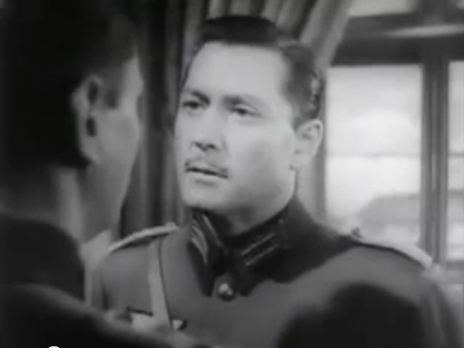
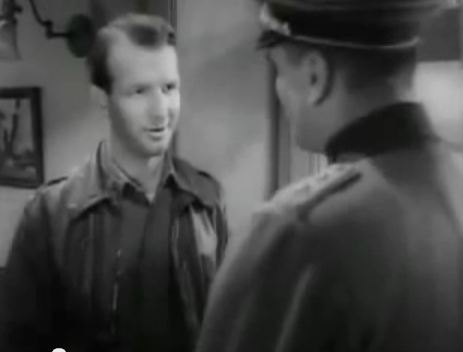
Kent Smith plays a German officer who was raised in the US, and so with his knowledge and his comfortable camaraderie with the American boys, tricks them into trusting him.
Hans Twardowski has minor role as a German Red Cross representative, also out to trick the men into filling out Red Cross forms that ask too much information.  You may remember him from “Casablanca” as a Nazi soldier.
James Seay plays the bomber crew Captain, most stalwart of the group, yet even he slips up and gives information he has no idea he’s giving.
Arthur Kennedy is a standout in the film as a cocky crewmember who thinks he’s going to outwit the Germans by giving them false info, but they are onto him and twist his words so that they find out the truth.  Kennedy gives a raw performance as man who is clearly rattled by these mind games.
It’s interesting to watch the Germans cleverly sort out the mystery of where the downed bomber came from, and where it was going.  By putting together small bits of information the men have unwittingly given them in unguarded moments, the Germans discover where the next raid of American bombers is likely to come from and where their next target is to be. 
When that next bomber mission occurs, the Nazis are waiting for them.  They shoot down most of the squadron of planes.  The footage, simulated obviously, of the American planes being shot down is not what that first generation of boys who grew up on movies would have ever expected to see.  It is brutal, with planes on fire, with machinegun fire ripping through crews, and images of blood spurting from the heads and faces of pilots and gunners.  The lesson about not talking is driven home graphically.
Only a few crews from this mission limp home.  They are debriefed by Lloyd Nolan, and bewildered over how the mission could have failed so badly. 
Rand Brooks has a small part as an American  back at the base, who grimly makes the accusation, “Somebody talked!”
George O’Hanlon, whom you might remember from a bunch of “Joe McDoakes” shorts also appears back at the base.  Mel Torme has a bit part as a pilot, though I confess I didn’t spot him.
Craig Stevens plays a returning pilot back at the base as well, interrogated by Lloyd Nolan after the disastrous mission.  Nolan, in that wonderfully edgy, serious tone that makes you pay attention to him no matter how quietly he is speaking, calms the men and tells them that the only information they are ever to give is their name, rank, and serial number.  Above all, don’t talk.
 
Then he looks right into the camera, right at us.  “Don’t talk.  Don’t talk.  Don’t talk.”
We may never talk again.
The FMPU was comprised of men from all the different Hollywood studios.  Some of them were not actually in the Army Air Corps, like Nolan, and like occasional guest actor Guy Kibbee.  The others who were, ranged from actors, writers, directors, cameramen, many of whom served their entire hitch here in Hollywood, and others who went on combat missions photographing the war, or to serve in other units.  More on that next week.
I’m not certain at this time the military rank of the men who performed in this film or many other FMPU training films.  I do believe Arthur Kennedy was a sergeant.  I believe Craig Stevens was a corporal.  Sgt. David Rose, incidentally, composed the music score for this film.
The AMC channel broadcast a documentary in 1997 made by Gregory Orr Productions called
“Hollywood Commandos”, about the First Motion Picture Unit, and we’ll be discussing that next Thursday.
“Resisting Enemy Interrogation”, now in the public domain, can be watched here on YouTube.

Thursday, October 9, 2008

The Spiral Staircase ( 1945)

“The Spiral Staircase” (1945) gives us a suspense story with the archetypal “dark and stormy night”. Many suspense films since have taken a leaf out of the book of director Robert Siodmak and especially cinematographer Nicholas Musuraca, and used the devices they did, which now may seem almost clichĂ©. Here every shadow and sinister nuance is fresh, and new, and like nothing that ever came before.

Dorothy McGuire is a servant in a New England household in the early 1900s, headed by a feisty invalid matriarch played by Ethel Barrymore. Miss Barrymore lives with her grown son, Gordon Oliver, and stepson, played by George Brent.

The film opens in a curtained-off room of a small village hotel where a silent movie is being shown. The determined matronly pianist grimly follows the action on screen with musical accompaniment. The camera pans to a rapt audience, no one more rapt than Dorothy McGuire, who is clearly deeply involved in the silent movie, clutching her hanky and suffering agonies with the heroine.

The camera leaves the audience and pans to an upstairs room in the hotel. A woman is spied upon from the dark recesses of her closet by a figure unseen except for the menacing gaze of one frightening eye. Next we see the woman as a victim from the perspective of this hidden killer. We still hear the accompanist’s piano rumbling ominous chords from the floor below. When the killer strangles the girl, the movie below concludes, and it is “the end” indeed.

We discover this is one of a string of murders, and that the victims are all young women with various afflictions.

When Miss McGuire walks back in the darkness to the enormous Victorian home where she works as a maid, the wind and rain kick up, and she hears the sound of footsteps following her. This, and when she fumbles with her house key and drops it in the mud are only two instances where suspense rises, even if nothing is really wrong. The idea of imminent danger is kept moving briskly along, like kids kicking a can down the street. We are continually tricked. There are even comic moments which continue the suspense, such as when the family cook played with humorous brandy-swilling buffoonery by sly Elsa Lanchester, tumbles in the dim hall. At first we are led to believe she may have been attacked, as Lanchester accuses with an outraged, “It was him!”

We see she has only tripped over the ever-recumbent bulldog, Carlton.

Another instance is at the entrance of Lanchester’s husband, handyman Rhys Williams, who enters from the storm suddenly when a door is opened for a guest to leave, and he is unexpectedly standing there on the porch, rain soaked and sinister-looking. Apparently, it is only another false alarm, this time. Maybe.

Williams later comforts McGuire during a cozy visit in the kitchen that being murdered is as rare as winning the lottery. “It’s never me. It’s never you. It’s always somebody else.” The director cleverly plays us between scenes where something could happen but doesn’t, and scenes where something happens before we realize the danger. Maybe it’s the lottery and maybe it’s more like roulette.

Dorothy McGuire’s character is repeatedly warned by others to be careful, as she is labeled, perhaps by them more than by herself, to be a prime candidate for the killer’s next victim, because the killer targets handicapped young women. McGuire is mute, the victim of past emotional trauma, rather than from a physical impairment. Her muteness makes the opening scene watching the silent movie especially poignant, where the pantomime on screen foreshadows McGuire’s world of pantomime to communicate.

The local young doctor, played by Kent Smith wants to help her recover her speech and pushes her to help herself, to get her to replay the trauma that left her mute, but she cannot face painful memories.

McGuire has a special, even occasionally playful, relationship with Ethel Barrymore, who prefers McGuire’s ministrations rather than the severe and much put upon nurse, played by Sara Allgood. Bullying Barrymore’s room is cluttered with hunting trophies. The feisty widow was a crack shot in her day, and she repeatedly warns McGuire to leave the house for her own safety, or else stay with her and sleep in her room, even at one point urging McGuire to hide under Miss Barrymore’s bed. As sick as this old lady with the frequent spells is, she feels quite capable of defending a much younger, stronger woman. We see that Miss McGuire, and her muteness, inspires protective feelings in most people, but apparent disgust in a killer who murders young women with imperfections.

Miss Barrymore’s concern is made greater, as we eventually come to realize, because she believes the killer is not only lurking in the neighborhood, but is actually in the house. We are given several broad hints that her charmingly insolent, gallivanting son Gordon Oliver has dubious morals and weaknesses that may include murder. He confesses that he likes to see women cry.

Stepson Mr. Brent, a workaholic professor, who keeps his secretary Rhonda Fleming busy typing on a clunky old typewriter the size of a Buick, seems to share his stepmother’s suspicions. At this point, with as many red herrings as suspicions, the foreshadowing warns us to be wary of everybody, from the pistol-packing constable to the pistol-packing Miss Barrymore, to Carlton the recumbent bulldog. As George Brent tells McGuire, “Don’t trust anyone.”

Central to the story is the house. The excellent ensemble cast seems to give us a tour of the house, breaking up into pairs for hushed discussions, and impatient lovers’ rendezvous, and bitter arguments in various different rooms, always interrupted at a scene’s climax by unwanted intruders.

A magnificent set, it has many levels and the camera follows McGuire, taking us the audience from room to room, almost like the eye of the killer. The spiral staircase of the title is an iron circular stairway, ugly utilitarian back stairs meant for servants, quite unlike the imposing staircase with the carved wooden banister in the front hall. The spiral staircase leads from the main floor of the house down to the kitchen, and then continues down to a lower cellar level, which is very creepy. People lose their candles down there and get lost in the dark.

Even just the hollow plunking sound of the actors ascending and descending the iron steps echoing in the bare, unadorned stairwell is evocative, as lonely and creepy a sound as the wind and rain outside.

The house is heavily ornamented with Victorian drapery, dark wainscoting, parquet wood floors, elaborate gaslight sconces, elegant chandeliers and miles of carpeting. The walls stretching to high ceilings close in on us with busy wallpaper and dour portraits. Dramatic for its overwhelming sense of a grand age in decline, it is as if the house represents the moral decay of the dwindling dysfunctional family limping along into the decadent present.

We see an interesting contrast in the daydream McGuire imagines of her wedding to the young doctor, which occurs, of course, in the house, the central place to the story. In her daydream sequence the house seems alive again, swarming with guests, and vibrant, lighter, and there are baskets of flowers festooning every corner. One might imagine this is how the house appeared in earlier times, before the old widow lost her husband and her enthusiasm for life, before her son and stepson became the kind of weak men she despises.

A large full-length mirror on the landing of the front stairs gives Dorothy McGuire an opportunity to appraise herself, to see herself as others see her. She silently moves her lips, works her jaw in a pose to see how she would look if she spoke as effortlessly as others do, all the people she envies for their eloquence. Suddenly we are aware through a subtle shift in the camera perspective that she is being watched. In another instant, it is apparent to us that it is the killer who is watching her, that we are looking over the killer’s shoulder, who is looking over hers. So smoothly do these moments of tension occur that they are upon us before we realize.

The last half hour of the film is the most suspenseful. The killer is loose in house and aggressively stalks her. The constable shows up unexpectedly but leaves before she can alert him. Her desperate attempts to attract his attention from an upper floor window bring the film to a dramatic crescendo, and when her last hope for aid is gone, we see there is nothing to stop the killer from getting her.

Now she charges all through the house, upstairs and downstairs, like an Olympic sprinter. The final showdown happens on the spiral staircase, and we learn that neither the mute Miss McGuire, nor the invalid Miss Barrymore, is as helpless as they seem.

Dorothy McGuire does recover her voice, first with a scream, and then with a choking call for help on that new-fangled telephone box. How nice for her that she gets to talk to an operator who is a real person, and not a recorded voice message telling her to press certain buttons for more options. That always makes me want to murder somebody.

An interesting version of this film was produced on radio by Screen Director’s Playhouse with Dorothy McGuire reprising her role. Of course, since this was radio, a mute actress will not do, so McGuire was allowed to speak the private thoughts of her character. This actually worked out pretty well, giving us deeper knowledge of her feelings and her past. The childhood trauma that left her mute was also devastatingly dramatized, and with radio word-pictures we are allowed to imagine an horrific scene fully played out. Her trauma is only briefly discussed in the film.

Also added to the radio version was the Bible passage from the Song of Solomon which McGuire’s character relates to the exquisite beauty of speech and how being able to speak to the doctor, whom she loves, would allow her to express not only her desire for him, but convey her deep wish to be desired, and not just pitied.

“My beloved spoke and said unto me
Arise my love, my fair one
And come away with me.
For lo, the winter is past
The rain is over and gone…
… let me hear thy voice,
for sweet is thy voice….”

This is not included in the film. The radio version also reminds us of the irony that an actress with such a lovely speaking voice is playing a mute.

We don’t get quite as much insight into McGuire’s psyche in the film as we do in the radio version, despite her engaging movie portrayal of the mute young woman. We do get that beautiful house, though. You can’t duplicate Musuraca’s cinematography, and that nightmare labyrinth house, on radio. It is one of those instances where the house becomes like another character in the movie.

Have a listen here for the Screen Director’s Playhouse version of “The Spiral Staircase”.

Related Products