IMPRISON TRAITOR, PEDOPHILE, AND CONVICTED FELON TRUMP.
Showing posts with label Harry Carey. Show all posts

Thursday, December 16, 2021

Beyond Tomorrow (1940)


Beyond Tomorrow
(1940) is Christmas ghost story, a fantasy of second chances.  George Bailey and his angel Clarence meet the Ghost of Christmas Present, or at least a slant on the theme of otherworldly visitors helping out dense, stubborn mortals.


The ghosts in this movie actually start out being mortals, sometimes dense and stubborn, but other times are decent and even lovable chaps.  They are Charles Winninger, C. Aubrey Smith, and Harry Carey as three old bachelors who own an engineering firm.  They live together in a New York City brownstone—so many of these Christmas movies in this series have taken us to New York City—and prepare for a quiet Christmas Eve dinner with company after working late in their apartment.

The secretaries are sent away and the gentlemen don evening dress for dinner, but the invited couple has made late regrets and can’t come, and the three men are let down that they have nothing else special to do for the holiday, having no families.  C. Aubrey Smith, we will find out later, is actually a widower whose soldier son has, like his wife, predeceased him.  Smith is English, naturally, a former officer in the Royal Army before setting himself up in business as an engineer.  He is kindly, avuncular, and cheerful.’

Charles Winninger is Irish, the most chipper of the group, who pushes Christmas on the other two workaholics and forces good cheer on everyone around him.


Harry Carey is a glum, even bitter, Midwesterner.  We do not know much about his story, except he gripes at everything, though we catch enough glimpses of his brief, secret smiles to know the guy isn’t a meanie. However, it is intimated that he once committed a crime for which he faced a jury and the scandal still hangs over him.  He is down on a world which he feels has not treated him fairly.


They are attended in their home by Maria Ouspenskaya as their housekeeper, official hostess, and head of staff.  She is a former countess who lost her home and social position, and wealth, during the Russian Revolution.  Alex Melesh, the butler, is a similar emigree who came along with Madame Ouspenskaya, and devotedly calls her “Excellency.”  She confesses to him that when she was rich in Russia, she was not happy, but in the lean years afterward learned that helping others made her happy, and that to be needed was what gave her life meaning and fulfillment.  Maria doesn’t need to be visited by any Christmas ghosts; she’s already learned her lessons.


Charles Winninger, intending to save Christmas, playfully suggests a sporting contest, that the men each put $10 and their calling cards in three different wallets and throw them out the window into the pedestrian traffic on the sidewalk.  They are fishing for guests for dinner.  People who come in to honestly return the wallets will be invited to stay.


The first wallet is scooped up by a flippant, greedy woman, who laughingly keeps it.  The other two are returned by two different souls wandering the streets this wintry Christmas Eve: Richard Carlson, and Jean Peters.  He is a cowboy stranded in New York after the rodeo he performed with at Madison Square Garden left town, and she is a New Hampshire schoolteacher now working in a children’s clinic in the city.  They are both alone, and will soon fall in love.

They all pass a pleasant evening singing and we find that Richard Carlson has a beautiful singing voice.  It will later bring him fame, fortune, and tragedy.

The young couple are completely taken with the three gentlemen, who have become their godfathers, who bestow gifts on them, offer advice, and visit Jean’s children’s hospital on Christmas Day to bring presents and play with the kids.  Just as we saw with the gang of squatters in the mansion in It Happened on 5th Avenue (1947) here, this hastily assembled crew has quickly become a family, and Christmas is for families, so much so that sometimes they need to be created in a pinch.

All Christmas week, the young couple is accompanied by the three men and Madame Ouspenskaya on group outings: to parties, a hockey match, and bowling.  It is a hoot to see the montage with the image of proper and dignified C. Aubrey Smith and the Russian countess at the bowling alley with hot dogs and Coke bottles in hand.

Then the family comes apart, but not with the natural going separate ways after the holiday.  The family is fractured instantly, tragically.

We have only a brief premonition of trouble; actually, it is Madame Ouspenskaya’s premonition.  The three fellows—neither stooges nor Magi—are off on a business trip to another state and their little family sees them off at the airport.  Maria is worried and wishes they would take the train instead. 

Headlines of a lost plane, of a crash, of bodies found.

We next see the dark, cold interior of the New York brownstone and the ghosts of the three men entering, bewildered, at first not aware they are ghosts.  Madame Ouspenskaya, in mourning, enters, and immediately senses their presence.  “I know you are here.  I cannot see you or touch you, but I know you are here.”

“So, this is it,” the ghosts understand they have passed on, but to where?

Before their flight, the men have left an envelope with bonds in it for the young couple, and Maria asks them to move in with her and the butler for a while.

But a quiet transition to a new family dynamic in the old house with three ghosts in it is not to be.  Richard Carlson gets an audition to sing on the radio, does well, and wins a spot on a regular program.  Next, a fading Broadway star played with sophisticated vampishness by Helen Vinson, takes a shine to the handsome Mr. Carlson.  She is attracted to him and to the possibility he will help to boost her career. 


Carlson’s charming county bumpkin ways become maddening as he does not seem to see the danger to his relationship with Jean Peters or that Miss Vinson in just using him. 

The ghosts, matchmakers in death as they were in life, are not happy about this at all and try repeatedly to warn the mortals.  But time is growing short for them. It seems they are not to be allowed to spend eternity in the living room after all.  With bolts of lightning and terrible thunderclaps, Harry Carey realizes with the customary sense of doom he wore in life that his final reward draws near.  His ghostly pals fear for him, and Charles Winninger urges him to ask forgiveness.  Carey is more than stubborn, he is proud, and he is honest.  He cannot say he is sorry for what he had done, “What I did needed doing.  I have no remorse.”  He accepts his fate and walks morosely into the terrible blackness.


The remaining ghosts now turn their attention to the continuing problem of Richard Carlson getting involved with a wicked lady and leaving poor sweet Jean Parker alone.  Both Carlson and Parker were second-tier players through the thirties and Jean may probably be best remembered as “Beth” to Katharine Hepburn’s “Jo” in the 1933 version of Little Women.

C. Aubrey Smith must give up the attempt to help, for now it is his turn.  Like the soldier he was once long ago, he is being called by a celestial trumpeting of “The Last Post.”  There is no terrible blackness, only a dim sense of light on the horizon, and from it, to his astonishment, walks his solder son.  “I’ve come for you, Dad.”

“What is it like?”

“What do you want it to be like?”

Mr. Smith recalls an old army post in the tropics where he enjoyed the companionship of fellow officers, sport, apparently no shooting at him, and the benefits of being a colonial master of sorts.  He will join his wife there and it will be his paradise.

Charles Winninger is left alone to deal with the problem of Richard Carlson, which grows worse as Helen Vinson’s ex-husband and former stage partner, played by Rod La Rocque in one of his last film roles, jealously follows them to a country inn where they intend to spend a few days.  Winninger has a few comic moments such as when he pulls down Miss Vinson’s skirt which has been provocatively raised, and when he knocks her hat off. But more than this he is helpless to do.  He cannot really turn Carlson away from bad mistakes or the tragedy to come.

Then it’s his turn to meet his final reward and cross over to his own paradise, but he refuses the voice, because he cannot leave Carlson alone.  He feels responsible for him.  The voice tells him if he does not follow, he will doom himself to wander the earth forever. 

“I can’t go now.  I can’t.”  He is sad and helpless, but ever faithful, and he has lost his chance at eternal happiness.

At the country inn, where Carlson and Helen Vinson are having dinner, drunken Rod La Rocque shows up with a gun and shoots them both.  Next, the inevitable operation scene and Winninger paces the corridor like an expectant father.  Instead of good news, the ghost of Richard Carlson comes out into the hall.  He realizes now his foolishness and must suffer remorse for eternity for what he has caused. 


Miracles conveniently happen in movies such as this, and so through the purity of Winninger’s heart, he is given a second chance to pass on to paradise, and Carlson is given a second chance at life.  They part as Winninger responds to the distant call of his mother, and, truly unexpectedly, to the vision of Harry Carey, who also has been granted a second chance at paradise because he has finally let go of the bitterness he carried in life.  There can be no light with bitterness, only darkness.

Beyond Tomorrow is a parable and a fantasy of unlikely events and possibilities, grounded perhaps not by a love story but by the notion that consequences are attached to everything, and that optimism, even in the face sometimes terrible consequences, makes life bearable and is a blessed thing.

You can watch Beyond Tomorrow here on YouTube:


  ********************

Jacqueline T. Lynch is the author of Ann Blyth: Actress. Singer. Star. and Memories in Our Time - Hollywood Mirrors and Mimics the Twentieth Century. Her newspaper column on classic films, Silver Screen, Golden Memories is syndicated nationally.  Her new book, a collection of posts from this blog - Hollywood Fights Fascism - is available here on Amazon.

Thursday, February 23, 2017

Happy Land - 1943

Happy Land (1943) is a gentle, yet powerful film of common decency, and the discipline and quiet courage that common decency sometimes requires.  We used to attribute these as American values.  The movie is sentimental about this, and yet bravely forward-thinking for all its nostalgia: there is an underlying current of foreboding almost as if they knew how delicate decency is, and that is must be nurtured.


The title of the movie, as related by the strains of the theme song, comes from the lines in “Hail Columbia,” composed for George Washington’s inauguration, that was often used as a national anthem up until the time “The Star Spangled Banner” was officially made the National Anthem in 1931.  With all due respect to our anthem, I have a preference for “Hail Columbia”.  It is stirring, and sweet, and nobly idealistic, and perhaps a little naïve. “Hail Columbia, happy land!”  Listen to song here on YouTube. 

Don Ameche stars as a man from a Middle West small town at the height of World War II.  He is a pharmacist and owns the town’s drugstore on Main Street, and much of what we see will remind us of a Norman Rockwell painting.  He is married to Frances Dee, lives in a cozy white wood frame house, and his only son is away in the Navy.  He knows all his customers personally.  It is a good life.

At the very beginning of the movie, we see a telegram delivery girl ride her bicycle up to the front steps of Don Ameche’s house.  Perhaps no image ever instilled more fear in the United States during World War II than the telegram delivery person.  Here it is a mere girl.  Her name is Hilda, and Don Ameche, of course, knows her.

Pleasantries are quickly dispensed with.  She hands him the telegram without looking at him.  He stands silently, and the close-up lingers on his expressionless face, on which we see only a flicker of realization that his son has been killed.

The movie is filled with moments like this, strong, gutsy, brave moments that are no less courageous from the actors and the director, Irving Pichel, because they are placed in a comfortable and nostalgic setting.  Sometimes the movie may well remind us of what The Best Years of Our Lives (1946) would have been had it been filmed three years earlier; and it is perhaps no coincidence that the material is from a novel by MacKinlay Kantor, just as Best Years was.

We shift quickly to the town’s newspaper office where the editor composes a hasty eulogy for Ameche’s son in his daily editorial.  There is slight leap forward in time—Ameche takes a leave of absence from his drugstore and his employees are left to run the shop: good old Mary Wickes among them.  The minister calls on Mr. Ameche to lend comfort with the true words, “Suffering and pain are part of life too.  We must accept them.”

But Ameche’s loss of his son Rusty is compounded by his sense of injustice that Rusty “never had a chance at life.  He never went anywhere.  Just a youngster living at home, going to school, working for his dad…It isn’t right.  It isn’t fair.”

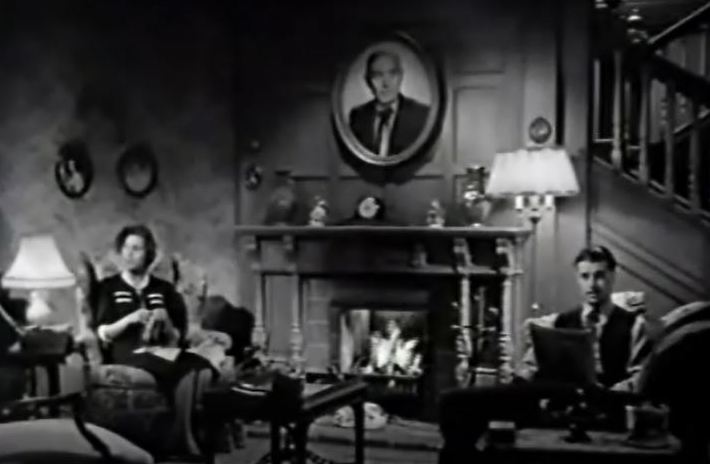
Ameche’s next visitor will have a stronger impact: Harry Carey, who plays his deceased grandfather.  We may compare this scenario with It’s a Wonderful Life (1946), but Harry Carey is no bumbling angel.  He speaks frankly with a kind of homespun horse sense we might expect from Will Rogers or Mark Twain, and though he has been dead twenty-one years, he is still very much alive to Don Ameche.  We know this because of Carey’s prominent portrait in Ameche’s home and at the drugstore.  Grandfather Carey’s influence is strong.  So it is with certain people in our lives, who seem to walk with us now and again even though they’re gone.

Ameche goes for walk into town, and Mr. Carey goes with him, and soon they travel not just through town, but through time.  We are brought to the end of World War I, when Harry Carey and the rest of the town welcomed home a parade of doughboys, including a younger Don Ameche.  (It is really something to consider that Ameche was still playing romantic leads at this point in his career, but in this movie he plays a character who ages, whose main purpose in the film is to be a father.  This would, as it does for aging actresses, signal a turning point, perhaps even a demise of his film career, but this movie is a gem and I hope he didn’t regret it.)  Grandpa Carey ran the drugstore then, and Don becomes a pharmacist as well.  We are then given a tour through Ameche’s adult life, of which his marriage to Frances Dee, and his son Rusty, is the biggest part.

Grandpa Carey died shortly after Rusty was born, and we jump to a Memorial Day of placing flags on Civil War vet Grandpa’s grave when Rusty is about six.  He is impressed, and knows that soldiers get flags.  He says that someday he wants one.  It is a moment of foreshadowing of doom, but Frances Dee confidently notes, “There aren’t going to be anymore wars.”  That, after all, was the slogan of World War I, when it was just still called The World War.

Grandpa Carey’s ghost remarks to Don Ameche, “She was right.  That’s the way to bring up American kids, not to be thinking always of conquests and battles, but to learn to enjoy the homely, simple things that are here all around them.”  It is a mighty thought, that to be peace-loving and grateful should be patriotic, for if we do not appreciate what patriots have won for us in war, we do not deserve the peace.  Then the strain of “Hail Columbia” repeats in chorus during this exchange.  The tune becomes our conscience.

We see Rusty playing with his friends at being Indians in a cornfield, and being dragged home by Mom to take his nap.  He balks at being called and answers, “Me no Rusty, Woman!”

Rusty gets spanked by Pop for refusing to go to kindergarten, but goes and makes pals there of two brothers who live on the other side of the tracks.  He brings them to the drugstore to meet Pop, and Ameche gives them free ice cream and orders some groceries for their family.  Their dad is out of work.  Ameche tells Rusty, “When you come across a fellow that hasn’t got anything and you’ve got things, why, you just give him some of your things.  Some folks call that charity.  I don’t like that word.  All it is, is being friendly.”

Rusty grows older, joins the Boy Scouts, and saves for a hatchet to take on a camping trip with the Scouts.  He’s almost got enough, but when he’s left in charge of the store and an old man comes in for medicine and can’t pay for it, Rusty buys it for him with his own money. Ameche witnesses the scene.  The expression of pride on his handsome face is exquisite.

He buys the hatchet for his son, and we see Rusty with other Scouts singing “MyDarling Clementine” to a harmonica accompaniment.  We are back to homespun pleasures, and a montage of scenes as Rusty plays football and runs track in high school.  He was not always the star, but tried his best, and his father notes with equal pride, “He was a good loser.” This is a virtue as important as being a good winner.

Rusty dates, and his eventual best girl, Ann Rutherford, shares with him an unusual but pleasingly respectful relationship, an old-fashioned courtliness borne of modern wariness.  She does not gush over him, and withholds her kisses from him because she has seen him lose his head over flashier girls and she will not lower herself to compete.  He must win her, and with gallant gentlemanliness, he acquiesces to kisses only on the forehead until the moment when the time for passion is right.

Rusty, played by Richard Crane as an adult, is touchingly mature.  He and his friends have fun at a late summer backyard party, but listen to Hitler’s invasion of Poland on the radio and soberly understand, wise beyond their years, that their future has just been altered.  As President Franklin D. Roosevelt had said only three years earlier in 1936: “There is a mysterious cycle in human events.  To some generations much is given.  Of other generations much is expected.  This generation of Americans has a rendezvous with destiny.”

Back at the drugstore, Old Ben, who works in town as a night watchman, played with eloquent, natural grace by Leigh Whipper, veteran of Broadway and the first African American to receive membership in the Actors Equity Association, remarks of the latest news on the radio about the threat of fascism, “It’s the same old thing, weasel talk.  The same old bunch of gangsters and killers out to make slave of the rest of Europe.”  Mr. Whipper’s too disgusted to be scared.  He sets a fine example in righteousness for the Rusty and his pals planning on joining the service, some fighting in these pre-Pearl Harbor days for Canada.

Along with Leigh Whipper, we must note how well chosen the cast is, from Richard Crane, who despite the enthusiasm of a boy coming of age really plays his role in a careful, understated manner which makes his character very likeable that makes us, like his father, seem to take pride in him.

His best friend is played by Dickie Moore, and Ann Rutherford’s character is played as a child by Darla Hood.  Also for the trivia buffs, this was five-year-old Natalie Wood’s first movie.  She has a brief walk-on as a child who drops an ice cream cone.  It also warms the heart see Adeline De Walt Reynolds in a brief role as a patron of the drugstore who trades homemade loganberry wine for a “snake oil” tonic. (We discussed her career in this previous post.)  The wine is reprised in several scenes as Rusty shares his first drink with Dad, and other momentous occasions.

Rusty decides, rather than enlist in a knee-jerk reaction to the world news, that he will go to pharmacy school.  After the war, he wants to join his father in business, and he feels that if he has his pharmacist’s license, he will be of more use to the service with this skill.  Don Ameche is once again beaming with pride, and invites his son for a toast of loganberry wine.

Rusty’s a strapping sailor in his Navy uniform.  But the world comes crashing down on us when we see his smiling face in the bus window pulling out of town and Ameche says in his soft, low voice, “That was the last time I saw him.”

Grandpa Carey is at his side again; we’re back in the present.  Carey says, “It was all worthwhile, the whole thing.”

We know what he means, that just because Rusty’s life was short doesn’t mean it didn’t have value, and that he didn’t pack a lot into it.  Ameche understand, too, but responds, “Rusty led a good life.  You’re right about that.  I know all the other things you’re hoping I’ll say, but I can’t.  He was my boy.  And now he’s dead.  I miss him.  I can’t help it.  I’ll always miss him.  I’ll always wish he was back, as long as I live.”

This exchange, during the height of World War II, was a very frank thing to say, and brave in its open-faced acknowledgement of grief.  We are most respectful to the grieving not when we try to cheer them up, but when we acknowledge their grief.  There is no cheerleading here, but the end of the movie gives us and Ameche a startling task.  It dares us to continue our lives and force ourselves to find a purpose.

The gentle but no less firm admonition for Ameche comes in the form of Henry Morgan.  He’s a young sailor, a shipmate of Rusty’s.  He shows up to the drugstore on furlough, and in an exchange of very few words, almost as if they are reading each other’s minds, Ameche invites Henry, who has no family of his own, to stay at his house.  Frances Dee, also awed by an unspoken epiphany, kisses Henry upon meeting him as if he was her son, and they, without talking about it, suggest he take Rusty’s room.  We know their bond is sealed when Ameche takes out the loganberry wine.

The strains of “Hail Columbia” rise again with lyrics, “peace and safety we shall find.”

But we shall only find it together.


Special thanks to fellow blogger Moira Finnie (see her blog The Skeins) for introducing me to this movie.  You can watch it here on YouTube.

*********************
The audio book for Ann Blyth: Actress. Singer. Star. is now for sale on Audible.com, and on Amazon and iTunes.


Also in paperback and eBook from Amazon.

Monday, November 5, 2012

Mr. Smith Goes to Washington - 1939


Mr. Smith Goes to Washington (1939) has grown to legendary status. It represents an icon of 20th Century American popular culture. It stands tall among the giants of that pantheon of 1939 films. It generated great controversy at its release, but today, though it enjoys restoration and placement in the Library of Congress as a film of significance, it is perhaps seen in the soft nostalgic glow as just another example of “Capra-corn.”

Its simplicity is both its greatest dramatic asset and its singular fault among critics. That is the dichotomy of any Capra film. Paradox is the order of the day. Just a few examples:

This movie was banned both in Nazi Germany and the Soviet Union for showing the American democratic process in a positive light. However, this film was roundly criticized by Washington as showing senators in a negative light and the political process as being rife with corruption. They wanted it banned, too.

The movie shows corruption in Congress, but no political party is ever named. Claude Rains plays the senior senator, who has compromised his integrity for graft, and James Stewart plays the junior senator from the same state. We do not know with which party they are affiliated. We do not even know which state they are from, but since the story is partly based on a book which named Montana as the home state, the senator from Montana walked out on this movie at its preview at Constitution Hall in Washington. Many other senators were no-shows in protest.

Art reflects life, as we realize the main message of this film is the crime of arrogance. Politics is rife with it. Both political parties are guilty. Graft is graft, no matter who does it.

And it’s easy see how Capra both pulled away and exploited the combustible nature of politics in this film. We take politics personally. We cringe and get our backs up when we hear an opposing political viewpoint. That is human nature. How we behave about how we feel is what makes us ladies and gentlemen…or thugs.

Politics is also rife with idealism, sometimes pure and hopeful in its natural state; sometimes exploited in creative political ads meant to play on the emotions of the public and how well they respond to dramatic backlighting of a candidate in his shirtsleeves superimposed over a waving flag. It’s hokey, and it’s still being done. The arrogance of politicians in believing we are really that stupid.

Director Frank Capra was a conservative Republican. The scriptwriter, Sidney Buchman, was a Communist Party member between 1938 and 1945. Yet, they shared ideals and vision for this movie. (Buchman would be blacklisted in the 1950s when he refused to name names.)

Most of those shots of Washington buildings and monuments were taken on the sly; the United States Parks Service denied the filmmaker access.

One more paradox: despite this canon of idealistic films of Capra’s, Mr. Smith Goes to Washington is actually quite a dark movie, sinister and cynical. James Stewart is the only Pollyanna of the bunch, and by the end of the movie even he gets his teeth kicked in.

Long post ahead. You’ve come this far. It would be a shame to turn back now.

We begin the movie with that heartthrob Charles Lane as a reporter, holed up in a phone booth barking in his sexy nasal twang about the sudden death of a senator and the need for his state to send an immediate replacement.

Only a truly great movie would start the show with Charles Lane.

We learn right off the bat that Edward Arnold, the prototype of the greedy corporate thief, runs his state with an iron hand and a bottomless wallet. Guy Kibbee is the harried governor, who asks “How high?” when Mr. Arnold tells him to jump, much to the chagrin of his wife, Ruth Donnelly, and his large family of children. The kids suggest James Stewart as a replacement senator. Stewart runs the Boy Rangers (because the Boy Scouts of America didn’t want to touch this film with a ten-foot pole) and publishes a boys’ newspaper and recently heroically fought a forest fire.


Edward Arnold is great in this film, with his voice kept low and sneering. If he bellowed and blustered it would not be half so chilling as that snide, quiet confidence he displays.

One of the real delights of this film is spotting the character actors. Porter Hall and Grant Mitchell are senators, Jack Carson gets a couple lines as a reporter. Lafe McKee (who we discussed in this previous post) gets a brief, but iconic moment in this film when he stands before the Lincoln Memorial helping his little grandson to pronounce the difficult words in the Gettysburg Address, which is engraved in stone on the building.

As he says the word “freedom,” we get a shot of an elderly African-American man standing nearby, who has removed his hat in respect for Honest Abe. If this man is over 77 years old, he might have been born a slave. Politics is personal.

Eugene Pallette is on board as Edward Arnold’s right-hand man. Catch the scene where Pallette struggles to get his large body out of a phone booth. Dub Taylor, who we last saw in Cowboy Canteen (1944), is a wisecracking reporter who is part of a gang that interviews a bewildered James Stewart upon his arrival in Washington. You might even catch a glimpse of a young Craig Stevens as a reporter in the Senate chamber gallery writing fast and furious with a pencil.

Dickie Jones, the young Senate page who helps out Stewart, you’ve likely seen in many films.

Much of this movie, when it really works well, hinges on the magnificent Jean Arthur. Her performance is transcendent. She is secretary to Claude Rains, and has seen enough of Washington’s seamy side to stamp out any idealism she once might have had. As she tells Rains, “When I came here my eyes were big blue question marks. Now they’re big green dollar marks.”

She is assigned to babysit James Stewart, whom she first regards with eye-rolling bemusement tinged with disdain. Gradually, however, her own latent idealism is re-ignited under his slow-talking, sincere, nervous charm. He tells her about the beauty of his state, and his father, a small-town newspaper publisher who was murdered for standing up to a mining company, and how his father told him to look with wonder at life around him and “Always try to live as if you’ve just gotten out of a tunnel.”

She is moved, in spite of her own misgivings and fear of being duped. You can see all of that in her delicate expression, her sense of breathlessness, and we watch her falling in love with him. As we’ve discussed before, Jean Arthur had a remarkable ability to play pathos and comedy right at the same time. I can’t think of anybody else who could work as well at this deceptively complex role, with perhaps the exception of Barbara Stanwyck. Jean Arthur’s faith in politics and mankind is rekindled, and then dashed again as her heart is broken when James Stewart becomes the prey of Edward Arnold and his machine.

Stewart gets himself targeted when he proposes a bill, with Jean Arthur’s help, to create a national boys’ camp where boys from all walks of life, races and creeds, can come together. The land he chooses is the spot Edward Arnold wants and has been sneakily buying up under false names. Claude Rains, the “Silver Knight,” a respected senator who has been kept in office for decades by allowing himself to be Mr. Arnold’s stooge, must now crush James Stewart on the orders of his boss. He even dangles his society snob daughter, played by Astrid Allwyn, in front of Stewart as a diversion.

Jean Arthur, who knows all of this, is heartsick. One of her best scenes is in the press club bar with pal Thomas Mitchell, as she self-medicates her pain with booze. She and Mitchell also played confidantes that same year in Only Angels Have Wings discussed here. Frank Capra, quoted in Frank Capra-The Catastrophe of Success by Joseph McBride (Simon & Schuster, NYC, 1992), p. 417 - “I defy any other actress to play that scene,” Capra marveled, “She’s a great actress, much better than she knows. She made it believable with little things, like the way she tried to pick up her glass and didn’t know which glass she was picking up.”

During this scene she tipsily mourns sending James Stewart off to the Senate with a bill that was going to make him a target of the bad guys: “I felt just like a mother sending her kid off to school for the first time. Watching the little fellow toddling off in his best bib and tucker. Hoping he can stand up to the other kids.” It’s hysterical, and heartbreaking at the same time.

Though I think my favorite line is when Thomas Mitchell, in her apartment looking for stuff to mix cocktails, asks her where the bitters are. She replies absently, “In the thing there. Behind the thing.”

At her drunken scene, she accepts Mitchell’s longstanding marriage proposal as a way to escape Washington and the hypocrisy around her. In Jean Arthur - The Actress that Nobody Knew (Limelight Editions, NYC, 1997), p. 116 - author John Oller quotes Howard Hawks, who directed Mitchell and Miss Arthur in Only Angels Have Wings, remarking of Arthur’s work in this scene, “That was a beautifully-done thing.”

Jean is quoted explaining the scene, “The trouble about a woman being drunk is you have to be careful not to go overboard because then it’s not funny…A man can be awfully funny when he’s drunk but not a woman.”

Still a little drunk, she and Mitchell head back to her office so she can clean out her desk (her stuff, comically, includes a large rag doll). She runs into Mr. Stewart there, and vents her anger at him for being so gullible. She clues him in on the facts of life, how he is being used, and how the bad guys are playing him for a sap. When she marches out, she stops, as if overwhelmed by her own misery, and leans on the wall out in the empty hallway. Thomas Mitchells hovers by her, concerned. Her back to us, she sobs with her head against the wall and we see, as does Thomas Mitchell, that there will be no marriage between them, that she is in love with Stewart, and that she is hopelessly afraid for him. It’s wordlessly eloquent, all done with body movement.

Two more brief moments I love: When she sleepily awakes, still sitting in the Senate gallery to watch him below standing alone in the middle of the night during his filibuster reading softly from the Bible, “and the greatest of these is charity.” Also when she sends him a love note tucked inside a bound copy of the Constitution.

James Stewart grows up a lot now. He sees the corruption, confronts Claude Rains and tries to spill the beans in Congress. He is silenced when Rains pulls a fast one on him and accuses him of corruption instead. Stewart gets pilloried. Jean Arthur finds him, at last, with his suitcases prepared to leave town, sitting before the Lincoln Memorial at night, crying with that bewildered pain we suffer when people, whether it’s the kids on the playground, our coworkers, or our family, have rejected us.

Just as Jean Arthur was so perfect for her role, I don’t think any other actor would have done as well in his part as James Stewart. Capra had originally hoped to use Gary Cooper in an extension of his “Mr. Deeds” role, but that fell through. Cooper was great, and Jean Arthur loved working with him, had a crush on him, but Cooper’s innocent heroes had something yet sly and knowing about them. Stewart is completely at the mercy of his own unthinking exuberance.

Jean Arthur saves him. She coaches him through a filibuster from her perch in the gallery of the Senate chamber. It’s a terrific showdown, a gunfight with ideals and stubbornness rather than six-shooters.

As Stewart’s voice grows hoarse through the weary hours of his filibuster, Edward Arnold tries to spin lies in the press to their home state, telling the public only what he wants them to know, faster than you can say Fox News.

These scenes are where Capra, in another paradox, both captures the emotions of the audience but also loses believability when small newsboys on the side of James Stewart are used to convey the David versus Goliath aspect. I suppose it’s difficult to find imagery to support the nobility of the common man without getting hokey. It’s difficult sometimes for Capra, anyway.

I get a kick out of real radio newsman H.V. Kaltenborn used here, standing in front of a mic, narrating the magnitude of the moment. Waxing eloquent with the few minutes allotted him in days when live news was in its infancy. Today, we have hack media personalities -- I hesitate to call them journalists -- telling us about the latest poll or topic trending on Twitter. And the overuse by CNN of “breaking news” with asinine repetition to hijack our attention over topics which are neither news nor breaking.

Many of us remember a time when the announcement “Special Report” was given sparingly and only for really big news. Our stomachs turned when we heard it because it usually followed with the first reports of an assassination.

But Mr. Kaltenborn stands at his post, using proper English and trying to give the circus some dignity, instead of trying to turn something dignified into a circus.


The Senate chamber scenes are wonderful. A replica was created on the Columbia lot. The pageboy explains to Stewart, and to us, who sits where, and the history and significance of the setting. In many scenes, we may note that many of the desks are empty -- a silent gesture showing that our senators are not always on the job.

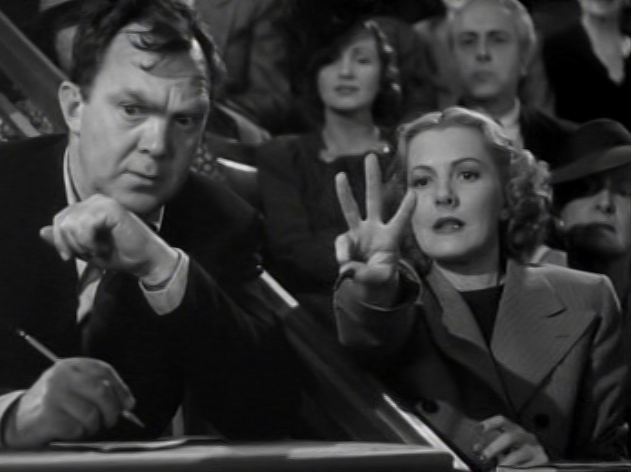
I love the shots of Jean Arthur in the gallery throwing signs to Stewart like a catcher to a pitcher to guide him through the filibuster process.

There is some strong imagery in the Senate chamber. We see Claude Rains and the other senators filmed from the floor to the ceiling so they look like giants. We see shots down from the ceiling at the menagerie of “senators” and extras looking small as they fill the room, a tight cluster of humanity. The arrogance of the senators when they turn their backs to Stewart as he speaks.

The climax is strangely quiet. Claude Rains directs the pageboys to carry in baskets of telegrams from an angry public denouncing James Stewart because of the lies they have been fed by Edward Arnold. It’s almost like that glorious scene in Miracle on 34th Street (1946) when the letters to Santa arrive. But these scraps of paper do not save Mr. Stewart. They condemn him.

He first looks heavenward, a Christ-like figure as if to say, “Why hast Thou forsaken me?” Then he locks his gaze on Harry Carey, who is sublime as President of the Senate, smiling through his fingers as he tries to mask his bemusement at Stewart through previous scenes. He is a kind of craggy-faced Will Rogers-type character whose eloquence is not in his quips, but in his expression.

Mr. Carey gives him a gentle smile of encouragement, and Mr. Stewart finds the will to continue despite it being a lost cause. James Stewart is triumphant in this moment, not because he has won, but because he has fought the good fight.


I find the ending is where Frank Capra loses us again in a saccharine solution. Claude Rains, overcome by his conscience, hysterically confesses his guilt. Convenient, but unlikely. We know too well that people in office rarely admit guilt. Especially if it would lead to a conviction.

Claude Rains is fascinating to watch in the film. He has a complex role and his evolution is just as important as Stewart’s or Arthur’s. He is a man of ideals who gave up most of them in order to survive in the Washington jungle.

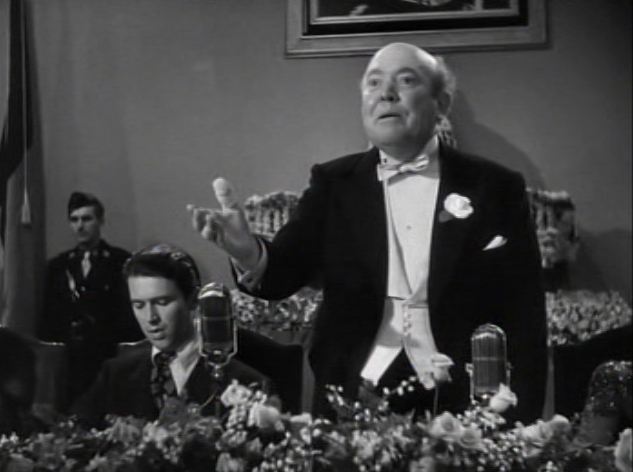
Early on in the film, a banquet is held to welcome Stewart to political life, and Mr. Rains is surprised to discover that Stewart is the son of his old friend. He leans over the dais to spy Stewart’s mother, the lovely Beulah Bondi, who exchanges a look of fond reminiscence. Here is where we first see that Rains has an honest past, and this is where his struggle of conscience begins. He carries the burden through the film.

We see a lot of father-son imagery in the movie: between Rains and Stewart, between Stewart and his Boy Rangers, with the pageboy, between Harry Carey and Stewart.

The first time I went to Washington, D.C., as a young woman and stood in the visitors’ gallery of the Senate chamber, I could not help but think of how it looked in Mr. Smith. It was one of many trips. Washington, D.C., is a place I never get tired of visiting. One can feel cynical and still be inspired.

Despite its occasional hokey sentimentality, these are the real truths expressed in this movie. Jean Arthur reminds a disgusted Stewart that, “They aren’t all Taylors and Paines in Washington. That kind just throw big shadows, that’s all.”

Another truth is Claude Rains’ dismissal of the people voting him out when they learn of the corruption: “You can’t count on people voting. Half the time they don’t vote anyway.”

We get heartily sick of the nastiness of political campaigns, especially when they seem to last so long. But it is a good thing, I think, that we air our grievances so publicly and that other nations can see our anger and discontent. Because they also see that it all leads to election day. No coups, no hanging or shooting the opposing party when you’ve won and they’ve lost. The winners take office. At the end of the term, we vote again. Like clockwork. It’s that splendid confidence in our own system that drove both Nazi Germany and the USSR to ban this movie. It was our suspicion of our own leaders that drove Washington insiders to criticize this film at its premiere. Trust and suspicion, in healthy doses. A marvelous paradox Frank Capra didn’t create, but was clever enough to appreciate. [Addendum: from the perspective of 2022, this last paragraph seems sadly naive.]

This movie, despite, or because of, its sentimentality has inspired many over the decades. It was one of my mother’s favorite movies, and she presented it to me as a kind of civics lesson. When the reporters rush from the Senate chamber shouting, “Filibuster! Filibuster!” -- I recall my mother echoing, “Filibuster!” excitedly when I saw it the first time on TV, grinning, urging me to see what happens next. She was one of the most politically astute people I ever knew. Though neither of my parents were joiners of causes, they learned early the intimate place politics had in their lives when as children the programs like the CCC and the WPA created by President Franklin Delano Roosevelt saved their lives.

Growing up in poor families, President Roosevelt literally kept them from starving and gave them job training and hope for the future. They never took politics for granted after that. It was personal. The most important program in my house was the news. They devoured news magazines and newspapers, and we watched conventions like some people watched the World Series.

When they got ready to go vote, my father shaved. My mother put on makeup. Reading glasses, check. Notes on specific ballot questions, check. They announced with almost theatrical dignity, “We Are Going to Vote,” as if they were about to save the world.  Being able to vote gives you a great sense of power.  Ask anybody who can't.

We were to be good until they got back from saving the world.

I am voting tomorrow because that is what I was raised to do. Because my mother loved Mr. Smith Goes to Washington. Because my mother, rest her soul, who never had a driver’s license or a passport, were she living today would be denied the right to vote by some politicians who are aching to get a whip-smart, no nonsense liberal like her off the books.

And because like James Stewart in the movie, I get all choked up when I visit the monuments in Washington, D.C.

   ********************

Jacqueline T. Lynch is the author of Ann Blyth: Actress. Singer. Star. and Memories in Our Time - Hollywood Mirrors and Mimics the Twentieth Century. Her newspaper column on classic films, Silver Screen, Golden Memories is syndicated nationally.  Her new book, a collection of posts from this blog - Hollywood Fights Fascism - is available here on Amazon.

Related Products