IMPRISON TRAITOR, PEDOPHILE, AND CONVICTED FELON TRUMP.
Showing posts with label Joseph Losey. Show all posts

Thursday, November 17, 2011

The Sleeping Tiger - 1954


“The Sleeping Tiger” (1954) is a little like a Rorschach test -- an ink blot image whose design can be interpreted in different ways, but for which there is no "right" answer, or at least no conclusive answer.

All movies are subject to interpretation. This movie, either by intention, or the serendipitous marriage between a dynamic director and a quirky script, invites us, teases us to interpret whole scenes and even small gestures -- but never to be too sure about our conclusions.   Our conclusions change, sometimes minute by minute, depending on how we hold up the inkblot.

This story embodies the personality of Alexander Knox, who plays the unflappable psychiatrist putting his wife and his patient through an emotional and psychological obstacle course.

His habit is to usually answer a question put to him, no matter how ordinary or innocuous, with another question (re: "Do you want some coffee?" -- "Is there any reason why you think I should want coffee?")...in the probing manner of a psychoanalyst. So does the director of this movie. You want to slap both of them after a while. We are never really given conclusions, only more questions, and sometimes this works to make the film fascinating, and sometimes it makes us frankly annoyed and impatient for a simple answer.

The director is Joseph Losey, who also gave us “The Prowler” (1951), which we discussed here. In this film’s credits he is listed as Victor Hanbury. He left the US in the early 1950s to escape the House Un-American Activities witch hunt, and worked for a time, as did many blacklisted filmmakers, under a pseudonym.

By the way, this post is going to be one long SPOILER. If you don’t want to know anything, then go into the kitchen and make me a cup of tea. Do the dishes while you’re out there. And see if the mail came.

It’s also going to be an excruciatingly long post. Yeah, big surprise.

The setting is England in the mid 1950s, still wearing its post-War bleakness. We haven’t got to Swinging London yet, that’s for later on in the Cold War.  The script is taut, and often a curious mixture of intelligent lines, but hard-to-swallow plot turns. We are prodded to question our assumptions -- at the same time we are told to accept what seems improbable.

We start with improbability.  Dirk Bogarde is a thief in his early 20s, a former juvenile delinquent now settling satisfactorily into a life of unending crime and violence. He attempts to mug Alexander Knox on a dark street, but the good Doctor had hand-to-hand combat training in the late war. Knox also collects psychological guinea pigs the way Dr. Frankenstein collects brains. He fights him off and convinces Bogarde to stay in his home for a six-month psychotherapy experiment. Bogarde agrees to avoid going to jail.

Alexis Smith is Knox’s wife, just returning from a trip alone to Paris and finding a sneering Bogarde in her living room. Cool, with the appearance of a somewhat bored sophisticate (how many times has she played that part?), she is amazingly far less perturbed about a street criminal staying as a guest in her home than is their shrill, opinionated maid, played by Patricia McCarron.

“How are his manners?” Alexis asks her husband, as if she were a school matron taking on a new charge. When one has a criminal under one’s roof, manners should be the least concern, but this is a clue to her personality. Even the most evil intent can be hidden with charming manners. Alexis does not like to look below the surface, unlike her husband. She is unsettled by what she may find there in others -- and in herself. She leaves probing under layers to the Doc.

Rounding out the family circle is Maxine Audley, who plays Knox’s lab assistant. She is perhaps the biggest question mark of the bunch. Always present with the Doc in his office, always seated at the dining room table where they have dressed for dinner and trade pleasantries over wine, always following the Doc out the door when he leaves for one of his many nightly lectures or board meetings. We are told very little about her, and so of course we wonder. It isn’t until well into the film we discover Alexis wonders as well.

It’s a low-budget film, you can see that from the start. A few shots of dark village streets under dim streetlamps, most of the film shot in the claustrophobic confines of their home. And it’s a public domain film, so of course the print could be better.

Dirk Bogarde’s manners, to begin with, are terrible. He is snide, rude, and quite mean to the maid when nobody is looking. He bullies her because he cannot bully Alexis or the Doc. He is immature, sullen, and resentful. He chafes under Doc’s grilling of his childhood memories.

These sessions take place in Knox’s office, which is in the home. His office is a stark contrast to the rest of the house, which appears cozy-cluttered, with dark wainscoting and bowls of flowers. And several photographs of Alexis.

His lair is spare, walls painted white, a set of narrow frosted windows placed high on the wall reminding one of an institutional infirmary, with modern furniture, peg-legged, Scandinavian design, utilitarian and not a bit cozy or ornamental.

There is a piece of modern art on the wall which the police inspector, played by Hugh Griffith, scrutinizes in frank puzzlement. This is the room of a man of unsentimental intellect and bold drive to expose naked the emotions and psyches of those who enter it. Curiously, he keeps his own emotions well hidden, or controlled, or perhaps he hasn’t any.

But Alexander Knox plays the man with such a pleasant, easygoing, almost guileless devotion to the truth. He is honorable, and we trust him. He does not appear cold or indifferent, though his actions reflect an ironic insensitivity. On a mission to tackle the obsessions of others, he does not realize how obsessed he is with his work.

The Doc keeps a loaded revolver in his desk which we see from time to time, and one wonders at the lack of prudence, but we always seem to find loaded guns, and open checkbooks, in desk drawers in the old movies, don’t we? I think they are a more common plot contrivance than boy-meets-girl.

However, we also have boy-meets-girl. Alexis, who spends several hours almost every day horseback riding (she seems to have very little else to do), is urged by her husband to take Bogarde along. She’s not happy about babysitting his patient, but they ride together and over a montage of scenes we see they share a similar restlessness that is relieved by the freedom of galloping fast. They both want to escape. He gets a little too familiar with the Doc’s lady, but she is more than capable of verbally slapping him down, back to his place as a street thug and object of charity.

“I despise hoodlums of any kind…they’re just stupid little animals asking for cages.”

They are left alone in each other’s company when the Doc goes out with his lab assistant -- a restful evening listening to oddly cacophonous symphonic music from the radio, fortified by cigarettes, brandy snifters, and the thrust and parry of quiet conversation. Ah, those days when we could amuse ourselves at home without 500 cable channels or 500 text messages.

Alexis is not afraid to be alone with Bogarde. She seems to want him to know this. She wears the protective armor of her own superiority.

All three principals have great roles in this movie, and they perform very well. Mr. Knox plays that fine line of unwitting cruelty in a mask of cultured academia. Dirk Bogarde, though in real life the same age as Alexis Smith, convincingly plays a younger man just clawing his way out of boyhood. He flip-flops in his manners and attitudes so smoothly that we don’t always know when he is putting someone on, including his seduction of Alexis Smith.

Miss Smith reportedly once remarked in an interview that in many films she did not wear shoes on set, to make her appear less tall against shorter actors. It might have been done in this shot, as she was actually a wee bit taller than Dirk Bogarde. More on the tall girl’s career in this previous post.

Alexis, bewitching in this dark role, starts the movie as a cool customer, classy and almost as self contained as the Doc, but by the end she downward spirals helplessly into an emotional train wreck. It was one of her last starring film roles and she must have savored the challenge.

We gradually learn all about Dirk Bogarde through his sessions with the Doc, because he tells us about his past, even when he lies about it. We do not have this open conduit to the other characters. Alexis reveals only briefly to Bogarde, meant as a put-down on his bad behavior, that she had an unhappy childhood, came from a broken home, and that her mother hated her.

“I made a life for myself just the same,” she slams him, not allowing him the convenient excuse of a bad childhood to entitle him to bad behavior as an adult. But Bogarde, bored with being the Doc’s guinea pig decides to get one for himself. Her. He astutely accuses her:

“You’re a phoney…inside you’ve got nothing. You’re empty. You’re hungry….You’re a tight wire and it wouldn’t take very much to break you.”

The thing is, he’s right. There’s a volcano under that black cocktail dress with the pearl choker. What was she like before her marriage with the Doc? How much did Knox do to hammer down her insecurities, or bolster her sense of self worth, or suppress her desires to make her the intelligent but bloodless Galatea she seems at the beginning of the movie? He took away the taint of her bad childhood with the prize of a secure marriage to an intellectual giant. But what did he give her?

The Doc clearly has regard for his wife. He talks shop with her constantly, interested in her opinion. They are equals. But there is nothing more than a chaste peck on the cheek between them, even when she has returned from a vacation she took by herself. He constantly apologizes for putting his work ahead of her, but one senses he is not deeply troubled by it.

His wife and his lab assistant are like a platonic harem over which he is lord. His manner of being completely unaware of this, and what seems his earnest desire to help Dirk Bogarde makes Knox a still likeable character, fascinating for his contradictions.  I love the contrast between his short military haircut and Bogarde's abundant pompadour.

Hugh Griffith comes around snooping for dirt on Mr. Bogarde, whom he is tracking like Inspector Javert. The Doc keeps covering for, even at some points, lying for Bogarde, putting himself and his professional reputation on the line in an extraordinary way.

And he persists in peeling away Bogarde’s protective lies about himself. Knox wants to know if he liked his stepmother.

Bogarde relents and describes her, “Tall, blonde, very smart. All ice on the outside and rotten inside.” He hated her. Is he describing Alexis, too?

In a later scene, rolling around on the ground cuddling together (“Follies” fans - “Could I bury my rage/With a boy half your age/In the grass? Bet your ass!”) -- he lays his head on her chest a moment and they appear that instant almost as a son taking comfort in his mother.

He gets back at the Doc by sneaking out to commit robberies. He gets back at Alexis by probing her emotional hunger and suppressed desire.

At one point, she catches him bullying the maid, and she is furious. She wants to deck him (why do directors of old movies insist women fight with polished claws extended. Like tigers? If I wanted to deck somebody for being nasty to the maid, I’d make a fist and fire off a haymaker at the cad), but he grabs her, and forces a kiss under which Alexis struggles, and then accepts, and then wants more. As he predicted, it doesn’t take much to break her. The more he breaks her down, the more she opens up.

“Don’t pretend you don’t like winding people up like little toys,” Alexis says in a rare moment of sniping at Knox. We see that she is more aware of things under the surface than she may have previously wanted to admit. Little by little she’s losing her protective reserve and finding the courage to look.


Left alone with Bogarde on another night, they prepare to go the movies together. He knots his tie at his mirror -- where another photo of Alexis has found a place on his dresser. She’s at her own mirror, excited, fingertips dabbing perfume behind her ears. They are Tony and Maria getting ready for date. Tonight…tonight…


But there’s no good movie, so she dares him to take her to his favorite hangout, a dingy club where 20-somethings writhe to bebop played by an African-American jazz combo. The musicians are cool, tight, and it sounds almost like the birthing pains of rock n’ roll.

Look at the guy perspiring as he plays his trumpet, cigarette burning in his free fingers. He’s in his own little world, in the throes of his passion, but free of everything else.  His torment and his escape from it are the same.  They are Americans, outsiders here and appreciated for being outsiders and being authentic musicians.

Interestingly, Alexis is an American, as Bogarde notes. I don’t know why she would not have been English, since she was able to do accents perfectly well, but being American also makes her an outsider, a stranger in a strange land. There the discussion of her origins ends. Too bad, we want more back story on her.

The other distinctive music in the film is the bluesy saxophone we hear whenever Alexis and Bogarde are together.

She is amused at slumming here, and teasingly tries to emulate the kids who cling to each other in couples by pressing herself against Bogarde. He verbally smacks her down, as well as with a cruel grip on her neck, just as she has discouraged him previously, and she is humiliated at being rejected. Like the horses they ride, he has learned when to give her her head, and when to rein her in.

At the same time, parallel to the development of their relationship, Doc has made progress in his therapy with Bogarde. They are forming a father-son union, something Bogarde is just beginning to realize he craves. Doc also wants to pursue the playacting of a father figure, but not to fulfill any emotional needs of his own -- he hasn’t any. It’s merely fascinating research. Bogarde is a specimen in a jar.

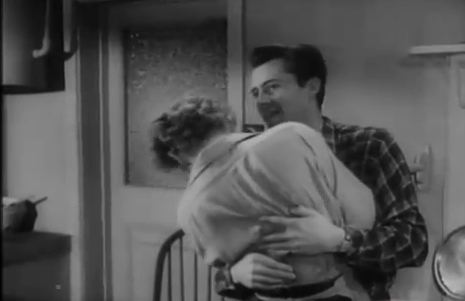
One day he catches Bogarde playfully pestering Alexis in the kitchen, trying to steal a kiss. Alexis is rattled at their being caught by her husband, and feigns the act of a virtuous wife on whom liberties have been taken. She demands an apology, and Bogarde plays along, apologizing. The scene gets more interesting when Bogarde leaves and Knox wants to know what brought the incident about, and Alexis fibs that Bogarde insinuated there is something romantic between Knox and his lab assistant. “He implied that you were neglecting me.” She does have not have the courage to confront the Doc herself, but we see this has been on her mind for some time.

The Doc does not deny it; the accusation is barely noticed by him, except with what appears to be faint amusement. Would Lab Assistant be amused at his amusement?  I wonder.  Instead he vacillates on whether to kick Bogarde out of their home now that he appears to be a danger to his wife, but the experiment is just too interesting to him. Perhaps if Alexis insisted he leave? She does not.

On another evening alone with Bogarde, they go to the jazz club again, and she’s having a blast. He is the responsible one, taking control, reminding her it’s time to leave. She doesn’t want to, and he daringly asserts that he’s “ready for a showdown” with her husband anytime she says.

His remark rebuffs her like a girl, but at the same time challenges her to be a big girl and decide what she wants. She can’t yet. A sudden, surprising fit of hysteria and she nearly knocks out the window of the car with a block of wood because she can’t open the door with her key. She drives like a maniac through winding country lanes, and then pulls over into a wooded copse to avoid the cops and let loose a crying jag, conflicted by her feelings and terrified at what is happening to her. Bogarde’s painful manner of closing his eyes when she wails, part concern, part relief, and part disgust, is one of his most eloquent actions. He’s creating a monster. He is just beginning to feel the consequences of it.

Meanwhile, the Doc, covering up for Bogarde again, pontificates, “All of us are capable of anything given the right provocation…in the dark forest of every human there’s a tiger -- a sleeping tiger.”

Tonight, it’s his wife.

While she’s beginning her downward spiral, Bogarde is being tamed by the Doc. In a climactic scene, the Doc finally penetrates Bogarde’s childhood torment over a father who abused him, and whose sudden death haunts him. Bogarde has a good scene here, breaking down and sobbing the story of his life. He feels comfortable at last to tell Knox because Knox has defended him time and again to the police and come to his rescue, supporting and nurturing him in a way his father never did. In case we miss that message, there is a melodramatic ending to scene where Bogarde swoons from the emotional effort and faints on the floor.

Alexis is surprised to see the Doc emerge from his office carrying Bogarde in his arms, taking him to his bedroom upstairs. The picture of father and son, or Pygmalion with a new Galatea.

We know from the fact of his subduing Dirk Bogarde at the beginning of the movie, which happens off camera, that Knox is a physically powerful man. Bogarde still bears the bruise on his twisted wrist. His first chastisement from Papa. When we see Knox carry Bogarde, it strikes us that not once in this movie has Knox ever taken Alexis in his arms.

We see there is a triangle here, not with the lab assistant, though she’s still in the ballgame. Alexis has lost her lover to her husband. They spend father-son fishing trips from which she is excluded.

She anticipates their homecoming excitedly, but only Doc comes home, and only because he remembered he has a paper to write. He did not come home to be with her, and Bogarde is distancing himself because he now thinks the Doc is a swell guy, and he feels guilty about luring his wife into cheating on him. She is more lonely now than she ever was before Bogarde came into their lives.

The Doc just gets more and more interesting. How much does he really know about their relationship? He declares Bogarde is cured. He confesses how hard his job has been, that as a therapist he is not supposed to show fear, dislike, or jealousy.

“Jealousy?” Alexis asks. Is she flattered that he might be jealous of Bogarde’s time with her? Or is she worried that he knows about her passion for Bogarde?

He suggests that he and Alexis should go on a vacation together. Earlier she would have jumped at the chance, but now she doesn’t want to leave Bogarde and she can’t tell the Doc that. What power over her does he have that she simply cannot ask him for a divorce? She becomes secretive and paranoid. She finds Bogarde at the inn where he is staying now and begs him to come back. “You’ve never seen me really angry. I warn you, you don’t know what I’m capable of.” It’s not a threat, it’s an intriguing, whimpered confession and is one of those elements in the script that gets dropped in but never explained.

But Bogarde is firm in breaking up with her because he just can’t hurt the Doc anymore. When he returns to their house to pack up his things, she finally rages at the humiliation to which he’s subjected her.

“You’re not going to give me notice like a waitress.” In her torment she has bit the back of her hand until it bleeds, finds the blood on her mouth. She’s gone over the edge. She staggers to the Doc, inferring that Bogarde became violent. Goads him into doing something about it, demanding some emotional response from him.  Doc goes for his handy dandy handgun in the desk drawer to avenge his wife.

Lab assistant tries to stop him (my heavens, this woman is always skulking around), but we hear the sound of a shot, and Alexis, shattered,

“You killed him?” she asks when Doc emerges from Bogarde’s room.

“That’s what you wanted, isn’t it?” The man of science. We see that it’s a trick. He never shot Bogarde. He wanted to jolt Alexis into confessing her feelings for him. How long has he suspected? This man never lets a chance pass to do an experiment, to “wind up people like little toys.” What must it be like to live with a man who turns every encounter with his wife into a psychotherapy session?

When Bogarde swooned to the floor, Knox cradled him in his arms. When his wife crumples to the floor in a sobbing, confused mess, he stands over her with probing questions and a shining light in his narrow eyes in what is probably the most cruel scene in the movie.  Doc is not a fiend, but his relentless clinical approach to everything has cruel repercussions.  They are both tragic.

Alexis bolts out of the house, now that she knows Bogarde has gone and there still might be a chance for her to catch him.

Finally…finally, we get some plot exposition from the lab assistant, who tries to keep Doc from going after her, “Let her go. It’s been wrong between you for years. You’ll never put it right.”

Whoa, about time, lady. Where were you in the first reel?

But what exactly do you mean? Riddles are pointless without solutions.

There’s a bit of a chase scene here, and the upshot is Alexis drives through what appears to be a circus billboard with a lunging tiger painted on it. She dies. Did I mention there would be spoilers?

I have a problem with the protagonist dying at the end of movies like this. Wages of sin and all, I know, but still, it smacks of laziness and the writer’s inability to find a resolution so it’s just more convenient to kill the character off.

We have no resolution for anybody, except that Bogarde intends to give himself up to Hugh Griffith to set things straight. But Doc expresses no emotion at the physical wreckage of his wife anymore than he did her emotional wreckage. Lab assistant, always prepared, remembers to grab his coat as they leave together for the chase scene. What is her story?

This is a film where the set decoration tells us much (or at least is supposed to) about the story and characters. We see that Alexis and Doc have twin beds in their room, but whenever she is in a bedroom with Bogarde it’s on a double bed. We get the message about Doc’s personality from his office. But the photos of Alexis all over the house are put there for what message?

In classic films I think we tend to know little about set designers, at least not as much as we know of costumers or cinematographers. In theatre they are immensely important because when it comes to deciphering a set, theatre audiences tend to be more sophisticated than film audiences. They know that everything on the set is there for a specific reason. The stage director hasn’t the luxury of a film director of soaking up a variety of images just by panning the camera. All he has to work with is this space.

Among classic film directors, I think Alfred Hitchcock was the most cognizant about this, the most theatrical, and obviously left his mark on every frame. You just know everything’s in the shot for a reason. Joseph Losey gives us as much as he can with “The Sleeping Tiger” in terms of imagery (including a couple of interesting mirror shots) -- again, which sometimes provoke more questions than answers, but some answers can only be provided in the script. And they aren’t there. We come to know all we need to about Dirk Bogarde, but the others in the original triangle -- Doc, Wife, and Lab Assistant -- are still beyond our reach.


The movie is one of a string of films made in this period about the mysteries of psychoanalysis, movies often lurid and fantastic, but in this case it’s interesting that psychology is used as the basis of a love triangle, and for manipulation. What Doc does is on purpose. What Bogarde does is on purpose. Only Alexis seems powerless, losing her grip on her emotions and on her thinking bit by bit until she destroys herself with her obsession.

As mentioned in Monday’s post, this movie is on YouTube here in a single file. Please go have a look, and when you’ve seen it, come back and tell me what you think. For once, we can all watch the same movie together. Pass the popcorn. And, as The Muppets say, no singing opera during the movie.

Monday, February 14, 2011

The Prowler - 1951 - Film Noir Blogathon

“The Prowler” (1951) was restored by the Film Noir Foundation. This post is part of the Film Noir Blogathon hosted by The Self Styled Siren and Ferdy on Films. The proceeds raised will be in support of the Film Noir Foundation. More on that at the end of this post.

We have come to expect certain stylistic attributes in film noir, though film buffs often argue about whether a particular film belongs in this category. “The Prowler” takes this genre, but seems to step just a little beyond it by carving out its own world, and playing by its own rules, just as the main character does, played by Van Heflin.

Van Heflin is a marvel in this film. He plays a man capable of being both a lowlife, and yet one who captures our fascination, perhaps even our admiration for his dogged grasping at his idealized goals, and certainly at times, our pity for his helpless bungling of his life based on his miserable inability to understand that integrity would save him in a way purchasing or stealing respect, or killing for it, cannot.

The movie plays out as an intriguing puzzle where layer upon layer peels away until we at last see the characters as bare and raw in the harsh glare of the desert landscape of their final showdown. Being film noir, the movie appropriately begins by putting the characters and us, in the dark…in Southern California, probably Los Angeles, at a Spanish-style home in a wealthy neighborhood in the wee hours of the night.

Evelyn Keyes is the wife whose husband works as a nighttime DJ. Home alone, she emerges from her bath to discover a peeping tom at her window. Two cops respond to her call, one older, genial, who tells her to pull her window shade down when she’s bathing. Duh.

The other is younger, somewhat bored, with smirking arrogance, played by Van Heflin. After his shift is over, he returns to her home by himself, just to follow-up, he says. But we see very quickly his nervy attitude as he makes himself at home, and we piece together, though it is never said in the film, that he was the peeping tom. She has no idea. Instantly this breaks the Code rule that police should not be shown in a disrespectful light. Bullying cops or crooked cops are one thing, but a cop pervert is more evil. What is amazing is how we gradually learn more about him so that he does not seem like such a danger, even when he is.

Evelyn Keyes is quick to invite him to stay, but though we may think her foolish, there is such subtlety to her performance that she walks a fine line between being a naïve victim and a woman simply going after what she wants.

She responds to his intrusive questions and insinuating conversation with the haughty defense that she is happily married, and we see she devotedly listens to her husband’s radio program at night. Her name is Susan, and he signs off with his trademark, “I’ll be seeing you, Susan.”

While her husband spins his 78’s, whatever alarm bells she may feel at the cocky cop’s leering attitude seem to dissipate instantly when they discover the coincidence of their both growing up in Terra Haute, Indiana, where he was the star of the rival high school’s basketball team. This is the only accidental device used in the film, and their winsome dual reminiscence of high school days is so genuine, it does not seem as contrived as it is.

It also lays the groundwork for his character. He was a gifted athlete, but lazy and not a team player. Because of his unwillingness to put himself out or work with others, he is bounced off the roster and loses his college scholarship. He laments this as a raw deal done to him, taking from him the eventual cushy high-paying job that he thinks a college degree would have given him. He came to California, (though we are not told how or why) and fell into a job on the police force, which he dismisses with disgust, though we might also believe he must have felt the uniform, and the gun allowed him an outlet for his swagger.

Another layer is peeled back, and they are companionably visiting on successive evenings while her husband is on the radio. She offers Heflin cigarettes, but says her husband keeps them locked in the desk, and allows Heflin to try to pick the lock with a hairpin. Lots of Freud here, but I think we get it. Her husband’s will is also in the desk, and later we learn that when her back is turned, Mr. Heflin reads it and discovers her husband’s worth, which is considerable.

Another layer peeled back. Her husband is older, and only works as a DJ for a lark. He is possessive, locks up his things, and her. She married him after a failed acting career because he seemed decent and could offer her security. She also wanted children, but he could not give her that.

While Keyes and Heflin talk, the large console radio plays in the living room, and it represents her husband’s presence. His voice follows them like a conscience. In this atmosphere, Van Heflin’s rough attempt at seduction fails and she orders him out, but we see she is less disturbed about him than she is about her own desire. He senses this too, and cleverly returns the next night apologetic, kindly, and they talk about good old high school days again, and high school dances. They dance in her living room to the record her husband plays.

This time, Heflin’s seduction is successful, and we have the panning shot from them cozy on the couch, to his police officer’s cap resting jauntily on top of the radio console. Her husband announces the song title, “Stolen Fun.”

Things move faster, start to become slightly chaotic, when Mr. Heflin invites her to join him on his two-week vacation in Las Vegas. He tells her there is a motor court there he always visits, hoping to own it himself one day. She tells him she won’t go with him because she feels guilty, her husband suspects, and she breaks it off.

Next we see Van Heflin in his dingy one-room apartment, and on the wall, a police gun range target he was presumably allowed to keep as a trophy, because he won a medal in marksmanship. The target is the silhouette figure of a man with a clump of bullet holes at his heart.

Evelyn calls him on the phone a couple times, desperate to see him, but he seems uninterested now. There’s a nice bit where as Van Heflin speaks to her, he scratches his cheek with the mouthpiece of the candlestick telephone, brooding and bored. He wants to break off with her. Or, is he just reeling her in? She shows up shortly afterward, telling him fearfully that she asked her husband for a divorce, and he refused. Her husband says he will kill her before ever divorcing her.

But Heflin staves her off with gentle, noble logic that they’re not good for each other and that he thinks they should break it off for the good of everyone. They stand side by side, gripping the footboard of his bed, holding onto it like a railing for support, as they say their goodbyes while absently staring down at his bed.


When she leaves, resigned to her unhappy marriage, he flops on his bed and tosses a clump of paper into the bowl-shaped ceiling light fixture with a light heart and a sense of victory, like when he was a high school basketball star. Two points!

Is he glad to be rid of her? Or does he have a plan?


Another layer is peeled away. He shows up at her house in the middle of the night and sets a crime scene as if a prowler had been trying to get into the house. The noise lures her husband outside, in his bathrobe and carrying his own gun, which Heflin anticipates. The marksman kills the DJ.

At the inquest, Miss Keyes is distraught and confused, and with a sense of guilt over her affair, dramatically accuses Mr. Heflin of murder, but she withholds from the court her relationship with him. He is found not guilty, by reason of shooting in self defense.

His plan is thus far successful, but it’s not over. Now he has to woo her, and her husband’s money, back. He takes the interesting route of appealing to her brother-in-law, who is a local pharmacist. Van Heflin pretends to be grief stricken, tells him he has quit the force, and offers his financial help to the grieving widow, asks that the brother-in-law relay this message to Miss Keyes. The dead DJ’s brother, played by Emerson Treacy, is impressed with Heflin’s phony integrity, and sets up a meeting between them.

Mr. Treacy’s wife, by the way, is played by Madge Blake, who among other minor film and TV roles you may best remember as Larry Mondelo’s hapless, forever fretting, and hilarious mother on “Leave It to Beaver.”

Mr. Treacy does one other thing for Mr. Heflin, and us -- he confides that the marriage between Miss Keyes and his brother was not a happy one, and reiterates that his brother was not able to sire children. This is planted for us to remember later on.

In another marvelous and quite long scene, Van Heflin appeals to her in her living room, while the records play from her husband’s vast collection, and convinces her that the shooting was an accident and he is remorseful, that he cannot even bear to look at a gun again.

They are married. It didn’t really take much convincing.

For the honeymoon in Las Vegas, they head to the very auto court he once dreamed of owning. Now, thanks to her husband’s money, he does.

He is vastly pleased with himself, boyishly enthralled with his combination new business and home. It represents easy money to him, and also respectability in the community. It is a fine combination of comedy and pathos that a man so slick and conniving could be so in love with a cheaply built post-War motel on a highway where traffic barrels outside his door day and night, and the lurid glare of the vacancy sign blinks in the window. This is earthly bliss to him. A man who wants class, and has no idea what it is. A man who wants respectability, and has no notion of integrity. A villain we grow to pity.

His pleasure in this setting is one of the twists and turns of this film that keep us glued and amazed. Van Heflin is not just the creep he seemed at the beginning of the film. He is that, but he’s also vain, resentful, charming, ruthless, and tragically yearning for his days as a high school hero.

Evelyn Keyes is almost as big a collection of contradictions. We may marvel that she was fooled by this guy at every turn. We may find it odd that she would come from a fine home in a wealthy neighborhood, albeit leaving behind the memory of an unhappy marriage, to seemingly share Heflin’s joy and triumph in a manager’s apartment in a motel. She is many things, naïve, lustful, and human, and there are times when we suspect she must be the jaded female, or the femme fatale because that would make sense and explain her actions, but she never quite reaches that, and I think that is what makes her character sympathetic. In her way, she is as much a dreamer and a bungler as he is.

Then she drops a bomb on him. It is their wedding night, and she is four months pregnant.

At first, his reaction is sweet and emotional. He looks humble and pleased, and clutches her, and cries. Another layer is peeled.

Then after a moment, he pulls away, and we see a duality to the tears. His mind is working. He realizes, and eventually she does, too, that it will become known that they were lovers while she was still married, because it is known by others that could not have gotten pregnant by her late husband. She lied at the inquest and said she had never seen Heflin before. He lied, too. The investigation would probably be re-opened and they would both face the consequences of perjury. He would face the gas chamber for murder. Suddenly, a siren blares by on the highway, and they shudder. It is only an ambulance for someone else, but it’s a moment of conscience.

They toss around ideas about what to do, then decide to leave the auto court in the hands of the gum-chewing front desk receptionist, and take long honeymoon, say about five months, out in a lonely desert ghost town.

His former police partner, played by John Maxwell, is a rock hound on his time off, and has described for Heflin trips he has taken with his wife in the desert to hunt for geologic specimens. Mr. Heflin remembers something about an old ghost town where they can hide.

The final scenes of the film take place in a wind-ravaged, sun-bleached barren landscape, where Mr. Heflin and Miss Keyes set up housekeeping in a tumbledown shack. Here, the movie reminds me very much of a kind of “Twilight Zone” setting. Like an episode about the end of mankind except for a modern-day Adam and Eve surviving a nuclear holocaust.

But, they are just on the lam, and they seem strangely contented, as if this dirty shack in the middle of nowhere offers them a chance to start a new life better than the motel would.

She putters at housekeeping in her maternity top. He wipes the dust off his new Cadillac, as if he were a suburban husband Simonizing the car in the driveway of their three-room ranch. It is comfortably familiar, and yet very, very strange. They are away from civilization, that thing that makes life complicated and lousy, and yet they bring civilization with them. It is only natural.

He rigs up the portable record player to a car battery, and they have their music. While the record plays, they stroll contentedly out a few yards from their shack and admire their vast, barren, and private world.

Then they hear her dead husband’s voice.


It is a demo record he made of his radio show that got mixed up with the albums. Heflin and Keyes are horrified, and she runs back to grab the needle off the groove, but too late. He gives his signature sign-off in his announcer’s oily voice,

“I’ll be seeing you, Susan.”

It is a truly creepy moment.

He’s not the only one to interrupt their honeymoon. Van Helfin’s former police partner shows up like a busybody neighbor. Keyes goes into labor. Heflin is genuinely frightened for her, and though they had planned to deliver the baby themselves without help, he panics and brings back a doctor. The lonely desert is suddenly busier than Grand Central.

Keyes, not really a femme fatale, and not really a naïve fool, and not really in love with her late husband, becomes something definite, finally. She sees Van Helfin has brought his old service revolver, this man who said he was sick of guns, and the penny drops. She knows he will kill the doctor to prevent him from reporting the birth, or his suspicions to the police about the odd couple in the desert.

She decides to get off the merry-go-round, and becomes a hero. When the doctor shoos Van Heflin out of the room (it’s the 1950s and a husband can’t be present for the birth of his child), she takes the moment to spill the beans to the doc, tells him to high tail it out for his own safety, and take the baby with him.

Which he does, and when an astonished Van Heflin sees the doc has escaped and his wife has betrayed him, he frantically searches for another way out before the police get here. He bitterly defends himself to his wife with tears in his eyes:

“So what? So, I’m no good. But I’m not worse than anybody else. You work in a store, you hock down on the cash register. A big boss, the income tax. Ward heeler, you sell votes. Lawyer, take bribes. I was a cop. I used a gun.”

The stuff of film noir. Bad mistakes. Getting trapped. Disillusionment. No way out.

Perhaps not so coincidentally, the three men most responsible for this story were similarly disillusioned and looking for escape. Dalton Trumbo, the gifted screenwriter who in just a couple years would turn out the enchanting “Roman Holiday”, but would do it under a fake name, had taken himself off to Mexico to wait out the frightening years of the Black List. One of the infamous “Hollywood Ten”, Trumbo served several months in prison for contempt of Congress, and took himself and his family out of Hollywood for the better part of the next decade, but still slipped scripts over the transom, so to speak, under other names. His name was left off the credits of this movie when it opened. His presence lingers, though. That’s his voice you hear as the DJ husband on the radio.

The other screenwriter for this film, Hugo Butler, also took it on the lam to Mexico when he was blacklisted. The director, Joseph Losey, fled to England to avoid being questioned by the House Un-American (such an ironic name for this group) Activities Committee.

Film noir is a style sometimes replicated today, but in its heyday served as an illustration of post-war societal fears and repression, angst and disillusionment that shows us a bit of our own popular culture and history. The Film Noir Foundation’s mission is “to find and preserve films in danger of being lost or irreparably damaged, and to ensure that high quality prints of these classic films remain in circulation for theatrical exhibition to future generations.” We can thank them for the restored issue of “The Prowler”.

You can thank them some more, and continue their work on other noir films, by donating to the Film Noir Foundation.  And visit the other blogs participating in this noir blogathon. You’ll find a list of them at The Self-Styled Siren, and Ferdy on Films.

Related Products