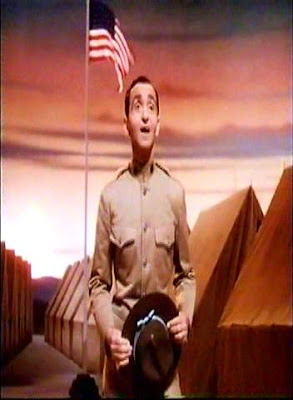
“This is the Army” (1943) is considered not quite as timeless for modern day audiences in comparison to other World War II-era films, like maybe “Casablanca”, made in the same year. In some spots you could say it’s a sticky mess. It has a single one-note message of cheerleading. However, this film contains an array of ironic images and symbols to consider.
It is also valuable for demonstrating that irresistible urge for nostalgia we sometimes have that only glosses over what really was, and turning the previous era into a cartoon, further diminishing our ability to really empathize with it. In “This is the Army” this happens with the characters’ (and director’s and producers’) bemused attitudes toward World War I, which is treated as something quaint. The message of tragedy in earlier films like “All Quiet on the Western Front” (1930) is diminished with an almost “those were the good old days” attitude. Watching the film with today’s perspective, this bemused nostalgia repeats itself with our similar attitude toward World War II and the generation that made this film.

We mark yesterday’s observance of Veteran’s Day with this film because like Veteran’s Day, “This is the Army” tends to make opaque our view of World War I, just as Veteran’s Day has supplanted Armistice Day. There was even a move some years ago promoting shifting Veteran’s Day to a Monday holiday in the tradition of our other Monday holidays, but protest prevented this, and this day that recalls the end of World War I remains as it has always symbolically been, on the 11th day of the 11th month, when at the 11th hour in 1918, the War to End All War ended. Even if it did not end war.
“This is the Army” is a musical review, a biography not of a person, but of a play, of a unique theatrical experience. In World War I, songwriter Irving Berlin produced a camp show fundraiser for Camp Upton in Yaphank, New York, a village on Long Island. The entertainers in the show were all soldiers, and this musical variety hodgepodge of singers, dancer, comics, and various novelty acts went on to the Great White Way. After that, it was on to Europe. When the war ended, the show, called “Yip, Yip, Yaphank” would have remained nothing more than a footnote in theatrical history, except that it was revived, in a huge way, for World War II.
Irving Berlin was also involved in this new production, pulled out his old songs, gathered some new ones, and some new soldiers, and put on the new Broadway show, “This is the Army” at the Alvin Theater (now the Neil Simon Theater). After touring, the idea, and much of the cast, went on to Hollywood.

Hollywood required a bit more than a song and dance review, so these numbers were strung together by a thin plot. George Murphy is a hoofer who gets drafted into World War I. George Murphy played another hoofer who was a doughboy in World War I in
“For Me and My Gal” (1942), seen in this post. He just had that kind of face, I guess, that belonged to Tin Pan Alley and the trenches. George Tobias (you might remember him better as the long-suffering neighbor Abner Kravitz on the television show “Bewitched”), and bugler Charles Butterworth, are a couple of his pals who all perform in the show “Yip, Yip, Yaphank.”

Fast forward to World War II. Ronald Reagan is George Murphy’s son, who is sweet on Joan Leslie, Charles Butterworth’s daughter, but Reagan is hesitant to marry her because he has been drafted and does not want to leave her a war widow. She spends the rest of the movie trying to change his mind. The old-timers set up a new show, the Army approves, yanks men out from various units, and they put together a new Broadway review called “This is the Army,” stage-managed by Reagan.
The movie is like a crazy quilt of images, but no coherent message except one of patriotism, and one of unintentional irony.

The World War I segment of the film shows us an immigrant neighborhood with hurdy-gurdy music and fruit stands, a cliché of a simpler world. It depicts that dramatic real-life moment when the men ended the stage show “Yip, Yip, Yaphank” one night by filing out of the theater and marching directly onto the troop ships when they received the call to go overseas.
“That’s not the way they rehearsed it!” Rosemary DeCamp cries, “It’s real! They’re going!”
Then we follow the boys to that mysterious location always called in movies “Somewhere in France”, where back lot trenches are exploded, and after George Murphy’s leg is permanently injured, the Armistice is signed, the world now safe for democracy.
Then the World War stopped being that penultimate and almost holy experience when it stopped being the World War and became World War I by default.
This movie, made in the troubled year of 1943 when the Allies had not made much headway to defeating the enemy, treats the current war as the penultimate experience, where sacrifices are honorable, and the ecstasy of duty in the young ones is observed with sad knowledge by the old-timers.

The only bridge between the two eras we are given is the bombastic Alan Hale as a drill sergeant in both wars, who provides stern warnings and comic relief. He is as stalwart as the Republic he serves, and just as horrified by change. But he changes. He goes along with the tide because it is for the greater good. Including dressing like a portly maiden in a chorus number.

Frances Langford stops by for a song. Some of the film’s striking images include Kate Smith singing, “God Bless America”, which Irving Berlin threw out of “Yip, Yip Yaphank” 25 years earlier and revived for this show. It became Miss Smith’s signature tune.
Irving Berlin himself sings “Oh, How I Hate to Get Up in the Morning” in a WWI uniform and his thin, raspy voice. This beloved little man who took Tin Pan Alley lyrics and molded love songs to his adopted nation brings tears to one’s eyes at the very sight of the fragile little guy.
The juxtaposition of the minstrel show scene and the scene by African-American soldiers performing a song called “What the Well-Dressed Man in Harlem Will Wear” is a strange but telling segment in the film.
First, it could be noted here that the men who performed in this stage show that came to Hollywood were all active servicemen. Most were uncredited in the film, but we know that future stars Private Gary Merrill, and Richard Farnsworth were among them. The black performers, including Sgt. Joe Louis (who, as the World Heavyweight Boxing champion was the leading celebrity of the group and the most famous cast member black or white) were also all soldiers. This stage show, made into a movie featuring a cast of actual servicemen, was technically the only de-segregated unit of the Armed Forces during World War II.

The minstrel segment was a part of the original “Yip, Yip, Yaphank” and Irving Berlin wanted it kept for the new show, despite attempts to persuade him that such entertainment was passé. The “Mandy” number performed by white men in blackface could have been performed without the minstrel makeup (as it was in "White Christmas" 1954). Performed with pretend glamor like something from a Ziegfeld show-stopper, it seems less exaggerated than the buffoonery of this scene in
“Holiday Inn” discussed in this post.
When the men rush offstage, a pleased George Murphy says, “And you kids were worried about a minstrel number being too old fashioned. Why, it went just as well tonight as it did in the old show.” The words sound a bit hollow. This line might have been thrown in to appease Mr. Berlin, but the following number shows that if the minstrel scene wasn’t as painful to watch as the one in “Holiday Inn”, it was certainly made irrelevant by what followed.

The black soldiers come on next with the swing rendition of “What the Well-Dressed Man in Harlem Will Wear” referring to Joe Louis punching the bag in his Army uniform. It is a patriotic offering, (Joe says, “I’m in Uncle Sam Army, and we on God’s side.”) and the men dance and sing in their uniforms, all with great energy and soldierly precision. These men are not goofing around, they mean business, and that is their message.

A later number set in a stage door canteen appears to be the only scene in which the white soldiers and the black soldiers appear together. That their musical numbers are separate through most of the show may have a message, too.
Another curious image is of the soldiers performing dressed as women. For practical purposes, the men, just as in Shakespeare’s day, had to perform women’s roles because women were not part of these all-male units. If the armed services were segregated by race, they were also separated by gender.
In some numbers the “women” are buffoonish, intended for comedy, and in other numbers they are meant only to represent females. One of the old-timers in the audience remarks to an officer sitting near him, “That’s my son, the fourth from the left.”
The officer replies affably, without a trace of sarcasm, “Very pretty, isn’t he?”
He is quite pretty.

In the number performed by the African-American soldiers, one man likewise plays a woman, jitterbugging with another soldier. Then we see him rush off to wings, where he hurriedly strips off his dress and returns in uniform, completing the row of soldiers tap dancing in unison, as if to reassure us this business of dressing as women is all a matter of course.

The most startling scene of cross dressing comes when two men impersonate the stage actresses/divas Jane Cowl (for more on
Jane Cowl’s run-in with James Stewart in Boston, see my post at Tragedy and Comedy in New England), and Lynn Fontanne.

These two men are not just putting on dresses and clowning around. They are female impersonators, and they are very good. In a movie that is otherwise rather naïve and simplistic, this is a stunning bit of sophistication, one most of us might not expect from films of this era.
Back to the raspy-voiced Irving Berlin, of whom it was famously said, “Irving Berlin IS American music.” Is the movie valid for purposes of our study today as an expression of patriotism during World War II? It evidently was considered so once, as this was the highest grossing film of 1943, extremely popular despite quickly becoming a museum piece. It moved people to do great things at the time.
Joan Leslie gets The Speech about what we’re fighting for at the end of the movie, still haranguing Ronald Reagan (actually reserve officer Lieutenant Ronald Reagan in real life) to marry her, telling him that his fear of leaving her a widow is not a reason not to live the life they have together now,
“Why do you act like we’ve lost the war?” Such a horrific slap in the face back in the day.
Perhaps the film’s most ironic image is its finale, where row upon row of soldiers sing with heroic determination that “this time is the last time”, a reference to the Armistice of 1918 that didn’t stick, and that they would remedy, “So we won’t have to do it again.”
They could not have known there would be an armistice for the Korean War ten years later, and a withdrawal from Vietnam, and other geopolitical compromises necessary to fighting so-called “limited” wars of the future.
If it was a “last time” for anything, it was the last time for segregated armed services.

“Then we’ll never have to do it again” they sing lustily as they march off stage.
They seem to make invalid the World War by their bold declaration, relegating the World War to clichés and a scrapbook of silly songs about the Kaiser, men in old fashioned uniforms, and the assumption of a generation’s naiveté. Like the double image of Veteran’s Day over Armistice Day.
But, what goes around comes around. When today’s young people were interviewed about what they knew of World War II at the time Ken Burns’ documentary series premiered on public television (
see my post on Burns’ The War here), they demonstrated a condescending dismissal over what they viewed as that generation’s naiveté.
One of the most striking elements of Ken Burns’ documentary series on World War II is the absence of the use familiar popular images we have of the war, which mostly come from the movies. Perhaps the movies of that era are what give today’s younger generations the impression of a more simplistic, naïve people. Hopefully, watching Burns’ excellent series taught them better.
“This is the Army” is not meant to objectively document an era; it is pure cheerleading. Despite this, it does manage to document quite a lot, and one may wonder about how Irving Berlin could have thought “God Bless America” a dud of a song in 1917? It sprouted wings during World War II. It enjoyed an emotional revival after 9/11.
One may wonder about the desegregated entertainment unit in a segregated Army.
One may wonder about the distant shot of an actor playing President Franklin Roosevelt in the theater balcony box (after a stirring rendition of “Hail to the Chief” at his entrance), who is shown being able to stand and sit easily. This was not something FDR could ever do without help, and demonstrates that in 1943, the extent of his paralysis was not known to the general public.
One might consider that Irving Berlin was awarded the Army’s Medal of Merit by General George C. Marshall at the direction of President Harry Truman in 1945 for “This is the Army.” He was awarded the Congressional Gold Medal by President Dwight Eisenhower in 1957, and was awarded the Presidential Medal of Freedom by President Gerald Ford in 1977 for “God Bless America.”
Kate Smith was awarded this same honor for her rendition of “God Bless America” in 1982 by her former cast member in “This is the Army”, now President Ronald Reagan.
Many of the men who performed in this unit gathered for reunions over the years, the last was for their 50th reunion in 1992 in New York’s theater district. How valid was this movie to them?

Seventeen years after that last reunion, another November 11th goes by, for another generation of veterans, who in yet another generation’s time may suffer the humiliation of being regarded as quaint.
For more on the story of this Army unit that performed around the country and around the world during World War II, have a look at this
excellent four-part article at the National Archives website by Lawrence Bergreen, who uncovered a great wealth of detail on this unit when writing a book on Irving Berlin.


