IMPRISON TRAITOR, PEDOPHILE, AND CONVICTED FELON TRUMP.
Showing posts with label Robert Preston. Show all posts

Wednesday, May 4, 2011

Union Pacific - 1939


“Union Pacific” (1939) is a Cecil B. DeMille spectacle on the joining of the transcontinental railroad, making this great big country a little smaller, or as it is said, uniting the country “with a wedding ring of iron”.

No longer did passengers need to suffer the dangers of a prairie crossing in a Conestoga wagon, or round Cape Horn in a six-month sea journey around South America to get to the west coast of the U.S. It seems we have Barbara Stanwyck and Joel McCrea to thank.

Miss Stanwyck plays the daughter of a train engineer on the Union Pacific. She holds court in the caboose as the postmistress for the workers laying track. She reads their letters to Irish immigrants, like Regis Toomey, who are illiterate.

As it is said of her, “She belongs to the railroad, although you’d think the railroad belonged to her.”  She uses an Irish accent in this film, which is pretty credible when she holds onto it, but she seems a bit self-conscious in this movie, as if trying to hold onto that accent is taking all her concentration.  She seems much less natural and relaxed than in other performances.

One of the film’s stunning images comes at the very beginning when we see her standing precariously atop the car of firewood on the moving train, bringing her engineer father, played by J. M. Kerrigan, his dinner pail. They lovingly verbally abuse each other in the manner of Irish families.

Our first glimpse of McCrea is a dramatic ride on horseback to catch up to the moving train, leaping onto the platform.  His character doesn't go through a lot of change or development in this movie, but his low-key heroism is always a pleasure to watch.

Joel McCrea is the other “Captain Butler” of 1939, an ex-soldier from the Civil War now on security duty for the railroad, keeping crooks like Brian Donlevy in order. Robert Preston is McCrea’s old army buddy, who is now in league with the evil Mr. Donlevy.

Preston is years, maybe light-years we could say, away from his future movie stardom as a happy go lucky flim-flam man, but he has his roots here as the charming ne’er do well in a pencil-thin mustache. He competes with Mr. McCrea for Miss Stanwyck’s affections.

One of the fun things about this movie is spotting (or at least reading credits on the IMDb site) all the minor characters and extras who found a job, for only minutes, on this movie. They include Ward Bond, Lon Chaney, Jr., Monte Blue, Will Geer -- who most of us remember more as the grandfather in “The Waltons” television series, Anthony Quinn -- the director was his father-in-law, Evelyn Keyes, and Bert Stevens, who was Barbara Stanwyck’s real-life brother.

Better known character actors like Lynne Overman and Akim Tamiroff play Joel McCrea’s sidekicks. They supply a bit of comedy relief, but with an unusual courage and capability not often granted to sidekicks in the movies. They are shrewd, sensible, and protect McCrea’s back on repeated occasions. He would be dead several times over if it weren’t for them.

Henry Kolker plays the crooked banker whose plans to scuttle the Union Pacific provide much of the plot. He played a lot of bankers, and you might remember him as Katharine Hepburn’s stuffy banker father in “Holiday” (1938).

Nameless are the scores of real-life Navajos playing the Indians who contemplatively watch the smoke-belching iron horse tear across the wide open landscape, who in other scenes, attack the beast with ineffectual courage against the passengers who fire at them with rifles. In a one scene they wreck a train and pillage its contents, causing anxiety for McCrea, Stanwyck, and Preston, who are trapped inside trying to hide. The idea that these three could send a Morse code message by tapping an electrified wire on the barrel of a shotgun pre-dates any of “MacGyver’s” antics by decades.

I’ll not do a play-by-play on the plot. Cecil B. DeMille was a showman, and what is most powerful about this film are the showman’s images, not necessarily the story (which has so much action and so many arcs it seems like a several-part serial shown all at once). We pretty much know who the good guys are, who the bad guys are, and in the mire of stereotypes, there really aren’t too many surprises.

Oh, the train wrecks are startling, but not really surprising. I think we expected them.

The images tell stories all on their own, quite apart from the plot. Those Native Americans watching the train thunder by, the one warrior on his pinto pony that rears up at the precise moment. It reminds one of those 1940s or 1950s magazine advertisements for the Santa Fe “Chief”.


Though the movie was filmed in many western locations, much of the interior work in the cars was obviously shot in the studio, though the rear-screen projection of the desert with distant rocky spires and buttes that slides on by us out the train windows is done pretty well. The train cars rock and sway as Barbara Stanwyck walks through and tenderly replaces the bonnet on a sleeping woman, and the top hat on a snoozing gent, careful to tuck his train ticket in his hatband.

The scene with the heard of bison roaming around Stanwyck’s and McCrea’s solitary handcart looks a bit more artificial, technically. Unlike the Sioux that look so picturesque watching the train from their ponies, there is no sense of foreshadowing of doom for the bison, though we know most of them were decimated by white hunters shooting them for sport, often right from trains.

There is instead the distasteful scene when one of Donlevy’s henchmen, played by Harry Woods (not Robert Barrat, thank you Caftan Woman), takes up a bet with Anthony Quinn that he can shoot an Indian for sport out the window of the train.

The warrior who rides along the train waves, and we see him smile, as if he is playfully challenging the train to a race. The bad guy takes his rifle, and, shockingly, murders the happy rider instantaneously. There is much less destruction in this instant than the later train wreck(s), and yet it is more heartbreaking. We hear the sounds of shock and anger from other passengers, the disdain over their complaints from the bad guys, “What’s one more dead Indian, more or less.”

Joel McCrea slugs it out with the murderer, while his sidekicks keep boss Donlevy and the other henchman at bay. Mr. Tamiroff is pretty handy with a bullwhip.

The murderer falls off the train platform. We see him roll in the dirt, and the train pulls off into the sunset, becoming smaller and smaller while the land gets bigger and wider, with the lone figure standing in the foreground. He is made small and insignificant in the shot, now that the train has pulled away, and tension builds as he is also probably in danger from the warrior’s tribe when they catch up with him, alone and unprotected.

The train is a world unto itself, and when it leaves in the distance, it takes civilization, protection, and companionship with it. But, the is not a very comfortable world, the hard train seats, the soot and smoke, the days on end of riding a swaying, narrow wooden box across an enormous wilderness.

The train heads for “end of track” where still another world is set up. Donlevy’s gambling house and saloon is there to lead the track workers astray. The supplies for track building, and everything needed for a temporary town, are hauled in, and Stanwyck sets up her post office in the caboose. End of Track is like Oz, but a whole lot less pretty and dream-like.

Back to the train wreck that imprisoned McCrea, Stanwyck, and Preston -- another dramatic image is when Stanwyck turns her back to the gentleman to pray for their salvation, and McCrea points his pistol at the back of her head, ready to do a mercy killing to keep her from getting captured or tortured by the Indians. A very eerie shot.

At the final moment, they are saved -- by another train. Trains are the real heroes in this movie, Joel McCrea notwithstanding. Even the U.S. Cavalry that comes to their rescue arrives by train.

In this world where the train is everything, the most iconic image, of course, is the final Golden Spike scene, where a bit of humor is injected when conniver Henry Kolker, having been forced by Tamiroff and Overman to pay for his evil deeds by driving spikes with a sledgehammer until he’s surprisingly gotten very good at it, does the honors.

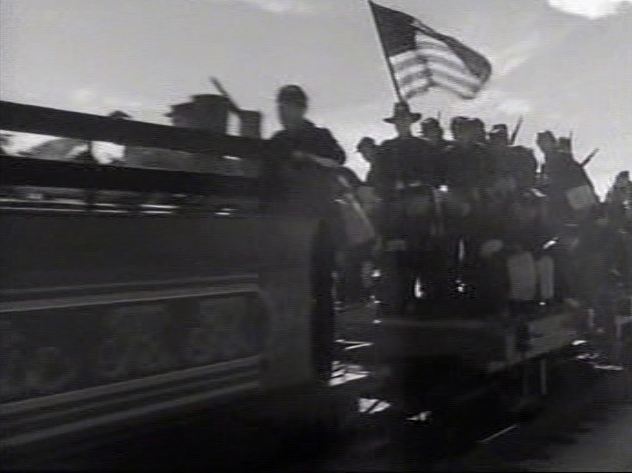
The two trains meeting nose to nose is as familiar as any image we have of 19th century America, of the West, and of the post-Civil War era when uniting North and South seemed more troublesome than uniting east and west. The throng of people climbing on the engines, the dignitaries in their top hats, the photographer and his bulky camera on a tripod to catch what everyone at the time knows is going to be the most historic event of their lives.

I first remember seeing this movie when I was quite young, perhaps as young as 8 or 9 years old, and as the movie played, tracing with my finger the route of the Union Pacific on a map of the U.S. Some place in Nebraska called Omaha to another place in Utah called Ogden, about four inches away. I sat on the floor with the coffee table as my desk. I think it was a Saturday afternoon, and I can still recall the play of afternoon sunlight, with one strong beam splashing on the map from the window behind me, so strong a light I could see the dust in the air.

I understood nothing of the history or the politics in the plot of the movie (even Ulysses S. Grant shows up at one point), but the images were easy enough for even a child to grasp. Maybe that’s what Mr. DeMille really excelled at, a simplified but still dramatic image. Most of his epics have more splash than depth, but they are eyecatching.

This post is part of our celebration of National Train Day, this Saturday May 7th. The train has an unusually iconic place not just in our history, but in classic films. This movie, throughout the jumble of carnival showmanship, imagines how important the train was to a 19th Century America with growing pains. It also shows Hollywood’s love of the train as a set, as a metaphor, and as a plot device.

It ends with a swell of patriotic music and a shot of a modern streamliner roaring past the camera.

Trains would continue to be important to America in the first half of the 20th Century, and to the movies for the first several decades of the film industry. Come back Thursday when we’ll have a look at “The Narrow Margin” (1952), which shows the other end of the romantic timeline of the train in American history and American film. It’s a sleek, modern train, faster and more elegant. There are no pioneers on this trip, even though it’s heading west to California, but there is plenty of danger, and almost all of it is on board.

And have a look here for National Train Day this coming Saturday.

Thursday, February 3, 2011

The Dark at the Top of the Stairs

“The Dark at the Top of the Stairs” (1960) gives us a curious mix of cozy nostalgia skewed with a foreboding modern world of alienation.

Thanks to Kate Gabrielle over at Silents and Talkies, I was able to finally see this movie. It doesn’t seem to play on TV much, and I don’t think it’s out on video or DVD. Maybe some of our readers can fill in the blanks on that info.

The film, set in the early 1920s, resonates today with problems of technology eliminating jobs, and the strain on marriage caused by the struggle for money, a lack of communication, and a lack of satisfying sex. But mostly money.

Robert Preston plays the middle-aged traveling salesman whose world is crashing down upon him. His products are horse harnesses and accoutrements, but even he, like most of his customers these days, are driving flivvers. The horse-drawn conveyance business is drying up, and here in small-town Oklahoma, a new world is on the horizon, literally. Oil rigs are going up on lonely farms, and a new era in transportation, and in the American economy, is beginning. Mr. Preston is laid off.

There are a few elements that make this quiet film, based on William Inge’s stage play, quite compelling. One is the serendipitous fact that Robert Preston had just come off Broadway in another hit, “The Music Man”, and was slated to star in the film version. Preston’s indifferent career really took off after the “The Music Man” a role which he was offered apparently only because just about everybody else turned it down. It proved to be his making.

Because of his enormous success in that musical, which today we know continued with the film version, this other traveling salesman character he plays in “The Dark at the Top of the Stairs”, sandwiched between “Music Man” gigs, makes his role as Rubin Flood, downsized harness salesman, seem like a Bizarro World version of the larger than life scamp, Harold Hill. It is impossible not to compare them when watching this movie.

Here, Preston is married to Dorothy McGuire, a sensitive, genteel woman, a warm supportive mother, but whose serenity is shaken by her frustration at being trapped in a helpless situation. It’s the kind of role Dorothy McGuire could play with one hand tied behind her back. The other compelling aspect to this movie is the several strong female roles that give us the range of the “woman’s world” experience in 1920s small-town America. They are played with a vengeance by Miss McGuire, by Eve Arden as her pushy sister, and by Angela Lansbury as the local beauty parlor operator and “other woman”. I don’t suppose the business, as well as the art, of casting a movie is given enough attention by old movie buffs, but whoever made the decisions on putting together the lineup for this team hit a homer.

We might also consider that this movie made in 1960, a time when the “greatest generation” of film stars were losing job opportunities due to their regrettable habit of aging, gives us a chance to see experienced actors and actresses in meaty roles. Had the movie been set in 1960 and not 1920s, would they have still seemed appropriate (marketable) for their roles by the producers? One might wonder if since these stars were leftovers from the Golden Age of Hollywood, did that make them seem old-timey automatically?

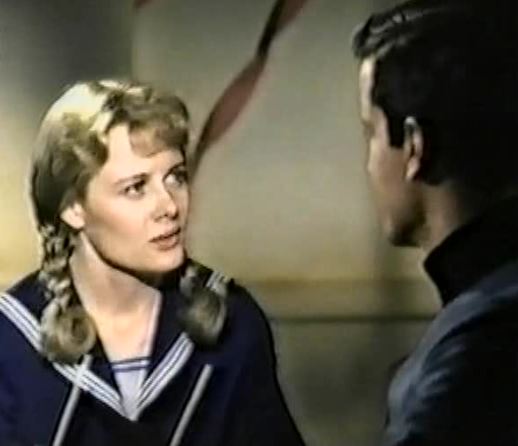
For the younger set, we have Shirley Knight, terrific as the shy, awkward daughter of Dorothy McGuire and Robert Preston, who is due to fall in love, and endure tragedy, the extreme highs and lows the movies tend to reserve for those who are young. But we see that highs and lows, falling in love and enduring tragedy belong to their elders as well.

One more note on the casting of Hollywood greats: Dorothy McGuire’s role was played by Teresa Wright on Broadway. The only member of the original Broadway cast to reprise his role in the film was Frank Overton, who plays the henpecked, morose husband of Eve Arden.

The plot seems episodic, and drifts in focus from one set of characters to another. Directed by Delbert Mann, there is a feeling about the cinematography and the pacing of the film that evokes a made-for-TV movie from the 1970s. We have a few outdoor shots, including our establishing shot of the turn-of-the century house with its big porch and gingerbread on the gables, though the paint is peeling here and there enough to keep us from assuming right off that we’re entering an idyllic world. Most of the scenes are interiors, maintaining the atmosphere of stage drama.

Robert Preston begins the film eager to head out on the road again, and Dorothy McGuire laments his frequent absences, clings to her shy daughter and her younger son, bullied by the other boys, in a stifling and over-protective manner, and complains about Preston controlling the purse strings in the family with a purse that doesn’t have much money in it. Shortly, Mr. Preston will learn he is fired, and all the petty annoyances of his life come crashing down on him like great big monsters.

He broods in the back room of the local drug store (the only place in small town Prohibition America where a fellow can get a drink -- because it’s a “prescription”), and angrily wonders “How does everyone else get rich?” Something plenty of us brood about today. Sitting next to him is the town rich guy, deeply troubled and guilty because his wealth came from an insurance scam.

Meanwhile, Miss McGuire fusses over daughter Shirley Knight and pushes the frightened girl into going to her first dance. “My only chance of staying young is through you,” she tells her.

By chance one afternoon, Shirley meets a wiseacre lonely boy from the local military academy, an outcast like her, and forms a bond with him. Later, when she reluctantly comes down the stairs in her home to meet her blind date, she discovers with delighted surprise it is him. It’s like a Cinderella moment.

But there are few magical happenings in this gentle, but realistic setting. Miss McGuire suspects her husband of philandering with the town beautician, Angela Lansbury. Beauticians, like librarians in old movies, seem to be geared to a certain stereotype -- in this case the world-weary, somewhat hardened female. Miss Lansbury doesn’t snap her gum, but she does smoke, so we know she’s been around the block. But, she has a heart of gold, can turn a deaf ear to the petty gossip she hears in the beauty parlor, which is literally her front parlor, and charges a dollar for a perm.

She and Preston are buddies, unusual in the old movies, particularly between traveling salesmen and hard bitten women who’ve been around the block, and Mr. Preston refreshingly acknowledges that she’s really one of his best friends. Partly, as we come to understand, he respects her because as a working woman she knows the value of a dollar, and he thinks his wife does not. Angela Lansbury is not a millstone around his neck.

In a touching scene that also manages to be rife with sexual tension, she talks about the happy marriage she once had, and how being a widow is tough on a woman with normal desires, including a very strong desire for him. The almost-seduction fails because Preston’s heart isn’t in it; he’s faithful to Dorothy McGuire. Miss Lansbury, like the pal she is, lets him off the hook. But when she confesses, without self pity, her loneliness and longing for a romantic relationship, Preston shoots her an expression of wonder, and sadness, and we see he clearly aches for his friend and wishes he could help, but he is no better at lending comfort than he is at finding a job.

The sad and depressing episode spurs him to trying again for a job, any job, and he humiliates himself by asking an old farmer friend to let him be a farmhand. The man tries to let Preston down easy, but must be frank that he’s too long in the tooth for that kind of heavy labor.

Meanwhile, Dorothy McGuire commiserates with sister Eve Arden, and we have yet another look at a broken marital relationship. Miss Arden is gloriously opinionated, funny in her very obnoxiousness, and her strong personality completely overshadows her quietly bitter husband’s moodiness. McGuire envies her a nice respectable dentist husband who works at home, while Eve Arden confesses her husband no longer makes love to her, that she never actually enjoyed sex, and her husband has long since pulled away from even any meaningful discussion with her. “God, I’d like a good fight. Anything would be better than this nothing,” she explodes.

While the grownups are bumbling through their errors, the younger set seem to have more promise. Shirley Knight’s young man, played by Lee Kinsolving, sweetly entertains her with a pretend scenario as he describes what it will be like for him to date her regularly, show up at her house and mow the lawn, being nice to her kid brother and her parents until he is “just like one of the family.” His own mother, a struggling actress in Hollywood, has nothing to do with him and he wants to belong to somebody.

Unfortunately, at the country club dance, we see, and Shirley Knight learns, what he has known all along: that he will never fit in for one reason or another. For tonight, it is because a society matron has decided that a boy named Samuel David Golden is Jewish and therefore does not belong in a restricted country club. He is more than humiliated; his romance and his daydream about fitting in are destroyed.

The film ends with an astonished, and sobered, Robert Preston getting a job as a traveling salesman for the oil corporation, selling drilling equipment about which he knows nothing. But, as he tells the smug young interviewer, he knows how to sell, how to talk to the common people hereabouts. The manager, an older man with enough experience about life to know about such things, decides that Mr. Preston talks horse sense. The job is his.

Becoming employed again does wonders for his marriage, but this is not a film of entirely happy endings. Other troubled lives we’ve seen are still unresolved, and Shirley Knight will carry the memory of a sad boy with her to whatever relationships she has in the future.

Robert Preston remarks with humble satisfaction about his new employment and starting over in his 40s in a new economy driven by new technology, “Now I’m a stranger in the land I was born in…but, I’m doing the best I can.”

A lot of us know the feeling.

Back to Harold Hill. It is irresistible to muse that this might have been the future of Harold Hill and Marian the Librarian 20 years down the line, after the final happy ending scene of “The Music Man”. Maybe they still heard the bells on the hill, but it might have taken more work to concentrate on them when things turned sour. The movie ends with Preston taking Dorothy McGuire’s hair down in the upper floor bedroom, the curtains billowing in the breeze, in the house with the gingerbread gables that need painting.

Thursday, January 29, 2009

Now Playing


This ad for “Typhoon” (1940) promises us a “tornado of tropic romance.” Dorothy Lamour, whose name became synonymous with the tropics, stars with Robert Preston as lovers who meet on a deserted island. Deserted except for Dorothy, her chimpanzee pal, and some bad guys and comedy relief. We can see here that “Billy the Kid in Texas” is second-billed, plus a Donald Duck cartoon. Enough to keep you occupied for the afternoon, for a 15-cent balcony seat.

This Just In....

Since it seems award season is upon us, and the blogging community is not one to be left out, there seems to be a friendly new honor bestowed among bloggers going around. Madame Campaspe across the hall at Self-Styled Siren has slapped me with a Premio Dardos award.

Explanation as follows:

"The Dardos Award is given for recognition of cultural, ethical, literary, and personal values transmitted in the form of creative and original writing. These stamps were created with the intention of promoting fraternization between bloggers, a way of showing affection and gratitude for work that adds value to the Web."

And the rules:
"1) Accept the award by posting it on your blog along with the name of the person that has granted the award and a link to his/her blog.
2) Pass the award to another five blogs that are worthy of this acknowledgement, remembering to contact each of them to let them know they have been selected for this award."

With deep gratitude I will merely curtsy (curtsies) and omit the tearful acceptance speech, even though I have practised it several times in the bathroom mirror. My glad duty now is to pass the award along, and so here goes:

To Moira at the TCM Movie Morlocks, (and other blogs) for her intelligent analysis and fine research on classic films.

To Jonas at All Talking! All Singing! All Dancing! for his masterful technical approach to the discussion of early sound films.

To Thom at Film of the Year for relating popular film as a tool for historical study, one of my favorite subjects.

To John at Robert Frost's Banjo whose blog enriches us not only with a discussion of classic film, but with music, poetry, and literature. It is a liberal arts smorgasbord.

And to Mr. Jeff Kallman at The Easy Ace, a Journal of Classic Radio, for his detailed blog on the art of classic radio programs, a topic dear to my heart and an important 20th century media which needs to be studied more and better understood.

Thank you again, Siren, and congratulations all.

Related Products