IMPRISON TRAITOR, PEDOPHILE, AND CONVICTED FELON TRUMP.
Showing posts with label Clifton Webb. Show all posts

Thursday, June 14, 2012

Stars and Stripes Forever - 1952


“Stars and Stripes Forever” (1952) strikes a resonant chord with the spirited marches of composer and conductor John Philip Sousa. Clifton Webb plays The March King, and he’s great as always. The movie, like most Hollywood biopics, strays from fact here and there, but captures spot-on the era when Sousa was -- to use a modern term -- a rock star.

We celebrate Flag Day in the US today, those “stars and stripes” with a movie not about flags, or even flag waving, but of patriotism expressed by that once-upon-a-time staple of American popular entertainment -- the marching band.

It’s the 1890s when John Philip Sousa is a Sergeant Major in the Marines and the leader of the Marine Corps Band. In real life, he was a renaissance man -- composer of scores of songs, operettas, even wrote novels and articles. In the movie, he is bummed because he wants to showcase his romantic ballads, but the public likes his marches.


Ruth Hussey is his warmly supportive wife with the wry sense of humor. One of their most charming scenes together is when Mr. Webb, with Miss Hussey accompanying him on piano, sings his latest syrupy love ballad. His bass voice languidly belches the plodding love song, while she giggles at the effect and urges him to pick up the tempo and turn the melody into a march. He will -- later on in the movie -- during another cute scene at a White House reception for President Benjamin Harrison. We recognize his love ballad has become “Semper Fidelis”, the march dedicated to the United States Marine Corps.

We may forget that Clifton Webb had a long career on stage in musical comedy, and as a professional ballroom dancer. The movies gave him a second career as an acerbic fussbudget, and the early 1950s was a busy time for him. In the same year as “Stars and Stripes Forever”, he also did the wonderful parody “Dreamboat” discussed in this previous post. We last saw him in one of his very best performances in “Titanic” (1953), discussed here.

Robert Wagner and Debra Paget are the second leads, and their characters are fictional. Wagner is another member of the Marine Corps Band who follows Mr. Webb into private life after Webb retires from the Marines to form his own celebrated band. Wagner invents the “Sousaphone”, a kind of tuba for a marching unit. Actually, it was a couple of other fellows who came up with Sousaphone, following ideas contributed by Mr. Sousa.

Debra Paget is a feisty music hall singer and dancer who marries the smart aleck Wagner and becomes the girl singer and specialty dancer for Sousa’s band.

We first see her in a scene at a run-down vaudeville house where she is one of the “Living Picture” tableau act. I like this scene for accurately showing what was a kind of risqué exhibition of bodies positioned in dramatic configurations that, for the stage censors’ benefit pretended to be culture -- but for the audience was a most benign source of titillation.


Another scene I like, not because it evokes the era so knowingly, but because it shows an early 1950s consciousness overlapping it in a natural and benevolent way. This is the scene where Webb takes his band on tour in the South. Ever the showman, he cannily marches his band down a street to the United Confederate Veterans reunion which has dubiously hired him to perform -- and he chooses the rousing “Dixie” to make his entrance. He finds a receptive audience to this favorite tune of the South, and then he recounts the story of when Confederate General Robert E. Lee surrendered to Union General Ulysses S. Grant at Appomattox Courthouse. Whether it is meant to placate the (fictional) United Confederate Veterans or to placate the 1952 Southern moviegoers, but Webb delicately refers to the surrender as Lee’s “visit” to Grant. At the time of the surrender, the Marine Corps Band serenaded President Abraham Lincoln, who in the spirit of “with malice toward none, with charity to all” requested they play “Dixie”.

Webb declares that in return for this magnanimous gesture a generation ago, his band, with the help of the choir of the Stone Mountain Church of Atlanta (who play themselves), will perform the song most associated with Lincoln -- “The Battle Hymn of the Republic.”

It is an African-American choir, who step forward among this all-white Confederate picnic and sings the battle cry of their former enemy. They are a mixed choir of men and women, children and elderly, and most strikingly -- lovely young women and handsome young men, serious singers with dignity and grace. They are dressed not in cartoonish slave garb, but in stylish modern (1890s) dress. Their voices are powerful, their diction is precise. They are impressive.

I doubt they would have been welcome at such a wingding in the 1890s (catch the enigmatic expression of the white gentleman in the white linen suit and string tie -- is he moved or merely uncomfortable), but the 1950s was just starting to wake up to certain things and get a little gutsy.

This movie effortlessly evokes the 1890s, but this scene is more about what we wish was, and not what was. However, it works even in its illusionary manner.

In the courting scene at the park between Mr. Wagner and Miss Paget, we hear the old movie background music favorite, “Sweet Marie” and I always think of the William Powell and Irene Dunne duet in “Life with Father” (1947), discussed here.

Another scene that endeavors to revel in the era, but is recalled with a modern twist, is when Clifton Webb receives a note in the middle of conducting in the pit during an operetta. Debra Paget is the lead. He stops the show and faces the audience. He reads the dispatch that the battleship USS Maine has exploded in San Juan Harbor, Cuba. It is the start of the Spanish-American War. The scene cleverly makes use of the audience’s memories of when they first heard the news of the start of World War II, but our brief war with Spain, with its politically murky beginning, has slipped away from modern consciousness though it cost many lives.

What this event in the movie leads to is a touching finale. Robert Wagner, the once and future Marine, happy-go-lucky scamp or not, enlists to fight in Cuba, is wounded in a round of “friendly fire” (more irony) and suffers a leg amputation. Clifton Webb brings his band to the rehabilitation hospital to entertain the wounded troops. His appearance is a surprise to Robert Wagner, and an even bigger surprise when Webb calls him up on stage to play his old Sousaphone. Wagner hobbles on crutches to the place in the band that has been saved for him. A nice gesture when he pats the Sousaphone draped over his shoulder as if it was his trusty steed.

We don’t remember the Spanish-American War, but we know about wounded veterans who need to be welcomed and given a place in the band.

The movie jubilantly reminds us how important music is to define an era. The music performed in this movie is given center stage. We end with Sousa’s march, now the National March of the United States of America -- “The Stars and Stripes Forever”. We are treated to long and leisurely close-ups on the musicians and their instruments.

It is played against a montage of military bands striding across the Mall in Washington, D.C., marching into future bands in future wars.

Listen below at the US Marine Corps Band playing John Philip Sousa’s “Stars and Stripes Forever.”

Happy Flag Day.


Monday, April 16, 2012

Titanic - 1953


“Titanic” (1953) shows that the most successful storytelling is based on what your audience provides in imagination. Other versions of this tragic tale have provided more technically thorough stories. None are as empathetic in the telling, or draw such empathy from the audience, as this version.

One hundred years ago today people were waking up to the news that the RMS Titanic sank on its maiden voyage in the wee hours of the 15th.

This movie was released some 41 years after the sinking of the RMS Titanic. Coincidentally, it was probably 41 years ago that I first saw this movie. I can’t be sure of the exact year but it’s a pretty good guess. I was a child, knowing nothing about the history of the story I was watching, and what I remember most vividly was the very last scene. Clifton Webb stood on the deck of the ship along the rail with many other men, all staring blankly out at the ocean. There were tears in Webb’s eyes. A little boy, his son, stood next to him on the deck. The son had all the energy and confidence of youth. He was probably only a little older than me.

The stark contrast between the sorrowful father, and that little boy, happy to be with him, confused me. I can remember asking an older sibling what was happening, what did this mean? I was told that the boy was going to drown along with his father, that he went back to the ship when he shouldn’t have, so now he was going to drown.

I think I must have assumed that at the last minute another boat would save them, so this news that their deaths were inevitable shocked me. More shocking was that this smiling boy’s fate was sealed by his eagerness. I wondered then if he knew he was going to die? His demeanor did not seem to indicate that he knew. He suggested to his father that they might swim for it.

I think this scene captures the essence of this remarkable movie. It was filmed on a set, so we are not dazzled too much by technological wizardry. But we are drawn into the consequences of the Edwardian (yes, I know George V was on the throne, but eras do not have air brakes) era-cum-dawn of the 20th century, through the splendor, costumes, values and customs, which all lead to consequences.

We have a little name-dropping. There are Guggenheims among the passenger list and of course, John Jacob Astor. He is played here by William Johnstone, whom you might remember as the radio voice of the Shadow, replacing Orson Welles. His wife is played by the lovely Frances Bergen, the wife of ventriloquist Edgar Bergen and mother of actress Candice Bergen.

One name they decided to drop literally was the “Unsinkable” Molly Brown. Her character here is played by Thelma Ritter with her customary earthy gusto, but the name is given as Maude Young.

A big, beautiful ship filled with beautiful people. We are given a hint as to what it’s like to travel in steerage, but we are not hammered too much on the injustices of third class travel. We are given credit for knowing - we or our parents likely traveled to America that way. 

We are given credit for knowing, too, about the era’s dignity, grace, inequity, and hypocrisy. After all, 41 years isn't even one lifespan, and not so much needs to be explained.

We are shown Richard Basehart as a recently defrocked priest returning home to America in disgrace because of his alcoholism. When the disaster happens, he redeems himself. Conversely, we are given Allyn Joslyn as the inevitable human being who disregards his humanity in the very human desire to live.

Look for Mae Marsh in a small role as the lady in the lifeboat to whom the boy, played by Harper Carter, gives up his seat.

The story and the tragedy is played out for us not so much in special effects but by two particular characters who carry with them the style and the consequences of the era. In a sense, Barbara Stanwyck and Clifton Webb as the estranged couple have the entire story resting on their shoulders.

She is an American woman returning to her Middle West roots after years of an unhappy marriage in Europe. She brings their teenage daughter and young son to the US because she does not want them to grow up to share the same meaningless, empty, shallow life which her dandy husband Clifton Webb pursues was such self superior conceit. Both Miss Stanwyck and Mr. Webb are fantastic in this movie. Stanwyck convincingly conveys the dual quality of this woman, one who was able to feel cowed under her husband’s superior birth and social set, and yet still have the mettle to want to save her children. Her Gibson girl hairstyle is very becoming to her in this movie. She wears her costumes well. Stanwyck always did look good in period pieces.

Clifton Webb is a marvel. One might chalk up his work here as standard Clifton Webb material, a fastidious man, the intellectual giant disdainful of all the lesser creatures around him. He played it well.  But there's more to him here, and he undergoes the greatest change of any character in this movie.

One of my favorite lines is when he puts down Stanwyck, “Twenty years ago I made the pardonable mistake of thinking I could civilize a girl who bought her hats out of the Sears Roebuck catalog.”

In one scene, after her confession of an adulterous tryst which resulted in the birth of her son, she drops her purse. Webb’s refusing to stoop to pick it up is his telegraphing to her, and to us, that she has dropped off the charts in respectability. If she were a lady, it would be beneath him not to pick it up. She is not a lady anymore. 1912 Etiquette 101.

But there are two sides to the coin, and Webb also shows a man deeply wounded. It is a devastating scene, his pride and his conceit shattered when he learns that the son of whom he is so proud is not his.

Stanwyck’s part in this scene is also amazing. But perhaps the real credit should go to director Jean Negulesco. The husband and wife face off over his refusal to let her take his son back to the United States.

“No court, no power under heaven will force me to give up my son.”

“He’s not your son.” She replies in the most eerily calm manner, shocking in its very everyday tone of voice almost as if she had said, “it’s time for dinner.”

The camera shows her turn around and walk out of the stateroom. We see her back and his back. We don’t need to see his expression.

In vengeance, he ignores his son for the remainder of the trip, hurting the boy who loves and admires him.

We are prepared by now to think him a monster, but we finally see a deeply courageous Clifton Webb, sensitive to the needs of others when the iceberg hits. It is such a turnabout transformation of his character, and yet, an extension of it. He is, after all, a gentleman. This is what a gentleman is supposed to do. When he learns the ship is sinking he hustles his family into life vests, not telling them of the real danger, keeping up a happy front. He gets them to the top deck.

Then he goes down to third class and hustles out the Basque family with whom he had boarded. The father of the family sold him his ticket, and Webb boarded the ship pretending to be this woman’s husband. He hustles them all into lifeboats, saving their lives. Then he helps others on the ship.

A young Robert Wagner plays a callow college student who is sweet on their daughter played by Audrey Dalton. And oh, the scores of extras. I love me a movie with lots of extras. One of them is Bert Stevens, Barbara Stanwyck’s brother.

Though we have these back stories, this is a movie of about greater things. Larger issues and devastatingly small details. Captain Brian Aherne conducts the Sunday services in the grand salon. A drunken Richard Basehart tries unsuccessfully to send a telegram home of explanation to his family. The crisp, crackling dialogue between Webb and Stanwyck in this most literate script.

I have only one minor, petty complaint. When Robert Wagner and his pals sing college fight songs, one of which is about Lord Jeffrey Amherst and Amherst College -- please, the H in Amherst is not pronounced. I don’t know how Lord Jeff of French and Indian War fame pronounced his surname, but those of us in western Massachusetts, where Amherst College is located, do not say the H. Accent on the first syllable - AM-erst.

I suspect folks from Mackinac, Michigan, might protest at that pronunciation in this film, too.

This has been a public service announcement. (Yes, I’m kidding. I realize there are far more important historical inaccuracies with which to take umbrage.)

The movie does not attempt to shock us or surprise us, rather just as it expects us to understand the mores and conventions of 1912, it also expects us to remember every moment that we are on a collision course with death.  We start the film with a shot of the iceberg.  We have a brief foreshadowing when Robert Wagner, cheered by the prospect of Audrey Dalton’s companionship, throws his soft cap into the ocean. It lands among chunks of ice floating by.

The band plays, first the Londonderry Air - better known to some of us as “Danny Boy”. And eventually we get around to “Nearer, My God, to Thee”. It has never been confirmed absolutely that this was played when the Titanic sank, but the legend has grown partly because of this movie.

Young Harper Carter scrambles out of the lifeboat to give his seat to Mae Marsh and joins his father on the deck because after all, he is now wearing long pants and so he is a man. This is what gentlemen do, give their seats to ladies and risk death. His explanation to his father as to why he returned to the ship is simply, “I’m wearing long trousers.”

Neither did that need to be explained to us in 1953, but I wonder if it might in 2012. I don’t mean just about boys wearing shorts and not wearing long trousers until they’re in their teens. I mean that essence of manhood that comes when one decides to be a man, i.e., to take responsibility. Steinbeck wrote, “A boy becomes a man when a man is needed.”

There are 12-year-old men, and there are 30-year-old boys.


Clifton Webb, heart breaking for his son and especially that he had ever denied his son, puts his arm around him and with tears in his eyes addresses the ocean waves “Whatever happens, I love you very much. I’ve been proud of you every day of your life. Never more than at this moment. I feel tall as a mountain.”

And yet it is not maudlin. It is a simple statement of fact, like the line “I’m wearing long trousers.”

When I watch the movie now, I see that these characters standing on the deck of the doomed ship clearly are not waiting for rescue. They are awaiting death. It is devastating in its theatricality. I can never watch it without being reminded of the first time I saw it, and could not quite comprehend then what was happening. In a way I still can’t believe it. That is the power of film, and especially of this film.

Barbara Stanwyck recalled in this oft-repeated quote:

"The night we were making the scene of the dying ship in the outdoor tank at Twentieth, it was bitter cold. I was 47 feet up in the air in a lifeboat swinging on the davits. The water below was agitated into a heavy rolling mass and it was thick with other lifeboats full of women and children. I looked down and thought: If one of these ropes snaps now, it's goodbye for you. Then I looked up at the faces lined along the rail - those left behind to die with the ship. I thought of the men and women who had been through this thing in our time. We were re-creating an actual tragedy and I burst into tears. I shook with great racking sobs and couldn't stop."

So powerful was this film that it inspired another young person, Edward S. Kamuda, who saw it in his family run theater, The Grand, in Indian Orchard, Massachusetts when it came out in 1953. Mr. Kamuda established the Titanic Historical Society, which is the home of a unique collection of artifacts from the RMS Titanic and from the decades of storytelling about this event. Please see my New England travels blog here for my original post on the Titanic museum and for update on the tribute to two Springfield, Massachusetts, victims of the Titanic.
http://newenglandtravels.blogspot.com/2012/04/titanic-centennial-memorial-springfield.html
Also, have a look here at this previous post on the recycling of the grand salon set of  "Titanic". You’ve seen it before.

There are a couple of other recent posts on “Titanic” (1953) I recommend, this on the blog Book Talk and More, and this, a beginning of a series on Titanic movies, from Matthew Coniam over at Movetone News. Great reading.

Monday, June 21, 2010

Dreamboat - 1952


This week we have a couple of movies that illustrate that cusp of the television era, just before the so-called Golden Age of TV, when the new medium was searching for fodder to fill up the airways. Old movies filled the gap and made life easier for the network programmers. They were cheap, plentiful, and most had not been seen for a generation.

Today, we have “Dreamboat” (1952), in which Clifton Webb’s former past as a silent screen heartthrob comes back to haunt him. On Thursday, we’ll have a look at the “Hopalong Cassidy” phenomenon (through a generic replica, of course, copyrights being what they are), with “Callaway Went Thataway” (1951).

That these two films came one after the other, and dealing with the same subject matter, is some indication of the enormous impact TV was beginning to have, and how dependent it still was upon old movies to fill up hours of programming. Movies and TV have always been co-dependent. Most of us who are classic film buffs were introduced to these films on television, long before DVDs and video. We would not be film buffs without television. Evidently in the early 1950s, though Hollywood might have panicked about being challenged by television, there was still some sense of humor about their relationship with the new gadget.

“Dreamboat” is a romp, as outrageous a vehicle for Clifton Webb and Ginger Rogers as the campy silent film clips we see of them together in the typical 1920s scenarios: a Zorro-like hero, a World War I ace, a Valentino-like hero, all shown on commercial television, commercials being the operative word. Ginger, now a Hollywood has-been, has a new job hosting these old silent movies and pushing the product, which in this case is perfume.

Clifton Webb is a college professor, intelligent, severe, whose extreme dignity makes him the butt of the campus jokesters. Mr. Webb’s dignity was a tool he used, or was made use of by others, in just about any film he was in. It made him alternately pathetic, heroic, sinister, or just plain foolish. It’s amazing how much mileage he got in his career with a withering glance and a sarcastic reply.

His daughter, played by Anne Francis, who we last saw as a teenager in the last few minutes of “Portrait of Jennie” (1948), is, in attitude, nearly a carbon copy of dad, except there is an added bit of shrewish impatience which threatens to stamp out any likeability in her. But this only helps to set up her eventual conversion.

Both father and daughter set out on a quest, for vindication, and though they don’t yet know it, for conversion to adapting to the big wide world they both disdain. That world, in part, is represented by television, which Miss Francis calls the “idiot’s delight.” She is reluctantly brought to a college party where the gang gathers to watch that program hosted by Ginger Rogers showing those old movies of hers with her former co-star, Clifton Webb. And push perfume during the commercials. One of the perfumes is called “My Five Sins.”

“Five?” Clifton Webb later asks, astonished.

The gang knows this simpering, overacting, sword carrying hero with the overdose of Brilliantine on his hair is their hated college professor, and they throw this revelation in young Miss Francis’ astonished face.

Pop, who tried to hide his former career, is equally abashed, and decides to go to New York where the TV program is produced to demand they take it off the air. Not only his dignity, but his job is on the line. The board is uneasy with an English professor with this kind of unsavory background, which seems to make a mockery of their prestige. Only the college president, played by the wonderful Elsa Lanchester, is willing to give Clifton Webb a break. She is a fan, and makes several awkward and athletic attempts to seduce him.

She asks the age-old question, asked so often in melodramas, “Has it ever occurred to you I’m also a woman?”

Off father and daughter go to New York, where he meets up again with his old co-star, the now much older Ginger Rogers. Miss Rogers sinks her teeth into what must have been a fun role as an over-the-top, manipulative, self-involved, has-been, who clings ferociously to any thread of her former career as a matinee idol.

While Rogers and Webb tangle with network executives, lawyers, and their own uncomfortable partnership, which we are made to understand was never as romantic as it appeared on screen, Webb’s daughter is shown around town, and his apartment, by a network underling, a very handsome and affable Jeffrey Hunter. She begins to experience life outside of museums and lecture halls, and likes it. We know she has become a woman of the world when she takes off her glasses.

Clifton Webb has a fun scene where he gets into a bar fight. Helpless to defend himself, he sees one of his old movies on the TV above the bar which shows him vigorously fighting off a gang of ruffians. So, he watches himself, gets a few pointers, and once again, beats the bad guys. Unfortunately for him, Elsa Lanchester pursues him to New York and he has a tougher time shaking her.

The dramatic climax takes place in court, with our old friend Ray Collins as the attorney defending the TV network in its right to show these old movies. Clifton Webb dismisses his own theatric attorney with my favorite line, “You overdid it. I’m not an unwed mother lost in a snowstorm.”

A TV set is put on the stand so that Mr. Webb may demonstrate to the court that TV is not, as Ray Collins would have us believe, an instrument of education, but rather a haven of idiocy. A couple of commercials are shown, typical of the day, that parody both the disingenuous message of commercials (something which has not changed through the decades), but also frank stupidity of the audience which the makers of these commercial must assume. The hair tonic with “Penetroleum” with ingredients like “cosmotron” may get us to laugh, but compare this with the more subtly sinister commercials in “A Face In the Crowd” (1957). That is a more cynical film, but this one, for all its silliness, is hardly naïve. We may get the feeling we are sliding inexorably toward “A Face in the Crowd”.

Mr. Webb wins his case, proving that the films have been altered to make him look foolish, but loses his college professor job when he spurns the scorned Miss Lanchester. She fires him in retaliation. This was the day when sexual harassment was an accepted mode of employee relations and job security.

Left without a career, Webb is not too downhearted, for as he gloats to the now also out of work Ginger Rogers, that Hollywood has come calling back for him. We see him finally in a clip of a new movie, where his dignity is abused for laughs, and three small children throw food at him. It’s a living.
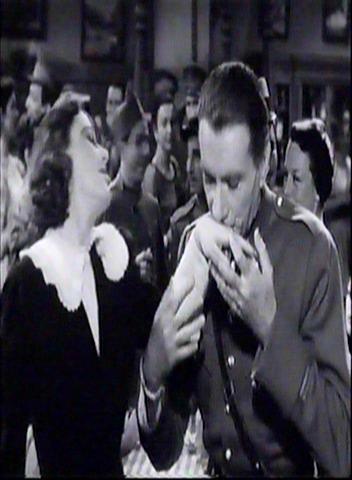
Come back Thursday for another look at the movies-cum-TV era with “Callaway Went Thataway,” with Dorothy McGuire, Fred MacMurray, and Howard Keel.

Monday, November 9, 2009

Waste Not, Want Not


If the ballroom on board ship in “A Blueprint for Murder” (1953), covered here last month, looks familiar, perhaps you remember it from another movie released earlier that year, “Titanic” (1953). Here, Brian Aherne holds court at the Captain’s table on the Titanic.

Where Joseph Cotten and Jean Peters met towards the movie’s end for romantic subterfuge and a potentially fatal showdown, Clifton Webb and Barbara Stanwyck met to condemn a failed marriage. Coincidentally, both men were to have sneaked onto the ship at the last minute to surprise their ladies. It’s interesting to look at the set from different angles.

Joseph Cotten in “A Blueprint for Murder” ballroom.


Jean Peters approaches Joseph’s Cotten’s table.


A similar vantage point in “Titanic”.


Clifton Webb greets his son in “Titanic.”


Reportedly, this set was also used for shipboard scenes in “Gentlemen Prefer Blondes” and “Dangerous Crossing”, both of which were released in 1953. Quite the year for going on a cruise.

Monday, November 24, 2008

A Guy, A Girl, and a Typewriter


The romantic triangle of a guy, a girl, and a typewriter is perhaps a little less discussed than the erotic symbolism of smoking in old movies, but should not be avoided due to prudery. We’re all adults here. Unless you’re a kid. Then, young sir or young lady, you are to leave the room immediately.

The typewriter and shapely hands above belong to Barbara Stanwyck, one of film’s most prolific typists. We see her here in “Christmas in Connecticut” (1945) as she bangs out her magazine column.


Here Reginald Gardiner is just about to swoop down and give her a kiss, because he’s nuts about her and because her typing is driving him wild. Understandable, for there are few things more sensual than typing, few physical attributes more desirable than the strong yet supple fingers of the typist.

In the Sherlock Holmes story “The Solitary Cyclist”, Sir Arthur Conan Doyle has Holmes appraise a woman’s hands, noting that she is either a typist or a pianist, "I nearly fell into the error of supposing that you were typewriting. Of course, it is obvious that it is music. You observe the spatulate finger-ends, Watson, which is common to both professions? There is a spirituality about the face, however" -- she gently turned it towards the light -- "which the typewriter does not generate. This lady is a musician."


How wrong he is, that typing on the QWERTY keyboard does not convey a certain spirituality, even passion. If he could see this close-up of Stanwyck’s eyes from “Meet John Doe” (1941), Sherlock would know just how wrong he was.


But passion through typing is not solely the province of ladies in film. Here Gregory Peck in “Gentleman’s Agreement” (1947) shows us what virility looks like: a handsome man brooding in front of a typewriter. Below we have the picture of motherly pride as Anne Revere fondly thinks to herself, “That’s my boy who can type.” Medical school? Bah! She sacrificed everything to put him through two semesters of Typing 101.


Here we have Rhonda Fleming in “The Spiral Staircase” (1945) showing that Edwardian ladies were every bit as sexy as the modern girls at a typewriter.

Here Gordon Oliver can’t resist planting a kiss on her. One of the first things he tells her when he enters the scene is to plead, “Don’t stop typing.”

Here the ménage à trois is complete as Rhonda attempts to dance with her typewriter and Gordon Oliver cuts in.


Typewriter passion is easily transferable to musicals, seen here in “Silk Stockings” (1957) where Fred Astaire’s immediate attraction to Cyd Charisse is due to her ability to type.


And even less glamorous couples find romance if left to themselves in a small secluded corner with a typewriter, as is the case here in “The Band Wagon” (1953) with Nanette Fabray and Oscar Levant. There is nothing like a typewriter to bring new life to a marriage in a rut.


Amid all the froth of “Three Coins in a Fountain” (1957), the only genuine passion comes from the unlikely duo of Dorothy McGuire and Clifton Webb, again because of the typewriter. He is a writer who dictates, and she is a typist who receives his words and produces the pages. Their relationship is interdependent. How many such lovers have thrilled to the ping that warns of the approaching right margin, and the grinding crank of the carriage return? Their need for each other is occasionally accompanied by a need for carbon paper and Wite-Out.

Film noir also explored the relationship between typing and sex, in “A Lonely Place” (1950) when Humphrey Bogart, a screenwriter, begins a relationship with Gloria Grahame that becomes more steamy when she starts to do his typing for him. I’d put up a screen capture for that, but I hear those kids coming back into the room. Everybody shut up.

Related Products