
A Woman’s Vengeance
(1948) is an English murder mystery that is more psychological drama than whodunit,
and in which the three leads played by Ann Blyth, Charles Boyer, and Jessica
Tandy form a triangle that is less romantic than it is simply purely
lustful. It is a literate, intelligent
film of great power, deep wounds, penetrating remorse, and playful hypocrisy.

Why Jessica Tandy, in particular, was not nominated for an
Oscar, I don’t know, but her performance is astounding. She plays her role on many levels, beginning
with the wry serenity of an unmarried country gentlewoman, navigating waves of
tension as the plot develops, that finally leave her the very epitome of
emotional wreckage.
Sometimes the commercial success of a film is not based so
much only on its quality, but on the boost the studio gives it. That may have been the case here. It floundered at the box office. The film was pulled out of circulation fairly
early. One theory for its early demise, with which I'm not sure I entirely agree—that of the
weakly melodramatic title—was put forth by Florence Fish Parry, a columnist for
the Pittsburgh Post-Gazette:
“The J.P. Harris Theater
showed a motion picture titled “A Woman’s Vengeance” for four days, and
withdrew it because of lack of public interest.
This is a recourse that has often been adopted by exhibitors, but
seldom, if ever, has such a good motion picture suffered so through
non-attendance.”

Miss Parry suggests the original title of the Aldous Huxley
short story, from which the film was taken, “The Gioconda Smile” would have
been a better title. “…one of the best short stores in modern
literature…a biting, rather funny and beautifully executed piece of
story-telling by one of our greatest writers…its dialogue was sharp, superior
to most screenplays…its casting was superlative.”
She relates that the studio, Universal-International, “…deserves to have a flop on its hands; but
it is too bad that their stubbornness in giving this fine murder thriller a
dumb title deprived intelligent audiences of the opportunity to see one of the
very best psychological murder stories of the year.”
“The Gioconda Smile”, of course, references La Gioconda, which is the real name of
Leonardo da Vinci’s painting of what is popularly called The Mona Lisa. In this movie, the Gioconda smile, that
enigmatic expression, belongs to Jessica Tandy’s character. Charles Boyer wonders what is hidden behind
that smile, and after a while, so do we.
This being a mystery, I won’t do a play-by-play on the plot,
though long before the movie ends we have an idea who the guilty person is, so it
becomes not so much a matter of who did it as how do we prove it, particularly
when nobody is really guiltless by their behavior.
Several persons in the cast are likely suspects, and
certainly, the three major players, Boyer, Blyth, and Tandy have all behaved
deceitfully, so we must assume all are capable of even murder.

The victim is Charles Boyer’s wife, played by Rachel
Kempson, or Lady Redgrave, of one of the most distinguished British acting families. She creates a
strong impression here. She is an
invalid, short-tempered and shrewish, and baits M. Boyer constantly by accusing
him of wishing she were dead.

Hugh French is her worthless playboy brother, who always
begs money from her and gets it. Boyer hates his guts. Especially when Mr. French blackmails him.

Cecil Humphreys is the genial retired general, also an
invalid, wheelchair bound, who is a bit more accepting of it, (unfortunately, this would be Mr. Humphrey's last film as he died in November 1947 shortly after this film was completed). Even his
good-natured self-pity at not wanting to be a bother can be a bother to his
dutiful daughter, played by Jessica Tandy.

She is thirty-five years old, unmarried, and we sense one of
her great pleasures in an unvarying routine of duty is her friendship with
Charles Boyer and his wife. She, with
great tact and gentleness, is a peacemaker between them. Rachel Kempson is her closest woman friend
and in one scene, she softly strokes Miss Kempson’s forehead with the
tenderness of a loving sister; yet we also sense, when Boyer gives her a set of
Proust for her birthday and they discuss his new Modigliani painting, that her friendship
with him is the most satisfying. He provides
an outlet for her intellect and emotions related to her appreciation for art
and literature. In his flippant, casual,
but educated way, he feeds her soul.
Ann Blyth is his mistress.

She was nineteen years old when A Woman’s Vengeance was filmed, and still in the early part of her
film career when she was often used in strong, sensual roles of compromised and
compromising young women. Decades later,
when she was in her sixties, she recounted for interviewer Lance Erickson
Ghulam for an article in Classic Images
her experience in this movie:
“I liked playing that
part very much! Charles Boyer and
Jessica Tandy were so professional, so courteous. It was never a question of one trying to
outdo the other. Indeed, I’ve never
worked that way. My feeling has always
been that when you are with a company, you work in unison to create the whole
of it. Not to isolate yourself.
“I understand that
Jessica enjoyed that movie. In later
years when she discussed her career, she mentioned that she had fond memories
of it.”
At the time, however, Ann was, according to columnist Sheilah
Graham’s 1949 article, a bit anxious about her romantic scenes with the great
screen lover.
“I was afraid I’d look
clumsy and inexperienced by comparison.
When his cheek was against mine and he was rumbling love words in his
deep voice, I got goose bumps. Sometimes
I thought he was treating me like a child.
I guess psychiatrists handle their patients by soothing them one way or
another. It was like that. When he kissed me, I was ashamed of being so
young and unsophisticated.”

Her work here is surprisingly delicate. We see her first as a somewhat petulant,
glossy young woman who knows her much older lover is married to an invalid wife
and she seems unconcerned, even dismissive about it. Their first scene together in the back seat
of his chauffeur-driven car gives us the image of two somewhat bored
sophisticates. When it ends with him teasingly whispering something into her
ear and she chuckles with suggestive amusement, we may think both have only one
thing on their mind, their immediate pleasure.

But we also have a glimpse of her envy of Jessica Tandy,
whom she has not met, but has heard Boyer talk about her as a good friend, and
of whom Ann is growing jealous because Miss Tandy shares an intellectual
intimacy with Boyer that she, in her youth and inexperience and lack of
education does not. Ann asks Boyer if he’s
ever flirted with Jessica.
He smirks his reply, “Only in the most spiritual way.” The dialogue crackles with the thrust and
parry of mature intelligence.
One of the most interesting aspects to the movie is how we are
allowed to see different sides of the three main characters and come to know them better through watching
them caroming off each other like
pinballs.

Though Ann Blyth starts out as common, hard-as-nails and
loose, we soon see cracks in her carefully groomed façade. She actually sounds like, and resembles, a
young Merle Oberon, one of her childhood favorite actresses. (Ann undertook diction lessons for this role
to match the British cast, and her breathy accent is light and natural.) Underneath, she is lacking in confidence,
desperate for love and affection, and anxious that her need for Boyer is not
reciprocated. After the death of his
wife, she becomes his second wife, and we see her clinging devotion to him, her
despondency when he is angry at her, to the point of attempting suicide. A scene aching with sorrow when they make up,
and she gulps her lines through tears. She
becomes pregnant, but even this enormous event does not mitigate her fear that
Boyer does not love her, nor does it lessen her envy of Jessica Tandy.

Jessica Tandy’s journey takes her from the intelligent, warm
friend to a striking scene before floor-to-ceiling French windows where she
stands silhouetted during a violent summer thunderstorm and confesses her
passion for Boyer. Her beautiful, round,
dark eyes drink him in, and a moment later, glaze over when he, embarrassed,
tells her he has just married Ann Blyth. The intense
expression of desire in her strong face slightly hardness as she echoes, in disbelief,
his description of Ann, “Eighteen.”
Immediately, the fake, almost grotesque plastered smile to
cover her deep embarrassment. “Nothing like a good joke to bring people
together. You didn’t think I was
serious, did you?”

Then when she first meets Ann Blyth, who has burst in to
escape the rainstorm, the picture of youth, loveliness, and the energy of a puppy in a sou'wester and Macintosh, looking rather like Paddington Bear—Jessica Tandy rides a
fine line between graciousness and steely condescension. “Isn’t she adorable?” she says to Boyer, and
it sounds like an insult.
Ann nervously confesses her ignorance on “Art and things.”
Miss Tandy, with a tense grin like a crocodile echoes, “Art
and things. You sweet child.”
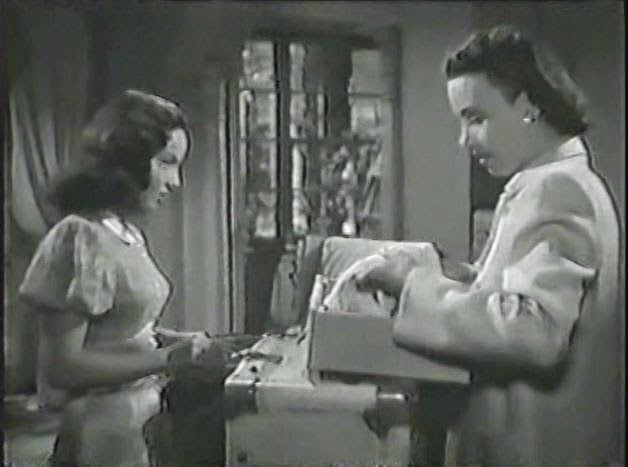
Later, when Boyer and Ann return from their honeymoon
abroad, Jessica once again becomes the soothing dogsbody, the wallflower who is left behind while everyone else she knows is married, the friend-servant who
helps her to unpack. She talks wistfully
of Ann’s pregnancy and asks questions on what it feels like to be pregnant, and
we see the wonder in her soft eyes, as her hands gently fold Ann’s camisoles.
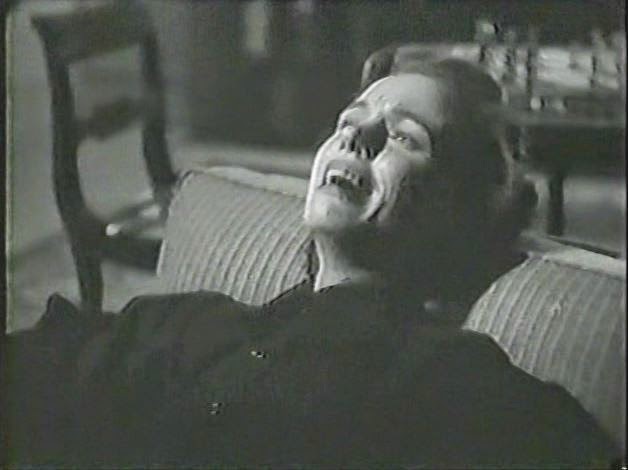
Still despondent over the loss of her friend, Boyer’s first
wife, and still emotionally battered by having been present at his wife’s
deathbed when the servants called her over because Boyer was on the town with
Ann and could not be reached, Jessica slides into an agony of insomnia and the added
tension of having to testify at Boyer’s trial.
She eventually must come to terms with the long crush she has had on
Boyer, and confront him, “Did I ever ask for mercy? Did you ever think of showing it?”
And breaks down when she must accept and face her
long-denied disappointment at not being his choice, “Just because she is
eighteen. Because of her mouth, because
of her skin…Oh, God! Oh, God! Oh, God!”

His wife’s nurse, played by dependable Mildred Natwick with
virulent disgust for Boyer and all men because, “Sex, that’s all they think
about,” has suggested to the police that Boyer probably murdered his wife, which leads to a hearing, and then a trial.
Sir Cedric Hardwicke plays the local doctor, longtime friend
of Boyer, his wife, and Miss Tandy, must also testify at the trial, along with
servants, Mildred Natwick, and Boyer’s no-good playboy brother-in-law.

John Williams plays the prosecuting
attorney. The supporting players are
wonderful in this movie, and Mr. Hardwicke commands every scene he’s in
with quiet, somewhat sad dignity, and some crusty humor.
“Some women cry as easily as a pig grunts.”

He takes charge at the end as the one who ultimately ferrets
out the real mystery behind Boyer’s wife’s death. He is the trustee for everyone's confidences, and is their nagging conscience.

Charles Boyer, is, by turns, a solicitous husband enduring
the rudeness of a gravely ill wife; a dog who cheats on her; a flippant bon
vivant who has little idea of the hearts he breaking; a latecomer to remorse
who finally accepts his guilt and can accept the punishment for it. He is always likeable, but always a hypocrite. He complains to Jessica Tandy that he is not
able to share his appreciation for art and the finer things with his dull and uninterested
wife, that he shares no intellectual companionship with her—yet when he marries
again, it is with Ann Blyth, with whom he lies in the grass, and teases her
over her worry that she is ignorant and cannot converse with his friends, that
she is not educated like Jessica Tandy is.
“That is precisely why I married you and not her, which
shows that there is something more in marriage than just the ability to make
polite conversation.”

Later, Boyer will talk with Ann Blyth in quiet tones across
the table from each other at the prison visiting cell about possible names for
the child she is carrying. She gives him
a four-leaf clover she found, then regrets it as a stupid, childish thing to
do, but he keeps it as if she had given him a diamond.
A Woman’s Vengeance
is exquisitely written by the author of the original short story, Aldous
Huxley, and strikingly directed by Zoltan Korda. The cast could not be better, nor work so
well together and if this had been the only film any of them ever made, it
would stand as a monument to their prodigious talents.

A Woman’s Vengeance seems to be lost in that world of if it’s not
on DVD, it doesn’t exist. (UPDATE - It has been released on DVD in 2016!) Jessica Tandy,
who did not even receive a nomination for this film, went on to Broadway next, creating
the role of Blanche Dubois in A Streetcar Named Desire, for which she won the Tony (and would win two more Tonys in
her stage career.) She lost the film
role of Blanche, typical for Broadway actors, but won the Oscar, late in life,
for Driving Miss Daisy (1989), the
oldest Best Actress winner. She would
later be nominated for Best Supporting Actress in 1991 for Fried Green Tomatoes.
A Woman’s Vengeance
would have the Lux Radio Theater treatment in March 1948, and be adapted for television
in the anthology program Climax! in
1954 with its original title, “The Gioconda Smile.” Dorothy McGuire played Jessica Tandy’s role,
and I would so love to see this. But
though we may find cloudy copies of the film, as I did, the chances of a
television kinescope being preserved is abysmally less.

The movie script shows shades of the characters that the short
story, dry and sarcastic in its wit, even somewhat cruel, does not, and it is a great
example of how powerful a story can grow when the original writer of the source
material is allowed to take his work to new stages. I don’t think that happened too often in
Hollywood, and I wonder how they came to allow Aldous Huxley, whom we know more
for his novel, Brave New World, a
crack at it.

The film was a good fit both for Ann’s youth (which she
fretted was inexperience in the face of Boyer’s suave screen image), and her
emotional depth as an actress. She holds
her own with the veterans, for even at nineteen years old, she was a veteran herself, and contributes energy and vulnerability to this quiet, cerebral film. From
here she would move on to Another Part of the Forest (1948), which we covered here, and a strikingly different
character who was decidedly more sure of herself and irresistibly without remorse.
Come back next Thursday as Ann becomes another entirely different
eighteen-year old, whose world and her place in it suddenly becomes jolted by a
family secret in Our Very Own (1950). That post will be our entry in the Fabulous
Films of the '50s blogathon, hosted by the Classic Movie Blog Association.

***************
Classic Images,
No. 236, February 1995, “Ann Blyth: Ann of a Thousand Smiles” by Lance Erickson
Ghulam.
Dick, Bernard F., City
of Dreams – The Making and Remaking of Universal Pictures (Univ. Press of
Kentucky, 1997) p.125
Hartford Courant,
September 3, 1944 p. 6C.
Milwaukee Journal,
August 22, 1949, column by Sheilah Graham.
Pittsburgh
Post-Gazette, February 20, 1948, column by Florence Fisher Parry, p. 2.
****************************
THANK YOU....to the following folks whose aid in gathering material for this series has been invaluable: EBH; Kevin Deany of Kevin's Movie Corner; Gerry Szymski of Westmont Movie Classics, Westmont, Illinois; and Ivan G. Shreve, Jr. of Thrilling Days of Yesteryear.
***************************
UPDATE: This series of blog posts about Ann Blyth's career is now a book, ANN BLYTH: ACTRESS. SINGER. STAR.

Also in paperback and eBook from Amazon, CreateSpace, and my Etsy shop: LynchTwinsPublishing.

***************************
UPDATE: This series of blog posts about Ann Blyth's career is now a book, ANN BLYTH: ACTRESS. SINGER. STAR.
The audio book for Ann Blyth: Actress. Singer. Star. is now for sale on Audible.com, and on Amazon and iTunes.

Also in paperback and eBook from Amazon, CreateSpace, and my Etsy shop: LynchTwinsPublishing.


