IMPRISON TRAITOR, PEDOPHILE, AND CONVICTED FELON TRUMP.
Showing posts with label Ann Sothern. Show all posts

Thursday, May 25, 2017

On the Sunny Side (1942) and You, John Jones! (1943)


On the Sunny Side (1942) and You, John Jones! (1943) give us a look at the wartime experience of children, as the movies viewed it, during World War II, particularly acknowledging how fortunate American children were compared to their counterparts in war zones.  We were encouraged to be both grateful as well as compassionate.  If there was also sometimes a sense of pride thrown into the mix, well, genuine humility is unfortunately not always our strong suit as a nation.  Still, we might imagine that much of the pride in our relative safety was borne of overwhelming relief.

This is our second entry in our series on childhood during World War II.  Roddy McDowall, whom we saw last week in The Pied Piper (1942), stars as well in On the Sunny Side, made in the same year.  Roddy had made a great impression on audiences in How Green Was My Valley (1941), and became one of the most recognizable, certainly one of the youngest, members of Hollywood’s “British Colony.”  He, his mother, and sister left Great Britain in 1940, an era when Dunkirk, the Blitzkrieg, and what appeared to be imminent invasion by the Nazis brought many Brits to the conclusion that London was no longer safe for their children.  Roddy knew something about the role he was going to play next.
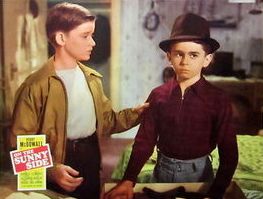

In On the Sunny Side, Master Roddy is an English boy sent to live with a family in the United States for the duration of the war.  In the company of a group of other child evacuees, all traveling without their parents, he arrives on a ship to New York, bound for the Midwest home of husband and wife Donald Douglas and Katharine Alexander, and their boy played by Freddie Mercer, who is nearly the same age as Roddy.  Their parents were acquainted from a previous trip to England, good enough friends to be trusted with the care of their child.  His father is an RAF officer, and his mother is played by Jill Esmond, who also played his mum in The Pied Piper.  Jane Darwell is their housekeeper.

Much of the story is a fairly routine plot of a boy in strange surroundings who makes friends and becomes part of the family/community.  Freddie Mercer lets Roddy into his gang, which, with a clubhouse in the woods that is an old abandoned bus, seems a lot like the kids from the Our Gang series, but less scruffy, and not as funny.  Indeed, they are a rather serious and doleful group of youngsters, but the grownups writing and producing this story are perhaps projecting their own seriousness on the nice American squeaky clean world they’ve set up for the kids.  But, like the Our Gang kids, they even have a bully to fear: Stanley Clements, whose tough wise-guy talk made him the leader of the pack in Going My Way (1945) and in future Bowery Boys films.   Ann Todd plays a classmate who, like most of the girls in the class, fancies gallant Roddy.  A guy with an English accent can really clean up in this town.


The climax occurs when Freddie gets fed up with everybody’s fussing over the new kid, so much so that he becomes jealous and wants to run away from home.  Freddie, who came to Hollywood on his singing talents as a noted symphony and choir soloist, also had a bit part in Going My Way.  Here he’s funny as he sputters about the tea-drinking English kid ruining his life, but he draws our sympathy, and Roddy’s.


Though the grownups are firmly in charge, the story is really presented from the viewpoint of the kids, and they have the most screen time.  Though we might wish for a deeper story less focused on report cards, bullies, and gosh-gee-whiz dialogue, it is true that the prosaic troubles faced by the kids in the story really do reflect what’s important to children.  The adults may be reading the war headlines, but the kids—at least in the U.S.—are more driven by the realities of their world of making friends, doing chores, and worrying about what others think of them.  We might note that the boys’ teaming up and eventually conquering the bully is a parallel to the U.S. and Britain teaming up to fight the fascists.
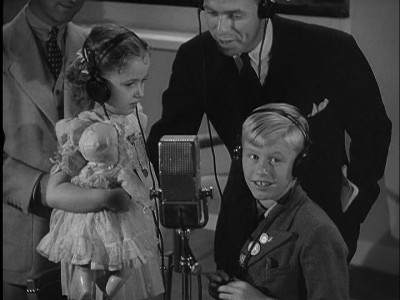

The movie does give us a few quite poignant scenes that hit on the broader crisis: The British kids on board ship, gathering at the rail to watch the Statue of Liberty slide by as they enter New York.  Roddy’s panic and nightmares when he hears a police siren, as it reminds him of the air raid sirens and emergency vehicles of the Blitz back home.  Most especially, the scene where a group of British kids are gathered in a New York radio studio, Roddy among them, to speak to their parents in a London studio via short wave.  The anxiety on the faces of the separate shots of kids and parents, their hesitancy to be too personal on the radio, their brave front of trying to give cheerful messages, and the cruel brevity of the time they are allowed create an image of both tenderness and anguish.  Tears are fought back.  Roddy, who even from a very young age was so good working before a camera, shows a myriad of feelings with the just the slight flickering of expressions on his face, in his lovely dark eyes.  He is nervous, then he warms up and excitedly tells his mother about his new life and friends, comically using American expressions he has learned that he must translate to her.  When his time is up, he realizes he has forgotten to use the notes he made beforehand of all the things he really wanted to say.


The evacuation of children from the London area had them seeking refuge in other parts of the U.K., in many dominion nations, including Canada, and also in the U.S., and involved children of every class.  Vera Brittain, noted British writer whose memoir of World War I, Testament of Youth, perhaps is more well known, at least in this country, than her other works, sent her two children away from their London home to stay with friends in Minnesota during the war.  Her son John was twelve at the time, the age of the boys in On the Sunny Side, and her daughter Shirley (a future member of Parliament), was not quite ten years old.

In excerpts from her diary, published as Wartime Chronicle – Vera Brittain’s Diary1939-1945, Brittain notes that the decision to send her children was a difficult one, “There seemed no right decision to be made, whichever course I took would involve bitter regrets.”

Her children left from Liverpool after Dunkirk, just missing the start of the Blitzkrieg and bombing of London by a matter of weeks.  They remained in the U.S. for three years, coming home, separately, in 1943.  She writes in her diary of the anguish of not receiving letters, then receiving them and learning her son has grown taller than she, and they are changing, experiencing new adventures in summer camp and in school where the curriculum is different.  Missing birthdays and Christmas.  At one point, Vera Brittain notes that her husband urged her to go to the movies to take her mind off their troubles.

“G. persuaded me to go to the new Disney film Dumbo, but it depressed me very much by reminding me of the children.”

Her children became teenagers while they were away.  Their mother drilling in firefighting practice to help after the bombing raids.  “One of the odd incongruities of this war to think that John—who must now be a fairly vigorous boy on the verge of 15—is safely in America while his middle-aged mother scrambles round in trousers fighting fires (or learning to).”

She remarks of her son’s return, “I did not recognize him, but it will take time to get to know him again.”  Her daughter arrived home, after a delay in the Atlantic due to perilous naval battle action, near the end of the year.  (Brittain’s husband, who was a university lecturer, had traveled to the U.S. for a part-year post and on returning, was on a ship that was actually torpedoed.  Twenty died, but he and some others made it to lifeboats and were afterwards picked up by a freighter and returned to England.)

When the family was reunited, a visit to Grandmother brings a comic conclusion to the adventure:

“Children uproarious over tea, Mother blames their manners on America.”


The children who remained in war zones with no avenue of safety were the subject of You, John Jones! (1943) a short subject about ten minutes long, directed by Mervyn LeRoy, starring James Cagney as an All-American dad who works as a supervisor in an airplane factory during the war, and also does his bit at night as a volunteer air raid warden.  Ann Sothern plays his wife, and their daughter is Margaret O’Brien.  When he arrives home from work, little Margaret is practicing her speech for an elocution contest, soberly delivering President Abraham Lincoln’s Gettysburg Address while perched on the living room window seat.  There are politicians who can’t deliver a speech as well as Margaret.  Perhaps they never “stumped” on a window seat.

Cagney leaves for his night watch, dressed in his trench coat with the Civil Defense armband and his helmet.  He sits on a park bench for a little plane spotting and considers how lucky he is to be living in a land where he is not likely to see an enemy bomber tonight.  The omniscient narrator, presumably his conscience, and ours, addresses Cagney (or John Jones), reminding him that if they were in other lands, his little Margaret, “Your baby, John Jones, your baby!” would be in danger.

Then we have a montage of scenes of Margaret as an English girl in the Blitz; as a Greek girl, her leg amputated, trudging with an amputation along a line of refugees; of a girl from Yugoslavia sobbing over a dead mother; from “Australasia” – quite a stunning image of Margaret looking hollow-eyed and shell shocked, then as the camera pans back, we see she is a prisoner of war behind barbed wire.  Margaret, as a Russian girl, lies dead in the ruins of a bombed out house.

To perhaps remind us not only of our good fortune in being spared these experiences in our own country (with the exception of the Americans of Japanese descent being held behind barbed wire in concentration camps), we are reminded, too, of the debt we owe our allies who are carrying the brunt of the war.  The narrator remarks, “If conquered people collaborated, your side couldn’t win this cruel war—did I say your side?  Our side.”

Then an attack occurs, but Cagney realizes it is only a dream.  (Sleeping on duty!)  He returns home, and Margaret finishes her speech with earnest, one may say almost fanatical delivery.   You can have a look at You, John Jones! here.


Kids here in the U.S. may have largely been spared the scenes little Margaret faced, but they were not without trauma caused by the war.  Come back next Thursday when we discuss the March of Time documentary Youth in Crisis (1943), and the Youth Runs Wild (1944) starring Bonita Granville.
**********
Wartime Chronicle - Vera Brittain's Diary 1939-1945, eds. Alan Bishop & Y. Aleksandra Bennett, Victor Gollancz Ltd, 1989.
*********************
The audio book for Ann Blyth: Actress. Singer. Star. is now for sale on Audible.com, and on Amazon and iTunes.

Also in paperback and eBook from Amazon, CreateSpace, and my Etsy shop: LynchTwinsPublishing.


Thursday, December 6, 2012

Cry Havoc - 1943


Cry Havoc (1943) transports us to a strange world.  We cling to what little seems familiar, and are forced to either bravely face the terrifying unknown, or just close our eyes to it, waiting to submit to it when it catches up with us.  A compelling stage play/film, it teeters between the rigid spatial boundaries of theatre, and the anything-is-possible artifice of Hollywood.  Most unusual, we are given a glimpse at world where the courage and fortitude of women are honored, and men are largely absent or helpless victims dependent on the women.
Tomorrow is the anniversary of the bombing of Pearl Harbor, and we continue our four-part look at women in the armed services, begun here Monday with Keep Your Powder Dry (1945).  Where that film shows us the sorority atmosphere of basic training for the new Women’s Army Corps (WAC) in the clean and orderly world of stateside army posts, Cry Havoc drops us in the maelstrom of the Philippines during the Japanese invasion. 
Even the title card means business.  I won’t go play by play, but there’ll be some spoilers.
Only two of the women here are military.  Fay Bainter and Margaret Sullavan play Army nurses.  The rest of the ladies are refugees, most Americans, two British, and one Filipina, from towns farther north who were evacuated to the last American stronghold on Bataan.  They become volunteers at the jungle hospital.
It’s a varied lineup.  Marsha Hunt as the head volunteer with hospital experience to show them the ropes.  Ella Raines is a glamour girl, Ann Sothern is a smart-mouthed dame down on her luck who loves to give the others a hard time.  Joan Blondell is the sassy ex-stripper with the heart of gold.

We have the usual innocent Southern Gal played by Diana Lewis, with the most adorable dimples.  She reminds me of Judy Holliday.  Wife of William Powell, it was her last film before she retired from acting. 

Two sweet, gently bred British sisters played by Heather Angel and Dorothy Morris, both students of art and music seem more suited to a rose garden than this hell on earth. 

Connie Gilchrist is on board as the camp cook, dishing out sympathy and lots of rice.
Young Robert Mitchum has a brief spot as a wounded soldier, but the men are the little seen in this film. 

However, it’s worth noting that among the men they treat in the camp hospital are several Filipino soldiers.  The most intriguing male is one we don’t see, except in a distance shot. He is the lieutenant in charge of the communications shack.  We see his name painted roughly on his crude office door in the hut where the women relay radio messages.  Ann Sothern is interested and visits him in his lair, but learns she has competition for his affections from Margaret Sullavan.
It’s not really Sullavan’s film, despite the top billing and the character of central importance that she plays — the head nurse in charge of the women.  Her screen time is intermittent; we spend a lot of time on the back stories and interactions between the other women.  However, Margaret Sullavan captures our attention, and our understanding, every time she pops her head in the room. 

Miss Sullavan brings her long stage training with her; you can see she does not play to the camera, rather she plays off her other scene partners.  That’s a trait among stage-trained actors.  Also, because she is stage-trained, she uses her whole body to express herself, whereas screen actors of the time with no stage experience tended to emote more with the face, which was sort of a technical requirement, and style then, anyway.
She did not make many films, as she really preferred the theatre, but what a great thing it is watch her move from patient to patient when we first see her.  Slumping, slouching, no rigid graceful posing from her.  Nothing seems choreographed.  Her movement is completely natural and appears unrehearsed.  A quick, impatient glance at a chart, a darting glance around the hospital hut.  When she smiles briefly at a patient or a fellow worker, it is a flash, a sparkling nanosecond of some self-deprecating mirth that tells us there is a great deal of charm and a possibly a goofy sense of fun buried in this overworked, intensely focused woman.
We would never know she is dying of malignant malaria.
As we mentioned in the previous post, “Cry Havoc” has many similarities with So Proudly We Hail, but Sullavan is a far more stressed leader than the always-elegant Claudette Colbert, and her charges are far more ill-equipped to this life of service.
Though we have scenes of soldiers lying in the dirt by the hospital tent awaiting treatment, and huts in the background ablaze from the latest bombing run by the Japanese, most of the movie takes place in the underground bunker that serves as the women’s dorm.  Crude bunk beds around a common table, a few lanterns hanging from the log roof.  We can sense the dankness and chill in this room, even in the heat of the jungle.
The women have their personal struggles to overcome: the need to conquer fear, the need to feel useful, the need to give back, the need to prove themselves.  Ann Sothern comes the farthest in her character development.  She starts out as rather sullen and bitter, ever spoiling for an argument.  A poignant scene where she must collect the personal belongings of deceased patients and catalogue them for shipment back to their families in the States helps to knock the chip off her shoulder a little.  She is not completely converted to a mensch until the very end when she and Sullavan face some hard truths.
The younger British girl gets to give “The Speech” about why we are fighting, in a soft-spoken, cultured voice that is notable for its matter of factness in someone who seems to have had such a sheltered life.  She talks of the survival of the free people of the world, and her words may echo in our heads when she is lost during a bombing raid.  She is found, days later, half crazed in a tangle of dead bodies.
Her anguished older sister can hardly bear the heartache, but amazingly rebounds with a warrior’s enthusiasm when she grabs an anti-aircraft gun from a wounded soldier and shoots down an enemy plane (off camera).  She glows when she describes her deed to the others, like she’s won a carnival prize.  If this were an English foxhunt back home, we might say she had been “blooded.”  No one ceremoniously smears blood on her forehead, but it seems as if someone should.
Just as in Keep Your Powder Dry we have another scene of water nymphs bathing in the river.  No Cokes to drink here; just strafing from the enemy that results in the murder of one the girls.
We get “The Speech” again at the end of the film, this time a hard-as-nails version from Ann Sothern, who uses a map of the Pacific as a visual aid for her show-and-tell.  No dewy words of inspiration this time.  The ladies, by now, understand full well that the only way to win the war is to make the enemy work twice as hard for every inch of ground.  “A delaying action,” Claudette Colbert put it in So Proudly We Hail, but here the reality is put more bluntly.  The Japanese are getting closer and closer to their position, and there is no longer any hope of escape, or of reinforcements to wage battle.  They are starving, the hospital is overrun with wounded and malaria cases, and General MacArthur left for Australia.  The ladies will be killed or taken prisoner in a matter of days.  The most noble sacrifice they can make for the war effort is to just wait for it.
Earlier Miss Sullavan gave them the chance to escape to Corregidor (not much of an escape it would prove to be anyway), but they all refused.  As Joan Blondell replies, “A man died in my arms tonight, and now I wouldn’t leave if I knew it was my last day on earth.”
Sullavan remarks to Fay Bainter, “They’re Americans.  They believe in happy endings.”
Miss Bainter responds quietly, “I’m an American.  I don’t.”  She is the picture of a career nurse, an officer in the Army who has seen too much to believe in miracles, but carries on with thoughtful, gentle stoicism.
The Japanese invasion of their camp is dramatically effective, the more so because we do not see caricatured villains.  We see nothing; we only hear single rifle shots, snipers in camp.  The ladies, gathered in their underground quarters, perk their ears and listen.  They know what it is.  Then a sudden burst or two of machinegun fire, and they know the enemy is “mopping up” outside.  Then a shout, an order for them to identify themselves and come out.
That the movie ends with the slow procession of tired, dirty females, arms raised, quietly submitting to a fate they’ve been imagining for the last hour and a half is a tribute to all the times this actually occurred in war zones all over the world, to women all over the world.  I suppose we can’t blame Hollywood for throwing in a few strains of “The Battle Hymn of the Republic” as former enemies and romantic rivals Ann Sothern and Margaret Sullavan walk out together.  Most of the film has been fairly schmaltz-free.
Another scene admirable for its restraint — when the male lieutenant is killed, and we have already been told that he is really Margaret Sullavan’s husband, she quietly enters his crude office and we see his world without him in it.  Maps, documents, radio equipment — and his officer’s cap left on a shelf.  Sullavan, a picture of stunned grief and stillness, regards his cap.  It represents him in this matriarchal jungle world where men are hardly seen.
There could have been a greater dramatic exploitation of the story of these women, and would be if this were filmed today — however, that’s one of the elements of this movie that makes it refreshing.  But it was not the director’s forbearance keeping the movie from showing more fear, more vulnerability, more skin, more torture, more rape.  It was the studio’s delicacy in fearing to offend the public.   
What we do see are a group of women we never really get to know well, but we know enough.  Sullavan is an intriguing mystery.  The others are too weary and too wary of attachment with death hovering in the bush to get to know each other that well.  We settle for a few common gripes, and a few helpless tears.  We never really get to know what happens to them when they leave the bunker at gunpoint.
Maybe it’s better that way.
Though we are presented these women as flawed but ultimately grand girls representing the best of civilized democratic nations — most of them American, we are not given the same idealistic message we see in so many other war films of the period.  Instead, we are haunted by what we see, and if that’s not a reason to buy war bonds, I don’t know what is.
Also refreshingly absent are condescending platitudes about women taking only gender-appropriate roles in the war.  These kids may have arrived in summer frocks with Panama hats or picture hats with floppy brims, but they slip into over-sized coveralls and spend the rest of the film with their hair tied back and a constant grimy film of perspiration on their faces.  No crisp uniforms for them, they look like garage mechanics. 
The well-trained WACs of Keep Your Powder Dry only wore such outfits when they were fixing the general’s car on the post.  Even if they serve overseas, will likely never find themselves close enough to the battle lines to be overrun by the enemy. 
Both films, along with So Proudly We Hail, for any flaws we see at the distance of more than six decades, lend dignity to their varied representations of women in war.  Next week, we’ll take two films made in the early 1950s, Never Wave at WAC (1953) and Skirts Ahoy (1952).  Though the Korean War was going on at the time, these films do not present a serious discussion of women serving their country, but rather take a lighter tone.  The first is a comedy, the second a musical.  We might never know we were at war.

*********

Jacqueline T. Lynch is the author of Ann Blyth: Actress. Singer. Star. and Memories in Our Time - Hollywood Mirrors and Mimics the Twentieth Century. Her newspaper column on classic films, Silver Screen, Golden Memories is syndicated nationally.

Monday, March 23, 2009

Ladies of the Noir - Pt 2 - Shadow on the Wall (1950)


Shadow on the Wall (1950) is one of the more unusual examples of film noir in that the hero, the villain, and the victim are all played by females in an era and a genre when a gritty story of intrigue and adventure was mostly told through a male protagonist.

The male protagonist in this story is played by Zachary Scott in a lesser role, but at the same time a very pivotal role. Though he spends a good part of the movie in jail waiting for judgment, he is not relegated to being inconsequential. He is very much a key player, but his fate depends upon the actions of the females.

Scott is married for the second time to a two-timing woman we get rid of early in the film. Or, I should say, Ann Sothern gets rid of her. Miss Sothern’s role here is a bit different than her role we saw here in this post on The Blue Gardenia. There she was typically wisecracking, but here she is more subdued and goes through an interesting transformation. Ann Sothern, with affable if brutal honesty, never thought of herself as a good actress and said as much, but this film gives her a bit more to do than be flippant. She makes a convincing baddie.

Here Miss Sothern is the less glamorous sister of Zachary Scott’s two-timing wife. She begins the film as a likable sister-in-law, and a bit anxious to keep her suave fiancé’s attention. Too late. Her fiancé is having an affair with Mr. Scott’s two-timing wife. Miss Sothern is crushed, once again the victim of her more beautiful sister’s popularity and lack of integrity.

Zachary Scott has just returned home from a trip, and he discovers his wife’s infidelity. Initially stunned, he decides to hold off confronting her until all the guilty parties and injured parties can be together in the same room. In the meantime, he listens to his wife’s lies about where she was all afternoon, and maintains self control even while steam is coming from his ears. He has some souvenirs from the war given to him by a friend he visited. There is a gun among them, which clues us into a future scene of violence.

Barbara Billingsley, The Beaver’s mom, has a brief role as Olga, their maid. I don’t really see her as an “Olga,” but it’s always nice to have the ever-chipper Miss Billingsley drop by.


Young Gigi Perreau plays Scott’s little girl by his first marriage. We see that he has an affectionate relationship with the engaging child. There is a cute scene where she brings in the neighbor boy to watch her father shave, because her pal doesn’t have a daddy and being a boy, he needs to know how to shave. Mr. Scott agreeably conducts a shaving demonstration for the kids.

Because we see that Scott is a nice guy, likes kids, takes over the chore of bathing his daughter, keeps his cool about his two-timing wife, and looks good in a sleeveless undershirt, we form a strong impression of his decency, his intelligence, and his virility early in the film. This is important, because he soon gets hauled off to prison and we could easily forget about him if he were a more dishwater character. But when the action gets going with the trio of females, we never forget about Scott.

It’s kind of like when we watch an old melodrama where the hero and the villain are slugging it out, and somewhere there’s a girl tied up to railroad tracks and the train is coming. We may be watching the fistfight, but in the back of our minds is the girl. And the train. So it is with Mr. Scott. And the electric chair.

There is a confrontation between husband and wife about the infidelity. There is some pushing, the gun gets used, and the husband gets clunked on the head. When he comes to, his wife had been shot dead. He believes he did it, though he does not remember.

The child enters the room as this happens, and when her father is taken to jail, she is remanded to a hospital to treat her psychological trauma. The child has emotionally closed down, and it is up to the doctor, played by Nancy Davis, to help her face the terror she has experienced.


Nancy Davis, the future First Lady as the wife of Ronald Regan, plays her role with an attitude of unemotional professionalism that seems appropriate and rather refreshing. It was, of course, typical for Hollywood heroines to be self-sacrificing and emotional, but here she plays a heroine who really is neither. She is passionate only for the detail of science, and helps the little girl because that is her job, and not for her a particularly womanly crusade. In her play therapy with the child, she is kindly and gentle, but not really motherly. There is always a professional objectivity which is realistic.

Her purpose is only to unlock the girl’s reticence to face her trauma, and to help her to heal emotionally. It is only by accident well on into the film that Miss Davis begins to suspect there is more to the child’s trauma than just witnessing a tragic killing. It occurs to Davis that what the child saw was not her father kill her stepmother, but that somebody else did it. Now Davis must ferret out the truth, not only to help heal the girl, but to save Zachary Scott from the electric chair.

The audience has already been in on the facts of the murder long before Miss Davis figures it out, so we get to watch with anticipation the murky evidence being untangled. We also get to watch the irresistibly fiendish transformation of Ann Sothern.

She begins as the frustrated, bitter younger sister, deeply hurt by her fiancé’s infidelity. We learn, through flashbacks as is typical in film noir, that she burst in on her sister while Scott was still out cold from being clunked on the head, and she shot her sister. It was done all in an unplanned, frantic moment during an argument, and Sothern immediately regrets the deed. Overwhelmed with guilt, she writes a confession.

But she can’t bring herself to go through with confessing. The vision of herself in the electric chair is too strong for her to save the innocent Zachary Scott. She saves her own skin instead. She just walks away and says nothing.

This action changes the course of the film and changes the course of her life. Lying and deception start to come easier to her now, now that it is a matter of her personal survival. Murder starts to come easier, too.

When she gets wind of Dr. Nancy Davis working with little Gigi Perreau to restore her memory of the murder, Miss Sothern panics. She makes two rather dramatic and spine-tingling attempts on the child’s life, both unsuccessful.

One of these involves manipulating a contraption in the hospital where the girl is put to bed in a water bath to relax her, and she is tied into it. Step-auntie Sothern attempts to drown her. The scene where the code red is called and all the medical staff rush to revive the unconscious child is one of those instances we often see in old movies about medical practices that bludgeons our belief. Nurses run from everywhere, and hot water bottles are produced. Hot water bottles? Remember to keep a hot water bottle in your first aid kits. Good for everything from reviving a drowning victim, to heart attack, stroke, snake bite, and iron deficiency.

The key to reviving the child’s memory lies in a doll, a figure of an Indian which reminds Gigi of a shadow she saw on the wall at the moment of her stepmother’s murder. We see, at the very last moment of the film, that the shadow is Ann Sothern in her feathered hat and trench coat, which is duplicated for us in the film’s final moments. This occurs just as Gigi is about to be turned over to evil Step-Auntie’s guardianship, when she will, no doubt, be murdered. We ache to see the little girl turn around and see it and be reminded, and when at last she does, and her emotional logjam is cleared, and we cheer in utter relief. Ann Sothern falls apart. It’s a scene chock full of movie-watching goodness.

When the newly freed Zachary Scott picks up his child from the custody of Nancy Davis, we see that there is none of the typical succumbing by the writers to have Davis and Scott fall in love. This, too, is refreshing, if only because it is logical. Scott looks at Davis with obvious gratitude and respect, but if there is to be an eventual romance between them, we do not suffer it being pasted as an afterthought to the end of the film.

That Davis is the hero of the film is really only due to her meticulous scientist’s review of data. She never turns into crime-solving Nancy Drew. She is as surprised as anybody that her office notes might reveal a mystery.

Gigi Perreau is the victim, but in a very strong role that she plays well. She is at turns rigid, terrified, thoughtful, and introspective and plays the victim of emotional trauma as well as any adult.

Ann Sothern is the villain, but she slides into that role gradually by turns and subterfuge, and shows that almost anybody could be capable of doing the most heinous deeds in order to survive.

It’s also fun that since film noir is a genre of shadows, here we have a film where a particular shadow is the solution to the crime.

Thursday, March 19, 2009

Ladies of the Noir - Pt 1 - The Blue Gardenia (1953)


Today we begin a three-part series on film noir females, particularly examining three films where the females represented are unique. Not the usual dames, nor even “the usual suspects”, and not the usual supportive girlfriends. They are protagonists, caught in the grimy, shadowy world of film noir, usually a man’s world. But being women, they are not subjected to the same kinds of justice, or fate, or simply recrimination suffered by their male counterparts.

The films we’ll discuss are “The Blue Gardenia” (1953), “The Shadow on the Wall” (1950), and “Make Haste to Live” (1954).

To illustrate what I mean about a woman protagonist’s fate in film noir, we can look at a kind of template noir film. Here is a link to “Detour” (1945) a classic film noir example now in public domain and available for viewing at this website. Tom Neal drives across country to be with his girlfriend, and through bad luck, and a few errors in judgment, finds himself a wanted man once he gets to California, with a shrewish babe blackmailing him into deeper trouble with the law. When the film ends, we see him wandering down a lonely road at night, in an attempt to escape, when the police catch up with him and he placidly succumbs to a seat in their squad car, and we imagine, an eventual appointment in the electric chair. The poor guy’s tale is like a Kafka nightmare.

Most women in film noir flicks are like the two important women in his life, his girlfriend of whom we see very little, and the vicious dame who brings him down. Lots of the best film noir movies have great roles for women, but usually either as vixen or victim, or lesser roles as long-suffering girlfriend, not as the hero protagonist. The three movies on our list for this series feature women who are, however, just like the Tom Neal character. They are the protagonists, the ones who find themselves locked in the grasp of fate and suffering the consequences of their own bad decisions.

None of them, however, ends up sharing Tom Neal’s end, because to be a female protagonist in this era is to be likeable, and likeable girls did not go the electric chair. Bad girls, yes. But according to the standards of the day, good girls had to be saved at the 11th hour.

The first of these films, “The Blue Gardenia” follows this trend, but the other two films deviate in interesting ways. In “Make Haste to Live”, the female protagonist must solve her own problem without help, playing cat and mouse with her persecutor, and in “The Shadow on the Wall”, we have a very unusual scenario where the victim, the villain, and the hero are all played by women.

“The Blue Gardenia” starts out, and ends, with shots of the Los Angles freeway. I don’t know why. There’s nothing about the freeway in the plot, but I suppose it establishes that we’re in Los Angeles.


Anne Baxter, a nice girl, shares an apartment with two nice girlfriends. Ann Sothern plays her typical sassy wisecracking role, and Miss Jeff Donnell plays the sweet naïve baby of the trio who, demonstrating the screenwriter’s sense of humor, reads trashy pulp detective novels.


Miss Baxter’s fiancé is serving in Korea, one of many topical references in this movie, like the freeways. On her birthday, she prepares a candlelight dinner for herself and her beau’s photograph, and opens his latest letter, only to discover he is jilting her for an Army nurse.


Devastated, she takes her pain out to a nightclub called “The Blue Gardenia” where cad Raymond Burr, gets her drunk and takes her to his bachelor pad. We are treated to the Nat King Cole hit “Blue Gardenia” with Mr. Cole himself at the piano. As discussed on this previous blog post from August 2008, the 1950s gave us a lot of movie themes that could turn even a film noir into a musical.

When Raymond Burr gets too physical, the very drunk but still feisty Anne Baxter clunks him on the head. The next morning, very hung over in her own apartment and remembering very little about the night before, she slowly comes to realize through a series of clues and newspaper headlines that Burr has been murdered and that she probably did it. This is her nightmare, and it trails her until the very end of the movie.

It’s too bad we lose Mr. Burr so early on, because his suave, self-absorbed predatory charm is quite good. He has a very compelling screen presence, something the hero of the piece, a newspaper columnist played by Richard Conte, unfortunately does not seem to have. Mr. Conte’s eventual romantic overtures to Miss Baxter even seem to clutter an already flawed ending to the film.


Sometimes a romance in a crime story works to develop the characters more fully, and does not detract from the plot, but it seldom helps the plot. In a movie like “The Big Sleep” (1946), which is notorious for having a quite confusing plot, Humphrey Bogart’s and Lauren Bacall’s romance is so absorbing to the audience that nobody cares about the plot. This isn’t the case with “The Blue Gardenia”. Richard Conte and Anne Baxter, neither separately nor together, are strong enough to make us forget the story is spinning its wheels at the end.

Ann Sothern provides the down to earth advice, with each line coyly delivered as if it should be followed by a snare drum rim shot. She is divorced, but continues to date her ex-husband because though he had a “husband’s faults,” he now has “a boyfriend’s virtues.” She returns from a date with him with a comic indictment of the 1950s LA car culture: “Drive-in diner, drive-in movie, then afterwards you go for a drive.”


Richard Conte’s sharp and sarcastic newspaperman is also a ladies man, like the cad Raymond Burr. We know because he thumbs through his little black book. In Conte’s case, he is reformed from his womanizing ways by his sympathy for one helpless female. We don’t know exactly why he falls in love with Anne Baxter, he just does. Nor does he completely solve the case himself, but has the help of Superman George Reeves in a good role as a police inspector. The ending is slapped together, and sun shines on the innocent, and on the maze of California freeways. Life goes on, at 50mph.


Baxter’s daffy roommate, Miss Donnell, pours over her lurid drugstore novel and exclaims over the tribulations of the book’s femme fatale, “lucky girl, living a life of passion and violence.” Miss Baxter, who starts the film as a wholesome and somewhat dull girl assiduously avoiding any type of excitement, learns firsthand that living a life of passion and violence is not all it’s cracked up to be. She has an interesting position of being a sort of victim, but possibly also a murderer escaping justice as she destroys evidence (the dress she was wearing when she clunked Raymond Burr).

Her guilt and her paranoia are intriguing and carry the story a long way, but Miss Baxter is caught in more than the web of fate; she’s trapped in the 1950s web of being a good girl in a film noir movie, and she’s stuck there.

One of the fascinating aspects of film noir is that it changed 1940s sassy ingénues into world-weary dames and babes, but that, in turn, created a problem. In the moral ambiguity of the film noir world, there is no complete evil in the characters, just as there is no complete virtue. But the shift was not so easily made for women. The sensibilities of the era seemed to indicate that in this film noir world a woman could be more comfortably a victim, or a villain, or a girlfriend little seen. Make her the protagonist and she must follow the film noir precept of being neither completely bad nor completely virtuous. A fine line to walk for an actress, but an even more difficult line to walk for the film producers, apparently.

In a film like “The Blue Gardenia”, the choice is made that this female protagonist ends up with a crusading boyfriend who will look after her. Unlike poor Tom Neal in “Detour”, who is a nice guy in the wrong place and made bad mistakes, she would not be allowed to go down the road to perdition unless she is truly a bad girl. Good girls get rewarded with good men. This is the lesson of 1950s film, even film noir. It’s not so much the Code, as it is a deft interpretation by the studio executives of what the general audience feeling was in those days, and what it would stomach.

Though Anne Baxter’s acting style is a bit melodramatic, just being the lead in the male-dominated film noir genre is unusual enough to make this film worth a look.

“The Blue Gardenia” is being shown on TCM this coming Tuesday, the 24th, if you’d like to have a look yourself. Let us know what you think.

Related Products