IMPRISON TRAITOR, PEDOPHILE, AND CONVICTED FELON TRUMP.
Showing posts with label Labor Day. Show all posts
Monday, September 2, 2024
Monday, September 3, 2012
I Can Get it For You Wholesale - 1951
“I Can Get It For You Wholesale” (1951) provides stellar performances, crackling dialogue, and a smattering of New York City shooting locations to set us right down in the vibrant pace of post-war business. What it does not give us, or at least some of us, is a satisfactory ending. That, of course, will depend entirely upon your point of view, but for my money, the leads play their roles so well that I believe them. Most of their time together is spent at variance. To tack on a reconciliation and promise of future happiness together seems nice—for other people. For them, it is the only unnatural aspect to this terrific movie.
We celebrate Labor Day today, just as we did last year, in New York’s 7th Avenue “Garment District” as it was when most of the clothing we wore in the US was actually made here.
The leads are Susan Hayward and Dan Dailey. Mr. Dailey, who we noted when we last discussed him here in “It’s Always Fair Weather” (1955), was a performer, often a song-and-dance man in musicals, who achieved greater depth in his acting than fellow, more famous, song-and-dance-men. As a dramatic actor, he is a natural, as he is here in the role of a charming, fast-talking salesman for a dress manufacturer.
Note plaid drapes. It disappoints me not to find a matching plaid couch in the scene.
He has favors in every pocket, a ready smile, and a joke appropriate to any kind of well-heeled buyer, from the genteel and savvy Vicki Cummings who plays Hermione, to the smarmy Harry von Zell, who likes to finger the female models in the dresses.
Dailey is more than hail-fellow-well-met, however. We see he has his serious and sensitive side, particularly when it comes to Susan Hayward.
We first meet Miss Hayward as one of those models, or mannequins, that Harry von Zell likes to paw when he examines the merchandise. Susan Hayward is splendid in this movie, playing a woman with ambition, intelligence, shrewdness, and often with very little heart. She is quite commanding in her role, and assumes the mantle of a strong woman without ever appearing as if she is posturing, as we sometimes see in films of this era. It’s a perfect fit.
Hayward has been studying design on the side, and wants to open up her own dress manufacturing company with Sam Jaffe, who plays a production manager in the firm. He is really more a glorified tailor, walking about with a long pair of shears protruding from the side pocket of his apron like a sabre, and a measuring tape always draped around his neck. He is there to work, and probably works harder than anyone.
What they need to open up their own business is a crackerjack salesman, and that’s where Dan Dailey comes in. He’s been chasing Hayward on every return from his road trips, and she takes advantage of this to make her sales pitch.
He joins the team, and they begin a curious relationship. He is taken aback by her blunt avarice and unladylike drive to get ahead, and yet he is also attracted by it, or by something about her. I’m not sure what. In an interesting scene that seems to symbolize their partnership, she taunts him for being afraid to take a chance on starting a new business. She tucks a bill into his breast pocket to pay for their cab, part challenge and part insult. When, in his own attempt at a power play, he kisses her, he pulls back and reaches for his handkerchief from that pocket to wipe her lipstick off his mouth—but pulls out the bill instead. He looks at it, smirks, and wipes her lipstick off his mouth with her money.
Their business is the backdrop to their relationship. He wants a personal relationship, to the point of asking her to marry him more than once; she wants only a business partnership. In business, she has experienced firsthand the disadvantage to women when men assume a business relationship should be personal.
“I’ve fought my way out of cabs, bars and hotel rooms, but I’ve learned this business. It took a strong stomach, but I learned it.”
Even Dan Dailey, who joins forces with her in a huge leap of faith to conquer the garment industry, imparts this double standard when she takes Harry von Zell out for drinks. Dailey barges in on them, this man who has just scored a date for von Zell like a pimp, belts von Zell for cozying up to his lady partner.
Hayward retorts, “Don’t you take your buyers out, wine them and dine them, and amuse them?”
“That’s different.”
“How?”
“Because I’m a man and you’re supposed to be a lady.”
Mr. Dailey isn’t the only one appalled by her nerve. Miss Hayward’s mother, played by Mary Philips, with whom she appears to have a cool relationship, offers, “You’re a throwback to an Irish bandit in the hills of Kilarney.”
This just because Hayward will get the money to put up for her share of the business by duping out her sister of her inheritance from their father’s insurance policy. All in a day’s work.
Hayward is really a pleasure to watch because her acting is so intense and yet so natural. She is at times an unlikable character, but we understand who and why she is what she is, and though her personality is strong, the only time she appears histrionic is when she’s obviously faking it to hatch a plot. Her only tender relationship appears to be with Sam Jaffe.
Jaffe, a likeable, gentle character, is unfortunately given short shrift in the film because he is subordinate to his two younger, more dynamic partners. However, since he is middle-aged, with all his life working in the cutting room for other bosses, it must have required extreme courage to leave a comfortable position and start over, with two young hotheads as partners, and risk everything. I’d like to know more about him, and see his own worries expressed, but he is allowed only to be a mild-mannered fairy godfather to Dailey and Hayward.
That handsome matinee idol, Charles Lane plays the boss of the company, and he and his two partners, like Jaffe, immigrants to this country who worked their way up in the “rag trade”, warn the trio not to quit, not to be so foolish as to think they can start their own company. For every successful business, they are told, a dozen fail.
Lane tells Jaffe, “You want to take your wife to Jones Beach? Take my Buick!”
His partner offer, “Take my Cadillac!”
His other partner chimes in, “Take my wife!”
In the end, they generously give them a month’s severance and their best wishes. There is as much camaraderie in the garment district as competition.
We hear nothing of unions in the movie, though like “Middle of the Night” (1959) which we covered last Labor Day, we do see a lot of the cutting rooms and workers in different departments, the diverse army that makes up a company. The receptionist, who is the boss’s daughter just out of business college. The office boy, played by adenoidal Marvin Kaplan, whose comical deadpan whine brings gossip and complaints.
There are the models and the sewers, and the executives who do not barricade themselves in inner corner offices, but are always on the floor, vests unbuttoned, pencil behind the ear, and barking a hundred reminders. We know Charles Lane is a hands-on boss because he has an ulcer. Just as we saw in “Middle of the Night”, this movie is really about the workplace as another kind of home, where we have purpose, achievement, a sense of belonging, a taste of competition. There is energy and a sense of urgency. Nobody is just waiting around for it to be Friday.
But counteracting that, and not always in a good way, this movie is a kind of fable—not about labor, but about boy meets girl. And then girl meets George Sanders.
I wonder if she finished her fruit cup before Mr. Sanders began his speech.
The on again/off again relationship between Mr. Dailey and Miss Hayward hits an iceberg in the form of one the screen’s most elegant cads. Except George Sanders is not really a cad here. He’s more direct and honest than Hayward is, and just as sure of what he wants. He lures Susan Hayward with the promise of letting her design gowns for his firm—she wants to break away from the $10.95 dress line—and it is made clear to us that he enjoys many relationships with strong, business-minded women in exchange for helping them in business. Not marrying them.
Which is fine for Susan Hayward, because she regards marriage as a trap and seems well suited to George Sander’s arrangement.
Which is why the ending (careening into spoiler here, close your eyes), seems to fall so flat with Dailey and Hayward making up one more time for what we are assured with be permanent. They will likely marry because they are both in love with each other and Susan has discovered that a promising career cannot match the fulfillment of True Love.
Fine, for another characters, but not these. Hayward is so riveting in her performance we have no reason not to believe her when we see her greatest happiness coming from her business success and not from cuddling with Dan Dailey. She is willing to destroy their business just to get out of her contract so she can work with Sanders.
For his part, Dailey is genuine in his agony about being in love, against his better judgment, with Hayward, who is so hard and determined to shut him out romantically. When he finally becomes so disgusted with her that he’d rather scuttle their business than take whatever crumbs she may throw their way from her new partnership with Sanders—we have no reason to believe he’ll ever want her back as a business partner or anything else.
He swallows, upset, choked up with anger when she returns to the work room where he and Jaffe are tabulating how deeply in debt they’re going to be. We don’t know if he’s going to yell, cry, or kill her with his bare hands.
We expect anything but for her to look contrite at this stage.
The two leads have done such a good job convincing us of their opposing feelings and motives, that it seems a jolt at the end to find the traditional love-conquers-all ending tacked on in the last few minutes. Forsaking ambition for the love of a good man is not something she ever indicates to us she wants.
Other incidentals: Some great outdoor location shots in the city and Central Park.
Some topical references to Dailey’s expense account being as large as the budget for the Marshall Plan.
Instead of selling “like hotcakes” a dress is said to be selling “like uranium”.
Hayward’s savvy appraisal of a gown, “The only place a woman can wear a gown like that is in a perfume ad.”
Another observation by a model, “The men like it, but the women know you can’t sit down in it.”
George Sanders remarks on a particularly provocative gown, “I thought it had a certain flare.”
Hayward replies, “But it wouldn’t on a hanger. The model brought her flare with her.”
We are accustomed to seeing much smoking in classic films, but it cracked me up to see a model smoking while being pinned into a dress by Susan Hayward.
Have a look here at Farran Nehme’s swell post on "I Can Get it For You Wholesale" from a few months ago over at Self-Styled Siren.
And Happy Labor Day.
Monday, September 6, 2010
Executive Suite - 1954
We mark Labor Day in the U.S. today with a look at Executive Suite (1954). It’s not just a retro look, but an echo from America’s mighty industrial past that drifts with some uncomfortable resonance today.
Robert Wise is the director, and we start from the first moments of the film with bold credits flying toward the audience while an ominous sounding bell tolls…for whom? For everybody, it seems. Maybe even us.
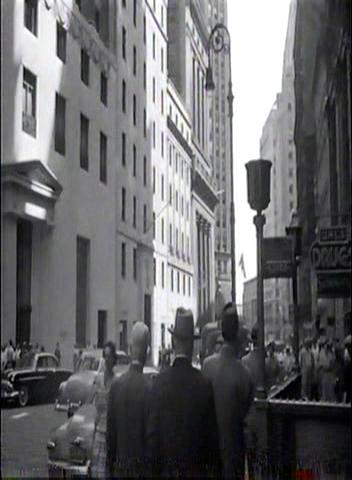
The bell sits in the tower above the executive suite of the title, in a downtown stone monument of a building that serves as the corporate office of a furniture company. We are not yet in the days of suburban industrial parks. We are downtown where the action is.
The action starts right off with the unseen CEO leaving his New York branch building at the end of the workday on a Friday. His perspective is the camera’s perspective. We see who sees him, who makes eye contact and who does not, as he leaves the world over which he is king.
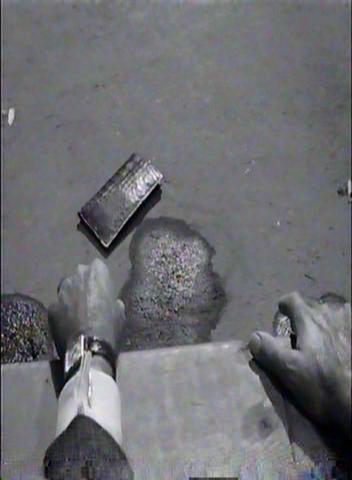
Then he hails a cab out on the sidewalk and crumples to the ground, dying instantly of a heart attack. We see, through the camera and his eyes, the swirling buildings, and the clear sky above
Looking down upon him from an upper floor is our old friend Louis Calhern, (whom we last saw as the rogue here in The Man With the Cloak) an executive in the firm, who, sensing an opportunity, sells a chunk of company stock he cannot cover. It doesn’t matter, because he knows that when the news gets out of the Big Boss’s death, the stock will plummet.
Once it does, he can buy it back for next to nothing. In the weeks to come, the stock will rise. He will make a tidy profit.
His cheap sell-out scheme lays out before us the message of the film. We get there, by and by.
It is fun to see Mr. Calhern’s meltdown when the Big Boss, whose wallet was stolen by a passer by when the ambulance arrives, is taken to the city morgue as a John Doe, and wrecks the timing on Calhern’s game.
Such is the behind-the-scenes maneuvering of the board of officers on this company, and there will be much jockeying for position to see who gets voted to be the new Big Boss. It is survival not of the fittest, but of the least principled.
Among the likely candidates is Dean Jagger, one of the old boys who helped build the company, but who is now regarded as too old to take the helm. Likewise Walter Pidgeon, the longtime partner of the Big Boss, who resents not having been named as second in command a long time ago.
Paul Douglas is the hail-fellow-well-met head of sales, who settles deals on the golf course and a bribe of a bottle of scotch. It is the charming façade of a spineless company man. His mistress, and secretary, played by feisty Shelly Winters provides the ego boost he needs, along with other comforts. Until he lets her down, and she shows more pride and mettle than he has.
Fredric March is a standout in this film as the smarmy numbers cruncher, who worms his way into other’s private affairs to get information to use against them. It is a magnificent performance, a virtuoso of snideness, ingratiating artificiality, and backstabbing. We see his grim confidence behind his sneer. We see his resentful insecurity when his wiping his sweaty palms with his handkerchief.
There is William Holden, as the Bright Young Man, who works in product development and represents the idealism that the Big Boss and his partners once had, but have abandoned in the lure of making an even bigger profit.
Holden’s supportive wife is played by June Allyson, who maintains their junior executive suburban home with its Mid-Century modern furniture (see this previous post on Strangers When We Meet for more examples of that), and raises their all-American boy, played by young Tim Considine.
I wonder if the furniture in his ultra modern house was made by his own company, and if it’s the good stuff or the cheap knock-off stuff, and if he got a discount?
Check out Walter Pidgeon’s home and we get an eyeful of traditional furniture, a nice contrast that tells us a lot about these two men, their perspectives and their eras. Furniture is not just set dressing in this movie. Look at the medieval design of the woodwork in the executive suite. The stained glass windows behind Holden during his big speech make him seem like an evangelist.
Finally, we have Barbara Stanwyck as the heiress whose father founded the company. Until recently it seems, she was also the mistress of the Big Boss. She is depressed and vulnerable in the aftermath of the death of the powerful man who rejected her, selfishly indifferent to what affect his death will have on the company.
Rounding out the cast we have Nina Foch, who as private secretary to the Big Boss, is the major domo of the Executive Suite, making sure meetings run smoothly, privy to all the secrets and keeping her mouth shut.
It’s an engrossing film, character-driven (which we get from the start when each main character is “introduced” to us when Nina Foch knocks on their office doors to remind them of a big meeting. Thus, we see their character names on their doors and identify their faces).
They all have their own agenda. Mr. Holden pouts because his latest product development test got messed up. The Big Boss, who once promised him free reign to improve their furniture, let the ball drop and fell under the spell of business ideology such as Fredric March’s character, Mr. Shaw, where profits are to be doled out to stockholders and not reinvested in the company.
Holden complains, “Improve the profits but never the product. That’s Shaw’s philosophy,” he says of Mr. March. “To him, the whole company’s just a curve on a chart.”
Dean Jagger, a hands-on man like William Holden, who helped start the company, resents Holden’s supposed “golden boy” (so to speak) position with the Big Boss. Mr. Jagger practically invented furniture, he seems to say, “And I didn’t need the boy wonders and the slide rule experts to show me how.” (See this previous post for our discussion on slide rules. My gosh, there’s a link for everything in the post.)
Mr. Jagger is so fed up, he is planning on retiring, and let the company crumble. I love Holden’s admiring smile across the boardroom table when Jagger says he is taking a weekend trip to sail on his boat and eat Maryland crab. It’s a small touch but says volumes about mutual appreciation and comradeship that can exist in companies as well as enmity.
Fredric March tails Paul Douglas to the airport (see this previous post on the Long Beach Airport), to humiliate him by catching him in a tryst with Shelley Winters.
Walter Pidgeon’s wife complains that he has been living in the Big Boss’s shadow, and urges him to make a play for the top job.
A great scene with Mr. Pidgeon, in an attempt to do just this by returning to the office to draft public announcements on the Big Boss’s death and funeral arrangements, discovers the presumptuous Fredric March already there and handling everything himself with a condescending air.
They argue details, but March has clearly assumed control. Walter Pidgeon, ever the gentleman from the old school, is aghast that Mr. March does not intend to close the factory out of respect for the deceased.
Time is money.
Suddenly the plot shifts from what will happen to these board members, to what will happen to the company.
To save it from the nefarious clutches of Fredric March and his ilk, Holden, the reluctant hero, must convince Walter Pidgeon to anoint him heir. Holden must dicker and pontificate in the boardroom in a tense scene to shake them up and win their confidence, rather like a politician. And he must shame Barbara Stanwyck, who holds a controlling vote, into dropping her self pity for two seconds to consider the lives of others and the legacy of this furniture company that bears her family name.
Mr. Holden is worried about the product, and about the workers. When he leaves the plant at the end of the day, after the whistle has blown, an army of laborers files out the gates with him. We see he is a man of the people. He knows many of them by name. Note the American flag in the background, over his head like a halo. This symbol as well as the workers crowding at his elbow already seems to anoint him.
The workers are worried the plant will shut down now that the Big Boss is gone and things are so unsettled. Some complain about the junk furniture they manufacture, a far cry from the good old days when they were proud of their product.
“Why did he allow it?” one disgusted laborer asks Holden, and then the other pivotal question, “Where do we go from here?”
Holden has no answers. But we know where they went. We’ve already arrived.
Have a look at this link to a New York Times story from July about the Harley-Davidson motorcycle manufacturer enjoying soaring profits, more than triple from a year ago. Reaping the profits, specifically, are the shareholders. The workers reap pink slips. Around 1,500 people will be let go by the end of this year. As the article notes, many other manufacturing firms reaping profits this year did so by trimming the fat, which in business terms always seems to mean people, and do not intend to use their profits to rehire anytime soon.
It’s endemic, this cutting the fat. Check out those self-service checkout lines in grocery stores, the ATM in the bank lobby while two tellers work in a bank that has eight empty teller windows, even the new self-service checkout stands in libraries. Cuts down on the need for librarians to check out your books. All for your convenience isn’t it? Yours or theirs?
So much convenience and so few jobs.
“Convenient!” Mr. Pidgeon blasts Mr. March, “That’s always been your attitude…to make everything as convenient as possible for yourself!”
It is interesting, and somewhat astonishing, to note that what we might lament as the failure of industry in this country and corporate greed today had roots as far back as 1954, specifically the notion that the product will become inferior and the jobs will be lost if the only object is profit for the shareholders.
We were enjoying one of the most energetic and profitable business booms of all time in the early 1950s. But here in this film, we see the veneer crack a little. In industry and in the cheap line of furniture this company has been making, shaving off quality to bolster the bottom line.
The climax of the film is a boardroom showdown between factions, intentions, and ideals. Where Nina Foch, by the way, takes notes in shorthand. Is shorthand taught anymore? I suspect it has gone the way of the dial telephone and antimacassars.
William Holden gets thrust to the top of the heap when he decides to take the responsibility to point out how lousy things have been run in the company. He assumes a leadership role by doing this, thereby anointing himself.
While we listen to his words, our minds may wander a little bit from the plot to what is going on in our own lives.
Fredric March spells it out succinctly, “I believe that a company is answerable first and last to its stockholders.”
Mr. Pidgeon protests, “I get it. Manufacturing and selling don’t count anymore.”
Mr. Holden agrees with Pidgeon, “Sometimes you have to use your profits for the good of the company, not paying them all out in dividends to impress the stockholders with your management record.”
Mr. March contends, with a nod to the brooding Miss Stanwyck at his elbow, that the Big Boss ran things that way. Holden comes back with a remark that seems to speak directly to us.
“He was wrong, the way a lot of people are wrong these days, grabbing for the quick and easy, the sure thing. That’s just a lack of faith in the future.”
His soliloquy about let’s run a better company starts to sound like Mickey Rooney exhorting the gang to put on a show, and some of his remarks might sound just as naïve to us. Holden talks about putting out a line of product that “has beauty and function and value.” Yeah, right.
He talks about workers on the line who prefer to take a pay cut to post to other jobs in the company, just to avoid working on the really cheap crap they’ve been making because it damages their pride.
He tells Barbara Stanwyck that they must put out product that she will be proud to bear her family name.
Do we still have that kind of pride? Willing to take a pay cut to avoid demeaning ourselves? As for pride in family names on companies, in a world where most of our big corporations are acronyms or just a meaningless jumble of vowels and consonants arising from many names over the course of many takeovers, do we really know what company we’re dealing with when we buy that item?
Though the movie ends on a hopeful note (except for Fredric March, whose sickened expression after losing the presidency of the company is priceless), we may not be able to help brooding on the old lady laborer, who walks out of the factory with the swarm of other workers after punching out, to ask William Holden about their future. They know the company is in trouble.
“Everything’s going to be all right, isn’t it?” She asks.
“Don’t you worry about it,” he tells her with a comforting smile.
“But you weren’t here in ’33, you don’t know how it was…”
I wonder, do we know now?
William Holden only guessed at catastrophe for the company and the nation in a booming 1954 when the net dividend for the stockholders was starting to become the benchmark for the health of the company, not the quality of its goods or services, not how many people it employed or if those employees were able to earn a sufficient living.
This is what makes this film fascinating. It can speak to us through a span of more than five decades and still be relevant, yet not relevant because of any timeless quality of human behavior…relevant because its subject is so ironically and unexpectedly topical.
Topical despite that they were in a boom, and we are…where we are, where we were headed back then with decades of deregulation in our future, and industrial flight to overseas plants to improve the net dividend for the stockholders.
By the way, happy Labor Day.
Jacqueline T. Lynch is the author of Ann Blyth: Actress. Singer. Star. and Memories in Our Time - Hollywood Mirrors and Mimics the Twentieth Century. Her newspaper column on classic films, Silver Screen, Golden Memories is syndicated nationally. Her new book, a collection of posts from this blog - Hollywood Fights Fascism - is available here on Amazon.
Robert Wise is the director, and we start from the first moments of the film with bold credits flying toward the audience while an ominous sounding bell tolls…for whom? For everybody, it seems. Maybe even us.
The bell sits in the tower above the executive suite of the title, in a downtown stone monument of a building that serves as the corporate office of a furniture company. We are not yet in the days of suburban industrial parks. We are downtown where the action is.
The action starts right off with the unseen CEO leaving his New York branch building at the end of the workday on a Friday. His perspective is the camera’s perspective. We see who sees him, who makes eye contact and who does not, as he leaves the world over which he is king.
Then he hails a cab out on the sidewalk and crumples to the ground, dying instantly of a heart attack. We see, through the camera and his eyes, the swirling buildings, and the clear sky above
Looking down upon him from an upper floor is our old friend Louis Calhern, (whom we last saw as the rogue here in The Man With the Cloak) an executive in the firm, who, sensing an opportunity, sells a chunk of company stock he cannot cover. It doesn’t matter, because he knows that when the news gets out of the Big Boss’s death, the stock will plummet.
Once it does, he can buy it back for next to nothing. In the weeks to come, the stock will rise. He will make a tidy profit.
His cheap sell-out scheme lays out before us the message of the film. We get there, by and by.
It is fun to see Mr. Calhern’s meltdown when the Big Boss, whose wallet was stolen by a passer by when the ambulance arrives, is taken to the city morgue as a John Doe, and wrecks the timing on Calhern’s game.
Such is the behind-the-scenes maneuvering of the board of officers on this company, and there will be much jockeying for position to see who gets voted to be the new Big Boss. It is survival not of the fittest, but of the least principled.
Among the likely candidates is Dean Jagger, one of the old boys who helped build the company, but who is now regarded as too old to take the helm. Likewise Walter Pidgeon, the longtime partner of the Big Boss, who resents not having been named as second in command a long time ago.
Paul Douglas is the hail-fellow-well-met head of sales, who settles deals on the golf course and a bribe of a bottle of scotch. It is the charming façade of a spineless company man. His mistress, and secretary, played by feisty Shelly Winters provides the ego boost he needs, along with other comforts. Until he lets her down, and she shows more pride and mettle than he has.
Fredric March is a standout in this film as the smarmy numbers cruncher, who worms his way into other’s private affairs to get information to use against them. It is a magnificent performance, a virtuoso of snideness, ingratiating artificiality, and backstabbing. We see his grim confidence behind his sneer. We see his resentful insecurity when his wiping his sweaty palms with his handkerchief.
There is William Holden, as the Bright Young Man, who works in product development and represents the idealism that the Big Boss and his partners once had, but have abandoned in the lure of making an even bigger profit.
Holden’s supportive wife is played by June Allyson, who maintains their junior executive suburban home with its Mid-Century modern furniture (see this previous post on Strangers When We Meet for more examples of that), and raises their all-American boy, played by young Tim Considine.
I wonder if the furniture in his ultra modern house was made by his own company, and if it’s the good stuff or the cheap knock-off stuff, and if he got a discount?
Check out Walter Pidgeon’s home and we get an eyeful of traditional furniture, a nice contrast that tells us a lot about these two men, their perspectives and their eras. Furniture is not just set dressing in this movie. Look at the medieval design of the woodwork in the executive suite. The stained glass windows behind Holden during his big speech make him seem like an evangelist.
Finally, we have Barbara Stanwyck as the heiress whose father founded the company. Until recently it seems, she was also the mistress of the Big Boss. She is depressed and vulnerable in the aftermath of the death of the powerful man who rejected her, selfishly indifferent to what affect his death will have on the company.
Rounding out the cast we have Nina Foch, who as private secretary to the Big Boss, is the major domo of the Executive Suite, making sure meetings run smoothly, privy to all the secrets and keeping her mouth shut.
It’s an engrossing film, character-driven (which we get from the start when each main character is “introduced” to us when Nina Foch knocks on their office doors to remind them of a big meeting. Thus, we see their character names on their doors and identify their faces).
They all have their own agenda. Mr. Holden pouts because his latest product development test got messed up. The Big Boss, who once promised him free reign to improve their furniture, let the ball drop and fell under the spell of business ideology such as Fredric March’s character, Mr. Shaw, where profits are to be doled out to stockholders and not reinvested in the company.
Holden complains, “Improve the profits but never the product. That’s Shaw’s philosophy,” he says of Mr. March. “To him, the whole company’s just a curve on a chart.”
Dean Jagger, a hands-on man like William Holden, who helped start the company, resents Holden’s supposed “golden boy” (so to speak) position with the Big Boss. Mr. Jagger practically invented furniture, he seems to say, “And I didn’t need the boy wonders and the slide rule experts to show me how.” (See this previous post for our discussion on slide rules. My gosh, there’s a link for everything in the post.)
Mr. Jagger is so fed up, he is planning on retiring, and let the company crumble. I love Holden’s admiring smile across the boardroom table when Jagger says he is taking a weekend trip to sail on his boat and eat Maryland crab. It’s a small touch but says volumes about mutual appreciation and comradeship that can exist in companies as well as enmity.
Fredric March tails Paul Douglas to the airport (see this previous post on the Long Beach Airport), to humiliate him by catching him in a tryst with Shelley Winters.
Walter Pidgeon’s wife complains that he has been living in the Big Boss’s shadow, and urges him to make a play for the top job.
A great scene with Mr. Pidgeon, in an attempt to do just this by returning to the office to draft public announcements on the Big Boss’s death and funeral arrangements, discovers the presumptuous Fredric March already there and handling everything himself with a condescending air.
They argue details, but March has clearly assumed control. Walter Pidgeon, ever the gentleman from the old school, is aghast that Mr. March does not intend to close the factory out of respect for the deceased.
Time is money.
Suddenly the plot shifts from what will happen to these board members, to what will happen to the company.
To save it from the nefarious clutches of Fredric March and his ilk, Holden, the reluctant hero, must convince Walter Pidgeon to anoint him heir. Holden must dicker and pontificate in the boardroom in a tense scene to shake them up and win their confidence, rather like a politician. And he must shame Barbara Stanwyck, who holds a controlling vote, into dropping her self pity for two seconds to consider the lives of others and the legacy of this furniture company that bears her family name.
Mr. Holden is worried about the product, and about the workers. When he leaves the plant at the end of the day, after the whistle has blown, an army of laborers files out the gates with him. We see he is a man of the people. He knows many of them by name. Note the American flag in the background, over his head like a halo. This symbol as well as the workers crowding at his elbow already seems to anoint him.
The workers are worried the plant will shut down now that the Big Boss is gone and things are so unsettled. Some complain about the junk furniture they manufacture, a far cry from the good old days when they were proud of their product.
“Why did he allow it?” one disgusted laborer asks Holden, and then the other pivotal question, “Where do we go from here?”
Holden has no answers. But we know where they went. We’ve already arrived.
Have a look at this link to a New York Times story from July about the Harley-Davidson motorcycle manufacturer enjoying soaring profits, more than triple from a year ago. Reaping the profits, specifically, are the shareholders. The workers reap pink slips. Around 1,500 people will be let go by the end of this year. As the article notes, many other manufacturing firms reaping profits this year did so by trimming the fat, which in business terms always seems to mean people, and do not intend to use their profits to rehire anytime soon.
It’s endemic, this cutting the fat. Check out those self-service checkout lines in grocery stores, the ATM in the bank lobby while two tellers work in a bank that has eight empty teller windows, even the new self-service checkout stands in libraries. Cuts down on the need for librarians to check out your books. All for your convenience isn’t it? Yours or theirs?
So much convenience and so few jobs.
“Convenient!” Mr. Pidgeon blasts Mr. March, “That’s always been your attitude…to make everything as convenient as possible for yourself!”
It is interesting, and somewhat astonishing, to note that what we might lament as the failure of industry in this country and corporate greed today had roots as far back as 1954, specifically the notion that the product will become inferior and the jobs will be lost if the only object is profit for the shareholders.
We were enjoying one of the most energetic and profitable business booms of all time in the early 1950s. But here in this film, we see the veneer crack a little. In industry and in the cheap line of furniture this company has been making, shaving off quality to bolster the bottom line.
The climax of the film is a boardroom showdown between factions, intentions, and ideals. Where Nina Foch, by the way, takes notes in shorthand. Is shorthand taught anymore? I suspect it has gone the way of the dial telephone and antimacassars.
William Holden gets thrust to the top of the heap when he decides to take the responsibility to point out how lousy things have been run in the company. He assumes a leadership role by doing this, thereby anointing himself.
While we listen to his words, our minds may wander a little bit from the plot to what is going on in our own lives.
Fredric March spells it out succinctly, “I believe that a company is answerable first and last to its stockholders.”
Mr. Pidgeon protests, “I get it. Manufacturing and selling don’t count anymore.”
Mr. Holden agrees with Pidgeon, “Sometimes you have to use your profits for the good of the company, not paying them all out in dividends to impress the stockholders with your management record.”
Mr. March contends, with a nod to the brooding Miss Stanwyck at his elbow, that the Big Boss ran things that way. Holden comes back with a remark that seems to speak directly to us.
“He was wrong, the way a lot of people are wrong these days, grabbing for the quick and easy, the sure thing. That’s just a lack of faith in the future.”
His soliloquy about let’s run a better company starts to sound like Mickey Rooney exhorting the gang to put on a show, and some of his remarks might sound just as naïve to us. Holden talks about putting out a line of product that “has beauty and function and value.” Yeah, right.
He talks about workers on the line who prefer to take a pay cut to post to other jobs in the company, just to avoid working on the really cheap crap they’ve been making because it damages their pride.
He tells Barbara Stanwyck that they must put out product that she will be proud to bear her family name.
Do we still have that kind of pride? Willing to take a pay cut to avoid demeaning ourselves? As for pride in family names on companies, in a world where most of our big corporations are acronyms or just a meaningless jumble of vowels and consonants arising from many names over the course of many takeovers, do we really know what company we’re dealing with when we buy that item?
Though the movie ends on a hopeful note (except for Fredric March, whose sickened expression after losing the presidency of the company is priceless), we may not be able to help brooding on the old lady laborer, who walks out of the factory with the swarm of other workers after punching out, to ask William Holden about their future. They know the company is in trouble.
“Everything’s going to be all right, isn’t it?” She asks.
“Don’t you worry about it,” he tells her with a comforting smile.
“But you weren’t here in ’33, you don’t know how it was…”
I wonder, do we know now?
William Holden only guessed at catastrophe for the company and the nation in a booming 1954 when the net dividend for the stockholders was starting to become the benchmark for the health of the company, not the quality of its goods or services, not how many people it employed or if those employees were able to earn a sufficient living.
This is what makes this film fascinating. It can speak to us through a span of more than five decades and still be relevant, yet not relevant because of any timeless quality of human behavior…relevant because its subject is so ironically and unexpectedly topical.
Topical despite that they were in a boom, and we are…where we are, where we were headed back then with decades of deregulation in our future, and industrial flight to overseas plants to improve the net dividend for the stockholders.
By the way, happy Labor Day.
*********
Monday, September 7, 2009
Picnic - 1955

“Picnic” (1955) takes place on Labor Day, in a Midwest small town. In the middle of the country, in the middle of the 1950s, we arrive at a point in the lives of the characters in this film when they are both looking back and looking forward. For most, it seems their prospects are as flat as the horizon.
William Holden plays Hal, an unrealistic dreamer and likable screw-up who arrives in town riding a boxcar, with little more than his father’s boots to his name. Holden is often judged by many as being too old to play this boyish character, and perhaps that is true. Already having successfully played more mature men of the world, one can sense in some scenes what might have been Mr. Holden’s discomfort at playing a man in his 20s with the emotional maturity of a teenager. But with a little makeup around the eyes, a little combing of his hair in bangs over a slightly receding hairline, Holden does fine showing us Hal’s loveable foolishness, his pathetic braggadocio, and brings a certain wistful pang of remorse to the inevitable harsh self-knowledge of his own failure. Perhaps a younger, less experienced actor would not have brought the enormous expression of regret we see in Hal’s face, a self knowledge that only time brings.
Besides, William Holden can heave the entire body of young Susan Strasberg over his head and carry her with one hand in a picnic race, and this is pretty impressive for a man in his late 30s.
Susan Strasberg shines as the brainiac teenager Millie, rebellious and restlessness, and deeply jealous of her pretty older sister, Madge, played by Kim Novak. “Madge is the pretty one!” Miss Strasberg wails, her teenage pain acute, with no one and nothing to comfort her. 
I believe it was in this movie that director Joshua Logan said of Kim Novak that she “wears her beauty like a crown of thorns.” A pretty well-repeated comment of Kim Novak by now, and in this role, remarkably true. Miss Novak is the anxious beauty queen Madge, who is as equally jealous of her younger sister because of the younger girl’s roundly acknowledged intellect. Her geeky little sister is more confident, dares to be more brash, and is headed off to college. Madge is going nowhere. Her only hope for a happy future, at least according to her worried mother, played by Betty Field, is for her to marry the rich boy in town.
The rich boy, son of the town’s grain elevator company owner, is played by Cliff Robertson. No struggle for Madge to snag him, because he’s already after her. The problem is Madge. She’s deeply insecure about her much-proclaimed beauty, wanting instead to be appreciated for more than that. Her fear is that there isn’t much more to her. She’s not really in love with Robertson, and she, a girl who has grown up fatherless by the railroad tracks, feels out of place among his wealthy set. And then William Holden arrives in town.
There are a lot of interesting comparisons to make to “Peyton Place”, which we covered last time. Both reflect the turmoil of the individual’s fitting into a tight-knit, and often judgmental community. Both, though launching the plot off the sexual desires of the youth, also reflect the emotional crises of the older generations with poignancy.

Rosalind Russell plays the spinster schoolteacher who boards with Betty Field’s family, and plays her like a force of nature, occasionally chewing the scenery. Footloose and fancy free, she boasts of relationships she has broken off to keep her independence, but we soon learn the only man willing to keep company with her these days is the befuddled Arthur O’Connell, one of the terrific character actors of this era. He is a confirmed old bachelor who brings liquor to liven up the party, and contentedly comforts himself in his bachelor apartment with his 21-inch TV. I love how his tie is too short.
Their relationship is old, stale, but livens up after a climatic scene when Miss Russell paws Holden in a desperate cry for attention, and afterward she realizes tearfully, with repentance and in some panic that Mr. O’Connell is the only man left to her who will keep her from being alone. She begs him to save her from a life of spinsterhood.One of the interesting differences in “Picnic” to “Peyton Place” is the role of the mother of the lead characters. Lana Turner is the mother who bore her child out of wedlock and afterward spends considerable energy keeping her teenaged daughter from any kind of intimate contact with any boy, who warns her of sex and accuses her of sex, but will not otherwise talk about it.
Betty Field in “Picnic”, however (in contrast to her own role in “Peyton Place” as the tragic figure so beaten by the circumstances of her life that she cannot comfort a brutalized daughter, only obsess over what the neighbors will think) practically throws Kim Novak at the rich boy. Field questions her daughter on how far she lets Cliff Robertson go on dates, not to warn her off intimacy before marriage, but to encourage it so that there will be a marriage. We can see Novak’s embarrassment with this discussion, and Betty Field’s determined desperation.
In both films we have the camera shots from high above, a point at which the characters can look down on the town and consider it. In “Peyton Place” it is Russ Tamblyn and Diane Varsi on the top of the mountain looking down upon the town. In “Picnic” it is William Holden and Cliff Robertson on the top of the grain elevator, a symbol of his family’s wealth and power, overlooking this Kansas town. Still, it is difficult to see the town even from this vantage, just as we might have to stand far back from a painting in a museum to really appreciate it. Some of these characters in both these movies will need to actually get out of town to see it for what it is.The climatic scene in both films takes place at the Labor Day picnic, which is as fun to watch as it is useful for helping the plot to unfold. All the lead characters in “Picnic” participate in various games and races. In one race the ladies are told they need a male partner to compete in a rather servile-looking ring-toss game, and Rosalind Russell crows, “I’ve got a man!” to the defeated looks of the ladies who don’t.
The evening brings the final event of the day, the choosing of the festival queen, in this case “Neewollah”, which is Halloween spelled backwards. Kim Novak is floated down the river on a swan boat wearing a crown and cape while the townspeople pay homage in what might look silly to an outsider, but we are no longer outsiders here. We can smile at the foolish pageantry, and understand the need for it at the same time.Mr. Holden is captivated at the sight of her, but mostly at what she represents, a grandeur he seeks for himself. We see Cliff Robertson now has a rival. In the next scenes over the course of the evening, a lot flip-flops and lives are changed forever. Relationships break off, new ones start, and Kim Novak, who has been eyeing Holden with fascination since she met him, now finds the guts to make the biggest decision of her life.
Probably the most interesting aspect in this film of what today might be considered rampant sexism, where the women are regarded, and regard themselves, as essentially worthless if they do not attract and keep a man, is the blatant exploitation of William Holden’s masculinity. He is ogled and pawed, his clothes are ripped from him by a desperate older woman. He is shirtless and leered at by the ladies and by the camera. He is Jayne Mansfield and Marilyn Monroe in his vulnerability as a sex object.
And he is miserable. Like Kim Novak. It’s a sweet idea that the comfort they seem to bring each, their mutual woes of not being appreciated for their inner worth, will make a bridge on which they can build a lasting romance. But the film carries with it an irresistible reality that maybe happily-ever-after is a matter of degree. When Mr. Holden all but demands Novak follow him when he must hurriedly leave town ahead of the police, we may wonder if he is ever going to grow up and stop thinking only about himself. We may suspect that Miss Novak is walking into as hopeless and unsatisfying a relationship as her parents’. But we don’t really know.
We don’t really know if Roz Russell and Arthur O’Connell are really going to make a life together in his bachelor apartment with his 21-inch television. She will quit teaching, which she wants very much to do, and will likely have to anyway as many teachers in many areas of the country were still required to be single at this time. They leave for they honeymoon, she ecstatic, he dazed.
We are left with Betty Field, the well-meaning and ambitious mother of two daughters as different as night and day, with different needs and different personalities. A woman who takes in borders to make ends meet, because her own marriage failed many years ago. We are left with the gentle older neighbor Miss Potts, played by Verna Felton, who cares for the demanding and unseen mother that requires all her energy, all her time. Just as in “Peyton Place”, the older generations are seen as having paid a price, and one of the most touching moments in the film is when Verna Felton and Betty Field sit pensively on a swing at the town picnic, the evening shadows lowering, and Felton confesses that just being able to watch Field’s daughters grow up from her vantage point of her own backyard made her lonely life easier. This is a woman denied her own family possibly by the very responsibility of caring for her invalid mother. How poignant it is to show an elderly woman calling to an even older woman, “Yes, Mama, I’m coming,” with no resentment, only concern. Miss Felton has made peace with her life, even as she lives vicariously through everyone else’s. It is she who first welcomes Holden into their lives, fusses over him and makes him comfortable. He playfully calls her his girl. It is she who first notices the attraction between Holden and Novak, and she wistfully, with wonder and captivation, but without an ounce of Miss Russell’s jealousy, comments, “Aren’t they graceful?”
Though Kim Novak is warned by Betty Field that time is flying, and she is at the peak of her bloom and needs to pursue marriage with the rich boy while she is still desirable, we are reminded that in Field herself, and in young Susan Strasberg, and in Verna Felton, time is flying for every generation. It brings to mind the old poem about gathering rosebuds while ye may, and it applies to everyone: “To the Virgins, to make much of Time,” by Robert Herrick.
GATHER ye rosebuds while ye may,
Old Time is still a-flying:
And this same flower that smiles to-day
To-morrow will be dying.
The glorious lamp of heaven, the sun,
The higher he 's a-getting,
The sooner will his race be run,
And nearer he 's to setting.
That age is best which is the first,
When youth and blood are warmer;
But being spent, the worse, and worst
Times still succeed the former.
Then be not coy, but use your time,
And while ye may, go marry:
For having lost but once your prime,
You may for ever tarry.
Verna Felton would identify more with this than either of Betty Field’s girls. But they’ll understand in time, in their own ways, with their own regrets. This is what makes the film interesting, is that it doesn’t really end. The audience decides what the ending will be. Because it is Labor Day, the summer, at least, is ending, the movie showing us a race against time that is an allegory for the broader issues.
Below, have a look at the famous dance sequence with William Holden and Kim Novak at the picnic. Enjoy your Labor Day, and may the eventual evening shadows fall gently on you and yours.
Monday, August 31, 2009
Labor Day "Picnic" at "Peyton Place"
For the next two posts, we’re going to tackle two films with a few elements in common, but how much of this is due to coincidence and how much due to the prevailing social winds of the late 1950s, I leave you to decide.
That they both include pivotal, and very entertaining scenes at community Labor Day picnics is certainly a coincidence (which both showcase dueling barbershop quartets), but there’s a lot more going on than picnics, and the community at large is an ever-present, one might suggest omnipresent, force in the stories of these two films.
Both are set in small towns. Both involve a soap-opera style telling, tiered interwoven stories of different generations of characters. Sexual awakenings. Middle-aged yearnings. Small-town prejudices and stifling judgment. A fear of scandal. Even labor versus management issues. The rich town scions, and the people struggling from the houses by the railroad tracks. For some characters, a need to fit in to the small town life, a desire to remain sheltered by it. For others, a need to escape to a broader, more diverse, more challenging world.

One represents a New England mill town, and the other an agriculturally-based town in the Midwest. They are like fraternal twins. Both films are heavy on location shooting and give us a great sense of place. We know where we are. We see the outside, the tangible very well, the solid pictures of American Main Street and back yards. These films try to give us a picture of their inner turmoil as well, but that is intangible and tricky to photograph.

And both films, coincidentally, feature Betty Field as the careworn mother of troubled teenaged daughters. She is the Midwestern abandoned wife and mother seeking upward mobility for her daughter through marriage. She is New England drudge, the wife of the town drunk, who suffers agonies over his brutality, and even more over the horror of what people will think. In both movies, she is the victim both of her husband and her own apathy. In both movies, living by the railroad tracks signifies her place in her rigid society.

Was there really such universality in America in the 1950s, such homogenous experiences? Or did we unwittingly create that all-purpose template just to tell the story, which has now become textbook 1950s Americana?
Both films originated from dynamic non-film worlds, “Picnic” from the Broadway stage, and “Peyton Place” from a blockbuster novel. Film changed them, because film uses its own language and puts its own spin on stories. Film also has, or did have at one time, a sometimes unspoken, and sometimes shouted out loud, requirement to not offend the public.
I don’t believe either of these films could be made today, not simply because each in its own way is somewhat dated, but mainly because of what offended the public then and what does not offend it now. The power that lies in these two films is the way they consciously reflected their era, and also held a questioning mirror up to it. They flirted somewhat coyly with questioning what was accepted as appropriate.We commonly hear the term “PC” today and sometimes bristle that the constraints of being “politically correct” are hypocritical and oppressive. However, back in the supposed comfortable world of 1950s America, when men were men, women were women, homosexuals were whispered about, and racial minorities were mostly invisible (being invisible perhaps a knee-jerk remedy to offset the outright stereotyping in films of previous decades), there was a far greater and insidious tippy-toeing effort not to challenge the mores of society that makes any effort at being “PC” today pale in comparison.
Defying this conformity carried heavier punishment, and its governance occasionally bordered on persecution. Not rocking the boat socially or politically, or by prevailing standards, morally, was the oppressive guiding rule, the obsessive-compulsive guideline of screenwriters, directors, producers, distributors, theater managers, and the public they provided entertainment to, from the Congressmen down to the paperboy. Any toe over the line could ruin the actor’s career, get the director fired, the ad campaign pulled, the threat of legal action for the studio, or even jail for the screenwriter.

Perhaps that’s why these two films were so entertaining, and enlightening for their day, and why they remain entertaining if only for their nostalgic value. They were films about small towns and regular folks that visually showed what was pretty and idyllic, and through the script showed what was repressive and ugly.
They may not seem terribly daring today, but they were filmed when it was okay to be a little seamy in movies about gangsters and criminals. But not about Main Street. As cleaned up as these films are not to offend too much, they still dared to suggest not everybody was happy.
One of the dangers the characters face in both films is public scandal, what the neighbors will think. Today, conversely, we may not even know our neighbors very well, let alone care what they think.
At least when it comes to social propriety. One may still feel the brunt of the neighbors’ ostracism, vandalism, or even physical threat if one disagrees with the neighbors’ politics. Social bullying, such as see with “town hall” thugs carrying weapons which they imagine give credence to their opinions, has gone far beyond whispering about the neighbor girl and what she does in the woods with the neighbor boy.
These two films, in some ways much more than even some of the classic films of the 1930s, are very topical for their era. For all their supposed universality in depicting small-town America, they really are locked in that time, like souvenirs in a scrapbook. They are also, to some extent, fabrications.
They had meaning and influence on the society they reflected at the time, but we might wonder, did these towns, this America, ever really exist?
With Labor Day just around the corner, celebrate with “Peyton Place” and “Picnic” this Thursday and next Monday.
Subscribe to:
Posts (Atom)