IMPRISON TRAITOR, PEDOPHILE, AND CONVICTED FELON TRUMP.
Showing posts with label John McGiver. Show all posts

Friday, March 21, 2025

Eve Arden in "Miss Aggie's Farewell Performance" on Ellery Queen


One of the joys of writing about classic films is occasionally exploring favorite stars’ performances on the small screen.  Eve Arden, veteran of stage and films, had also enjoyed a thriving career on radio as the beloved Our Miss Brooks.  In a guest appearance on Ellery Queen in the mid-1970s, she plays a pompous radio show star with panache.  It is a joy to watch her; too bad she dies early in the episode.  But it’s a mystery program and somebody’s got to be murdered. 


This is my entry into the 11th Annual Favourite TV Show Episode Blogathon hosted by Terence at his great A Shroud of Thoughts blog.  Have a look at the other lovely posts at thislink.

The episode “The Adventure of Miss Aggie’s Farewell Performance” stars Eve Arden as Miss Aggie, “beloved principal” of a small-town high school on a daytime soap opera.  Her role as principal is a promotion in job title and tribute to her longtime Connie Brooks character, who was a lowly high school English teacher.  Except for that carefully intoned, crystal voice, the characters are nothing alike.  Hapless Connie had a wry sense of humor, and the character of Miss Aggie is all hearts and flowers, though the actress playing her is a bit of a phony, full of venom and self-aggrandizement.  She rules the roost in the small radio studio, demanding and getting attention, favor, and tribute, if not affection from her cast, which includes Bert Parks playing the football coach, and Penelope Windust as the ingenue, of whom she is jealous.


In the middle of a broadcast, Eve sips water and begins to choke, and collapses, as the organist covers with a burst of incidental melody, as was common on radio, where in some shows it seemed every dramatic moment was punctuated by a blast on the Wurlitzer.  The shy, mousy organist is played sweetly by Bernice Colen, a common face on 1970s television.


Not dead yet, Eve Arden is taken to the hospital, where she lords it over the floor in her private room swamped with floral tributes from fans.  Reigning in her feathery bedjacket, she holds court for the press, and is especially pleased that Ellery Queen is on the case to investigate who poisoned her.  She is so used to acting a part, she asks him to call her by her character name, “Miss Aggie.”


Jim Hutton plays a bumbling but clever Ellery Queen and David Wayne is his crusty father, Inspector Richard Queen of the New York City Police.  The time period of the show is post-World War II in New York, with some foggy establishing shots of the Empire State Building and late-model cars driving past their brownstone where father and son share an apartment.  Ellery is a mystery writer, and the program, as fans will know, is inspired by the series of books and short stories written from 1929 through 1971 by the writing team of Frederic Dannay and Manfred Bennington Lee, who published under the pseudonym “Ellery Queen.”


The TV series lasted only one year, from the fall of 1975 through the spring of 1976, and it was probably my favorite show, or at least one of them, when I was entering my teen years.  I loved everything about it, from the saxophone wail of the jazzy theme, to the opening credits, to the accuracy of its period setting, to the parade of favorite classic film stars, and younger familiar TV character actors, that made it such a kick to watch.  I don’t know why it didn’t last longer, but it was terrific show.  It managed to carry off an irresistible blend of whimsical storytelling with sentimental nostalgia. 


It led to me reading the Ellery Queen books, and Agatha Christie, and eventually led to writing my own post-War II mystery series here are Barnes & Noble, or here at Amazon. Or here, directly from me.  Oh, come on.  All TV shows have commercials.


I really only had one complaint of the series, but it can be traced to the books and classic mysteries of this sort: the well-worn device of the victim leaving a dying clue.  Some of the episodes’ dying clues are little overreaching.  Personally, were I shot in my poofy bedjacket in my hospital room, I would not be trying to figure out how to create an elaborate clue to the identity of my killer that only Ellery Queen could solve.  I would be trying to attract the attention of a nurse, or even a janitor, somebody who could get me some help.  Or franticly making my peace with the Creator.  But then, I have never been very clever, not enough to spend my last breath devising an intricate clue.  


Eve Arden, does, indeed, succumb to a gunshot wound while in the hospital, and Ellery solves the case in such a roundabout way that we kind of forgot he was even investigating it.  His casual solutions also baffle and infuriate his rival, Simon Brimmer, who is a professional radio criminologist, desperately trying to get his ratings up and his sponsor dollars increased.  Simon is played by the wonderful John Hillerman, just as dapper and acerbic, with his ascot and cigarette holder, as his later role on Magnum P.I., for which most people probably remember him better.


Another feature to the program is that just before the final scene, and just before the commercial break before the final scene, Jim Hutton would break the fourth wall and speak directly to the TV viewers and review the clues and the suspects, and ask them if they had figured it out yet.  Try as I might during that commercial, I don’t think I ever got the answer right.


Also in the cast is Betty White, who plays Eve Arden’s agent.  John McGiver plays the show’s stern and stuffy sponsor.  It would be Mr. McGiver’s last role; he died of a heart attack in September 1975.  This program was broadcast a few weeks later on October 16, 1975.

The series is apparently now in public domain and you can watch it here at the Internet Archive.  Scroll down to the episode.

Please have a look at the other blogs participating in the 11th Annual Favorite TV Show Episode Blogathon hosted by Terrence at A Shroud of Thoughts.

 *******************************


My new non-fiction book, CHILDREN'S WARTIME ADVENTURE NOVELS - The Silent Generation's Vicarious Experience of World War II -- is now available in eBook here at Barnes & Noble, Apple, Kobo, and a wide variety of other online shops.

Or here from my Shopify store if you want to buy direct from me and avoid the big companies.

And it is here in eBook, paperback print, and hardcover, from Amazon.

From Cherry Ames, to Meet the Malones, from Dave Dawson to Kitty Carter - Canteen Girl, the Silent Generation spent their childhood immersed in geopolitical events through the prism of their middle grade and young adult books.  From the home front to the battlefield, these books are a window on their world, and influenced their hard-working, conformity-loving generation.

Thursday, November 25, 2021

Fitzwilly - 1967


Fitzwilly
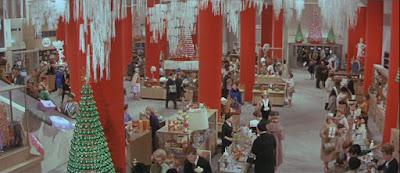
(1967) is both a heist movie and a Christmas movie, another example of whimsical blending of genres, but it also provides a last look at the grand era of the grand downtown department stores.  Gimbels in New York City is a supporting player in this movie.

As we mentioned in the previous two posts of this series on Christmas movies, Cover Up (1949) and The Lemon Drop Kid (1951), that one also about "Christmastime in the city" -- building up to the release of my next book Christmas in Classic Films -- Christmas evokes nostalgia, it is dripping with it, in a way unlike other holidays or festivals in our lives. Nostalgia, rather than just being a by-product, is the driving engine of our modern secular yuletide. Classic films delivered what later generations would think of as nostalgia in an effortless and unselfconscious way, which is part of their charm.  Today’s faux-cozy attempts at Christmas movies seem strained and forced by comparison – with one notable exception, which we’ll get to in weeks to come.  That would be A Christmas Story (1981).

In between the classic films and the modern movies lies Fitzwilly, billed as a romantic comedy but is really a farce, which delivers no intentional sentiment. It is viewing this movie from the distance of the early 21st century that the sentimentality appears like magical snow. Gimbels is the “mark” for the robbers in this movie, but to us, the store is a lovely and now unreachable fairyland.


The robbers are a band of servants led by butler Dick Van Dyke, one of the most popular comedic actors of the 1960s, riding the crest after his landmark TV series, big musicals Mary Poppins (1964) and his next feature Chitty Chitty Bang Bang (1968).  Here,  Mr. Van Dyke is not the usual likeable and quirky buffoon, but rather a more reserved, urbane, and aloof character.  He is Claude Fitzwilliam, butler and head of staff to the wealthy Miss Vickie played by Dame Edith Evans.  She gets to play the quirky eccentric here, and his job is to protect her from her best instincts.  Dame Edith likes to donate to many, many charities, but the problem is she’s really flat broke due to the squandering of the family fortune by her father.

So the butler Fitzwilliam, known affectionately by his employer as Fitzwilly, is her resourceful protector.  He followed his father into service, a family trade, but when his mother died when he was a child, Edith Evans raised him and the two are devoted to each other.

He runs the house with spit and polish precision, but his staff hero-worships him.  They are involved in the many complicated capers he orchestrates to get money to continue to keep the old lady in the style to which she, and they, are accustomed.  This involves an elaborate system of playacting, forgery, fraud, fencing of stolen goods (through his uncle in Philadelphia played by Cecil Kellaway), and most of the thievery done to upscale boutiques and department stores results in damage to the insurance companies.

Since we all hate insurance companies, nobody feels too badly about this.

There are some gems among the junior staff, including Anne Seymour as the lady’s maid whose funny remarks are delivered with deadpan seriousness.  Noam Pitlik is a footman eager for the next exciting adventure.  Helen Kleeb is on the kitchen staff, whom most readers may likely remember for her role in The Waltons television series as Miss Mamie Baldwin.  A young Sam Waterston plays the chauffeur.


Van Dyke’s right-hand man is the wonderfully poker-faced John McGiver, and he is the only one who seems to feel a sense of guilt over their happy misdeeds.  His conscience will nearly send them all to prison.

Into this mix comes Barbara Feldon in her first movie. She’s a spunky and brainy grad student hired to be Edith Evans’ temporary secretary.  Dame Edith has been working on writing a dictionary for people who can’t find the word in a dictionary they want to spell.  Quite a bit of her entries are accompanied by entertaining stories of her ne'er do well father, which Miss Feldon thinks is a hoot and she brings the manuscript to her professor father for his opinion.


At first sight, butler and new secretary detest each other.  She is forward and frank; he is reserved and dignified.  When Feldon begins to know him better and begins to like him, she thinks he is wasting his life as a butler.  He is college educated, he clearly has managerial qualities.  She looks down on his life in service, and he bristles at her snobbery.

He remains in his job not merely to look after the welfare of his beloved employer; he, and his staff, have come to really enjoy robbing stores.  It’s fun.

Their biggest caper is coming up on Christmas Eve.  Until the big night, Christmas is sprinkled throughout the movie in low-key but decorous images: a wreath on a door, a bit of evergreen garland on a mantle, some silver and gold touches on the wall decorations on the rich wood-paneled mansion of the Dame Edith, to the apartment of Barbara Feldon’s father, to the unobtrusive table-top tree in the servants’ hall.  Christmas is graceful and elegant, not screaming at us.  It is the guest at the door who waits patiently for us to make our way there and invite it in. Ironically, the servants prepping for the final Christmas Eve caper in the servants’ hall makes them appear almost like elves in Santa’s workshop.  They must make haste.  They’re robbing Gimbels at 5 o’clock. Good servants are always punctual.


Gimbels, in 20th-century pop culture, was famed for being the rival of Macy’s (they even beat Macy’s by having the first Thanksgiving parade in 1920 in Philadelphia), but most of that so-called rivalry was just publicity for both stores. It was established first in 1887 in Philadelphia and opened its flagship store in New York City in 1910 in Herald Square.  In the waning years after this movie was made, the store was bought up, as companies are, by conglomerates and sold off in chunks, finally meeting its demise in 1987.  Gimbels lasted 100 years.

My favorite part of this movie is the climactic heist scene.  I like heist movies, but really the main attraction here is just the store.  The wonderful, big, colorful, dignified store.  Though really geared toward middle-class customers, today it looks posh to us.

This is where the Christmas nostalgia inadvertently comes in.  Allow me to detour for just a brief moment to recount a recent mall trip.

This particular mall in my neck of the woods is quite large, with long concourses stretching across former farmland to create a glass and concrete indoor city of commerce.  It was established in the late 1970s, grew a bit through the decades, and is now quite fallen from its heyday.  It is probably no different from any other mall across the U.S., with the same chain stores.  It still has a Macy’s anchor store, which is the only spot where one can imagine what shopping was like back when, although a young clerk, when I found one, did not know what a cardigan sweater was, and when I described a sweater that buttoned down the front, she pointed me to a rack of flannel shirts, because they had buttons.  I thanked her anyway.

A young male clerk told me to “just look.” Or was that in Penney's? 

Still, I enjoy Macy’s for the ambiance and the escalator ride this time of year, and the knowledge that, unlike the unhappy Gimbels, it still exists in some form, both the flagship store in New York (which I have also visited and like a giddy child ridden many escalators) to its suburban spawn.

The rest of the mall has deteriorated into a mass of arcades, cell phone stores, nail salons, and shops which cater to the ripped-jeans wearing set.  The nadir of the afternoon was passing a new store: a tattoo parlor and body piercing clinic.

I joked to my sister afterward that I next expected a new shop to open up called “The Red Light District.”

But it was only half-joking. The shopping experience has become dismal.  Down in the similarly dismal food court, a teenaged girl at the next table gleefully yelled out obscenities in a merry chat with her friends seated with her and in a more intimate relationship with her phone.  She was not cussing to express anger; the f-words were only adjectives.


This brings us to the nostalgia of final scene at Gimbels in Fitzwilly, which was not intended to be nostalgic when it was filmed.  Director Delbert Mann would not have envisioned a world where future movie fans would watch his finale in fascination, not only for the heist, but for the, compared to today at least, opulence of the store’s décor, the floors and floors of merchandise, the proper protocol of service, and the customers who dressed for shopping the same way they might dress to visit a house of worship. Coats and ties, white gloves, not a pair of ripped jeans in sight.

The entire staff is enlisted like special ops, each to a task to create an elaborate diversion so that Dick Van Dyke can head up to the business office on the tenth floor and snatch the day’s profits.  Norman Fell is the guardian of the vault, a nervous man who admits he is not at all well. He’s the only one with whom we sympathize.

The diversion tactics are at first subtle, then build, until finally the entire store erupts in chaos.  The final ruse is to convince shoppers to flood the business office upstairs because there the store is giving away free color televisions with any purchase. This is news to the store staff.

Color television.  Nirvana.  You remember: the wonderful world of, “color, color, COLOR!”


The caper is successful until Mr. McGiver’s sense of shame takes over, but a happy ending is pulled out of the hat at the last minute.

The movie is cute and pleasant, but it is the finale at Gimbels that I could watch over and over again.  When I watch with family, there are invariably delighted remarks of “remember that?” and again and again, “remember that?” when we point to the store interior, the shoppers, the world that we remember that is no more.  If we are not reminiscing about Gimbels exactly, we are really recalling the big family-owned department stores we did know locally, run by local prominent families, and the store was never some gimmicky made-up name; it was the family name proudly emblazoned on the marquee, on the gift boxes, the hat boxes, the charge-a-plates.

Christmas was commercial back then, admittedly, just as much as it is today, but in a less tawdry way that it was hard to frown upon. Just shopping there made you feel classy.

Happy Thanksgiving to American readers. Eat, drink, and be merry, for tomorrow is Black Friday.

 ********************

Jacqueline T. Lynch is the author of Ann Blyth: Actress. Singer. Star. and Memories in Our Time - Hollywood Mirrors and Mimics the Twentieth Century. Her newspaper column on classic films, Silver Screen, Golden Memories is syndicated nationally.  Her new book, a collection of posts from this blog - Hollywood Fights Fascism - is available here on Amazon.

Related Products