IMPRISON TRAITOR, PEDOPHILE, AND CONVICTED FELON TRUMP.
Showing posts with label Dean Jagger. Show all posts

Thursday, December 19, 2024

Anne Whitfield -- Susan Waverly's White Christmas


Susan Waverly, the granddaughter of General Tom Waverly, has a larger role in White Christmas (1954) than might be noticed at first viewing.  She has few lines and is a minor character.  Upon successive viewings (at least once every Yuletide season would rack up a lot of times watching this movie -- some of us watch it more often than that) we see that Susan is a major player.  She's in almost every pivotal scene.

Anne Whitfield was about fifteen years old when she played the part of Susan.  Her passing last March at the age of 85 brought to mind how much I've enjoyed her work over the years -- in television guest roles, and on radio, especially as one of the daughters of Alice Faye and Phil Harris on their radio comedy program -- and certainly as Susan Waverly in White Christmas.  According to her obit online (which you can read here), Anne celebrated the 70th anniversary of the movie by watching it with her family last Christmas. 

Happily for us, a few years ago she did a charming podcast interview with Tammy Tuckey and discussed her impressions of working on the movie. Listen to it here.


We meet Susan for the first time as she enters with an armload of firewood behind her grandfather, played by Dean Jagger (whom, Anne says in the podcast interview was "a sweetie").  Musical performers Vera-Ellen and Rosemary Clooney have just arrived, booked here over the Christmas holidays, to work in Dean Jagger's Vermont Inn.  With them are Bing Crosby and Danny Kaye, big-time Broadway producers and performers who have latched onto the ladies.  When Bing and Danny see Dean Jagger coming through the door they are shocked: he is their old army general, and their bumbling salutes and obvious respect are noticed by Susan.  It's quite endearing how she beams with pride over her grandfather (and will again in a famous scene at the end of the movie).

More than pride, Susan has that look of delight to be a fly on the wall in the world of grownups, where from the safety of her own innocence and perhaps insignificance, she can discover all that is profitable about people-watching.  And to Anne's credit, she does look deeply into the faces of the other actors when they are speaking.  This is not only generous to her castmates, it actually strengthens the character of Susan.

We don't really know much about Susan's backstory.  She lives in the inn with her grandfather and their housekeeper, played by the wonderful Mary Wickes.  We assume she is in the care of her grandfather, now retired from the military, because she has lost her parents, but this is never mentioned.  We don't know how long Mary Wickes has been in the general's employ.  Her crusty, no-nonsense repartee with him, particularly when he blows up at her for sending both of his two suits to the cleaners and she reminds him that when he was in the army, "it took 15,000 men to take my place," that perhaps she has been with the family for a long time, maybe even helped raise Susan.  Miss Wickes and Mr. Jagger do seem something like an old married couple at times.


Susan is quiet, kindly, and respectful.  She has no scenes of teenage angst or drama.  We do not see her friends.  However, she is not mousy or a shy child; she actually seems to enjoy being included in the grownups' world.  She moves about the room during the cast party with a tray of cups of coffee, but we also see her mingling in the background, laughing and talking.  When Danny Kaye and Vera-Ellen announce their pretend engagement, Susan is in the background, but standing right between them in the shot.

Though she lugs firewood and acts as a waitress in the inn's restaurant, she does not seem to be an overworked drudge, but gives the impression of enjoying tagging along with her grandfather and noticing everyone about her.  She understands the importance of making the inn profitable.  When Bing and Danny come up with the idea of bringing their roadshow to the inn, she remarks, "This will bring in business, Grandpa!"

We find her importance to the setting of the inn, if not important to the plot of the movie, and yet she is present at turns in the plot.  When Mary Wickes eavesdrops on Bing's phone call to New York and misinterprets what she hears, causing problems and misunderstandings, Susan interrupts her with an armload of parcels, "Here's the laundry, Emma."

When Rosemary Clooney trots off to New York, putting distance between her and Bing, Susan brings the note to Vera-Ellen to give her the news.


When Danny Kaye has to keep the general busy so he can't watch the TV show Bing Crosby is appearing on to plan a big surprise for him, Susan offers, "Grandpa, the battery's dead on the jeep."  When Danny fakes an injury to keep the general's attention on him, Susan smiles, catching Danny's wink.  She is not just an observer of grownups' antics; this time she is part of the adventure.

There is famously that lovely look of pride on her face when her grandfather comes down the stairs in his Army uniform (she rates a closeup), and she takes his arm.  "Grandpa, you look wonderful!"  They head into the large restaurant where Bing, Danny, and the general's old unit pay him tribute.   Susan and Mary Wickes step back and give the general his moment in the spotlight. But they are there in the background and we see them.


When the long-awaited snowfall happens, the general steps out onto the porch and basks in its loveliness--and the knowledge that the local ski areas will be booming and so will his business.  Susan and Mary Wickes are standing together in the background, his "womenfolk," moved by the moment and happy for him.


At the end of the film, when we take that long pan down the tables of ex-GIs and their families, everyone toasting to the sentiment of the holiday, Susan sits next to her grandfather at the head table and passes a champagne glass.  Perhaps she gets to take her first sip of the bubbly.  She beams a beautiful smile, enjoying being grown up and yet not so grown up that she will ever forget the excitement of the evening.


Just before "The End," if you look hard, you can see Susan leaning over to kiss Grandpa's cheek a second time.

Anne Whitfield, no older than Susan Waverly, seems to have been just as decent, humble, and mature a young lady as the part she played.  Perhaps that is why, as she stated in the podcast interview, that the role was enlarged by director Michael Curtiz, giving her an extra line, a bit of business, including her in the background of yet another scene--because he liked her.  Me too.

*******************

TODAY, December 19th, I'll be a guest on the podcast Forgotten Hollywood, hosted by Doug Hess.  We'll discuss Christmas movies and my book, Christmas in Classic Films, and renew auld acquaintance with some of our favorites.  I hope you can listen in here at this link.

LOOKING FOR A STOCKING STUFFER?


Get your copy of CHRISTMAS IN CLASSIC FILMS here at Amazon in print or eBook...and now, HARDCOVER!

Buy your eBook directly from me at my online shop HERE.

Or here at Barnes & Noble, Apple, Kobo, and a variety of other online stores.

  ************

Jacqueline T. Lynch is the author of Ann Blyth: Actress. Singer. Star. and Movies in Our Time - Hollywood Mirrors and Mimics the Twentieth Century and Hollywood Fights Fascism and Christmas in Classic Films. TO JOIN HER READERS' GROUP - follow this link for a free book as a thank-you for joining.


Thursday, January 24, 2013

Parrish - 1961


Parrish (1961) proves that Hollywood can fabricate a lush soap opera story anywhere, under any conditions.  All you need is beautiful leads, nasty villains, and a Big Idea that the characters can exploit and then be destroyed by, or overcome.
This movie has an incongruous edge to it because probably most people not familiar with the Connecticut River Valley of western New England know that tobacco growing was a huge part of our agriculture here at one time, going back to the 1600s.  It was a very important crop, and a big engine in our economy.  Less so today.  For those of us living in the Connecticut River Valley, it is incongruous that Hollywood would turn it into a place of greedy land barons, nubile female field hands of questionable virtue, and Troy Donahue.

Long post.  Get a sandwich.
The Connecticut River Valley is my home, and so this movie has special significance for me just because so much of it was filmed on location, and the sites are familiar to me.  I had family and friends who worked on tobacco farms, and one friend in particular, now sadly no longer with us, claimed he made his film debut in Parrish.  He was just a teenage kid working on the farm where the final scenes of the movie were shot.  He recalled that he and a bunch of other kids were pulled from work and told to race across the fields. Lots of locals were in the movie.  I’m afraid I don’t recognize him in the long shots of running kids, and I doubt he could have recognized himself, but it gives me a warm feeling to know he was there.

 
In my neck of the woods, this is what barns look like.  Tobacco barns and curing sheds stand sentinel on the valley floor, fewer than there once were, but ghosts of former times. 

 Sunderland, Mass., photo by JT Lynch
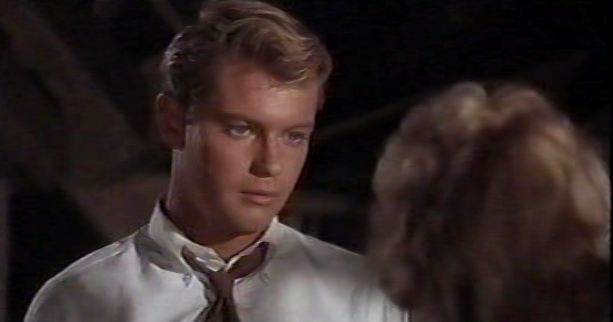
Troy Donahue, who always looked good in red, travels with his mother, Claudette Colbert, from Boston to the tobacco farm of Dean Jagger just north of Hartford, Connecticut.  Mr. Jagger is a gentleman farmer, whose family farm, and its lovely Georgian house, has been here for ages.  His daughter, however, is no lady, played by Diane McBain with an industrial strength pout.
 
Miss Colbert is hired to help with Miss McBain’s coming out, in debutante-speak, and be a steadying influence for the rebellious young motherless woman. 

 
Donahue and Miss Colbert are seen first crossing a river on a ferry.  They are supposed to be in the Boston area, but this is clearly the ferry across the Connecticut River down by East Haddam.  You can even see the Gillette Castle across the river in the distance on the bluff in the photo below.  Have a look here for photos of the ferry crossing site on my essay about the Gillette Castle here on my New England Travels blog.  And here is another post on the other ferry on the Connecticut River joining Rocky Hill and Glastonbury.  It is the oldest river ferry in the US.

 
They fly from Boston to Hartford, which cracks me up.  (Look at it on a map.  They’re an inch and a half away from each other.)  I imagine the director thought that this would give him an opportunity to show the massive white tents of the Shade tobacco fields to their best advantage, and give the plane’s pilot a chance to narrate the view, thereby giving the audience a brief intro on the location and story background.

 
This movie is based on the novel, Parrish, by Mildred Savage.  It was her first of three novels and became a best seller.  I know she is a Connecticut native (and died only a couple years ago), but I don’t know what her connection was to the tobacco growers of the Connecticut River Valley.  Her book is rich in detail about the process of growing tobacco, about the economic realities, and labor problems, and history of this unique agriculture.  This area is one of the few places in the world able to produce quality Shade tobacco, which is used for the outer wrapper of cigars.  How a Wellesley-educated girl knew about the nuts and bolts of this world is something I have yet to learn, but I’d love to know more about her experience.

 
The book, like the novel, is largely a coming of age story about a young man named Parrish who must strike out on his own and deal with what he sees are the challenges and hypocrisies of life.  In a New York Times article by Eugene Archer (June 5, 1960), Mildred Savage, who visited the filming location stated, “I wanted to show an affirmative hero who may be confused because of his youth and sex troubles but is still masculine, unaffected, and optimistic—able to get ahead on his own two feet.  The idea of setting the story in this tobacco industry came last.  It seemed sensible to put a vigorous healthy young man to work in the soil.”

 
Her description pretty much defines Troy Donahue for us.  Never a great actor, but here he’s awkward, sincere, bewildered—just what he should be.  I find him very touching in the scene where he defends his decision to escort Connie Stevens, pregnant by the loutish son of the tobacco baron Karl Malden, to a harvest fair. 
“If some person needs a little bit of kindness, that’s no good.  That’s immoral.  That’s a disgrace to the great world we live in.”  The baritone ripple of indignation is boyishly brave, and if he seems naïve, it’s because he’s supposed to be. 
 
 
But other aspects of Mildred Savage’s book are not brought out in the movie. For instance, there is the young character who talks of unfair labor practices and unions.  There is another character named Tom Holden, who in the movie is played by Hayden Rorke in a brief scene.  He is at the party celebrating Karl Malden’s marriage to Claudette Colbert, and he defends her against the disparaging remarks of Malden’s son, played by Hampton Fancher.  Rorke’s defense is gallant and gentlemanly, but that’s all we get from Tom Holden.
In the book, he is a mouthpiece for progressive ideals.  His family has been raising tobacco for generations here.  He tells Judd Raike, the character played by Karl Malden, who is a newcomer to the Valley and new money, “It never bothers me to pay a good foreman a good wage...He’s worth it.”
But Raike, who is Snidley Whiplash, responds, “A man…is worth exactly as much as his nearest replacement.” 
His son, wanting to impress him, echoes his father, “It’s a crime what labor’s getting an hour these days.  Common labor.”

 
We don’t get these issues in the movie, and it only flirts with other issues about conformity and the hypocrisy of society.  We also don’t get as close a look at Mr. Fancher’s browbeaten wife, who figures more prominently in the novel.  We get more about the Jamaican workers in the novel.  In the movie they are seen from a distance.

 
Parrish likes the Connie Stevens character and her family (her brother-in-law in the movie is played by our old pal, Dub Taylor with delightful aplomb) because they are unfettered by social rules and self-consciousness.  They are easy and hail-fellow-well-met.  Connie is a tramp.  It is possible this is what Troy likes best about her.

 
In a scene that squeezes out every drop of eroticism you can get in a bottle of calamine lotion, Connie dabs Troy’s back gently with the lotion to soothe his tobacco poisoning rash. 
(When she shows him his room in her family’s ramshackle house, we hear the musical intro to A Summer Place, but director Delmer Daves coyly saves us from the rest of the song.)
Later, after the birth of her child out of wedlock, a fact that infuriates and shocks the locals, Parrish is compassionate and understanding.  However, what finally disappoints him is when Connie and her family accept a bribe from the absent father, for letting him remain anonymous.  He will not help raise the child nor contribute to its support, and not acknowledge his relationship to the child.  That’s okay with Connie and the gang, because they’ve got a new refrigerator and a TV set.  It’s like they’ve won the lottery.
Parrish sees that even these independent common folk have a price and can be bought, and that’s when he takes a step back from them.  It’s in the book, but not the movie.
Another thing that comes out more clearly in the book is the similar duplicity and opportunism of Parrish’s mother.  Claudette Colbert plays her like a ladylike member of the garden club, smooth talking and demure, and so she is in the book as well, but she’s also gently manipulative, of Parrish, of her employer played by Dean Jagger in the movie, and eventually of her husband.

 
She marries Judd Raike, played by Mr. Malden in the movie, because he’s filthy stinking rich.  She wants more than anything for Parrish to get ahead in life, and she sees he’s too cussed stubborn and independent to care about getting ahead, at least on her terms.  She has perceived that Judd’s sons are no-account fools, and that Judd will need an heir to take over his tobacco kingdom one day.  She sets her sights on the job for her boy.  Claudette has a brief scene where she stands up to her husband’s nasty remarks about her son, but that never happens in the book.  She’s just as phony as Connie Stevens and her family.  Just on a larger scale.

 
 As far as I know, there were never any tobacco barons in the Connecticut River Valley.  Most farms were small, family owned, and other farms were larger commercial farms owned by faceless corporations.  One guy gobbling up other farms like taking pieces on a chess board is as good a catalyst to tell the story of Parrish’s coming of age as any.  A story needs conflict, and especially conflict of a personal nature, conflict with a face.  That is the purpose in the novel for the character of Judd Raike, and he is as fiendish a guy as you will ever encounter between the covers of a book.
The author deftly depicts him as a man so clever, so moody, so tricky in his passive-aggressive challenges to his family and employees that he is actually one of the most vivid, most real people in the story.  He’s a bit frightening.

 
In the movie, however, Malden is given a script that shows only Raike’s anger, and none of his subtle machinations.  Malden has the thankless task of being nothing but an enraged cartoon of a man.  The character, and the actor, deserve better.  I suspect this was the director’s shorthand, like the plane flight over the valley.
Critic Bosley Crowther in the New York Times (May 5, 1961), is unusually accurate and eloquent in his wry review.
“Who would have ever imagined that growing tobacco in Connecticut would be as socially involved and emotionally exhausting as it is made to appear…”
Who, indeed?

 
He calls it a “status-conscious story,” where the locations and people are “over-dressed and artificial…They are all more or less absurd extensions of some kind of slicked-up social image or cliché.”
Well played, Bosley.

I suppose the biggest acting challenge, and most successfully done, was by Sharon Hugueny, who plays Karl Malden’s daughter.  She ages from her early teens to her early 20s in this movie, and proves to be the most sensible person in it.

 
I have a soft spot for Dean Jagger in his quiet, stubborn role as mentor to Troy Donahue.

 
Other faces to pick out are Hope Summers, who played Hattie for a while on The Rifleman, and Madeleine Sherwood, a lusty young field hand, who did lots and lots of TV and played Mother Superior on The Flying Nun.  I still think of her as Mother Superior and the field hand with the bare midriff shocked my delicate sensibilities. 


Carroll O’Connor is the fire chief, and wouldn’t you know it?  Bess Flowers is a party guest.  You can’t put out a plate of hors d'oeuvres without her showing up.

 
We get a shot of Mystic Seaport, and Troy and Claudette strolling on the whaler Charles W. Morgan.  More on Mystic here at my New England Travels blog, with the whaler in the background of these photos.  I, too, have strolled the deck of the Charles W. Morgan and took the wheel, pretending to be Captain Ahab.  Well, pretending to be Gregory Peck pretending to be Captain Ahab.

 
I’m not sure where the hotel on the shore is supposed to be.  Old Saybrook, I think, or Madison?  Maybe somebody can clear that up for me.  I wonder if it could be someplace they shot in California.  Also the church where two weddings take place, somewhere in the Valley.  What church is that?

 
We also get a brief glimpse of the submarine base at New London, which family and friends of mine have passed through as well.  About the only place I haven’t a connection with in this movie is the scene where Parrish, aboard the nuclear sub USS Nautilus (Correction:  I have since been informed that this is actually the USS Skate), spears the ice at the North Pole.

 
(The Nautilus is still down in New London, on display for visitors, and I may feature that on New England Travels sometime or other.)
In the novel, to get away from his troubles, Parrish joins the Navy, but since the book is set in the late 1940s and early 1950s, he is sent to the waters around Korea and he and his mates fear what might happen if the Korean War involves them.
The movie strips us of that conflict and instead makes Parrish’s naval service a footnote, but still a fun peek at popular culture of the early 1960s.

 
There are grand parties, and grand tantrums, but most appealing are the scenes that focus on smaller images that become intimate: the young shoots of tobacco growing; we watch them climb and reach their full height.  The fields in all seasons, the muddy spring, the fallow autumn, the snow, the lush summer.  Dean Jaggers’ colonial furniture in his farmhouse, against the rich colors of the walls compared to the modern furniture, the pastels in Karl Malden’s showy Hartford mansion.

 
Those red sweaters of Troy’s.

 
And the final shot where Troy and Sharon Hugueny sew up a gap in the tent over his tobacco field.  We see an aerial shot, with just their two heads poking out of a massive field of white cloth.  They look like the submarine surfacing at the North Pole.

 
Parrish is not a great movie, but it is valuable if only for the scenes it preserves of my backyard.  The histrionic soap stuff I can live without.  But give me shots of my ain countrie, and I’m happy.

 
Have a look here at Moira Finnie’s post at The Skeins on Parrish, which I love, especially for remarks like this:
“As filmmakers sought to push the envelope on what was acceptable fare for general cinematic consumption, movie audiences were shifting dramatically from a substantially adult market to one that had the maturity of the average prurient thirteen-year-old. This movie reflects that trend.”
This is perhaps the greatest flaw in this film and other Troy Donahue flicks of the period (I’m looking at you A Summer Place and Susan Slade).  It shucks the social relevance of the novel for the frothy, the shallow, and the gloss.  That's what sells...if you're selling to a thirteen-year-old.  Or someone with the mind of one.
For more on tobacco growing in the Connecticut River Valley, including the remarks of Martin Luther King, Jr., who worked on a tobacco farm here when he was 15 years old, have a look here at my New England Travels blog this week.

*************************************

Come back next Thursday for The Woman in White (1948) with Sydney Greenstreet, Alexis Smith, Eleanor Parker, and Gig Young.  A Victorian mystery based on the classic novel by Wilkie Collins.  Rich in atmosphere, unlike Parrish, the evocative locations in this movie are all backlot and soundstage.  But you'd swear you were there.  See you next week.

************

Jacqueline T. Lynch is the author of Ann Blyth: Actress. Singer. Star. and Movies in Our Time - Hollywood Mirrors and Mimics the Twentieth Century and Hollywood Fights Fascism.  Her latest book is Christmas in Classic Films. TO JOIN HER READERS' GROUP - follow this link for a free book as a thank-you for joining.


Monday, September 6, 2010

Executive Suite - 1954

We mark Labor Day in the U.S. today with a look at Executive Suite (1954). It’s not just a retro look, but an echo from America’s mighty industrial past that drifts with some uncomfortable resonance today.

Robert Wise is the director, and we start from the first moments of the film with bold credits flying toward the audience while an ominous sounding bell tolls…for whom? For everybody, it seems. Maybe even us.

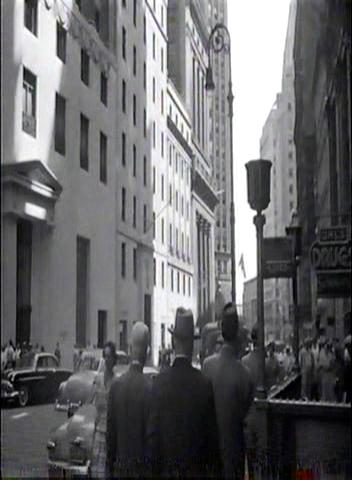
The bell sits in the tower above the executive suite of the title, in a downtown stone monument of a building that serves as the corporate office of a furniture company. We are not yet in the days of suburban industrial parks. We are downtown where the action is.

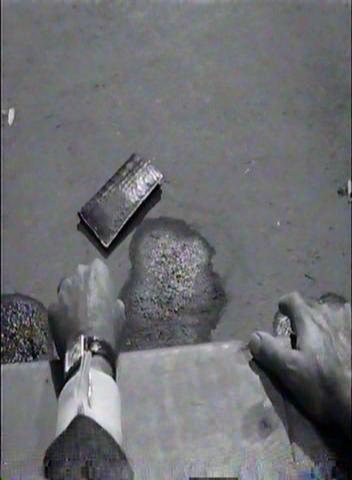
The action starts right off with the unseen CEO leaving his New York branch building at the end of the workday on a Friday. His perspective is the camera’s perspective. We see who sees him, who makes eye contact and who does not, as he leaves the world over which he is king.

Then he hails a cab out on the sidewalk and crumples to the ground, dying instantly of a heart attack. We see, through the camera and his eyes, the swirling buildings, and the clear sky above

Looking down upon him from an upper floor is our old friend Louis Calhern, (whom we last saw as the rogue here in The Man With the Cloak) an executive in the firm, who, sensing an opportunity, sells a chunk of company stock he cannot cover. It doesn’t matter, because he knows that when the news gets out of the Big Boss’s death, the stock will plummet.

Once it does, he can buy it back for next to nothing. In the weeks to come, the stock will rise. He will make a tidy profit.

His cheap sell-out scheme lays out before us the message of the film. We get there, by and by.

It is fun to see Mr. Calhern’s meltdown when the Big Boss, whose wallet was stolen by a passer by when the ambulance arrives, is taken to the city morgue as a John Doe, and wrecks the timing on Calhern’s game.

Such is the behind-the-scenes maneuvering of the board of officers on this company, and there will be much jockeying for position to see who gets voted to be the new Big Boss. It is survival not of the fittest, but of the least principled.

Among the likely candidates is Dean Jagger, one of the old boys who helped build the company, but who is now regarded as too old to take the helm. Likewise Walter Pidgeon, the longtime partner of the Big Boss, who resents not having been named as second in command a long time ago.

Paul Douglas is the hail-fellow-well-met head of sales, who settles deals on the golf course and a bribe of a bottle of scotch. It is the charming façade of a spineless company man. His mistress, and secretary, played by feisty Shelly Winters provides the ego boost he needs, along with other comforts. Until he lets her down, and she shows more pride and mettle than he has.

Fredric March is a standout in this film as the smarmy numbers cruncher, who worms his way into other’s private affairs to get information to use against them. It is a magnificent performance, a virtuoso of snideness, ingratiating artificiality, and backstabbing. We see his grim confidence behind his sneer. We see his resentful insecurity when his wiping his sweaty palms with his handkerchief.

There is William Holden, as the Bright Young Man, who works in product development and represents the idealism that the Big Boss and his partners once had, but have abandoned in the lure of making an even bigger profit.

Holden’s supportive wife is played by June Allyson, who maintains their junior executive suburban home with its Mid-Century modern furniture (see this previous post on Strangers When We Meet for more examples of that), and raises their all-American boy, played by young Tim Considine.

I wonder if the furniture in his ultra modern house was made by his own company, and if it’s the good stuff or the cheap knock-off stuff, and if he got a discount?

Check out Walter Pidgeon’s home and we get an eyeful of traditional furniture, a nice contrast that tells us a lot about these two men, their perspectives and their eras. Furniture is not just set dressing in this movie. Look at the medieval design of the woodwork in the executive suite. The stained glass windows behind Holden during his big speech make him seem like an evangelist.

Finally, we have Barbara Stanwyck as the heiress whose father founded the company. Until recently it seems, she was also the mistress of the Big Boss. She is depressed and vulnerable in the aftermath of the death of the powerful man who rejected her, selfishly indifferent to what affect his death will have on the company.

Rounding out the cast we have Nina Foch, who as private secretary to the Big Boss, is the major domo of the Executive Suite, making sure meetings run smoothly, privy to all the secrets and keeping her mouth shut.

It’s an engrossing film, character-driven (which we get from the start when each main character is “introduced” to us when Nina Foch knocks on their office doors to remind them of a big meeting. Thus, we see their character names on their doors and identify their faces).

They all have their own agenda. Mr. Holden pouts because his latest product development test got messed up. The Big Boss, who once promised him free reign to improve their furniture, let the ball drop and fell under the spell of business ideology such as Fredric March’s character, Mr. Shaw, where profits are to be doled out to stockholders and not reinvested in the company.

Holden complains, “Improve the profits but never the product. That’s Shaw’s philosophy,” he says of Mr. March. “To him, the whole company’s just a curve on a chart.”

Dean Jagger, a hands-on man like William Holden, who helped start the company, resents Holden’s supposed “golden boy” (so to speak) position with the Big Boss. Mr. Jagger practically invented furniture, he seems to say, “And I didn’t need the boy wonders and the slide rule experts to show me how.” (See this previous post for our discussion on slide rules. My gosh, there’s a link for everything in the post.)

Mr. Jagger is so fed up, he is planning on retiring, and let the company crumble. I love Holden’s admiring smile across the boardroom table when Jagger says he is taking a weekend trip to sail on his boat and eat Maryland crab. It’s a small touch but says volumes about mutual appreciation and comradeship that can exist in companies as well as enmity.

Fredric March tails Paul Douglas to the airport (see this previous post on the Long Beach Airport), to humiliate him by catching him in a tryst with Shelley Winters.

Walter Pidgeon’s wife complains that he has been living in the Big Boss’s shadow, and urges him to make a play for the top job.

A great scene with Mr. Pidgeon, in an attempt to do just this by returning to the office to draft public announcements on the Big Boss’s death and funeral arrangements, discovers the presumptuous Fredric March already there and handling everything himself with a condescending air.

They argue details, but March has clearly assumed control. Walter Pidgeon, ever the gentleman from the old school, is aghast that Mr. March does not intend to close the factory out of respect for the deceased.

Time is money.

Suddenly the plot shifts from what will happen to these board members, to what will happen to the company.

To save it from the nefarious clutches of Fredric March and his ilk, Holden, the reluctant hero, must convince Walter Pidgeon to anoint him heir. Holden must dicker and pontificate in the boardroom in a tense scene to shake them up and win their confidence, rather like a politician. And he must shame Barbara Stanwyck, who holds a controlling vote, into dropping her self pity for two seconds to consider the lives of others and the legacy of this furniture company that bears her family name.

Mr. Holden is worried about the product, and about the workers. When he leaves the plant at the end of the day, after the whistle has blown, an army of laborers files out the gates with him. We see he is a man of the people. He knows many of them by name. Note the American flag in the background, over his head like a halo. This symbol as well as the workers crowding at his elbow already seems to anoint him.

The workers are worried the plant will shut down now that the Big Boss is gone and things are so unsettled. Some complain about the junk furniture they manufacture, a far cry from the good old days when they were proud of their product.

“Why did he allow it?” one disgusted laborer asks Holden, and then the other pivotal question, “Where do we go from here?”

Holden has no answers. But we know where they went. We’ve already arrived.

Have a look at this link to a New York Times story from July about the Harley-Davidson motorcycle manufacturer enjoying soaring profits, more than triple from a year ago. Reaping the profits, specifically, are the shareholders. The workers reap pink slips. Around 1,500 people will be let go by the end of this year. As the article notes, many other manufacturing firms reaping profits this year did so by trimming the fat, which in business terms always seems to mean people, and do not intend to use their profits to rehire anytime soon.

It’s endemic, this cutting the fat. Check out those self-service checkout lines in grocery stores, the ATM in the bank lobby while two tellers work in a bank that has eight empty teller windows, even the new self-service checkout stands in libraries. Cuts down on the need for librarians to check out your books. All for your convenience isn’t it? Yours or theirs?

So much convenience and so few jobs.

“Convenient!” Mr. Pidgeon blasts Mr. March, “That’s always been your attitude…to make everything as convenient as possible for yourself!”

It is interesting, and somewhat astonishing, to note that what we might lament as the failure of industry in this country and corporate greed today had roots as far back as 1954, specifically the notion that the product will become inferior and the jobs will be lost if the only object is profit for the shareholders.

We were enjoying one of the most energetic and profitable business booms of all time in the early 1950s. But here in this film, we see the veneer crack a little. In industry and in the cheap line of furniture this company has been making, shaving off quality to bolster the bottom line.

The climax of the film is a boardroom showdown between factions, intentions, and ideals. Where Nina Foch, by the way, takes notes in shorthand. Is shorthand taught anymore? I suspect it has gone the way of the dial telephone and antimacassars.

William Holden gets thrust to the top of the heap when he decides to take the responsibility to point out how lousy things have been run in the company. He assumes a leadership role by doing this, thereby anointing himself.

While we listen to his words, our minds may wander a little bit from the plot to what is going on in our own lives.

Fredric March spells it out succinctly, “I believe that a company is answerable first and last to its stockholders.”

Mr. Pidgeon protests, “I get it. Manufacturing and selling don’t count anymore.”

Mr. Holden agrees with Pidgeon, “Sometimes you have to use your profits for the good of the company, not paying them all out in dividends to impress the stockholders with your management record.”

Mr. March contends, with a nod to the brooding Miss Stanwyck at his elbow, that the Big Boss ran things that way. Holden comes back with a remark that seems to speak directly to us.

“He was wrong, the way a lot of people are wrong these days, grabbing for the quick and easy, the sure thing. That’s just a lack of faith in the future.”

His soliloquy about let’s run a better company starts to sound like Mickey Rooney exhorting the gang to put on a show, and some of his remarks might sound just as naïve to us. Holden talks about putting out a line of product that “has beauty and function and value.” Yeah, right.

He talks about workers on the line who prefer to take a pay cut to post to other jobs in the company, just to avoid working on the really cheap crap they’ve been making because it damages their pride.

He tells Barbara Stanwyck that they must put out product that she will be proud to bear her family name.

Do we still have that kind of pride? Willing to take a pay cut to avoid demeaning ourselves? As for pride in family names on companies, in a world where most of our big corporations are acronyms or just a meaningless jumble of vowels and consonants arising from many names over the course of many takeovers, do we really know what company we’re dealing with when we buy that item?

Though the movie ends on a hopeful note (except for Fredric March, whose sickened expression after losing the presidency of the company is priceless), we may not be able to help brooding on the old lady laborer, who walks out of the factory with the swarm of other workers after punching out, to ask William Holden about their future. They know the company is in trouble.

“Everything’s going to be all right, isn’t it?” She asks.

“Don’t you worry about it,” he tells her with a comforting smile.

“But you weren’t here in ’33, you don’t know how it was…”

I wonder, do we know now?

William Holden only guessed at catastrophe for the company and the nation in a booming 1954 when the net dividend for the stockholders was starting to become the benchmark for the health of the company, not the quality of its goods or services, not how many people it employed or if those employees were able to earn a sufficient living.

This is what makes this film fascinating. It can speak to us through a span of more than five decades and still be relevant, yet not relevant because of any timeless quality of human behavior…relevant because its subject is so ironically and unexpectedly topical.

Topical despite that they were in a boom, and we are…where we are, where we were headed back then with decades of deregulation in our future, and industrial flight to overseas plants to improve the net dividend for the stockholders.

By the way, happy Labor Day.


*********
Jacqueline T. Lynch is the author of Ann Blyth: Actress. Singer. Star. and Memories in Our Time - Hollywood Mirrors and Mimics the Twentieth Century. Her newspaper column on classic films, Silver Screen, Golden Memories is syndicated nationally.  Her new book, a collection of posts from this blog - Hollywood Fights Fascism - is available here on Amazon.

Related Products