IMPRISON TRAITOR, PEDOPHILE, AND CONVICTED FELON TRUMP.
Showing posts with label Martin Balsam. Show all posts

Friday, March 19, 2021

TV's Decoy - "Fiesta at Midnight" episode, 1958


Beverly Garland starred in a weekly police procedural drama called Decoy that ran only one season from 1957-58.  It was a ground-breaking program and far ahead of its time in many respects.  It achieved something rare during what was called the Golden Age of Television, and what is sad -- it’s even more rare today: a well-written, well-acted, sharply produced weekly show with a female protagonist that presents a refreshingly unselfconscious view of her abilities, intelligence, and emotions.


This is our entry into the “7th Annual Favourite TV Show Episode Blogathon” at Terrence Cowles Canote’s A Shroud of Thoughts blog.

It’s a rather long entry.  Sorry.  Go get a snack.

She plays a policewoman, as the term was used then, named Patricia Jones, who frequently is referred to by her nickname, “Casey” Jones.  She uses both names, seemingly without preference.  She is smart without being brilliant – she sometimes gets it wrong and learns from her mistakes.  She is courageous without being a thrill-seeker; she knows fear but also knows that’s human.  She does not forsake being human in order to be a good cop – she follows procedure with the dogmatic persistence of Sgt. Joe Friday on Dragnet and sometimes sounds like him, but she is also empathetic and seems to take quiet pleasure in observing the troubled humanity she meets on her cases.

We see little of her personal life, we do not know about her family or much about her past, only that her fiancĂ©, also a police officer, was killed in the line of duty.  She is not driven to revenge, to drink, to wallowing in angst, but she deals with the occasional stabs of pain from the memory as the price everyone pays for being alive, loving, and remembering.  She is sensitive, but also pragmatic.


We sense that the creation of Officer Jones is entirely a collaboration between director, writers, producers, and actress, and as such, she is a most polished enigma.  In an era of “Hi, honey, I’m home!” sitcoms, she does not take insecure pains to reaffirm her femininity.  On the contrary, she is unconsciously sexy, perhaps never more so when breaking into a brief Mona Lisa-smile in odd moments that remind us her mind is always working and her heart is always open.

Also unusual for the day – and for females represented on TV shows for decades after – her male colleagues do not belittle her, or makes passes, or treat her in any way other than as friendly professionals who rely on each other.  While some of her duties are quite routine, she often must go undercover, which means she is rather like an actress.  She must be a society woman one episode, and a secretary in another. 

If the show were filmed in later decades, she would spend every other episode victimized by being tied up or her vulnerability capitalized on, and the threat of rape would be implied to a degree that makes an intelligent person wonder what has happened to our society that that would be entertaining for the female to always be in danger.  Or she'd be swinging on that insane pendulum between dealing with her private demons with compensating addictions or supercharged overcompensating aggression, both to show that she is a "real" woman dealing with the pressures of her career.  This keeps the actress and the writers busy, but can ironically make for a less interesting character.  One of the most appealing aspects of Officer Jones is her stoicism.

The range of crimes Officer Jones investigates from white collar crime to arson to murder is such that not every episode is peppered with a hail of gunfire.  The show might be too slow for today, but that is one of its strengths.


From a production perspective, one of the most intriguing aspects is that the show is filmed largely on location in New York City.  We see neighborhoods, buildings from the late fifties, the street scenes, the nightlife.  The cameras were hidden, so what you’re seeing happen in the background is real.  The old Penn Station, long gone, is beautifully filmed.  There’s Coney Island, theater marquees, an array of interesting sites.  Many of the interiors are also shot on location, so when you see an office in a factory, that’s where you are.  There is no clean, fake scenery, no set flats.  We see the grime of the factory walls, the old, uneven floorboards and the overstuffed file cabinets. We see the rain-washed streets with real people pulling racks in the garment district or walking in a park.  Everything is real.


Perhaps just to punctuate that, or perhaps just to add an unusual style – Officer Jones breaks the fourth wall at the end of the episode and talks to us.  Sometimes it’s a little startling, even when you know it’s going to happen, because she does not break character.  She suddenly turns and her eyes lock onto yours and she comments about the case, as if she knows we were there every step of the way, as if we are the rookie cop she is teaching.  Sometimes it's to wrap it up, or tell us what happens next.  Sometimes it’s just a final thought.  In one episode, “Night of Fire” she discusses not the case, but ruminates on one character in that episode.  It’s the story of a suspicious factory fire, and she is placed undercover as an office worker.  Another worker in the office is a young woman with a history of being treated for mental illness.  The other workers are hostile to her, tease her, and even suspect her of being the arsonist.  However, she’s only a patsy, and Officer Jones figures out who done it.  At the end of the episode, she breaks the fourth wall and talks not about the crime, but about that young woman.

“Tomorrow she’ll be looking for a job.  I hope she finds a good one, a place where people are enlightened about things like mental illness.  If she comes to your office…give her a break.”  That brief, sad, enigmatic smile, a flicker of warmth in her lovely dark eyes, and she turns away.  She’s said her piece.  No need to beat it to death.  I wonder how many bosses and fellow employees took it to heart at work the next day.

After this rather long introduction to Beverly Garland’s character and the program, (are you still with me?) I’ll move on to the single episode I’d like to discuss for this Blogathon.  It’s “Fiesta at Midnight”, episode 32, broadcast on May 19, 1958.  The director is Michael Gordon.  We discussed his wonderful directorial work on Another Part of the Forest (1948) in this previous post.  The scene is set at Hunt’s Point Palace; again, a real venue.  There’s a dance hall up a flight of stairs, where tonight it’s a Latin combo playing for an energetic crowd of romantic young people.  We listen to the music, watch the couples dancing in the dim evening light as if it’s a documentary and they have no idea we’re observing them.  Maybe they don’t.


Hunt’s Point is in the Bronx, and the Hunt’s Point Palace around a century ago brought swing music to fans in the 1920s and ‘30s, and by the late 1940s, jazz bands gave way to Latin music as a new Puerto Rican population came to the neighborhood.  The ballroom held about 2,500 people, and top bands played here for decades.  Salsa music was coined in the 1970s, but the Palace closed in the 1980s.  The building still stands, but now it’s an office complex.

But in “Fiesta at Midnight” we’re still in 1958, the first flush of Puerto Rican immigration to New York City, only months after West Side Story hit Broadway, so Decoy was not the first pop culture exploration of the problems of Puerto Rican immigrants, but it was certainly among the vanguard. 


With moody shots up and down the staircase that leads to the music from the hall, we meet three people on the town:  Anita, played by Gloria Marlowe, and her fiancĂ© Raoul, played by Dario Barri.  They will be married in a week.  With them is Anita’s cousin, Maria, played by Miriam Colon.  Maria wants to remain at the bottom of the stairs, not going into the dance, but just listening, dreamy-eyed, where she is.  They urge her to come, but she insists she just wants to listen and to contemplate.  She is not looking for a date for the evening: she reminds them she is going to be married tomorrow.

They leave her alone and go up to the dance.  After a moment, Raoul leaves Anita, says he has to meet a man around the corner.  She warns him against getting into trouble again, but he is a charmer and tells her he will be right back. 


Seeing she is alone, a young newly arrived immigrant from Puerto Rico approaches Anita.  He is Juan, played by Tomas Milian.  He asks her to dance, but she tells him she is engaged to be married.  Juan is a quiet, shy young man and he confesses that he cannot get anyone to dance with him, that all the girls are paired off with husbands or boyfriends.  Anita, half in sympathy and half teasing, suggests he go down to the bottom of the stairs and talk with Maria, maybe she will dance with him.


He meets Maria, but she will not dance with him either.  Again, what he dreads to hear: she will be married tomorrow.  She is a lovely young woman, and he is very taken with her and they chat a moment, at least until the midnight church bells signal that, like Cinderella, she must leave the ball.  He respects that she is off limits and he leaves the dance hall without following her.


We walk through the dark street with him, past storefronts, and about to cross a dark alley when a man runs towards us out of the blackness, topples Juan, and runs away.  Followed close on his heels are the cops, who grab Juan, thinking he's the guy they are chasing.  Poor Juan gets dragged to jail for the armed robbery of a store.
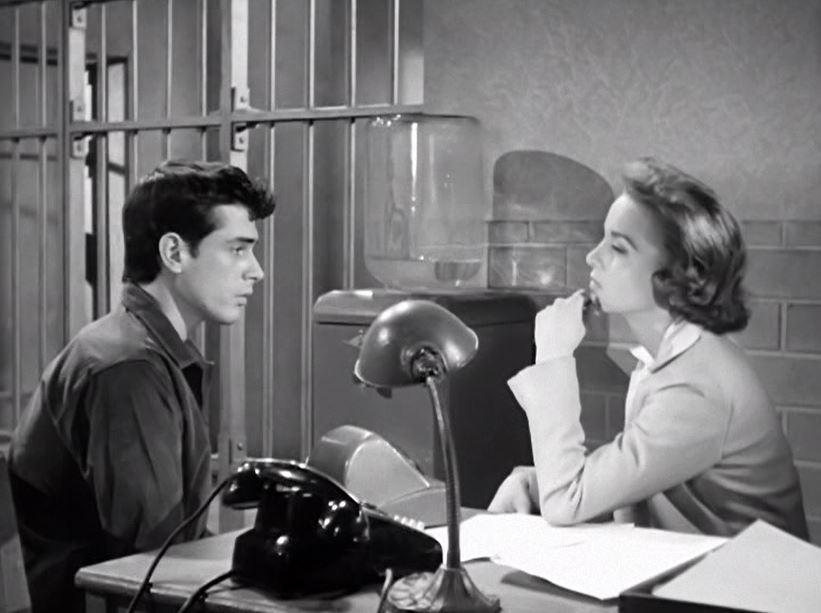

Officer Patricia Jones gets called in on the case, not undercover this time, but a routine investigation.  She visits the store owner in the hospital, a middle-aged white woman named O’Connell, played by May Michael, who was shot in the robbery.  She is conscious, and furious at the cops’ apparent slowness to understand what a menace the Puerto Ricans are.  She is asked,

“Are you sure the man who shot you was Spanish?”

“I’m sure, all right. Don’t I hear them jabbering all day long?”

Discussing the case with her chief, Officer Jones remarks, “Somebody steals an apple from a fruit cart and they’re ready to lynch anybody by the name of Jose or Pablo.”

She interrogates Juan (and even demonstrates a rudimentary knowledge of Spanish), who is scared stiff and desperate to find someone who will believe him.  She begins her drudge work of questioning leads to find out if his alibi – talking to a girl named Maria at midnight when the crime happened – is real.


She eventually finds Anita at home, a week later and now married to Raoul.  Anita is closed-mouthed and denies meeting Juan, denies even knowing Maria.  We begin to understand that she suspects Raoul, because he left her for a few minutes, to be the one who actually committed the robbery.  She is trying to protect him.  When “Casey” Jones leaves, Raoul comes back to the apartment and Anita confronts him.  “Casey” returns when it is reported by neighbors that Raoul beat her up.

Still, she attempts to protect her husband, and “Casey” gives her the sensible advice, “You’re a fool to let him get away with it, honey.  He’ll do it again sometime.  Maybe that time you won’t be able to complain.”

Then the O’Connell woman in the hospital dies.  It’s a murder rap now, for Juan unless “Casey” can prove his alibi is true.


Running down all the logical prospects and getting nowhere, she wonders if perhaps the woman called Maria – who was supposed to be married the next day after the incident – did not marry after all.  Perhaps the wedding was called off and that’s why Officer Jones can’t find any public record of it.  She goes to the neighborhood church to ask the priest if he can confirm this.  He is in the middle of a First Communion rehearsal with a group of little girls, so she has to wait for him.  She spots Anita kneeling in one of the pews, her Rosary beads in hand.  “Casey” tries again to work on her, but Anita is stubborn and won’t tell her anything.

It’s a small thing, but because we don’t know Officer Jones’ own personal religion, I find it quite touching as well as a sign of the times that she pauses before she enters the Catholic church to pull her scarf over her head.  In pre-Vatican II days, head covering for women was required, and still is the custom in some countries.


We are actually teased with religious symbols throughout the episode, but unless you’re really observant, or have seen the episode a couple times, you won’t know that director Gordon means them for clues:  the large cross Juan wears in the neck of his open shirt, the crucifix on the wall of Anita’s apartment framed behind Officer Jones’ head.  It’s all pointing to a solution that only hits “Casey” when she’s given up on Anita, and, about to leave the church, smiles at the passing procession of girls walking down the aisle to the altar to practice receiving their First Communion.


Then it hits her – but not us yet.  Next, she drags Anita, Raoul, and Juan to another place where she has located Maria.  We are in a hallway, which has a figurine of the Virgin Mary on a heavy piece of furniture – another last-minute clue.

Then the door opens and Maria enters. 

She’s a nun.


When she said she would be a bride the next day, she meant she was joining a holy order and become the “bride of Christ.”  Juan is shocked, but Anita and Raoul are only uncomfortable because now that Maria has been found, she will undoubtedly tell the truth, if she remembers talking to Juan at midnight.

She does, and recognizes him.  Raoul is off to prison. Juan’s free, if still pained by his crush on Maria.  Anita is just plain crushed, and Sr. Maria is wondering what’s going on.

Officer Jones realized that Maria could be a nun when she saw the little girls in their white dresses walking down the aisle towards the altar, looking like a row of little brides.  She figured out Maria’s use of the phrase “tomorrow I will be a bride” as if it were a riddle. 

It’s a shame Decoy lasted only one season.  Several future stars appeared on the program, such as Colleen Dewhurst, Peter Falk, Martin Balsam, and Suzanne Pleshette.  Many of the episodes are in public domain and have been released on DVD, but the three-disc set released by Film Chest MediaGroup is excellent and contains a booklet with facts about the show and a synopsis of episodes.

One interesting fact the booklet relates: Between 1949 and 1990 there were around 555 dramatic television series.  Only about 36 starred women.

I hope you can catch up with the series Decoy sometime, and please visit the rest of the blogs participating in this “7thAnnual Favourite TV Show Episode Blogathon” at Terrence Cowles Canote’s A Shroud of Thoughts blog.

----------

Jacqueline T. Lynch is the author of Ann Blyth: Actress. Singer. Star. and Memories in Our Time - Hollywood Mirrors and Mimics the Twentieth Century. Her newspaper column on classic films, Silver Screen, Golden Memories is syndicated nationally.  Her new book, a collection of posts from this blog - Hollywood Fights Fascism - is available here on Amazon.

Thursday, August 18, 2016

Seven Days in May - 1964


SevenDays in May (1964) uses a most meaningful and chilling biblical term in the crackling dialogue: “false prophets”. It is this phrase, so well known, and occasionally exploited by religious fundamentalists, that we hinge this post on, and not so coincidentally, this election year.

This is the fifth and last movie we will discuss in our series on the treatment of fascism in classic films. The previous four films were The Mortal Storm (1940), Address Unknown (1944), Storm Warning (1951), and Keeper of the Flame (1942).

“False prophets” is the term used by star Fredric March to describe General Edwin Walker, a real-life figure, who attempted a political career, unsuccessfully, after President John F. Kennedy accepted his resignation in November 1961. Walker, an outspoken critic of political figures and members of the government he felt were communist sympathizers – naming, in his accusations, President Harry S. Truman, former First Lady Eleanor Roosevelt, and others in government, used his position in the Army to impose his extreme right-wing views and attack those who did not agree with him.  Crossing the line of propriety, not to say prudence, among military figures who desire political power is nothing new. General Douglas MacArthur, also frustrated in political aspirations, was removed from his position by President Truman when he attempted to sidestep the authority of the President and run the Korean War in his own manner, which included his intention to escalate a full-scale war with China.

Adolf Hitler was a soldier in World War I who blamed Germany’s defeat on the politicians, and thought he could run things better, too.

The story in Seven Days in May is fictional, but that it was, and is, entirely plausible makes the movie an important voice not only of those tense days of Cold War crisis when nuclear weapons raised the ante in a war of words with the Soviet Union, but remains relevant today. Nuclear weapons have not gone away. A new demagogue has risen from the dark corners of a free and tolerant society to exploit it. Donald Trump, however, was not a soldier or representative of our arms services. He has declined membership and avoided the draft on several occasions. But he has more support and free range than any false prophet in our history. The lazy, shallow, and inept media, and a moronic legion of extreme right-wing supporters, has allowed this. They even celebrate it.

Though we have seen much in this election year alone to make us jaded, nevertheless I don’t think that keeps us from feeling the power of Seven Days in May, the shock of the characters facing an unimaginable threat to our democracy.  Though it was made at the height of the Cold War, and is set in a vague not-too-distant future of the early 1970s, the theatricality of the movie (it is really a series of “drawing room scenes”); the sharp, literate dialogue; the fast-paced plot; and the stellar acting make this movie as equally relevant today as it is a timepiece from an era when the media wasn’t so much a “loose cannon” as it is today, providing a showcase for other loose cannons.

I first read the novel on which the movie is based when I was in high school, and re-read it before preparing for this post. I understand much more about politics and government, and life, than I did at sixteen – but the eerie chill that something like this could happen remains just as profound in middle age as it did in my teens, but the movie works even simply an entertaining thriller of Cold War intrigue, if one is unaware of how real it is.

Directed by John Frankenheimer, everything in the film is a purposeful tool, right down to the credits which count off to seven numerals superimposed over the Articles in the Constitution. The arrows in the talons of the eagle on the presidential seal, they are weapons. They are a threat – but not to foreign enemies. They also resemble missiles.

We begin with an orderly protest of marchers carrying signs in front of the White House. We, today, might be first struck that the protesters are well-dressed, conducting themselves with cordial dignity. Compared to protest mobs today, it looks like a country club cotillion. We are not sure exactly what they protest, but soon there is a group of counter protesters. They are for the president. They are against the president. They are for a nuclear weapons treaty. They are against the treaty. In another moment, the scene becomes less strange and more familiar to us – the two factions get loud, ugly, and start to beat each other up.


Fredric March is a beleaguered President, who has just signed a pact with the Soviet Union over the use of nuclear weapons. His ratings in the polls has dropped. His doctor warns him about his high blood pressure. He is a man of principle, but he is discouraged and fed up.

Among his confidants is a Southern senator played by Edmond O’Brien, terrific in the role as an acerbic, no-nonsense career politician. He also has a drinking problem, which he recognizes with a mixture of sadness and amusement. Martin Balsam is an adviser. The movie is so jam-packed with the best actors of the day, just picking them out is entertaining.


Burt Lancaster shines as a General of the Joint Chiefs of Staff who has come to The Hill to testify to a senate committee that he feels the treaty with the Soviet Union is a bad idea, that it makes our country vulnerable. He makes several impassioned points. “There hasn't been a single piece of paper written in the history of mankind that could serve as a deterrent to a Pearl Harbor. I sometimes wonder why we haven't learned that lesson by now. Every twenty years or so we have to pick ourselves up off the floor bleeding and pay for that mistake. Those mistakes are delivered to us C.O.D. by peace loving men. And bought and paid for with the lives of other men. Men in uniform.”


Kirk Douglas is Lancaster’s aide, a Marine Corps colonel who agrees with Lancaster’s view that the disarmament treaty isn’t worth the paper it’s printed on. Mr. Douglas will soon become embroiled in a mystery, a political controversy, and inevitable disillusionment in the man he most admires – Burt Lancaster – when he discovers that Lancaster is planning to take over the government and appoint himself as dictator in a military coup.

It begins, innocently enough, when Kirk Douglas discovers betting slips left by the members of the Joint Chiefs of Staff on the coming Preakness horse race. He is amused by this, and especially amused that an admiral is too cheap to cough up a ten-dollar bet.

Soon, the young aide who let this funny gossip slip, as well as the code used by the betters: ECOMCON, has suddenly been reassigned. He’s there one day, gone the next.


An old friend of Douglas, played by Andrew Duggan, is a colonel who has been assigned to a new secret base in Texas, and he confesses to Douglas that he is baffled by the mission for which he and his men are training: not defense, but seizure of the government. Douglas, fearing something is going on behind his boss’s back, keeps his eyes and ears open. We follow him to a Washington cocktail party, where he meets up with Ava Gardner, who happens to be Lancaster’s former mistress, whom Burt has dumped.

We follow Douglas as he tails the car of a firebrand right-wing senator to Lancaster’s home in the middle of the night. We follow Douglas through a darkened parking garage, and through the halls of the Pentagon. We come to understand, as he does, eventually, that Burt Lancaster is plotting to take over the country. Lancaster has established the secret base, unknown to the President and other members of the government, and will take over all the media first, shut them down, and then throw the treaty out.

Douglas, choked by his suspicion, brings it to the President, but neither Fredric March nor his staff believe him at first. Still, they look into the matter.

Edmond O’Brien is dispatched to Texas to find out where this secret base is. He is kidnapped and held in confinement at the base. Knowing his problem with alcohol, O’Brien is brought a steady supply of whiskey to quiet and disorient him, which he heroically pours down the toilet. Andrew Duggan checks on the prisoner, and O’Brien manages to convince him about the plot to overthrow the government. Duggan fires on his own men to free O’Brien in a daring nighttime escape. Then Duggan disappears.

President Fredric March was slated to attend scheduled war games exercises in a secluded bunker with Lancaster, but he declines to go, insisting he is going to go to his fishing camp instead. He doesn’t; he cleverly remains safe at the White House, and it is discovered that Lancaster’s henchmen arrived at the fishing camp on a mission to kidnap March.

Martin Balsam is sent to an aircraft carrier in the Mediterranean to obtain the confession of the admiral who knew about the plot, but decline to place his “bet”. He is played, in his acting debut, by John Houseman. A masterful scene, as Houseman squirms, wishing he  had more time. His gentlemanly guilt turns our stomachs.  But the pot is not foiled just yet. The tables are turned when Balsam, signed confession in hand, dies in a plane crash. Houseman will later lie and insist he never signed any confession document.


Douglas is sent to New York to woo and con Ava Gardner out of her love letters from General Burt Lancaster in an attempt to use anything against him to stop him from taking over the government. It is a chore that sickens him.

It’s a nail-biting finish, but an 11th-hour lucky break for the doomed democracy occurs, and Fredric March, proof in hand, demands the resignations of all the Joint Chiefs of Staff.  Lancaster, with that steely-eyed glare that bores through the unfortunate person to whom he is speaking, arrogantly declines, and openly declares his intentions to take charge. He insults the President, and the presidency, and declares war on democracy to get what he wants. 


Their firey exchange:

Lancaster, resplendent in his uniform, his broad shoulders, his ramrod straight posture of a proud, accomplished man. He is filmed from a low camera angle, so he looks even taller, mightier:  “I'm here to tell you face to face, President Lyman, that you violated that oath when you stripped this country of its muscles, when you deliberately played upon the fear and fatigue of the people and told them they could remove that fear by the stroke of a pen. And then when this nation rejected you, lost faith in you, and began militantly to oppose you, you violated that oath by not resigning from office and turning the country over to someone who could represent the people of the United States.”


President Fredric March, sitting, older, looking defeated and horrified, “And that would be General James Mattoon Scott, would it? I don't know whether to laugh at that kind of megalomania, or simply cry.”

Lancaster, addressing himself in the third person, the telltale sign of the depth of his conceit: “James Mattoon Scott, as you put it, hasn't the slightest interest in his own glorification. But he does have an abiding interest in the survival of this country.”

March responds “Then, by God, run for office. You have such a fervent, passionate, evangelical faith in this country, why in the name of God don't you have any faith in the system of government you're so hell-bent to protect?”

But with evidence in hand, and a still-free press in place, and men in the military—like Kirk Douglas and Andrew Duggan—who may not agree with politicians, but who agree that as military men their purpose is to defend the Constitution and not to circumvent it—Lancaster’s coup collapses. Lancaster accuses Kirk Douglas of being a Judas. “Are you sufficiently up on your Bible to know who Judas was?”


Douglas, at attention, looks him in the eye and answers, calmly, without any passion, “Yes, Sir, I know who Judas was. He was a man I respected and admired—until he disgraced the four stars on his uniform.”

It has been noted that the Pentagon did not want this movie made, but that President John F. Kennedy supported it, through his press secretary, Pierre Salinger, and “conveniently” left for weekends at Hyannis so the film crew would be free to film exteriors in front of the White House.

Fredric March offers a summary of the evil of the day: “He's not the enemy. Scott, the Joint Chiefs, even the very emotional, very illogical lunatic fringe: they're not the enemy. The enemy's an age, a nuclear age. It happens to have killed man's faith in his ability to influence what happens to him. And out of this comes a sickness, and out of sickness a frustration, a feeling of impotence, helplessness, weakness. And from this, this desperation, we look for a champion in red, white, and blue. Every now and then a man on a white horse rides by, and we appoint him to be our personal god for the duration. For some men it was a Senator McCarthy, for others it was a General Walker, and now it's a General Scott.”

I would suggest, however, that this is not a sickness specifically of the nuclear age. Hitler’s rise to power was not a product of the nuclear age, nor Napoleon’s, nor any dictator through history who exploited misery, spread lies, and relied upon the ignorance and bigotry of an easily-manipulated populace to steal power. The only distinction between the dictators or would-be dictators of history and Donald Trump is Trump has the advantage of a media enamored of “reality” television, who regards him as entertainment and thus has given him a platform and stature he would not have so easily attained in another age. He has been given a free ride to fame. He has learned through the process that he can do whatever he likes, the more obnoxious he is, the more attention he gets.

The truth is what he decides it will be. His rabid followers will not complain so long as they agree with him. When he goes after them, they will have no one to turn to for help—except any trace of democracy that might be left to shield them.

Benjamin Franklin announced at the close of the Philadelphia Constitutional Convention in 1787 that his colleagues had created “a Republic—if you can keep it.”

President Barack Hussein Obama told the delegates assembled in the same city at the Democratic National Convention this year that “democracy works, but we’ve got to want it.” As regards Trump, the President noted, “We don’t look to be ruled,” he said. “Anyone who threatens our values, whether fascists or communists or jihadists or homegrown demagogues, will always fail in the end.”

It is up to us to make sure they fail, those “false prophets.”

Returning to that term, for those extreme right-wing fundamentalists who are so fond of looking ahead, almost gleefully, to Armageddon, a warning of “false prophets” occurs several times in the Bible.  We use the imagery of the Bible too much like a Rorschach test, seeing what we want to see.  Look hard and see if you can recognize Donald Trump.

In Matthew 7:15 (quoting from the King James Bible):

Beware of false prophets, which come to you in sheep’s clothing, but inwardly they are ravening wolves.

And from John 8:44:

 He was a murderer from the beginning, and abode not in the truth, because there is no truth in him. When he speaketh a lie, he speaketh of his own: for he is a liar, and the father of it.

This concludes our five-part series on how fascism was depicted in classic films. I would like to conjecture why modern filmmakers don’t cover, intellectually and passionately, the issues of our own times, instead of wiping them away with allegorical stories of space warriors and fictional superheroes. But I don’t know the answer. Perhaps the wish to be “politically correct” has made seeming to take a partisan editorial stance in a film too uncomfortable, leaving one too open to criticism, sort of "damned if you do and damned if you don't," or is just unprofitable. 

Or maybe our society, and especially our movies and media, just needs to grow up.
**************


The audio book for Ann Blyth: Actress. Singer. Star. is now for sale on Audible.com, and on Amazon and iTunes.


Also in paperback and eBook from Amazon.


Monday, September 5, 2011

Middle of the Night - 1959


Middle of the Night (1959) begins with a camera shot out the back of a moving truck in New York City traffic. It is early morning. The soft strains of a single oboe lend a contemplative touch. We float through the traffic and the pedestrians (actual New Yorkers going to work and unaware they are being filmed from the back of a truck). We head into the Garment District, and we see workers pushing rolling racks of clothing on the street. Here is where Fredric March spends his days and a good many of his nights as a clothing manufacturer.

We celebrate Labor Day today with a look at this terrific film about a middle-aged widower, a self-made man and workaholic, who begins a romantic relationship with his 24-year-old receptionist, played by Kim Novak. Their performances are powerful, and the script by Paddy Chayefsky adapted from his Broadway play, is the kind of introspective, sensitive, and adult (in the real meaning) story we rarely see anymore. There are no “Storyline for Dummies” clichĂ© images; we are meant to take our time, and expend a little effort, to understand.

Directed by Delbert Mann, the film, being film, takes us places that the stage play can’t - outside in the wintry streets, allowing us to examine the cold stone exteriors of the claustrophobic interiors were we spend so much time.

What interests me most about the writer’s and director’s treatment of this story is how much importance they place on the workplace. We know that Fredric March is a well-off factory owner, but are not asked to accept this on faith with a shot of him at a desk mumbling into a Dictaphone. He is a hands-on manufacturer and his work is his life. He is sort of the opposite of the smarmy corporate shark he played here in Executive Suite, which we examined Labor Day last year. Fredric March is riveting, commanding every scene.

The scenes showing the love story between Kim Novak and March, and the emotional confrontations with their families, are always interspersed with scenes of the workplace. Unlike like many films showing career people in turmoil, here it is the job that represents the sane, safe place, and the home life is the source of tension and chaos.

When we arrive at the factory, it is as if we are taken out of the back of the truck by the delivery driver, and brought up to the dark, narrow hall where Kim Novak types and shuffles manifests and bills of lading behind her receptionist’s window. The delivery guy leers at her, and she is flustered, wants to get rid of him quick. She is distraught and in the throes of some emotional crisis.

Just beyond the office is the factory floor, where men are cutting out clothing patterns on long tables, and Fredric March takes a moment to have a coffee in a paper cup with some of his salesmen, who tell tales of the road. They are all middle aged men, feeling the angst of knowing their own mortality, and morbidly gossip about whom among their peers is sick and who is dead.

His business partner brags of his romantic conquests of younger women. Played by Albert Dekker, he has a pivotal role through the film as the example of a man not going gently into that good night, but making a fool of himself among his colleagues. Towards the end of the movie, we see how really unhappy he is, and how a desperate action of his makes March take some decisive action of his own.

Dekker playfully leers at Kim Novak, and she is unnerved, ready to fall apart.

Mr. March leaves work early to go home and change for a meeting with the union that evening, the drudge and curse of management. He lives with his older unmarried sister, who manages their apartment and tries to manage him. He has a grown son and daughter, and a grandchild. When his daughter tells him he should start to see other women, he tells her that he had been seeing a woman who was a buyer for Saks Fifth Avenue -- it’s all about work in this movie -- but she declined his marriage proposal. He has not seen her in a couple months.

When March is heading out the door to his union meeting, he stops, in his hat and coat, to try one more phone call to this woman. Though we hear only his side of the conversation, we watch him become deflated as she brushes him off, and tells him she has married someone else. As pitiful as the scene is, Mr. March is not the kind of man to ask for pity. He is gracious and gentlemanly on the phone, though his voice shakes and his lips tremble.

It is an interesting sketch of a man who, as we are gradually told through the film, came to this country as a child, had no formal education, and though he lived through some hard and miserable times on the street, worked diligently to establish his own business and thrived. Not only did he work hard, but he learned -- from others, from the people around him whether they were his workers or others, perhaps bankers and business associates, and teachers from the design school he attended -- people who were his superiors in education and society -- how to speak and how to behave like the man he wanted to become. We sense that though he came from the streets, by the time he worked his way up to his own factory floor, he left streets outside.

Before he can attend his meeting, he has to stop by Kim Novak’s apartment to pick up some work she had brought home. He is cordial and businesslike with her, but suddenly struck with sympathy for her when he sees she is struggling with some unspoken overwhelming burden. Though he may occasionally bark at his employees, he is an old-style paternalistic master, who takes responsibility for his own. Through the course of the evening, he gets her to talk, and he listens patiently, to her unhappy marriage that ended in divorce, to her unhappy childhood with a father who abandoned them and a mother who ignored her.

Cut to later in the evening when she is telling a funny story about her teenage years, and we see he is laughing and enjoying her company. He breaks up the evening only long enough to make a quick call to the union meeting and tells them affably, with only mock gruffness, “All right, tell them we’ll make it six cents a seam.” He used to belong to a union himself. He knows that workers have value, not just because of what they can do for him, but because they are human beings and so is he.

And those of us who had been union factory workers or children of union factory workers know that each sick day, health benefit, or few cents an hour raise came not through the corporation’s benevolence, but by fighting tooth and nail for it.

In one scene, March is urged by his salesmen to take on a big new client and dump the little ones. He refuses, because they have been faithful customers, these smaller stores who buy his merchandize. He treats his customers with fairness and respect, because they have been with him through thick and thin, and he knows the bigger conglomerates will not extend him the same courtesy. “We don’t chisel our customers for anybody!”

Mr. March finds himself smitten with Miss Novak, astonished that it should be so, but with honesty and frankness, has already diagnosed himself as going through a midlife crisis. Because of his unflinching analysis about himself, he is able to apply the same direct focus on her problems. She feels confidence in him, and he helps her to untangle her emotional pain.

We see a shot of him later on in the movie pinning a cloth pattern on a dressmaker’s dummy, smoothing the fabric over the shoulders with a capable, almost loving touch. We sense his knowledge of human beings developed through years of making clothing for them, as if in creating this shell for the outside of the people, he has gained knowledge of what’s going on inside them.

Their relationship is tenuous, frightening for both of them. They pull away, and get back together with frustrating repetition. We are reminded by them, and by their unsympathetic families how impossible or inappropriate a romance between a 56-year-old man and a 24-year-old woman is supposed to be. We are shown no fairy tales of love conquers all or automatic happy endings, but we see the struggle of loving and being loved.

We see other married couples in the film who are more suitable for each other, yet are more unhappy. Martin Balsam plays Fredric March’s son-in-law, one of a few actors who also appeared in the original stage version. (Edward G. Robinson played March’s role on stage, with Gena Rowlands in the Kim Novak role.) Balsam has some great scenes as one of the Bright Young Men of the late corporate 1950s whose wife shows, at times, cruel disregard for his feelings until he finally blows up at her.

I love these films of the late 1950s and early 1960s when we get to see the greats of Hollywood’s Golden Age matched up with the rising young TV-trained stars. We saw some of this before here in The Dark at the Top of the Stairs (1960) -- another Delbert Mann-directed movie.

In some scenes, Mr. March tentatively talks about his youth, which is tied inextricably like everything else in his life, to his business. It is as if he tries to explain himself to her, for the sake of transparency let her see the goods before she buys. During one such scene, they are in the work room late at night alone, he in his shirt sleeves finishing up an order, tracing markers for a pattern.

He talks about being a kid of 14 when he started work. “I joined the union, they made me a goon…you don’t know what went on here 30, 40 years ago. Bosses hired gangsters, we hired gangsters. People were murdered right in the streets here.”

But though she listens, those other moments she explores his craggy face with her young hands are what seem to tell her more about him, and it is exquisitely touching how hungrily she seeks to know him by touching his face, on which his age is plastered more plainly than anything else about him. His birth certificate or his resume of past experience could not tell her more than the lined and sagging skin on his cheek.

More juxtaposition of home with work. After a scene where Novak comes to March’s apartment to meet his family, where all are well-behaved but on tenterhooks, we cut to a more relaxed and happy scene in the workroom where the office girls and the salesmen from the road, and cutters in the shop gather for a farewell party for Miss Novak. She is leaving her job to marry Mr. March (which though common back in the day, it was also common for married women in mom-and-pop establishments to continue working. March’s factory seems less corporate than it does mom-and-pop. You’d think that both would prefer to continue to spend their days together as well as their nights.) The workers celebrate with cold cuts from the deli and champagne in paper cups. It is her first party, and she is delighted at the attention.

Then cut to another nasty confrontation from her family, who bring her down quickly, especially her best friend, a very bitter Lee Grant, who tells her that life is just “pay the rent, and go to sleep.”

Novak defends her relationship with Mr. March, “I don’t have to beg him for kindness; he gives it with both hands.”

We know what they want and they know what they want, the question is, are labor and management able to get together? And would world end if they did?

As long as we’re talking about juxtaposition here, a good film to watch with this movie is the HBO documentary Schmatta: Rags to Riches to Rags (2009).


This is a fantastic documentary illustrating the history of the garment industry in New York City, with lots of archival footage from the early 1900s right up through the 1990s. Immigrants, mom and pop to big corporations -- the nuts and bolts of the garment industry and how its story works as a microcosm for what has gone wrong with the American economy -- namely the deregulation that allowed jobs to be sent overseas, the weakening of unions, and the new corporate mentality of focusing on the stockholder instead of the product as Wall Street takes over the operation.

What do they know about making clothes? This is what one laid-off garment worker in the film wants to know. Maybe nothing, but they do know that slave labor, including that of children, in overseas sweatshops makes for a sweet profit.

There are many interviews with garment industry workers from all levels, from sewing to the designers. One recalls her immigrant mother quitting her sewing job one day -- I believe this was in the early 1960s. The woman, herself a laid off garment industry worker today, recounts with disbelief that her mother simply walked into another factory and got a new job that same afternoon. There was a sea of jobs in what had been the largest single employer in New York City. And over 90 percent of those jobs union.

Archival footage showing us fashion through the decades. We see the guys hauling rolling racks of clothes along Seventh Avenue, and the enormous work rooms full of sewing machines, the designers who in the 1970s and 1980s became rock star famous, the bridal shops, the sportswear and separates, the ranchero scarves, and the glitz of the sequined 1980s. It’s a fascinating ride through fashion and culture, and money, and politics.

A stunning montage shows that in 1965 about 95 percent of the clothes bought and worn in America were made in America.

In 1975, that dropped to 80 percent.

In 1985 - 70 percent.

In 1995 - 50 percent.

And in 2009, the year this television documentary was made -- only 5 percent of the clothing sold and worn in the USA was made here.

That’s a lot to think about, and I leave you to think about it. Happy Labor Day.
*********

Related Products