IMPRISON TRAITOR, PEDOPHILE, AND CONVICTED FELON TRUMP.
Showing posts with label James Cagney. Show all posts

Thursday, July 6, 2017

George M. Cohan's movies


Independence Day wouldn't be the same without Yankee Doodle Dandy (1942).  Fortunately, Turner Classic Movies seems to agree.  James Cagney might well be inextricably linked to George M. Cohan, to the extent that Cohan's career in theatre far outstrips his handful of film appearances.  Cohan did, however, make a few movies.

His first, Broadway Jones (1917) transferred his stage persona to screen, though a silent film is obviously not the best showcase for a musical star.  It was based on his stage show and filmed by his own company, Cohan Feature Films Company.

His play Seven Keys to Baldpate (1917) was his next try at films.  Hedda Hopper was his co-star.  This and his next film were produced by Famous Players.  That was Hit-the-Trail Holliday (1918), a comedy about a temperance crusade --  before Prohibition.

The Phantom President (1932) is interesting for its election year subject, and especially that his co-star was Claudette Colbert and Jimmy Durante.  This was produced by Paramount.  Have a look at a clip here.


Gambling (1934) was George M.'s last movie, for Fox this time.  Films were not his forte -- like some stage actors, he preferred the live audience reaction -- but his prodigious theatre career is remembered mainly by Cagney's movie about him. 

photo by JT Lynch

The statue on Broadway is, like Cohan himself, larger than life.
photo by JT Lynch


Thursday, May 25, 2017

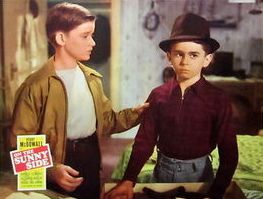
On the Sunny Side (1942) and You, John Jones! (1943)


On the Sunny Side (1942) and You, John Jones! (1943) give us a look at the wartime experience of children, as the movies viewed it, during World War II, particularly acknowledging how fortunate American children were compared to their counterparts in war zones.  We were encouraged to be both grateful as well as compassionate.  If there was also sometimes a sense of pride thrown into the mix, well, genuine humility is unfortunately not always our strong suit as a nation.  Still, we might imagine that much of the pride in our relative safety was borne of overwhelming relief.

This is our second entry in our series on childhood during World War II.  Roddy McDowall, whom we saw last week in The Pied Piper (1942), stars as well in On the Sunny Side, made in the same year.  Roddy had made a great impression on audiences in How Green Was My Valley (1941), and became one of the most recognizable, certainly one of the youngest, members of Hollywood’s “British Colony.”  He, his mother, and sister left Great Britain in 1940, an era when Dunkirk, the Blitzkrieg, and what appeared to be imminent invasion by the Nazis brought many Brits to the conclusion that London was no longer safe for their children.  Roddy knew something about the role he was going to play next.


In On the Sunny Side, Master Roddy is an English boy sent to live with a family in the United States for the duration of the war.  In the company of a group of other child evacuees, all traveling without their parents, he arrives on a ship to New York, bound for the Midwest home of husband and wife Donald Douglas and Katharine Alexander, and their boy played by Freddie Mercer, who is nearly the same age as Roddy.  Their parents were acquainted from a previous trip to England, good enough friends to be trusted with the care of their child.  His father is an RAF officer, and his mother is played by Jill Esmond, who also played his mum in The Pied Piper.  Jane Darwell is their housekeeper.

Much of the story is a fairly routine plot of a boy in strange surroundings who makes friends and becomes part of the family/community.  Freddie Mercer lets Roddy into his gang, which, with a clubhouse in the woods that is an old abandoned bus, seems a lot like the kids from the Our Gang series, but less scruffy, and not as funny.  Indeed, they are a rather serious and doleful group of youngsters, but the grownups writing and producing this story are perhaps projecting their own seriousness on the nice American squeaky clean world they’ve set up for the kids.  But, like the Our Gang kids, they even have a bully to fear: Stanley Clements, whose tough wise-guy talk made him the leader of the pack in Going My Way (1945) and in future Bowery Boys films.   Ann Todd plays a classmate who, like most of the girls in the class, fancies gallant Roddy.  A guy with an English accent can really clean up in this town.


The climax occurs when Freddie gets fed up with everybody’s fussing over the new kid, so much so that he becomes jealous and wants to run away from home.  Freddie, who came to Hollywood on his singing talents as a noted symphony and choir soloist, also had a bit part in Going My Way.  Here he’s funny as he sputters about the tea-drinking English kid ruining his life, but he draws our sympathy, and Roddy’s.


Though the grownups are firmly in charge, the story is really presented from the viewpoint of the kids, and they have the most screen time.  Though we might wish for a deeper story less focused on report cards, bullies, and gosh-gee-whiz dialogue, it is true that the prosaic troubles faced by the kids in the story really do reflect what’s important to children.  The adults may be reading the war headlines, but the kids—at least in the U.S.—are more driven by the realities of their world of making friends, doing chores, and worrying about what others think of them.  We might note that the boys’ teaming up and eventually conquering the bully is a parallel to the U.S. and Britain teaming up to fight the fascists.


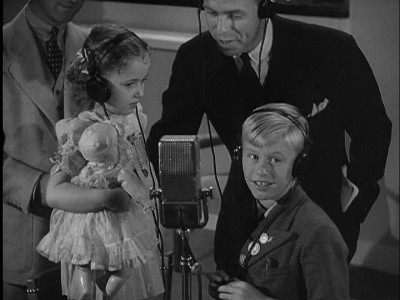
The movie does give us a few quite poignant scenes that hit on the broader crisis: The British kids on board ship, gathering at the rail to watch the Statue of Liberty slide by as they enter New York.  Roddy’s panic and nightmares when he hears a police siren, as it reminds him of the air raid sirens and emergency vehicles of the Blitz back home.  Most especially, the scene where a group of British kids are gathered in a New York radio studio, Roddy among them, to speak to their parents in a London studio via short wave.  The anxiety on the faces of the separate shots of kids and parents, their hesitancy to be too personal on the radio, their brave front of trying to give cheerful messages, and the cruel brevity of the time they are allowed create an image of both tenderness and anguish.  Tears are fought back.  Roddy, who even from a very young age was so good working before a camera, shows a myriad of feelings with the just the slight flickering of expressions on his face, in his lovely dark eyes.  He is nervous, then he warms up and excitedly tells his mother about his new life and friends, comically using American expressions he has learned that he must translate to her.  When his time is up, he realizes he has forgotten to use the notes he made beforehand of all the things he really wanted to say.


The evacuation of children from the London area had them seeking refuge in other parts of the U.K., in many dominion nations, including Canada, and also in the U.S., and involved children of every class.  Vera Brittain, noted British writer whose memoir of World War I, Testament of Youth, perhaps is more well known, at least in this country, than her other works, sent her two children away from their London home to stay with friends in Minnesota during the war.  Her son John was twelve at the time, the age of the boys in On the Sunny Side, and her daughter Shirley (a future member of Parliament), was not quite ten years old.

In excerpts from her diary, published as Wartime Chronicle – Vera Brittain’s Diary1939-1945, Brittain notes that the decision to send her children was a difficult one, “There seemed no right decision to be made, whichever course I took would involve bitter regrets.”

Her children left from Liverpool after Dunkirk, just missing the start of the Blitzkrieg and bombing of London by a matter of weeks.  They remained in the U.S. for three years, coming home, separately, in 1943.  She writes in her diary of the anguish of not receiving letters, then receiving them and learning her son has grown taller than she, and they are changing, experiencing new adventures in summer camp and in school where the curriculum is different.  Missing birthdays and Christmas.  At one point, Vera Brittain notes that her husband urged her to go to the movies to take her mind off their troubles.

“G. persuaded me to go to the new Disney film Dumbo, but it depressed me very much by reminding me of the children.”

Her children became teenagers while they were away.  Their mother drilling in firefighting practice to help after the bombing raids.  “One of the odd incongruities of this war to think that John—who must now be a fairly vigorous boy on the verge of 15—is safely in America while his middle-aged mother scrambles round in trousers fighting fires (or learning to).”

She remarks of her son’s return, “I did not recognize him, but it will take time to get to know him again.”  Her daughter arrived home, after a delay in the Atlantic due to perilous naval battle action, near the end of the year.  (Brittain’s husband, who was a university lecturer, had traveled to the U.S. for a part-year post and on returning, was on a ship that was actually torpedoed.  Twenty died, but he and some others made it to lifeboats and were afterwards picked up by a freighter and returned to England.)

When the family was reunited, a visit to Grandmother brings a comic conclusion to the adventure:

“Children uproarious over tea, Mother blames their manners on America.”


The children who remained in war zones with no avenue of safety were the subject of You, John Jones! (1943) a short subject about ten minutes long, directed by Mervyn LeRoy, starring James Cagney as an All-American dad who works as a supervisor in an airplane factory during the war, and also does his bit at night as a volunteer air raid warden.  Ann Sothern plays his wife, and their daughter is Margaret O’Brien.  When he arrives home from work, little Margaret is practicing her speech for an elocution contest, soberly delivering President Abraham Lincoln’s Gettysburg Address while perched on the living room window seat.  There are politicians who can’t deliver a speech as well as Margaret.  Perhaps they never “stumped” on a window seat.

Cagney leaves for his night watch, dressed in his trench coat with the Civil Defense armband and his helmet.  He sits on a park bench for a little plane spotting and considers how lucky he is to be living in a land where he is not likely to see an enemy bomber tonight.  The omniscient narrator, presumably his conscience, and ours, addresses Cagney (or John Jones), reminding him that if they were in other lands, his little Margaret, “Your baby, John Jones, your baby!” would be in danger.

Then we have a montage of scenes of Margaret as an English girl in the Blitz; as a Greek girl, her leg amputated, trudging with an amputation along a line of refugees; of a girl from Yugoslavia sobbing over a dead mother; from “Australasia” – quite a stunning image of Margaret looking hollow-eyed and shell shocked, then as the camera pans back, we see she is a prisoner of war behind barbed wire.  Margaret, as a Russian girl, lies dead in the ruins of a bombed out house.

To perhaps remind us not only of our good fortune in being spared these experiences in our own country (with the exception of the Americans of Japanese descent being held behind barbed wire in concentration camps), we are reminded, too, of the debt we owe our allies who are carrying the brunt of the war.  The narrator remarks, “If conquered people collaborated, your side couldn’t win this cruel war—did I say your side?  Our side.”

Then an attack occurs, but Cagney realizes it is only a dream.  (Sleeping on duty!)  He returns home, and Margaret finishes her speech with earnest, one may say almost fanatical delivery.   You can have a look at You, John Jones! here.


Kids here in the U.S. may have largely been spared the scenes little Margaret faced, but they were not without trauma caused by the war.  Come back next Thursday when we discuss the March of Time documentary Youth in Crisis (1943), and the Youth Runs Wild (1944) starring Bonita Granville.
**********
Wartime Chronicle - Vera Brittain's Diary 1939-1945, eds. Alan Bishop & Y. Aleksandra Bennett, Victor Gollancz Ltd, 1989.
*********************
The audio book for Ann Blyth: Actress. Singer. Star. is now for sale on Audible.com, and on Amazon and iTunes.

Also in paperback and eBook from Amazon, CreateSpace, and my Etsy shop: LynchTwinsPublishing.


Thursday, July 2, 2015

Independence Day


Independence Day always seems more nostalgic and sentimental when viewed through the perspective of classic films.   Perhaps because, as with Christmas movies, we are transported to our own childhoods, and the weight of the world lifts from our shoulders for a few moments, a world where freedom and civil rights were attainable surely by the second chorus, or if we bought enough bonds.  


They celebrated Independence Day during a brutal and terrifying time of war, yet they managed to convey a silliness that was perhaps necessary to maintain courage.


Peace in our time is a lovely ambition.  

To this end, I would prefer neighbors not shoot off home fireworks (which they have obtained illegally in my state), or firecrackers.  The town fireworks are better, and do not leave burning bits of wood and paper in my yard, or disrupt my old movie on TV with stomach-turning explosions.  James Cagney, and Bugs, and Fred, and Bing, and a bunch of others are waiting in the wings to celebrate this day in a gentler fashion.  

And I like Fred's socks.

I wish all American readers a Happy Independence Day.  Pass the mustard.

***************************

Ann Blyth: Actress. Singer. Star. 

The eBook and paperback are available from Amazon and CreateSpace, which is the printer.  You can also order it from my Etsy shop. It is also available at the Broadside Bookshop, 247 Main Street, Northampton, Massachusetts.

If you wish a signed copy, then email me at JacquelineTLynch@gmail.com and I'll get back to you with the details.


Monday, June 13, 2011

Dillinger - 1945


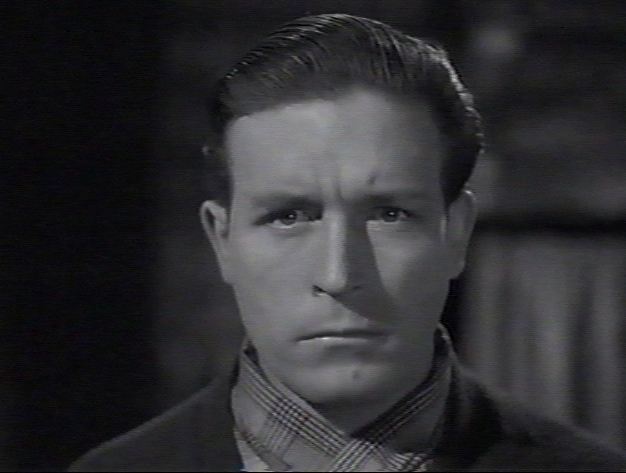
“Dillinger” (1945) is a fast-paced “B” movie that stands out as the first dramatization on the life of real-life gangster John Dillinger, and takes much of its energy from the infamy of his headline grabbing career.

What seems most interesting about this movie, apart from the rather psychopathic characterization actor Lawrence Tierney gives his character, is the not-quite-documentary, not-quite-noir look of the film. It is missing that stylish, guilty-pleasure treatment of the more famous gangster films of the 1930s, such as the very film John Dillinger saw just moments before he was gunned down by FBI agents in 1934: “Manhattan Melodrama” with Clark Gable, William Powell, and Myrna Loy. Have a look at our discussion of that movie here.

The capture and killing of John Dillinger occurred July 22, 1934, only some 11 years before “Dillinger” was made, at Chicago’s Biograph Theater. Have a look here for photos and our recent discussion on the Biograph.

This absence of the kind of gangster as charismatic screen icon that made careers for James Cagney, Humphrey Bogart, and could not tarnish Gable’s romantic image, might be an indication how much films had changed in a decade, for we were now on the cusp of the grimmer post-War world.

Though the real John Dillinger was reportedly not the psychopath Lawrence Tierney modeled him to be, the post-War film seemed to have done with bank robbers as Robin Hood figures, whose problems stemmed from troubled childhoods on the wrong side of the tracks, who needed only the love of a good woman and a helping hand from a friendly priest to set them on the path of salvation…even if that conversion began only on death row.

Mr. Tierney gives a riveting performance, if not as John Dillinger, then as a reasonable facsimile of a guy hell-bent to make his mark on his particular world.

At the film’s beginning, he is on a date in a café, and is humiliated because he hasn’t enough money. When petty crime gets him chucked into jail, he meets much smoother, professional crooks and learns from them. Boss of the gang, “Specs”, a “bank man” is played by Edmund Lowe. Eduardo Ciannelli, Marc Lawrence, and Elisha Cook, Jr. who we last saw in “Shane” here, round out the gang. These men are fictitious characters, based on Dillinger’s real associates, but no real names or situations are used. Some scenarios are manipulated for dramatic effect. For instance, later on in the film, Tierney carves a gun out of a piece of wood while in jail (how a fellow inmate got a knife to whittle is not explained), and breaks out when the guard thinks it’s real. Actually, John Dillinger did once escape from a jail when his lawyer smuggled into him a wooden gun.

Tierney is paroled before the rest of the gang, and he smuggles weapons to them so they can break out of prison. There is a power struggle between him and Edmund Lowe, who is the senior member of the group. Lowe is eventually dethroned by Tierney when the men give him their confidence as a result of Tierney’s imaginative and successful bank robbery schemes.

Tierney meets a sassy girl at the ticket booth of a movie theater (foreshadowing of his eventual end), and though he at first robs her, she refuses to pick him out of lineup for the police. We next see them having dinner together. For a guy who has not the charm of a Cagney, Powell, or Gable, we might wonder how he does it, what she sees in him. But, we never learn much about Helen, played by Anne Jeffreys. She’s just a gun moll along for the ride.

A chilling scene is when Tierney goes back to the café where his crime spree began and faces the same waiter who humiliated him. He invites the waiter to join him in a glass of beer, which the waiter happily does. Tierney reminds the waiter who he is, smashes his beer mug, and grinds the broken edge into the waiter's face while a jazz pianist in the background plays louder. We don’t actually see the violence of course, but that split second when the jagged mug is thrust into our faces as Tierney aims right for the camera, is enough for us to gasp and imagine what happens next.

Once free, and with a few bank robberies under their belts, the gang goes on the lam and hides out in the backwoods resort of Elsa Janssen and Ludwig Stössel. These two veteran character actors seem to be perennially married in the movies, as they were in “Pride of the Yankees” (1942), and “Casablanca” (1943), and others. Elisha Cook, Jr. calls them Mom and Pop.

When Eduardo Cianelli grows restless in the rural hideout and complains of the noise of the crickets, Edmund Lowe sarcastically fires back, “Why don’t you complain to John? He’ll knock them off for you.” The gang is growing nervous about Dillinger’s fits of temper and his readiness to use his gun. Soon, he shoots Edmund Lowe dead, kills another for trying escape the hideout, and when Elisha Cook, Jr. is killed in a heist, Mom and Pop show a little gumption and try to call the police on the phone. Tierney murders them both.

All alone, he hides back in the city, shut up in a one-room flat with his own wanted poster on the wall for a decoration. It’s Christmas 1933, and we hear kids in the depths of the Great Depression singing “Silent Night” around a street Santa. Somehow that quiet scene, that gives Dillinger and us a chance to catch our breath and reflect, seems more evocative of the era than anything else in this movie.

Cut to six months later, June 1934, and he has grown his familiar mustache (though Tierney looks nothing like Dillinger). Stir crazy and out of cigarettes, he says to Anne Jeffreys, “Let’s go to the movies.”

Though it’s a black and white movie, we are informed Miss Jeffreys’ dress is red. This is to foreshadow again the actual circumstances (though much twisted) of Dillinger’s demise. He was turned in by the so-called Lady in Red, but in real life this was not his girlfriend at the time; it was a brothel owner, originally an immigrant from Europe, who made a deal with the FBI to lead them to Dillinger in exchange for not deportng her.

We see Tierney, nestled in a dark movie theater, enjoying a Mickey Mouse cartoon, and it’s almost like shades of chain gang prisoner Joel McCrea in “Sullivan’s Travels”. We are not shown “Manhattan Melodrama”, likely for legal reasons, as that was an MGM film. Even the marquee of the Biograph looks nothing like it actually did.

When Dillinger leaves the movies, he is shot dead in the alley, with the same $7.20 he had in his wallet as at the beginning of the film.

“Dillinger” is a hybrid between something documentary and something noir, and never really achieving either, but it was explosive enough in its day to draw the criticism of religious groups, and to be banned for two years from being shown in Chicago by the Chicago Censorship Board.

Monday, May 3, 2010

Trains in the Movies


This Saturday, May 8th, is the 3rd annual National Train Day, so to celebrate we cast a nod to the importance train travel has had in old movies. As you probably know, the Golden Age of Hollywood was also the era in which most people moved about the country by train.


Bette Davis, impatient to see her bosom buddy Miriam Hopkins, leaps from the train before it comes to a complete stop.  For more on Old Acquaintance (1943), have a look here.


When James Cagney pursues Priscilla Lane, he does it on the train.  For more on "The Roaring Twenties" (1939), have a look here.


When Harold Lloyd goes to  college, he arrives on the train.  For more on "The Freshman" (1925), have a look here.


Whether it's Alan Hale and Barbara Stanwyck behaving in an unseemly manner on a train in "Stella Dallas" (1937), or Barabara Stanwyck and Fred MacMurray throwing her dead husband's body off one in "Double Indemnity" (1944), trains are so much a part of classic film because they were so much a part of American life up until the late 1950s and early 1960s when a network of highways and a generation of muscle cars made them quaint and anachronistic, if not exactly obsolete.  They have never been obsolete.  For many reasons environmental, political, and logistical, passenger train travel may one day grow to be as important as ever in many areas of the country. 

The movies found them irresistable from the start.  Here is "The Great Train Robbery" (1903). 

For more on National Train Day and the history of train travel in the US, have a look at these websites.

Thursday, October 29, 2009

The Roaring Twenties - 1939

The Roaring Twenties (1939) may have even more resonance today than it did when it was produced. The year it premiered was only ten years after the 1929 Stock Market Crash, and the world had entered a new era in 1939 with a vengeance. This end of the Depression look back at how-we-got-to-where-we-are is certainly nostalgic, but it was also a critical success and should be regarded as one of the champion movies in that champion movie year of 1939.

The Roaring Twenties, fast-paced and well directed by Raoul Walsh, is remarkable for all the things it attempts to be and succeeds. It is a docu-drama as much as a melodrama. It is a gangster film, but there are so many musical numbers you could as easily call it a musical. It has some outrageously funny lines, but it contains scenes so heartbreakingly pathetic.

Most especially, it looks back on an era still so recent in 1939 and yet from such a remarkably distant perspective, the way we might pack for college and discover with condescending amusement some old souvenir from grammar school. It is a mere ten years from eight years old to adulthood. It also feels like a lifetime.

The film begins with a rolling title prologue that speaks to us today in our present economic crisis: “It may come to pass that, at some distant date, we will be confronted with another period similar to the one depicted in this photoplay. If that happens, I pray that events as dramatized here, will be remembered.” It is signed Mark Hellinger, the writer of the script, who took the stories of real people and real incidents as a basis for the film.

Then the stern voice of John Deering, the narrator, takes over and through a montage of images, the clock is turned back, year by year, to 1918, the last year of the Great War.

“What’s past is prologue” Shakespeare wrote in The Tempest, and as such it is appropriate to begin a story that concludes with the Crash at a point in time when the seeds for that event were sewn. Perhaps too often we look at a moment in time as if it really stands apart from other moments, but it does not. It cannot.


James Cagney, Humphrey Bogart, and Jeffrey Lynn are doughboys in France. Cagney is the rough-and-ready average Joe. Jeffrey Lynn is the sensitive college boy who struggles with ideas of right and wrong. Bogart is the thug. It would be one of Humphrey Bogart’s last thug roles before he moved on to being the reluctant hero in 1940s films. He’s looking hale and hearty here, fit and much younger than he did even four years later in Casablanca.

In one scene, his thuggishness borders on the psychotic, when Jeffrey Lynn hesitates to shoot a German soldier because he looks only about 15 years old. Bogart plugs him with relish. He loves his gun.

The war ends, and Cagney straggles back home to New York to try to get his old mechanic’s job back, but his job has been given to someone else in the meantime, and he can’t find another one in the post-war recession. This is rather like a foreshadowing of Dana Andrews’ inability to fit in and find a place for himself after World War II in The Best Years of Our Lives (1946). (It was in reaction to such conditions that the government mandated during World War II that returning veterans be guaranteed a job with their former employers.)

One very brief, but funny scene if you catch it, is when Cagney gives his old pal, Frank McHugh, a souvenir from the war. It is a German helmet, and McHugh hides it from would-be thieves by shoving it under his bed. Cagney wordlessly motions McHugh to turn the helmet over, because the way he placed it under his bed looks like a chamber pot.


The narrator comes back with more March of Time stuff about bobbed hair, shorter skirts, and the power that drives the rest of the film, Prohibition. Cagney, working as a cab driver, innocently delivers some bootleg liquor to Gladys George, who plays a gal-who’s-seen-it-all and runs a speakeasy. Cagney gets nabbed, takes the fall for Miss George, who later gets him out of jail and becomes his partner in the bootlegging business.

James Cagney spends the rest of the decade getting richer and richer, and more deeply involved in bootlegging, corruption, and gangland murders. Eventually, Priscilla Lane shows up to expose Cagney’s softer side. She had written him pen-pal letters during the war, but when he returned, he dismissed her as a schoolgirl when he had mistakenly thought she was much older. Reunited when she is a struggling dancer in the chorus, Cagney promotes her career in Gladys George’s speakeasy as a singer.

Priscilla Lane actually shares top billing with James Cagney in this movie, and would continue to have a successful year with Four Daughters where she was reunited in the first of several more films with Jeffrey Lynn. Here, likewise, Lane and Lynn fall for each other. Cagney falls for Lane. Gladys George falls for Cagney. It is an inextricable web of unrequited love.


Jeffrey Lynn, now a lawyer, helps Cagney with the legal aspects of his business empire and rather hypocritically tries to overlook the illegal. Eventually, Humphrey Bogart joins the business, and the intense scenes between Bogart and Cagney trying to assert their power over each other are something terrific.

If you have ever seen the Carol Burnett parody of this film with Carol as Gladys George, Steve Lawrence as Cagney, Harvey Korman as Jeffrey Lynn, and Sally Struthers as Priscilla Lane, then perhaps, like me, you are reminded of it all through watching this movie. Thanks a whole lot, Carol.

Gladys George, who played the world-weary dame with the heart of gold better than anyone (and speaking of The Best Years of Our Lives, pulled off the same magic there in a minor role), has some great lines and delivers them with deadpan humor. She is most effective silently pining after James Cagney. In the scene where Cagney brings Priscilla Lane to audition for Miss George, he fidgets with the excitement of a schoolboy crush, and he absently grips Gladys George’s hand as he listens to Priscilla Lane sing.

Gladys George seems to feel an electric current at Cagney’s touch, and sadly watches his enchantment for another, much younger, much prettier woman. Another actress might have shown a cliché tinge of jealously or resentment in her reaction, but Gladys George plays it inwardly, almost with shyness.

“What a load of ice!” she blurts when he shows her the diamond rings he has bought for Priscilla Lane. We know her heart is breaking, and we know that Cagney’s will, too, when he discovers Priscilla does not love him, despite the fact that he also bought her a new-fangled crystal set radio which she and Cagney listen to on headphones.

Speaking of 1920s paraphernalia, look at the scenes of Cagney and others handling money. The paper bills are much larger and wider than we have today. The government changed to the size bills we use today in July 1929, ostensibly to save paper. As a result, wallet manufacturers had to come up with new, slimmer, models.

We see the crystal sets, the bathtub gin, the rum runners, the Tommy guns, the gangsters, the cops on the make, but the film manages to give us a tour of the Roaring Twenties with only a little feeling of parody. Most of it is a survey class in what can happen when lives are lived to excess, without a thought of tomorrow.

On this 80th anniversary of the Crash of 1929, we may look for parallels between this time and our own. There are inevitably some parallels, but nothing so neat and clear. Time isn’t a blueprint for us to follow. We still have to make up much of it as we go along.

Perhaps at this anniversary, we may watch this movie with something more than just nostalgia. Perhaps we might even be moved to empathy as we understand a bit more about excess and failure with the economy of the last few years.

There are no films of “the Crash.” Newsreel cameras cranked out footage of panicked crowds at Wall Street this day 80 years ago, but that was rather like today when the news media shifts (and wastes) its enormous resources not to cover an event but to cover the public opinion poll about the event. Perhaps filming panicked crowds is more exciting than filming numbers on a chalk board being erased and written over.

This movie covers the Crash by framing it in the context of this whole era, from the end of World War I, through the Noble Experiment, from Main Street to Wall Street, and the resulting Great Depression. In the study of any historic event, it is the months and years preceding the event that really tell us all about the event. We might say our current economic challenges have their roots as far back as the 1980s. We do know, in hindsight, that the 1929 Crash devastated a generation, and forever colored the world of that generation’s children, the ones who would spend their childhoods during the Great Depression and would grow up to fight World War II.

For a long time after this movie, after that generation grew up, the perspective of this 1929 nightmare was growing dim and made somehow quaint by nostalgia crazes. Eighty years on, we might be in perfect position, the first audience for this film in generations, to really identify with the suckers and the straight arrows, the crooks and the gangsters, and the average Joes, and maybe even the omniscient narrator, the whole menagerie that make up The Roaring Twenties.

When this film was released in 1939, though it was a success, the world was moving at breakneck speed into another, even more sinister era. It was as if this film was a last look back at the life they knew before they became engulfed in the complete unknown.


James Cagney loses his shirt in the Crash, and loses much of his business to Bogart. Cagney is on the skids, but he has Gladys George to keep him company, now singing herself (“A Shanty in Old Shantytown” no less) in a cheap saloon. Prohibition is over.

“The days of the rackets are over,” Jeffrey Lynn tells Cagney, but he answers with more truthfulness than even the writer of the script probably knew,
“Don’t kid yourself about that.”

Cagney has one last, very violent, power play with Bogart, and in the memorable final scene on the snow-covered church steps, only Gladys George is left to comfort a dying Cagney. When a cop asks who the bum on the steps is, she replies, “He used to be a big shot.”

It might be a pronouncement upon that whole careless era -- or on any Ponzi schemer, unscrupulous investment manager, or average chump who lost a good chunk of his retirement in ours.
*********
Jacqueline T. Lynch is the author of Ann Blyth: Actress. Singer. Star. and Memories in Our Time - Hollywood Mirrors and Mimics the Twentieth Century. Her newspaper column on classic films, Silver Screen, Golden Memories is syndicated nationally.

Monday, March 3, 2008

The Strawberry Blonde (1941)

The Strawberry Blonde (1941) is a parody of The Olden Days with James Cagney in the unusual role of a stiff-necked and somewhat moralistic loser who becomes the butt of his huckster pal’s schemes. That he finds happiness with Olivia de Havilland is only because he has finally woken up and stopped being a slow-witted fool. Not the usual Cagney outing. 
 
Jack Carson plays Cagney’s pal in his typical fast-talking smart aleck role. Mr. Carson is dependably funny, and has an interesting way of being able to play a creep or a poor soul even though his delivery remains the same no matter in what film he appears. The other characters around him seem to make him sympathetic or arrogant. Mr. Cagney is a hapless dental student, equally busy with keeping his drunken skirt-chasing rogue of a Da, played with his usual nothing-up-my-sleeve finesse by Alan Hale, as he is with pursing the girl of his dreams. 

The girl of his dreams is played by Rita Hayworth, the strawberry blonde of the piece, as elegant appearing as a wedding cake on the outside, but inside as common as a mug of beer. Olivia de Havilland is her friend, a nurse, seen as an unromantic profession of serious and single-minded ladies soon to be spinsters. To make matters worse in Cagney’s eyes, she is also a suffragette who smokes. Not very expertly. But she does. 

On their first date, a fix-up when Cagney thought he was going to get Hayworth but gets stuck with Miss de Havilland instead, there is much bickering and posturing about modern women, to which Mr. Cagney scoffs with one of his many platitudes, “An empty barrel makes the most noise.” 

We get an eyeful of straw boaters and leg-o’mutton sleeves, and lots of choruses of “The Band Played On.” When Carson steals Hayworth from him and marries her, Cagney dejectedly tries to make do with de Havilland, never really appreciating her until time passes and he sees what a brassy gal his ideal Miss Hayworth really is, how unhappy their marriage is, and what a swell gal the suffragette turns out to be. Carson gets rich as a shady contractor. 

When Cagney and de Havilland come to dinner, Carson and Hayworth show off their new electric lighting. “I just can’t get over that electric light,” an awed Miss de Havilland remarks, “Isn’t it dangerous?” “Not if you pay the bills,” is Carson’s line, delivered in a cute way of trying too hard to be funny. Even when he’s a braggart and a blowhard, it’s hard to dislike him. They have a new dish for dinner, something called “spaghetti” which none of them knows how to eat. 

Carson throws his down and out old buddy a bone by giving him a job in his company, but makes Cagney the fall guy when because of inferior materials being used, a building Carson’s firm is constructing collapses. Cagney’s father also happens to be fatally injured in the collapse. Cagney goes to jail for several years, and so the plot turns from one of smirking over high button shoes to a tragedy. 

But wait, no, it’s not a tragedy, because there are more comic scenes of Cagney keeping up with his dental studies in prison. When he gets out of jail, he removes Carson’s sore tooth without anesthetic, just for spite. Cagney, who would never even whistle at Hayworth out of respect for her, abandons his idealistic obsession and instead finds happiness with the down-to-earth de Havilland. The film ends, charmingly, with another round of “The Band Played On” in sing-along style with the words printed out on title cards as they might have been in the early days of silent films, with the final card in elegant script declaring, “Thank You, Come Again.”

Related Products