IMPRISON TRAITOR, PEDOPHILE, AND CONVICTED FELON TRUMP.
Showing posts with label Jane Wyatt. Show all posts

Thursday, May 18, 2023

Greer Garson on Father Knows Best - 1957


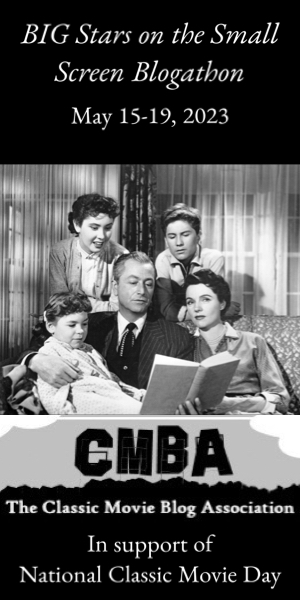
Greer Garson chews the scenery—all in fun, on a visit to the Anderson family in an episode of Father Knows Best.  Originally broadcast November 13, 1957, it's "Kathy's Big Chance."


This is our entry for the Classic Movie Blog Association’s blogathon -- Big Stars on the Small Screen: In Support of National Classic Movie Day.  Have a look here for more great bloggers on the subject of classic film stars and television.

Though Miss Garson plays herself, touring in their Midwest town of Springfield to promote her latest film called “Rebel Lady,” the movie is fictional.  She never made such a film, but perhaps that gives her the freedom to act out such a comic and outlandish synopsis of the movie for the benefit of the Anderson’s youngest daughter.  A real movie she might be actually trying to promote would require more dignity.  Certainly, the studio heads would require it.  Greer throws dignity out the second-floor window of Kathy’s bedroom.


Kathy, or “Kitten” as her father calls her, played by Lauren Chapin, is the youngest of the three Anderson kids.  Billy Gray plays “Bud” the middle child, usually popping in and out of scenes with the funniest lines and the best comic timing.  


Elinor Donahue is the lovely eldest, Betty or “Princess” as Dad calls her.  Dad prefers nicknames (to the point where we may have forgotten that “Bud” is actually named for him—James Anderson, Jr.)  Miss Donahue, despite the trope of Big Sister Scorn she was forced to play in so many episodes, is probably one of the best “child” actresses in the enormous landscape of television families through the decades, who handled both dramatic and comedy scenes very well.


Mother is played by Jane Wyatt, who won three consecutive Emmy awards for her role as Margaret Anderson.  With her Eastern finishing school voice and manners, we may overlook that she is one of the most genuine of TV moms of the era in her relationship with husband and kids.  She gets mad and says so.  She is not always so understanding.  She even wears jeans and a sweatshirt once in a while.  She introduces herself to Greer Garson as “I’m the mother” but she’s a lot more than that on this show, if not this particular episode.

In an almost forerunner of what she would play on TV, Jane Wyatt starred as the mother of Ann Blyth in Our Very Own (1950) which we previously discussed here.


Robert Young plays Father, who actually began this role on radio in 1949, but the radio version of Jim Anderson was much more sarcastic and even mean, as radio tended to play in broader strokes for comedy.  When it moved to television, Mr. Young, who had a hand in production, wanted a warmer dad and a more loving family.  The show ran from 1954 to 1960, and became one of the iconic TV shows of an idealized suburban America in the 1950s.

Robert Young appeared with Greer Garson in That Forsyte Woman (1949), which we discussed in this previous post.  In that film, he is a prospective lover who ardently pursues Greer, but in this TV episode he only chases her for her autograph.  Young’s last film was made in 1954, and Greer Garson had also not made a film since 1954, though she had a few more in her, beginning with her turn as Eleanor Roosevelt in Sunrise at Campobello in 1960.  Until then, these two stars, like so many classic film stars and character actors, turned to the new medium of television for work.  They are middle-aged, but Young is the settled family man with the graying hair, and Greer is still glamorous, so much so that she mesmerizes the household, and is Kathy’s favorite actress.


Kathy must write an essay on the Civil War for school and has chosen to write on a new Civil War film starring Greer Garson called “Rebel Lady.”  She submits her essay to a contest, the prize for the several winners chosen is to visit Miss Garson in her hotel suite for cake and ice cream, and then accompany the famous actress to the theater to see the movie with her.


Kathy imagines what this will be like, and in her daydream, Greer Garson is dressed like a queen, complete with tiara, and their la-de-da dialogue Garson delivers with deadpan charm.   She tells Kathy, “You have such intellectual brains.”  Another actress gushing this would be cute, but spoken with Greer Garson’s regal intonation, it’s really funny.

Roused from her reverie, Kathy has a lot of work to put in on this essay, which is the most important essay anybody ever had to write.  She finishes it, sends it off, wins the prize, and then gets the measles.  Even in idyllic white middle-class suburbia, life dumps on you, apparently.

Measles, back in the day, could be a nuisance, or a sick-as-a-dog but you get over it illness, or serious complications, including death, usually from pneumonia.  Isolated populations with no immunity suffered cruelly, which an estimated 20 percent of people in the Hawaiian Islands in the 1850s and 40 percent in Fiji in 1875 killed by this sickness.  Millions of kids the world over died from measles every year, until vaccines were produced in the 1960s. 

We’re pretty sure Kathy will get over it, though.  She’ll probably be on the show next week.


Kathy, with nothing left to live for now that she can’t go to Greer Garson’s hotel room and eat ice cream and cake, sends dear old dad to her hotel to sign Kathy’s glamorous studio photo of Greer.  Dad, on the spot, reluctantly goes and stands in line with a bunch of clambering schoolgirls to get an autograph.  Supposedly, one of those kids is played by Kathy Garver, who later got to be older sister Cissy in Family Affair (1966-1971).  If you recognize her, let me know.

Just as he gets to the head of the line, Greer’s pen runs out of ink, and she is whisked away by her handlers.  Poor Jim Anderson has failed Kitten.  I love the line of the girl who, also denied an autograph, complains, “If that old man hadn’t hogged so much time.”  Robert Young has progressed from middle-age to old man.

Back in the sickroom, older sister Elinor Donahue aka Princess is trying to amuse the fretful Kathy with a game.  Kathy wants to know what’s taking Dad so long, and bitterly snaps, “Probably ran off with her.”  Another good line well delivered.  Yeah, there’s a few here and there even in a show with a rather too-sweet reputation.


Finally, Father returns, with Greer Garson herself in tow, and she compliments Kathy on her essay.  “It was so intellectual I could hardly understand part of it.”


Then, at Kathy’s request, she puts on a boffo performance of the entire movie in five minutes.  Flinging herself around the little girl’s bedroom, she mugs, she fires the opening salvo of the Civil War, she primps, she spies (her character is a spy for the Confederacy), she grabs the unsuspecting Bud, uses him for a prop as he unwittingly stands in for a Union sentry and later her husband, plants a lipstick smear on his forehead, to the gales of laughter from his parents, and finally, Greer delivers a message behind the lines to Stonewall Jackson, whom she also plays.


When it’s time for Greer to leave, Kathy says in sincere appreciation, “You’re such a good guy.”


Yeah, she is.

Remember to visit the other good guys blogging about Big Stars on the Small Screen here.


Notes:  "Migration and Disease" article Digital History site. 

            Fiji University National College of Medicine site.

 ************

Jacqueline T. Lynch is the author of Ann Blyth: Actress. Singer. Star. and Movies in Our Time - Hollywood Mirrors and Mimics the Twentieth Century and Hollywood Fights Fascism.  Her latest book is Christmas in Classic Films. TO JOIN HER READERS' GROUP - follow this link for a free book as a thank-you for joining.


Thursday, November 16, 2017

Hollywood Fights Back - A Radio Protest


Hollywood Fights Back was a radio program broadcast in two parts in the autumn of 1947. Some 50 Hollywood stars, writers, directors, as well as some journalists, and some members of the government, appeared in open defiance of the House Un-American Activities Committee (HUAC), which was then launching a twenty-year nightmare on the entertainment industry known as the Blacklist. Its repercussions were felt for a generation, and it has lessons which echo our troubled times today.  This is our entry into the Classic Movie Blog Association’s Banned and Blacklisted blogathon.

The group behind radio broadcasts, the Committee for the First Amendment, was formed in Ira Gershwin’s house as a response by alarmed members of the Hollywood community about the persecution by Congress of those they regarded as communists or as sympathizers of communists in Hollywood.

The program is startling, particularly the first episode which was aired on October 26, 1947, just as a group of their members and fellow actors were flying to Washington on a chartered plane to observe the proceedings by HUAC against the so-called Hollywood Ten, a group of writers who were to be skewered by the congressional committee headed by J. Parnell Thomas (R-NJ). Charles Boyer a led off the program in his resonant voice announcing their fourteen compatriots were carrying on, in person, “the fight for our rights as American citizens.”

Judy Garland, in a voice easily recognizable for her soft, girlish sweetness, sounds like her innocent but spunky characters in the Andy Hardy series or as Dorothy tugging at our heartstrings: “It’s always been your right to see and read anything you want to.  But now it’s getting kind of complicated.”  She says that Hollywood is hopping mad about being accused of being communists and that HUAC is about to strangle not only their creativity, but their freedom.  “I’ve never been a member of any political organization, but I’ve been following this investigation and I don’t like it.”  Her voice rises, impassioned, “It’s something again to say we are not good Americans. We resent that!”

Hollywood Fights Back: Myrna Loy, Fredric March, Lucille Ball

Gene Kelly follows noting that The Best Years of Our Lives (1946 – covered in this previous post, part 1 of 4) the film that won seven Academy Awards and is arguably one of the best if not the best film ever made in Hollywood, remarks “I understand that supporters of the Un-American Committee didn’t like this film. Did you like it?  Were you subverted by it? Did it make you un-American?”

The Best Years of Our Lives would be mentioned more than once in Hollywood Fights Back, and some of its stars, including Fredric March, Myrna Loy, and Dana Andrews, would take part in the broadcasts. One of the reasons the film is used in their argument, one of the reasons it met with disfavor by the HUAC is because of the famous scene where Homer, played by Harold Russell is told by Ray Teal that we fought on the wrong side in World War II and should have supported the Nazis. Homer of course becomes upset and in the physical altercation that occurs, Dana Andrews punches the Nazi in the face.  We discussed this scene not too long ago in this previous post. Depictions of extreme right-wing politics were not to be seen as negative, let alone traitorous.

How quaint, considering extreme right-wing treason is considered somehow righteous today.

There was another reason HUAC disliked this movie, and it is because Fredric March’s banker boss, Ray Collins, is portrayed as stuffed shirt who cares more about business than he does about helping returning veterans. The movies often portrayed wealthy men of business as stuffed shirts, sometimes even corrupt, and apparently then as now, the very wealthy, very conservative in our country feel that such depiction is suspicious and threatening, meriting punishment. To HUAC, it was regarded as subversive.

The blacklist – and later Senator Joe McCarthy’s hearings – was not just about politics of communist infiltration to overthrow the government. That alone would make the whole seamy affair seem patriotic and righteous. But it was never about that, because we were never under threat by communist infiltration and overthrow of the government. The politics was about conservative versus liberal, and the wealthy elite versus everyone the wealthy elite felt was a threat to their personal prosperity: liberal views which they felt led to higher corporate taxes and trade unions, and enemies of all stripes including the various racial and religious minorities some would invariably despise.

HUAC had been around since the late 1930s under Martin Dies, Jr. (D-Texas). It kept its eyes on actors who supported liberal causes like James Cagney (who would a few years later perform in Yankee Doodle Dandy (1942), in part to reaffirm before the public and the studios that he was patriotic), Katharine Hepburn, Melvyn Douglas, and Fredric March.  Most did not suffer a threat to their careers, except for Lionel Stander, who was one of the earliest victims of what became known as the blacklist and it would be many years before he worked in film again.  Dies’ committee came under strong rebuke by the American public when it also claimed to have caught Shirley Temple in its net of possible communists.  She was ten years old.

But the politics was always deeply entwined with money. Walt Disney took revenge on his staff who took part in the cartoonists’ and animators’ strike in 1941 by publicly accusing many of them of being involved in communist activities, and he felt the strike was a communist activity that was personally meant against him.

During the Depression most people were terrified of the wolf at their door, but for the very well off and the very conservative, they viewed the wolf at their door as the liberals who under the successful four-term President Franklin Delano Roosevelt were able to invoke sweeping changes in our society that brought out reforms in economics, the stock market, banking, unions, and in social causes.

But 1947 was a different climate.  When Hollywood Strikes Back was aired while the fourteen compatriots went to Washington to observe and to protest HUAC, it was then under J. Parnell Thomas. He had begun his career as a stockbroker, later going into politics and he served seven terms in the House of Representatives as a Republican from New Jersey. He was one such who despised Franklin Roosevelt and the New Deal. One of his pet hates was the Federal Theater Project which brought work to thousands of actors, writers, directors and other theatre professionals during those starving years, and also brought new life and important new works into American theatre. Parnell declared that the plays were nothing but propaganda for communism or for the New Deal, which he felt was the same thing.

Money and political ideology were joined by the third member of this unholy triumvirate, prejudice. One of Parnell’s complaints was that the Federal Theater Project frequently featured plays referring to racial discrimination. Indeed, when HUAC was originally formed in the late ‘30s, it was responsible for investigating both left-wing and right-wing political groups, but calls for leaders of the Ku Klux Klan to be investigated were refuted by the then chairman Dies because he supported the Klan and spoke at Klan rallies. Other members of HUAC, including John S. Wood (D-Georgia) and John Rankin (D-Mississippi), an avowed anti-semite, also supported the Klan. Mr. Wood defended the Klan by arguing that “the threats and intimidation of the Klan are an old American custom.” They decided not to pursue any investigation against the Ku Klux Klan, as John Rankin agreed, “The KKK is an old American institution.”

Donald Trump, as has been widely reported, agrees.  We sometimes think we are always facing new problems, but they are usually very old problems in new wrappings.

After World War II, but long before the Russians obtained the Bomb, a shift was occurring led mainly by politicians and which would then sweep across the entertainment world, business and industry. The real shift on its axis began in November 1946 when after the election, the Republican Party gained control of Congress for the first time in fourteen years. HUAC, which had waned during the war years when the Russians were our allies, was shifted to the forefront and became once again a pet project of a party which now had the power to pull the strings. In May 1940, J. Parnell Thomas went to Hollywood to meet with studio execs about the problem of infiltrating communist ideals into movies principally through the Screenwriters Guild. The screenwriters’ Guild. Yes, this was about labor unions, not about invasion by the Russians.  We have much more to fear about Russian infiltration today than we ever did in 1946.

Now the focus of the committee would be about the film industry.

Jack Warner was the first person to testify before HUAC in September 1947. He wasn’t subpoenaed—he volunteered. He had spoken to the committee earlier that spring, in closed-door sessions, and had admitted to John Huston that he had named the names of “a few” people he “thought might be communists.” In a recollection by Warner’s son, Jack Warner panicked at the lights and the questions and spit out any names he could think of.  Power is always intimidating, even for a man like Warner who garnered plenty of power himself and enjoying wielding it.

That same month, back at Ira Gershwin’s house, a group of actors with astounding pluck, admirable idealism, and perhaps forgivable naïveté, formed the Committee for the First Amendment to support the ten screenwriters, known afterward as the Hollywood Ten, who were to be subjected to questioning in Washington, D.C., by HUAC. Myrna Loy, John Huston, William Wyler, and screenwriter Philip Dunne founded the group.

Other members included Jane Wyatt, Edward G. Robinson, Henry Fonda, Dorothy Dandridge, Melvyn Douglas, Lena Horne, Marsha Hunt, Burgess Meredith, Frank Sinatra, Katharine Hepburn, Evelyn Keyes, John Garfield, Burt Lancaster, Ira Gershwin, June Havoc, Gene Kelly, Groucho Marx, Billy Wilder, Paul Henreid, and Humphrey Bogart and Lauren Bacall. Many of them would later suffer for it.

On October 27, fourteen of the committee flew to Washington, D.C., to attend and protest the hearings. The day before, on October 26th, the first one half-hour episode of Hollywood Fights Back aired, and some members who flew to Washington had pre-recorded their contributions to the program. Howard Hughes, who was a conservative and actually supported HUAC, provided them a chartered plane at a discount. Although we may smile at Mr. Hughes’ business sense over his ideology, but this only underlines the real purpose of the actors going to Hollywood: no one saw themselves as defenders of communism, only of free speech. They were going in support of the First Amendment, as their committee name said.

The program was a stirring performance, as one actor after another tag-teamed on a tightly written theme of freedom of speech. The program was written by Norman Corwin, one of the finest writers during the Golden Age of Radio. It was he who wrote the program We Hold These Truths after the bombing of Pearl Harbor, which we discussed in this previous post. Please see my post on my blog on New England history and culture, New England Travels, for more on the career of Norman Corwin, whom I’m pleased to say once wrote for my local newspaper, the Springfield (Mass) Republican.

The script is a marvel of simple messages and riveting urgency. There is no sense of preaching, rather it is like a college pep rally of hope and promise, a call to defeat to the bad guy, of the wonderful feeling of doing right and doing well. It is biting, angry, sarcastic, and exuberant.  Though their remarks are scripted and not off the cuff, is a rare treat to hear these stars as themselves for what they truly think.  In an era where the stars were kept at a mysterious distance from us, this was an unaccustomed intimacy.

Lauren Bacall mentions the new movie Crossfire (1947), “the American people awarded it four stars. The committee gave the men who made it three subpoenas.” Here she’s a tough-talking dame. Judy Garland sweetly implored us; Bacall’s taking no prisoners.

Joseph Cotten speaks, and Peter Lorre, June Havoc, and John Huston, who notes that in nine years of its existence HUAC had come up with only one piece of legislation, which was ruled down by the Supreme Court as being unconstitutional.

Danny Kaye quotes FDR in a speech from 1938 “most fair-minded Americans will hope that the committee will abandon the practice of merely providing a forum to those who for political purpose or otherwise seek headlines which they could not otherwise obtain.”

Marsha Hunt affirmed, “The committee uses methods that undermine the democratic process. By ruining reputations by publicity, inference and innuendo.”

Cornell Wilde and Melvyn Douglas speak and Richard Conte notes that among those who support HUAC are Nazi sympathizers and the KKK. Evelyn Keyes speaks and Burt Lancaster, Paul Henreid and William Holden. Robert Ryan speaks; and Florence Eldridge; and Myrna Loy, who notes that our First Amendment rights were first put into play by Jefferson, Madison, and Benjamin Franklin.

Robert Young notes that the methods used by the committee, refusing to let their victims testify, go back through the centuries: calls before tribunals included Galileo, Joan of Arc, the Salem witch hunt victims, and Roger Williams.

Lucille Ball recites Article 1 from the Bill of Rights:

Congress shall make no law respecting an establishment of religion, or prohibiting the free exercise thereof; or abridging the freedom of speech, or of the press; or the right of the people peaceably to assemble, and to petition the Government for a redress of grievances.

It’s so important, she repeats it.

Van Heflin speaks, and Henry Morgan and Keenan Wynn reenact some of the circus dialogue at the hearing.

Hollywood Fights Back: Fredric March, Paulette Goddard,
Edward G. Robinson, and Audie Murphy

Other speakers include John Beal, Edward G. Robinson, Paulette Goddard, Fredric March, Artie Shaw and Vincent Price. Humphrey Bogart wants to know if democracy is so brittle that it can be subjugated by a look, or a line or a gesture. And notes that people’s beliefs are nobody’s business but their own.

William Wyler again refers to his masterful film, The Best Years of Our Lives:  “I’m convinced today that I wouldn’t be able to make The Best Years of Our Lives as it was made a year ago.” At the very end of the broadcast Judy Garland comes back and exhorts us to write our Congressman and to send it “airmail special.”

It was an inspirational beginning to the fight, a fight which continues today. Unfortunately, their battle was soon lost in a climate which no longer allowed for a difference of opinion.

“This has nothing to do with communism. It’s none of my business who’s a communist and who isn’t,” Bogart said in a statement in advance of the journey. “The reason I am flying to Washington is because I am an outraged and angry citizen who feels that my civil liberties are being taken away from me and that the Bill of Rights is being abused and who feels that nobody in this country has any right to kick around the Constitution of the United States, not even the Un-American Activities Committee.”

But the protest folded like a house of cards. This was due principally to two things: one, the fact that many of the Hollywood Ten either were or were formerly members of the Communist Party, seemed to taint the First Amendment Committee’s reputation. Lost in the message that it didn’t matter who was communist and who wasn’t because there wasn’t any plot to overthrow the government, was the overwhelming urge for the despotic to gain control, gain followers, and for those followers to throw all reason and integrity to the wind in their attempts to find a scapegoat to ensure their own safe harbor. This is a fight as old as man himself, and despite what we always like to think of as our sophistication and our basic human decency, when we turn into a mob we lose our humanity and our sense of right and wrong, and even a nation of laws can become a nation of wild impulse given the right circumstances.

John Huston noted of the circus in Washington, D.C., “It was a sorry performance. You felt your skin crawl and your stomach turn. I despaired of what was being done to the ten, but I also disapproved of their response. They lost a chance to defend the most important principle.” He also did not want to be associated with them, because it was getting dangerous. He would eventually take off for Ireland.

When the tide began to turn against them, the actors were clearly overwhelmed but no one was more vocal than Humphrey Bogart, who felt that he had been betrayed and embarrassed by the fact that the people who they were defending were actually communists. He even went so far in order to save his own reputation and his own career to write an article for Photoplay magazine in March 1948 affirming that he was not a communist. The tough guy panicked and caved.


Excerpts from Bogie's Photoplay article March 1948

But others caved worse. Another member of their group, Sterling Hayden, found himself in the hot seat when it was revealed he was for a brief time a member of the Communist party. His activity consisted of supporting a union of motion picture painters to take over some other film industry unions, and that union was controlled by members of the Communist party. Hayden’s interest in the party likely began during his service in World War II. He had been a member of the Marine Corps and later served as an Office of Strategic Services agent, which involved parachuting into Croatia and helping the Yugoslav partisans who were fighting the fascists. They were our allies.  The OSS was a forerunner of the CIA. He was awarded a Silver Star for gallantry and received a commendation from Marshall Tito of Yugoslavia. The partisans our government was directing him to support were communist; their courage and their work against fascism led him to take on their ideals. Though his participation in the Communist party back in Hollywood was apparently neither deep nor long-lasting, it nevertheless branded him for the rest of his life. But something else branded him even worse when he was called before HUAC when he confessed his communist ties and he named names, selling out friends and colleagues. It was an act which humiliated him and for which he felt guilt for the rest of his life, confessing his own self-loathing in his autobiography.

But because he played along, his career went on. Others who refused to cooperate with the committee on principle were put on a blacklist.

Before that happened, the second episode of Hollywood Fights Back aired a week after the first episode, on November 2, 1947. It is a less tightly written show, a less effusive and optimistic show perhaps because the seeds of doubt and fear and a sense of defeat had already crept in. Fredric March and Myrna Loy spoke again, and Douglas Fairbanks, Jr. reported that newspapers were supporting their efforts, echoed by Rita Hayworth, Lauren Bacall, Anne Revere, Lon McCallister, Burt Lancaster, Danny Kaye, Evelyn Keyes, Paul Henreid, and June Havoc. Groucho Marx and Keenan Wynn acted out dialogue demonstrating how a nicely a “friendly” witness was treated and how rudely an “unfriendly” witness was treated. Humphrey Bogart said “We sat in the courtroom and saw it happening. We said to ourselves it couldn’t happen here.”

John Huston, Marsha Hunt, Peter Lorre, and Burl Ives spoke, Geraldine Brooks and Jane Wyatt spoke, and Vanessa Brown. Playwrights George S. Kaufman and Moss Hart spoke and Hart referred to his work on the screenplay for Gentleman’s Agreement (1947) and wondered if more such future bold scripts about religious discrimination would be allowed. We discussed Gentleman’s Agreement in these two previous posts here and here.

Composer Richard Rogers wondered, “Are we Americans trading our soapbox for the hooded sheet?”

Leonard Bernstein and Bennett Cerf spoke, and author Thomas Mann, an immigrant from Germany noted “an alleged state of emergency, that’s how it started in Germany. What followed was fascism, and what followed fascism was war.”

Sound familiar?

Dana Andrews spoke, “The committee recessed because they think they got what they were after – blacklist, people fired from their jobs, and a blanket of fear smothering free speech.” Dorothy McGuire and Gregory Peck spoke, and Richard Conte urged us to write to Washington. The show ended on a less inspiring note, with a greater sense of dread.

Bogart and some others began to distance themselves from the tainted ones, saying they had been duped. John Garfield and Edward G. Robinson agreed, but Bogart escaped the blacklist and Garfield and Robinson did not. Garfield would not even escape with his life, as when he was subpoenaed by the committee in 1951 and refused to name names, he was blacklisted, hounded, and died of a heart attack the following year. He was not a member of the Communist party. What started as the HUAC Hollywood investigation later melted into “McCarthyism” as Senator Joe McCarthy (R-Wisconsin) saw what a hit the witch hunt was, what a forum for publicity, and decided to parlay the smear tactics as the fastest and surest branding to success.

Sound familiar?

The Hollywood Ten, November 1947 about to be fingerprinted after being cited for contempt of Congress. Front row: Herbert Biberman, attorneys Martin Popper and Robert W. Kenny, Albert Maltz, Lester Cole. Middle row: Dalton Trumbo, John Howard Lawson, Alvah Bessie, Samuel Ornitz. Back row: Ring Lardner Jr., Edward Dmytryk, Adrian Scott.

The Hollywood Ten, those writers who were called to testify and answer questions refused to testify, so they were all cited for contempt of Congress. Many of them served prison terms, for contempt of Congress—not for being communists because, of course, being communist is not against the law. Belonging to a political party other than the Democratic Party or the Republican Party is not unconstitutional, a very simple fact that the meanest and most moronic among our society cannot understand or accept. The actual crime is in the overthrow of government, like the people today who hoard weapons so that they may fight their government and yet nothing is done to them because they have the powerful backing of the NRA that has deep pockets and has bought off many politicians. It is also like accepting support, monetary and otherwise, from a foreign government to win a presidential election in return for favors.

Then as now, most of the ideological fight is not about ideology; it is about money and prejudice and power.

In 1950, a fascist publication called Red Channels began to out people in the entertainment field accused of being communists or being sympathizers. Most of them named, over 150, found themselves blacklisted. The first among these was actress Jean Muir. But many others later felt the ax of the blacklist because of this publication, including Lena Horne, Marsha Hunt, Anne Revere, Hazel Scott, Artie Shaw, José Ferrer, Orson Welles, and Aline MacMahon. It would be many years before some of them were able to work again and by then their careers were effectively over. They could never gain the momentum back, never gain that part of their lives, their most creative years, or the income they would have earned.

J. Parnell Thomas, the stockbroker turned ultraconservative crusader and seeker of fame and headlines in the spotlights of his hearing room, also had a sorry end.  For several years he had been defrauding the Congress by claiming to hire several people whom he did not hire but he put them on the payroll for a kickback of their salary. He was investigated by a grand jury, and like those victims he had persecuted only a few years before, refused to cooperate and answer questions, claiming his Fifth Amendment rights—for which he had found them in contempt. He was indicted on charges of conspiracy to defraud the government, fined, and given a prison sentence of 18 months, however he only served nine months. He was sent to the same prison where, being nothing if not ironic, two of the people who he had persecuted as part of the Hollywood Ten were also serving terms: Lester Cole and Ring Lardner, Jr. Thomas, of course, was forced to resign from the House of Representatives and his later attempts at politics and business failed. He died in 1970.

Hollywood Fights Back: Gregory Peck, Dorothy McGuire,
Danny Kaye, Fredric March.

Hollywood Fights Back was a small but very important experiment in the long war against civil liberties in the mid-twentieth century. We may recall the blacklist, and the House Un-American Activities Committee, Joe McCarthy, and all the hearings and all the ringing of, “Are you now or have you ever been a member of the Communist party?” But that idealistic group of Hollywood actors and writers and other people interested in something so simple, so basic as the First Amendment should have equal importance, and perhaps even reverence, in our memories of that era.

Sixty years later, in September 2007, Hollywood Fights Back was re-created in a performance for ABC radio. Modern stars were going to take the parts read by those long ago Hollywood stars, including James Whitmore, Larry Gelbart, Cameron Manheim, Chris Trumbo (the son of blacklisted writer Dalton Trumbo one of the original Hollywood Ten) and many more. But one person was there to re-create what she said herself: Marsha Hunt was on hand to read her own lines from the broadcast of 60 years earlier. 

It is now been 70 years since the original broadcast of Hollywood Fights Back, and Marsha Hunt, still with us, has recently celebrated her 100th birthday. She is the subject of Marsha Hunt’s Sweet Adversity (2015), a documentary on those times. Those times? Our times.

Listen yourself on YouTube to the two episodes of Hollywood Fights Back, here the first episode from October 26, 1947, and here the second episode from November 2, 1947.

This post is part of the Banned and Blacklisted blogathon hosted by the Classic Movie Blog Association. Read other terrific blogs in the blogathon here.

Thursday, October 15, 2015

Jane Wyatt - We're Only Human and Pitfall


The two films we cover today displayed Jane Wyatt’s strength on screen, no less steely for being presented with genteel poise. She is two different women here – a young urban career girl, and then, thirteen years later, a settled suburban housewife and mother. We recognize what is often referred to as her “finishing school accent,” but is she the same person? She could be. In both, she is supportive of the men in her life, but she demands they measure up to her standards.

We discussed last week how the Turner Classic Movies showing of four films of hers from the 1930s through the late 1940s in chronological order gives the viewer a fun tour of Jane Wyatt’s range as an actress, but the eras which reflected her film career were sometimes vastly different from her 1950s sitcom role as the suburban wife and mother. Because this long role on TV (for which she won three consecutive Emmys) is how most of us were introduced to her work, her film career is something yet to be discovered, sometimes with surprise.

Her early roles were sassy, sexy, and allowed her to demonstrate her talent for comedy, to be both sensual and scrappy. The unruffled 1950s woman who vacuumed in pearls waits in the future – but we shouldn’t just dismiss that role (screen role or real life for millions of women) as a consolation prize for youthful adventure lost. It was, rather, a progression, a maturity. For those who might consider it a regression forget how profound an impact those 1950s TV moms made on our lives and in pop-culture – so much as to leave us shocked at Jane Wyatt “girl reporter.”


We're Only Human (1935) pits Jane Wyatt against Preston Foster in her third film. It’s a gritty, somewhat manic cops-and-robbers story. Foster is a fascinating study as an aggressive cop who pushes the rules, breaks a few, to round up the bad guys, Depression-era gangsters, just so many notches on his gun. He is an adrenaline-junkie, and this will be his downfall, his greatest strength is his curse.

Jane Wyatt is the girl reporter, new to New York City from Kansas City, and it is refreshing that nobody – neither her photog sidekick, her editor, or Preston Foster – or the script, treats her condescendingly. She is as hard-hitting in her profession as Preston Foster is in his, and interestingly, even her good judgment leaves her at the end.

James Gleason is dependable as Foster's crusty-but-lovable partner. Jane Darwell, likewise, as Gleason’s wife. Foster lives with them, and they are his example of a supportive marriage and domesticity - Darwell bullies Gleason through a cold and rules the roost.

A collection of favorite character actors are on hand – Moroni Olsen as the police inspector who chews out Preston Foster over aggressive police tactics. Ward Bond is in a brief scene as a bank robber. Arthur Hohl is a crooked lawyer in league with gangsters, and Hattie McDaniel is his maid, whom Foster pushes past to have a hasty meeting with the pettifogger.  Even a few minutes of Hattie McDaniel is better than no Hattie McDaniel.

Mischa Auer is surprising as the crime boss, a far cry from his more famous comedy roles. His boisterous, goofy, charm and his Russian accent are gone here. He’s a hollow-eyed sinister creep, recently escaped from prison. Foster catches him with a display of foolhardy daring – angering his superiors for not calling backup – and when Auer eventually escapes his custody, Foster looks doubly bad.

Jane Wyatt is at first impressed with Foster's heroics. They begin a playful relationship – and though he barks, “How’d you like to be my girl?” they are friends rather than lovers. He is socially inept, and she is amused rather than devastated by his preoccupation with Mischa Auer.

She steers the course of their romance, just as she steers the roadster. At one point, he thinks she is offering him a home-cooked meal; she steers him to the delicatessen where he pays for the armload of food. She’s not a homebody.

The movie is a great big canvas for Preston Foster and he splatters himself all over it. Foster is in practically every scene, arguing, fighting, pushing, brooding, and loses none of his momentum – though nearly loses his mind – when his beloved partner James Gleason is gunned down by the bad guys.

The above spoiler was brought to you by Another Old Movie Blog – “Cheerfully Serving You Spoilers Since 2007.”

In an intense scene, Foster, accompanied by Jane Wyatt, must tell Jane Darwell that her husband is dead. Like an antsy kid who can’t keep a secret, he just blurts it out, wild and anxious. Jane Wyatt is shocked. His lack of sensitivity had been annoying to her, but now she sees the depth of his failure to appreciate or even understand the feelings of others.

Foster, as a reaction to his own grief and sense of guilt, goes off the wall, repeatedly haranguing the stunned widow with his defense that he told Gleason not to be too cautious, to rush in, that to hesitate would leave him a target, that a cop is as good as dead if he doesn’t strike first. It is a defense of his own carelessness, and an unrelenting rant of anger at his friend for dying.

Miss Wyatt silences him with a no less shocking, “Shut up!”

He tries to continue, but she slaps him down for good. “Get out!…Get. Out.”

The little woman shames him and controls him far more effectively than his bellowing police superiors, for she has worked her way into his self-serving conscience. He leaves.  She remains to console the widow.

In a later meeting when he tries to reconcile, he asks, “Mind if I sit down?”

“I wouldn’t mind if you fell down.” The sass and humor is back, but she is not punishing him like an angry girlfriend, she’s keeping herself at arm's length for her own protection.

The plot takes several twists and turns in the chase for Mischa, who taunts Foster with messages. In a shoot out, Foster is wounded in the head, and his eyes are bandaged temporarily. Another intense scene brings Jane Wyatt to his room to babysit him when Miss Darwell has left to buy groceries. Wyatt then leaves to go to the corner for a pack of cigarettes, and he has a meltdown, panicked by being alone, jumping at every sound.

A light bulb left on a table pops when it falls to the floor, and it sounds like a gunshot. 

Completely unglued, Foster pulls out his own gun and shoots wildly. He runs out of bullets just as Jane Wyatt reenters the room, the gun pointed at her.


Mr. Foster has at last learn to be cautious, so much so that when an opportunity arises to capture Mischa Auer, he hesitates, preferring to call for backup. Now it is Jane Wyatt who is rash. She has a tip on the bad guys' whereabouts and shares it with Foster, but doesn’t want anyone else to know. It might ruin her scoop. She is the aggressor now, pushing him – as Darwell says it is the job of a woman and a wife – “to make a man of him.”

There is an interesting scene using the lie detector technology of the day. Invariably, some comments left on the IMDb website reveal an unfamiliarity with the time, as some younger viewers forget that films were not made for our era, but for theirs. For example, there seems to be some disbelief over Foster's tendency to intimidate witnesses and force confessions from perpetrators by beating them up. This was, if not wholly acceptable, at least common back in the day. It should not be surprising seeing it surface in a film of that era. What is surprising is that police brutality continues in this country today – in an era where such behavior is more likely to be discovered. One can only attribute this to the fact that brutality and stupidity so often go hand-in-hand.

Preston Foster has his final showdown with the bad guys, pushed by Jane Wyatt. In the final scene, she is still in the driver's seat, recklessly kissing him as she steers – or not. She is a dynamo in a short curly bob, with a feather in her hat, and an infectious smile.

Jane is still driving in Pitfall (1948), and still challenges her man to measure up.


She is billed third behind Dick Powell, who plays her husband, and Lizabeth Scott, who plays the other woman.

Pitfall is a smooth and amazingly intricate noir, well-written and meticulously acted. Dick Powell is a revelation as the bored insurance salesman (the schmucks of film noir), frustrated by the sameness of his everyday life, who is nearly destroyed by events that all began when he finally finds something to interest him at his boring job - Lizabeth Scott.

In the opening scenes, we might almost take this for a family comedy, so funny is Powell in his sarcastic expressions of his restlessness, but he displays no sign of that shallow, smart-mouthed guy in earlier films where flippancy took the place of real acting. His usual wise-guy persona in early films seems to keep us at arm's length, not letting us get to know him too well.

Here, Powell turns himself inside out in a gutsy portrayal of a man whose integrity, his security, his family, his very life is slipping through his hands, with no one to blame but himself.


Lizabeth Scott plays her trademark role of the noir dame down on her luck who is bad luck to others but accepts it all with depressing resignation.  She is, however, very likable in the role and very personable. And the black beret she wears in the lounge scene is all I need to know she’s a great gal.


Raymond Burr is terrific as the sleazy private detective who is obsessed with Miss Scott. The scene where he poses as a customer in the dress shop where she works as a mannequin/model is one of the creepiest and most disgusting scenes of film noir. It is amazing how much is accomplished, how much is gotten away with in these days of Production Code censorship. She stands before him in an off the shoulder evening gown that demonstrates her attributes, and he as a customer has the right to ask her to remove her shawl, to turn around slowly before him while he undresses her with his eyes, a sneer indicating not only his pleasure in looking at her, but his pleasure in forcing her to do what he wants in full view of others.

She stands, fully clothed, in the midst of a crowd of workers and shoppers, almost as completely humiliated as if he had accosted her in a back alley.

John Litel is the district attorney whose speech to Powell on his idiocy for taking a gun to solve his problems remind us of the earlier movie, We’re Only Human, when the police inspector berates Preston Foster for ignoring police protocol.

Jimmy Hunt, whom we saw as the cute kid in the library in Katie Did It, is younger as Powell’s and Wyatt’s son. He adores his pop, although they have a difference of opinion as regards the comic books little Jimmy reads.

Byron Barr is the palooka who went to prison for going too far to dress his girl, Lizabeth, in jewels. Ann Doran is Powell’s dependable secretary.  Burr's secretary steals her scenes with the simple act of applying nail polish as she ignores Powell and other potential clients.

One of the treats of the film are the location shots of Los Angeles streets, Wilshire Boulevard, and the May department store where Lizabeth Scott works.

We get several postwar mile-markers – the so-called Busby Boys chapter book Powell reads to his son to distract him from the lurid comic books. “With perfect coordination” the Busby boys leaped to safety. That cracked me up. Young Jimmy wants to know why the Busby boys don’t use ray guns.

Powell snaps at him, “These are the Busby boys. They don’t have ray guns. They have slingshots.”

Jimmy sullenly answers, “Dopes.”

I also like the very small action of Powell wiping the nib of his dip pen before he uses it.  As one who occasionally uses a fountain pen, I was delighted as this bit of “business” that rings true.  I find myself always wiping the nib and lower barrel after I take off the cap.  Pen wipers used to be standard issue for offices and kids going back to school.

We start with Jane Wyatt cracking eggs in the skillet, feeding husband and son at the start of another busy day in their unvarying lives. She is just as sassy and intelligent as she was as a girl reporter in We’re Only Human. We have the feeling Jane Wyatt could not play in unintelligent person – it would be believable. Her intelligence is a huge part of what makes her an appealing screen presence. There is an excitement about her time on screen that is not really present with the languid Lizabeth Scott.

Dick Powell laments the sameness of their everyday lives.

"Whatever happened to those two people were going to build a boat and sail around the world?”

She replies breezily, while eating, “Well, I had a baby. I never did hear what happened you.”


We see at once that despite the burden he feels, theirs is a good marriage. Though his frustration will prove lethal, he is not looking for an extramarital affair.

Mr. Powell first visits Lizabeth Scott to get an inventory of the items obtaind by her imprisoned boyfriend with embezzled funds. 

His relationship with her starts as a fun and pleasant friendship. She is open, easy-going, shares her past with him as he takes notes on the insured items. She takes him for a ride in her motorboat, (not a boat to sail around the world) and we see he is instantly one of the Busby boys, going on an innocent but thrilling adventure in the middle of the workday. But Johnny stays too long at the fair, and Raymond Burr, jealous boyfriend-wannabe is lurking in the dark.

Through well-crafted twists and turns Powell gets more entangled with Scott, Burr, and the boyfriend soon to be released from prison.

Raymond Burr is a compelling creep, so sinister and if, as in the case of Jane Wyatt’s TV fans, one has been introduced to Raymond Burr through his decade-long stint as the stalwart Perry Mason, this turn as a smarmy stalker is fascinating. 

When events lead to Powell’s shooting a man, his conscience can take no more and he finally tells his wife what he’s been up to. Her reaction is cutting. No mourning and defeated little woman, she stares at him, with her expression sliding from disbelief to resentment, to something close to hatred.

“I can’t go on with this on my conscience," he says.

“Conscience?  You make it sound like a dirty word.  You worry about your filthy little conscience.  But I’ve got my son to think about…”

He wants to confess to the cops, too, but she orders him not to – not to drag the family through the dirt. “You lied once,” she snaps at him, “Came easy enough for you then.  You can lie now.”

In their early scenes, though he is troubled and wanting to break off from Scott, deeply seeking to appreciate his simple life once more, we are treated to some great lines and wonderful banter between husband and wife and son. When he is depressed, she cheers him up with the teasing, “We won the war together.” This is a brief comment that is so telling for so many married couples of that generation. The men didn’t just go away to war. The home front was as much involved. And on VJ day they had a right to slap themselves on the backs.

At one point little Jimmy wants to know what his father did during the war. Powell, somewhat shamefacedly confesses he was stationed in Denver. Jimmy is a little disappointed. Jane amusingly pipes up, "The Japs never got to Denver as long as your father was there.”

But Jane is not an idiot. She knows something’s going on with her husband. She’s just cutting him some slack, keeping observant, and waiting.

It is Lizabeth Scott who admonishes Powell, “What happens to men like you, Johnny? If I had a nice home like you do, I wouldn’t take a chance on losing it for anything in the world.”

Powell’s partner has the same opinion, and also chews him out. We see Powell is a man who desperately wants to unburden himself but he just waits too long.  He’s a decent guy, and we are touched by his humanity and his human failings, by the way he explains a nightmare to his son and kisses him goodnight, and the way he owns up to his mistakes, and tries to solve them.  By the time DA John Litel chews him out, we could cry for Powell.

In a final scene, Jane Wyatt is in the driver's seat again, picking him up from the police station and cruising down Wilshire Boulevard. He is beaten, without energy or hope, but she offers him not so much an olive branch, as a lease on a new life, suggesting that they move away to some new town. She has thought about divorce, and she is still very much on the fence. She doesn’t know if she can put this past her, but with flint in her voice, her determined gaze fixed on the road ahead, she suggests that it might be possible.

No clinch. No passionate, reckless kiss behind the steering wheel. They just go forward from that point in heavy traffic. We don’t really know what’s going to happen to them, or to Lizabeth, or to Raymond Burr, and the open-ended finale is refreshingly honest.

Jane Wyatt has backbone and a streak of independence. Her “finishing school accent” is hard and proud.

She could have been a girl reporter in her youth.

But she’s morphed into a suburban mom, a job no less gritty, shoring up the family, demanding her husband measure up, doing her job to “make a man of him.”


But Wait, There's More: Your friend and mine, Laura of Laura's Miscellaneous Musings covers We're Only Human here.

******************************

And another thing:  Join us next week when we take part in the Planes, Trains, and Automobiles Blogathon hosted by the Classic Movie Blog Association.  My pick will be Bright Eyes (1934) with Shirley Temple, James Dunn, and a bunch of flyboys.


And the week after that, the Universal Pictures Blogathon hosted by the Metzinger sisters over at Silver Scenes.  My pick for the party -- Abbot and Costello Meet Frankenstein (1948).


********************************

"Lynch’s book is organized and well-written – and has plenty of amusing observations – but when it comes to describing Blyth’s movies, Lynch’s writing sparkles." - Ruth Kerr, Silver Screenings

"Jacqueline T. Lynch creates a poignant and thoroughly-researched mosaic of memories of a fine, upstanding human being who also happens to be a legendary entertainer." - Deborah Thomas, Java's Journey

"One of the great strengths of Ann Blyth: Actress. Singer. Star. is that Lynch not only gives an excellent overview of Blyth's career -- she offers detailed analyses of each of Blyth's roles -- but she puts them in the context of the larger issues of the day."- Amanda Garrett, Old Hollywood Films

"Jacqueline's book will hopefully cause many more people to take a look at this multitalented woman whose career encompassed just about every possible aspect of 20th Century entertainment." - Laura Grieve, Laura's Miscellaneous Musings''

"Jacqueline T. Lynch’s Ann Blyth: Actress. Singer. Star. is an extremely well researched undertaking that is a must for all Blyth fans." - Annette Bochenek, Hometowns to Hollywood


Ann Blyth: Actress. Singer. Star. 
by Jacqueline T. Lynch

The first book on the career of actress Ann Blyth. Multitalented and remarkably versatile, Blyth began on radio as a child, appeared on Broadway at the age of twelve in Lillian Hellman's Watch on the Rhine, and enjoyed a long and diverse career in films, theatre, television, and concerts. A sensitive dramatic actress, the youngest at the time to be nominated for her role in Mildred Pierce (1945), she also displayed a gift for comedy, and was especially endeared to fans for her expressive and exquisite lyric soprano, which was showcased in many film and stage musicals. Still a popular guest at film festivals, lovely Ms. Blyth remains a treasure of the Hollywood's golden age.

********************

Jacqueline T. Lynch is the author of Ann Blyth: Actress. Singer. Star. and Memories in Our Time - Hollywood Mirrors and Mimics the Twentieth Century. Her newspaper column on classic films, Silver Screen, Golden Memories is syndicated nationally.  Her new book, a collection of posts from this blog - Hollywood Fights Fascism - is available here on Amazon.


Related Products