IMPRISON TRAITOR, PEDOPHILE, AND CONVICTED FELON TRUMP.
Showing posts with label Claude Rains. Show all posts

Thursday, October 1, 2020

Strange Holiday - 1945


Strange Holiday
(1945) is a dystopian view on the United States in the closing days of World War II. It’s warning message, belatedly, was for the generation of civilians that fought the war on the home front to keep them pitching in, doing their part, and remembering why doing their part was so important. Soon to be a museum piece in the post-war era when victory brought both relief and amnesia, the movie ironically has more punch to it today. It is a message for our time.

I’d like to note that this movie first came to my attention back in May when I posted a request from someone wanting to know the name of a move he recalled from childhood.  I had no clue, based on his description, but a reader came up with this movie, and I think it might have been the one in question.  Many thanks to readers of this blog for always providing such a wonderful wealth of information.  I learn a lot from you.  The movie is currently up on YouTube.


Claude Rains stars as a businessman on a fishing trip in the wilds of “the north woods” with his buddy, played by Milton Kibbee. Since the movie is sandwiched in this period of Rains’ career between Mr. Skeffington (1945) and Notorious (1946) and Deception (1946), which we discussed here, it’s a little surprising to see this magnificent actor in his prime appearing in such a low-key, and low-budget-looking film (it runs just over an hour).  It’s difficult to surmise whether this is just an example of Rains’ fulfilling his studio contract and getting off the bench when he was called, or if this movie was intended to create a bigger splash but the production never lived up to its greater possibilities.


Rains is a family man.  His wife is played by Gloria Holden, and his three young children are Bob (Bobbie) Stebbins, Paul Hilton, and Barbara Bate. It was little Barbara’s only film; the boys both had minor careers in a handful of movies, but Paul actually started in the Our Gang shorts in the 1930s. 


Rains’ marriage is a happy one, and he is a doting father.  The movie begins when he realizes he must return home from his vacation immediately because it is his wedding anniversary.  We have a flashback to his life at home, his kids celebrating Christmas, enduring school assemblies.  It is a quiet and contented life, but even through these prosaic early scenes we are jabbed with a sense of foreboding by his voiceover questioning, “How did it happen?  When did it happen?”

The director is Arch Oboler, from his screenplay based on his radio play.  His name may be more familiar to fans of old time radio for his work as a producer/writer/director, a creator of many thoughtful, inventive radio stories that were powerful in that medium.  Here, the emotional and psychological meandering seems somehow diluted as we must wait a rather long time to find out exactly not just how or when, but “what” happened.

Mr. Rains and Mr. Kibbee have taken their trip to get away from the tiring war news.  Rains is sick of it and wants a break.  They have been gone from home for a few weeks. They have been cut off from any news.  They are in such a remote area that it was only accessible to them by plane.  Kibbee flies the small plane that is owned jointly by several of their buddies. 


The plane has some engine trouble and they land in a field, where they approach a farmhouse to use the phone. The farmer acts as if he is suspicious of them, shuts the door and tells them to go away.  The buddies are baffled and miffed, but shrugging it off, they begin to hitchhike down a highway. A truck comes along and they stop the driver.  He is also standoffish, rude, but he will take one of them back to town for $20.  Kibbee stays with the plane, Claude Rains goes with the truck driver and will send help back.

When he reaches the city where he lives, there is nobody in the streets.  He meets a few people he knows, but they shun him. He goes to a familiar shop to buy an anniversary present for his wife, but is told, “We can’t sell anything. You know that.”

He knows nothing, but his unthinking, exuberant nature seems to keep Rains from questioning any of this too deeply.  At this point in the film, we have more questions than he does, and the sense of fear comes to him rather late in the game.

He meets someone from work and is told, “You can’t ask questions.”  There is no one in the office.  There is no one at home. Everyone is fearful and more than a little impatient with him for behaving as if he doesn’t understand what’s happening.  He gets on their nerves as much as they get on his.


Two plainclothes detectives grab him and hit him with a blackjack. He wakes up in jail. A slow-talking older man is his cellmate, who kindly brings him water and tries to revive him. He is played by Thaddeus Jones.  He had a long acting career, but not many movies and most roles were servants, porters, or waiters.  He quiet gentleness is appealing, and unlike all the other frightened citizens, displays humanity despite his obvious helplessness.  He tries to tell Rains what’s been happening to society while Rains was on vacay, but it is difficult to comprehend, let alone to explain it.  The best he can do is, “They threw out the Bill of Rights.”


Claude Rains doesn’t believe him, and shouts for a lawyer.  Though all the authority figures up to this time have been Americans, the local man in charge, called the examiner, is a man with a slight German accent, played by Martin Kosleck.  Kosleck had a long career in film and TV, with his earlier movies casting him mostly as terrifying Nazis.  He interrogates Rains, wants to know all about his vacation, where did he go.  They bring in Rains’ wife, who is crying, and then take her immediately away.  They knock Rains unconscious again and he wakes tied to a table, where the examiner will beat him with a rubber hose.  We see Rains’ bound hand flinching, and then it does not move.


He is interrogated again and is told, “Discipline, the first rule you must learn in this new state of ours…This glorious new state that we are planting here. The fulfillment of the dreams some of us have had since the day we heard a voice telling us of our destiny.”

Though there are few displays of fascist regalia, it is inferred that this new order came from outside our country, but that we were not so much invaded as displaced by people educated by a foreign fascist doctrine planted here.

The words were likely less chilling to audiences then, when the war was nearly won, than they are today.  “We will turn your own democratic weakness against you.”  Marches, labor unions, all our freedoms will be wiped away.
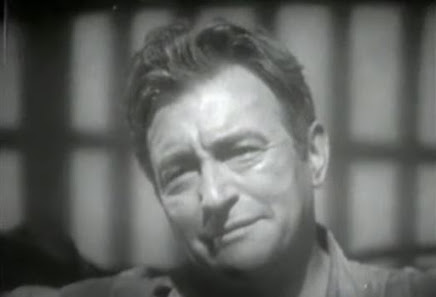

In a haze in between beatings, Claude Rains reviews in his tangled mind what has happened.  He dreams of an idyllic scene of his family and friends having a picnic in the country, where a young couple discuss their future.  “We were too young for the war and we’ll be much too old for the next one…We can have anything and everything we want…”  Are the young always so callow and self-centered, so unable to see trouble ahead?  Rains, back in his cell ponders with greater regret of those lost in the war, “They died on the battlefield that I might live, and out of their victory, I made nothing.”

Through nightmarish whispers, he confesses, “I’m not afraid to die.  I’m afraid to go on living.” 

“I thought that freedom was like the air, always with me as long as I lived.  I thought you didn’t have to do anything about it.”

He resolves in his cell to keep on fighting.  However, and somewhat disappointingly (because a Resistance-style pushback would have added some satisfying action), it was all a dream.  He wakes in the fishing camp in the north woods and is eager to rush home to his wife and kids.

“It was only a dream” is probably the biggest deflator in any movie plot.

A lot more might have been made of this movie, which feels like it was padded a bit to fill out what might have been a more taut radio script.  The most chilling aspects are the loss of the Bill of Rights and the way his frightened community has caved.  And his confession that he is afraid to go on living.

We are on the brink of such a scenario today. Russian election sabotage mixed with white supremacist street gangs playing soldier with AR-15 weapons, rampant police brutality, along with a Republican Party that has caved in to the Trump Party, all gleefully and greedily conspiring to destroy American democracy, and during a raging pandemic to boot.  It would be a good time to wake up.

*********************

Jacqueline T. Lynch is the author of Ann Blyth: Actress. Singer. Star. and Memories in Our Time - Hollywood Mirrors and Mimics the Twentieth Century. Her newspaper column on classic films, Silver Screen, Golden Memories is syndicated nationally.  Her next book, a collection of posts from this blog - Hollywood Fights Fascism - will be out next month.

Thursday, October 26, 2017

Phantom of the Opera - 1943


Phantom of the Opera (1943) is a musical, a Technicolor feast for the eyes. There is a horror story in here, too, but it is cloaked in understanding and the eerie hindsight that dreams dashed can be a pervasive kind of horror.

Between the Phantom’s woes, portrayed with much more sensitivity than Lon Chaney’s infamous ghoul in the silent 1925 version, and the young soprano Susanna Foster’s real-life sorrows – there is enough pathos to make this movie a poignant ode to dreams that died.

The movie, more musical than monster, seems an homage to the world of operatic music than to the original nineteenth century penny-dreadful novel, though it was perhaps a smart move not to attempt to re-create the original classic silent story "note-for-note," as it were. We are given something extra, treated to the powerful baritone of Nelson Eddy and the beauty of Marta. Other “operatic” performances are not taken from operas, but are adapted works from Chopin and Tchaikovsky.


The Paris Opera of the late nineteenth century is the familiar setting for the tale, but there are differences in this movie – Nelson Eddy stars as the opera company’s baritone and Edgar Barrier plays Raoul, the local police inspector. Both men are romantic rivals for the hand of Susanna Foster, who plays Christine DuBois, a talented member of the opera chorus. The gents try to woo her, and Susanna enjoys their attention. Another man loves her and works to further her career – Claude Rains.


Mr. Rains is the Phantom of the piece – and there is no mystery about his identity. When we first meet him, he is not hiding in the shadows. He is in the orchestra pit playing the violin, a mild-mannered, middle-aged musician employee of the opera house. His encounters with Susanna are shy and awkward, and she gives him no thought other than he is a polite but odd old man. The Phantom is not a ghoul here, but a sad soul, and he breaks our hearts from the beginning. We discussed the original Phantom and the 2004 movie based on Andrew Lloyd Webber’s long-running stage musical in this previous post. We observed that the presentation of the Phantom had changed because of our evolution, not his:

      Perhaps a good deal of this transformation of the Phantom in our popular culture has simply to do with ugliness. Gerard Butler’s Phantom is a man with what looks like a few old burn scars on part of one side of his face. Nothing we can’t live with, even though he vainly keeps it covered. Lon Chaney’s face is a rotting, putrid skull. It gives us nightmares. The original book was written in the days when ugly was synonymous with evil, at least as far as storytelling was concerned. Chaney’s film was made, similarly, when the representation of evil was done mainly through an image of ugliness. We still have film monsters who are ugly to be sure, but they are evil and ugly, not evil because they are ugly. There was not a whole lot of sensitivity towards people with mental or physical handicaps in those days, when desperate parents were still leaving deformed children with carnivals. There wouldn’t be any empathy left over either for folks who were less than beautiful. In the code of old Hollywood, the heroes and heroines were beautiful, and the sidekicks and villains were not.

Today we have a bit different take on evil, on beauty, and on empathizing with those who appear different, and that perhaps is one of the reasons why the Phantom has changed. He needs to be repackaged in order to be sold. It would be difficult to film the same 1925 story and present it to a 21st century audience, with the same simplistic judgments. The Phantom’s evil as represented today is more psychological, and more a problem of society because he has been treated so shamefully. Instead of nightmares, he gives us second thoughts.


Universal was known for monster movies as being its specialty, but it also produced a large number, even more than MGM, of what could be termed teen musicals. It is from their stable of talent they drew Susanna Foster and began to groom her as one of their biggest stars. As such, Susanna had a featured role in Bowery to Broadway (1944), which we discussed here, with another youngster who was to replace Susanna as Universal’s leading songstress – Ann Blyth.

The 1943 Phantom is a kind of missing link between the two incarnations of silent ghoul and Lloyd Webber’s lavish musical.


The camera pans from Claude Rains playing violin with the orchestra in the pit, and pulls back to encompass a grand opera house interior, with every seat occupied by the well-to-do in their gowns, tuxedos, and jewels, in every box and loge. We finally pull back to the very end of the farthest rafters, the cheap seats, to reveal the enormous opulent glass chandelier. This, of course, has a prominent place in the story and the shot is breathtaking for its dual use as eye candy and premonition of things to come. It is more so a premonition because by 1943, though the original Phantom, while it may not have been as familiar to that generation, nevertheless had reached legend such that people knew the story they were about to see, or they thought they did.

There are flickering candles in every desk candelabra and overhead ceiling chandelier in every office, in every parlor and boudoir, casting shadows, and reflecting a warm glow. The film moves at a leisurely pace and we sink ourselves into its environment, from cold, gray streets, to actors adjusting costumes behind the flats backstage, to the grand but artificial sets on stage.

Claude rains plays Erique. He is a longtime employee of the opera house orchestra, but is fired because his playing has become slack, to which he attributes his hands and fingers becoming stiff. He may be one of the first people in classic films to be fired for a repetitive motion injury. But poor Erique has no workers’ compensation to fall back on. He is, worse still to any employer, getting old.

He is crushed by being dismissed, and wanders in a daze back to his one-room garret. We see he is living a poverty-stricken life, though his employer and others assume he must have a lot of money in savings from his 20-year career. However, we next see that he has spent his savings on a very expensive endeavor that is both a kindness and a fantasy. He has been anonymously paying for singing lessons for Susanna Foster, who does not know her benefactor. She has been studying with the Maestro – that’s our old friend Leo Carrillo, for three years.

Claude Rains also writes music, and he has an ace in the hole, a manuscript of a concerto he has been writing for years. He intends to have it published, thereby solving his money problem. However, the publishing house stalls him, treats him badly, and when he perceives that they are going to steal his work, in an angry rage he confronts the publisher, who is in conference with his lady friend. They are amusing themselves with his hobby of etching photos on steel plates with acid.  Nothing says love in the afternoon like etching photos on steel plates with acid. Rains attacks the publisher and strangles him to death, and the lady friend grabs the acid and tosses it in Rains’ face.

Whimpering in pain, Rains staggers out of the office and through a maze of rain-washed streets. He is hunted by the police. He takes refuge, of course, in the city sewers that lead to the bowels of the opera house – and we have our Phantom.

He steals his trademark mask and cape from the opera house costume department. It is a rather stylish sea-green mask with eerily arched brows painted on it. He steals supplies from the opera house and lives there and continues to support Susanna Foster’s career, mainly by trying to oust the pompous Diva with threats of violence. Something in his gentle, befuddled personality has slipped askew – he is more cunning, more sinister, and will do anything to get what he wants – and now he wants Susanna, no longer content to love her from afar.


Claude Rains has become strangely athletic and acrobatic in his rope climbing and rafter leaping, and that rakish forelock that drapes over his mask adds a cavalier touch.

Look for Hume Cronyn as one of the police inspector’s men who chase the Phantom through the opera house and try to lay traps for him.


Susanna Foster, at the center of the piece, is a delicate figure, but despite being the focus of the film—even more than the Phantom in this version—she seems not to have a strong screen presence here, though perhaps the role of Christine is too passive to appreciate Foster's abilities as an actress. She was known for having the ability to reach the note B above high C in her vocal range; and the film presents her beautifully, exhibiting this tremendous gift.  Perhaps this information was difficult for audiences who were not opera fans to appreciate, despite the Universal publicity department’s attempt to market it.  Phantom of the Opera was her most important film, her fifth film. She began in Hollywood in 1939 at the age of 12 years old in The Victor Herbert Story, and her path went from MGM, which never used her, to Paramount; to Universal, where they had a robust youth unit whose most famous star at the time was Deanna Durbin.


Reportedly, Susanna was brought on to keep Durbin “in her place,” giving the studio the ability to threaten to replace Durbin with another soprano if she did not conform to their demands of her. Durbin turned down the Phantom script and Susanna inherited the role. She only did a handful of films in her career. In 1945, Universal granted her wish to study opera and tour overseas, which she did, but then she decided to quit the movies.

She confessed to never being very ambitious and felt overwhelmed by the Hollywood machine, but she must really have been made of stronger stuff, for Susanna coped with more than her share of burdens. She grew up with alcoholic, abusive parents, but supported them and two younger sisters while she was still a child herself. When she returned from Europe and her movie contract was over, she reportedly gathered her resources, including selling her fur coat, to rescue and raise her two younger sisters and make a home for them. She eventually married baritone Wilbur Evans, but that union was unhappy. They did some stage work together, but when they divorced, though he was an absent father, he apparently demanded as part of the divorce decree that she not take their two sons more than 100 miles away from New York, thereby ending her attempts to have a comeback in film. She took work in New York City as a receptionist and did what she could with office jobs to support her two sons, with no help from her controlling ex-husband. Years later, she returned to the West Coast, and for a time, was homeless and living in her car.

According to author Bernard F. Dick in City of Dreams: The Making and Remaking of Universal Pictures (The University Press of Kentucky, 1997, p. 125), he notes that in 1989, Jane Withers and Margaret O’Brien learned that Susanna Foster was living in her car and “they came to her aid.”

Most poignantly, The Phantom of the Opera had begun an amazing new incarnation through Andrew Lloyd Webber’s blockbuster stage musical. At that time that Jane Withers and Margaret O’Brien were financially helping Susanna, Lloyd Webber’s Phantom was playing in Los Angeles. According to Mr. Dick, the two ladies “made it possible for her to see it.”

She had been the first singing Christine in a time when the Phantom began to appear less ghoulish to us and more troubled, more sad. For the first time, we saw his side of the story.

Susanna had a story, too. In her final years, her son (one had predeceased her) moved her back to the East Coast and was able to place her in nursing home care. She died in 2009 at the age of 84 at the Lillian Booth Actors Home in Englewood, New Jersey.

No horror story for the blog for this Halloween. At least, not the kind you were expecting.

Monday, November 5, 2012

Mr. Smith Goes to Washington - 1939


Mr. Smith Goes to Washington (1939) has grown to legendary status. It represents an icon of 20th Century American popular culture. It stands tall among the giants of that pantheon of 1939 films. It generated great controversy at its release, but today, though it enjoys restoration and placement in the Library of Congress as a film of significance, it is perhaps seen in the soft nostalgic glow as just another example of “Capra-corn.”

Its simplicity is both its greatest dramatic asset and its singular fault among critics. That is the dichotomy of any Capra film. Paradox is the order of the day. Just a few examples:

This movie was banned both in Nazi Germany and the Soviet Union for showing the American democratic process in a positive light. However, this film was roundly criticized by Washington as showing senators in a negative light and the political process as being rife with corruption. They wanted it banned, too.

The movie shows corruption in Congress, but no political party is ever named. Claude Rains plays the senior senator, who has compromised his integrity for graft, and James Stewart plays the junior senator from the same state. We do not know with which party they are affiliated. We do not even know which state they are from, but since the story is partly based on a book which named Montana as the home state, the senator from Montana walked out on this movie at its preview at Constitution Hall in Washington. Many other senators were no-shows in protest.

Art reflects life, as we realize the main message of this film is the crime of arrogance. Politics is rife with it. Both political parties are guilty. Graft is graft, no matter who does it.

And it’s easy see how Capra both pulled away and exploited the combustible nature of politics in this film. We take politics personally. We cringe and get our backs up when we hear an opposing political viewpoint. That is human nature. How we behave about how we feel is what makes us ladies and gentlemen…or thugs.

Politics is also rife with idealism, sometimes pure and hopeful in its natural state; sometimes exploited in creative political ads meant to play on the emotions of the public and how well they respond to dramatic backlighting of a candidate in his shirtsleeves superimposed over a waving flag. It’s hokey, and it’s still being done. The arrogance of politicians in believing we are really that stupid.

Director Frank Capra was a conservative Republican. The scriptwriter, Sidney Buchman, was a Communist Party member between 1938 and 1945. Yet, they shared ideals and vision for this movie. (Buchman would be blacklisted in the 1950s when he refused to name names.)

Most of those shots of Washington buildings and monuments were taken on the sly; the United States Parks Service denied the filmmaker access.

One more paradox: despite this canon of idealistic films of Capra’s, Mr. Smith Goes to Washington is actually quite a dark movie, sinister and cynical. James Stewart is the only Pollyanna of the bunch, and by the end of the movie even he gets his teeth kicked in.

Long post ahead. You’ve come this far. It would be a shame to turn back now.

We begin the movie with that heartthrob Charles Lane as a reporter, holed up in a phone booth barking in his sexy nasal twang about the sudden death of a senator and the need for his state to send an immediate replacement.

Only a truly great movie would start the show with Charles Lane.

We learn right off the bat that Edward Arnold, the prototype of the greedy corporate thief, runs his state with an iron hand and a bottomless wallet. Guy Kibbee is the harried governor, who asks “How high?” when Mr. Arnold tells him to jump, much to the chagrin of his wife, Ruth Donnelly, and his large family of children. The kids suggest James Stewart as a replacement senator. Stewart runs the Boy Rangers (because the Boy Scouts of America didn’t want to touch this film with a ten-foot pole) and publishes a boys’ newspaper and recently heroically fought a forest fire.


Edward Arnold is great in this film, with his voice kept low and sneering. If he bellowed and blustered it would not be half so chilling as that snide, quiet confidence he displays.

One of the real delights of this film is spotting the character actors. Porter Hall and Grant Mitchell are senators, Jack Carson gets a couple lines as a reporter. Lafe McKee (who we discussed in this previous post) gets a brief, but iconic moment in this film when he stands before the Lincoln Memorial helping his little grandson to pronounce the difficult words in the Gettysburg Address, which is engraved in stone on the building.

As he says the word “freedom,” we get a shot of an elderly African-American man standing nearby, who has removed his hat in respect for Honest Abe. If this man is over 77 years old, he might have been born a slave. Politics is personal.

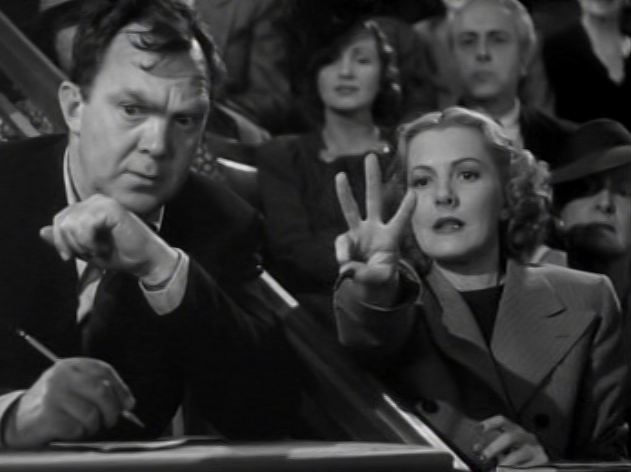
Eugene Pallette is on board as Edward Arnold’s right-hand man. Catch the scene where Pallette struggles to get his large body out of a phone booth. Dub Taylor, who we last saw in Cowboy Canteen (1944), is a wisecracking reporter who is part of a gang that interviews a bewildered James Stewart upon his arrival in Washington. You might even catch a glimpse of a young Craig Stevens as a reporter in the Senate chamber gallery writing fast and furious with a pencil.

Dickie Jones, the young Senate page who helps out Stewart, you’ve likely seen in many films.

Much of this movie, when it really works well, hinges on the magnificent Jean Arthur. Her performance is transcendent. She is secretary to Claude Rains, and has seen enough of Washington’s seamy side to stamp out any idealism she once might have had. As she tells Rains, “When I came here my eyes were big blue question marks. Now they’re big green dollar marks.”

She is assigned to babysit James Stewart, whom she first regards with eye-rolling bemusement tinged with disdain. Gradually, however, her own latent idealism is re-ignited under his slow-talking, sincere, nervous charm. He tells her about the beauty of his state, and his father, a small-town newspaper publisher who was murdered for standing up to a mining company, and how his father told him to look with wonder at life around him and “Always try to live as if you’ve just gotten out of a tunnel.”

She is moved, in spite of her own misgivings and fear of being duped. You can see all of that in her delicate expression, her sense of breathlessness, and we watch her falling in love with him. As we’ve discussed before, Jean Arthur had a remarkable ability to play pathos and comedy right at the same time. I can’t think of anybody else who could work as well at this deceptively complex role, with perhaps the exception of Barbara Stanwyck. Jean Arthur’s faith in politics and mankind is rekindled, and then dashed again as her heart is broken when James Stewart becomes the prey of Edward Arnold and his machine.

Stewart gets himself targeted when he proposes a bill, with Jean Arthur’s help, to create a national boys’ camp where boys from all walks of life, races and creeds, can come together. The land he chooses is the spot Edward Arnold wants and has been sneakily buying up under false names. Claude Rains, the “Silver Knight,” a respected senator who has been kept in office for decades by allowing himself to be Mr. Arnold’s stooge, must now crush James Stewart on the orders of his boss. He even dangles his society snob daughter, played by Astrid Allwyn, in front of Stewart as a diversion.

Jean Arthur, who knows all of this, is heartsick. One of her best scenes is in the press club bar with pal Thomas Mitchell, as she self-medicates her pain with booze. She and Mitchell also played confidantes that same year in Only Angels Have Wings discussed here. Frank Capra, quoted in Frank Capra-The Catastrophe of Success by Joseph McBride (Simon & Schuster, NYC, 1992), p. 417 - “I defy any other actress to play that scene,” Capra marveled, “She’s a great actress, much better than she knows. She made it believable with little things, like the way she tried to pick up her glass and didn’t know which glass she was picking up.”

During this scene she tipsily mourns sending James Stewart off to the Senate with a bill that was going to make him a target of the bad guys: “I felt just like a mother sending her kid off to school for the first time. Watching the little fellow toddling off in his best bib and tucker. Hoping he can stand up to the other kids.” It’s hysterical, and heartbreaking at the same time.

Though I think my favorite line is when Thomas Mitchell, in her apartment looking for stuff to mix cocktails, asks her where the bitters are. She replies absently, “In the thing there. Behind the thing.”

At her drunken scene, she accepts Mitchell’s longstanding marriage proposal as a way to escape Washington and the hypocrisy around her. In Jean Arthur - The Actress that Nobody Knew (Limelight Editions, NYC, 1997), p. 116 - author John Oller quotes Howard Hawks, who directed Mitchell and Miss Arthur in Only Angels Have Wings, remarking of Arthur’s work in this scene, “That was a beautifully-done thing.”

Jean is quoted explaining the scene, “The trouble about a woman being drunk is you have to be careful not to go overboard because then it’s not funny…A man can be awfully funny when he’s drunk but not a woman.”

Still a little drunk, she and Mitchell head back to her office so she can clean out her desk (her stuff, comically, includes a large rag doll). She runs into Mr. Stewart there, and vents her anger at him for being so gullible. She clues him in on the facts of life, how he is being used, and how the bad guys are playing him for a sap. When she marches out, she stops, as if overwhelmed by her own misery, and leans on the wall out in the empty hallway. Thomas Mitchells hovers by her, concerned. Her back to us, she sobs with her head against the wall and we see, as does Thomas Mitchell, that there will be no marriage between them, that she is in love with Stewart, and that she is hopelessly afraid for him. It’s wordlessly eloquent, all done with body movement.

Two more brief moments I love: When she sleepily awakes, still sitting in the Senate gallery to watch him below standing alone in the middle of the night during his filibuster reading softly from the Bible, “and the greatest of these is charity.” Also when she sends him a love note tucked inside a bound copy of the Constitution.

James Stewart grows up a lot now. He sees the corruption, confronts Claude Rains and tries to spill the beans in Congress. He is silenced when Rains pulls a fast one on him and accuses him of corruption instead. Stewart gets pilloried. Jean Arthur finds him, at last, with his suitcases prepared to leave town, sitting before the Lincoln Memorial at night, crying with that bewildered pain we suffer when people, whether it’s the kids on the playground, our coworkers, or our family, have rejected us.

Just as Jean Arthur was so perfect for her role, I don’t think any other actor would have done as well in his part as James Stewart. Capra had originally hoped to use Gary Cooper in an extension of his “Mr. Deeds” role, but that fell through. Cooper was great, and Jean Arthur loved working with him, had a crush on him, but Cooper’s innocent heroes had something yet sly and knowing about them. Stewart is completely at the mercy of his own unthinking exuberance.

Jean Arthur saves him. She coaches him through a filibuster from her perch in the gallery of the Senate chamber. It’s a terrific showdown, a gunfight with ideals and stubbornness rather than six-shooters.

As Stewart’s voice grows hoarse through the weary hours of his filibuster, Edward Arnold tries to spin lies in the press to their home state, telling the public only what he wants them to know, faster than you can say Fox News.

These scenes are where Capra, in another paradox, both captures the emotions of the audience but also loses believability when small newsboys on the side of James Stewart are used to convey the David versus Goliath aspect. I suppose it’s difficult to find imagery to support the nobility of the common man without getting hokey. It’s difficult sometimes for Capra, anyway.

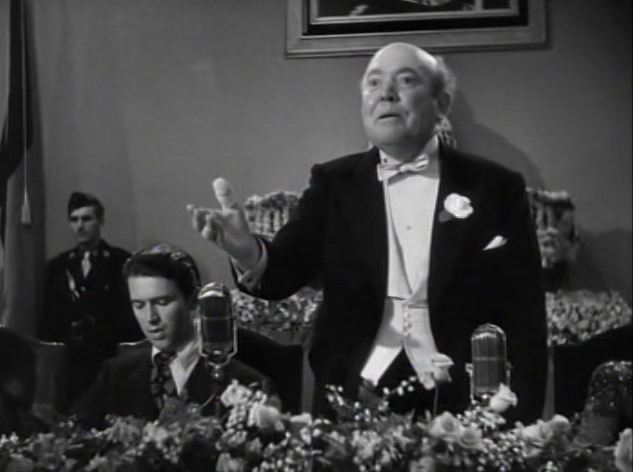
I get a kick out of real radio newsman H.V. Kaltenborn used here, standing in front of a mic, narrating the magnitude of the moment. Waxing eloquent with the few minutes allotted him in days when live news was in its infancy. Today, we have hack media personalities -- I hesitate to call them journalists -- telling us about the latest poll or topic trending on Twitter. And the overuse by CNN of “breaking news” with asinine repetition to hijack our attention over topics which are neither news nor breaking.

Many of us remember a time when the announcement “Special Report” was given sparingly and only for really big news. Our stomachs turned when we heard it because it usually followed with the first reports of an assassination.

But Mr. Kaltenborn stands at his post, using proper English and trying to give the circus some dignity, instead of trying to turn something dignified into a circus.


The Senate chamber scenes are wonderful. A replica was created on the Columbia lot. The pageboy explains to Stewart, and to us, who sits where, and the history and significance of the setting. In many scenes, we may note that many of the desks are empty -- a silent gesture showing that our senators are not always on the job.

I love the shots of Jean Arthur in the gallery throwing signs to Stewart like a catcher to a pitcher to guide him through the filibuster process.

There is some strong imagery in the Senate chamber. We see Claude Rains and the other senators filmed from the floor to the ceiling so they look like giants. We see shots down from the ceiling at the menagerie of “senators” and extras looking small as they fill the room, a tight cluster of humanity. The arrogance of the senators when they turn their backs to Stewart as he speaks.

The climax is strangely quiet. Claude Rains directs the pageboys to carry in baskets of telegrams from an angry public denouncing James Stewart because of the lies they have been fed by Edward Arnold. It’s almost like that glorious scene in Miracle on 34th Street (1946) when the letters to Santa arrive. But these scraps of paper do not save Mr. Stewart. They condemn him.

He first looks heavenward, a Christ-like figure as if to say, “Why hast Thou forsaken me?” Then he locks his gaze on Harry Carey, who is sublime as President of the Senate, smiling through his fingers as he tries to mask his bemusement at Stewart through previous scenes. He is a kind of craggy-faced Will Rogers-type character whose eloquence is not in his quips, but in his expression.

Mr. Carey gives him a gentle smile of encouragement, and Mr. Stewart finds the will to continue despite it being a lost cause. James Stewart is triumphant in this moment, not because he has won, but because he has fought the good fight.


I find the ending is where Frank Capra loses us again in a saccharine solution. Claude Rains, overcome by his conscience, hysterically confesses his guilt. Convenient, but unlikely. We know too well that people in office rarely admit guilt. Especially if it would lead to a conviction.

Claude Rains is fascinating to watch in the film. He has a complex role and his evolution is just as important as Stewart’s or Arthur’s. He is a man of ideals who gave up most of them in order to survive in the Washington jungle.

Early on in the film, a banquet is held to welcome Stewart to political life, and Mr. Rains is surprised to discover that Stewart is the son of his old friend. He leans over the dais to spy Stewart’s mother, the lovely Beulah Bondi, who exchanges a look of fond reminiscence. Here is where we first see that Rains has an honest past, and this is where his struggle of conscience begins. He carries the burden through the film.

We see a lot of father-son imagery in the movie: between Rains and Stewart, between Stewart and his Boy Rangers, with the pageboy, between Harry Carey and Stewart.

The first time I went to Washington, D.C., as a young woman and stood in the visitors’ gallery of the Senate chamber, I could not help but think of how it looked in Mr. Smith. It was one of many trips. Washington, D.C., is a place I never get tired of visiting. One can feel cynical and still be inspired.

Despite its occasional hokey sentimentality, these are the real truths expressed in this movie. Jean Arthur reminds a disgusted Stewart that, “They aren’t all Taylors and Paines in Washington. That kind just throw big shadows, that’s all.”

Another truth is Claude Rains’ dismissal of the people voting him out when they learn of the corruption: “You can’t count on people voting. Half the time they don’t vote anyway.”

We get heartily sick of the nastiness of political campaigns, especially when they seem to last so long. But it is a good thing, I think, that we air our grievances so publicly and that other nations can see our anger and discontent. Because they also see that it all leads to election day. No coups, no hanging or shooting the opposing party when you’ve won and they’ve lost. The winners take office. At the end of the term, we vote again. Like clockwork. It’s that splendid confidence in our own system that drove both Nazi Germany and the USSR to ban this movie. It was our suspicion of our own leaders that drove Washington insiders to criticize this film at its premiere. Trust and suspicion, in healthy doses. A marvelous paradox Frank Capra didn’t create, but was clever enough to appreciate. [Addendum: from the perspective of 2022, this last paragraph seems sadly naive.]

This movie, despite, or because of, its sentimentality has inspired many over the decades. It was one of my mother’s favorite movies, and she presented it to me as a kind of civics lesson. When the reporters rush from the Senate chamber shouting, “Filibuster! Filibuster!” -- I recall my mother echoing, “Filibuster!” excitedly when I saw it the first time on TV, grinning, urging me to see what happens next. She was one of the most politically astute people I ever knew. Though neither of my parents were joiners of causes, they learned early the intimate place politics had in their lives when as children the programs like the CCC and the WPA created by President Franklin Delano Roosevelt saved their lives.

Growing up in poor families, President Roosevelt literally kept them from starving and gave them job training and hope for the future. They never took politics for granted after that. It was personal. The most important program in my house was the news. They devoured news magazines and newspapers, and we watched conventions like some people watched the World Series.

When they got ready to go vote, my father shaved. My mother put on makeup. Reading glasses, check. Notes on specific ballot questions, check. They announced with almost theatrical dignity, “We Are Going to Vote,” as if they were about to save the world.  Being able to vote gives you a great sense of power.  Ask anybody who can't.

We were to be good until they got back from saving the world.

I am voting tomorrow because that is what I was raised to do. Because my mother loved Mr. Smith Goes to Washington. Because my mother, rest her soul, who never had a driver’s license or a passport, were she living today would be denied the right to vote by some politicians who are aching to get a whip-smart, no nonsense liberal like her off the books.

And because like James Stewart in the movie, I get all choked up when I visit the monuments in Washington, D.C.

   ********************

Jacqueline T. Lynch is the author of Ann Blyth: Actress. Singer. Star. and Memories in Our Time - Hollywood Mirrors and Mimics the Twentieth Century. Her newspaper column on classic films, Silver Screen, Golden Memories is syndicated nationally.  Her new book, a collection of posts from this blog - Hollywood Fights Fascism - is available here on Amazon.

Monday, February 28, 2011

Deception - 1946

“Deception” (1946) has a melodramatic plot of unexpected twists, and is guided by the very strong characterizations of the three principle figures. Mood and atmosphere play an equal hand in the telling of the story, and may be the most fun thing about it.

Rest easy, no plot spoilers this time. There’s not much to pluck apart when it’s all handed to us with grandiose panache on a platter.

Bette Davis discovers her long-lost lover, played by Paul Henreid, in a small university concert hall in New York City where he is featured playing the cello. They had been music students together years before in Europe, but were separated during the war. She thought he had died, and their reunion is a joyous miracle. She takes him to her loft apartment, tells him to make himself at home, literally by making closet space for him. We are made to understand they want to take up where they left off many years ago, and be married as soon as possible.

Perhaps the censors were distracted from her plain insistence they live together until such a time as their troths are plighted by Mr. Henreid’s sudden baffled curiosity as he notes her stylish apartment, her furs in the closet, the sculpture and artwork. A grand piano. She has lamented that she is still a struggling musician, but this opulence clearly indicates to him she is being kept by someone.

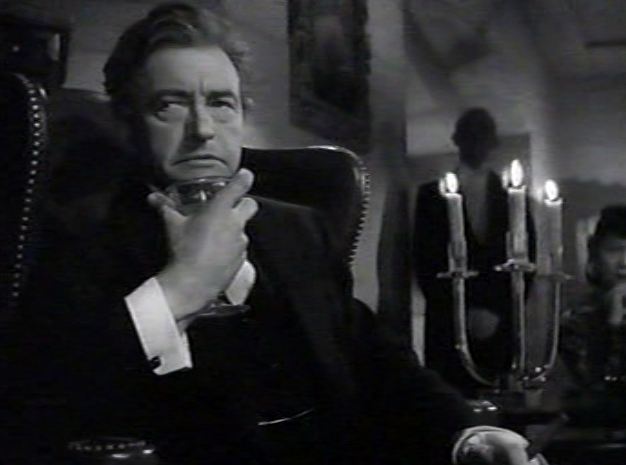
That someone is Claude Rains, a composer and conductor, a maestro of larger than life appetites, a mercurial temperament, and formidable arrogance. Bette spends the rest of the movie telling lies, and surfing the moods of two very jealous men, until her best motives bring about disastrous events.

Does it seem that the immediate post-War period led Hollywood on a rather moody exploration of the sinister possibilities of the arts? In the same year as this film, 1946, we have “Humoresque” with Joan Crawford and John Garfield, and in the next year we have “Night Song” with Dana Andrews, “Song of Love” with Katharine Hepburn, and we were taken out of the concert hall and into world of ballet with “The Unfinished Dance” and in 1948, “The Red Shoes.” The backwash of the war seemed to have us convinced there was no safety even in a quieter world among man’s most creative endeavors.

“Deception” provides a wealth of great music, including Wagner, Schubert, Haydn, and Beethoven. One of the luxuries of the film is that the classical music gets a long, leisurely treatment. Bette Davis plays Beethoven’s “Appassionata” piano sonata in one telling scene that sets up the jealously of the two men in her life, and provides a glimpse into a world where music is not staid or the dominion of polite elite society, but rather a bare, passionate expression of human greatness, and weakness, and pleasure, and torture.


I like the way she is reflected in the shiny piano lid as she plays. And the way the men grip their champagne glasses while listening to her, as if they were strangling someone’s throat.

The characters display a passion for their work, a passion for life, and also for revenge.

But not all the music in this movie is so grand. Curiously, as Bette is walking Paul Henreid to her apartment for the first time, they cross a city street where a Salvation Army band is thumping out “What a Friend We Have in Jesus”, and in another scene, she listens to a cheesy radio commercial jingle. What director Irving Rapper meant to suggest with these bits is a mystery to me, except to keep things off kilter, which is the engine of suspense.

The dialogue is crisp, witty, and with innumerable flourishes by Claude Rains. He is matchless in this film, his intellectual bullying, his mind games, his petulance are something magnificent. He doesn’t steal scenes so much as always commands any scene he is in. It’s his movie.

A few interesting scenes: When he takes them out to dinner and makes a grand production ordering the food, irritating them both and putting Paul Henreid, who is to audition for him after dinner, extremely on edge. One of the more delightfully over-the-top remarks by Mr. Rains when he orders, “A nice brook trout, not too large, from a good stream.”


Another off-kilter scene is when Miss Davis goes to his home to have it out with him, and he lies in bed reading the Sunday funnies. This man who dismisses everything as not his equal, evidently has time for Dick Tracy and Terry and the Pirates.

We have scenes of disguised threats and vengeful accusations, of suspicions declared, and self indulgent tantrums that takes us smoothly from concert hall to Rains’ uptown mansion, to cab rides in the rain, and many times returning to Bette Davis’ loft studio apartment.

The apartment is my favorite thing in this film, almost like another character in the movie, with its modern furniture and sparse elegance, and the enormous window that seems to carve out a great big chunk of the gray city with its buildings and bridges, and plunks it right down in her living room.

We get to look out that window at night, in the morning, and follow the traces of raindrops that make a design around the heads of Bette Davis and Paul Henreid.

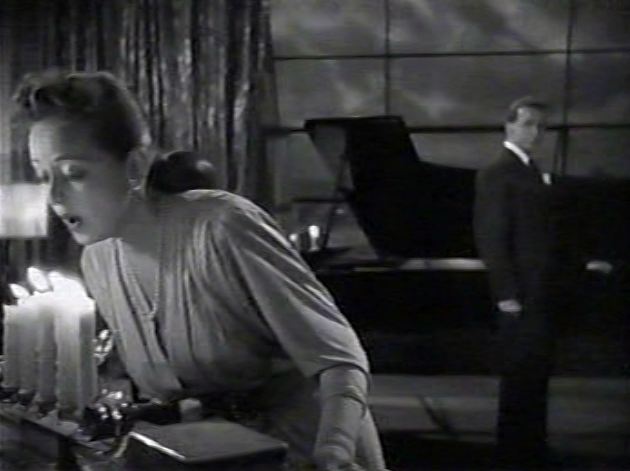
A scene where she blows out several candles placed around her apartment while keeping up the fancy footwork of defensive conversation with Paul Henreid in between blowing out another candle.

A scene where she and Henreid talk to each other from opposite ends of a hallway leading to the bathroom, where she primps before the mirror, and we can hear the hollow echo of her voice bouncing off the cement block walls.

The apartment seems to be neither a haven nor a cage, but a statement on the price one has to pay to make dreams come true.

Related Products