IMPRISON TRAITOR, PEDOPHILE, AND CONVICTED FELON TRUMP.
Showing posts with label Gale Sondergaard. Show all posts

Thursday, December 8, 2022

Christmas Holiday (1944)

Christmas Holiday (1944) is an absorbing noir that despite the bleakness of the tale, captivates the audience with quiet storytelling sprinkled with visual epiphanies, clever cinematography, and stellar performances.

The title credit announces this is “W. Somerset Maugham’s” Christmas Holiday, and though it is not entirely faithful to the Maugham story, one suspects the studio judiciously gave top credit to the noted author in order to ease the way a little for its two stars Deanna Durbin and Gene Kelly to be presented in a movie so unlike what either had ever done or would do again.  It’s as if the execs felt the audience needed to be prepared for what they were about to see.  It’s okay everybody, it’s English literature.


This post is part of the countdown to Christmas coinciding with the launch of my newest book, 
Christmas in Classic Films.

Some of the public and evidently, critics, were put off by this unexpected handling of the normally bright, chipper, and virginal Miss Durbin into a vehicle that was decidedly sordid.  She is great in the movie, in what is probably her best ever performance.  She deserves credit not only for her work in this odd little film, but for the courage to want to test her abilities and expand her career options into something a little meatier.

In the original Maugham story, an English university student skips his family’s Christmas gathering to go to Paris for a little adventure, meets an old friend who has now fallen under the spell of fascism, who takes him to a brothel and introduces him to a Russian emigree down on her luck and now a prostitute.  Her husband is in prison for murder, and she still loves him, degrades herself in a masochistic attempt to share his misery. 

Maugham tells it better than I do.

Possibly the main confounding aspect to the movie is not so much that Deanna Durbin is playing a slightly cleaned up version of the prostitute, but that the title Christmas Holiday would seem to evoke for us scenes of sleighrides and snowball-throwing jocularity. To further complicate matters, the cheery title credits are accompanied by a sprightly instrumental leaving us to believe this might be a musical.

The studio could have changed the movie’s title from the original source material—something that they did, let’s face it, all the time.  But sticking their most important star in a movie called something like “Rainy Night in New Orleans” and then later on in tiny script at the bottom, “adapted from a story by W. Somerset Maugham” would not give the movie the same prestige of pasting the name of a noted English author, whose rights to his story the studio had paid good money for and wanted us to know it.

So Christmas Holiday is not exactly meant to be a deceiving title.  But it deceives, and there’s a lot of deception going on in this movie.


Dean Harens plays a newly minted lieutenant, just graduated from officers’ training school.  He’s on a furlough before deployment, and he intends to fly to San Francisco to be married.  The commanding officer awarding them their commissions has a brief and frank, and frankly, chilling, admonition to them:  “Some of you will serve in one way, some in another. Some by living. Some by dying.”

One has to wonder about the table-top Christmas tree in the barracks.  Not regulation, I’m thinking, but it’s as if the director, noir master Robert Siodmak is deliberately saying, “You want Christmas?  I got your stinking Christmas!”

Just as the young lieutenant is packing his duds, he gets a telegram from his fiancée announcing that she has married someone else. 

It’s Christmas Eve.  There has never been a cheatin’ song to match this.

Though his pals invite him to join them on furlough as they go on the razzle in New York, he grimly decides to continue his plan to fly to San Francisco and evidently confront the couple.  “They’re not going to get away with this.” 

Does he mean them harm?  It is a passionate decision by a man who’s just been gut punched, but we will come to know this fellow by following over his shoulder on this 24-hour adventure that he is actually a cool, level-headed type, ready to step in when he’s needed, and nonjudgmental: good qualities in a man and in an officer.

I like Dean Harens in the role.  He made only a few movies, but went on to do decades of television.  His reactions and his support of Deanna Durbin in this film are solid and he is as interesting to watch as she is.  His acting style seems quite mature for a fellow with so little experience before the camera.  He and Miss Durbin certainly play well off each other, there is a rapport that indicates their characters bring comfort to each other, but that there is still an enigmatic wall between them that is intriguing.

The whole movie is an enigma, and it’s one of those that you have to see a couple times at least to catch everything.

He catches his flight to California, but there is bad weather and the plane must land near New Orleans.  Screenwriter Herman J. Mankiewicz plucked the story from Paris and plunked it down in New Orleans as a suitable substitute.  There’s French placenames and a certain gothic decay that lends verisimilitude.  Ornate wrought iron and Spanish moss.

In the bar of the hotel where the airline puts him up, he is annoyed by Richard Whorf, a splendid scamp of a journalist lush.  In only a few moments, when he quickly gives up questioning passengers over their plane being forced down because he is desperate to have anything to write about, we discover he’s really more of a boozehound than a reporter.  He might have been a good reporter years ago, but he really doesn’t care anymore, if he ever did.

Though his sales pitch is vague, he entices Harens to come with him to a “joint” where the owner might be able to fix him up with another way home.  The joint is a cheap nightclub as a meager front to what is actually a cheap brothel.  Even with the Production Code, we can clearly see this is a brothel.  Gladys George is the madam, reliable in her fallen woman with a heart of gold resume.  Though she apparently has connections, Miss Gladys is not able to help Harens get onto another flight, if that was even realistic. 

Because Harens plays his role like a young man who is bitter and unhappy, but not at all naïve or foolish, we are not really sure if he is unaware what kind of place this is, or that Mr. Whorf’s side gig is bringing men to the establishment as prospective customers.  Harens may not be aware because he is too distracted by his own problems, or he may just not care.  He’s not looking for a prostitute; he might not even want anything to do with women right now.

Still, he’s a gentleman.  Watch how he stands whenever Miss Gladys comes and goes, and when Deanna Durbin is summoned to his table.  Both the ladies notice this about him. 


Deanna also has troubles of her own, and the movie, unlike a lot of noirs, will take a leisurely pace unraveling them.  We see her first as a singer in this brothel, performing a breathy, half-hearted version of “Spring Will Be a Little Late This Year.”  It is not same trilling soprano that captivated “100 Men”, etc., in the string of hits that filled Universal’s coffers.  Her mood, like her lovely voice, is restrained, reined in, and she is almost somnambulant. 

An older chap, a businessman perhaps, silently hands his card to a waiter, who sneaks it to Deanna.  She reads it with no expression and continues her song.  Afterwards, she sits at table with a couple of other female staff and hands the card to one of them, as if to say she doesn’t want the customer and she’s giving up the chance to earn to her friend.  The other lady takes the card and introduces herself to the businessman, who briefly looks with surprise at Deanna, since she is the one he wanted, but he takes the substitute.  We see young women climbing the stairs over Deanna’s shoulder as she’s singing.  We know what kind of place this is.

Gladys George hands Harens a flyer announcing Midnight Mass at a local church, and says Richard Whorf suggested he might want to take it in.  This is a strange turn of events, but in hindsight, the kind you get when you watch the movie a couple times, it seems as if Miss Gladys has read this chap to be a decent guy and she is setting up a chance for Deanna to get away for the evening, because Miss Durbin has suddenly come alive, eager to go to church.  Gladys also refuses to take Harens’ money for the drink and the cab ride over, but slyly says it would be okay if he wanted to tip Deanna, however.

Ah-ha, so maybe she’s not just giving Deanna the night off.  Maybe she’s just finishing the setup that the drunken Whorf started.

The church service is an actual filmed Latin Mass in a Catholic church, and the director lingers over the enormous Gothic cathedral with its full attendance, choir, several priests and altar servers.  The organ thunders, and perhaps the director is saying again, “Yeah, I got your Christmas right here.”

Dean Harens, who didn’t really want to come to church, is nevertheless patiently watching the proceedings, perhaps lulled to a peaceful forgetting of his troubles for the moment, but Deanna Durbin, who is absorbed in the Mass, will break the serenity first when her eyes fill with tears as she watches the people gather for Communion, and then as the boy choir launches into “Adeste Fideles,” she begins to cry, struggling to stop.

Harens notices, and kindly asks her if she would like to leave, but she shakes her head.  In another moment, she is kneeling not on the kneeler but on the floor, in an effort to hide herself, and sobs uncontrollably.  Others glance at her and at Harens with embarrassment, and he is helpless to either comfort or remove her, so he stands at the end of the pew and blocks her from view with his long trench coat so that she may weep in private.

After the Mass has ended (“Deo gratias”), he waits for her to pull herself together.  Most of the church has emptied out, but for a few left kneeling, perhaps saying the Rosary, and one fellow who appears to be doing the Stations of the Cross.  She apologizes to him, gives him back his handkerchief, and they go to an all-night diner, where she confesses she has never cried like that before.  When it is too late for her to get a bus back to her room, she intends to sit up all night there, but he takes her back to his hotel suite.

It is not the meeting up that Glady George would have preferred for her employee perhaps, but neither Harens nor Miss Durbin have designs on each other.  Having pulled herself together, she is no damsel in distress.  There is a quiet, sensible strength about her.  When he offers to take the couch so she can have his room, she refuses.  I love her reply, “In my own little way, I’m just as much a gentleman as you are.” 

He doesn’t press the point, but sleeps in his room (though with twin beds, one would think if it were not for the Production Code, these two very tired people would be perfectly happy each taking one and sleeping in the same room).

The next morning, she has ordered breakfast and they chat over his “dear John” telegram, which he has left lying around and she has read.  Then it’s her turn, and we launch into the noir flashback. She is originally from Vermont, has been on her own since her teens.  I love that she wears reading glasses to peruse the morning paper, without a joke or explanation.

Her husband is in prison for murder.  She tells him, and prepares us, that the prison psychologist said “his relations with his mother were pathological.” 

Lots of enigmatic inferences, code talk, and unfinished sentences.

She met him at a concert where they are both absorbed in the nosebleed section by the thunderous “Liebestod” from Wagner’s Tristan und Isolde.  It is a pretty tepid meet-cute, but there is something puppy-like in Gene Kelly’s demeanor, desperate to be liked, and after a few dates, she was charmed by his boyish awkwardness and flighty, happy manner.  She had been alone for years, without family, that when he brought her home to Mother, she had found the place of belonging she had missed.

Kelly’s awkward, strangely needy young man may touch our sympathy as well, but like a good mystery, there is sleight of hand happening here and we won’t really know the truth about him until the end.  Kelly had played rogues before and would make a career of playing them, but this character has many layers to him and Kelly plays him with eerie panache.  He seems like only an odd duck on first appearance, a little pathetic and somewhat tiresome; but by the end of the film, he is a soulless monster, and Kelly is masterful in the progression.  It is not until the end of the movie that we really see, as does Durbin, that the character always was a sociopath.  He never changed; we just weren’t really seeing him.  He was playing us for fools, and we were.

Gale Sondergaard, as Mother, is…well, Gale Sondergaard.  She created the template for sinister gloss.  She welcomes Deanna Durbin into the family with vague warnings about her son but requires Durbin’s devoted partnership.  Between the two of them, they will make a man of her boy.


The trio is cozy at first, with Mother knitting, fondly watching as her boy plays the piano and Durbin, clinging to him, bending over him like a protective cape, sings “I’ll Be Loving You Always.” It is their song, a leitmotif that, like so much else in this movie, will turn sour.

At one point in their courtship, Kelly takes Deanna to a gambler’s den he frequents, wanting her to see it, maybe just perversely wanting to see this beautiful woman in it, to say farewell to his old life of dissolute behavior.  We are startled by seeing Richard Whorf there; he has been part of this tangled web farther then we knew. 

Gene has a hard time keeping a job, and admits his own inability to live up to the greatness of his ancestors, who practically ran Louisiana once upon a time.  He falters, and apologizes again.

Not too far into their marriage, he returns to his old ways, if he ever really left them.  In one scene he returns late at night, she has waited for him, and he, boyishly, teasingly, apologizes, almost clownishly begging for forgiveness to make her smile.  She does, as she murmurs, “Devil.”  Her delivery in the half-shadows is delectable.


But he gets deeper into trouble, and murders his bookie.  Mom tries to cover it up, and when Deanna finally finds out about it and has cops searching their rooms, she tries to cover it up, too. But Gene is caught, awaiting trial, and Gale Sondergaard lambastes her daughter-in-law for not loving her son enough, for not pulling her weight and helping her to “manage” him.  If only she were a better wife, had done her part, then they could have saved Gene from himself.

Gene goes to prison, Mother leaves New Orleans to find work as a housekeeper to a wealthy family in New York, and Deanna, maybe with the assistance of Richard Whorf, finds herself at Madam Gladys’s bordello, still singing “I’ll Be Loving You Always,” but now like a lament.

Dean Harens decides not to fly to San Francisco to confront his former fiancée after all, he will just let it go.  He’s learned a lot in the last 24 hours.  He decides he will just go back to camp, but when he sees the newspaper headline this Christmas morning that Gene Kelly has broken out of prison…

He rushes to Gladys George’s establishment to warn Deanna and to support her in any way he can.  Nice guy, for not being in love with her, and though Deanna and Dean clearly have a strong connection with each other, we are never given any indication they are in love, and realism of that makes the impact of the movie stronger.

Gene Kelly tracks down Richard Whorf and holds a gun on him, forcing him to take him to Deanna.  When Whorf gestures to her that her husband is in the building, she rushes forward, eager to see Kelly again.

But this is a sneering, angry Gene Kelly, no longer asking insincerely for forgiveness.  He’s quite sincere when he accuses her of being a tramp, of being unfaithful to him here.  If we assumed that Deanna had taken the filthy job in this disreputable place as the only option she had of supporting herself, we are shocked to hear her excuse for choosing to work here: she wanted to subject herself to degradation as a punishment and as a way to share his misery in prison.

He doesn’t believe her, pulls his gun on her, and when he is gunned down by the cop and she tearfully cradles him in her arms, we see she is still gripped by that hopeless, helpless love for someone who can’t seem to cope without her.

In what is probably the most magnanimous gesture, though he obviously means it ironically, Kelly tells her, “You can let go now.”

But she doesn’t let go until Dean Harens, in his quiet but firm voice repeats, “You heard what he said.  You can let go now.”

She seems to wake up and lets him go.  She looks up and the parting clouds reveal a starry sky as “Liebestod” swells up and one star seems brighter than the others.  After all, it’s Christmas night.

Director Siodmak is saying again, “Yeah, I got your Christmas right here.”

**********

Come back next week for a (much) lighter story in Love Finds Andy Hardy (1938), in which a visiting Judy Garland saves Christmas.

************

Jacqueline T. Lynch is the author of Ann Blyth: Actress. Singer. Star. and Movies in Our Time - Hollywood Mirrors and Mimics the Twentieth Century and Hollywood Fights Fascism.  Her latest book is Christmas in Classic Films. TO JOIN HER READERS' GROUP - follow this link for a free book as a thank-you for joining.

Thursday, July 11, 2013

The Unfaithful - 1947


The Unfaithful (1947) is a superior movie to The Letter (1940). 
I just wanted to get your attention.  I’ve been away from this blog for a long time.  I’m still here.
But seriously, I really do prefer The Unfaithful to the much more well-known and deservedly lauded The Letter.  Pour yourself a cuppa and I’ll tell you why.  You don’t mind spoilers, do you?  I didn’t think so.
Both films are based on the story and subsequent stage play by W. Somerset Maugham, (went through a handful of other film versions as well) but The Unfaithful is a re-working of the story to fit into a different locale: post-war Los Angeles.  The original story, you’ll remember, is set in a Malaya rubber plantation.  The Letter stars Bette Davis and Herbert Marshall in the tale of an unfaithful wife, who murders her married lover, and then must hide the truth from her husband and the police.  The device that seals her fate and proves her guilt is a letter written to her lover.  Gale Sondergaard, who strikes fear into the hearts of everybody, not just in this movie—she probably struck fear into the hearts of people just walking down Wilshire Boulevard—is the dead man’s wife who holds the whip hand over Bette Davis.

Directed by William Wyler, The Letter is lush and mysterious, steamy and provocative, beginning with Miss Davis unblinkingly gunning down her lover.  We are plunked down at the edge of the jungle, under a tropical moon, where civilization, i.e. white European society, is represented in a dance at the Raffles Hotel in Singapore.  It is about guilt and revenge and racial stereotypes.  The famous line uttered by Bette Davis: “With all my heart, I still love the man I killed!” is still a shocker, an electric moment. 
But for me, the film is a marshmallow: all air, sticky, and without nourishment.  Even the impressive Miss Sondergaard reminds me of The Dragon Lady in the old Terry and the Pirates comic strip, and so the “mysterious orient” clichés that abound in this movie strike me as somewhat cartoonish.  I prefer The Unfaithful for several reasons.  Here we go:
Ann Sheridan is in the Bette Davis role, but unlike Davis—who we know is guilty from the very first moment in the film—Ann Sheridan’s guilt, her sin of being unfaithful, is not apparent until far into the movie.  We start with a happy Miss Sheridan speaking on the phone with her husband who is away on a business trip.  We see she is in love, and eagerly awaiting his return the next day.  We do not suspect her of an adulterous affair.  What we do learn about her comes through twists and turns, and by the end of the film, we see we do not know her at all.  In comparison, Bette Davis comes off as transparent, and I find her brittle rigidity, though compelling psychologically, still two-dimensional, even if we are shocked by her declaration at the end of the film.
Miss Sheridan attends a party thrown by her husband’s cousin, Eve Arden.  Any movie with Eve Arden is always better than a movie without Eve Arden.  Our Eve has a good role here.  We first meet her as a new divorcee who throws herself a Happy Divorce Party.  All her friends are there, and one who is not her friend: her ex-husband shows up, drunk and angry, and vents his bitterness before he is dragged away.  Douglas Kennedy has this small role.  We saw him previously in South of St. Louis (1949).
Miss Arden is raucous, crude, loud, and tasteless in the early part of the film, but she keeps popping up from time to time, and each time we see her, a little more of her hard shell gets peeled away and we discover by the end of the film she’s really a sad and lonely person, and a mensch.  She turns out to be a real pal to Sheridan and her husband, played by Zachary Scott, when they really need her.

Zachary Scott has a more interesting role than the character played by Herbert Marshall in The Letter.  Though I love Herbert Marshall, and though we feel great sympathy for him as the cuckolded husband of Bette Davis, we also can’t help but regard him as a sap.  She’s playing him like a fiddle.  The story, and the director, allows us to see right through Davis, but he has no such advantage and we may wonder how he could be so dense.
Mr. Scott is nobody’s fool, an enterprising builder taking advantage of the post-war boom.  He’s devoted to Sheridan, but when the clues of her guilt wipe the scales from his eyes, he’s determined to dump her and see her rot.  How quickly, and stunningly, love turns to hate.  It’s all passion in one form or another.
Lew Ayres plays their friend and lawyer in a role similar to James Stephenson in The Letter; likewise he is devoted to his friends, plays knight errant to the accused until he discovers her guilt and then fights his own disgust to be able to save her.
Most especially, I love that The Unfaithful is frankly and most purposefully without that fantasyland setting of the tropics.  It is set in a mundane and more familiar time and place.  (Although, I confess, as a New Englander, I find palm trees, even lined up in front of a shopping mall, extremely exotic.) This is a setting we recognize; these are people with whom we are familiar.  It brings this tumultuous story down to earth, with consequences that are real.  We must take their troubles more seriously because they may be our own.
This being a blog about how classic films teach us much about the eras in which they were made, I find The Unfaithful a very useful tool in examining the post-war era.  It’s got all the details.  The narrator tells us as the camera pans from the home of Sheridan and Scott to the palm-tree lined roadway, “The problem with which it deals belongs not to any one town, city or country, but is of our times.”  In this respect, the movie is less like The Letter and more like The Best Years of Our Lives.
The “problem,” it seems, is that so many marriages begun in haste during the romantic and rushed war years are ending in divorce.  Lew Ayres’ clients are mostly women seeking divorces, and he has mixed feelings about that: a desire to be successful, and yet a sense of disgust for his clients.  Eve Arden is his latest client and his latest victory in the courtroom. 
Ann Sheridan is the opposite of Eve Arden: she is a loving wife who waited patiently for her husband to return from war, who still waits patiently for him to return from every business trip.  She waits around a lot.  She and Eve Arden are not close friends; they are too different.  One is a lady and one is…not.
Things turn very bad for Ann and progressively get worse.  She arrives home from Eve Arden’s divorce party, and parks her car in the back of the house.  As she pulls into the drive, we see a man is watching her.  Instantly, the tone of the movie changes.  She walks to the front of the house and we see her silhouetted in the mist.  We watch her walk towards us, knowing the man is hiding, also watching her.  At her door, the man attacks her, pulls her into the darkened house.  We watch through the windows, from the street, a scene of terror and the sounds of struggle, and screams.  We don’t know what’s happened, but we’ve imagined the worst.
It’s the next morning and Zachary Scott lands at the airport, wondering why his wife isn’t there to pick him up.  I like the way the director, Vincent Sherman, takes his time and lets this scene play out.  He’s very good at developing these very tense scenes from ordinary situations.  Your stomach tightens when you see Ann Sheridan walking at night in her own driveway.  Your stomach tightens when you see Zachary Scott get bad news.  We’ve been there.  This is a large part of why I prefer this movie to The Letter—it brings high drama to smallest, quietest elements of what we know as “real” life.
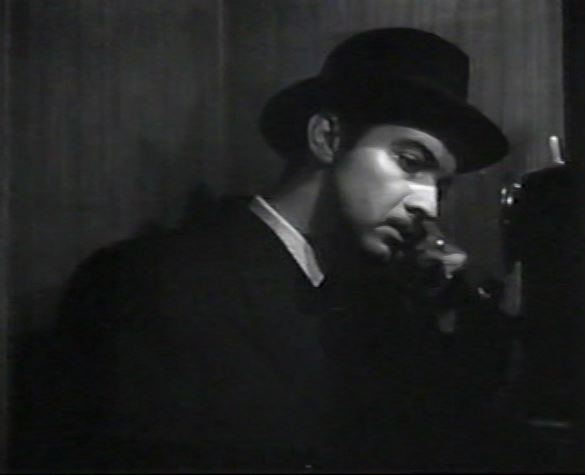
Mr. Scott looks and looks around, finally goes to a phone booth to call home.  Because he’s closed the door of the booth, and because there are constant announcements on the public address system about flights, we barely hear his voice.  We strain to hear him—a nice dramatic touch over not hearing him at all.  It makes us an active participant.  We don’t know what he’s saying—just like we couldn’t see the attack except from yards away and through curtains.  By his expression, we realize somebody on the other end told him shocking news, and he rushes to find his checked luggage and get a cab.
The phone, we learn, was answered the by the police, and we see when he arrives that his home is chaotic with reporters, and police all around.  For the first time, we learn that Ann Sheridan is well and survived the attack, but that her attacker lies dead on the living room floor with an ornamental knife in him that Mr. Scott had brought back from Japan during the war.  That’s about all of the mysterious orient you’ll find in this movie.
When Miss Sheridan is interviewed in her bedroom by the police, with her husband and Lew Ayres at her side, we see that she is traumatized and miserable.  We knew Bette Davis’ distress was just an act, but Sheridan’s horror is real.  The million-dollar question is asked of her “Had you ever seen him before?”  She answers no, and we have no reason to doubt her.  Neither does her husband or her lawyer pal.  The police detective, played by John Hoyt, remains cynical, but that is his job.

The widow of the dead man, played by Marta Mitrovich, accuses Ann of murder. “You killed him!” She is not as scary as Gale Sondergaard, but she’s pretty worked up about it.

By the way, does anyone know who plays the stenographer in this scene?  She has no lines, but she looks familiar.  I love stenographers.  
The detective tells us that the dead man has no criminal record, that he was a sculptor.  His mind, and ours, turns to the question, why did he go to her house?  If robbery wasn’t his motive, we are left with a question of attempted rape, though nobody uses the word.  Ann Sheridan’s expression is our first clue that she’s not being completely honest, she’s withholding some information, but we have to find out the hard way.
Steven Geray plays a smarmy art dealer who contacts Lew Ayres about a bust of a woman, asking him if he wants to buy it.  It was sculpted by the dead sculptor guy.  The face is Ann Sheridan’s.
Ann lied.   The dead scupltor obviously knew her and she knew him, because we are told that this kind of piece would have to be modeled from real life.  He didn’t sculpt it from a photo of her.  I find Ann's scatterbrained, guilt-driven, panic-induced deceit much more understandable and appealing than Bette Davis' psychotic, chilly posturing, but that is not to say that one actress is better than the other in the role; it's just a preference for characterization. 
The art dealer is attempting to blackmail Mr. Ayres’ client, but our noble Lew isn’t having any of it.  He brushes off the smarmy art dealer and goes straight to Ann, who, reluctantly, relents and confesses she did know the dead guy.  It was during the war, and she hired him to do the sculpture, but after a few sittings, he got too personal and creepy and made her feel uncomfortable, so she avoided him and never went back.  He stalked her a few times, but when her husband came home from oversees, it scared the guy off.
Ann tells Lew she didn’t tell him or the police that she knew the guy because, “I was afraid of what people would say.”
Now Lew has to hammer home to her that what people say is not the problem.  The problem is if she knew the guy, a jury might think she let him into the house and murdered him, that it was not self-defense.  She’s frustratingly slow on the uptake about this.
Unless there's more to it that she isn't saying.  

And there is.  

Then Ann goes to the smarmy art dealer herself to pay the blackmail, but the widow doesn’t want her money.  She wants her to go to jail. 
Ann goes back to Lew Ayres in a panic, getting herself in deeper and deeper, and finally Lew understands, as do we, that she had more than a professional relationship with the sculptor.  She had a fling with him.
Lew, lawyer and bachelor, is disgusted.  “You’re no different from all the other cheating, conniving women who parade through my office.”  Now he strips the final layer away:  Did she kill him on purpose to shut him up?
We pause here to watch the how her web of lies has taken on a life of its own.  Smarmy art dealer still wants a cut of the blackmail money he thinks he’ll get, so he contacts Zachary Scott and meets him, like a spy movie, in MacArthur Park (no cake out in the rain here, so just never mind that), one of the many neato Los Angeles scenes we have in this movie.  He takes him to the widow’s run-down apartment and meets Ann’s sculpted likeness as the art dealer hammers him with the old Othello scenario about the treachery of women.  Zachary is crushed.
He goes home to have a showdown with Ann.  She tries to explain her loneliness during the war.  He blasts her, “Millions of women waited, they waited decently, loyally.  They didn’t cheat.”
Mr. Scott wants a divorce, but just as he’s about to storm out, the cops show up at the door to arrest Ann on suspicion of murder.  See, the cops discovered Zachary going to the widow’s apartment with the smarmy art dealer.   They know about the sculpture now.  The jig is up.
Our Lew, despite his profound disappointment in Ann, agrees to represent her at the murder trial, where the prosecuting attorney is our old pal, Jerome Cowan.
The trial sequence builds to a crescendo of self- knowledge—of Zachary about Ann, and of about himself and his failings as a husband.  We learn they knew each other two short weeks before they were married, and he was so eager to pursue his career on his return home, she became an afterthought.  We also learn, somewhat surprisingly, that she was a fashion editor for a magazine before the war, yet we are given the impression she does not have a career now.  She gave up a job like that to stay home and volunteer for the Red Cross?  That is an interesting subplot that is not pursued, however. 
Neither is it fleshed out the possibility that Lew Ayres may feel more than friendship and respect for Ann and could present as a romantic rival, which would have been intriguing, but no triangle happens. 
What we do have is the crime of the century—not the murder, and not just cheating on her husband, but cheating on a vet in a post-war climate that revered them.
Jerome Cowan asks us, “Is this a woman you can believe?”
But Lew Ayres, and the producers remind us, “She is not on trial for infidelity.”  Mr. Ayres, from his own professional perspective as a divorce lawyer counters: “How many personal tragedies occurred far from the battlefield,” and “If there had been no war, she would not be in this court today.”  So it’s the war’s fault.  We see Zachary Scott mulling this over.
The best summation of the story is handled by Eve Arden.  When the jury is out a long time, Zachary Scott goes over his cousin Eve’s house to wait.  The merry divorcee is spending a quiet evening alone, with a book, the radio, and a box of chocolates, still wisecracking, but softer and sympathetic.  Zachary tears up, and cries, and she softly replies, “I’m glad to see you acting like a human being for a change.” 
Though she was never best pals with Ann Sheridan, whom she regarded as too good to be true, she defends her, and Zachary is upset.  “Is it my fault I was sent overseas?”
“You knew you were going when you met her.  Let’s face it, that’s why you married her…what you wanted was a whirl and a memory.  You wanted a beautiful woman waiting for you, and you didn’t want anyone making time with her when you were away, so you hung up a no trespassing sign, like you’d stake a gold claim.  You didn’t marry her; you just took an option on her.”
“She could have said no.”
Eve continues her sane, and somewhat shocking for the times, rebuttal: “When the band was playing?  Listen, I was there.  I saw you making with that uniform and that ‘today we live’ routine.  And then you were off.”
Production on this movie was begun in late 1946.  Just a year after the war, and we’re already negating all that movie patriotism and sacrifice that got us through the worst of it.
Then a phone call lets them know that Ann has been acquitted by the jury.  Mr. Scott quietly says, “Oh.”  So that we are still not sure how the ending will be played.
With Lew Ayres seemingly guiding the shell-shocked couple to a negotiation, it ends with a cigarette on the couch, and the leaden film noir score suddenly lighter, giving us hope, a suggestion of gentleness, and we even hear bells pealing.
We are left with an indictment not of Ann Sheridan, but of the era, and that gave the audience then, and gives the viewer now, something to think about. 
“With all my heart, I still love the man I killed” is just a cheap thrill in comparison. 
And the ending of The Letter where Bette Davis is murdered was not in the original story.  This was tacked on by the stalwart keepers of the Production Code to see that a murderess and adulteress was punished.
Ann Sheridan, in The Unfaithful remarkably gets away with both a killing and adultery, and still holds our sympathy.  She’s rebuked, but still noble.  Way to go, Ann.  It would have been a great scene for the movie if Ann had discussed her affair,  what attracted her to the man and why she needed to be with him.  Perhaps the intimacy of her face and body being so closely studied in creating the sculpture was what seduced her.  But I guess you can push the Hays Office just so far.
You may now rebut.

Related Products