IMPRISON TRAITOR, PEDOPHILE, AND CONVICTED FELON TRUMP.
Showing posts with label Gary Merrill. Show all posts

Thursday, April 19, 2018

Phone Call from a Stranger (1952)


Phone Call from a Stranger (1952) is engrossing for the work of its cast, the sensitive and shrewd viewpoint of the director, and mostly for being a fine example of what was most entertaining about classic films:  They were almost always character studies, and the characters were not so very different from us. Also, they were quite bold and courageous about playing the ball where it lies.

When a child reads Cinderella, there is no questioning the logic of how there could be such a thing as a glass slipper and that there’s only one person in the whole kingdom whom it will fit. That's just the way it is.  The child accepts those terms in order to enjoy the story.


In Phone Call from a Stranger, we are expected to accept a series of unusual or even unlikely scenarios as a matter of course. Therein do we find the magic of storytelling.

Many critics and fans alike will point to classic films as examples of entertainment that were escapist. For many films, this was true, but even in the most fantastical adventure what I find most compelling in classic films is not their escapism but their relevance.  Time and again, I find relevance more than escape.

What I also admire about the people who made classic films is that they had the guts to focus on the most mundane lives and circumstances to launch an adventure. In many respects we've gotten away from that in our modern films and television entertainment, where to be competitive in the marketplace where there is so much competition, the film's story must have some sort of special hook to it, either the characters must be unusual or their experiences must be, or they must be seen as representing a segment of society which is currently marketable.

But old movies, in an era where they churned them out by the dozens by the week, there was little self-conscious need to market the story right from the script.  That was the purview of the publicity men; directors and writers and actors could be more playful with an idea. It didn’t always necessarily need to be considered logical.

Phone Call from a Stranger is a mystery, a character study, a moralistic fable, that is also quite funny at times, and often unflinching at the foibles and inconsistencies of not only its characters but of us.  It also manages to be inspirational.

Gary Merrill stars as a lawyer who is leaving his wife because she has been unfaithful to him. Like a noir film there are flashbacks and it will take almost until the very end of the film until we understand his whole story and his motivations. At first, we only know that he is angry and resentful, that he loves his wife and two daughters, but he cannot reconcile himself to living with her anymore. He leaves his Midwest home to take a flight to California to start a new life.

The film begins as a noir, at midnight, in a rainstorm, with ominous music flooding over the title and credits.

By the way, there’s going to be enough spoilers in here to choke a horse.  You love spoilers?  Oh, that's fine, then.

He takes a cab to the airport and books his one-way flight by an assumed name so that she cannot track him down, yet he calls her from a phone booth so that she will not worry. We see from the very first moment of the film that despite his need to escape his life, which has become bitter and disappointing, he still has enough sympathy for his wife not to put her through the agony of wondering where he went. He tells her he will be in touch. The rain drips off the brim of his fedora.

He will spend the next couple of days on a long-distance journey full of layovers and delays in the company of three other passengers. They are Michael Rennie, a doctor; Keenan Wynn, a traveling salesman; and Shelley Winters, a second-rate actress. Director Jean Negulesco allows their stories to unfold in a leisurely way that is interesting and easily keeps the audience's attention with a kind of sleight-of-hand that is as effective as Hitchcock's but much more subtle. There are mysteries all around us, and sudden tragic scenes of violence, but it is the deceptively normal, innocent moments of seeming irrelevance that keep us off balance the most.

Michael Rennie, who we last saw in I'll Never Forget You (1951) here, plays a reserved, gentlemanly, and somewhat anxious man. Like Merrill, he seems to have some secret trouble.
Keenan Wynn is a joker and a constant motormouth, pulling out novelty items like clattering teeth and funny glasses and letting rip off high, maniacal laugh that echoes in the lunch room, in a waiting room, on the plane. He is a little annoying for his over-the-top extroverted character. We haven't an inkling what his story really is, not because he is more clever at hiding his emotions than the other three, but because he is less burdened by them, and that will be the most amazing thing of all.

Shelley Winters, who played goodhearted but common-as-dirt dames, is very likable as a small-time performer who wants to be a big-time actress but has failed to gain any traction in New York. She is flying home to California to rejoin her husband and his overbearing mother because she misses him and she has learned that the bright lights of Broadway are probably not going to shine on her. Rather than being despondent about that, she has decided to focus herself on her marriage, what she realizes means more to her. Because she is so gregarious, she draws out the back stories of the three men. She guesses before anyone, with common sense and razor-sharp astuteness, that Rennie is a doctor and that Keenan Wynn is a traveling salesman, and she has guessed that all the men are married. She freely discusses her own problems and we can commiserate with her about her fear of flying on her very first plane trip.

It's fun to see the trappings of the era: walking out to the plane on the tarmac; the plane, a prop job with a small cabin; the smoking and no smoking and fasten seatbelt lights going on and off in the days before jets when a transcontinental flight would actually have to make stops to refuel at certain points along the way. It is on the stops that they get to know each other.

Gary Merrill, despite his troubles at home, has the easiest manner of the bunch, is the most level-headed and patient with them. He is a lawyer.  It is his calm nature that makes Shelley Winters want to sit next to him on the plane. At one point, in their chumminess, when he puts his seat back to sleep, she does the same and jokes about their spending the night together. For those who find it difficult to sleep on planes, one has to envy them in the shot at night when most of the people on the plane are asleep even during a violent thunderstorm. When the storm forces them to land in an out of the way spot, they sing “The Man on the Flying Trapeze” as the plane lurches in the descent.  (Quick, what other road movie has the characters singing “The Man on the Flying Trapeze?”   Yeah, I know you know.  It Happened One Night -1932, which we discussed here.)  In a panic, Shelley Winters clutches Merrill’s hand, and lurches forward with what looks like a stomach-churning lift of the plane.

Gary Merrill, with that craggy face had a wonderful knack for playing unassuming characters of quiet strength that were somehow heroic simply for being unassuming. During one point in the trip, the plane has come to a difficult landing and in a layover waiting for the storm to pass he and Michael Rennie discuss Rennie’s troubles. He wants Merrill's help and his professional judgment as an attorney.
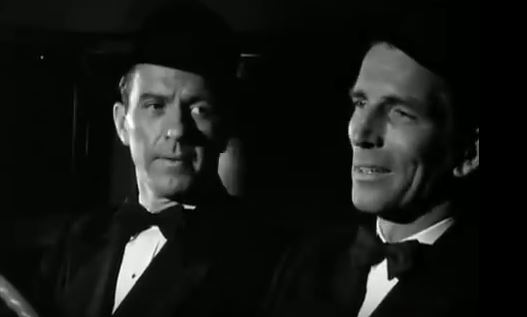
Five years earlier, when at a dinner dance at a country club, Rennie had too much to drink and was called away to perform surgery on a patient. His fellow physician, played by our friend Hugh “Ward Cleaver” Beaumont went with him. In a childish bit of drunken bravado, in spite Beaumont's protests and perhaps because of them, Rennie drove very recklessly and they got into an accident. Beaumont was killed, as were two others in a car with which they collided. Rennie lied to the police, telling them Beaumont was driving, and his wife, played by Beatrice Straight, stoically and with disgust, did not contradict her husband, lying as well to protect him. Their son never knew the truth, but he did observe the break in his parents’ marriage after this incident where his father drank more and his mother seemed to shut him out. This is told in flashback scene.


Now Rennie is coming home to California to face the music and he wants Gary Merrill to go with him to the DA’s office to tell them the truth. He had already gotten away with it, but he can no longer live with his guilt and needs to regain his wife's respect. Rennie is brittle, bitter, good with the conflict.

Shelley Winters is charming in her effortless and natural friendly if outspoken dame who’s been around the block, not playing it at all like a stereotype.  There is something sweet and childlike about her.  She confesses to Merrill about her failure to hit it big in New York and her desire to go home to be with her husband.
Her biggest problem was the conflict she had with her mother-in-law, an ex-vaudevillian, played with venomous panache by Evelyn Warden, who owns a supper club in Los Angeles where her son, Shelley's husband, performs with her. Mama rules the roost, and she disliked Shelley from the beginning. But Shelley is willing to go home and even brave her mother-in-law just to be with her husband again. She’s a people person, and it’s fun to watch her figure out what makes everyone tick.  We realize, later on, that she has given Merrill a lot to think about.

Keenan Wynn seems such a shallow and trite man that we don't imagine there is anything below the surface, and others refer to him, among other things, as a jerk.  We never get a chance to get his story – the plane crashes.

It happens on the second leg of the journey, the next morning, when the day is fine and there is no hint of the noirishness of the night before. It is shocking when, in an instant, the pilots notice ice on the wings, and Shelley Winters’ body is thrown over Gary Merrill, on top of us, and the whole plane lurches, and then we see the plane flailing through the trees and upending. We see the inevitable headlines about the plane crash – most of the people on board are dead, except for three who survive.

We wonder which three of the four lived?

We’re next brought to a hotel room in Los Angeles and – Gary Merrill walks through the door.   

He has facial bruises, his arm in a sling, his torn suit a mess and we see he has just gotten out of the hospital. He dictates a telegram to his wife telling her where he's going to be staying for a few days but mentioning nothing about the plane crash. She would not have been alerted to it, because he had checked in under a phony name anyway. He could have gotten away with disappearing.

Absentmindedly, he reaches into his pocket and pulls out the business cards of the two men and a piece of paper with Shelley's address info on it. The four musketeers, as they called themselves, decided that they would keep in touch.

We realize now that the other three have all been killed.

Merrill seems to be making up his mind about something, and his character suddenly takes the movie one step further, one step beyond a typical plane crash movie. What happens next isn’t about the crash, but about the families of these three characters and what happens next for them. 

Merrill does the very noble thing of contacting their loved ones, not only to bring them comfort to share with them the last moments, but to right some wrongs and to repair the damage in the lives of the deceased so that at least the living can go on.

In the case of Michael Rennie, Merrill visits his wife who laments that their teenage son has run away.  He does not know the truth about his father. Gary Merrill tracks him down, brings him home and tells the boy, played by Ted Donaldson (whom we saw here in A Tree Grows in Brooklyn – 1945) the truth about his father's guilt in the accident and reminds him that an indecent man would've taken pleasure to have gotten away with something; a decent man is horrified by the guilt. He also learns that his mother has protected him. The son grows up quite a bit in those few minutes. The family is restored even though Rennie will never come home to them, and his memory will be sweeter for them. In a sense, he has come home.


Next Merrill tackles Shelley Winters’ story. He goes to the supper club where her mother-in-law is onstage, the next to the last of the big hot mamas, and a cute, if well-worn, club routine with her son, who is played by Craig Stevens. It's not a large role but Craig Stevens always acquits himself very well and it is a pleasure to see him in anything. He jokes on stage with mom and gets to sing a song, although I'm not sure that's really his voice on “Again”, though he was a singer and clearly sings the preceding “The Old Gray Mare.”


Merrill gets to see just how overbearing mom really is. She is rude, selfish and bad-mouths Shelley Winters and has tried to break up the marriage, wanting to keep sonny boy to herself. She tells her side of the story in a wholly made-up flashback that seems to parody noir movie flashbacks, but Merrill sets the path straight by throwing in a cute flashback of his own imagining where Shelley Winters has been a big hit on Broadway taking over for Mary Martin in South Pacific. It’s a clever and really funny bit where we see Shelley pantomiming the stage bits of Nellie Forbush including washing that man out of her hair, and he tells her that Shelley wanted to have her mother-in-law join the cast as Bloody Mary, had she not been killed in the plane crash. Mother-in-law, who would have killed for the part, is finally put in her place and her big mouth is finally shut once and for all. Craig Stevens is not fooled, but what is more important to him is Merrill's telling him that Shelley was coming home of her own will, not to battle him in a divorce case, but because she missed him and wanted to give up entertaining for him.

As the days progress, Merrill seems to heal a little from his injuries. He's got a new suit, he loses the sling, the Band-Aid on his head is removed to reveal a thin scar. He finally makes his way to the last stop:  Keenan Wynn's house. Now his last duty is to comfort his widow. We wonder what he will say about Keenan Wynn. He had no heart to hearts with Wynn, no one really got to know him that well; it is hard to know someone who shines such a bright light on himself, a jokester who always goes too far. At one point, Keenan Wynn had passed around a photograph he carried of his wife in a bathing suit on a beach. And everyone is surprised, partly because showing cheesecake photos of one’s wife is a rather tasteless thing to do, and partly because she is such a good-looking young woman, everyone wonders how someone so smashing could've ended up with a schmuck like Keenan Wynn?

But the mystery grows even greater when Gary Merrill goes to his widow's home and finds Bette Davis, Keenan’s widow, lying in bed, hoisting herself up with the handgrips of medical frame. She is paralyzed from the waist down. She is not the sexy young woman in the photo; that was years ago. She knits industriously and seems matter-of-fact in her discussion with Gary Merrill. She does not seem to grieve. When she acknowledges to Merrill that her husband was a loudmouth and crude and uninteresting and that people tended to avoid him, Merrill is at a loss for words. He has come to comfort this woman who seems to want no comforting.

Then she tells him her story and we fall into another flashback. She tells Merrill that very early in their marriage she became tired of him and had an affair. She ran away with another man and on a cross-country trip to Chicago, she was injured in a swimming accident and became partially paralyzed. Her lover abandoned her. In the most touching scene in the film, and ironically, one of the most shocking, we see Bette Davis lying in an iron lung and we hear the ghastly wheezing sound made by the machine that will keep her alive. Her head is completely bandaged after brain surgery. There is that the mirror positioned above the iron lung, which was common so that people who were in them could see visitors above and behind them without having to turn their heads. Over Bette's shoulder we look into her mirror and we see her and then we see the reflection of someone who visits her.  Keenan Wynn puts his face close to hers and looks at her through the mirror and smiling with a great twinkle in his eye, he says in his great booming voice, “Hello, beautiful!" It is a stunning moment of love and forgiveness and the heroism that is involved in both.


The flashback completed, Bette sits in her bed knitting and looks over at Gary Merrill with tears in her eyes and says that she never knew what love was until that moment.

I love that the director focuses not just on Bette’s delivery, which is quite moving, but on Gary Merrill watching her. There is a marvelous gleam of admiration and pride in his eyes as he watches her. We know, of course, that at that time Gary Merrill and Bette Davis were married and maybe he was just getting a kick out of watching his wife hit one out of the park, but it fits so well with his character, for a wonderful everyman sort of empathy in the admiration he feels not only for her for accepting her husband's forgiveness and for being grateful to him staying by her when she was injured, but for this great tribute to Keenan Wynn who really wasn't such a schmuck after all. Gary Merrill will learn that Wynn was the better man of all of them. It teaches Merrill something about forgiveness and about the guts it takes to do that.

She tells him of her husband, “Nothing could shake his love.  It was from him that I learned what love really was – not a frail little fancy to be smashed and broken by pride and vanity and self-pity.  That’s for children.  That’s for high school kids.”

Merrill immediately sees a parallel with his own situation and wants to go back to his wife, and we see that his experience in helping resolve the loose ends in the lives of these other people has done something far greater for himself. He is the lucky one after all, not just because he is alive, but because he will get to mend fences, theirs and his, and he will always have them as an example and a memory to walk with him.

Some might say escapist, or schmaltz, but I say relevance. It's a gutsy movie that tries to tell a story for the story’s own sake—Cinderella was the only one that the glass slipper would fit, so deal with it—and allows us and gives us permission to be entertained by something that is so simple.

An acquaintance, who knows nothing about this blog but who has discussed his love of old movies with me, loaned me the DVD of Phone Call from a Stranger because he loves this movie. He had to pass it along. That’s another thing I like about classic films; they inspire old movie lovers to do things like that. Thanks, Jean-Paul.

Somebody else passed it on, too: it's here on YouTube, at least for now.

Thursday, March 23, 2017

Another Man's Poison - 1951


Another Man’s Poison (1951) is a suspenseful cat-and-mouse game between leads Bette Davis and Gary Merrill.  The twists and turns of the often surprising plot, punctuated by some clever lines, create a fast-paced psychological drama with an O. Henry ending.

We take a little break from our series on musicals about composers to review this new release from Classic Flix. Another Man’s Poisonwill be available in a restored version on DVD and Blu-ray next Tuesday, March 28.

Bette Davis plays a successful mystery writer. She lives in an English country house, an imposing brick and stone mansion on the edge of rugged mountains and a deep lake. The movie is very atmospheric and dark, typical for postwar British dramas. Directed by Irving Rapper, and filmed in England, one of the producers was Douglas Fairbanks Jr.

Barbara Murray is Bette’s secretary who transcribes her novels from dictation. Anthony Steel plays Barbara Murray’s fiancé. Almost immediately, we are introduced to an uncomfortable romantic triangle. Bette and Anthony Steel are having an affair behind the secretary’s back. It’s just a fling for him, but Bette doesn’t want to let him go. She’s not a desperate clinging older woman, however; she’s a demanding, commanding siren who gets what she wants.

Gary Merrill shows up. He emerges from the shadows, an intruder in her home in a spooky and terrifically framed shot over the back of an easy chair as Bette pours herself a drink in the background. She gasps, and we jump.

Gary is the partner-in-crime of Bette’s estranged husband, who has not been seen in these parts in over three years. They robbed a bank together, and when the caper went sour, a man was shot and killed. The husband pulled the trigger, and Gary doesn’t want to be blamed. He has retrieved the gun used to commit the murder to prove that the fingerprints on it are not his and to force the husband not to back out of his plan to get them both out of the country. Bette tries to offer Gary money to go away – her lover is due any minute – but Gary is adamant he will not leave until she tells him where her ex-husband is.

Exasperated, she announces she has killed him.

It’s an eye-opening, matter-of-fact statement and a bit hard to believe until she brings Gary into the study where the corpse lies on the couch. She casually plays an instrumental record of “Stardust” on the console record player as Gary, confused and grim, examines the body of his partner, and ponders the loss of his alibi and means of escape.

She tells Gary that her husband was blackmailing her over her romantic liaison and that would hurt her career.

Gary incredulously responds, “Will murder make your sales jump?”

There is more to their estranged marriage – she says her husband hit her, that it was self defense, and she rubs her shoulder. Gary, disbelieving, grasps the neckline of her dress and pulls it down to look at her shoulders and back. The image captured on the movie poster is seductive, but the moment in the film is not. Gary grimaces because apparently there is a bruise, and she is not lying.

When they are lying and when they are telling the truth is the trick of the game as they try to fake each other out for the rest of the movie. Gary insists on remaining, pretending to take the role of her husband as a way of hiding in plain sight. Anthony Steel and Barbara Murray arrive to spend the weekend. Though they are featured characters important to the plot, neither really gets a chance to match the intensity of Mr. Merrill and Miss Davis. Their characters are just not as interesting, and their conflicts are not as fleshed out as the leads.

We get a better sense of conflict and irony from the minor characters of a comic shopkeeper in the village, played by Reginald Beckwith, who keeps pestering Gary Merrill to speak at his civic club; and the housekeeper, played by Edna Morris, who suspects Gary is not really the master as she uncovers an old photo of Bette’s real husband.

The local veterinarian, who is treating Bette Davis’ prize horse, is the catalyst for the story. He applies the pressure, with almost Columbo-like questioning behind the mask of a bland smile, keeping the story off-balance, but we don’t know if he’s going to stumble onto the truth accidentally and possibly become the next murder victim, or if he’s really smarter than they are and is teasing them, annoying them purposely because he knows about the murder. He is played by Emlyn Williams, who wrote the play The Corn is Green and who also acted as script doctor for this film when Merrill and Davis felt the script needed work.

There are several breathless moments in the nonstop shell game Davis and Merrill play, getting increasingly daring and dangerous. For the most part, it’s Davis’ vehicle. She was just off her marvelous role in All About Eve (1950), but unlike the troubled Margo Channing, here Davis does not mourn middle age but embraces it, seems to barely notice it. She is not glamorous, even appears rather heavy and wears little to no makeup, but striding around in jodhpurs with her hair pulled back is the picture of a star who has courageously embraced vigor over elegance.

Gary Merrill is, for me, more intriguing than Davis’ scenery chewing. He is strong, clever, but also vulnerable and trapped. Despite being a dangerous criminal on the run who will resort to anything, he actually attracts our sympathy and we want to see if he will succeed.

But the flip-flop of who has the upper hand is constant, and we never find out the destinies of the two firebrands until the last moments of the film. For my money, the end is a little too simplistic, despite the surprising O. Henry ending.

But you can decide for yourself when you watch the restored suspense story from Classic Flix.


Classic Flix provided a DVD of Another Man's Poison in exchange for this review.
********************

Come back next Thursday when we return to musicals about composers in The Best Things in Life are Free (1956) with Dan Dailey, Ernest Borgnine, Sheree North, and Gordon MacRae.

Thursday, October 8, 2009

A Blueprint for Murder (1953)


“A Blueprint for Murder” (1953) is a murder mystery that some six months after its release in the theaters was performed as a radio broadcast on the Lux Radio Theater program. This review is the tale of two productions, and what happens to a suspense story in two different worlds.

In the film, Joseph Cotten plays a rather lonely bachelor who travels a good deal in his employment as an engineer. His only family is his late brother’s son and daughter, and their stepmother, the second wife of his late brother. Joseph Cotten is called to their side for a family emergency when his little niece is hospitalized with a mysterious illness. She dies.


Mr. Cotten stays with his sister-in-law, played by Jean Peters, to comfort her and his young nephew. Visiting his old friend and family attorney played by Gary Merrill, they discuss the upsetting tragedy, and Merrill’s mystery novel author wife, played by Catherine McLeod, puzzles over the sick child’s odd symptoms. (Both Merrill and McLeod are strong as supporting players in this film.) It occurs to her, through her writing research, that the little girl may have died of strychnine poisoning.

There is a lot of back and forth about how outlandish this idea is. Eventually, there is enough conjecture about the possibility of poisoning, and his brother’s will in which both Jean Peters and Joseph Cotten stand to inherit his brother’s fortune if both children are dead, and how such a crime could have been committed, all of which lead Mr. Cotten to putting off going back to work. He sticks around to learn more about poisons, about hospital procedures, and about his sister-in-law.

Eventually, Jean Peters becomes the main suspect, and the film becomes a detective story on how to prove she murdered the child. The story, in itself, has some intriguing aspects to it. First, there is obviously the hideous notion of a woman murdering a child in her care. Trailing behind this but complimenting the suspense story is the nuance of the reticent, workaholic bachelor brother always a little bit in love with his brother’s glamorous new wife. He is also, due to the travel required by his work, a man without a home, and suddenly he becomes an important figure to the grieving widowed stepmother and his grieving, fatherless nephew. He suddenly has the family he always wanted.

The character played by Joseph Cotten, despite whatever suspicions his friends are touting about the possibility of Jean Peters being a murderer, wants nothing to do with any kind of talk like that. He refuses to believe she could be guilty. In his eyes, she can do no wrong. Finally, when he begins to himself suspect her, his infatuation for her painfully drains away. Then he becomes determined to know the truth. Yet, at the end of the story, in order to gain her confidence to trick her into confessing, he now has to pretend to love her and to make her love him. That’s a lot going on, but it’s not action. Perhaps for this reason, the film, which requires action, handles it awkwardly.

The film also strays briefly into a police story when we are shown several scenes of the police doing their investigation. This removes the focus off of Joseph Cotten and Jean Peters, and makes the police detectives, which up until now had been secondary characters, into the main characters. The film is weakened when the focus is off the two most important characters.

However, the suspicion and/or sexual tension between the two characters is also weakened by the actors. Joseph Cotten played contemplative characters very well, but his style was usually so low-key that he played better off actresses, and actors, who were not low-key themselves. Consider his four pairings with Jennifer Jones, an actress who could be intensely emotional. Her energy complimented his more reserved acting style and vice versa. Jean Peters in this role, however, is so low-key herself that there is nothing to distinguish Mr. Cotten’s subtleties.

Jean Peters plays the part of a glamorous, cultured second wife of a wealthy man, who is now in sole guardianship of his children. She is cool and refined. She appears friendly with her stepson but there is a dignified reserve, and in brief scenes with her servants, her manner seems somewhat dismissive and haughty. While this all might be appropriate and realistic for a character of her place and position, it does nothing to throw off our suspicions of her guilt. She seems guilty the minute we first see her, despite the reality that a person looking archly is not necessarily guilty of anything, but that is the human nature of the audience, to assign guilt and favoritism. (Cotten also asks Catherine McLeod why she doesn’t like Peters, and that brief remark also adds to our prejudice.) That assumption of her guilt solely by her somewhat femme fatale manner is unfortunate, particularly when we consider the powerful radio version.

The Lux Radio Theater version of this story, broadcast on March 29, 1954, starred Dorothy McGuire and Dan Dailey. Because this is an hour-long show, the script was cut to conform to time constraints, but what is left is essentially word-for-word. Cutting the script actually helps to speed up the story and make it more suspenseful. The police investigation is truncated as well, but yet not diminished in importance. The focus never strays from the drama of the couple.

The very fact of being radio means we must imagine what is happening, so we do not see close-ups of guilty expressions or suspicious smirks. The camera tips us off so many times in the film, but the radio microphone never does. As a result, we don’t really know, for sure, whodunnit until the very last few minutes of the show. It is a far more suspenseful telling of the story.

Most especially, the work of the actors makes a huge difference in this version. Dorothy McGuire, who possessed one of the most natural and pleasant speaking voices in film at the time, was a natural for radio, where she displays in a variety of vocal textures the character’s distress over the death of the child, her weariness over the strain, her gratitude to her brother-in-law for his emotional support, her growing attraction for him, and especially her warmth and affection for her stepson. She never becomes a suspect, not in the story, and not in our minds, until later in the program. Even then, her attitude of graciousness makes it difficult to believe her guilt. We only accept she is a suspect because the facts logically make her one, and that is the punch of a good mystery, our minds not necessarily following our hearts, as the Joseph Cotten/Dan Dailey character must learn for himself. We identify with Dan Dailey more because we are going through the same roller coaster emotions. We are not just passive observers, the way we are when watching the film.

Dan Dailey does very well portraying the lonely, workaholic bachelor, growing closer to his sister-in-law in the aftermath of the tragedy, and then later agonized to admit she is a suspect. In the final moments of the story his character takes an outlandish and dangerous (and criminal, if you think about it) action to force a confession, and he fails in a shocking ending. While Joseph Cotten plays the character as tense and worried, Dan Dailey becomes absolutely unglued with the pressure.

There are a couple of interesting scenes to note in the story: one is another in our collection of Unbelievable Medical Practices when the child is poisoned in the hospital because the hospital pharmacy was closed and so the medical staff actually let an outsider run the errand of filling a prescription at another pharmacy down the street. The medication bottle was tampered with, especially as it was never sealed. Call in the FDA on this one.

The other scene of note in the film (not the radio version) is when Joseph Cotten and his young nephew play “Monopoly”. Usually brand name products were avoided in films at that time so as not to appear to endorse them. “Monopoly” had been around since the early 1930s, so perhaps it was considered venerable enough by 1953 for this not to matter.

Bacardi cocktails seem get a prominent “endorsement” as well.

Follow this link to have a listen to the Lux Radio Theater broadcast of “A Blueprint for Murder,” now in public domain from the Internet Archive website. Or you can visit the website for Lux programs of 1954 and download this program to your computer.

Monday, July 28, 2008

Witness to Murder (1954)

“Witness to Murder” (1954) presents Barbara Stanwyck in the role of an intelligent woman no one believes.

Unlike the adventure in “Rear Window”, also made in the same year, where James Stewart slowly comes to the suspicion of a murder committed and must puzzle out the proof, “Witness to Murder” begins in all film noir garish glory, with a clap of thunder, a dark and stormy night, and the sight of a woman being strangled just as soon as we get the main titles out of the way. There is no doubt about the murder being committed or that George Sanders is the murderer. The story is about how Stanwyck cannot convince the police about what she saw.

Her role is a bit of a departure from the typical 1950s hysterical woman roles (though she does have a brief fling at raising her voice at the cops which puts her in a hospital psychiatric ward for observation). Her character is a single professional woman, an artist and interior decorator. She is sensible, intelligent, has a fetching wardrobe of flattering full skirts and tailored jackets, which like her character are not ostentatious in any way but both chic and reserved. She is a quiet person, contained, who though she dines alone at drugstore counters, seems content in her quiet life. She listens to classical music when she putters alone at home. We are told a man she loved died in the war, but she gives no indication that she is looking for a replacement.

We see her at work, comfortable at her drawing table. She has a drawing table in her apartment as well, and her expressionistic paintings hang on the wall, passionate and somewhat dark. The doctor who later interrogates her will infer that they reflect psychosis. People watching this film in 1954 must have been deterred by it from ever seeking help from either the police or from mental health professionals, so callously is she treated.

Her world turns upside down when she sees the murder. World weary Gary Merrill is the responding police lieutenant who investigates, and finding nothing, writes Miss Stanwyck off as a woman who had a bad dream. Her indignation spurs her to do a little of her own investigating, and with each new call to Merrill to report more information, she is told in pleasant, but always condescending tones that she is obsessed over nothing. He spends much of movie telling her to just take it easy.

George Sanders plays the villain with such suave and clever and contrived innocence that perhaps if we had not seen him commit the crime at the beginning of the movie, we would not believe her either. As an ingenious former Nazi who was “de-nazified in court” and emigrated to the US after the war, we might look for some explanation as to why his speech sounds more Oxford than Leipzig. Nevertheless, he is so quick and crafty baiting Miss Stanwyck, reveling that no one believes her, and paints her as a looney before the police.

It is interesting that Merrill’s character, in relating Sanders’ Nazi history to Stanwyck, does it in such a ho-hum manner. This is, I think, not a reflection on Merrill’s abilities as an actor as much as it reflects society of the early 1950s. We see this even in the brilliant “Judgment at Nuremberg” (1961) where the post-war years shifted from the righteous calls for revenge of the war years to the let’s just move on with our lives attitudes that let so many Nazis escape. It was impossible to punish them all, anyway. Even by 1954, the war was old news.

When Merrill bluntly comments on Stanwyck’s fiancé never making it back from his last bomber mission and she seems to slightly flinch in distress, he remarks laconically, “Sorry. I didn’t know it still hurt.” Apparently, she was supposed have gotten over that a long time ago.

When Sanders at the end of the film reveals his vitriolic, hate-filled ubermenschen philosophy in a soapbox rant, it is almost comic. How frightening his rage would have appeared in a 1940s film. Now only ten years later it seems archaic and quaint. We have a short attention span. We have left the lessons of war far behind us. Don’t believe a Nazi is dangerous because he writes books which map out evil intentions. Don’t believe a woman crying murder. Neither is plausible.

The role is a good one for Barbara Stanwyck, but it is unfortunate that more was not made of her character’s sensibilities and her artistic talents. In one scene we see her absentmindedly sketching the murder at her drawing board as if to come to terms with the horrible act. In another scene she remarks to Merrill about Sanders’ face, “The smile and the eyes don’t go together. They look at you, but they don’t see you.” It’s something an artist would notice. Instead of playing up her character’s approach to the crime as an observant artist, the script merely emphasizes that all her suspicions are based only on women’s intuition, which of course the police scoff at, and Sanders abuses.

We might expect an eventual romance between Merrill and Stanwyck, because they begin to see each other socially, but there doesn’t appear to be much chemistry between them. More than his disbelief in her accusations, which is pardonable without concrete proof, is the almost overbearing condescension of his attitude towards her emotional and mental state. Finally, this is culminated in her being sent to a psychiatric ward for observation, where the film takes a bizarre turn, suddenly becoming “Ladies They Talk About” (1933). (One of her fellow inmates, played by Adeline De Walt Reynolds, will be discussed on Thursday.)

Another odd twist is the chase scene at the end, prompted by a severe policewoman who calls for onlookers to stop Stanwyck from running away because she is insane. She knows that Stanwyck is insane because George Sanders told her so. Everybody believes George Sanders.

Miss Stanwyck attempts to escape up a construction site with Sanders hot on her heels, along with a street crowd. Eventually Merrill shows up to help lift her off a ledge. Since Stanwyck enjoyed performing her own stunts, perhaps for her this fun bit made up for the weaknesses of the story.

Very much a film of its day, it accurately sloughs off the last of the World War II sense of urgency and commitment to seek justice. It makes reference to television (and perhaps radio) when Merrill’s partner playfully hums the well-known opening notes to the “Dragnet” theme. The African-American actress Juanita Moore, who would win an Academy Award nomination for her role in “Imitation of Life” (1959), appearing here as one of the psychiatric ward patients, is referred in the credits only as “Negress.”

Sometimes it actually is better to just move on and away from such as this. But first you have to look back.

Related Products