IMPRISON TRAITOR, PEDOPHILE, AND CONVICTED FELON TRUMP.
Showing posts with label Four Daughters. Show all posts

Friday, May 20, 2022

Young at Heart at the beach


Young at Heart
(1954) gives us a glimpse of an idyllic beach scene on the Connecticut shore in the 1950s.  To be sure, it is mostly of Hollywood origin, or at least, California, but if the beach is not in the right location, the warm and lovely nostalgia of the beach is genuine.


This is my entry to the Fun in the Sun Blogathon, hosted by the Classic Movie Blog Association.  Have a look at some great posts on this topic here.


The movie Young at Heart is a remake of Four Daughters (1938), which we covered previously in this post.  In that original story, widowed Claude Rains heads a family of four girls, played by the Lane sisters plus Gail Page, and all are musicians.  May Robson plays the auntie matriarch who lives with them.  The girls’ suitors have picked out their choices among the daughters, but all the young beaus have competition with the newcomer: handsome and happy-go-lucky Jeffrey Lynn.  But an even newer newcomer, a dour, sarcastic and self-pitying John Garfield swoops in to really disrupt things and his love for Priscilla Lane nearly tears the family apart.

We see the beginnings of the rift and a change from a lighthearted first part of the movie to a more serious and even tragic second part at a family picnic in a secluded country glen.  Here we see the sisters are really all interested in the same man. 
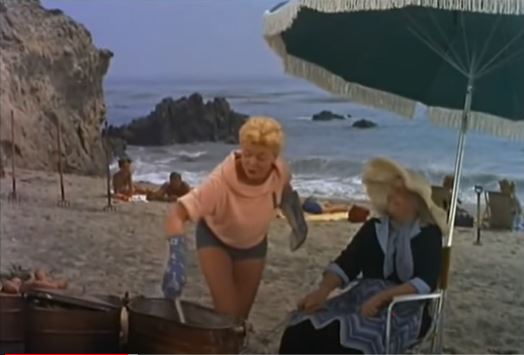

In Young at Heart, this scene is transported to the beach.  Robert Keith plays the Claude Rains role of the dad, Ethel Barrymore in a charming mixture of regal and down to earth plays the May Robson role.  Here the sisters number only three instead of four: Elisabeth Fraser, Dorothy Malone, and Doris Day.  Doris plays the lead Priscilla Lane role.  The boyfriends are with the family at the beach, and the heartthrob who will cause unspoken jealousy among the sisters is played by Gig Young in the Jeffrey Lynn role.

Frank Sinatra plays the John Garfield role in this movie, but this scene is just before he makes his first entrance in the film, so we don’t know yet how he’s going to upend the family.  Even without him, the seeds of discontent are already sown, making the day at the beach bittersweet.


With an almost nuclear-powered sunny disposition, Doris Day is the most lighthearted of the group and fails to see her sisters’ yearning for the man she playfully cavorts with in the surf.  Doris gets to sing two songs during this nearly 10-minute beach sequence. 

For those of us who live close enough to a coast to have spent pleasant days on the beach, the movie image of sand and sea, of wave-kissed rocks and sunshine reflecting off the constantly moving ocean is familiar and almost personal, like someone with a movie camera somehow entering our brains and capturing a memory.  Some sensations experienced going to the beach are really timeless and there is a distinct and powerful comfort about that.


But we may sense that some aspects of this scene are not timeless, and that perhaps going to the beach in the 1950s was a little more do-it-yourself, simple, and perhaps with a slower pace of life.   Yes and no.  We don’t see any arcades or water parks or concessions, or even bathhouses with facilities on this beach, but there were beaches back then and even before – though not all – with plenty of tourist amenities. 

That this beach is not crowded and there is plenty of space between the actors and the extras in the background should not be taken that beaches were not crowded in the 1950s.  Of course, they were.  But not all were, and even in these modern times, I have been to New England beaches that were just as unspoiled and unpopulated as this one in the movie seems to be.

So that is not quite it, either.  There must be something else that evokes the strong feeling of nostalgia for a 1950s beach in this film.  Is it because there are no loud radios playing?  Maybe, but we see Doris singing along to a portable record player.  We don’t see too many record players at the beach these days.  

Is it because nobody’s in a bathing suit and they come lounging on the sand in their clothes?  Maybe.  No sunscreen?  Maybe.  


It could just be that the clam digging and the large pots with New England clambake accoutrements – corn on the cob, potatoes, etc., are not seen quite as much now as in the old days, or campfires on the beach, or gathering driftwood to fuel the fires.

There is a noticeable lack of people taking selfies or scarfing packaged junk food snacks.  No one is being divebombed by seagulls for a few Cheetos. 


I get a kick out of Alan Hale, Jr., who plays the suitor of Dorothy Malone, talking about his sudden idea of what a great thing it would be “buying this strip of beach, tearing down all the bungalows on the highway and putting up some hotels, a whole string of them.” 

She responds, “Whoever heard of a string of hotels along the beach in Connecticut?”

There are some hotels here and there on the Connecticut coast, and were, too, in the 1950s, but not enough perhaps to make Alan Hale, Jr.’s dream come true.  Instead of hotels today there are more likely to be a few condominiums, but the geography doesn’t always allow for development.  Working harbors, saltwater marshes here there, and far more protected areas than there used to be.  Thank heaven.


I think what I really like about this beach sequence is the work of the sound technicians.  Behind all the dialogue, behind Doris’s songs and the “orchestration” that seems to bloom from her portable record player, is the omnipresent, lazy, rhythmic sound of the waves rushing to the shore.  The seacoast is not a quiet place.  The sound of the surf is eternal.
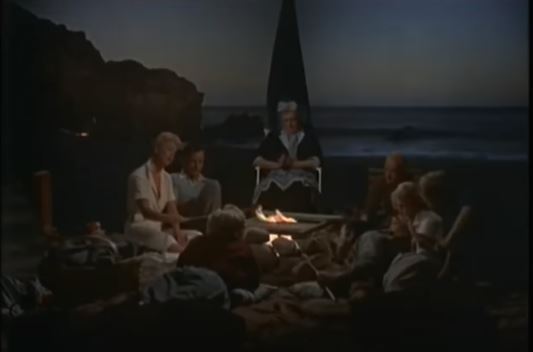

The bright, almost blinding daylight of the first part of the sequence becomes a peaceful twilight with the family around the campfire, and Doris still singing, toasting marshmallows.  The large beach umbrella that sheltered Ethel Barrymore earlier in the day has been folded up.  You can almost feel the refreshing cooler breeze off the ocean, almost feel chilled by it.  It is an idyllic ending to the sequence, a calm before the storm.  A day at the beach is a respite, time to enjoy, to reflect, and to make a memory that will last through days to come.  A beach memory may mark epochs in our lives, just as it does in the movie.

Visit the CMBA website here for more Fun in the Sun Blogathon.

    ********************

Jacqueline T. Lynch is the author of Ann Blyth: Actress. Singer. Star. and Memories in Our Time - Hollywood Mirrors and Mimics the Twentieth Century. Her newspaper column on classic films, Silver Screen, Golden Memories is syndicated nationally.  Her new book, a collection of posts from this blog - Hollywood Fights Fascism - is available here on Amazon.

Thursday, September 10, 2009

Civilian Conservation Corps Movie Fan


Above we have a photo of Priscilla Lane pasted on the inside cover of a young man’s footlocker. The footlocker was part of his equipment as a member of the Civilian Conservation Corps during the Great Depression. This particular footlocker is on exhibit at the Civilian Conservation Corps Museum in Stafford Springs, Connecticut. See my post on New England Travels for more on this museum.

It brings to mind something we discussed a month ago in this post about there being few old movies that dealt with the subject of polio. Not addressing the treatment of polio and the frantic search for a vaccine in the years in which it was so rampant and so frightening, to me is like cranking out a slew of movies during the early 1940s and hardly mentioning World War II.

Seeing the pretty young face of movie ingĂ©nue Priscilla Lane on the inside of this CCC boy’s footlocker brings another realization. I don’t believe I have seen the Civilian Conservation Corps even mentioned in a movie from the 1930s.

The film industry covered a lot that was topical back in the day, as we know, even if sometimes to gloss over issues. But to never bring up the CCC is amazing. President Franklin Delano Roosevelt initiated many programs during the Great Depression, and most were fairly controversial among Republicans in Congress, but we’ve all seen many films with the “blue eagle” logo of the NRA (National Recovery Act) plastered like an imprimatur on the end of the film. That the very controversial NRA was afterward nullified does not erase it from the history of American film of this period. Young people can still notice it, and ask what that meant.

Conversely, the CCC, though not supported by Republicans as much as by Democrats, nevertheless achieved a slight majority in favor even among Republicans. It was easily FDR’s most highly regarded program. If representing the CCC might seem too political for some studios, one would think that Warner Bros. at least would have a take on it, being more apt to present more gritty films during the Depression and stances supportive of the then current administration. They gave us “Wild Boys of the Road” (1933). There would have been a lot more wild boys of the road if not for the CCC.

The Civilian Conservation Corps put thousands of young men into thousands of outdoor camps to work in forestry, the establishing of state and national parks, conservation, public works projects, and even helped out communities during floods and fires. The money they earned that was sent home supported thousands of families during the bleakest years of the Depression and kept them from starving.

The boy who pasted Priscilla Lane’s picture in his footlocker is unknown to us. The only thing we know about him is he loved Priscilla Lane. He probably went to the movies on his pass to go to town. Maybe he went to see “Four Daughters” with Priscilla Lane, discussed here in this post.

If you know of any old movies where the CCC was depicted or even mentioned, please let us know. I’d love to know if there were any.

Thursday, January 31, 2008

May Robson

May Robson was another one of those remarkable character actresses whose work in film increased as they grew older, and when they eventually died, they died with their boots on.

Miss Robson was from a different world. Born n 1858 in Melbourne, Australia long before the separate Australian colonies became the Commonwealth, she married young, and when widowed young, took up any work she could find to support her three children. The job that stuck was acting. She had never intended to become an actress, but that was the road that life presented her, and she took it.

She appeared in stock and Broadway, and came to Hollywood for silent films, but it was the sound era of the 1930s where her career flourished. In 1933 she was nominated for a Best Actress Academy Award for Frank Capra’s “Lady for a Day”, the earliest-born person ever to be nominated for an Oscar. She lost out to Katharine Hepburn.

As noted in the previous post, playing Aunt Etta she had some of the best lines in “Four Daughters” and the other succeeding Lemp family films, which she delivered with wry humor and charming spirit. She was the quintessential old lady, with the cameo broach pinned at the throat of the high-necked ruffled blouse. Hollywood had a curious habit of depicting elderly women as if they had never left the Victorian era of their girlhood. From Maria Ouspenskaya to the character of Granny in the Tweety Bird cartoons, these old girls eschewed modern dress for the look of the 19th century. Since most elderly women of the late 1930s dressed in the manner of the late 1930s and not the 1890s, we could take this as further evidence of the studios’ reliance on the convenience of stereotyped caricature to establish minor characters. It was done so often with race, ethnicity, with physical impairment. Giving an elderly woman the look of another time and place somehow sets her apart from the other actors, as if she is from another world.

May Robson handled the modern world with smart-mouthed panache as Aunt Etta in the “Four Daughters” series. But she really was from another world different to the one of the young actresses playing her nieces. She was 83 years old when the final film in the series, “Four Mothers” was released in 1941. She died the following year.

For a bit more on May Robson, have a look at this website.

Monday, January 28, 2008

"Four Daughters" (1938) and Sequels

“Four Daughters” (1938) and the sequels which followed, “Four Wives” (1939) and “Four Mothers” (1941) was a brief but successful series featuring three actual sisters, the Lanes, who through their individual stage work and musical careers with big bands brought them separately to Hollywood.

Priscilla, Lola, and Rosemary Lane worked separately before and after this series of films, but along with Gale Page, who played the fourth sister, were ever afterward identified with the Lemp family portrayed in these films.

The first film in the series, “Four Daughters” is the best, and was nominated for several Academy Awards, including Best Picture. It’s mix of supporting actors, from the always terrific Claude Rains as their father, to the handsome young Jeffrey Lynn, to the ever dependable Frank McHugh, Dick Foran, and especially May Robson (who will be the topic of Thursday’s blog), lends a lot to the film. Most striking, however, is the debut of John Garfield, who was nominated for his role.

The dialogue is fast and funny. Rains plays the father, the director of a local music academy. The girls are all musicians. Aunt Etta, their father’s sister, lives with them, runs the house, and acts as surrogate mother. The film starts out being a wholesome Andy Hardy type outing, light and funny, particularly when the girls’ beaus are brought home for the first time to meet father, subjected to the usual discomfort of trying to impress and fit into this army of females. As anyone from a big family, or marrying into a big family will tell you, it’s difficult for outsiders to join in to what appears to be an impregnable wall of familial affection, inside jokes, and a tight-knit past that has nothing to do with the newcomer. These scenes are done well, first with Frank McHugh running the gauntlet as the new boyfriend. His discomfort is acute and sweet.

Dick Foran plays the shy, stumbling neighbor they’ve known forever, and Jeffrey Lynn charges into the scene as a happy-go-lucky young musician, bouncy as a puppy, who all the girls immediately fall in love with, but when he eventually chooses Priscilla Lane for his love, there is a rollercoaster dip in the tenor of the film. When the two announce their engagement, the quick close-ups on the other girls showing disappointment is quietly intense.

The real fireworks begins when John Garfield enters the picture as a self-pitying, bitter musician at first sarcastic towards this close family, and then sadly desperate to join it. When Priscilla leaves Jeffrey Lynn at the altar for Garfield, it is meant as a sacrifice to release Lynn to marry her sister. The light and funny outing is over for this family, and the film increasingly becomes more serious and somewhat sinister, with delicate romantic triangles and unrequited love. Though she has agreed to marry Garfield, Priscilla still loves Jeffrey Lynn, and there is an intense scene at a Christmas reunion where all are stiff and mannerly, but anguished in each other’s company. Priscilla gets Jeffrey’s coat for him when he leaves, and takes a moment to gently run her hands on the shoulders and back of the coat and hold it a moment before bringing it to him.

The film then turns tragic as Garfield performs what he must regard as the ultimate sacrifice for his unhappy wife. There is a simple but evocative foreshadowing shot of his wet shoe on the accelerator of the car he is driving, and an unusual shot of his stony face from the floor of the car through the steering column, and we know he is going to kill himself in that car. When he speeds up and turns off the windshield wipers, letting the windshield fill with snow, it’s almost sickening.

Director Michael Curtiz does some interesting things with pacing in this film, and his repetition of themes, like the squeaky swinging front gate and several establishing shots of items in the house and the flowering tree outside. The final shot is of the gossipy neighbor lady, intrigued with the young lovers swinging on the gate, finally stealing a moment to try it herself. Her astonished expression of bliss is a quirky and delightful way to end the film.

Most remarkable I think is the use of music in this film. It’s not strictly a musical, but there is a great deal of classical music played and sung by this family, from pieces of “Lohengrin” by Richard Wagner, to Brahms, Mendelssohn, and a long, lazy rendition of “Serenade” by Franz Schubert that opens the film and is reprised in the sequels. Rosemary Lane, the aloof sister with the dry humor, does the singing, and she appears to be the only Lemp sister who plans a professional career as a performer. To have classical pieces and German lieder given such space in a film made about four attractive, modern sisters in the height of the era of Big Band music, and not have them portrayed as glasses-wearing intellectual freaks, is unusual. They handle these classical pieces with natural ease and with evident pleasure, even if they occasionally madden their father by teasing him with swing renditions of his revered Beethoven.

This film was followed by “Daughter’s Courageous” reunited all the cast, but was not about the same Lemp family as in “Four Daughters”. An unusual move and evidently the studio felt it was more profitable to go back to the well and do more movies about the original family, so “Four Wives” and “Four Mothers” were released carrying the further adventures of the girls into marriage and motherhood. The second film, “Four Wives” is more maudlin, and third had more to do with the family’s financial ruin than with motherhood. We are afforded only brief glimpses of the baby daughters, another generation of girls.

The second film “Four Wives” has an even longer musical segue as a so-called “Symphonie Moderne” is staged. This piece was actually composed by Max Steiner. The camera slowly pans the orchestra conducted by Jeffrey Lynn, to the hospital bed of Priscilla and her new baby, the child of her deceased husband John Garfield who appears through flashback, and to her family listening to the radio at home. Such a lot of time spent on the piece might make those not interested in classical music fidget a bit, but director Curtiz’s use of it remains intriguing. I like the slow pace in this part of the film, and the tour of the emotions on which the camera takes us.

Also, the manner in which all the sisters and their separate stories are shown through the course of the three films is one of brief scenes and using small nuances to symbolize larger themes. There is no single star of the films, though Priscilla Lane’s and Jeffrey Lynn’s characters change the most, from silly and carefree, to deeply hurt and sorrowful. It can’t have been an easy job either for the writers or the director to use such a large cast in equal proportions, which is pretty much what happens.

“Four Daughters” was remade as “Young at Heart” (1954), and both films were coincidently shown on TCM last night. The original series probably could have been extended, with the war and a new set of tribulations facing the sisters as a backdrop, but perhaps neither the Lanes nor Gale Page wanted to be stuck with playing the Lemp sisters for too long. Only Gale Page would continue her acting career in later decades; none of the Lane girls ever made a film beyond the 1940s.

Related Products