IMPRISON TRAITOR, PEDOPHILE, AND CONVICTED FELON TRUMP.
Showing posts with label Joel McCrea. Show all posts

Saturday, February 22, 2020

Sullivan's Travels - 1941 - The Butler's Admonition


Sullivan’s Travels (1941) is a madcap romp and not-so-incidental grim social commentary—a most striking combination.  Writer/director Preston Sturges deftly constructs a screwball comedy around the framework of a sensitive and serious examination of poverty—while lambasting Joel McCrea’s naïve character for even seeking a social message.  As he begins his exploration of what it is to be poverty stricken so that he may produce a deep and profound message film instead of his usual comedies, Joel McCrea’s first and perhaps best admonition against such a quest comes from his butler.

“I have never been sympathetic of caricature of the poor and needy, sir.”

This is our entry in the Butlers and Maids Blogathon hosted by Rich at Wide Screen World and Paddy at Caftan Woman.  For more on butlers and maids, please see these posts by some terrific bloggers.

Robert Greig plays film director Joel McCrea’s butler in this movie, and Eric Blore his valet.  So intentionally anonymous are they that they are not given names, only referred to in credits as Sullivan’s Butler and Valet.  Both men spent much of their film careers playing butlers.  Mr. Greig, born in Australia in the 1870s, and Blore born in London in the 1880s, were perhaps destined for a life of genteel servitude on film in the caste system of Hollywood character actors.  Their accents, their ages, their physical types certainly recommended them for the job, and that indefatigable knack of being silly and supremely dignified at the same time, their very dignity being the springboard of their comedy. They died a year apart from each other in the late 1950s, an era when the British butler was becoming scarcer in Hollywood.

The movie begins ridiculously enough with Joel McCrea, a director fed up with producing comedies and seeking a serious subject worthy of a work of art, announces to the aghast studio heads played by Robert Warwick and Porter Hall his intention not to direct any more comedies.  Mr. McCrea is starving for satisfaction in his work, takes himself and his art very seriously, and having been raised with all the financial and social advantages of the monied class, is completely innocent about the harsh world of poverty.

Quite unexpectedly, the silliness is deflated like a balloon pricked with a pin early on in the movie when the fast-talking McCrea is brought short by the sonorous tones of his suddenly serious butler, Robert Greig.  Greig, unlike most Hollywood butlers, gets the honor of a closeup and a thoughtful soliloquy.

“If you’ll permit me to say so, sir, the subject is not an interesting one. The poor know all about poverty, and only the morbid rich would find the topic glamorous.”

Mr. McCrea defends his intentions, “But I’m doing it for the poor….”

To which Mr. Greig adamantly responds, “I don’t think they would appreciate it, sir. They rather resent the invasion of their privacy—I believe quite properly, sir. Also, such an excursion can be extremely dangerous, sir.”

This is not the “walk this way” nose-in-air schtick of the Hollywood butler.

“You see, sir, rich people and theorists, who are usually rich people, think of poverty in the negative, as the lack of riches as disease might be called a lack of health, but it isn’t.  Poverty is not the lack of anything but is a positive plague, virulent in and of itself, contagious as cholera, with filth, criminality, vice, despair as only a few of its symptoms. It is to be stayed away from even for purposes of study. It is to be shunned.”

Baffled and rebuffed, McCrea responds, “Well, you seem to have made quite a study of it.”

Mr. Greig answers, “Quite unwillingly, sir.  Will that be all, sir?”

Eric Blore, his valet, cleverly conceals identification in the soles of McCrea’s shoes like a mother protecting her boy at camp with nametags in his clothes, and in a phone call pretending to be a gentleman rather than a gentleman’s gentleman, he manages to trick a railroad clerk to tell him how and where a hobo might hop a freight.  He knows he cannot dissuade McCrea from his mission, but he does his best to pave the way for him.

We might like to know more about the butler’s past that would make him so articulate on the subject of poverty, but the story is McCrea’s, a well-meaning but essentially innocent and perhaps even pompous man who discovers the grim world of Depression-era poverty in a very personal way and learns to find his way back to the safety and blessed relief of comedy.

Veronica Lake is his companion on the trip, and as funny as the slapstick gets on their journey, it is astoundingly interspersed with almost documentary-like scenes without dialogue or narration of breadlines, crowded filthy flophouses, desperate Hoovervilles, and soul-crushing chain gangs. Some scenes are reminiscent of The Grapes of Wrath, and of I Was a Fugitive from a Chain Gang.

Comedy and tragedy, after dancing around each other for a bit, finally intersect at the end of the film in a sweet, sad, and gentle scene in a crude wooden southern Black church, led by minister Jess Lee Brooks, a figure of dignity and nobleness of spirit.  After services, they are to have the special treat of showing a film and have invited the inmates of the local prison to join them.  The preacher reminds his flock, “Neither by word, action, nor by look to make our guests feel unwelcome, nor draw away from them, nor act high with them, for we’s all equal in the sight of God.”  The prisoners, shackled, file in – McCrea among them, who has been mistakenly arrested for murder—as preacher Brooks sings in his majestic bass voice, “Let My People Go.”

The oil lamps on the wall sconces are turned down, and the projector is started up, and a Mickey Mouse cartoon featuring Pluto, who struggles with flypaper stuck to him, entertains the congregation and their guests. McCrea observes the pleased reaction of everyone around him, how they laugh, and finds himself laughing.  He has discovered the magic of comedy in the war against poverty. Real-life director Sturges is far more successful than fictional director McCrea, for he has managed to combine tragedy and comedy in a way that validates both and trivializes neither.

The butler and valet are not present at Joel McCrea’s moment of epiphany.  We could not imagine them guffawing at Pluto with flypaper on his tail.  Perhaps they might have smirked only slightly with disciplined propriety and uttered to their master in clipped speech, “Very good, sir.”
*********
Jacqueline T. Lynch is the author of Ann Blyth: Actress. Singer. Star. and Memories in Our Time - Hollywood Mirrors and Mimics the Twentieth Century. Her newspaper column on classic films, Silver Screen, Golden Memories is syndicated nationally.

Thursday, January 18, 2018

Extras - A Life in the Background


Extras line up for a job in Meet John Doe (1941)

Spotting familiar “extras” is fascinating to classic film buffs, and is something we can’t help doing even while enjoying the screen time of our favorite stars.  They may have a minute or two on camera, a single line or none at all, but they contribute immeasurably to the look and tone of a movie.

Last week we discussed Beverly Washburn’s accepting work as a television extra as an older adult despite her early career of starring and supporting roles on film and TV in the 1950s.  Once in a great while, an unknown extra became a star—John Wayne was perhaps the most famous former-extra.  Sometimes they became stand-ins and then graduated to starring roles:  Joel McCrea was a stand-in for Valentino and for Wallace Reid in the 1920s.  Gilbert Roland once served as a stand-in for Ramon Novarro, and Ann Dvorak for Joan Crawford.

The plight of most extras, though, was far from hopeful and could be heartbreaking.  Gone Hollywood, an interesting book of classic film trivia by Christopher Finch and Linda Rosenkrantz notes that Central Casting, an employment registry for studio extras, came about in the 1920s as a response to the hordes of young people heading for Hollywood in search of fame and fortune.  There were more hopefuls than there were jobs, and the lucky ones sometimes snagged a role through nefarious means, including bribes and sexual favors.  Will Hayes, of Production Code fame, set up Central Casting to circumvent feared scandal when it appeared that a fair number of prospective starlets were actually prostituting themselves for work.

Central Casting established a pool of extras and a more appropriate and professional way for them to acquire work from the studios.  Hundreds were assigned jobs on films every day, but with as many as 15,000 on the rolls, there still weren’t enough roles.  It was also a factor of their employment that they supply their own costumes—street clothes, sport clothes or evening dress for scenes that required them.  The authors of Gone Hollywood reference a 1934 Photoplay magazine article about extras pooling their meager resources and living five and six to a room to share costumes and expenses, and that others were living in Hoovervilles around Los Angeles

They would usually earn an average of $5 per day and overtime, if called for.  The authors report that in 1936, only 58 out of 5,500 men and only 20 out of 6,500 women averaged three or more days of work per week.  One could earn a little more if they were willing to take roles which required them to get wet or fall off a horse.  Certain physical impairments might also be on demand for a particular film, and often there was a demand for extras based on ethnicity or race. 

It is harrowing to recall that, according to the authors, the average yearly income for an extra in the mid 1930s was only $131.36.  Think of this the next crowd scene you see.  Their plight, especially for older extras, was sometimes met with sympathy by some directors and producers, who would throw work their way whenever possible.  MGM casting director Billy Grady organized the Casting Directors Ball to raise money for extras who were ill or in need.

Perhaps the most famous of these not famous actors was Bess Flowers, who we’ve mentioned on this blog from time to time, known as The Queen of the Hollywood Extras. She worked in the background from the early 1920s through the early 1960s, in more than 350 films, as well as television.  She was one of the founders of the Screen Extras Guild.


 Gone Hollywood.  Finch, Christopher and Linda Rosenkrantz (Garden City, NY: Doubleday & Company, Inc.) 1979.


Thursday, August 8, 2013

Adventure in Manhattan - 1936


Adventure in Manhattan (1936) is a strange mixture, not always successful, but intriguing, nevertheless, of drama and romantic comedy—and stretches our ability to suspend our disbelief simply because it is both suspenseful and comedic.
The movie pairs Jean Arthur and Joel McCrea for the first time (they would later be paired together in the magnificent The More the Merrier– 1943, which we discussed here).  Some comments I’ve noted express disappointment that Arthur and McCrea fail to live up to the Nick and Nora Charles image in this movie.  That’s because they’re not Nick and Nora Charles.
I sometimes wonder if we are not too mired in genre to an extent that we cannot accept hybrid.  I find it very odd that an audience that can accept films of fantasy and science fiction and are able to suspend their disbelief under the implausible circumstances of these kinds of films, yet cannot suspend their disbelief watching a movie which simply has both dramatic and comic elements to it at the same time.  We struggle to paste one label or the other on a film.  Adventure in Manhattan is both, sometimes alarmingly so.
This week and next were going to cover two movies that deal with stolen art.  Unlike films about bank heists that show thuggish gangsters, theft in the art world always seems to be done by gentlemen, or at least devil-may-care scamps.  We are perhaps left with the fallacy that no one really gets hurt in art theft, and that it is more or less a high-stakes gentleman’s game, like polo without the horses. But crime is done, people do get hurt, there are consequences, and these two films show us the difference in genre and how we accept genre.
The movie we’ll talk about next week is Crack-Up (1946), strictly noir, and the gentlemanly art of stealing art shown as a world of dark shadows and grim postwar angst, psychological terror, and a really mean trick.  It stars Pat O’Brien and Claire Trevor, and they are not Nick and Nora Charles, either.
Both films have plots that hinge on a really mean trick.
Adventure in Manhattan is part 1930s with a little hint of 1940s noir thrown in, quite unexpectedly, and this is what is most tantalizing about the film—and most unbalancing.  It seems to be a precursor of what will come, but quite unconsciously.  It is not trend-setting; it is only experimentation.


Joel McCrea is a writer of crime stories.  He writes newspaper columns on real-life crimes and mystery novels about famous cases.  He is very successful, very much in demand, and very well aware of his gifts and his success.  He’s charming and so confident that he drives everyone else around him nuts.  He’s the kind of guy who does everything perfectly.  You want to see him mess up just once to see if he’s real.
A series of art thefts and jewel robberies has occurred, and we are told this as the film starts with several flashing headlines and the blare of police sirens.  We are in New York City in the middle of the Great Depression.  

Thomas Mitchell is a newspaper editor, the kind of crabby, shrieking, in-your-face-palooka who wants a feature story on the crime wave.  He hires Joel McCrea to investigate and to write purple prose on the crime spree.
“Involve a woman in it!”
He’s getting a little ahead of us.  But we can tell by the cast of credits that the only woman listed is Jean Arthur, so there’s going to be a woman in it, and the job is all hers.
I wonder if newspaper offices are to thirties movies as living rooms are to fifties movies?
Enter Joel McCrea, know-it-all, laconic, wearing his fame like a kingly robe.  He presumes to sit right down at Thomas Mitchell’s typewriter, still wearing his hat and begins to weave a tale.  (I recall a funny line in the old Mary Tyler Moore Show where the character of Lou Grant tells Mary about the good old days when he used to work in a newsroom, and he said that they were real newsman because they wore their hats in the office.)
Mr. McCrea takes a break from his masterpiece, and heads to the local bar the reporters hang out, where he grabs a beer and a cheese sandwich, and where his fellow journalists are playing pool. One of the fellows is a playwright, played by hangdog Victor Kilian, who we last saw with Jean and Thomas Mitchell in Only Angels Have Wings (1939).  The play he is currently writing will figure a great deal in the story, but we don’t know that yet.  And neither does he.
McCrea is smooth and confident and chatters about the latest robbery, which aggravates the other reporters who just can’t seem to get any leads.  McCrea acts self-superior, lecturing them, but it’s not just arrogance.  He really is superior.  He’s much smarter than the fellows and he takes the route of solving the crimes by what today we would consider a rather modern tactic: he uses profiling. He tries to get into the head of the man he thinks is behind these crimes.  McCrea, interestingly, plays his character like a charming egghead, who knows people’s psychology, but does not have the social skills to get close to anyone himself.  For all his intelligence, he is socially inept and doesn’t know it.
He plays pool and makes fantastic shots, never missing one.  When he leaves, Mr. Kilian remarks, echoing the other guys’ thoughts, “How do you live with a guy like that?”
Jean Arthur enters the story at this point, and her work in this film, as usual, is deft and many layered. We’ve mentioned before that there’s no one like her for playing along that thin knife edge of comedy and drama, of evoking great pathos, even tragedy, and yet still being able to shine a ridiculous spotlight on her character.  In this movie, her character might be considered all over the place by some viewers because at times she is very dramatic, and at other times she is doing screwball comedy.  We struggle to find what pigeonhole to put her in.
This is probably the same difficulty that early directors and the studio head Harry Cohn had with Jean Arthur, until the mid-thirties when she began to hit her stride, showing that she can do these unusual characters that flourished in the Depression era like nobody else. She’s not doing Nora Charles.  She’s doing Jean Arthur.
We first see her walking down a crowded city street.  She is bundled up to the neck in a plain unflattering raincoat and her cloche hat is pulled down close over her eyes.  Droplets of rain dot her hat and shoulders as she sidles up to people quietly, with anxiety and embarrassment, but desperate, she begs for money.
Joel McCrea sees her.  Neither he, nor the movie audience of the day, is surprised to see woman trying to quietly ask for change on a city street corner.  But his attention is distracted by an automobile accident close by.  We hear the screech of tires, a crash and everyone walking on the crowded sidewalks rushes to the scene of the accident.  We see that Jean Arthur moves through the crowd and tries to get close to Joel McCrea, because it looked as if he might have given her some money only a moment before and she doesn’t want to lose him. Instead, she gets up to him and then disappears.  When the chaos dies down, he realizes his wallet is missing.  He looks around and sees Miss Arthur walking quickly away.  She has taken his wallet.
 
She gets into a taxi.  He gets into another and utters that immortal line “Follow that cab!”
She gets out at a beauty salon.  A beauty salon?  We would have expected anything but this, and from this point on the next series of scenes is nothing like we would’ve ever expected to see. 
And culminates in one of the most shocking scenes I’ve ever seen in a movie of this era.
Bess Flowers is one of the beauty shop attendants.  At least she has to work in this movie and is not just some party guest this time.
He waits for her to come out of shop because he wants to follow her to see what she is doing with his money.  She emerges beautifully coiffed and in a dazzling white outfit.  She gets into a cab.  He forces his way in, and she is embarrassed and nervous and wants to stall him from going to the police.  He is cynical and disbelieving of her pleas for help.  He has every intention of turning over to the cops, but he is a student of human nature, and he wants to make her wriggle on the hook while he dissects her emotions.  He does not really care about her plight; this is only another psychological game for him.
She tells him that she had to steal the money, because she’s waited three years for tonight.  She has an appointment to see someone and begs him to give her only the next few hours and then she will go with him to the police.  He is dubious, but she invites him to come with her because he doesn’t trust her.  It’s wonderful to see Jean Arthur in these scenes because of her sensitive ability to seem so complicated and yet so transparent.  I can think of so many other actresses who would put a hearts-and-flowers spin on the scene, like an orphan in a snowstorm. Jean just looks very real and very uncomfortable, as if her own words are being dragged out of her, as if the very act of giving plot exposition is killing her.
She tells him that she is going to visit her ex-husband.  He was very cruel to her and they were divorced.  She fell in love with another man, and ran away with him, but she is now separated from that man, and she is alone.  She had a daughter with her husband and he kept custody of the child.  Today is her daughter’s fourth birthday, and she is going to go visit her.  She had asked her husband repeatedly to allow her to see the child, but he always refused.  Finally, tonight, he’s allowing her to see her daughter.  Jean tells Joel, “I couldn’t let her see me the way I was.”
Her damsel in distress routine is very genuine, but it does not move Joel.  He has told his reporter friends that they get too sentimental in their stories, they forget to be objective and that is why he is always able to solve crimes.  
They arrive at her ex-husband’s mansion and the butler answers the door.  The husband is there, pompous and severe.  He allows Jean Arthur to go visit her daughter, and tells her the girl is in the next room.  Jean rushes into the room, leaving the ex-husband and Joel McCrea to size each other up in the foyer.  We think that the husband probably thinks that Joel McCrea is Jean’s latest lover.
Okay.  You know this thing I have about always giving out spoilers.  I’m not going to go into detail about the mystery of this story, or who the guilty person is.  But I have to go into detail about this scene that’s coming up because it shocked the socks off me.  If you do not want to get the surprise, run away from this paragraph as if you are running for your very life from the bulls of Pamplona.
Are they gone?  Good.  Now we can talk in whispers.
Just as we are about to smile at the way Joel McCrea realizes he is being mistaken for “the other man,” we hear Jean’s piercing scream from the other room.  Joel rushes into the room and we get a quick, sliding close-up on his shocked expression.
Then the camera shifts to the interior of the room and we see a small white child’s coffin dimly illuminated in the dark room.  Suddenly this has become a Universal horror picture.  We look around for Bela Lugosi.  Jean is prostrate on the floor, crying. 

Joel leads her away.  The pompous ass of a husband says that the child died the day before yesterday, so there would be no harm for her to have her visit from her mother, now.  He has exacted his final, most-heartbreaking revenge on his ex-wife.
This scene will cause you to offer up your favorite exclamation of alarm and dismay, perhaps several times.  You may even need a drink.  I recall myself saying to the TV, "I can't believe they did that."
The discomfort this scene causes the audience is remarkable and may be one of the greatest reasons why some viewers tend to see this film as a failed Nick and Nora Charles, because so much of the rest of it is funny and lighthearted, with teasing banter between Jean Arthur and Joel McCrea.  But this scene stands out like a sore thumb.  It is too much reality shoved into a cozy little romantic comedy world.  It is not movie-melodramatic, the way you might see the coffin in a monster movie, because it is real, and because it is Jean Arthur.  She has such a real presence in her films.  She is the woman on the Depression-era streets.  She’s the shop girl.  The newspaper reporter.  She’s the noble, the indefatigable and the downtrodden common woman.  And yet she still manages to be somehow ethereal and above us, if only for the purity of her conflicting emotions.
The next scene finds Jean in Joel’s apartment, lying on his bed, and he revives her with a drink. She really looks ill.  She is not the swooning type, but she really looks like she wants to die and doesn’t want to say so.  Joel tells her that she will stay here for the night and asks if there’s anything else he can do.  With difficulty, she tells him that she would like to have her daughter’s ring.
Mr. McCrea, with the relish for revenge, and the first real flush of emotion we’ve seen him display so far, says that he is only too happy to go back and face her ex-husband.  We imagine he wants to sock him.
When he goes back to the mansion, it is dark.  There are no lights in any of the windows and when he approaches the door, a night watchman questions him and asks him to leave.  Joel tells him that he was here only a little while ago speaking with the owner of the house.  The night watchman tells them that the owner is in Europe, and that the tenant to whom he is renting the home is not here right now.  And he kicks Joel out. 
Huh?  Is this a ghost story?
Now we have a different mystery on our hands, quite apart from the jewel heist.  Joel McCrea, with his inquisitive mind and his stubborn nature, is intrigued.  He sneaks back into the house and walks around in the dark.  He finds the child’s coffin, which has been tipped over one end on the floor.  There is no body inside.
We have definitely entered creepy movie territory.  Joel is then accosted by man with a gun, played by Reginald Owen.  They exchange words, and they also exchange neckties.
Neckties?  
The man with the gun admires Joel’s tie, and Joel, attempting to be cute and to distract him because he’s pointing a gun, tells him he can have it, and so they trade ties.
Is the guy with the gun a crackpot?  Or have we just crossed over back into screwball comedy?
 
Suddenly the lights come on and people come out of the woodwork.  They are Joel’s reporter buddies with Miss Arthur in tow.  She is an actress in Victor Kilian’s play and some of the others are actors in his cast.  It was all a practical joke.
Jean Arthur is rueful, feels guilty, but thanks Joel for being gallant enough to come to her aid. We can see that he is embarrassed and sore about it, but he is a gentleman and a good sport.  He offers to buy everybody drinks, and this the beginning of his teaming up with Jean Arthur. 
We also have a foreshadowing in the scene of who the real criminal is behind the robberies, and very shortly, the film tells us point-blank who the bad guys are, so there really isn’t much of a mystery for the viewer.  From now on, the movie is about how Joel McCrea cracks the case, and a lot of that has to do with how he also plots to get back at Jean Arthur for her trick on him.  Both subplots are intertwined.
Victor Kilian’s play also has a lot to do with the case.  It is a World War I melodrama and Jean Arthur plays a kind of Red Cross volunteer or ambulance driver.  We see her in a kind of uniform.  She is a good actress and she is a lady, not a chorus girl.  Listen to her voice in this movie.  It’s slightly lower than her usual squeak, the quality of her voice that Edward G. Robinson once commented was like freshly grated peppermint.  There is something wistful and sad about her, as if she is still wearing the cloak of her many damsel-in-distress roles of the twenties and early thirties.  She made five movies in 1936, including the magnificent Mr. Deeds Goes to Town.  She was starting to come into her own and Columbia started to realize this.
Another movie she made in 1936, The Ex-Mrs. Bradford, was the real Nick and Nora knockoff, with William Powell, the real Nick, as her costar.  We’ll talk about that one sometime or other.
Adventure in Manhattan seems to start to get off-kilter from this point on, but mainly perhaps because Joel McCrea was trying to keep Jean Arthur off-kilter.  He sets the tone for the whole movie by playing small jokes on her to make her exasperated.  He invites her to the Ritz for lunch, but brings her home to his apartment instead, which he says he calls the Ritz and they eat beans.  She ends up having to cook them herself.  Reginald Owen shows up.  He is a wealthy man about town and is also the angel in charge of producing Victor Kilian’s play.  
When he shows up unexpectedly for lunch, they invite them to have beans and they sit there, eating their beans, trading banter.  We’re deep in screwball comedy territory again.  At one point Mr. Owen wanders into Joel’s bedroom to admire the valuable and artistic furnishings—Joel has an eye for art, which is probably why he’s so good at finding art thieves.  All three of them go Joel’s bedroom and eat their plates of beans.
A climactic scene occurs with a robbery during a live performance of the play in which Jean is performing.  She stumbles on the bad guys backstage, and drags Victor Killian to help her investigate, because after all, when you’re really in trouble, you go to the nearest playwright.  I can’t tell you how many times people have asked me to fight crime.  It’s really annoying.  I’m just sitting down to dinner, and they’re at the door, just because I write plays and I’m in the neighborhood.
The shift between scenes of extreme horror and extreme silliness make this film seem like it’s swinging back and forth on a pendulum and we don’t know what to think of it—but isn’t that the very essence of a mystery, a suspense story?  It plays upon what we were expecting and does not deliver.  I think the ultimate joke is played on us.  The audience, unlike Joel McCrea, are not always good sports.
Come back next Thursday for Crack-Up, where, again, all is not what it seems, and this nearly sends Pat O’Brien into a mental breakdown in a psychological post-war art mystery.  But it’s noir, so we don’t take offense if we’re caught in the middle of a shell game. That’s to be expected.

Monday, May 28, 2012

South of St. Louis - 1949


“South of St. Louis” (1949) displays an almost startling lack of moral righteousness. Set in the comfortable Western venue, the good guys, instead of seeking justice, are looking for a profit. Against the backdrop of the American Civil War, what sides are taken are easily abandoned. Its moral ambiguity could make it film noir, except it’s shot in Technicolor and a burst of final sentiment makes over ninety minutes of vendetta crumble away. Still, there are no lessons, no morals, except to let go of one’s hatred because it kills everything around you.

On this Memorial Day, we once again turn our attention to Hollywood’s treatment of the Civil War, the war that gave us Memorial Day.

The prologue narration describes a “wall of hate between North and South,” but if we are expecting a story of torn loyalties, we get fooled. There is precious little loyalty to either North or South going on in this movie.

Joel McCrea, Zachary Scott, and Douglas Kennedy are pals who run a ranch together in Texas. The ranch is called Three Bell, and they each wear a tiny bell on one spur that jingles when they walk. When they are off rounding up cattle, Victor Jory and his band of raiders burn out the ranch, abscond with some cattle and chase off the rest. The three pals are left with nothing.

Victor Jory, in his patented nasty heavy role is currently working for the Union Army, which has just taken the border town Brownsville, Texas from the Confederates. Jory scatters and terrorizes the settlers.

One of which is Dorothy Malone, who here is a couple years after her intriguing book shop proprietress from “The Big Sleep” (1946), and several years away from her Oscar-winning mambo in “Written on the Wind” (1956). You might not recognize her in her long brown curls and gingham. She’s as pretty -- and as static -- as a daisy. Not her fault, though. She clearly got the leftovers on this gig.

The flashy part goes to Alexis Smith as dance hall singer Rouge. She was quoted in an article by Bob Thomas syndicated in the Regina, Saskatchewan Ledger-Post (July 28, 1948): “It’s a pleasure to be playing someone named ‘Rouge’ after seven years of ‘Ceciles’”.  It amuses me that Canadian newspapers back in the day never missed a chance to publish anything on Alexis Smith, usually heading the article "Penticton, B.C. girl...."

She elaborated her delight on shifting from icy clotheshorse to lusty babe for the Dayton Beach Morning Journal (June 15, 1948): “For seven years I’ve played society dame parts and begged for a role with guts. Now I’ve got my wish and I’ll probably spend the next seven years wishing to get back into clothes.”

Not likely.  The seven-year contract days were ending for the Hollywood studios, and she would soon be, along with hundreds of others, cast into the freelance lagoon to sink or swim.

Joel McCrea and the boys head for Brownsville to beat up Victor Jory for torching their ranch. McCrea, his matinee idol face now craggy and softer -- he would turn to cowboy movies pretty much for good now -- tells Jory to get out of Texas. Jory flees to Matamoros, Mexico, just over the Rio Grande.

The movie is kind of "a tale of two cities" -- Brownsville and Matamoros.

Zachary Scott and McCrea have to scrounge up some money to replace their herd and fix their ranch. This is where Alexis Smith comes in.  She sets them up in the gunrunning business. They will take weapons from Matamoros into Texas and sell them to the Confederate Army.

Douglas Kennedy bows out, decides he wants to join the Confederate Army. His pals tease him. There is no question of fighting for “the cause” for McCrea or Scott. Neither of them are pacifists or Unionists -- they hate the Yankee soldiers in Brownsville -- but they wander around in a most curiously self-involved cloud, as if the monumental events of the day, the battles ranging all around them are far away and none of their business.

Their self-preservation is not unique. Everybody in Brownsville is afflicted with it. When Joel makes his first gunrunning attempt and gets caught by the Union Army, he is sent to the stockade, possibly to be shot -- Alexis bribes the marshals to get him out.

She explains, “They’re southerners -- for $100 gold.”

There is much back and forth between Brownsville and Matamoros. McCrea and Scott get themselves a band of cutthroats to help them smuggle the guns into Texas. One of these men, played by Bob Steele, wears a long knife in his belt and has an almost psychotic silent-movie stare. No wonder, for Mr. Steele, who made about a zillion westerns, began his film career in 1920.

The gunrunning trade shows us a complex economy. They pick up the guns in Matamoros, and sell them to the Confederates in Texas, but are paid in Texas cotton. Then they must take the cotton back to Matamoros where they sell it to a British agent for pounds. Remember, the Union blockade of southern ports hit the British textile industry. The cotton mills of Manchester were waiting for Joel McCrea to get them some more raw material.

All this has been set up by Alexis, a shrewd businesswoman with no seeming loyalty to North or South. When we meet her, she is singing in Alan Hale’s saloon (Hale too little used, by the way), “Yankee Doodle.” The Union men are cheering her and buying another round, making Mr. Hale very rich and very happy. Later on, after the Confederates have taken Brownsville again (though actually the Union Army abandoned Brownsville), she sings to Confederate men, noting to Zachary Scott, “I’ve got a couple of fences that need mending.”

Hale is happy, too, for after all, he stresses he was born in Missouri. Alexis is from Baton Rouge (her nickname Rouge is from her birthplace and not her fancy gal cosmetics). Both southerners, each blows with the wind. (All the main characters in this movie are southern, and none have appropriate accents.)

Alexis’ singing in this movie is done by herself, according to the syndicated article in The Deseret News (Salt Lake City, December 29, 1949), but the IMDb lists her as being dubbed by Bonnie Lou Williams. I believe the first number, “Yankee Doodle” is definitely Alexis, but I’m not sure about the other two numbers. In the quiet, sultry, “Too Much Love”, which she croons, bitterly tipsy, to Joel McCrea could be dubbed, but it’s just such a good vocal match it’s hard to tell. I’m even less certain about the third song, “It Must Be Fun to Have a Soldier”.


Somewhere between gunrunning and vendettas with Victor Jory, Miss Smith has fallen hard for Joel, who is planning to marry Dorothy Malone. Smith’s “How pretty is she? Very pretty? Kip, is she very pretty?” shows the showy saloon girl with a heart full of pain, asking for what can only hurt her.

Her song and dance number, “It Must Be Fun to Have a Soldier” comes with other consequences. You can see as she sings that the dark beauty spot located just to the right side of her mouth has slipped off her face and landed conspicuously on her right breast.  Blooper?  Joke?


For those of you who sing in public, please be sure your beauty spot is fastened firmly to your face, or you may lose it on the next chorus. This has been a public service announcement from Another Old Movie Blog - Serving Your Old Movie and Saloon Girl Cosmetic Needs Since 2007.

Dorothy Malone, no beauty spot needed, works as a nurse in a makeshift hospital for Confederate soldiers. Douglas Kennedy has become an officer and is posted to Brownsville. In one of the most ironic scenes in the movie, McCrea’s gunrunning band dresses as Union men to steal weapons from Victory Jory and sneak across the border, but runs into a Confederate patrol. A skirmish occurs and men are killed on both sides. McCrea’s band, who are running guns in support of the Confederate Army, have just wiped out a Confederate patrol.

So many true-life senseless killings happened in that war, but rarely has old Hollywood acknowledged it, let alone treated it with such a blasé shrug of the shoulders. Douglas Kennedy finds out and is of course outraged, but no pangs of conscience hit his buddies.

“We couldn’t help it,” McCrea says, “They started shooting. We had to defend ourselves.”

“Defend the wagons, you mean,” Kennedy answers, “You were willing to fight us, kill our men, anything just to make sure you got your money.”

Vendettas continue between Jory, who is no longer working for the Union Army, but is selling guns to the Confederates in competition with McCrea and Scott. Scott takes it up a notch by looking the other way when Bob Steele attempts to assassinate McCrea so they could have a greater share of the wealth.

The only two people with a sense of commitment are Dorothy Malone and Douglas Kennedy, who finally commit to each other and intend to marry, and McCrea is disgusted at one buddy who tries to kill him and one who steals his girl. It is from disgust, more than any moral epiphany, that he resigns from the gunrunning business and tells Scott he can have all the money.

Alexis follows him, even though he doesn’t want her, and Zachary Scott, who fancies her himself, wants to know why she’d give up a lucrative business for a saddle tramp who doesn’t even know she’s alive.

“He ain’t got nothing but the clothes on his back.”

“It’s how you wear them, Charlie,” she responds, “It’s all in how you wear ‘em.”

Eventually he does notice Alexis in a scene more sweet than passionate, and has a final showdown, helping Douglas Kennedy, now a Texas Ranger that the “hostilities have ended” -- you’d think the end of the war was nothing more than a passing thunderstorm -- fight off the bad guys.

We hear the tiny jingle of silver bells on their spurs, and cut to a shot of Zachary Scott’s face. Will he remember past friendships? Will he have a change of heart before the trigger is pulled?

There is no sense of redemption for anyone, but a lesson nevertheless as Alexis slams Joel, who is caught it a morass of anger, self-pity and vengeance, “What are you going to do, spend the rest of your life getting even?”

With malice toward none, with charity to all.

A peaceful day of solemn remembrance to everyone this Memorial Day.

Wednesday, May 4, 2011

Union Pacific - 1939


“Union Pacific” (1939) is a Cecil B. DeMille spectacle on the joining of the transcontinental railroad, making this great big country a little smaller, or as it is said, uniting the country “with a wedding ring of iron”.

No longer did passengers need to suffer the dangers of a prairie crossing in a Conestoga wagon, or round Cape Horn in a six-month sea journey around South America to get to the west coast of the U.S. It seems we have Barbara Stanwyck and Joel McCrea to thank.

Miss Stanwyck plays the daughter of a train engineer on the Union Pacific. She holds court in the caboose as the postmistress for the workers laying track. She reads their letters to Irish immigrants, like Regis Toomey, who are illiterate.

As it is said of her, “She belongs to the railroad, although you’d think the railroad belonged to her.”  She uses an Irish accent in this film, which is pretty credible when she holds onto it, but she seems a bit self-conscious in this movie, as if trying to hold onto that accent is taking all her concentration.  She seems much less natural and relaxed than in other performances.

One of the film’s stunning images comes at the very beginning when we see her standing precariously atop the car of firewood on the moving train, bringing her engineer father, played by J. M. Kerrigan, his dinner pail. They lovingly verbally abuse each other in the manner of Irish families.

Our first glimpse of McCrea is a dramatic ride on horseback to catch up to the moving train, leaping onto the platform.  His character doesn't go through a lot of change or development in this movie, but his low-key heroism is always a pleasure to watch.

Joel McCrea is the other “Captain Butler” of 1939, an ex-soldier from the Civil War now on security duty for the railroad, keeping crooks like Brian Donlevy in order. Robert Preston is McCrea’s old army buddy, who is now in league with the evil Mr. Donlevy.

Preston is years, maybe light-years we could say, away from his future movie stardom as a happy go lucky flim-flam man, but he has his roots here as the charming ne’er do well in a pencil-thin mustache. He competes with Mr. McCrea for Miss Stanwyck’s affections.

One of the fun things about this movie is spotting (or at least reading credits on the IMDb site) all the minor characters and extras who found a job, for only minutes, on this movie. They include Ward Bond, Lon Chaney, Jr., Monte Blue, Will Geer -- who most of us remember more as the grandfather in “The Waltons” television series, Anthony Quinn -- the director was his father-in-law, Evelyn Keyes, and Bert Stevens, who was Barbara Stanwyck’s real-life brother.

Better known character actors like Lynne Overman and Akim Tamiroff play Joel McCrea’s sidekicks. They supply a bit of comedy relief, but with an unusual courage and capability not often granted to sidekicks in the movies. They are shrewd, sensible, and protect McCrea’s back on repeated occasions. He would be dead several times over if it weren’t for them.

Henry Kolker plays the crooked banker whose plans to scuttle the Union Pacific provide much of the plot. He played a lot of bankers, and you might remember him as Katharine Hepburn’s stuffy banker father in “Holiday” (1938).

Nameless are the scores of real-life Navajos playing the Indians who contemplatively watch the smoke-belching iron horse tear across the wide open landscape, who in other scenes, attack the beast with ineffectual courage against the passengers who fire at them with rifles. In a one scene they wreck a train and pillage its contents, causing anxiety for McCrea, Stanwyck, and Preston, who are trapped inside trying to hide. The idea that these three could send a Morse code message by tapping an electrified wire on the barrel of a shotgun pre-dates any of “MacGyver’s” antics by decades.

I’ll not do a play-by-play on the plot. Cecil B. DeMille was a showman, and what is most powerful about this film are the showman’s images, not necessarily the story (which has so much action and so many arcs it seems like a several-part serial shown all at once). We pretty much know who the good guys are, who the bad guys are, and in the mire of stereotypes, there really aren’t too many surprises.

Oh, the train wrecks are startling, but not really surprising. I think we expected them.

The images tell stories all on their own, quite apart from the plot. Those Native Americans watching the train thunder by, the one warrior on his pinto pony that rears up at the precise moment. It reminds one of those 1940s or 1950s magazine advertisements for the Santa Fe “Chief”.


Though the movie was filmed in many western locations, much of the interior work in the cars was obviously shot in the studio, though the rear-screen projection of the desert with distant rocky spires and buttes that slides on by us out the train windows is done pretty well. The train cars rock and sway as Barbara Stanwyck walks through and tenderly replaces the bonnet on a sleeping woman, and the top hat on a snoozing gent, careful to tuck his train ticket in his hatband.

The scene with the heard of bison roaming around Stanwyck’s and McCrea’s solitary handcart looks a bit more artificial, technically. Unlike the Sioux that look so picturesque watching the train from their ponies, there is no sense of foreshadowing of doom for the bison, though we know most of them were decimated by white hunters shooting them for sport, often right from trains.

There is instead the distasteful scene when one of Donlevy’s henchmen, played by Harry Woods (not Robert Barrat, thank you Caftan Woman), takes up a bet with Anthony Quinn that he can shoot an Indian for sport out the window of the train.

The warrior who rides along the train waves, and we see him smile, as if he is playfully challenging the train to a race. The bad guy takes his rifle, and, shockingly, murders the happy rider instantaneously. There is much less destruction in this instant than the later train wreck(s), and yet it is more heartbreaking. We hear the sounds of shock and anger from other passengers, the disdain over their complaints from the bad guys, “What’s one more dead Indian, more or less.”

Joel McCrea slugs it out with the murderer, while his sidekicks keep boss Donlevy and the other henchman at bay. Mr. Tamiroff is pretty handy with a bullwhip.

The murderer falls off the train platform. We see him roll in the dirt, and the train pulls off into the sunset, becoming smaller and smaller while the land gets bigger and wider, with the lone figure standing in the foreground. He is made small and insignificant in the shot, now that the train has pulled away, and tension builds as he is also probably in danger from the warrior’s tribe when they catch up with him, alone and unprotected.
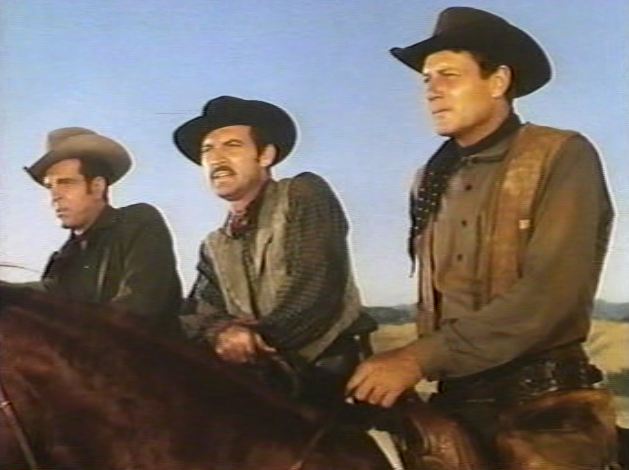
The train is a world unto itself, and when it leaves in the distance, it takes civilization, protection, and companionship with it. But, the is not a very comfortable world, the hard train seats, the soot and smoke, the days on end of riding a swaying, narrow wooden box across an enormous wilderness.

The train heads for “end of track” where still another world is set up. Donlevy’s gambling house and saloon is there to lead the track workers astray. The supplies for track building, and everything needed for a temporary town, are hauled in, and Stanwyck sets up her post office in the caboose. End of Track is like Oz, but a whole lot less pretty and dream-like.

Back to the train wreck that imprisoned McCrea, Stanwyck, and Preston -- another dramatic image is when Stanwyck turns her back to the gentleman to pray for their salvation, and McCrea points his pistol at the back of her head, ready to do a mercy killing to keep her from getting captured or tortured by the Indians. A very eerie shot.

At the final moment, they are saved -- by another train. Trains are the real heroes in this movie, Joel McCrea notwithstanding. Even the U.S. Cavalry that comes to their rescue arrives by train.

In this world where the train is everything, the most iconic image, of course, is the final Golden Spike scene, where a bit of humor is injected when conniver Henry Kolker, having been forced by Tamiroff and Overman to pay for his evil deeds by driving spikes with a sledgehammer until he’s surprisingly gotten very good at it, does the honors.

The two trains meeting nose to nose is as familiar as any image we have of 19th century America, of the West, and of the post-Civil War era when uniting North and South seemed more troublesome than uniting east and west. The throng of people climbing on the engines, the dignitaries in their top hats, the photographer and his bulky camera on a tripod to catch what everyone at the time knows is going to be the most historic event of their lives.

I first remember seeing this movie when I was quite young, perhaps as young as 8 or 9 years old, and as the movie played, tracing with my finger the route of the Union Pacific on a map of the U.S. Some place in Nebraska called Omaha to another place in Utah called Ogden, about four inches away. I sat on the floor with the coffee table as my desk. I think it was a Saturday afternoon, and I can still recall the play of afternoon sunlight, with one strong beam splashing on the map from the window behind me, so strong a light I could see the dust in the air.

I understood nothing of the history or the politics in the plot of the movie (even Ulysses S. Grant shows up at one point), but the images were easy enough for even a child to grasp. Maybe that’s what Mr. DeMille really excelled at, a simplified but still dramatic image. Most of his epics have more splash than depth, but they are eyecatching.

This post is part of our celebration of National Train Day, this Saturday May 7th. The train has an unusually iconic place not just in our history, but in classic films. This movie, throughout the jumble of carnival showmanship, imagines how important the train was to a 19th Century America with growing pains. It also shows Hollywood’s love of the train as a set, as a metaphor, and as a plot device.

It ends with a swell of patriotic music and a shot of a modern streamliner roaring past the camera.

Trains would continue to be important to America in the first half of the 20th Century, and to the movies for the first several decades of the film industry. Come back Thursday when we’ll have a look at “The Narrow Margin” (1952), which shows the other end of the romantic timeline of the train in American history and American film. It’s a sleek, modern train, faster and more elegant. There are no pioneers on this trip, even though it’s heading west to California, but there is plenty of danger, and almost all of it is on board.

And have a look here for National Train Day this coming Saturday.

Related Products