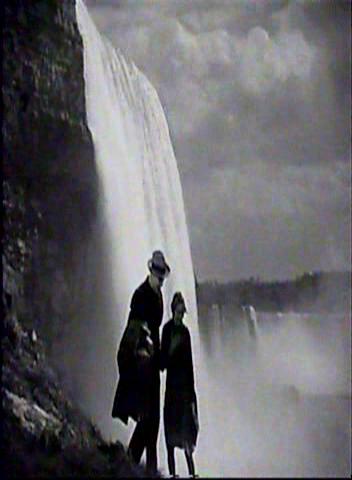
In keeping with our review of “Niagara” (1953) on Monday, let’s continue our visit at Niagara Falls with some other old movies.
That magnificent water works we share with our pals up the road in Canada has long been a tourist attraction, and most film depictions of Niagara Falls show characters on vacation, as in “Niagara”, or on honeymoons. By the way, Americans visiting the falls should most definitely go over to experience the view, and hospitality, on the Canadian side. You need your passport these days, but any inconvenience is worth the effort.
Any film about Niagara Falls is likely going to be filmed on location, since it is a bit unwieldy to fake on the back lot or slap in the background with rear screen projection. However, that’s not to say doubles can’t be used with a second unit film crew.
This shot from “Callaway Went Thataway” (1951 - see this previous post), shows Howard Keel and Dorothy McGuire on a cross-country publicity tour. This actor and actress were probably stand-ins. It could be rear-screen, but in that case I don't think they'd be shooting them from the back.
Harry Houdini, however, had no problem showing up in person, and naturally, performing his own stunts, in “The Man From Beyond” (1922). Mr. Houdini co-wrote the scenario and also produced this silent film, about a man revived from a one-hundred year sleep. Supposedly, the dangerous action you see in this clip below was done without camera tricks.
(Don't forget to scroll to the bottom of the page to pause the music so you can hear the following video clips.)
Here in “The Crowd” (1928 - see this previous post), the honeymooners James Murray and Eleanor Boardman are actually shot at the Falls, climbing a pretty steep hill to the side of it.
Rainbow Bridge is behind them in this view.
Here below is another movie, this time a 43-minute B-movie (sorry about the commercials) made in 1941 by Hal Roach, “Niagara Falls”. A couple of couples endure comic hijinks at the “Falls View Hotel”, a much swankier spot than the efficiency cabins pictured in “Niagara.” It stars Marjorie Woodworth, Tom Brown, Zasu Pitts, and Slim Summerville, who is featured at the beginning and the end as intending to end his life by jumping into the falls in his jammies. We shouldn’t be too worried about him, he hasn’t been successful at any other endeavor in this movie. A minor role of another honeymooner is played by Rand Brooks, who you may remember as Charles Hamilton in “Gone with the Wind” (1939). What two years can do to your career.
Then of course we have popular references to the Falls, most notably in “42nd Street” (1933), where we have the musical skit “Shuffle Off to Buffalo”. As we are told, “To Niagara in a sleeper, there’s no honeymoon that’s cheaper.”
Then there is the ever-popular, “Niagara Falls routine”, better known to some as “Slowly I Turn.” Here are two variations on this old vaudeville bit. First, with The Three Stooges from “Gents Without Cents” (1944).
Next up to bat, we have the Abbott & Costello version from their 1950s TV show:
You may remember Lucille Ball having a crack on this theme, too, in an episode of “I Love Lucy”, though the trigger word here is not “Niagara Falls”, but Martha. Niagara Falls is the blast of seltzer she gets in the pus. You can watch in on YouTube here.
THIS JUST IN!!!!!.......
Doaf! Our roving reporter Moira Finnie (catch her here at Skeins of Thought), just reminded me about "Remember the Night" (1940) with Fred MacMurray and Barbara Stanwyck. Am kicking myself as we speak. Moria supplies us with these two great shots from the film:
We begin a two-part series today comparing two films which are similar, and completely different. That they are so similar, and so completely different, may not be ironic, just signs of the times. Perhaps the films are what they are simply because they were made when they were made. Today we examine “The Crowd” (1928), and we conclude on Monday with “Roughly Speaking” (1945).
Each film deals with a kind of “parade of years” theme which shows the main characters through many eras of their lives, and focuses particularly on the misfortunes they experience. Both handle this deftly, and with a remarkable degree of humor. “The Crowd” achieves a stark realism, despite its simplistic treatment, that is more artful, and perhaps is even more easy to relate to today than “Roughly Speaking”, which is so uplifting that we are inclined to remark “they don’t make films like that anymore”, something we usually do with heartwarming films of that World War II era that are so fun to watch, but which have very little resemblance to our lives today.
“The Crowd”, with its wry tone, could have been made yesterday rather than decades ago, and is often considered director King Vidor’s masterpiece. We follow the life of Everyman, an office worker named John Sims, from the moment he is born on July 4, 1900 (the symbolism here to put both the nationalistic stamp on our Everyman and therefore ourselves, and to put him smack at the beginning of our American Century), up to the late 1920s when the film was made, the heyday of The Age of Wonderful Nonsense.
The baby is born to a proud papa who predicts great things for him, but the march of time has different plans for our John. Even at the start of the movie depicting the birth, we may well be startled to see such unaccustomed realism in an era of filmmaking reliant on exaggerated pantomime, fantasy worlds, and mandatory happy endings. The doctor holds up an infant by his ankles (doll or baby?), and smacks his bottom as if to show the moment of birth in a tableau far more bold than anything that would have been filmed in the 1930s or 1940s.
When John is still a boy, he arrives home to learn of the death of his father. The scene where we see him, stunned, climbing the stairs toward the camera to his father’s deathbed is eerie and heartbreaking. We don’t know if having lost his father at a young age is what makes the adult John so lacking in direction. We only see as time goes on that he remains just as helpless as this in moments of decision or trauma.
John is played by James Murray, one of the most natural actors of the silent film era, whose performance in this film is sensitive and stunning. He hits all the right notes, from the humorous scenes, to the tragic ones. John works in an insurance company, and shots of his desk situated among a maze of others you may recognize as well in “The Apartment” (1960), which director Billy Wilder seemed to have taken for a model. All the shots of New York City have that wonderful natural and unselfconscious feel of 1920s films we’ve noted before that are so common in the backgrounds of the films of Harold Lloyd. There is no cozy and artificial feel of a set.
John is coaxed by a co-worker to come out on a double date to Coney Island. At first he must be persuaded. Gradually as they come down their giant office building in the elevator, John warms to the idea. (He is castigated by the elevator operator for not facing front, one of the many times John will suffer for not fitting in with The Crowd.) By the time they have reached the street, John, easily swayed, meets his date and becomes a party animal.
He and his pal take a moment to stare up the skirts of their dates as they climb to the upper deck of an open omnibus. They spend the evening at Coney Island amusement park, and on the sleepy ride home, John sees an advertisement placard directed at newlyweds who want to furnish their new homes. This gives him the impulse to propose marriage to his date.
Obviously, scenes such as this are meant to hurry the plot along, but it does not seem strange for John to be so easily influence by an ad. He is so easily influenced by everything.
His bride is played by Eleanor Boardman, who likewise gives a touching and realistic performance. There are romantic scenes on their train to their honeymoon destination of Niagara Falls, and in their one-room apartment by the El tracks. Soon, however, life intrudes on their bliss, first in the form of her mother and brothers, who seem to disapprove of John, and his foolishly boyish tricks. John is not much of an insurance “company man”. He is really a writer of advertising jingles, an habitual contest entry fanatic, a lazy strummer of the ukulele, an impulsive juggler, and a man so easily distracted by any of these things, that he is prevented from either advancing at work or helping his wife with the house chores. She must constantly, though gently, prod him and keep him to task like a child with ADHD.
(As far a realism goes, we might musingly note this film also shows a toilet in the bathroom, something which would be absent pretty much from all bathrooms and all mention in Hollywood films of the 1930s and 1940s. We even get to see the inside of the tank as John fumbles with it because the toilet is running. Decades pass, but some things never change.)
As the years pass, his boredom with his job, his failure to be a success wears on him and he becomes occasionally churlish. Then one of his contest entries wins, and for a moment we think his ship has come in. However, tragedy of unimaginable horror occurs, and nearly destroys them.
After that, just the business of getting up every day and finding a purpose to go on becomes John’s monumental task. He quits his job, and finds, then quits, several others, not being able to stick with anything. The title cards provide some excellent prose, observations on life more than descriptions of the action.
One tells us, “We do not know how big the crowd is, and what opposition it is…until we get out of step with it.”
Finally, his wife considers leaving him, frustrated by his whining refusal to accept a job offer. His brother-in-law tells him, “You’ve never been anything but a big bag of wind.” It’s true. A loveable guy, a fun guy, but maddeningly undependable, and a big bag of wind. John is shocked by his wife’s criticism, and comes close to taking his life, but instead takes a job wearing a clown suit, and a sandwich board advertising a restaurant, juggling to attract attention. It was just such a person he ridiculed early in the movie. Now, he is the clown, but absurdly grateful to get a job he can handle.
Success is usually measured in dollars in our society, but sometimes we might remember than finding a job that matches our skills is success enough for people out of step with The Crowd.
The end gives us that iconic scene of John, his wife, and their son watching a vaudeville show, as the camera pans back to show the fullness of the audience, as John and his family is lost in The Crowd. They are together, and for the moment, content, but we do not really know if it is a happy ending.
What many film buffs associate with this film is the real-life tragedy of its star, James Murray. King Vidor chose him personally for this film, admiring his natural abilities. Murray was a newcomer to film, reportedly insecure and overwhelmed by the sudden fame which greeted him when this film was released. Some felt he was really playing himself in this movie, and though he gave other good performances in films for the next few years, was unable to handle the pressure of a Hollywood career.
Murray became an alcoholic, and soon, like his character John Sims, could not keep a job. In 1936, he drowned in the Hudson River; though it is not clear if this was a suicide. He was 35 years old. Reportedly King Vidor was so moved by Murray and his tragic life, he would one day write a film script about him, but the movie was never made.
“Roughly Speaking”, which we’ll take a look at Monday, was based on the true-life memoirs of Louise Randall Pierson, but “true life” had a different feel to it in this 1945 movie than the hauntingly artistic reality of “The Crowd.”
If you’ve not seen “The Crowd”, now in the public domain, you can watch it in several parts beginning here on YouTube.