Adventure in Manhattan (1936) is a strange mixture, not always
successful, but intriguing, nevertheless, of drama and romantic comedy—and stretches
our ability to suspend our disbelief simply because it is both suspenseful and
comedic.
The movie pairs Jean
Arthur and Joel McCrea for the first time (they would later be paired together
in the magnificent
The More the Merrier– 1943, which we discussed here).
Some
comments I’ve noted express disappointment that Arthur and McCrea fail to live
up to the Nick and Nora Charles image in this movie.
That’s because they’re not Nick and Nora
Charles.
I sometimes wonder if
we are not too mired in genre to an extent that we cannot accept hybrid. I find it very odd that an audience that can
accept films of fantasy and science fiction and are able to suspend their
disbelief under the implausible circumstances of these kinds of films, yet cannot
suspend their disbelief watching a movie which simply has both dramatic and
comic elements to it at the same time.
We struggle to paste one label or the other on a film. Adventure
in Manhattan is both, sometimes alarmingly so.
This week and next were
going to cover two movies that deal with stolen art. Unlike films about bank heists that show
thuggish gangsters, theft in the art world always seems to be done by gentlemen,
or at least devil-may-care scamps. We
are perhaps left with the fallacy that no one really gets hurt in art theft,
and that it is more or less a high-stakes gentleman’s game, like polo without
the horses. But crime is done, people do get hurt, there are consequences, and
these two films show us the difference in genre and how we accept genre.
The movie we’ll talk
about next week is Crack-Up (1946), strictly
noir, and the gentlemanly art of stealing art shown as a world of dark shadows
and grim postwar angst, psychological terror, and a really mean trick. It stars Pat O’Brien and Claire Trevor, and
they are not Nick and Nora Charles, either.
Both films have plots
that hinge on a really mean trick.
Adventure in Manhattan is part 1930s with a little hint of 1940s
noir thrown in, quite unexpectedly, and this is what is most tantalizing about
the film—and most unbalancing. It seems
to be a precursor of what will come, but quite unconsciously. It is not trend-setting; it is only
experimentation.
Joel McCrea is a writer
of crime stories.
He writes newspaper
columns on real-life crimes and mystery novels about famous cases.
He is very successful, very much in demand,
and very well aware of his gifts and his success.
He’s charming and so confident that he drives
everyone else around him nuts.
He’s the
kind of guy who does everything perfectly.
You want to see him mess up just once to see
if he’s real.
A series of art thefts
and jewel robberies has occurred, and we are told this as the film starts with
several flashing headlines and the blare of police sirens.
We are in New York City in the middle of the
Great Depression.
Thomas Mitchell is a
newspaper editor, the kind of crabby, shrieking, in-your-face-palooka who wants
a feature story on the crime wave.
He hires
Joel McCrea to investigate and to write purple prose on the crime spree.
“Involve a woman in
it!”
He’s getting a little
ahead of us. But we can tell by the cast
of credits that the only woman listed is Jean Arthur, so there’s going to be a
woman in it, and the job is all hers.
I wonder if newspaper
offices are to thirties movies as living rooms are to fifties movies?
Enter Joel McCrea,
know-it-all, laconic, wearing his fame like a kingly robe. He presumes to sit right down at Thomas
Mitchell’s typewriter, still wearing his hat and begins to weave a tale. (I recall a funny line in the old Mary Tyler Moore Show where the
character of Lou Grant tells Mary about the good old days when he used to work
in a newsroom, and he said that they were real newsman because they wore their
hats in the office.)
Mr. McCrea takes a
break from his masterpiece, and heads to the local bar the reporters hang out,
where he grabs a beer and a cheese sandwich, and where his fellow journalists
are playing pool. One of the fellows is a playwright, played by hangdog Victor
Kilian, who we last saw with Jean and Thomas Mitchell in
Only Angels Have Wings (1939).
The play he is currently writing will figure a great deal in the story,
but we don’t know that yet.
And neither
does he.
McCrea is smooth and
confident and chatters about the latest robbery, which aggravates the other
reporters who just can’t seem to get any leads. McCrea acts self-superior, lecturing them, but
it’s not just arrogance. He really is superior. He’s much smarter than the fellows and he
takes the route of solving the crimes by what today we would consider a rather
modern tactic: he uses profiling. He tries to get into the head of the man he
thinks is behind these crimes. McCrea,
interestingly, plays his character like a charming egghead, who knows people’s
psychology, but does not have the social skills to get close to anyone himself. For all his intelligence, he is socially
inept and doesn’t know it.
He plays pool and makes
fantastic shots, never missing one.
When
he leaves, Mr. Kilian remarks, echoing the other guys’ thoughts, “How do you
live with a guy like that?”
Jean Arthur enters the
story at this point, and her work in this film, as usual, is deft and many
layered. We’ve mentioned before that there’s no one like her for playing along
that thin knife edge of comedy and drama, of evoking great pathos, even
tragedy, and yet still being able to shine a ridiculous spotlight on her
character. In this movie, her character
might be considered all over the place by some viewers because at times she is
very dramatic, and at other times she is doing screwball comedy. We struggle to find what pigeonhole to put
her in.
This is probably the
same difficulty that early directors and the studio head Harry Cohn had with
Jean Arthur, until the mid-thirties when she began to hit her stride, showing
that she can do these unusual characters that flourished in the Depression era
like nobody else. She’s not doing Nora Charles. She’s doing Jean Arthur.
We first see her
walking down a crowded city street.
She
is bundled up to the neck in a plain unflattering raincoat and her cloche hat
is pulled down close over her eyes.
Droplets
of rain dot her hat and shoulders as she sidles up to people quietly, with
anxiety and embarrassment, but desperate, she begs for money.
Joel McCrea sees her. Neither he, nor the movie audience of the day,
is surprised to see woman trying to quietly ask for change on a city street
corner. But his attention is distracted
by an automobile accident close by. We
hear the screech of tires, a crash and everyone walking on the crowded
sidewalks rushes to the scene of the accident. We see that Jean Arthur moves through the
crowd and tries to get close to Joel McCrea, because it looked as if he might
have given her some money only a moment before and she doesn’t want to lose him.
Instead, she gets up to him and then disappears. When the chaos dies down, he realizes his
wallet is missing. He looks around and
sees Miss Arthur walking quickly away. She has taken his wallet.
She gets into a
taxi.
He gets into another and utters
that immortal line “Follow that cab!”
She gets out at a
beauty salon. A beauty salon? We would have expected anything but this, and
from this point on the next series of scenes is nothing like we would’ve ever
expected to see.
And culminates in one
of the most shocking scenes I’ve ever seen in a movie of this era.
Bess Flowers is one of
the beauty shop attendants. At least she
has to work in this movie and is not just some party guest this time.
He waits for her to
come out of shop because he wants to follow her to see what she is doing with
his money.
She emerges beautifully
coiffed and in a dazzling white outfit.
She gets into a cab.
He forces his way in, and she is embarrassed
and nervous and wants to stall him from going to the police.
He is cynical and disbelieving of her pleas
for help.
He has every intention of
turning over to the cops, but he is a student of human nature, and he wants to
make her wriggle on the hook while he dissects her emotions.
He does not really care about her plight;
this is only another psychological game for him.
She tells him that she
had to steal the money, because she’s waited three years for tonight. She has an appointment to see someone and begs
him to give her only the next few hours and then she will go with him to the
police. He is dubious, but she invites
him to come with her because he doesn’t trust her. It’s wonderful to see Jean Arthur in these
scenes because of her sensitive ability to seem so complicated and yet so
transparent. I can think of so many
other actresses who would put a hearts-and-flowers spin on the scene, like an
orphan in a snowstorm. Jean just looks very real and very uncomfortable, as if
her own words are being dragged out of her, as if the very act of giving plot
exposition is killing her.
She tells him that she
is going to visit her ex-husband. He was
very cruel to her and they were divorced. She fell in love with another man, and ran
away with him, but she is now separated from that man, and she is alone. She had a daughter with her husband and he
kept custody of the child. Today is her
daughter’s fourth birthday, and she is going to go visit her. She had asked her husband repeatedly to allow
her to see the child, but he always refused. Finally, tonight, he’s allowing her to see her
daughter. Jean tells Joel, “I couldn’t
let her see me the way I was.”
Her damsel in distress
routine is very genuine, but it does not move Joel. He has told his reporter friends that they get
too sentimental in their stories, they forget to be objective and that is why
he is always able to solve crimes.
They arrive at her
ex-husband’s mansion and the butler answers the door.
The husband is there, pompous and severe.
He allows Jean Arthur to go visit her
daughter, and tells her the girl is in the next room.
Jean rushes into the room, leaving the
ex-husband and Joel McCrea to size each other up in the foyer.
We think that the husband probably thinks that
Joel McCrea is Jean’s latest lover.
Okay. You know this thing I have about always giving
out spoilers. I’m not going to go into
detail about the mystery of this story, or who the guilty person is. But I have to go into detail about this scene
that’s coming up because it shocked the socks off me. If you do not want to get the surprise, run
away from this paragraph as if you are running for your very life from the
bulls of Pamplona.
Are they gone? Good. Now we can talk in whispers.
Just as we are about to
smile at the way Joel McCrea realizes he is being mistaken for “the other man,”
we hear Jean’s piercing scream from the other room.
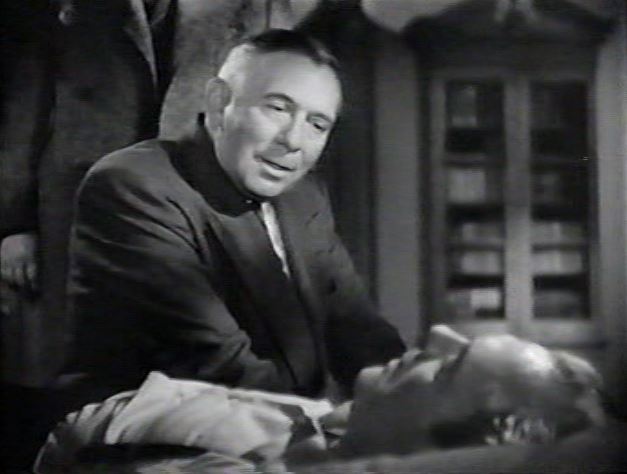
Joel rushes into the room and we get a quick,
sliding close-up on his shocked expression.
Then the camera shifts
to the interior of the room and we see a small white child’s coffin dimly
illuminated in the dark room.
Suddenly
this has become a Universal horror picture.
We look around for Bela Lugosi.
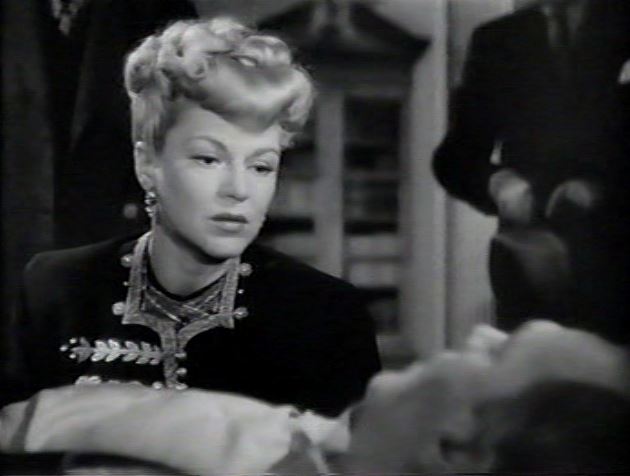
Jean
is prostrate on the floor, crying.
Joel
leads her away.
The pompous ass of a
husband says that the child died the day before yesterday, so there would be no
harm for her to have her visit from her mother, now.
He has exacted his final, most-heartbreaking
revenge on his ex-wife.
This scene will cause
you to offer up your favorite exclamation of alarm and dismay, perhaps several
times. You may even need a drink. I recall myself saying to the TV, "I can't believe they did that."
The discomfort this
scene causes the audience is remarkable and may be one of the greatest reasons
why some viewers tend to see this film as a failed Nick and Nora Charles,
because so much of the rest of it is funny and lighthearted, with teasing
banter between Jean Arthur and Joel McCrea. But this scene stands out like a sore
thumb. It is too much reality shoved
into a cozy little romantic comedy world.
It is not movie-melodramatic, the way you might see the coffin in a
monster movie, because it is real, and because it is Jean Arthur. She has such a real presence in her films. She is the woman on the Depression-era
streets. She’s the shop girl. The newspaper reporter. She’s the noble, the indefatigable and the
downtrodden common woman. And yet she
still manages to be somehow ethereal and above us, if only for the purity of
her conflicting emotions.
The next scene finds
Jean in Joel’s apartment, lying on his bed, and he revives her with a drink.
She really looks ill.
She is not the
swooning type, but she really looks like she wants to die and doesn’t want to
say so.
Joel tells her that she will
stay here for the night and asks if there’s anything else he can do.
With difficulty, she tells him that she would
like to have her daughter’s ring.
Mr. McCrea, with the
relish for revenge, and the first real flush of emotion we’ve seen him display
so far, says that he is only too happy to go back and face her ex-husband. We imagine he wants to sock him.
When he goes back to
the mansion, it is dark. There are no
lights in any of the windows and when he approaches the door, a night watchman
questions him and asks him to leave. Joel tells him that he was here only a little
while ago speaking with the owner of the house.
The night watchman tells them that the owner is in Europe, and that the
tenant to whom he is renting the home is not here right now. And he kicks Joel out.
Huh? Is this a ghost story?
Now we have a different
mystery on our hands, quite apart from the jewel heist.
Joel McCrea, with his inquisitive mind and
his stubborn nature, is intrigued.
He
sneaks back into the house and walks around in the dark.
He finds the child’s coffin, which has been
tipped over one end on the floor.
There
is no body inside.
We have definitely entered
creepy movie territory. Joel is then
accosted by man with a gun, played by Reginald Owen. They exchange words, and they also exchange
neckties.
Neckties?
The man with the gun
admires Joel’s tie, and Joel, attempting to be cute and to distract him because
he’s pointing a gun, tells him he can have it, and so they trade ties.
Is the guy with the gun
a crackpot? Or have we just crossed over
back into screwball comedy?
Suddenly the lights
come on and people come out of the woodwork.
They are Joel’s reporter buddies with Miss Arthur
in tow.
She is an actress in Victor
Kilian’s play and some of the others are actors in his cast.
It was all a practical joke.
Jean Arthur is rueful,
feels guilty, but thanks Joel for being gallant enough to come to her aid. We
can see that he is embarrassed and sore about it, but he is a gentleman and a
good sport. He offers to buy everybody
drinks, and this the beginning of his teaming up with Jean Arthur.
We also have a
foreshadowing in the scene of who the real criminal is behind the robberies,
and very shortly, the film tells us point-blank who the bad guys are, so there
really isn’t much of a mystery for the viewer.
From now on, the movie is about how Joel McCrea cracks the case, and a
lot of that has to do with how he also plots to get back at Jean Arthur for her
trick on him. Both subplots are
intertwined.
Victor Kilian’s play
also has a lot to do with the case.
It
is a World War I melodrama and Jean Arthur plays a kind of Red Cross volunteer
or ambulance driver.
We see her in a
kind of uniform.
She is a good actress
and she is a lady, not a chorus girl.
Listen
to her voice in this movie.
It’s
slightly lower than her usual squeak, the quality of her voice that Edward G.
Robinson once commented was like freshly grated peppermint.
There is something wistful and sad about her, as
if she is still wearing the cloak of her many damsel-in-distress roles of the
twenties and early thirties.
She made
five movies in 1936, including the magnificent
Mr. Deeds Goes to Town.
She
was starting to come into her own and Columbia started to realize this.
Another movie she made
in 1936, The Ex-Mrs. Bradford, was
the real Nick and Nora knockoff, with William Powell, the real Nick, as her
costar. We’ll talk about that one
sometime or other.
Adventure in Manhattan seems to start to get off-kilter from this
point on, but mainly perhaps because Joel McCrea was trying to keep Jean Arthur
off-kilter.
He sets the tone for the
whole movie by playing small jokes on her to make her exasperated.
He invites her to the Ritz for lunch, but
brings her home to his apartment instead, which he says he calls the Ritz and
they eat beans.
She ends up having to
cook them herself.
Reginald Owen shows
up.
He is a wealthy man about town and
is also the angel in charge of producing Victor Kilian’s play.
When he shows up
unexpectedly for lunch, they invite them to have beans and they sit there,
eating their beans, trading banter.
We’re
deep in screwball comedy territory again.
At one point Mr. Owen wanders into Joel’s bedroom to admire the valuable
and artistic furnishings—Joel has an eye for art, which is probably why he’s so
good at finding art thieves.
All three
of them go Joel’s bedroom and eat their plates of beans.
A climactic scene
occurs with a robbery during a live performance of the play in which Jean is
performing.
She stumbles on the bad guys
backstage, and drags Victor Killian to help her investigate, because after all,
when you’re really in trouble, you go to the nearest playwright.
I can’t tell you how many times people have
asked me to fight crime.
It’s really
annoying.
I’m just sitting down to
dinner, and they’re at the door, just because I write plays and I’m in the
neighborhood.
The shift between
scenes of extreme horror and extreme silliness make this film seem like it’s
swinging back and forth on a pendulum and we don’t know what to think of it—but
isn’t that the very essence of a mystery, a suspense story? It plays upon what we were expecting and does
not deliver. I think the ultimate
joke is played on us. The audience,
unlike Joel McCrea, are not always good sports.
Come back next Thursday
for Crack-Up, where, again, all is
not what it seems, and this nearly sends Pat O’Brien into a mental breakdown in
a psychological post-war art mystery. But
it’s noir, so we don’t take offense if we’re caught in the middle of a shell
game. That’s to be expected.