IMPRISON TRAITOR, PEDOPHILE, AND CONVICTED FELON TRUMP.
Showing posts with label Lillian Hellman. Show all posts

Thursday, February 27, 2014

Another Part of the Forest - 1948


Another Part of the Forest (1948) is one of the finest movies made in this era, and Ann Blyth displays her ability to inhabit the role of a lusty, complex conniver so thoroughly that her film reputation as a meek good girl of only a few years later, mentioned in this post, is an almost shocking contradiction. 

The film is currently not available for sale either in VHS or DVD, and this is a shame.  I think it’s time to take a large battering ram to the Universal vault.  Where are all those rampaging village idiots with the flaming torches and pitchforks when you really need them?  Off chasing Frankenstein's monster when they should be here.  UPDATE: This film has been newly released on DVD in 2017!

Long post.  Oh, stop crying and pull yourself together.

All three elements of acting, writing, and direction come together so perfectly, so intensely that the movie stands as a remarkable work of art—truly, and timeless.  The screenplay by Vladimir Pozner is based on the Lillian Hellman stage play.  The story is of the Hubbard family, a prequel to her The Little Foxes, which had been wildly successful both on Broadway and in the 1941 film starring Bette Davis.  Another Part of the Forest takes us to the earlier years of the three inscrutable Hubbard siblings and how they got to be that way. 

The second element is the flawlessly creative and evocative direction by Michael Gordon, which we’ll get into in a little bit.  It is, I think, the best filmed version of a stage play I’ve ever seen, because it takes the intimacy and the dynamics of a live stage setting and yet implements those tricks and nuances of film to make it a kind of hybrid film-play.  Some stage plays are filmed with a static camera and so we are left with what appears to be an authentic image of the play, but it seems stiff on film.  Conversely, some stage plays are adapted to film in such a manner that we forget they ever were on stage; the director applies superfluous action and settings that draws away from the intensity of the literary drama. 

But in Another Part of the Forest, we have a director who understands the subtleties of the finest elements of film and stage, and combines them in a beautifully artistic way. 

The third basic element to the making of any great film, of course, is the acting and here we have an ensemble cast who simply could not be better.  We see on the opening title card the unusual setting of the four main players all listed equally above the title and they deserve it.  They are a well-oiled team.  I wonder how long these scenes, particularly the dining room scene, was rehearsed, because it looks for all like they’ve been playing it on stage for months.

The story is set in 1880.  Fredric March plays Marcus Hubbard, patriarch of this dysfunctional clan.  His real-life wife, Florence Eldridge plays his wife Lavinia.  He is a storekeeper and up-and-coming businessman in a sleepy southern town, and he has been branching out into different investments that have been profitable for him.  He gives loans, he takes over mortgages, growing his tiny economic empire.  He is a shrewd and cunning man, and not at all likable.  He is rude and blunt, and openly displays his disdain for his customers, his family, his community.

He is also something of a pariah in his town because of an incident that happened fifteen years earlier during the Civil War.  He was a merchant even then, and he was accused of profiteering from the war by securing a supply of badly needed salt and then charging high prices for it to a war-torn townspeople who couldn’t pay for it.  Marcus is proud, defiant, and totally uncaring in a kind of Scrooge-like way about the needs of others.  He is focused on his own advancement.

His wife, Lavinia, a soulful, gentle, frightened woman is his whipping boy in the sense that she carries the burden of his guilt because only she feels it.  But there is another secret between them, and another secret in the town of a terrible betrayal that occurred during the war leading to the ambush and massacre of several local boys in the Confederate army, and it isn’t until the end of the movie that we discover the traitor. 

Fredric March is riveting.  The character alone is intriguing. Marcus had pulled himself up by his bootstraps, emerged from a hardscrabble boyhood through very hard work.  When he was still a boy, he took his first hard-earned dollar and bought a card at a lending library.  While he was still a child in the fields and driving a mule team, with what little free time he had he taught himself to read and then he taught himself languages: French, Latin, Greek.  He read the classics and he desired what he saw in those classics: a sense of beauty and grace that was denied him in shabby poverty.  There is much to admire in Marcus.

But like those ancient Greeks and their tales and fables, he bears a fatal flaw, and that is his avarice.  Though he has a deep love of beauty and literature and music, there is a very strong strain of the acquisitor in him, so much so that like all acquisitors, his main joy is not in the appreciation, but in the simply possessing, the controlling.  Fredric March is stunning in this role, and we at turns can despise him, can feel sorry for him, and yet also can admire him for his clear thinking.  There is a certain nobility about him.  If it weren’t for his weaknesses, he could be a great man. 

His three children are the sins he created and also the burdens on his back.  Edmund O’Brien plays Ben, the eldest, a man about thirty years old who is taking after his father, inheriting his father’s intelligence, shrewdness, and acquisitive acumen, and also his hardness of heart.  But he has something his father hasn’t, and that is a true sense of graciousness.  It is a false graciousness in many instances.  He is able to speak to people, to make people like him, to ingratiate himself when he needs to, to close a business deal, where his father is just rude.  Edmond O’Brien does not have his father’s arrogance, but he is double the monster because, like his father, he has no heart or feelings for others.  Any display of affection or kindness is merely a tool he uses to get what he wants.  The wheels are always turning in that sneaky mind.

I think it is one of Edmond O’Brien’s best roles and he commands most of the scenes he’s in.  It makes you wish he had done more leading man parts instead of character roles, but in a role like Ben Hubbard he gets to do both, and he’s quite good. 

The second son is Oscar, a weak-willed sniveling creep, who has the position in this film as a kind of comic relief.  He’s played by Dan Duryea in whimsical casting because Mr. Duryea earlier played Oscar’s son in the film The Little Foxes.  Oscar’s son Leo in that film was very much like his father is in this film. 
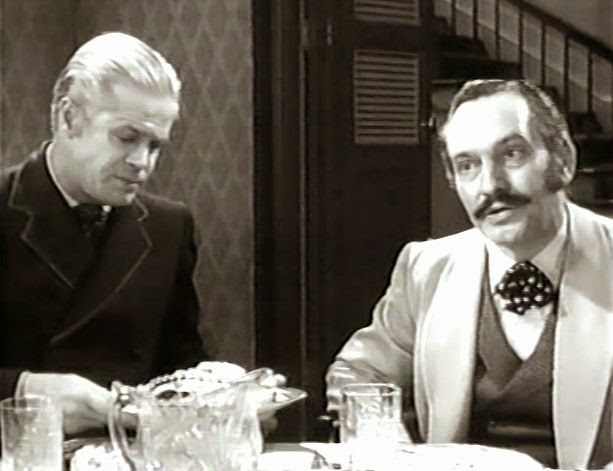
Duryea does not have that sinister sneer he wears in other villain roles.  Here he is helpless in his petty self-absorption, and we can even feel sorry for him, particularly in the luncheon scene when he says something stupid and his father makes a sarcastic reply.  Duryea looks down, wearing an expression of pain, because he knows he put his foot in his mouth again. 

He just can’t please his father, lacking shrewdness, and he is the most despised by his father for his ignorance.  Duryea is also an undisciplined hothead, much more so than his father.  He is easily led, and by the end of the movie, Edmund O’Brien will do the leading. 

The youngest sibling is Regina, played Ann Blyth.  Here she has one of her best roles and one of her most complex and sinister, even to rival Veda Pierce.  In the movie The Little Foxes, Regina is played in middle age by Bette Davis.  Perhaps not so coincidentally, Ann Blyth in this period of her career was being called a young Bette Davis.

Regina is attractive, sexy, and her moods rise and fall--coldness to her mother, a beguiling charm to those who can do most for her.  She is shrewd and intelligent like her elder brother and her father.  She also bears their flaw of avarice and the need for power, but she has another need which neither father nor elder brother seem to share: she juggles a strong sexual longing, where the other two men appeared to be asexual.  They lust only for money.

John Dall plays Capt. John Bagtry, a man in his thirties who left the best part of his life behind him in the Civil War.  He is the cousin of Miss Birdie Bagtry played as a delicate flower by Betsy Blair.  Betsy and her mother still run the old plantation and are struggling financially.  John lives there on charity, not able or willing to contribute to his support.  He just loafs and dreams of the old days when he was a gallant soldier.  When we first see him, he is still in uniform, having attended a Confederate Day service.  He is the pathetic object of Ann Blyth’s lust, and though John Dall is happy to let himself be captured for stolen liaisons, he does not want to marry her.  He does not want to do anything but live in the past, and it takes a while for her to see that. 

Another sticky relationship she juggles is the one with her father.  Fredric March has only one weakness—and that is his daughter.  He loves her more than his wife, more than his despised sons and his relationship with her is somewhat incestuous.  Not literally of course, but emotionally.  He splurges on her and when he arranges to go for a walk with her, it looks for all as if he is courting her.  She refuses an invitation to spend the afternoon with her mother, who suddenly looks like a wallflower losing her beau to a more glamorous rival.


In one scene, several boxes of dresses have arrived that she ordered from Chicago, and she takes them out and shows them off to the family, like a child trying to make her brothers jealous that her father is spending money on her.  She lifts one gown out of its box and goes to sit on the arm of her father’s chair.  She spreads the skirt of the dress over her lap and over his, and he is obviously delighted with her, and she knows this, and she’s using it.  She’s manipulating him, and in certain scenes, seems to coyly dangle herself before him.  They are always “Darlin’” to each other.

But she’s playing with fire, as her older brother Edmond O’Brien teasingly reminds her.  She and Mr. O’Brien walk up the stairs, a promenade-cum-plot exposition, while she gloats about her ability to control her father and O’Brien suggests that one day she will be a forty-year-old woman and will still be taking care of her father because he won’t let her go.  

Edmond O’Brien is in the background, a calm look of command on his face.  In the foreground, we see Ann’s expression has turned from gloating to one of cold fear.  Staying with her father until she is forty is just the thing she does not want, and knows that she must not let her father get too great a control over her.  She spends the better part of the movie walking a tightrope in her unnatural relationship with her father.

She wants the pretty things he buys her, but she wants to be in John Dall’s bed.  Controlling him.

Late in the film, a climactic scene occurs when the Bagtrys come to a train wreck of a party at the Hubbard’s house, along with a floozy girlfriend Mr. Duryea has invited, played by Dona Drake, and we see a smashing of wills, intentions, and the worst of these people come pouring out.

John Dall has a plan to take borrowed money and travel to Brazil where they are having a revolution.  He wants to be a soldier again.  As Betsy Blair explains, the “radicals” are trying to abolish slavery down there and “ruin the country” and her cousin is going to fight for his “ideals” to preserve slavery.  Fredric March is the only courageous one in this polite bunch who dares to snub the "quality" folk and tell the once-and-future Confederate to his face that he's a jerk.  But his reasons for doing so are only partly because of his admiration for the vox populi of his heroes of Ancient Greece.  Mainly, he just enjoys telling people off.

He is also jealous of the man who appears to have turned his daughter's head.  He refuses to lose her to anyone.

Ann Blyth, in a profile view, stands silent during the discussion while a leaden epiphany sneaks up on her, her eyes curiously roaming on John Dall as her father berates him.  We see the truth is settling in that John Dall will never be anything than what he is—a boy in his thirties who can’t give up playing the soldier, a job that was never really more than an ego trip for him and if he were fighting for as ideals, his ideals are pretty shabby.  And yet she wants him for the sexual hold he has over her, which she imagines is reciprocal.

However, she gets another grim surprise that evening when the floozy that Duryea invites also appears to know John Dall intimately.  Clearly, he is not as obsessed by Ann as she is with him.

The intricate plot flip-flops constantly in the tricks the siblings and father play on each other, like kids playing keep-away with somebody’s hat on a schoolyard, only it is bits of information they toss around and keep from each other, and tell lies instead. It is all a lovely, literate, shell game.

There is so much to admire in the staging of the film, in the camera blocking where characters in the background are as much as part of the intensity of the scene, and where mirror shots allow for a larger grouping.    March’s store is filled with goods and items and trinkets and you could spend the whole movie just looking at everything. 

There’s a comic scene where Dan Duryea, afraid that a lynch mob might be after him for something he did, walks through the store and bangs his head on a pair of men’s riding boots hanging from the ceiling.  He looks up and we see instantly it is like an image of a man being hanged, and we see only his boots dangling from a tree.  It’s sinister, but it’s also funny. 

Another fascinating sequence is where Duryea and his gang of KKK friends chase down a Yankee visitor and beat him up.  There’s a scene where a horse rears and we see the horse’s mouth open and his sharp teeth parted in a grimace. 


Immediately we cut to the local saloon where Duryea’s floozy girlfriend is dancing a can-can.  In a flirtatious toss of the head to her audience, her teeth are parted in the same manner as the horse. 

We cut back to the Yankee being dragged to the ground, trampled in the forest of legs around him.

Then cut back to the can-can where the floozy drops to the floor of the stage looking submissively at the audience, tauntingly, seductively in the forest of legs of dancers around her.  The shots of the brutal beating and the dance are erotic mixture of violence and pleasure. 

The camera work flows beautifully from the very beginning of the movie.  There is a Confederate memorial celebration where a speaker refers to an act of betrayal and he points to a far hill to discuss an event of the past.  But the past becomes instantly the present, as the camera swoops to the hill and we see Florence Eldridge hiding with a bouquet of flowers waiting to place it at the memorial. 

We hear a train whistle, and she looks over her shoulder at a distant passing train and the camera swoops to the interior of the train and there is her son, Edmond O’Brien.  It is so flawless and keeps the action moving wonderfully.

The costumes, the hair, the makeup, the men’s full sideburns and muttonchops are historically accurate and not caricature.  There is no cartoon campiness of the Old South, here it is all very real and unblinking. 

We see the mother has a good relationship with their three black servants, especially with Coralee, played by Libby Taylor, who finds small and clever ways of protecting Lavinia from her family’s meanness.  In the play, we are told that Mrs. Hubbard actually goes to the black church because she feels more at home there.  She feels the congregation is more spiritual; besides, she is the wife of Marcus Hubbard and so she is ostracized from the white townspeople, the "quality folk." 

At the end of the film, Edmond O’Brien has wrested his father’s business and fortune from him through blackmail.  Fredric March wants to run away with his daughter, and tells her he will continue to find a way to provide for her.  But Ann Blyth has had enough of this cloying “suitor."  She considers her options, pouring herself a cup of coffee on the patio while Edmond O’Brien announces his plans to invest his father’s money and make still more, that they will all be rich.  Her father, beaten and begging her attention, asks her to pour him a cup of coffee too.  In a priceless image of nasty survival instinct, Ann Blyth, one eyebrow raised, walks away from her father and sits down by her brother.  She gleefully agrees to let Mr. O’Brien plan her marriage to his future business partner, Horace Gibbons.  She gives up her lust for the fleeing John Dall in exchange for a profitable, and loveless, marriage.

She, Edmond O’Brien and Dan Duryea will continue to squabble and play tricks on each other the rest of their lives and become the people we know from The Little Foxes.  Part of our enjoyment of this film is knowing where they ended up.

It’s difficult to pick out favorite scenes because they’re all so very fine, and the dialogue crackles, especially when Fredric March rises to sarcasm.  Then there is the delectable cagy sparring between Edmond O’Brien and Ann Blyth.  Dressed in her new finery, showing it off for O’Brien, she taunts him, “I just wanted to show you what you’ve been paying for.  How do I look?”

He replies, “Bright and shiny, honey, like a new two-bit piece.”  A lovely backhanded compliment, and we see the insult is not lost on her.

And when the Yankee carpetbagger, a guest at the Confederate memorial ceremonies, responds with surprise, “In Boston, we stopped fighting the war fifteen years ago.” 

To which the old Confederate soldier, a town pillar, replies, “You won it.  You can afford to forget.”

And I love Dan Duryea's nervous Woody Woodpecker laugh, that Fredric March even imitates at one point. 

Today we have many sequels and prequels of films.  It’s become kind of a standard practice, but it is not done for the storytelling—it is for the merchandising, and we know that. Yeah, I’m looking at you “Star Wars 23.”  Another Part of the Forest was created by Lillian Hellman for the excitement of discovering more about the characters, knowing with a writer's instinct that there really was more to the story she had left on the table.  This film was one of the first times a prequel was created and some of the critics didn’t seem to know how to take a prequel.

Lillian Hellman, unfortunately, did not really have any part in the making of this film.  At this time, she became blacklisted in Hollywood for her refusal to cooperate with the House Un-American Activities Committee.  Lillian Hellman, who wrote the play Watch on the Rhine, which Ann appeared in on Broadway as a child, discussed here in our intro post, proved to be good luck again for Ann.  She shows again how adept she is at playing complex women, not simply females who were dastardly. 


Louella Parsons announced in December 1946 that Ann, “…that marvelous child actress, who did so well in Mildred Pierce,” had won the role of Regina.  It was a splendid opportunity for Ann Blyth to work as part of a top-notch ensemble cast, and so demonstrate an ability to stand out among them.  Syndicated columnist Dorothy Manners wrote, “In spite of her tender years, she is one whale of an actress…When Fredric and Florence March were here, they said they would like to do a show with Ann on Broadway.  That’s real praise, because the Marches do not usually like anything in Hollywood.”

The columnist Sue Chambers wrote, “Fredric March, who doesn’t usually go overboard for the young and unsophisticated told me, ‘She’s a great actress,’ when he was doing Another Part of the Forest with Ann.”  Apparently March wanted her for his upcoming film Jupiter’s Wife, but according to this columnist, William Powell snagged her for Mr. Peabody and the Mermaid (For which she took time out from Another Part of the Forest to fabricate the mermaid’s tale, which we discussed here), and Chambers commented, “How about all this for a girl who isn’t yet twenty?” 


I’ll go one more and say that, as regards her portrayal of Regina Hubbard, if Gone with the Wind had not made it to the screen until 1949, instead of having been made ten years earlier in 1939, Ann Blyth would have been a top contender for Scarlett.

Ann remarked of Fredric March and Florence Eldridge in a 2006 interview with Eddie Muller: "To watch both of them so impressed upon me. They were so good at what they did. He was terrific. It was just electric to be on the set even if I wasn't in a scene with him. He was wonderful."
Another Part of the Forest was also made as a Lux Radio Theater presentation, with Ann as the only cast member from the film.  Walter Houston played her father Marcus and Vincent Price played her brother Ben.  You can hear it here at the Internet Archive website.  Unfortunately, the quality is a bit muffled, but it will give you an idea of the story.  Later on in November 1948, Ann also re-teamed on radio with Edmond O’Brien in the Suspense story “Muddy Track.”  The quality is quite good and you can listen to it here.  She plays a woman who is not all what she seems to be, and he is a man in trouble and on the run.  At the end, the announcer reminds us that she can now be seen in Mr. Peabody and the Mermaid.

The copy of Another Part of the Forest I managed to obtain was in poor condition, but I was lucky to be able to find it at all.  This film badly needs to be restored and released for sale, not only because it is one of the best films of the era, but because it is an example of stellar American playwriting of the twentieth century, and about distinctly American themes.   I don’t know about the complex legal machinations involving the Universal vault and what keeps so many Universal films, thereby of course, several Ann Blyth films, from not being widely shown again, but I certainly hope that TCM is able to use its influence and free these films from that stupid vault.

I still think a battering ram is a good option.  SEE UPDATE ABOVE -- The film has been released on DVD!  Saints be praised!

Come back next Thursday when we jump ahead to 1957, the year Ann’s last three movies were released, all very different and showing, not surprisingly, her versatility.  However, her film career was winding down as good roles were getting harder to come by for a 29-year old in an industry that was changing.  Her second-to-last film was The Buster Keaton Story, the last time she was paired on film with her first co-star and old friend, Donald O’Connor.


**********************************

The Deseret (Salt Lake City, Utah) News, syndicated article by Dorothy Manners, February 4, 1949, p. F-3.
The Evening Class Blog, July 28, 2007, transcript of Eddie Muller's interview with Ann Blyth July 2006 at Castro Theater, San Francisco.

Milwaukee Journal, syndicated article by Sue Chambers, February 29, 1948.

Milwaukee Sentinel, syndicated article by Louella Parsons, December 27, 1946, p. 10.

*********************************

UPDATE:  This series on Ann Blyth is now a book - ANN BLYTH: ACTRESS. SINGER. STAR. -

*********************
The audio book for Ann Blyth: Actress. Singer. Star. is now for sale on Audible.com, and on Amazon and iTunes.


Also in paperback and eBook from Amazon, also available in eBook at:


and my Etsy shop: LynchTwinsPublishing.


 "Lynch’s book is organized and well-written – and has plenty of amusing observations – but when it comes to describing Blyth’s movies, Lynch’s writing sparkles." - Ruth Kerr, Silver Screenings

"Jacqueline T. Lynch creates a poignant and thoroughly-researched mosaic of memories of a fine, upstanding human being who also happens to be a legendary entertainer." - Deborah Thomas, Java's Journey

"One of the great strengths of Ann Blyth: Actress. Singer. Star. is that Lynch not only gives an excellent overview of Blyth's career -- she offers detailed analyses of each of Blyth's roles -- but she puts them in the context of the larger issues of the day."- Amanda Garrett, Old Hollywood Films

"Jacqueline's book will hopefully cause many more people to take a look at this multitalented woman whose career encompassed just about every possible aspect of 20th Century entertainment." - Laura Grieve, Laura's Miscellaneous Musings''

"Jacqueline T. Lynch’s Ann Blyth: Actress. Singer. Star. is an extremely well researched undertaking that is a must for all Blyth fans." - Annette Bochenek, Hometowns to Hollywood


Ann Blyth: Actress. Singer. Star. 
by Jacqueline T. Lynch

The first book on the career of actress Ann Blyth. Multitalented and remarkably versatile, Blyth began on radio as a child, appeared on Broadway at the age of twelve in Lillian Hellman's Watch on the Rhine, and enjoyed a long and diverse career in films, theatre, television, and concerts. A sensitive dramatic actress, the youngest at the time to be nominated for her role in Mildred Pierce (1945), she also displayed a gift for comedy, and was especially endeared to fans for her expressive and exquisite lyric soprano, which was showcased in many film and stage musicals. Still a popular guest at film festivals, lovely Ms. Blyth remains a treasure of the Hollywood's golden age.


The eBook and paperback are available from Amazon and also available in eBook at:


You can also order it from my Etsy shop.

If you wish a signed copy, then email me at JacquelineTLynch@gmail.com and I'll get back to you with the details.

Thursday, January 2, 2014

The Year of Ann Blyth - Intro to the Series


This post begins what, by default, I’m calling The Year of Ann Blyth—because I’m going to be writing about the career of actress Ann Blyth for pretty much the entire year. 

About as simpleminded as calling another blog about old movies Another Old Movie Blog.

I’m not terribly clever.

This is also going to be a series, by default, about acting in the 20th century. Actors, from the beginning of the trade, have struggled to find work, struggled in their performing to find fulfillment in self-expression, and then struggled to find the next job. The 20th century, for the first time in the history of theatre, exploded with new outlets for actors beyond the proscenium. “The theatre” became “the media”.

Movies, radio, television—our entertainment industry became America’s greatest export to the world, for better and for worse.  I want to examine this watershed century in the acting profession and the media through the career of one actress, and am particularly drawn to Ann Blyth for different reasons; including that she moved comfortably between the different media and excelled at each, and because long after she performed in her last movie she continued to work when it suited her, on television and most especially, the stage, including plays, musicals, concerts, night clubs and cabaret.  Throw in a few TV commercials, and you can see she tagged all the bases. 

And something else...something intangible and perhaps only evident when you stack her performances on a timeline: if you know Ann Blyth only through her frothy MGM musicals, you don't know Ann Blyth.  In dramas she has morphed into the epitome of hateful, sensual, heartbroken, and shamed.  If you know her only as the demon teen Veda in Mildred Pierce, you don't know Ann Blyth.  The same colossal greedy train wreck of a girl who spit invective at Joan Crawford and smacked her in the jaw also performed a night club act to enthusiastic crowds in Las Vegas, bringing them to tears with the sentimental "Auld Lang Syne" and sang at the California state fair.  If you only know her from The Helen Morgan Story or melodramas, you are missing her genuine gift for screwball comedy.  Sinking herself intellectually, just as much as emotionally into these roles, she swims against the powerful and unrelenting current of studio typecasting . 

The scene of her debut was radio variety and drama, the true child of the 20th century that, with few exceptions, became orphaned long before the century was over.  It trained her to use her voice, not only as a singer, but as a character.

As Gary Merrill’s character says in All about Eve: It’s all theatre.

This intro post to the series is going to take a while.  You might want to call in sick to work. 

Ann Blyth’s career is interesting for its length—she began at six years old on radio; for its diversity—she leapfrogged from radio to Broadway to Hollywood before she became an adult, then jumped into a variety of screen roles in that common struggle not to be typecast, and continued, during and after raising her family, to appear on television and the stage.  Along with her seemingly effortless versatility, most especially laudable is her ability to successfully keep in perspective her career and private life—yet nothing is simple about the way we weave our lives, particularly for someone who juggled so much even from a very young age.

Her ambition certainly, but also her self-discipline and work ethic, perhaps sense of responsibility to her mother, to directors, fellow performers, her husband and children, her faith--must have been enormous. 

Ann Blyth has been described in the press that always looks for catch phrases, slug lines and labels, as a devout Catholic, and she herself would credit her faith as being of major importance in her life.  Being labeled a Nice Girl by the press eager to call her something was probably better than getting tagged “The Oomph Girl” or “The Dynamite Girl”, which Ann Sheridan and Alexis Smith, respectively, hated, but I wonder if it may have sometimes been a detriment.  We’ll talk about that in a later post.  She has also been called reserved (to the point of driving some interviewers crazy over her reticence to speak ill of coworkers), serene, “the calmest person in Hollywood.”

Interviewer Clyde Gilmour of the Vancouver Sun wrote with humorous exasperation that Blyth, “is one of the sweetest gals any columnist could ever hope to talk with—and one of the most difficult to interview.  No matter what you ask her, all she does is smile and nod and chuckle and utter a series of gentle dove-like murmurs indicating her total satisfaction with every phase of human existence on this planet.”

That one cracked me up.

In her senior years, celebrated as a veteran of old Hollywood at benefits or being interviewed at film festivals, Ann Blyth is invariably described as elegant, classy, drawing awed remarks on her still stunning beauty.  Even more thought-provoking is her character and the career choices she’s made.

Ralph Waldo Emerson said, “The only person you are destined to become is the person you decide to be.”

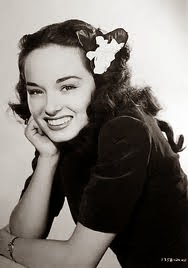
Look at the photo above, which is striking for its sweetness of attitude—we may notice the girl is quite pretty, but there is more to read in the glance she gives the camera.  A slight lowered tilt of the head, a calm, level gaze that invites as much as it withholds from the viewer.  She's studying us as much as we are studying her.  An actor’s audition headshot, or a publicity photo from her Broadway turn in Watch onthe Rhine?  I don’t know.  But you can see the girl in this photo, young Ann, is carefully tended. 

She was the gently-bred daughter of an Irish immigrant, a mother she adored.

For this year-long series, I’m not going to dwell on Ann Blyth’s personal life too deeply, rather touching upon her private life only as it bears upon her career.  Nor am I going to proceed in chronological order, for I want to present this series as snapshots of moments.  We’ll be leaping back and forth across the years like time travelers playing hopscotch.

But today we need to start at the beginning, if only for a foundation from which to leap first.   She was born in Mt. Kisco, New York in 1928, but never actually lived there.  Mrs. Blyth was visiting her sister at the time of Ann’s birth.  (Her name was Anne, but lost the ‘e’ on Anne when she went to Hollywood.  Ann remarked in an interview that her surname also once carried an 'e' on the end.  Perhaps for a previous generation?  Silent vowels are easily misplaced in transit if they are not firmly affixed.)  Ann grew up in a fourth-floor walkup by the river in the Lower East Side of Manhattan, a world narrowed to her mother and a sister who was some ten years her senior (her father left the family when she was still a child), and a few city blocks.  They struggled financially.  Her mother took in washing to make ends meet.  (One columnist would later write that Mrs. Blyth once worked for actor Joseph Cotten as a housekeeper.)

In an interview quoted by author Karen Burroughs Hannsberry in Femme Noir-Bad Girls of Film, Ann recalls a "rather meager" childhood:

The fact that my father left my mother with two daughters to raise is, of course, something many families and children have to face...My mother faced it, as indeed anyone who knew her and loved her felt she would.  And she always saw to it that my sister and I had enough to eat, and clean, pretty clothes on our backs--but I know that it wasn't easy for her.

Ann’s very early desire to sing and perform, and perhaps a precocious talent for both, led Mrs. Blyth to seek outlets for her daughter, which led to auditions and lessons, and soon, jobs.  Ann began singing and reciting on New York’s WJZ (on the NBC Blue Network) at six years old in the middle of the Depression.  She was one of the regular gang for several years on a children’s program called Coast to Coast on a Bus, where the bus "conductor" was Metropolitan Opera announcer Milton Cross...
“Coast-to Coast on a Bus—The White Rabbit Line jumps anywhere, anytime!”
It was a show to discover talented children. Future Metropolitan Opera star Risë Stevens appeared here, and other kids on the bus included Billy and Florence Halop, Billy and Bobby Mauch,Walter Tetley and Jackie Kelk.  They sang songs and hymns and recited poetry, and picked up guest “passengers” along the way.  Other shows she did were The Sunday Show, Our Barn, and Jean Hersholt's  Dr. Christian program.  (On the other network, little Beverly Sills, future opera star, was also doing a kids’ show.)  WJZ also gave us Little Orphan Annie, Amos n' Andy, and Death Valley Days. 

A teenage boy working as a pageboy in the same NBC building while little Ann was working at the microphone in one of the studios would meet her for the first time only many years later in California.  His name was James McNulty, her future husband.  Kismet, you might say.  (Yeah, we'll get to that movie down the road.)

Of these early years, Ann gives us a brief glimpse in an article syndicated in newspapers and published in a collection of stories of faith conquering adversity, edited by Dr. Norman Vincent Peale, and published as FaithMade Them Champions. (The chapter is posted at the SE Entertainment blog here.)

“Mother worked very hard and her tiny body wasn't nearly as big as her heart.”

Mrs. Blyth was Ann’s cheerful emotional rudder, her advisor, and her close companion.  It’s interesting that for someone who did not come from a show business background that Mrs. Blyth, with apparently no “stage mother” temperament, was still able to guide her daughter through a world that was strange to both of them.

From an interview with The New York Times in 1952: "Life was one big struggle then, but mother managed somehow to keep me in parochial school and later in professional school.  She provided me with singing and dramatic lessons besides."
Ann was given minor children’s roles with New York’s San Carlo Opera Company, in Carmen, Pagliacci, and LaBoheme, where she was introduced to the colorful and irresistibly larger than life storytelling world of opera.  She became a lifelong fan.  The opera company performed during these years at the Gallo Opera House on West 54th Street, and Ann’s world stretched a little wider, all the way uptown.  (The opera house later became the site of the disco era’s Studio 54 nightclub.)

She had some small parts in minor plays, along with her radio work, and actor, later agent, Richard Clayton, who knew Ann as far back as their New York casting days and appeared on different radio shows with her, recalled for interviewer Sue Chambers in 1954 how the stage mothers of other kids at auditions would look pityingly at Ann, “the quiet, skinny little girl effacing herself in the corner.  But when the time came to read for the part, the other kids didn’t have a chance.”

But there were other jobs she did not get, and the Depression rolled on while she attended parochial school, later dramatic and singing lessons at the Professional Children’s School (then at Broadway and 61st Street), and stood before the mic in the radio station.  

“When I tried for something better and failed, she would smile her wonderful warm smile, put a pert new feather in my hat, and together we'd go to St. Boniface's to pray.

‘Just have faith, my darling,’ she'd say cheerfully as we walked home in the fading light. ‘Something better will come.’  And it did.  It came so fast it was like riding a giant roller coaster clear to the top.  We two looked out over the whole world.”

Ann was called to the principal’s office at school.  Usually a heart-stopping moment for any kid.  Her fate was behind the door, literally.

Herman Shumlin and Lillian Hellman were there, asking if she would read for a part in Miss Hellman’s new play Watch on the Rhine.  Ann Blyth was 12 years old.


Watch on the Rhine Playbill, September 1941, author's collection.

She did not know anything about the famous producer-director or the famous playwright, but she passed the auditions and spent the next year at the Martin Beck Theatre on West 45th Street (renamed the Al Hirschfeld Theatre in 2003) as her world now included Broadway.  Any Broadway play would have been a feather in her cap and a terrific notch on her résumé, but Watch on the Rhine was a major theatre event and its illustrating the danger of foreign fascism on American soil in the home of one sheltered family made it one of the most meaningful productions of the era.  Brooks Atkinson’s review in The New York Times lauded the power of that play to glaringly reflect the current political climate which inspired it.

“Lillian Hellman has brought the awful truth close to home…Curious how much better she has done it than anybody else by forgetting the headlines and by avoiding the obvious approaches to the great news subject of today.”

Watch on the Rhine Playbill, September 1941, author's collection.

Cast members included Paul Lukas, Mady Christians, Lucile Watson, and George Coulouris.  (Lukas, Watson, and Coulouris would, of course, reprise their roles in the 1943 film.)  It was a monumental play, and if Ann, who turned 13 during its Broadway run, was not mature enough to fully appreciate the political message, she must certainly have been impressed by the prestige the production garnered.  Especially when she, along with other cast members, was invited to the White House to meet President Franklin Delano Roosevelt. 

She could also appreciate that, as author Hannsberry quotes, "It meant that for the first time in years, my mother wouldn't have to work so hard."
Postcard advertising the play, author collection.  Ann Blyth is in the top right photo.

Here are some photos of the production as published by Life magazine in April 1941.

Watch on the Rhine Playbill, September 1941, author's collection.


Watch on the Rhine Playbill, September 1941, author's collection.

The show closed in February 1942; afterward it toured for nine months across the country, and Ann joined the touring company.  It was during this period they gave a command performance for the President and had dinner at the White House.  She recalled for The New York Times in 1952, "I was so excited that I still can't tell anyone anything coherent about it.  I still have a souvenir, though, which the President gave me--a beautiful green match box which has a ship embossed upon it with FDR worked onto the boat."

At the age of 14, her world grew wider still with every train stop in towns and cities across the continent.  Finally, they played the Biltmore Theater in Los Angeles, where Henry Koster, a director for Universal, saw her and she was given a screen test.  By the time she performed with the touring company in San Francisco, Ann was signed to the Universal studio.

Gossip columnist Hedda Hopper spread the word in February 1943: "Henry Koster has little Ann Blyth...who was so good in Watch on the Rhine...when talking to her, he discovered she could also sing."

Her first four films, all released in 1944, were a series of small roles in B-musicals (which we’ll discuss in later posts), and then the big break when she was allowed to test for Mildred Pierce at the Warner Bros. studio.  (We’ll cover her role in that film, also, in a later post.) 

It was five days after wrapping this major film that Ann Blyth experienced an horrific event, and would spend her remaining teen years in a most heartbreaking series of personal challenges.

Her mother took Ann and some friends up to the Lake Arrowhead area in the San Bernardino Mountains to have a few days’ holiday in the snow in April 1945.  Ann was injured in a toboggan accident.  From her article on the incident in Faith Made Them Champions:

“One minute we were sailing down the hard-packed icy hillside like snow birds, then there was a crash and I fell on my back with a sickening thud.”

She was 16 years old.  She had fractured her spine.

“I didn't cry out.  The feeling was too big for that.  Involuntarily, from long habit, my spirit reached out for faith and halting prayers rose to my lips.” 

First newspaper reports called it a “near-fatal accident.” 

“At the hospital, the doctors were grave; my back was broken.”

She was told she might not walk again.

“At first, I couldn't look at my mother.  When at last I raised my head, I was startled.  Those warm, hazel eyes under her crown of auburn hair were actually smiling.

‘Have faith, my darling,’ she said.  ‘You'll walk.’”

Ann spent several months flat on her back in a body cast.

“I concentrated on high school work, determined to graduate with my studio class.  But still there were those long periods of just lying down.  The busy, exciting world I had known faded away and my life slowed down to little things.”

It may be at this period that Ann learned her later-to-be-celebrated patient demeanor.  From a 1953 Miami News article she was: “…long noted as the most serene actress in town…”

“A visit with her is like taking a tranquilizer pill,” according to a producer interviewed for an article syndicated in the Miami News in 1957.

“Miss Blyth is a singularly soothing young lady to have around,” noted an article in The New York Times from 1952, that called her “serene and almost childlike.”

And something else, a faith in which she’d been trained since childhood began to evolve into a source of strength that would take her into adulthood.

“I found myself blessed, for a new sense of prayer began to unfold to me.  Now there were not the busy times of telling Him what I needed, but rather, times of listening communion, of gathering strength, when my human strength and courage seemed to ebb away.”

After seven months, she was freed from the body cast, put into a steel back brace from her neck to her lower back, and allowed to take a few steps.  She spent several months in and out of her wheelchair, in therapy (which included swimming in Joan Crawford’s pool) and finally did graduate with her studio school class in her wheelchair. 

Years later, her teacher at the Universal schoolhouse, Mrs. Gladys Hoene (pronounced "Haney"), was interviewed on what it was like to teach at the studio school by the syndicated columnist Bob Thomas, who noted that so many child stars had unhappy adult lives.  Mrs. Hoene agreed, having seen first-hand the pressures faced by child stars and the peculiar circumstance of playing roles “that are far apart from reality.  You can’t expect them to have a down-to-earth attitude toward life.”
Publicity still from Universal Studios in front of schoolhouse. 
I believe Ann is 2nd from right, with Sabu just to the right.  Can you name the others?

Mrs. Hoene was prompted to “tell tales out of school,” as it were, on her former students.  She recalled that, “When Ann and Donald O’Connor were put together, they could cut up,” but she put Ann, who was reportedly one of her favorite students, in a different category than the other kids who might grow to unhappy adults.

“I think the exception is Ann Blyth…I would stake everything I had on her chances of success.”

She was not speaking of career success.  Nor did Ann, apparently, regard career success as her only yardstick on happiness, though she certainly remained very keenly ambitious and loved to work.

“Now, at last, my life was again the same.  Only, not quite the same.  I found within me an immense gratitude for simple things.  An acute appreciation of all I might have lost, all the things I had accepted unconsciously before.”

There was a bright, shining moment during her convalescence when she was nominated for an Academy Award for Best Supporting Actress for MildredPierce (a heck of a get well card), and she attended the Oscars ceremony with her mother, a sublime evening of personal triumph they both shared.  The studio arranged for a special gown to be made for her which would hide her back brace.  The gown was pink, made of pre-war bengaline silk.

 Ann & Mrs.Blyth at Grauman's Chinese Theater, March 1946,
from a newsreel of the 1945 Oscars
What anguish Mrs. Blyth endured over Ann’s injury and long recovery anyone can only imagine, but the dark days were left behind by the renewed prospect of Ann’s return to good health and a bright future as a Hollywood actress. 

In April 1946, gossip columnist Louella Parsons remarked, "Ann is extremely ambitious.  Her career comes first in her life, and I think you'll see that she'll go far...I couldn't look at the sweet young face of Ann Blyth without feeling that she was something very special, and is not the ordinary girl.  She's well bred, quiet...."

This happy, hopeful time was cruelly brief, and in turn, eclipsed by another, greater tragedy.

Four months after the Oscars, over a month after Ann was finally allowed to remove the back brace for good, only a few weeks after her returning to work on a new movie, Mrs. Blyth died of cancer in July 1946. 

Ann was 17 years old, less than a month shy of her 18th birthday. 

Despite sympathy from those around us, grief is inevitably an agony faced alone, even for the very young.  The very depth of our mourning isolates us.  Fortunately, her mother’s sister and brother-in-law around this time gave up their home in Connecticut and moved out to California to help during the family crisis, and stayed.  As guardians and parent-figures her aunt and uncle thereafter had a huge supportive part in her life.  Ann dealt—forever after would deal—with the loss of her mother through the prism of her religious faith.

“There was an aching emptiness.  Until it came to me, almost in a revelation, that she had not left me.  She had prepared me for her going as she had prepared me for everything else I'd met in life.

Reaching out again for my faith came the assurance that she would be by my side in every good, beautiful, and true experience, wherever I might go; a part of every decision, every success and every happiness –for they all stemmed from her inspired teaching.  They would become the flowers of the mustard seed of faith she had placed in my heart.”

Now we jump ahead several decades.  Have a look below at the video taken at the Castro Theatre in San Francisco July 6, 2006 for a special screening of Mildred Pierce.  Miss Blyth is interviewed on stage by Eddie Muller.  She is 77 here, elegant, classy, gentle, stunningly beautiful, and delightfully funny.  She’s slaying her audience.  Note how effortlessly she launches into imitations of co-star Butterfly McQueen and director Michael Curtiz.  She's good with accents; we can imagine the first accent she ever learned to mimic as a child may have been her mother’s Irish brogue.  Her mother was Nan Lynch of Dublin.  (‘Tis a grand name, to be sure, but I’m sorry to say I have no reason to believe we are related.)

Note how, at the very end of the video, she is prompted to sing a line from Kismet’s “Baubles, Bangles and Beads” – the strength and loveliness of her voice, the almost startling power of it.  We have to marvel at the still prodigious talent of a lady who, we sense, as Emerson said, became the person she decided to be.


Consider as well that, unlike everyone else in that theater, Ann Blyth has just watched the screening of Mildred Pierce not as a favorite classic noir, but something more akin to a home movie of herself as a teenager only weeks before her life so shockingly changed.  The other actors on screen were all friends and colleagues—and all of them, down to little Jo Ann Marlowe who played her younger sister Kay, are all gone.  They are ghosts on the giant screen.  A thousand people in the theater have watched the intimacy of her, a solitary survivor, watching her own past.

The whole interview is not recorded on this video, but you can read a bit more of the conversation in a transcript of the interview at Michael Guillen’s blog The Evening Class.  Part 1 is here, and part 2 is here.

Come back next Thursday, and we’ll talk about Ann Blyth’s underwater adventure, which included a four-foot long fish tail with lead weights in it to make her sink, in Mr. Peabody and the Mermaid (1948).

 ________________________________________


Dunning, John. On the Air: The Encyclopedia of Old-Time Radio (NY: Oxford University Press, 1998), p. 162.
The Evening Class blog, July 28, 2007

The Film Daily, July 24, 1946, p. 2.

Hannsberry, Karen Burroughs.  Femme Noir - Bad Girls of Film (Jefferson, NC: McFarland & Co. Inc.) pp. 32-33.

Ladies Home Journal, article by Cynthia McAdoo Wheatland & Eileen Sharpe, "Young Hollywood at Home", February 1957, p. 104.
Life Magazine, April 14, 1941, pp. 81-84.

Los Angeles Times, July 23, 1946, p. A8; also August 12, 2013, article by Susan King.

Miami News June 26, 1953, p. 6A; November 23 1957, p. 10B
The Milwaukee Journal, syndicated article by Sue Chambers, May 1, 1954, p. 3

Muller, Eddie.  Interview on stage with Ann Blyth, Castro Theatre, San Francisco, July 6, 2006.
The New York Times, article by William Brownell, October 12, 1952, p. X5.

Peale, Dr. Norman Vincent, ed. Faith Made Them Champions (Guidepost Associates, Inc., 1954).

The Radio Annual, 1944, p. 732.

SE Entertainment blog, August 5, 2012.

Spokane Daily Chronicle, syndicated article by Dorothy Roe, July 29, 1955, p. 11.

St. Petersburg Times, syndicated article by Hedda Hopper, February 18, 1943; syndicated article by Louella Parsons April 21, 1946, p. 39.
The Tuscaloosa News, syndicated article by Bob Thomas, May 11, 1955, p 5.

Universal Studios Entertainment Tumblr site.

The Vancouver Sun, article by Clyde Gilmour, June 28, 1952, p. 45


UPDATE:  This series on Ann Blyth is now a book - ANN BLYTH: ACTRESS. SINGER. STAR. -

*********************
The audio book for Ann Blyth: Actress. Singer. Star. is now for sale on Audible.com, and on Amazon and iTunes.

Also in paperback and eBook from Amazon, CreateSpace, and my Etsy shop: LynchTwinsPublishing.


 "Lynch’s book is organized and well-written – and has plenty of amusing observations – but when it comes to describing Blyth’s movies, Lynch’s writing sparkles." - Ruth Kerr, Silver Screenings

"Jacqueline T. Lynch creates a poignant and thoroughly-researched mosaic of memories of a fine, upstanding human being who also happens to be a legendary entertainer." - Deborah Thomas, Java's Journey

"One of the great strengths of Ann Blyth: Actress. Singer. Star. is that Lynch not only gives an excellent overview of Blyth's career -- she offers detailed analyses of each of Blyth's roles -- but she puts them in the context of the larger issues of the day."- Amanda Garrett, Old Hollywood Films

"Jacqueline's book will hopefully cause many more people to take a look at this multitalented woman whose career encompassed just about every possible aspect of 20th Century entertainment." - Laura Grieve, Laura's Miscellaneous Musings''

"Jacqueline T. Lynch’s Ann Blyth: Actress. Singer. Star. is an extremely well researched undertaking that is a must for all Blyth fans." - Annette Bochenek, Hometowns to Hollywood


Ann Blyth: Actress. Singer. Star. 
by Jacqueline T. Lynch

The first book on the career of actress Ann Blyth. Multitalented and remarkably versatile, Blyth began on radio as a child, appeared on Broadway at the age of twelve in Lillian Hellman's Watch on the Rhine, and enjoyed a long and diverse career in films, theatre, television, and concerts. A sensitive dramatic actress, the youngest at the time to be nominated for her role in Mildred Pierce (1945), she also displayed a gift for comedy, and was especially endeared to fans for her expressive and exquisite lyric soprano, which was showcased in many film and stage musicals. Still a popular guest at film festivals, lovely Ms. Blyth remains a treasure of the Hollywood's golden age.


Related Products