IMPRISON TRAITOR, PEDOPHILE, AND CONVICTED FELON TRUMP.
Showing posts with label Don Ameche. Show all posts

Thursday, February 23, 2017

Happy Land - 1943

Happy Land (1943) is a gentle, yet powerful film of common decency, and the discipline and quiet courage that common decency sometimes requires.  We used to attribute these as American values.  The movie is sentimental about this, and yet bravely forward-thinking for all its nostalgia: there is an underlying current of foreboding almost as if they knew how delicate decency is, and that is must be nurtured.


The title of the movie, as related by the strains of the theme song, comes from the lines in “Hail Columbia,” composed for George Washington’s inauguration, that was often used as a national anthem up until the time “The Star Spangled Banner” was officially made the National Anthem in 1931.  With all due respect to our anthem, I have a preference for “Hail Columbia”.  It is stirring, and sweet, and nobly idealistic, and perhaps a little naïve. “Hail Columbia, happy land!”  Listen to song here on YouTube. 

Don Ameche stars as a man from a Middle West small town at the height of World War II.  He is a pharmacist and owns the town’s drugstore on Main Street, and much of what we see will remind us of a Norman Rockwell painting.  He is married to Frances Dee, lives in a cozy white wood frame house, and his only son is away in the Navy.  He knows all his customers personally.  It is a good life.

At the very beginning of the movie, we see a telegram delivery girl ride her bicycle up to the front steps of Don Ameche’s house.  Perhaps no image ever instilled more fear in the United States during World War II than the telegram delivery person.  Here it is a mere girl.  Her name is Hilda, and Don Ameche, of course, knows her.

Pleasantries are quickly dispensed with.  She hands him the telegram without looking at him.  He stands silently, and the close-up lingers on his expressionless face, on which we see only a flicker of realization that his son has been killed.

The movie is filled with moments like this, strong, gutsy, brave moments that are no less courageous from the actors and the director, Irving Pichel, because they are placed in a comfortable and nostalgic setting.  Sometimes the movie may well remind us of what The Best Years of Our Lives (1946) would have been had it been filmed three years earlier; and it is perhaps no coincidence that the material is from a novel by MacKinlay Kantor, just as Best Years was.

We shift quickly to the town’s newspaper office where the editor composes a hasty eulogy for Ameche’s son in his daily editorial.  There is slight leap forward in time—Ameche takes a leave of absence from his drugstore and his employees are left to run the shop: good old Mary Wickes among them.  The minister calls on Mr. Ameche to lend comfort with the true words, “Suffering and pain are part of life too.  We must accept them.”

But Ameche’s loss of his son Rusty is compounded by his sense of injustice that Rusty “never had a chance at life.  He never went anywhere.  Just a youngster living at home, going to school, working for his dad…It isn’t right.  It isn’t fair.”
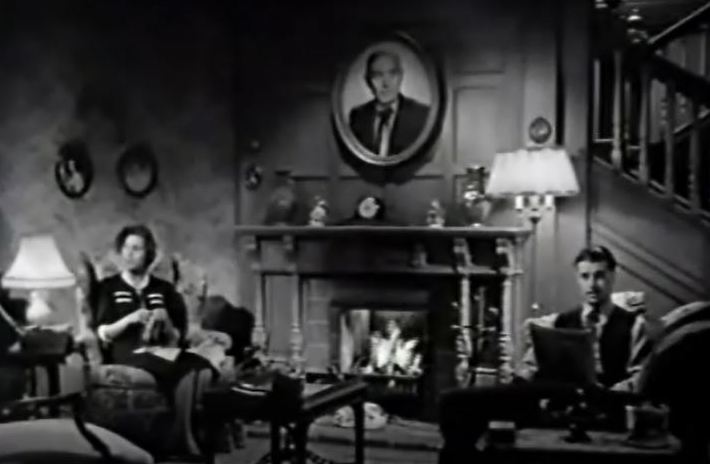
Ameche’s next visitor will have a stronger impact: Harry Carey, who plays his deceased grandfather.  We may compare this scenario with It’s a Wonderful Life (1946), but Harry Carey is no bumbling angel.  He speaks frankly with a kind of homespun horse sense we might expect from Will Rogers or Mark Twain, and though he has been dead twenty-one years, he is still very much alive to Don Ameche.  We know this because of Carey’s prominent portrait in Ameche’s home and at the drugstore.  Grandfather Carey’s influence is strong.  So it is with certain people in our lives, who seem to walk with us now and again even though they’re gone.

Ameche goes for walk into town, and Mr. Carey goes with him, and soon they travel not just through town, but through time.  We are brought to the end of World War I, when Harry Carey and the rest of the town welcomed home a parade of doughboys, including a younger Don Ameche.  (It is really something to consider that Ameche was still playing romantic leads at this point in his career, but in this movie he plays a character who ages, whose main purpose in the film is to be a father.  This would, as it does for aging actresses, signal a turning point, perhaps even a demise of his film career, but this movie is a gem and I hope he didn’t regret it.)  Grandpa Carey ran the drugstore then, and Don becomes a pharmacist as well.  We are then given a tour through Ameche’s adult life, of which his marriage to Frances Dee, and his son Rusty, is the biggest part.

Grandpa Carey died shortly after Rusty was born, and we jump to a Memorial Day of placing flags on Civil War vet Grandpa’s grave when Rusty is about six.  He is impressed, and knows that soldiers get flags.  He says that someday he wants one.  It is a moment of foreshadowing of doom, but Frances Dee confidently notes, “There aren’t going to be anymore wars.”  That, after all, was the slogan of World War I, when it was just still called The World War.

Grandpa Carey’s ghost remarks to Don Ameche, “She was right.  That’s the way to bring up American kids, not to be thinking always of conquests and battles, but to learn to enjoy the homely, simple things that are here all around them.”  It is a mighty thought, that to be peace-loving and grateful should be patriotic, for if we do not appreciate what patriots have won for us in war, we do not deserve the peace.  Then the strain of “Hail Columbia” repeats in chorus during this exchange.  The tune becomes our conscience.

We see Rusty playing with his friends at being Indians in a cornfield, and being dragged home by Mom to take his nap.  He balks at being called and answers, “Me no Rusty, Woman!”

Rusty gets spanked by Pop for refusing to go to kindergarten, but goes and makes pals there of two brothers who live on the other side of the tracks.  He brings them to the drugstore to meet Pop, and Ameche gives them free ice cream and orders some groceries for their family.  Their dad is out of work.  Ameche tells Rusty, “When you come across a fellow that hasn’t got anything and you’ve got things, why, you just give him some of your things.  Some folks call that charity.  I don’t like that word.  All it is, is being friendly.”

Rusty grows older, joins the Boy Scouts, and saves for a hatchet to take on a camping trip with the Scouts.  He’s almost got enough, but when he’s left in charge of the store and an old man comes in for medicine and can’t pay for it, Rusty buys it for him with his own money. Ameche witnesses the scene.  The expression of pride on his handsome face is exquisite.

He buys the hatchet for his son, and we see Rusty with other Scouts singing “MyDarling Clementine” to a harmonica accompaniment.  We are back to homespun pleasures, and a montage of scenes as Rusty plays football and runs track in high school.  He was not always the star, but tried his best, and his father notes with equal pride, “He was a good loser.” This is a virtue as important as being a good winner.

Rusty dates, and his eventual best girl, Ann Rutherford, shares with him an unusual but pleasingly respectful relationship, an old-fashioned courtliness borne of modern wariness.  She does not gush over him, and withholds her kisses from him because she has seen him lose his head over flashier girls and she will not lower herself to compete.  He must win her, and with gallant gentlemanliness, he acquiesces to kisses only on the forehead until the moment when the time for passion is right.

Rusty, played by Richard Crane as an adult, is touchingly mature.  He and his friends have fun at a late summer backyard party, but listen to Hitler’s invasion of Poland on the radio and soberly understand, wise beyond their years, that their future has just been altered.  As President Franklin D. Roosevelt had said only three years earlier in 1936: “There is a mysterious cycle in human events.  To some generations much is given.  Of other generations much is expected.  This generation of Americans has a rendezvous with destiny.”

Back at the drugstore, Old Ben, who works in town as a night watchman, played with eloquent, natural grace by Leigh Whipper, veteran of Broadway and the first African American to receive membership in the Actors Equity Association, remarks of the latest news on the radio about the threat of fascism, “It’s the same old thing, weasel talk.  The same old bunch of gangsters and killers out to make slave of the rest of Europe.”  Mr. Whipper’s too disgusted to be scared.  He sets a fine example in righteousness for the Rusty and his pals planning on joining the service, some fighting in these pre-Pearl Harbor days for Canada.

Along with Leigh Whipper, we must note how well chosen the cast is, from Richard Crane, who despite the enthusiasm of a boy coming of age really plays his role in a careful, understated manner which makes his character very likeable that makes us, like his father, seem to take pride in him.

His best friend is played by Dickie Moore, and Ann Rutherford’s character is played as a child by Darla Hood.  Also for the trivia buffs, this was five-year-old Natalie Wood’s first movie.  She has a brief walk-on as a child who drops an ice cream cone.  It also warms the heart see Adeline De Walt Reynolds in a brief role as a patron of the drugstore who trades homemade loganberry wine for a “snake oil” tonic. (We discussed her career in this previous post.)  The wine is reprised in several scenes as Rusty shares his first drink with Dad, and other momentous occasions.

Rusty decides, rather than enlist in a knee-jerk reaction to the world news, that he will go to pharmacy school.  After the war, he wants to join his father in business, and he feels that if he has his pharmacist’s license, he will be of more use to the service with this skill.  Don Ameche is once again beaming with pride, and invites his son for a toast of loganberry wine.

Rusty’s a strapping sailor in his Navy uniform.  But the world comes crashing down on us when we see his smiling face in the bus window pulling out of town and Ameche says in his soft, low voice, “That was the last time I saw him.”

Grandpa Carey is at his side again; we’re back in the present.  Carey says, “It was all worthwhile, the whole thing.”

We know what he means, that just because Rusty’s life was short doesn’t mean it didn’t have value, and that he didn’t pack a lot into it.  Ameche understand, too, but responds, “Rusty led a good life.  You’re right about that.  I know all the other things you’re hoping I’ll say, but I can’t.  He was my boy.  And now he’s dead.  I miss him.  I can’t help it.  I’ll always miss him.  I’ll always wish he was back, as long as I live.”

This exchange, during the height of World War II, was a very frank thing to say, and brave in its open-faced acknowledgement of grief.  We are most respectful to the grieving not when we try to cheer them up, but when we acknowledge their grief.  There is no cheerleading here, but the end of the movie gives us and Ameche a startling task.  It dares us to continue our lives and force ourselves to find a purpose.

The gentle but no less firm admonition for Ameche comes in the form of Henry Morgan.  He’s a young sailor, a shipmate of Rusty’s.  He shows up to the drugstore on furlough, and in an exchange of very few words, almost as if they are reading each other’s minds, Ameche invites Henry, who has no family of his own, to stay at his house.  Frances Dee, also awed by an unspoken epiphany, kisses Henry upon meeting him as if he was her son, and they, without talking about it, suggest he take Rusty’s room.  We know their bond is sealed when Ameche takes out the loganberry wine.

The strains of “Hail Columbia” rise again with lyrics, “peace and safety we shall find.”

But we shall only find it together.


Special thanks to fellow blogger Moira Finnie (see her blog The Skeins) for introducing me to this movie.  You can watch it here on YouTube.

*********************
The audio book for Ann Blyth: Actress. Singer. Star. is now for sale on Audible.com, and on Amazon and iTunes.


Also in paperback and eBook from Amazon.

Thursday, October 16, 2014

"The Death Challenge" - Quincy, M.E. - 1979


“The Death Challenge” brings together Ann Blyth and Don Ameche as a show-biz couple on whom the glare of the spotlight is focused after a long period of being ignored—but they also attract the attention of the police and our intrepid medical examiner, Quincy, played by Jack Klugman, when a stunt goes terribly wrong.

It’s the first of two episodes of the TV program Quincy, M.E. on which Ann Blyth appeared.  We’ll discuss the second one next week.  One of the sublime joys of episodic television in the 1970s and 1980s, for lovers of classic films at least, is that a huge roster of players from Hollywood’s heyday took their final curtain calls as guests on these shows.  

 “The Death Challenge,” from season 4 of the series, was broadcast March 24, 1979.  In the seventies, Ann played only one other role on television, a guest appearance on another detective show, Switch, starring Robert Wagner and Eddie Albert as an ex-conman and an ex-cop, respectively, joining forces.  Sharon Gless, who later starred in her own cop series Cagney and Lacey, played their girl Friday.  The episode was called “Mistresses, Murderers, and Millions,” broadcast December 23, 1975.  I haven’t seen this episode yet, but I hope to in the months ahead, and if so, I’ll include a more detailed discussion of Ann’s role on this show in the book next year.

Both Switch and Quincy, M.E. were Universal television productions, filmed on the Universal lot.  It gave Ann a chance to return to her old studio.  A 1976 interview shares her perspective on returning after first entering those gates in 1943:

“It was a beautiful place then, full of lawns, trees, and cottages.  I thought of it as sort of a college campus.  Now it’s huge, busy, and full of modern buildings.  They bulldozed the old schoolhouse eight or nine years ago.”
Ann isn’t sentimental about the studio.  She’s a clear-eyed pragmatist.

Ann had spent the better part of the 1970s on stage in musical theatre, as we discussed in this previous post, but when a reporter asked her if she would like to do another musical film, she responded, “I would rather have a good dramatic role instead.”  At the time of this 1976 interview, she had hoped to star in a “Movie of the Week” for TV, “although admitting it has been difficult to come up with a good story.”

The “Movie of the Week” never happened, but the decade ended with a gig on Quincy, M.E., where she was reunited with star Jack Klugman, who had earlier guest appeared with her on the TV show Name of the Game in 1969, which we discussed in this previous post.


Ann Blyth, throughout her film career, was starred with some of the greats of Hollywood’s leading men, including Charles Boyer, Frederic March, Paul Newman, Gregory Peck, Robert Mitchum, Bing Crosby, Robert Taylor, William Powell…and we can see by the list that most of the leading men were much older than she.  “The Death Challenge” gives her one more opportunity to star with a handsome, and older, leading man, Don Ameche.

Mr. Ameche is in fine form here, trim and fit at 70 years old to Ann’s 50 years old in this pairing.  They are a longtime couple devoted to each other.  He is a former magician, and one of the delights of this show brings us to some real-life Los Angeles locations—here the Magic Castle on Franklin Street, a private club and fraternal organization for magicians.  The other is the TAV Celebrity Theater on Vine Street, where the Merv Griffin Show used to be filmed.

Ameche, no longer a headliner, is reduced to being a kind of maître d' in the restaurant of The Magic Castle.  He is as dapper as ever in his evening clothes.  Ann works at the front desk, and together they manage as best they can, with their glory days behind them.

As the episode begins, Ameche appears on television introducing a new young magician—his protégé—performing the dangerous stunt known as The Death Challenge.  The protégé is tied up, locked in a chest, and submerged in a tank of water.  He is supposed to escape before he dies.

He doesn’t.  He dies.

Jack Klugman soon has a new corpse in his autopsy room and he suspects, guess what, that the drowning wasn’t accidental.  The protégé was murdered.

Our suspects include Bobbi Jordan, who is good in this episode as the not-so-bereaved widow.  She was abused by her no-good budding magician husband, and she has a new relationship with the stage manager, played by Martin Kove, who leaves his shirt unbuttoned down to his navel, just so we don’t forget it’s the 1970s and he’s macho.  The not-so-bereaved widow had assisted her husband with the stunt on stage, and later actually attempts to step into his shoes and perform the stunt herself—hoping to take some of the glory and all of the money.

Martin Kove could have bumped him off, hating him and wanting his wife.  Then, too, we have the down-and-out, but dignified couple Don Ameche and Ann Blyth.  Don, a former student of the great Houdini, taught the protégé everything he knew, but then was cut out of the act and humiliated.  Ameche, furious, threatened him.  I love Don Ameche in this role.  Listen to that wonderful speaking voice, so measured and well modulated.  I wish newscasters would speak that way instead talking too fast, too loud, and too much as they do.  They might be worth listening to if they spoke well.

Ann stays in the wings during the act, adoring her husband, concerned and yet, enigmatic.  There is an archness, a fey expression of wonder on her face, a mask of heavy makeup and insecurity behind the pose of serenity.  We are compelled to look for cracks in the brittle brave façade.

Or Rufus, the surly growling co-worker at The Magic Castle?  Or Ron Masak as the smarmy TV host who’ll do anything for ratings, whose insurance rates must be sky high with so many accidents on his show.  Dependable Mr. Masak is like the Lou Gehrig of TV, he’s been on everything.


 The horrified studio audience reaction three times during three different performances of this dangerous stunt makes me wonder if they just had the same people move to different seats, or if they bothered with costume changes?

Toward the end of the episode, our Don Ameche steps into the tank himself to prove he can still do it.  A nice scene where, in his dressing room before the act, Mr. Ameche sits before the well-lighted mirror while Ann lovingly touches up his stage makeup.  She proudly fastens his magician’s cape on him.  She is dressed in the gown she wore when they were presented to the queen on a long-ago English tour.  They have kept their figures even if their faces are lined.  They are young again even while entering their golden years, the magic of love creating a double image for us as they share the promising kiss of devotion of a bride and groom before he heads for the stage.

Jack Klugman figures out who the murderer is, of course, being very clever about math and chemicals and stuff.  I normally don’t give away the endings on mysteries, but I’m going to this time.  After the break of lines below, I’m going to talk about the ending, so if you are allergic to spoilers, run away now.
Ready?  Here we go…


************************************************************************************
***********************************************************************************
***********************************************************************************
***********************************************************************************


Okay.  If you’re still here, the guilty person is….

Ann.

I’m not going to explain the whys and wherefores, I’ll leave that to you to watch the episode, but there’s a final scene, where, confronted by Quincy and the detectives who come to arrest her husband for the crime, she breaks down and admits she did it.  She couldn’t stand seeing her adored Don Ameche treated so shabbily and just wanted to see him be the star one last time.  Tears flood her eyes in an instant, she sobs uncontrollably, and we are reminded, who may not have seen her in recent years on stage and remember only her film roles of long ago, how deep she dives in character to bring up emotions on that still lovely face, and uses her whole lithe body to purge them.

For somebody who was tagged with a good girl image that, in some respects I think hamstringed her career (despite, as we’ve discussed before, her several “bad girl” roles), one must smile at the thought that Ann, presented with this script must have relished being the murderer.  ("Hurray!  I get to bump somebody off!  Where do I sign?”)

Ameche is natural and understated, quietly commands every scene he’s in, and it’s no wonder his film career revived for a brief, if glowing, few years in the 1980s.  The younger cast members seem ersatz, unfinished and underdeveloped compared to these two finely polished actors.

Come back next Thursday when we discuss Ann Blyth’s second appearance on Quincy, M.E., from 1983, where several friends and colleagues—all played by stars from Hollywood’s heyday—are trapped in a snowbound cabin.  Also present are Quincy and his new bride.  And a murderer.

*************************
Milwaukee Journal, January 27, 2976, syndicated article by Vernon Scott, p. G1.

Springfield (Mass.) Daily News, September 1, 1976, article by Sam Hoffman, p. 25.
***************************

As  most of you probably know by now, this year's TCM Classic Cruise will set sail (proverbially) in October, and one of the celebrity guests is Ann Blyth.

Ann will be doing a couple hour-long conversation sessions, and will also be on hand for a screening of Mildred Pierce.

Have a look here for the rest of the schedule and events with the other celebrity guests. Unfortunately, the cruise is booked, so if' you're late, you can try for the waiting list.

I, sadly, am unable to attend this cruise, but if any reader is going,  I invite you (beg you) to share your experiences and/or photos relating to Miss Blyth on this blog as part of our year-long series on her career.  I'd really appreciate your perspective on the event, to be our eyes and ears.  Thanks.
****************************
 THANK YOU....to the following folks whose aid in gathering material for this series has been invaluable:  EBH; Kevin Deany of Kevin's Movie Corner; Gerry Szymski of Westmont Movie Classics, Westmont, Illinois; and Ivan G. Shreve, Jr. of Thrilling Days of Yesteryear.  And thanks to all those who signed on as backers to my recent Kickstarter campaign.  The effort failed to raise the funding needed, but I'll always remember your kind support.
***************************
TRIVIA QUESTION:  I've recently been contacted by someone who wants to know if the piano player in Dillinger (1945-see post here) is the boogie-woogie artist Albert Ammons. Please leave comment or drop me a line if you know.
****************************
UPDATE:  This series on Ann Blyth is now a book - ANN BLYTH: ACTRESS. SINGER. STAR. -

*********************
The audio book for Ann Blyth: Actress. Singer. Star. is now for sale on Audible.com, and on Amazon and iTunes.

Also in paperback and eBook from Amazon, CreateSpace, and my Etsy shop: LynchTwinsPublishing.


 "Lynch’s book is organized and well-written – and has plenty of amusing observations – but when it comes to describing Blyth’s movies, Lynch’s writing sparkles." - Ruth Kerr, Silver Screenings

"Jacqueline T. Lynch creates a poignant and thoroughly-researched mosaic of memories of a fine, upstanding human being who also happens to be a legendary entertainer." - Deborah Thomas, Java's Journey

"One of the great strengths of Ann Blyth: Actress. Singer. Star. is that Lynch not only gives an excellent overview of Blyth's career -- she offers detailed analyses of each of Blyth's roles -- but she puts them in the context of the larger issues of the day."- Amanda Garrett, Old Hollywood Films

"Jacqueline's book will hopefully cause many more people to take a look at this multitalented woman whose career encompassed just about every possible aspect of 20th Century entertainment." - Laura Grieve, Laura's Miscellaneous Musings''

"Jacqueline T. Lynch’s Ann Blyth: Actress. Singer. Star. is an extremely well researched undertaking that is a must for all Blyth fans." - Annette Bochenek, Hometowns to Hollywood


Ann Blyth: Actress. Singer. Star. 
by Jacqueline T. Lynch

The first book on the career of actress Ann Blyth. Multitalented and remarkably versatile, Blyth began on radio as a child, appeared on Broadway at the age of twelve in Lillian Hellman's Watch on the Rhine, and enjoyed a long and diverse career in films, theatre, television, and concerts. A sensitive dramatic actress, the youngest at the time to be nominated for her role in Mildred Pierce (1945), she also displayed a gift for comedy, and was especially endeared to fans for her expressive and exquisite lyric soprano, which was showcased in many film and stage musicals. Still a popular guest at film festivals, lovely Ms. Blyth remains a treasure of the Hollywood's golden age.


***************************
A new collection of essays, some old, some new, from this blog titled Movies in Our Time: Hollywood Mimics and Mirrors the 20th Century is now out in eBook, and in paperback here.


Related Products