IMPRISON TRAITOR, PEDOPHILE, AND CONVICTED FELON TRUMP.
Showing posts with label Beverly Garland. Show all posts

Friday, March 19, 2021

TV's Decoy - "Fiesta at Midnight" episode, 1958


Beverly Garland starred in a weekly police procedural drama called Decoy that ran only one season from 1957-58.  It was a ground-breaking program and far ahead of its time in many respects.  It achieved something rare during what was called the Golden Age of Television, and what is sad -- it’s even more rare today: a well-written, well-acted, sharply produced weekly show with a female protagonist that presents a refreshingly unselfconscious view of her abilities, intelligence, and emotions.


This is our entry into the “7th Annual Favourite TV Show Episode Blogathon” at Terrence Cowles Canote’s A Shroud of Thoughts blog.

It’s a rather long entry.  Sorry.  Go get a snack.

She plays a policewoman, as the term was used then, named Patricia Jones, who frequently is referred to by her nickname, “Casey” Jones.  She uses both names, seemingly without preference.  She is smart without being brilliant – she sometimes gets it wrong and learns from her mistakes.  She is courageous without being a thrill-seeker; she knows fear but also knows that’s human.  She does not forsake being human in order to be a good cop – she follows procedure with the dogmatic persistence of Sgt. Joe Friday on Dragnet and sometimes sounds like him, but she is also empathetic and seems to take quiet pleasure in observing the troubled humanity she meets on her cases.

We see little of her personal life, we do not know about her family or much about her past, only that her fiancĂ©, also a police officer, was killed in the line of duty.  She is not driven to revenge, to drink, to wallowing in angst, but she deals with the occasional stabs of pain from the memory as the price everyone pays for being alive, loving, and remembering.  She is sensitive, but also pragmatic.


We sense that the creation of Officer Jones is entirely a collaboration between director, writers, producers, and actress, and as such, she is a most polished enigma.  In an era of “Hi, honey, I’m home!” sitcoms, she does not take insecure pains to reaffirm her femininity.  On the contrary, she is unconsciously sexy, perhaps never more so when breaking into a brief Mona Lisa-smile in odd moments that remind us her mind is always working and her heart is always open.

Also unusual for the day – and for females represented on TV shows for decades after – her male colleagues do not belittle her, or makes passes, or treat her in any way other than as friendly professionals who rely on each other.  While some of her duties are quite routine, she often must go undercover, which means she is rather like an actress.  She must be a society woman one episode, and a secretary in another. 

If the show were filmed in later decades, she would spend every other episode victimized by being tied up or her vulnerability capitalized on, and the threat of rape would be implied to a degree that makes an intelligent person wonder what has happened to our society that that would be entertaining for the female to always be in danger.  Or she'd be swinging on that insane pendulum between dealing with her private demons with compensating addictions or supercharged overcompensating aggression, both to show that she is a "real" woman dealing with the pressures of her career.  This keeps the actress and the writers busy, but can ironically make for a less interesting character.  One of the most appealing aspects of Officer Jones is her stoicism.

The range of crimes Officer Jones investigates from white collar crime to arson to murder is such that not every episode is peppered with a hail of gunfire.  The show might be too slow for today, but that is one of its strengths.


From a production perspective, one of the most intriguing aspects is that the show is filmed largely on location in New York City.  We see neighborhoods, buildings from the late fifties, the street scenes, the nightlife.  The cameras were hidden, so what you’re seeing happen in the background is real.  The old Penn Station, long gone, is beautifully filmed.  There’s Coney Island, theater marquees, an array of interesting sites.  Many of the interiors are also shot on location, so when you see an office in a factory, that’s where you are.  There is no clean, fake scenery, no set flats.  We see the grime of the factory walls, the old, uneven floorboards and the overstuffed file cabinets. We see the rain-washed streets with real people pulling racks in the garment district or walking in a park.  Everything is real.


Perhaps just to punctuate that, or perhaps just to add an unusual style – Officer Jones breaks the fourth wall at the end of the episode and talks to us.  Sometimes it’s a little startling, even when you know it’s going to happen, because she does not break character.  She suddenly turns and her eyes lock onto yours and she comments about the case, as if she knows we were there every step of the way, as if we are the rookie cop she is teaching.  Sometimes it's to wrap it up, or tell us what happens next.  Sometimes it’s just a final thought.  In one episode, “Night of Fire” she discusses not the case, but ruminates on one character in that episode.  It’s the story of a suspicious factory fire, and she is placed undercover as an office worker.  Another worker in the office is a young woman with a history of being treated for mental illness.  The other workers are hostile to her, tease her, and even suspect her of being the arsonist.  However, she’s only a patsy, and Officer Jones figures out who done it.  At the end of the episode, she breaks the fourth wall and talks not about the crime, but about that young woman.

“Tomorrow she’ll be looking for a job.  I hope she finds a good one, a place where people are enlightened about things like mental illness.  If she comes to your office…give her a break.”  That brief, sad, enigmatic smile, a flicker of warmth in her lovely dark eyes, and she turns away.  She’s said her piece.  No need to beat it to death.  I wonder how many bosses and fellow employees took it to heart at work the next day.

After this rather long introduction to Beverly Garland’s character and the program, (are you still with me?) I’ll move on to the single episode I’d like to discuss for this Blogathon.  It’s “Fiesta at Midnight”, episode 32, broadcast on May 19, 1958.  The director is Michael Gordon.  We discussed his wonderful directorial work on Another Part of the Forest (1948) in this previous post.  The scene is set at Hunt’s Point Palace; again, a real venue.  There’s a dance hall up a flight of stairs, where tonight it’s a Latin combo playing for an energetic crowd of romantic young people.  We listen to the music, watch the couples dancing in the dim evening light as if it’s a documentary and they have no idea we’re observing them.  Maybe they don’t.


Hunt’s Point is in the Bronx, and the Hunt’s Point Palace around a century ago brought swing music to fans in the 1920s and ‘30s, and by the late 1940s, jazz bands gave way to Latin music as a new Puerto Rican population came to the neighborhood.  The ballroom held about 2,500 people, and top bands played here for decades.  Salsa music was coined in the 1970s, but the Palace closed in the 1980s.  The building still stands, but now it’s an office complex.

But in “Fiesta at Midnight” we’re still in 1958, the first flush of Puerto Rican immigration to New York City, only months after West Side Story hit Broadway, so Decoy was not the first pop culture exploration of the problems of Puerto Rican immigrants, but it was certainly among the vanguard. 


With moody shots up and down the staircase that leads to the music from the hall, we meet three people on the town:  Anita, played by Gloria Marlowe, and her fiancĂ© Raoul, played by Dario Barri.  They will be married in a week.  With them is Anita’s cousin, Maria, played by Miriam Colon.  Maria wants to remain at the bottom of the stairs, not going into the dance, but just listening, dreamy-eyed, where she is.  They urge her to come, but she insists she just wants to listen and to contemplate.  She is not looking for a date for the evening: she reminds them she is going to be married tomorrow.

They leave her alone and go up to the dance.  After a moment, Raoul leaves Anita, says he has to meet a man around the corner.  She warns him against getting into trouble again, but he is a charmer and tells her he will be right back. 


Seeing she is alone, a young newly arrived immigrant from Puerto Rico approaches Anita.  He is Juan, played by Tomas Milian.  He asks her to dance, but she tells him she is engaged to be married.  Juan is a quiet, shy young man and he confesses that he cannot get anyone to dance with him, that all the girls are paired off with husbands or boyfriends.  Anita, half in sympathy and half teasing, suggests he go down to the bottom of the stairs and talk with Maria, maybe she will dance with him.


He meets Maria, but she will not dance with him either.  Again, what he dreads to hear: she will be married tomorrow.  She is a lovely young woman, and he is very taken with her and they chat a moment, at least until the midnight church bells signal that, like Cinderella, she must leave the ball.  He respects that she is off limits and he leaves the dance hall without following her.


We walk through the dark street with him, past storefronts, and about to cross a dark alley when a man runs towards us out of the blackness, topples Juan, and runs away.  Followed close on his heels are the cops, who grab Juan, thinking he's the guy they are chasing.  Poor Juan gets dragged to jail for the armed robbery of a store.
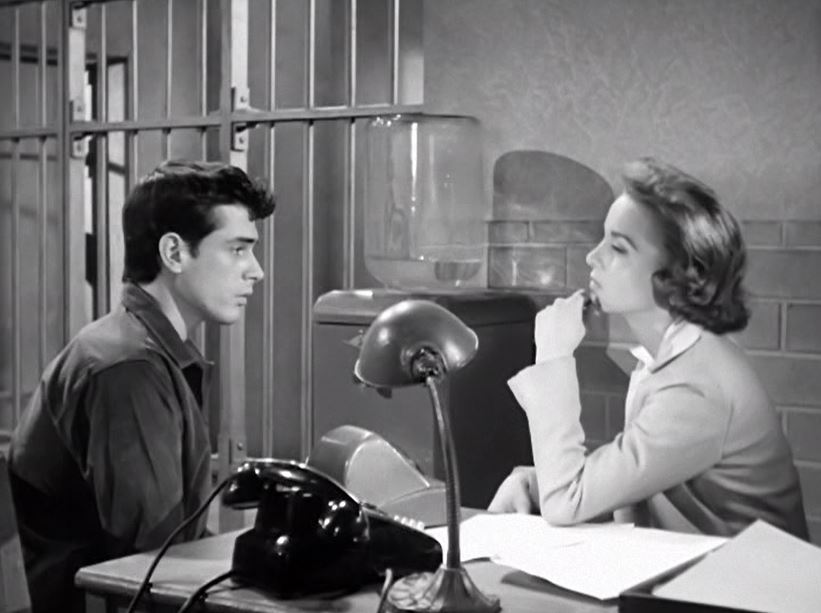

Officer Patricia Jones gets called in on the case, not undercover this time, but a routine investigation.  She visits the store owner in the hospital, a middle-aged white woman named O’Connell, played by May Michael, who was shot in the robbery.  She is conscious, and furious at the cops’ apparent slowness to understand what a menace the Puerto Ricans are.  She is asked,

“Are you sure the man who shot you was Spanish?”

“I’m sure, all right. Don’t I hear them jabbering all day long?”

Discussing the case with her chief, Officer Jones remarks, “Somebody steals an apple from a fruit cart and they’re ready to lynch anybody by the name of Jose or Pablo.”

She interrogates Juan (and even demonstrates a rudimentary knowledge of Spanish), who is scared stiff and desperate to find someone who will believe him.  She begins her drudge work of questioning leads to find out if his alibi – talking to a girl named Maria at midnight when the crime happened – is real.


She eventually finds Anita at home, a week later and now married to Raoul.  Anita is closed-mouthed and denies meeting Juan, denies even knowing Maria.  We begin to understand that she suspects Raoul, because he left her for a few minutes, to be the one who actually committed the robbery.  She is trying to protect him.  When “Casey” Jones leaves, Raoul comes back to the apartment and Anita confronts him.  “Casey” returns when it is reported by neighbors that Raoul beat her up.

Still, she attempts to protect her husband, and “Casey” gives her the sensible advice, “You’re a fool to let him get away with it, honey.  He’ll do it again sometime.  Maybe that time you won’t be able to complain.”

Then the O’Connell woman in the hospital dies.  It’s a murder rap now, for Juan unless “Casey” can prove his alibi is true.


Running down all the logical prospects and getting nowhere, she wonders if perhaps the woman called Maria – who was supposed to be married the next day after the incident – did not marry after all.  Perhaps the wedding was called off and that’s why Officer Jones can’t find any public record of it.  She goes to the neighborhood church to ask the priest if he can confirm this.  He is in the middle of a First Communion rehearsal with a group of little girls, so she has to wait for him.  She spots Anita kneeling in one of the pews, her Rosary beads in hand.  “Casey” tries again to work on her, but Anita is stubborn and won’t tell her anything.

It’s a small thing, but because we don’t know Officer Jones’ own personal religion, I find it quite touching as well as a sign of the times that she pauses before she enters the Catholic church to pull her scarf over her head.  In pre-Vatican II days, head covering for women was required, and still is the custom in some countries.


We are actually teased with religious symbols throughout the episode, but unless you’re really observant, or have seen the episode a couple times, you won’t know that director Gordon means them for clues:  the large cross Juan wears in the neck of his open shirt, the crucifix on the wall of Anita’s apartment framed behind Officer Jones’ head.  It’s all pointing to a solution that only hits “Casey” when she’s given up on Anita, and, about to leave the church, smiles at the passing procession of girls walking down the aisle to the altar to practice receiving their First Communion.


Then it hits her – but not us yet.  Next, she drags Anita, Raoul, and Juan to another place where she has located Maria.  We are in a hallway, which has a figurine of the Virgin Mary on a heavy piece of furniture – another last-minute clue.

Then the door opens and Maria enters. 

She’s a nun.


When she said she would be a bride the next day, she meant she was joining a holy order and become the “bride of Christ.”  Juan is shocked, but Anita and Raoul are only uncomfortable because now that Maria has been found, she will undoubtedly tell the truth, if she remembers talking to Juan at midnight.

She does, and recognizes him.  Raoul is off to prison. Juan’s free, if still pained by his crush on Maria.  Anita is just plain crushed, and Sr. Maria is wondering what’s going on.

Officer Jones realized that Maria could be a nun when she saw the little girls in their white dresses walking down the aisle towards the altar, looking like a row of little brides.  She figured out Maria’s use of the phrase “tomorrow I will be a bride” as if it were a riddle. 

It’s a shame Decoy lasted only one season.  Several future stars appeared on the program, such as Colleen Dewhurst, Peter Falk, Martin Balsam, and Suzanne Pleshette.  Many of the episodes are in public domain and have been released on DVD, but the three-disc set released by Film Chest MediaGroup is excellent and contains a booklet with facts about the show and a synopsis of episodes.

One interesting fact the booklet relates: Between 1949 and 1990 there were around 555 dramatic television series.  Only about 36 starred women.

I hope you can catch up with the series Decoy sometime, and please visit the rest of the blogs participating in this “7thAnnual Favourite TV Show Episode Blogathon” at Terrence Cowles Canote’s A Shroud of Thoughts blog.

----------

Jacqueline T. Lynch is the author of Ann Blyth: Actress. Singer. Star. and Memories in Our Time - Hollywood Mirrors and Mimics the Twentieth Century. Her newspaper column on classic films, Silver Screen, Golden Memories is syndicated nationally.  Her new book, a collection of posts from this blog - Hollywood Fights Fascism - is available here on Amazon.

Thursday, November 15, 2018

The Desperate Hours - 1955


The Desperate Hours (1955) brought the escaped convict genre to suburbia. That’s where everyone else was headed in the 1950s, and the house in the neighborhood is as much a character in this film as the three outlaws and the family they terrorize.

This is our entry into the Outlaws blogathon hosted by the Classic Movie Blog Association. Please check out this link to read some other great blogs on this sinister subject.

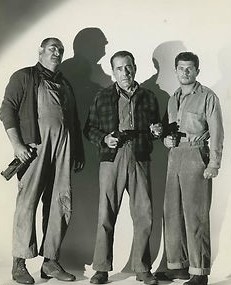
In The Desperate Hours, Humphrey Bogart plays the lead bad guy in his second-to-last film and the very last bad guy role he was to play in movies. He shows he’s still got it.

Dewey Martin plays his younger brother who has broken out of prison with him. The third member of their gang is played by Robert Middleton, who is arguably the most frightening member of the trio.

The movie begins with an audience perspective shot as we move down a suburban subdivision. There are lawns and trees, children, a dog or two, people walking on sidewalks. It is deceptively peaceful. The camera moves very quickly to one particular home on the block. If the house looks familiar to you from the outside that’s because two years later, Beaver Cleaver lived here. The television sitcom Leave It to Beaver (1957-1963) used this exterior for the Cleaver home.

Fredric March is the head of the clan, doting father and husband and executive, who works “downtown,” a place which with the settlement of suburbia has become more distant and vaguer to us.

Martha Scott is his wife; Mary Murphy is his grown daughter; and the wonderful Richard Eyer, who as we’ve seen was such a standout in films here like Friendly Persuasion (1956) and here in Slander (1957), plays his young son.

Though we see the family gathered together for a cheerful, if rushed, breakfast, it is not all idyllic on the home front. Fredric March does not approve of his daughter’s latest boyfriend, a hotshot young lawyer played by Gig Young. She is rebellious and they argue in the car when he drives her to work “downtown.”

Young Richard no longer wants to kiss his father goodbye when he leaves for school; he’s too man for that now and he does want to does not want to be known by a nickname anymore. He’s an All-American boy, pretty much goes his own way and his sudden streak of independence, while cute in this scene, is going to prove to be a greater problem later on when he tries to rebel against their captors.


The story was written by Joseph Hayes from his novel and his original script which was performed on Broadway at the Ethel Barrymore Theatre from February to August 1955, the film’s release year. For some years thereafter, it was a popular summer theatre play and the two-level set which was required to tell the story of showing the family in different rooms with the bad guys was always a challenge and always a hit on stage. We take things for granted like a two-story house in the movies, but on stage we appreciate more the architectural skill it takes to build and to work on a two-level open set.

The Broadway version was directed by actor and director Robert Montgomery. Karl Malden played Fredric March’s role as the suburban husband and father, and Paul Newman played the Humphrey Bogart role. We can imagine that the younger gangster in the mid-1950s might have carried a more sinister suspense story because the brothers would have been contemporaries and because they might have appeared more violent and impetuous.


Though Bogart is a generation older than his brother played by Dewey Martin, we can accept them as brothers and accept that Bogart, even though famed for playing dangerous criminals, serves a different function in the screen version. His is rather like a parallel to Fredric March, than to his partner younger brother.  Like March, he is the head of his family, or his gang, and he sometimes has trouble keeping them in line. Fredric March bristles at his daughter’s romance, believing her to still be a kid. Humphrey Bogart is stumped when later in the film his brother rebels not just against his authority but against the whole way of life in which his big brother has raised him.

Bogart and his gang have chosen this house at random, which is certainly an eerie aspect about the story, it could have been any home—maybe even yours. Bogart’s reason for choosing this house was that Richard Eyer has left his bicycle on the front lawn. Bogart knows he would be able to make the family more fearful and more easily cooperative if they have to protect children. This tells us that he has some experience and logic in his craft, and also that he would prefer not to have any trouble if he could avoid it. He intends to hole up here until he can arrange for a former girlfriend to bring them money to escape.  But he also wants to go after the deputy sheriff responsible for putting him in prison.

Arthur Kennedy plays the deputy sheriff, who is the only one among the police officials to take the news of the jailbreak seriously, feeling certain that Humphrey Bogart is coming straight for him. He is not so paranoid as he is analytical, just as logical as Bogart or Fredric March is in this scenario. There is an attempt to turn the story into more or less a triangle to include the efforts of the police to trace Bogart’s whereabouts. This is obviously not something that would have been easily done on stage where the whole story was pretty much set in the home.

Note Bogart’s disgust when he sees that March, whom he resents for his middle-class respectability, has only $800 in his bankbook.  In that era, it would have represented probably something like three or more months’ wages saved.  That may not be terrific in Bogart’s eyes—he’s after all the marbles—but today when it is estimated that only about 18 percent of Americans have three-to-five months’ savings in the bank, then this family is doing okay.

The movie also gives us a lot of familiar faces to pick out in the crowd, Ray Teal as the state police detective, Alan Reed (Fred Flintstone) is another officer, Ray Collins, Simon Oakland will also play police officials, Whit Bissell plays a pensive and intellectual FBI agent. Beverly Garland plays the teacher who drops by and in front of whom March must pretend to be bringing home drinking buddies to cover for her seeing the bad guys. Joe Flynn plays a panicky motorist taken hostage, and poor Walter Baldwin plays the junkman in the greatest danger of all of them.


Shortly after father and daughter leave for work, and Junior’s off to school, mom Martha Scott begins her housecleaning. She brings along a portable radio into every room to listen to music and, of course, to give us the opportunity to hear the news bulletins about the escaped convicts. Later on in the movie, Humphrey Bogart will smash the radio in a fit of anger.

It is interesting that even though this film was released in 1955, we see no television set in the home. It is more than likely that by the mid-1950s, a middle-class home such as this would have a television. I’m not sure why they don’t include one, either because it didn’t figure into the plot, or because the film industry was still chafing with resentment over its new competitor and didn’t want to acknowledge its existence?  Though Fredric March drives an older model car, the movie is not set in the late 1940s—Gig Young’s flashy sportscar alone tells us that.

We might think today that the TV would be a better place than the radio for news bulletins, but this was long before 24-hour news and also it was an era where news broadcasts were infrequent and brief. There were usually only one or two news programs lasting all of about 15 minutes from the 6 o’clock to the 7:30 time frame in the morning, and it was much the same in the early evening from 6 o’clock to about 7:30. We might have one or two news programs 15 minutes in duration. Television news did not really come of age until the 1960s, and much of that, sadly, was launched in the aftermath of the Kennedy assassination. Newspapers were still king of the news--even of bulletins, with the ability to produce "extras" several times a day.

Robert Middleton, the large hulking Neanderthal of the bad guys with one presumes the IQ of a child, plays with Richard Eyer’s toys in his room and break some of them in frustration when he smacks his head while looking out the window.  He fumbles with a toy bank that looks like a little safe, and he cannot open it. At one point he takes a toy gun and blasts it around the house until Humphrey Bogart tells him knock it off. In one scene—one of director William Wyler’s touches, while Bogart is terrorizing Martha Scott in the foreground, in the background we see Middleton drinking from a milk bottle and spilling it down his chest (just as the boy will do later).  These images of the buffoon are only half-comic.  They also point to Middleton’s mental instability, which is the most dangerous thing about him. These fellows had been in prison, we don’t know for how long, but it’s possible that television would have been a complete novelty to them. I imagine if Robert Middleton’s character was so enthralled by Richard Eyer’s toys, then he might have enjoyed CaptainVideo or Hopalong Cassidy.

Bogart snidely says of Middleton to Martha Scott, “Crude, ain’t he?”

Bogart is commanding in his sneering, angry role, indeed, it is a role he has played many times. There is stubble on his face and over the phone he calls his gun moll “Doll,” like a man from another era, and he is supposed to be. He has no place in modern society.


His younger brother, Dewey Martin, feels this more acutely than Bogey. He is more wide-eyed at the appearance of the house, and at the nubile young daughter. At first, when he enters the daughter’s bedroom while she is at work and sees her canopy bed, he touches the frills on the canopy and brushes his face seductively on them.  It is an image which causes us to think he will present a sexual threat to her, but when he meets the girl and examines the whole house more closely, there is an unexpected change in him.  He is strangely awed and respectful of this world and its people.

Interestingly, the scene with her canopy bed reminds me of the scene in Wyler’s other film The Best Years of Our Lives (1946) when Dana Andrews wakes after a drunken night in Teresa Wright’s canopy bed, and he amusedly blows on the canopy’s frills, surprised to find himself in such a feminine haven.

When father and daughter come home from work, and Junior comes home from school, the entire family is held hostage and they are moved from room to room at gunpoint. In some scenes, it even looks as if they are camping in their own home as they try to stay together.

Martin seems more than attracted to daughter Mary Murphy; there is a shy, almost boyish crush he exhibits for her. Bogart notices the attraction and jokes that when they leave, they will take the daughter with them as a hostage just as a present for his younger brother. It is a chilling moment.

But the brother protects the girl from Robert Middleton, who is a far greater danger not only to her but everyone in the house, even to Bogey, because he is so undisciplined and so mentally unstable.

The real terror in the film comes from the sudden destruction of the blessed normality of their everyday lives. They live in a world of 1950s conformity, and though it may get a little stale sometimes, they know they are safe there. Their safety has been shattered not necessarily by three escaped convicts, one of them with a gun, but that the normality is gone and the unknown has entered their lives.

One gun becomes two as Bogart discovers that the family keeps a pistol in the house. This evens up the score a little and makes Bogart happy because Middleton has the other one.

But there is an even greater danger to Bogart than Robert Middleton’s instability. It is his younger brother. Dewey Martin doesn’t want to take over his brother’s life of crime anymore. When Bogart tells him to stick with him, that he got them out of prison and he will take care of him, that he taught him everything he knows – a common manipulation used by the heads of families to keep the younger in line – Dewey Martin disgustedly replies, “You taught me everything, except how to live in a house like this.”

If Dewey Martin was not dissatisfied with his life in prison, he certainly is now because he sees a glaring comparison to how his life has gone. This is a nice home, with a nice family. If Mary Murphy’s beau, Gig Young, is not welcomed by her parents, then what chance would he have? Even though he respectfully calls her, “Miss,” and calls Fredric March, “Sir.”


The family has its own struggles, its own splinters and breakdowns, and coming together. Unfortunately for Fredric March, who tries to shepherd his family through this terrible experience and proves himself to be courageous and very intelligent in how he manages to outmaneuver the bad guys, his greatest handicap is also his greatest treasure – his family. Neither his daughter nor his son obey his explicit instructions and they mess things up, even his wife rebels and throws a monkey wrench into the works. At some point we have to wonder if March just wants to throw his hands up and yell, “All right then, go get yourself killed! I’m sick of talking to you people!”

But he doesn’t. At one point when he is allowed to leave the house on a mission for the bad guys, he stumbles onto the dragnet by the cops who have traced Bogart’s whereabouts, and he has to plead with them to allow him to go back in to mediate the situation because he doesn’t want them shooting up his house and killing his entire family. They reluctantly agree, but give him a gun. He empties it of all the bullets. He takes it with him. The cops think he’s nuts, but we see in the course of his last gambit that he is more clever than anybody.

It is an intricate and interesting movie and fast-paced but I won’t linger too much on the heroics of the family. This blogathon is about outlaws. In the tradition of classic films, none of these outlaws comes to a good end.

We may not mourn Robert Middleton, he’s just too scary and too bad, and has already committed one murder right before our eyes.

Dewey Martin has the greater share of our sympathy and how he meets his end is entirely accidental and tragic because he is escaping his brother and a life he does not want.

Bogart plays his cards all the way to the end, and it’s just March and Bogart at the end. March has outsmarted him because he has managed it so that Bogart holds the gun with no bullets in it.

When March has his own gun, Bogart sneers, “You ain’t got in you.”

March growls, “I’ve got it in me. You put it there.”

Then March does something so effective and perhaps even cruel, to get back at Bogart. Having heard the news about Bogart’s brother’s death – which Bogart doesn’t know – March tells him how his brother died and he sneers and shouts, “You did it! How do you like it?”

This is really the end of Humphrey Bogart. Yes, he has a few more minutes in the film, and yes, he rushes out into the police spotlights and drops down on their front lawn only a few feet from the boy’s bicycle that had brought him to the house in the first place, but it was really upon hearing of the death of his brother, the end of his family, and the collapse of his authority that kills him.


Some may say that Bogart was a little too old to play this role, especially if they had seen Paul Newman play it on Broadway, but this is a different interpretation. Movies are different from plays. We wouldn’t have had all the cops in the play, we wouldn’t have all the bicycles, the milk delivery trucks and the sound of crickets in the evening. We wouldn’t have had March’s bewildered office staff in front of whom he has to pretend, we wouldn’t have had the roadhouse where Dewey Martin tries to escape. We wouldn’t have had the town dump where Robert Middleton commits a cruel and vicious murder.

Bogart was in his element in this role because Bogart was in his own world. Hollywood at this time took its gangster movies from the faux city streets of its backlot and soundstages, to a wider and somehow more complex world on a backlot suburbia. The Cleavers would move into that house – on television of course – and the conformity of suburbia would cover over Bogart, Dewey Martin, and Robert Middleton, like a blanket of snow, masking the ugliness, but not obliterating it.

The 1950s introduced us to new bad guys – psychos, rebellious youth, juvenile delinquents. They would be more at home here in suburbia. They could not be gotten rid of so easily, like the crabgrass on the lawns of the middle-class homeowners; they were rooted and endemic.


Please visit the Outlaws blogathon hosted by the Classic Movie Blog Association for more great entries on bad guys in film.

Related Products