IMPRISON TRAITOR, PEDOPHILE, AND CONVICTED FELON TRUMP.
Showing posts with label Craig Stevens. Show all posts

Friday, March 18, 2022

Peter Gunn meets Diahann Carroll - "Sing a Song of Murder"


Peter Gunn
(1958-1961) was a unique program, one would hope to say a forerunner in its genre, except that it was not a forerunner.  There has been nothing since to compare with it, it stands alone.


This is my entry in the 8th Annual Favorite TV Show Blogathon at the A Shroud of Thoughts blog, see more bloggers here.


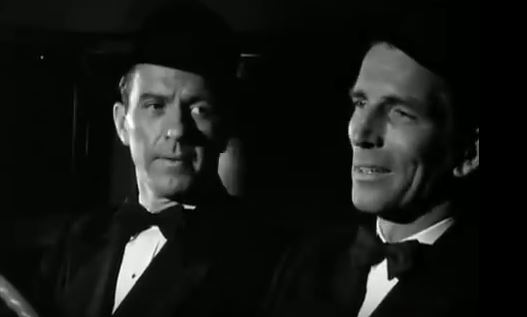
Gunn was a private eye.  Both the character and the show were vastly stylistically different from private eye programs then or since.  Played by tall, handsome Craig Stevens, Gunn was intelligent, witty, dressed with tailored, conservative, Madison Avenue-sans-a-belt chic, more Ivy-leaguer than back-alley gumshoe.  Not that Gunn didn’t find himself tailed into back alleys, and there was plenty of shooting and punching in what was generally a half-hour show filled with requisite violence in between commercials. 

But Peter Gunn was not the usual glum, hard-drinking private eye who trusted neither dames nor the police, who were usually rivals.  Gunn enjoyed a monogamous relationship with girlfriend Edie, played by Lola Albright.  She was a singer at Mother’s bar and jazz club.  Mother was played by Hope Emerson in the first season, and by Minerva Urecal the last two seasons.

Gunn didn’t have an office with his name on the door.  Mother’s was his “office” where they took phone messages for him.  Gunn was a connoisseur of “cool” jazz that was flying eastward from California in those days.  Henry Mancini wrote the Peter Gunn theme, a tune so unrelentingly cool and forever identifiable with Peter.

There was jazz in each episode, and the start of the show usually featured a short ripple of thumping bass to glide us into the action, before a burst of trumpet flashed the title of the show across the screen.

Peter was not bitter, hardened like other TV or movie PI’s, but he was serious and questioning.  But with that slight amused smirk whenever he spoke to suspects, criminals, stool pigeons or even Mother and Edie, he seemed to find life an enjoyable and entertaining puzzle that he watched like a fly on the wall.


Perhaps this studied air contributed to his appearance of aloofness, though he was also engaged with his work, his ladylove – with whom scenes of sultry passion occur at astonishing sudden moments of simple “helloes.”


Rather than an adversarial relationship with the local police, Gunn had a teasing, but ultimately mutually respectful relationship with Lt. Jacoby, played with sarcasm that was somehow self-deprecating by the wonderful Herschel Bernardi.  They jabbed each other with brotherly insults, but always came to each other’s rescue.

There were others in Gunn’s orbit and his relationships with them show a lot about Craig Stevens’ deftness at playing the role, and at creator/producer/sometimes writer and director Blake Edwards’ intelligent creativity.  Gunn always smoothly sat down when talking to informant Babby, played by Billy Barty.  One suspects this was not just because Mr. Stevens was tall and Mr. Barty was a “little person,” but rather because the director knew that sitting to make himself less towering over the little man was part of Gunn’s empathetic character and not just for the convenience of a camera shot.  Gunn never uttered "small” jokes, and if he smiled it was because Babby was a pool shark of no little bravado, who gave valuable information but expected to be well paid for it like the businessman he was.

Gunn was inevitably courtly to women, and indeed, treated “Mother” protectively, like his mother.  For an ultra-cool guy who liked jazz, had an upscale apartment with tasteful works of art, Gunn was a square, and daring to be so may have been his coolest moments.  He charged a high fee for his talents, but sometimes did pro bono work if his heart was touched.  He was a conundrum, and that was the most special quality about him.  You couldn’t figure him out, and you’d come back episode after episode to try to do just that.


The episode I chose for this blogathon, “Sing a Song of Murder,” could be seen as a landmark episode in the history of television, but was just another day in the life of Peter Gunn.  Diahann Carroll guest stars as a lovely singer in swank jazz club, whose life is in danger.  She is the focal point of the episode.  It aired March 7, 1960, marking a breezy new decade in which Peter Gunn seemed more at home than the 1950s.  

In two years, Diahann Carroll would be the first Black actress to win Broadway’s Tony Award, and in eight more years, she would be the first female Black actress to star in her own television show in a non-stereotyped role:  Julia (1968-1971), but it had been only four years since Nat King Cole’s TV show debuted and was canceled, and opportunities for Black actresses mostly involved domestics.  It was no big deal having her on Peter Gunn; Pete took it for granted she belonged anywhere she wanted to be.


The show opens with a funeral graveside service breaking up, and Pete is left standing in the cold, gray cemetery, the leafless early spring trees and bare branches, the collar of his trench coat turned up.  It’s not a double-breasted trench coat like Bogie wore of another generation, it’s the lapel-less model of the modern man, and Pete does not wear a fedora.  Like JFK, the next President, Pete doesn’t wear hats.


The mournful sound of a clarinet draws him to a man seated by a monument.  He has contacted Gunn to meet him here at this funeral, the funeral of his wife.  He is a down-and-out musician.  He thinks his wife has been murdered and he wants Pete to find the killer.  He can’t pay much, but Pete gently says, “We’ll work it out.”  One can see by his expression he isn’t sure there’s really a case here, and it might just be that this poor slob, who feels guilty about being away from his wife for so long and not being able to support her because he’s been sick, just can’t accept that she died and it isn’t anyone’s fault.

Pete visits a couple of his sources, one a kooky hack musician, and the other a glum bartender, and both know something but tell him very reluctantly because they want to do the right thing but don’t know what the right thing is.  It’s a common malady in Pete’s world.

He is directed to visit a bar across the river.  Pete lives in a town that is always nameless and through which runs a working port river that is always shrouded in fog and full of dead bodies.  He pulls his flashy car up to the classy joint, and we see he is being followed.  Pete’s always being followed.


Inside, a gorgeous Diahann Carroll, triple-strand of pearls at her throat, sings the sad ballad “Don't Worry 'Bout Me.”  In this episode, Miss Carroll gets to sing two songs straight through, which is unusual because Pete’s girlfriend Edie usually only gets to sing clips of songs before the camera shifts to another dead body going in the river.

She is followed by a tight combo; the horn has a mute.  Pete, his superior knowledge of cool jazz, releases a slight, appreciative smile as he watches her.  When he tries to speak to her after her number, she tells him she must change and to wait at the bar. 

She never shows up.  Pete pumps the dour manager, who reluctantly gives him the address of her apartment, because he wants to help but doesn’t know what’s the right thing to do.


When Pete enters the apartment, she has bolted out the window and onto the fire escape, and when he catches her, they have a sad, breathy conversation, looking like Tony and Maria in each other’s arms on the fire escape, and we have her back story.

She’s the down-and-out clarinetist’s wife.  She faked her death.  He’s just gotten out of prison, a jealous monster who wants to kill her.  A shot rings out.  Pete has been followed here.  (But of course) and now the jealous husband knows where she is.


Since the show is only a half hour, it’s surprising how much happens in every episode.  We move from quick action scenes to quiet dialogue and exposition, from another body plunked into the river, to Lt. Jacoby’s office where we discover a few missing pieces of the story.  Ultimately, they set up a sting where Diahann Carroll will return to the jazz club and perform, and hopefully, draw out the would-be killer so they can catch him.  Edie’s worried about her, but Diahann faces facts that she’s never going to be able to get on with her life if she keeps running.


At the club that night, Pete teases Lt. Jacoby, who is wearing a false mustache and pretending to be a waiter.  There are other cops undercover here, too.  In an intriguing ceiling-to-floor shot, Diahann steps into the spotlight, and we see, from behind an unknown man’s shoulder, a pistol being loaded.  Is he a cop?  Maybe.  Maybe not.


Diahann sings “I’m Through with Love” and after the song, the jealous husband shows himself, but Lt. Jacoby gets his man.  Miss Carroll stays around to sing another set.


It’s just another night in the life of Peter Gunn, but a landmark night in television.

For more great posts on classic TV, visit the 8th Annual Favourite TV Show Blogathon at Terence Towles Canote's A Shroud of Thoughts blog here.

This one's for you, Paddy.

   ********************

Jacqueline T. Lynch is the author of Ann Blyth: Actress. Singer. Star. and Memories in Our Time - Hollywood Mirrors and Mimics the Twentieth Century. Her newspaper column on classic films, Silver Screen, Golden Memories is syndicated nationally.  Her new book, a collection of posts from this blog - Hollywood Fights Fascism - is available here on Amazon.

Thursday, August 15, 2019

Wretched Refuse of Your Teeming Shore - Since You Went Away (1944)

Since You Went Away (1944) is a tribute to the American home front during World War II, its cozy, meandering plot glowing with quiet moments of breathtaking truth. Sentimental, certainly, but no less truthful for its sentiment, and never more so than the important scene toward the end of the film when we see Claudette Colbert learning a lesson on what it is to be an American.

She takes a coffee break in the canteen at the shipyard where she is doing war work. Her co-worker, an immigrant from Europe, recounts of the terror of the old country, of clutching her child, hearing, "the sound of heavy boots marching down the street."  

We do not know the country, or her religion, or how she came to arrive in America, only that her little boy did not come with her. We cannot imagine the circumstances of what we presume was his death, or what happened to his father. 

"We'd pray together that God would let us go to the fairyland across the sea."

Nazimova plays Zofia Koslowska.  Her name, Claudette Colbert writes to her husband, "is nothing like we ever heard at the country club."  Nazimova describes her visit to the Statue of Liberty upon arrival in the country, and recites from memory over the lunch counter, over their coffee, as Claudette listens, watching her face with awe, the Emma Lazarus poem inscribed on the bronze plaque on the pedestal of Lady Liberty:

Give me your tired, your poor,
Your huddled masses yearning to breathe free,
The wretched refuse of your teeming shore,
Send these, the homeless, tempest-tost to me,
I lift my lamp beside the golden door!"

"I know it so well here," she points to her head, "because I feel it so much here," she points to her heart.

It was Nazimova's last film; she died the following year at 66 years old.  Another veteran of the European stage, Albert Basserman, plays another immigrant in the film, and producer/screenwriter David O. Selznick prefaces his appearance with the tender, and pointed, quote on a plaque by another American poet, Carl Sandburg, 

"America, thy seeds of fate have borne a fruit of many breeds..."

Then we see a university degree awarded to Sigmund Gottlieb Golden, M.D., a kindly psychiatrist treating a young serviceman in a veteran's hospital, played by Craig Stevens, who is suffering from what we today call post-traumatic stress.  The doctor's name, like Zofia Koslowska's, would never be heard at the country club.

But middle class WASP Claudette Colbert, and her daughter played by Jennifer Jones, embrace these "wretched refuse" as role models and as friends.  We next see Nazimova as a guest at a party at Claudette's home.

Selznick uses these inferences and examples of the strength, nobility, and virtue of a culturally diverse America -- and the white Christians openly accepting the newcomers who are different -- not as a shaft of conscience, but as a source of pride during a desperate war against fascism.  Our cultural diversity and our pride in that was one of our greatest weapons against evil.


*********

Jacqueline T. Lynch is the author of Ann Blyth: Actress. Singer. Star. and Memories in Our Time - Hollywood Mirrors and Mimics the Twentieth Century. Her newspaper column on classic films, Silver Screen, Golden Memories is syndicated nationally.

Thursday, April 19, 2018

Phone Call from a Stranger (1952)


Phone Call from a Stranger (1952) is engrossing for the work of its cast, the sensitive and shrewd viewpoint of the director, and mostly for being a fine example of what was most entertaining about classic films:  They were almost always character studies, and the characters were not so very different from us. Also, they were quite bold and courageous about playing the ball where it lies.

When a child reads Cinderella, there is no questioning the logic of how there could be such a thing as a glass slipper and that there’s only one person in the whole kingdom whom it will fit. That's just the way it is.  The child accepts those terms in order to enjoy the story.


In Phone Call from a Stranger, we are expected to accept a series of unusual or even unlikely scenarios as a matter of course. Therein do we find the magic of storytelling.

Many critics and fans alike will point to classic films as examples of entertainment that were escapist. For many films, this was true, but even in the most fantastical adventure what I find most compelling in classic films is not their escapism but their relevance.  Time and again, I find relevance more than escape.

What I also admire about the people who made classic films is that they had the guts to focus on the most mundane lives and circumstances to launch an adventure. In many respects we've gotten away from that in our modern films and television entertainment, where to be competitive in the marketplace where there is so much competition, the film's story must have some sort of special hook to it, either the characters must be unusual or their experiences must be, or they must be seen as representing a segment of society which is currently marketable.

But old movies, in an era where they churned them out by the dozens by the week, there was little self-conscious need to market the story right from the script.  That was the purview of the publicity men; directors and writers and actors could be more playful with an idea. It didn’t always necessarily need to be considered logical.

Phone Call from a Stranger is a mystery, a character study, a moralistic fable, that is also quite funny at times, and often unflinching at the foibles and inconsistencies of not only its characters but of us.  It also manages to be inspirational.

Gary Merrill stars as a lawyer who is leaving his wife because she has been unfaithful to him. Like a noir film there are flashbacks and it will take almost until the very end of the film until we understand his whole story and his motivations. At first, we only know that he is angry and resentful, that he loves his wife and two daughters, but he cannot reconcile himself to living with her anymore. He leaves his Midwest home to take a flight to California to start a new life.

The film begins as a noir, at midnight, in a rainstorm, with ominous music flooding over the title and credits.

By the way, there’s going to be enough spoilers in here to choke a horse.  You love spoilers?  Oh, that's fine, then.

He takes a cab to the airport and books his one-way flight by an assumed name so that she cannot track him down, yet he calls her from a phone booth so that she will not worry. We see from the very first moment of the film that despite his need to escape his life, which has become bitter and disappointing, he still has enough sympathy for his wife not to put her through the agony of wondering where he went. He tells her he will be in touch. The rain drips off the brim of his fedora.

He will spend the next couple of days on a long-distance journey full of layovers and delays in the company of three other passengers. They are Michael Rennie, a doctor; Keenan Wynn, a traveling salesman; and Shelley Winters, a second-rate actress. Director Jean Negulesco allows their stories to unfold in a leisurely way that is interesting and easily keeps the audience's attention with a kind of sleight-of-hand that is as effective as Hitchcock's but much more subtle. There are mysteries all around us, and sudden tragic scenes of violence, but it is the deceptively normal, innocent moments of seeming irrelevance that keep us off balance the most.

Michael Rennie, who we last saw in I'll Never Forget You (1951) here, plays a reserved, gentlemanly, and somewhat anxious man. Like Merrill, he seems to have some secret trouble.
Keenan Wynn is a joker and a constant motormouth, pulling out novelty items like clattering teeth and funny glasses and letting rip off high, maniacal laugh that echoes in the lunch room, in a waiting room, on the plane. He is a little annoying for his over-the-top extroverted character. We haven't an inkling what his story really is, not because he is more clever at hiding his emotions than the other three, but because he is less burdened by them, and that will be the most amazing thing of all.

Shelley Winters, who played goodhearted but common-as-dirt dames, is very likable as a small-time performer who wants to be a big-time actress but has failed to gain any traction in New York. She is flying home to California to rejoin her husband and his overbearing mother because she misses him and she has learned that the bright lights of Broadway are probably not going to shine on her. Rather than being despondent about that, she has decided to focus herself on her marriage, what she realizes means more to her. Because she is so gregarious, she draws out the back stories of the three men. She guesses before anyone, with common sense and razor-sharp astuteness, that Rennie is a doctor and that Keenan Wynn is a traveling salesman, and she has guessed that all the men are married. She freely discusses her own problems and we can commiserate with her about her fear of flying on her very first plane trip.

It's fun to see the trappings of the era: walking out to the plane on the tarmac; the plane, a prop job with a small cabin; the smoking and no smoking and fasten seatbelt lights going on and off in the days before jets when a transcontinental flight would actually have to make stops to refuel at certain points along the way. It is on the stops that they get to know each other.

Gary Merrill, despite his troubles at home, has the easiest manner of the bunch, is the most level-headed and patient with them. He is a lawyer.  It is his calm nature that makes Shelley Winters want to sit next to him on the plane. At one point, in their chumminess, when he puts his seat back to sleep, she does the same and jokes about their spending the night together. For those who find it difficult to sleep on planes, one has to envy them in the shot at night when most of the people on the plane are asleep even during a violent thunderstorm. When the storm forces them to land in an out of the way spot, they sing “The Man on the Flying Trapeze” as the plane lurches in the descent.  (Quick, what other road movie has the characters singing “The Man on the Flying Trapeze?”   Yeah, I know you know.  It Happened One Night -1932, which we discussed here.)  In a panic, Shelley Winters clutches Merrill’s hand, and lurches forward with what looks like a stomach-churning lift of the plane.

Gary Merrill, with that craggy face had a wonderful knack for playing unassuming characters of quiet strength that were somehow heroic simply for being unassuming. During one point in the trip, the plane has come to a difficult landing and in a layover waiting for the storm to pass he and Michael Rennie discuss Rennie’s troubles. He wants Merrill's help and his professional judgment as an attorney.
Five years earlier, when at a dinner dance at a country club, Rennie had too much to drink and was called away to perform surgery on a patient. His fellow physician, played by our friend Hugh “Ward Cleaver” Beaumont went with him. In a childish bit of drunken bravado, in spite Beaumont's protests and perhaps because of them, Rennie drove very recklessly and they got into an accident. Beaumont was killed, as were two others in a car with which they collided. Rennie lied to the police, telling them Beaumont was driving, and his wife, played by Beatrice Straight, stoically and with disgust, did not contradict her husband, lying as well to protect him. Their son never knew the truth, but he did observe the break in his parents’ marriage after this incident where his father drank more and his mother seemed to shut him out. This is told in flashback scene.


Now Rennie is coming home to California to face the music and he wants Gary Merrill to go with him to the DA’s office to tell them the truth. He had already gotten away with it, but he can no longer live with his guilt and needs to regain his wife's respect. Rennie is brittle, bitter, good with the conflict.

Shelley Winters is charming in her effortless and natural friendly if outspoken dame who’s been around the block, not playing it at all like a stereotype.  There is something sweet and childlike about her.  She confesses to Merrill about her failure to hit it big in New York and her desire to go home to be with her husband.
Her biggest problem was the conflict she had with her mother-in-law, an ex-vaudevillian, played with venomous panache by Evelyn Warden, who owns a supper club in Los Angeles where her son, Shelley's husband, performs with her. Mama rules the roost, and she disliked Shelley from the beginning. But Shelley is willing to go home and even brave her mother-in-law just to be with her husband again. She’s a people person, and it’s fun to watch her figure out what makes everyone tick.  We realize, later on, that she has given Merrill a lot to think about.

Keenan Wynn seems such a shallow and trite man that we don't imagine there is anything below the surface, and others refer to him, among other things, as a jerk.  We never get a chance to get his story – the plane crashes.

It happens on the second leg of the journey, the next morning, when the day is fine and there is no hint of the noirishness of the night before. It is shocking when, in an instant, the pilots notice ice on the wings, and Shelley Winters’ body is thrown over Gary Merrill, on top of us, and the whole plane lurches, and then we see the plane flailing through the trees and upending. We see the inevitable headlines about the plane crash – most of the people on board are dead, except for three who survive.

We wonder which three of the four lived?

We’re next brought to a hotel room in Los Angeles and – Gary Merrill walks through the door.   

He has facial bruises, his arm in a sling, his torn suit a mess and we see he has just gotten out of the hospital. He dictates a telegram to his wife telling her where he's going to be staying for a few days but mentioning nothing about the plane crash. She would not have been alerted to it, because he had checked in under a phony name anyway. He could have gotten away with disappearing.

Absentmindedly, he reaches into his pocket and pulls out the business cards of the two men and a piece of paper with Shelley's address info on it. The four musketeers, as they called themselves, decided that they would keep in touch.

We realize now that the other three have all been killed.

Merrill seems to be making up his mind about something, and his character suddenly takes the movie one step further, one step beyond a typical plane crash movie. What happens next isn’t about the crash, but about the families of these three characters and what happens next for them. 

Merrill does the very noble thing of contacting their loved ones, not only to bring them comfort to share with them the last moments, but to right some wrongs and to repair the damage in the lives of the deceased so that at least the living can go on.

In the case of Michael Rennie, Merrill visits his wife who laments that their teenage son has run away.  He does not know the truth about his father. Gary Merrill tracks him down, brings him home and tells the boy, played by Ted Donaldson (whom we saw here in A Tree Grows in Brooklyn – 1945) the truth about his father's guilt in the accident and reminds him that an indecent man would've taken pleasure to have gotten away with something; a decent man is horrified by the guilt. He also learns that his mother has protected him. The son grows up quite a bit in those few minutes. The family is restored even though Rennie will never come home to them, and his memory will be sweeter for them. In a sense, he has come home.


Next Merrill tackles Shelley Winters’ story. He goes to the supper club where her mother-in-law is onstage, the next to the last of the big hot mamas, and a cute, if well-worn, club routine with her son, who is played by Craig Stevens. It's not a large role but Craig Stevens always acquits himself very well and it is a pleasure to see him in anything. He jokes on stage with mom and gets to sing a song, although I'm not sure that's really his voice on “Again”, though he was a singer and clearly sings the preceding “The Old Gray Mare.”


Merrill gets to see just how overbearing mom really is. She is rude, selfish and bad-mouths Shelley Winters and has tried to break up the marriage, wanting to keep sonny boy to herself. She tells her side of the story in a wholly made-up flashback that seems to parody noir movie flashbacks, but Merrill sets the path straight by throwing in a cute flashback of his own imagining where Shelley Winters has been a big hit on Broadway taking over for Mary Martin in South Pacific. It’s a clever and really funny bit where we see Shelley pantomiming the stage bits of Nellie Forbush including washing that man out of her hair, and he tells her that Shelley wanted to have her mother-in-law join the cast as Bloody Mary, had she not been killed in the plane crash. Mother-in-law, who would have killed for the part, is finally put in her place and her big mouth is finally shut once and for all. Craig Stevens is not fooled, but what is more important to him is Merrill's telling him that Shelley was coming home of her own will, not to battle him in a divorce case, but because she missed him and wanted to give up entertaining for him.

As the days progress, Merrill seems to heal a little from his injuries. He's got a new suit, he loses the sling, the Band-Aid on his head is removed to reveal a thin scar. He finally makes his way to the last stop:  Keenan Wynn's house. Now his last duty is to comfort his widow. We wonder what he will say about Keenan Wynn. He had no heart to hearts with Wynn, no one really got to know him that well; it is hard to know someone who shines such a bright light on himself, a jokester who always goes too far. At one point, Keenan Wynn had passed around a photograph he carried of his wife in a bathing suit on a beach. And everyone is surprised, partly because showing cheesecake photos of one’s wife is a rather tasteless thing to do, and partly because she is such a good-looking young woman, everyone wonders how someone so smashing could've ended up with a schmuck like Keenan Wynn?

But the mystery grows even greater when Gary Merrill goes to his widow's home and finds Bette Davis, Keenan’s widow, lying in bed, hoisting herself up with the handgrips of medical frame. She is paralyzed from the waist down. She is not the sexy young woman in the photo; that was years ago. She knits industriously and seems matter-of-fact in her discussion with Gary Merrill. She does not seem to grieve. When she acknowledges to Merrill that her husband was a loudmouth and crude and uninteresting and that people tended to avoid him, Merrill is at a loss for words. He has come to comfort this woman who seems to want no comforting.

Then she tells him her story and we fall into another flashback. She tells Merrill that very early in their marriage she became tired of him and had an affair. She ran away with another man and on a cross-country trip to Chicago, she was injured in a swimming accident and became partially paralyzed. Her lover abandoned her. In the most touching scene in the film, and ironically, one of the most shocking, we see Bette Davis lying in an iron lung and we hear the ghastly wheezing sound made by the machine that will keep her alive. Her head is completely bandaged after brain surgery. There is that the mirror positioned above the iron lung, which was common so that people who were in them could see visitors above and behind them without having to turn their heads. Over Bette's shoulder we look into her mirror and we see her and then we see the reflection of someone who visits her.  Keenan Wynn puts his face close to hers and looks at her through the mirror and smiling with a great twinkle in his eye, he says in his great booming voice, “Hello, beautiful!" It is a stunning moment of love and forgiveness and the heroism that is involved in both.


The flashback completed, Bette sits in her bed knitting and looks over at Gary Merrill with tears in her eyes and says that she never knew what love was until that moment.

I love that the director focuses not just on Bette’s delivery, which is quite moving, but on Gary Merrill watching her. There is a marvelous gleam of admiration and pride in his eyes as he watches her. We know, of course, that at that time Gary Merrill and Bette Davis were married and maybe he was just getting a kick out of watching his wife hit one out of the park, but it fits so well with his character, for a wonderful everyman sort of empathy in the admiration he feels not only for her for accepting her husband's forgiveness and for being grateful to him staying by her when she was injured, but for this great tribute to Keenan Wynn who really wasn't such a schmuck after all. Gary Merrill will learn that Wynn was the better man of all of them. It teaches Merrill something about forgiveness and about the guts it takes to do that.

She tells him of her husband, “Nothing could shake his love.  It was from him that I learned what love really was – not a frail little fancy to be smashed and broken by pride and vanity and self-pity.  That’s for children.  That’s for high school kids.”

Merrill immediately sees a parallel with his own situation and wants to go back to his wife, and we see that his experience in helping resolve the loose ends in the lives of these other people has done something far greater for himself. He is the lucky one after all, not just because he is alive, but because he will get to mend fences, theirs and his, and he will always have them as an example and a memory to walk with him.

Some might say escapist, or schmaltz, but I say relevance. It's a gutsy movie that tries to tell a story for the story’s own sake—Cinderella was the only one that the glass slipper would fit, so deal with it—and allows us and gives us permission to be entertained by something that is so simple.

An acquaintance, who knows nothing about this blog but who has discussed his love of old movies with me, loaned me the DVD of Phone Call from a Stranger because he loves this movie. He had to pass it along. That’s another thing I like about classic films; they inspire old movie lovers to do things like that. Thanks, Jean-Paul.

Somebody else passed it on, too: it's here on YouTube, at least for now.

Thursday, September 8, 2016

Work in Progress - Stars on Stage on Mt. Tom


This is a playhouse within an amusement park, up on a mountain, at the edge of a New England factory town.  You may not find a more unlikely place for a summer theater than this, but it was a giant in its day.  Some great actors--before they were famous, and some after they became famous--performed here.

I am currently writing a book on this place and the companies which performed on Mt. Tom in Holyoke, Massachusetts, from 1895 to 1965.  I hope to have it available in December.

Hal Holbrook debuted his the full-length version of his one-man show here: Mark Twain Tonight!  He was a member of The Valley Players here long before he won his Tony award, and his fame, for playing that role that he created.

A generation earlier, George Brent, before he came to Hollywood (and before he was George Brent -- he still used the surname Nolan) was the leading man here for a couple summers. 

Betsy Drake, before her film career, and her marriage to Cary Grant, performed here as a young ingénue.  James Coco was a member of the company here, and Mary Jackson, long before you knew her as Miss Emily Baldwin on The Waltons, played here.

Others performed at this playhouse, long called The Casino, and in later years, The Mt. Tom Playhouse, after they had achieved their fame:  Walter Pidgeon, Van Johnson, Alexis Smith and her husband, Craig Stevens, Kathryn Crosby, Eve Arden, Dana Andrews, and Tallulah Bankhead, to name a few.

You may have never heard of Jackson Perkins, or Lauren Gilbert, Jean Guild, or Anne Follmann, Hugh Franklin, or John O'Connor.  Maybe some of you will remember Joseph Foley only from his turn as the principal on the Mr. Peepers TV show in the 1950s.  I am equally excited to be presenting their stories.

We've discussed in these previous posts the summer theatre work of Ann Blyth, and film stars on stage at the La Jolla Playhouse, and at the Storrowton in West Springfield, Massachusetts.  Theatre is such an exciting art form, and it enriches any community lucky enough to have live theatre.

Those who love classic films often follow their favorite stars' career paths into television.  Theatre is another world, one that required enormously hard work, self-discipline, and for which they did not always receive a great deal of money.  It was done for the love of it.  I would encourage all classic film fans to explore the dual heritage of the history of theatre as it may relate to your favorite film stars.


****************

The audio book for Ann Blyth: Actress. Singer. Star. is now for sale on Audible.com, and on Amazon and iTunes.


Also in paperback and eBook from Amazon.


Thursday, February 11, 2016

Alexis Smith and Craig Stevens


Alexis Smith and Craig Stevens were married in a wedding ceremony scene at the end of their first film together, Steel Against the Sky (1941).  Their careers were just beginning on the Warner Bros. lot, and each had only played in bit parts or walk-ons up until that time.

They were married again in their next film together, The Doughgirls (1944). She played an ex-hoofer and he played a Navy airman during the war in this raucous comedy (which we really have to cover someday).  In real life, she actually was an ex-hoofer of sorts, having made her professional debut at thirteen years old as a ballet dancer at the Hollywood Bowl.  In real life, he was in the Army Air Corps, stationed in Hollywood with the First Motion Picture Film Unit making training films, which we covered in this previous post.  

By this time, in real life, they were dating.  He had just been discharged from the service, and they were actually preparing for their wedding the following month after this film wrapped.

Alexis and Craig with Dane Clark and Robert Alda

“That was one role I enjoyed playing,” Alexis commented in an interview for syndicated columnist Erskine Johnson, “We went into a clinch and I didn’t care if the director ever yelled ‘cut’.”  It was also a relief that Craig was one of her few male co-stars taller than she.  “It’s a good thing that I fell in love with a tall man.” 

“I have been in love with her ever since we appeared together in Dive Bomber,” Craig told columnist Louella Parsons in 1942.

The third time’s the charm, as they say, when their next wedding ceremony, their third, was for real.  Alexis and Craig were married before some 300 guests in a Presbyterian ceremony at the Church of the Recessional in Glendale, California, in 1944 (after Craig had asked the old-fashioned Alexis’ parents for their permission).  Errol Flynn, one of the friends of the bride, warned him to be good to her.


Today we mark Valentine’s Day upcoming this weekend with a look at one of Hollywood’s most enduring working marriages.  There were other notable long-lived marriages in Hollywood, of course, but few where both partners were actors in careers remarkable for their independence and longevity. Their tandem careers sometimes intertwined, but they allowed each other the freedom of independence when it came to acting gigs. 

They first met when they appeared in the movie Dive Bomber, 1941, which we discussed here, but had no scenes together.  In this movie, she was Errol Flynn’s sweetie.  (See this previous post on her friendship with Errol Flynn here.)  In Steel Against the Sky, like their characters, they began to date. They also appeared, though not in the same scene, in Hollywood Canteen (1944) as themselves.  Alexis is chatted up by a star-struck Dane Clark, and Craig is on KP duty, picking up trays.

Craig and Alexis also worked many times together on stage.  Their stage plays included touring in Cactus Flower; Mary, Mary; Any Wednesday; The King of Hearts, and the musical Plain and Fancy throughout the 1960s.  They were part of a troupe of Hollywood actors at a command performance in London for King George VI and Queen Mary in 1947. 

In the early 1950s, when the studio system collapsed, Craig Stevens’ film career, in which he tended to play second leads or supporting roles, came to an end.  He looked for stage work in New York and there were reports the couple had separated.  However, great things were ahead of him as he garnered the lead in the landmark television detective series Peter Gunn, for which he was nominated for an Emmy®.  He got that role through a chance meeting with writer/producer Blake Edwards, who met Craig when Craig visited his wife on the set her film This Happy Feeling (1958), which we covered in this post.  For several years, with Peter Gunn, with another series filmed in England, and with his Broadway debut in the musical Here’s Love (based on Miracle on 34th Street), Craig enjoyed enormous success and fame, and it was during this period that Alexis took a hiatus from her career and took a back seat to Craig’s. 

His hobby was woodworking, and he made much of their furniture.  She learned to become a gourmet cook. They appeared as guests on TV’s Person to Person, interviewed by Charles Collingwood in May 1960.

By the mid-sixties, she was ready to plunge back into the act, and worked with Craig on the above-mentioned plays, touring all over the country.  (One of those gigs, a summer theater atop Mt. Tom in Holyoke, Massachusetts, was called the Mt. Tom Playhouse.  I’m currently writing a book on the history of theatre on Mt. Tom. You’ll hear more about that bye and bye.)

Alexis noted of working together, “He’s a joy to work with, but particularly in theater when you share a stage, you wind up being together 24 hours a day.  I don’t think that allows either of you to bring anything fresh to a marriage.  When you’re on separate projects, each of you meets new people and has different things to talk about.  That seems to work for us, at least.” 

In, 1978, in answer to yet another question on how their marriage lasted, Craig remarked, “We are lucky.  We are both understanding people.  We have been separated a lot (due to theatre engagements), but we understand that and have grown together, rather than apart, as happens to some people.” 

They also played together on television in an episode of Marcus Welby, M.D., as a husband and wife in 1971, and rejoined the good doctor for a TV-movie based on the show in 1988.

Also in 1971, she had won the coveted role in Steven Sondheim’s Follies, which we mentioned in this previous post.  Craig was there in her dressing room on opening night, helping her to remain calm and focused.  She won the Tony® Award. 

She was also surprised by Ralph Edwards and the This is Your Life show for an episode on her life and career.  Her favorite guest—and conspirator to give Ralph Edwards the inside dope on her—her husband, Craig.  She wagged a finger at him as he marched out from the wings, laughing at her, wagging a finger back at her, teasingly, as the riveting theme music from Peter Gunn ushered him onstage.  In her official bio in the program for Follies, she calls her husband “her favorite leading man.”

Craig did a number of television guest appearances and starred in some short-lived series, and Alexis wanted nothing more than for him to win an Emmy.®

They both sailed on The Love Boat, and appeared in the French film La Truite in 1982, though they did not have a scene together.  Their careers sometimes separated them for days or weeks at a time, but they found it brought a sense of re-discovery and appreciation for each other. 

Photos of them as a couple through the years (and I wish I could post them, but I don’t have publishing rights) show the class and polish of their movie star years in their youth remained through middle age and into their senior years.  The camera captures them in evening clothes, her furs, his tux, her blonde hair is colored, his goes gray, but they remain trim and aging gracefully, a class act always at a play opening night, a gallery opening, a movie premiere, or just on the town going to a restaurant.

In 1982, they appeared in the walk-on menagerie of Hollywood celebrities in the television special, Night of 1,000 Stars.

Alexis died in June 1993, the day after her 72nd birthday, of brain cancer, with Craig at her bedside.  They were married 49 years.

In Women of Warner Brothers. (McFarland, 2002) by Daniel Bubbeo, the author interviewed Mr. Stevens about his late wife’s career and their life together.  He recalled of Alexis’ role on Broadway, “I said to her, ‘The luckiest thing they ever did was get you.’”

He felt the same.  Craig Stevens died before the book was published.  It is poignant that what was probably his last interview was his wife and their life together.

Truly blessed are they who find their soul mates, doubly so if they can share not only their lives, but their life’s work.

Happy Valentine’s Day to all who enjoy a good love story.


Shots from the short Alice in Movieland (1940), with special thanks to Elizabeth from the David Bruce Appreciation Society blog for pointing it out to me.


*******************
Bubbeo, Daniel, The Women of Warner Brothers (North Carolina: McFarland, p. 222)

(Milwaukee Journal July 7, 1945, p. 11 - “Tall Alexis Smith Plays Role, Mrs. Cole Porter, in Composer’s Biography” syndicated by Erskine Johnson; November 26, 1947, p. 12.)

(Pittsburg Press, December 17, 1978, “Cool Alexis in Command”, by Ed Blank, Press Drama Editor.)

(St. Petersburg Times, August 24, 1942, p 10; St. Petersburg, Florida Times, June 28, 1976 “Old Image Hasn’t Held Actor Back From New Roles,” by Marian Coe, p. 3D.)

 *****************************************
"Lynch’s book is organized and well-written – and has plenty of amusing observations – but when it comes to describing Blyth’s movies, Lynch’s writing sparkles." - Ruth Kerr, Silver Screenings

"Jacqueline T. Lynch creates a poignant and thoroughly-researched mosaic of memories of a fine, upstanding human being who also happens to be a legendary entertainer." - Deborah Thomas, Java's Journey

"One of the great strengths of Ann Blyth: Actress. Singer. Star. is that Lynch not only gives an excellent overview of Blyth's career -- she offers detailed analyses of each of Blyth's roles -- but she puts them in the context of the larger issues of the day."- Amanda Garrett, Old Hollywood Films

"Jacqueline's book will hopefully cause many more people to take a look at this multitalented woman whose career encompassed just about every possible aspect of 20th Century entertainment." - Laura Grieve, Laura's Miscellaneous Musings

"Jacqueline T. Lynch’s Ann Blyth: Actress. Singer. Star. is an extremely well researched undertaking that is a must for all Blyth fans." - Annette Bochenek, Hometowns to Hollywood


Ann Blyth: Actress. Singer. Star. 

by Jacqueline T. Lynch

The first book on the career of actress Ann Blyth. Multitalented and remarkably versatile, Blyth began on radio as a child, appeared on Broadway at the age of twelve in Lillian Hellman's Watch on the Rhine, and enjoyed a long and diverse career in films, theatre, television, and concerts. A sensitive dramatic actress, the youngest at the time to be nominated for her role in Mildred Pierce (1945), she also displayed a gift for comedy, and was especially endeared to fans for her expressive and exquisite lyric soprano, which was showcased in many film and stage musicals. Still a popular guest at film festivals, lovely Ms. Blyth remains a treasure of the Hollywood's golden age.


The eBook and paperback are available from Amazon and CreateSpace, which is the printer.  You can also order it from my Etsy shop. It is also available at the Broadside Bookshop, 247 Main Street, Northampton, Massachusetts.

If you wish a signed copy, then email me at JacquelineTLynch@gmail.com and I'll get back to you with the details.


**************************

My new syndicated column SILVER SCREEN, GOLDEN YEARS, on classic film is up at Go60  or check with your local paper.


Related Products