IMPRISON TRAITOR, PEDOPHILE, AND CONVICTED FELON TRUMP.
Showing posts with label Anne Revere. Show all posts

Thursday, August 20, 2020

The Shocking Miss Pilgrim - 1947


The Shocking Miss Pilgrim
(1947) is an affectionate spoof of a suffragette (or suffragist, as they actually called themselves) and her mission to become independent and self-supporting as a first step to gaining the right to vote, which, as we know, was a long way off.  We celebrate the 100th anniversary of the 19th Amendment this week, which gave women the right to vote in all federal and state elections.  It was not “universal.”  The poll tax and civil rights abuses kept women (and men) of color, and Native Americans, from voting in certain parts of the country until the late 1950s and finally, until the Voting Rights Act of 1965, which prohibited discrimination in registering to vote and being able to vote.

The real story of the fight for women to achieve full voting rights in this country, which took several generations, is a frustrating and often harrowing, even horrific, series of events. Recently, PBS tackled the subject in an excellent two-part documentary, “The Vote,” as part of its American Experience series.  Have a look at the clips on the website, and don’t miss the chance of watching it the next time you see it scheduled on your local PBS station. It is a well-told examination of the truly dramatic and inspirational fight that women endured to gain this most basic right of citizenship.

The Shocking Miss Pilgrim, obviously, does not tell the story of women’s suffrage in all its fullness, or grim realities.  To give it its due, it does show strong, intelligent women bucking the powers that be to gain respect (which, without civil rights, no respect would be required), and it shows the men to be grudging, but ultimately won over by the ladies’ perseverance.  And charm. That, it seems, would always be a necessary element. Hollywood was certainly frank about that.

Classic films were not dismissive of the 19th Amendment, but on the few occasions Hollywood tackled the subject, it was always in this quaint, stereopticon view of The Good Old Days and my, wasn’t Grandma spunky?  We covered The Strawberry Blonde (1941) here, which showed Olivia de Havilland’s suffragette as a foil and a mere subplot to James Cagney’s aspiring dentist dealing with legal issues who didn’t get the girl of his dreams. Again, the story is quaint and affectionate, down to the singalong ending.  The suffragette theme is mere window dressing.

When it comes to this cozy view of the fight to gain suffrage, I think my favorite example is from Mary Poppins (1964), where Glynis Johns sings with ladylike gusto, “Well done, Sister Suffragettes!”  My favorite line, delivered with gentle sincerity: “Though we adore men individually, we agree that as a group – they’re rather stooopid.”

Her jubilant, sunny, marching rant in the foyer of her home is turned into a party when the servants, Reta Shaw and Hermione Baddeley join in, dragging into the chorus the reluctant Elsa Lanchester (the children’s nanny who is about to quit, thereby creating a job opening for the new nanny, Mary Poppins). 

The background to Glynis Johns’ suffragette activities is sketched out for us by her husband, played by David Tomlinson, who sings with self-satisfaction, “King Edward’s on the throne; it’s the age of men!”  He is lordly, and therefore is somewhat clownish, but his wife is equally clownish, hiding her activities from him, stuffing her sash in a closet before he comes home. “You know how the cause infuriates Mr. Banks.”  At the end of the movie, she will give up her sash to make a tail for her son’s kite.

Interestingly, the magical, yet no-nonsense Mary Poppins is the ultimate feminist in the movie – independent, self-assured, not taking orders.  But she is humanized for us by being vain in a typically feminine manner.

It is 1910 in Mary Poppins, but The Shocking Miss Pilgrim takes us back to 1874.  Female independence from men is tied to, for me, a beloved object—the typewriter.  Betty Grable stars as Miss Cynthia Pilgrim, a new graduate of a business school in New York which has admitted women for the first time.  She and the other female students are admonished at the beginning of their course of study: “Until now, the business world has been a man’s world. If you fail, it will remain so!”


That’s quite a burden on their shoulders, but they are courageous pioneers, and Betty becomes the class champion at typing.  The students are referred to prospective employers (in an immediate job placement program that might be enviable for any college student today) and Betty draws a shipping company in Boston run by Dick Haymes.

Mr. Haymes runs his family firm, which is actually owned by his suffragette aunt, played by Anne Revere.  Haymes, however, thinks that women do not belong in the workplace and is surprised when Miss Grable shows up for work, as he thought he would be sent a male typewriter (or typist, when the person doing the work was finally viewed as separate from the machine).

Another person in the all-male office who disdains women in the workplace is Gene Lockhart, who plays the office manager.  The guys at first mock her, but her moxie, and her good-natured ability to take kidding endears her to them.  They put on their suit coats in a gentlemanly effort to not show her disrespect by working in the same room with her in their shirtsleeves.  Ah, me, but such niceties are lost to us today.

All are fascinated by her clatter on the typewriter, which was introduced in this same year of 1874 to commercial offices, though it would be a long time before they became common in workplaces or even had a standard keyboard.  Though Betty was the class champ in typing, we can see she does not know how to touch-type.  She does the old hunt-and-peck with two fingers. Actually, the touch-typing system was not invented until 1888, so this is not an error.

You will notice also that her typewriter appears to be operated with a foot treadle; this is because the first typewriters put out this year of 1874 were mounted on sewing machine stands and the foot treadle operated the carriage return.  They typed only in capital letters. So all your business correspondence would be screaming.

Betty takes a room at one of the few lodging houses in Boston that accepts women office workers, who are shunned as undesirables, women of probably questionable virtue.  Like actresses.

Elizabeth Patterson is her kindly landlady who takes her in and who belligerently accepts all outcasts from Boston society, including artists and writers.  Gad!  Arthur Shields and Allyn Joslyn are two of her vagabond lodgers, and together they make up a happy family.


Anne Revere recruits Betty into the local suffrage movement and Betty makes a hit making speeches. She drags the reluctant Dick Haymes along, and we have our obligatory, if clunky, romance budding between them. Dick introduces Betty to his mother, a high society lady played by Elisabeth Risdon, who is also a closet suffragette and who will, at the end of the film, buy her own typewriter.  I love the line when Betty, who is surprised to discover the great lady is a kindred spirit, is answered by Miss Risdon, “You expected to find a witch burner.”  This, of course, a nod to a period in Massachusetts history when intolerance, as it will, brought ghastly tragedy.  (It’s a common euphemism, of course.  Nobody was burned in Salem for witchcraft; nineteen were hung, one was pressed to death, and others died in jail.  Burning at the stake in Europe, of course, was another matter.)

As long as we’re being sticklers on accuracy on my home state, I’d like to congratulate those responsible for this film for the correct pronunciation of “Peabody.”  Hereabouts, it is not pea-body.  It’s PEAbudee. One of the men in the office, Mr. Peabody, who presents her flowers, corrects Betty on her pronunciation. 


Like Glynis Johns, Betty Grable dons her “Votes for Women” sash and heads out for another rally.  True love does not run smooth, especially when the ardent young man thinks suffragettes are frustrated old maids. But Betty is sensible, not flighty or shrewish.  She thinks women should gain equality by entering many careers, rather than just protesting. When he tries to replace her with male secretaries, he finds them lacking in…uh, charm.  Finally reverting back to female secretaries, he finds them plain, unattractive, and none suit him. He goes to the Boston Academy of Typewriting for a new graduate.  Our old friend Mary Field is the receptionist who refers him to the manager—Betty Grable.  Ah, Dick Haymes sees the light.  It is implied, rather than stated, that he has come around to the idea that women are just as capable in business as are men. Will they marry?  Will she give up her job if she does marry him?

How old will she be when she finally gets to vote in 1920?

Many social issues were covered across a broad spectrum in films from the 1920s through the 1950s, yet women’s suffrage was not really addressed except in parody.

There is a line in the “Sister Suffragette” song from Mary Poppins that Glynis Johns sings: “Our daughters’ daughters will adore us, and they’ll sing in grateful chorus, ‘Well done, sister suffragette!’”

Hollywood has never really said, “Well done,” or given them their due, and perhaps even today, neither have we.  Watch the PBS documentary.  Then go vote, each and every election you can. It took a lot of sacrifice and fighting to get that right.  If circumstances arising from the pandemic makes it more difficult for you to vote, or the current traitorous administration of criminals tries to stop you, then move heaven and earth to do it.

Jacqueline T. Lynch is the author of Ann Blyth: Actress. Singer. Star. and Memories in Our Time - Hollywood Mirrors and Mimics the Twentieth Century. Her newspaper column on classic films, Silver Screen, Golden Memories is syndicated nationally.


Thursday, October 15, 2009

Old Acquaintance (1943)


Old Acquaintance (1943) is a tour de force for both stars Bette Davis and Miriam Hopkins. It shouldn’t be a surprise that a film could be this good with two terrific actresses and a witty, literate script by John Van Druten. Somehow, though, the movie can still astonish, in large part because much of it seems like a lighthearted romp, even though we get splashed with soap opera elements and Miriam’s personality disorder that hammers us like a hangover.

Perhaps because it flows something like a concerto with different movements. The soap opera quality to the plot involves the complicated relationship between two old friends who face, together and separately, the “passing parade of years” (which should be a movie genre unto itself), but there are also elements of screwball comedy, and social commentary.

The film, something in the manner of the play on which it is based, is presented in three acts. First, we come upon a young and triumphant first-time author, Bette Davis, returning to her hometown. It is 1924, and she arrives as the guest of her girlhood chum, Miriam Hopkins, now a housewife expecting a baby.

Davis breezes into town, spirited, somewhat hoydenish, exuding good-natured self effacing humor, when she is carried away by a flock of serious co-eds who make her their heroine. Davis laughs off their attention, but Miriam Hopkins is furious when her plans to lead the welcoming committee are derailed. Miss Hopkins gets into a minor car accident with a farmer’s truck loaded with cages of chickens. Seems to be a mainstay of old movies, doesn’t it? Car crashes with chicken cages. You don’t hear things like that happening these days, but apparently in the 1930s you couldn’t back out of your own driveway without smashing eggs, or plowing into squawking chickens.


Miss Davis meets Hopkins’ good-natured husband, played by John Loder, and they become fast pals. Look for Roscoe Karns as the annoying local newspaper editor. We saw him as the annoying traveling salesman in It Happened One Night. If only we could all make a living just being annoying, what a wonderful world it would be.

Miss Hopkins returns, furious at her grand welcome being foiled, especially since she is chafing in the mundane life of the housewife. She envies Davis’ fame. She confides to Davis that she herself has literary ambitions and has written a romance novel. We have a few flippant, but spot on, observations on the monetary success of genre fiction as opposed to what is called literary fiction, the kind that Davis writes that gets applause from the critics but that doesn’t sell well. Not much has changed in the publishing world, though it would be interesting to see what the future has in store for “eBooks” and the literary market.


Getting ready for bed, Miss Davis shocks Miss Hopkins by appearing in only the pajama top and not the bottoms, exposing her legs to us as she strolls to her bed. Even before he says goodnight to her, we see that swell guy husband John Loder is charmed by Bette Davis, a hint for what will follow.

This first “act,” so to speak, is screwball comedy, but the tone changes in the next act when we find ourselves in the mid-1930s. Davis, who plods carefully along in her writing, still critically successful but still not rich, is nervously preparing for the opening night of her first play. Meanwhile Hopkins, ever confident and prolific, has by this time dashed off one potboiler after another, making buckets of money.

Miss Hopkins is no longer the homey housewife, but has morphed into a career woman with all the charm of a steamroller. Society columnist Anne Revere has come to interview her in her New York City hotel digs. Anne Revere as a gussied up Manhattan sophisticate is treat, a 180-degree turn from her usual earth mother type roles. Perc Westmore must have slapped the pancake makeup on with a trowel to cover up those peasant freckles of hers.

Miss Revere asks about the progress of Bette Davis’ new novel, to which Davis modestly replies, “Well, I write and re-write, and I still don’t like it.”

Revere encouragingly replies, “Well, at least when you do turn one out it’s a gem. None of this grinding them out like sausage.” Miss Revere suddenly realizes the indirect insult to romance novelist Hopkins and offers, “I suppose I could cut my throat.”

“There’s a knife on the table,” Hopkins replies.

We see by now that Miss Hopkins’ swell guy husband is still full of comic asides, but there is a note of sarcasm now. He drinks a good deal, is neglected by his wife for the sake of her career, just as she neglects their young daughter. He puts up with it gallantly, without seeming jealousy for her success, but becomes angry only when Hopkins flings one too many cruel barbs at her old pal Davis. Hopkins’ irritation has grown with her income. No matter how successful she has become, she is still insecure and jealous over Davis. Davis, perhaps because of her quiet seriousness about her work, appears to have grown more introverted in contrast to her friend’s more explosive personality. Davis also chain smokes through the movie, and I lost count after a while.

John Loder’s fondness for Davis has evolved into infatuation, which Davis will not return, holding him off out of loyalty for Hopkins. She recounts for him her lonely childhood when Hopkins was her only friend. When she was orphaned, Hopkins’ parents took her in. Another actress could take the speech and make it maudlin, but Bette Davis has that quality of hard unblinking honesty that makes it work. This section of the movie has become a soap opera, but the pace is not slowed. There is poignancy to the growing resignation and sadness of the Bette Davis character, after having appeared so resilient and devil-may-care in the preceding act when she was a younger woman.

At the end of this “act,” John Loder gets fed up with walking the tightrope of Miriam Hopkins’ moods, and leaves her.

Act three brings us to the 1940s and the solemn urgency of wartime. Davis, appearing in a Red Cross volunteer’s uniform, makes a plea for support during a radio broadcast rally. We see she has entered middle age by the heavy glasses she wears to read her script, and that artistic streak of gray in her hair that, like driving your car into a chicken-filled truck, was a movie cliché.


Miriam Hopkins’ daughter is now grown up, dating a gigolo, and Bette Davis is dating Gig Young, a man ten years her junior. She is sensitive about this, and hesitant to marry him because of it. Now, nearly twenty years after we first met her, she is bedeviled with insecurities and regrets, but still steadfast in her loyalty to Hopkins, and by extension, to Hopkins’ daughter.


She is also, delightfully, still wearing only pajama tops and still giving us a glimpse of her legs as she strides across her bedroom. We see that despite the gray streak in her hair, despite the fear of aging alone, she still has a tiny bit of that careless young Jazz Age writer in her. It’s a nice bit of continuity.

We have a bit more soap opera with the reappearance of John Loder, a fuming Hopkins who seems to destroy Davis’ one last chance at happiness, and the romantic troubles of the daughter, but here again, the pace never slows. This act contains one of the funniest Bette Davis scenes ever, where she finally gets fed up with Hopkins, shakes her nearly to death, shoves her on the couch, and mutters a perfunctory, “Sorry.” We are back to screwball comedy.

Other nice touches that reflect the war period are the way when Davis, needing time to think, tells the cab driver to just drive around and he replies he is not allowed to because of gas rationing. Also, John Loder, now in uniform, appears to have something of a military haircut, which is realistic detail we don’t often see in Hollywood films of this period, despite their intention to reflect what was happening in the country at this time.

Miriam Hopkins is the engine that drives much of the conflict, and though one might accuse her of overacting, I would guess many of us actually know people like this character she plays, over-sensitive, quick to accuse, where almost any conversation turns into high melodrama.

The film’s final moments with Davis and Hopkins drinking flat champagne in a tribute to their cockeyed friendship, and especially to the passing parade of years, is another astonishing scene, made so by the unexpected sudden camera pan back from behind and above them. It seems they will age together, as their characters did in their previous film The Old Maid (1939). In films of later decades, two women aging without romantic partners might be depicted either as a sad failure, or else not depicted at all. Here, there is almost a note of triumph that they have weathered the years and the ups and downs of their relationship.

Inevitably, one of the guilty pleasures of watching the film is doing so with the knowledge that Hopkins and Davis disliked each other in real life. You don’t see it in this film, where both actresses are deeply engaged in the dynamics of their characters’ relationship, like two old warhorses charging out of the gate.

Well, maybe you see that dislike in one scene. Have a look at the famous shaking scene from Old Acquaintance.

Monday, April 13, 2009

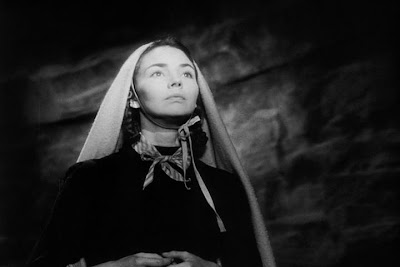
The Song of Bernadette (1943)


“The Song of Bernadette” (1943) pits man against miracle in a many-layered universe. The first layer of this complicated universe is the historical 19th century event on which the story is based. Then, there is the book by Franz Werfel and the World War II climate under which that book was written and published. Finally, there is Hollywood, that tries diplomatically to be both pious and frank, spiritual and temporal, to present a money-making story, and yet present it under the auspices of a religious experience.

By filming a story about a miracle, Hollywood created something of a miracle in its own craftsmanship just by what it accomplished and how.


On this Easter Monday, we take a look at Hollywood’s presentation of a miracle and the ironically realistic way it chose to present it. Man is by nature a creature which believes. We have religions and sometimes complicated protocols of faith. We have superstitions, and we have good luck and bad luck, and we have worries and fears and paranoia, and that is all part of what we willingly believe without proof. On the opposite side of man’s nature is an innate skepticism.

Someone who believes in the efficacy of the prayers of his own faith, may disbelieve the efficacy of prayers of another faith. An atheist may disbelieve the efficacy of any prayer at all, and yet wholeheartedly believe in luck, or horoscopes, or that a co-worker who gives him a dirty look is out to get him. It may be the co-worker is just in a bad mood, but that does not shake the belief of the paranoid. A lot of logical, sensible people knock on wood. Even people who believe in nothing believe in something, even if it is only the superiority of their own opinions.

So, we believe, regularly, commonly, without proof. It may be part of our DNA. But at the same time we are skeptical over someone else’s experiences. “The Song of Bernadette” shows these disparate sides of human nature and the clinging onto of human dignity more than it puts forward of one belief over another, or promotes miracles. The film begins with the narrative,

“For those who believe in God, no explanation is necessary. For those who do not believe in God, no explanation is possible.”

But this is not merely a disclaimer to placate a general movie-going audience of mostly Christians, albeit demographically mostly non-Roman Catholics. It is a simple analysis of human nature. Belief and skepticism may be at opposite poles, in life and in this movie, but they do not represent good and bad. There is nothing bad in skepticism. Skepticism is healthy and beneficial, except when it becomes distorted as a tool for manipulation. The same may be said for belief. It is healthy and beneficial, except when it becomes distorted as a tool for manipulation. This film is remarkably and consciously clear in demonstrating that.

It is the telling of the story, and not the miracle, that is the subject of this post. Such care was taken in the historical accuracy of the southern French village (a realistic set of stone which was also used, I believe, for “How Green Was My Valley”?), in the soaring and evocative music by Alfred Newman, in the clothes, the everyday life of the poor-as-dirt peasantry, in the meaty, articulate script, in the camera work which plays on light and dark with such soul-baring intimacy. This film is an example of craftsmanship at its best. Stark, unflinching, and yet remarkably empathetic craftsmanship. The studio, and all those involved evidently wanted to make not just a money-making film, but a great film. So often we have seen so-called blockbuster movies made at this period, and especially today, where a truckload of money is thrown into a project, but what results is only lumbering over-produced garbage. This film shines with the obviously meticulous care put into it.

The cast is a collection of some of the best character actors of the day, along with a flock of extras as villagers, and a young Jennifer Jones in the title role that made her a star, and won her an Academy Award. About the only weak links are the child actors playing her younger siblings, who seem by the way they speak and carry themselves to resemble 20th century American kids rather than 19th Century European children, but the rest of the cast are true and believable.


Anne Revere and Roman Bohnen play the parents of Jennifer Jones’ Bernadette. Miss Revere was commonly cast in hardscrabble mother roles. How much was due to her scrubbed complexion mottled with freckles and her strong jaw and the flint in her eyes that suddenly turned soft and sympathetic can be guessed at. Most actors are chosen for their roles because of their looks, and sometimes their height. Other actresses habitually played mothers on screen, but did not have Miss Revere’s quality of appearing genuine. Other screen mothers were often only superficially mothers, the kind who came out of the kitchen with milk and cookies. Revere gives us the impression she actually changed diapers, wiped noses, was the hand that rocked the cradle, and sometimes the backhand to the cheek or slap on the bottom.


Roman Bohnen played Jones’ father, an out-of-work peasant at his wits end, beyond hope and failing strength. He is downtrodden and resentful, petty and frustrated, but we see the depth of his love for his daughter when he desperately promises to let her return to the grotto, after having already forbid it, and when he scrambles fearfully into the Royal Prosecutor’s office, where Jones has been taken for questioning, to claim her and take her home. From the time we see him rise up early to beg for a job dumping hospital waste, to the point where he must say a final goodbye to his daughter, in every action, this man’s heart is breaking.

Charles Bickford is the Dean of Lourdes, the village priest who, in his dashing Cavalier-like hat and cape looks something like a superhero before the ragged villagers. The sash on his cassock is cinched firmly about his waist, making the line of his body look lean and rugged, with broad shoulders and he takes his long strides with a lordly bearing. Mr. Bickford, last seen here as Jane Wyman’s father in “Johnny Belinda” (1948), played tough, commanding men who kept their own counsel, and whose role here as the scornful priest who doubts Bernadette and later becomes her staunchest ally, demonstrates his formidable screen presence.

Vincent Price heads the local magistrates who connive to discredit Bernadette. He is the self-important and dangerously ambitious Royal Prosecutor. It is a role perfect for Mr. Price, whose elegant disdain so completely captures this highly intelligent, highly skeptical man. There is a particular facet about his character that is especially memorable, and that is his constant flourishing of a voluminous handkerchief, dabbing at his nose as he makes a gesture or a point about the foolish Jennifer Jones and the idiot townspeople.

“What do you expect from a peasantry fed on dogmas and superstitious nonsense?”

At times he looks foppish waving the hanky, and at other times, it is as if he is using it to steal scenes, and it becomes an almost funny prop, along with his ever-present allergy symptoms. It is only late in the film we notice with an ominous sense of foreboding that his voice has grown hoarse, and that his raw throat and troublesome sinuses, which he writes off as influenza, is actually a serious illness. Contrasting the lighter earlier scenes of the scene-stealing foppish hanky, it is a shock to learn now he has throat cancer.

Charles Dingle, so delightfully wicked as the rascal older brother in “The Little Foxes” (1941) plays another devious role here as the chief of police, and Lee J. Cobb as the kindly and scrupulously objective village doctor rounds out a very strong supportive cast of town officials.


Gladys Cooper, so impressive here as the envious, bitter nun who first presents as Bernadette’s stern school teacher, and then her mistress of novices in the convent, conducts a master class on acting just in the convent scenes alone when she confronts Jennifer Jones about her supposed sightings of the Lady. Miss Cooper’s dark eyes burn in her wan face, emitting her particular venom for Jones through those eyes. Then a convulsion of emotion rips out of those remarkable eyes as we see Cooper has an epiphany of her own when Jones reveals proof of her agonizing illness that she has borne with quiet patience. Miss Cooper’s character takes a complete turn, and she melts almost like the Wicked Witch of the West, but not from water, from the sickening knowledge of her own deformed reflection in the mirror of her soul.


Jennifer Jones is Bernadette, from every nuance cast in stillness, even from her screen test. It is a famous Hollywood anecdote that among all the actresses trying out for this much-sought-after role and who were told to gaze at a stick held above the camera, Jennifer Jones, according to the director, was the only one who saw the Lady.

We can easily believe it. Her quiet sense of wonder is exquisite in this film. In the scene where she sees the Lady for the first time, there is a really very long moment of her fixated, unblinking stare into a kind of paranormal light cast during the Lady’s presence. In subsequent encounters, Jones’ child-like characterization is so complete that her fascinated gaze reminds one of the way a child will turn, eyes wide and unblinking, to the TV, absolutely absorbed by a toy commercial. If you’ve ever tried to talk to a child when a toy commercial is on, you know how exasperated Bernadette’s parents are when they cannot make her disregard her rapture for the Lady.

But her stillness, her economy of gesture and movement does not keep her from growing as a character, and this is another remarkable aspect to her work in this movie. She begins as a somewhat diffident, frail girl, a poor student who everyone, including herself, refers to as stupid. Her personality enlivens under the presence of the Lady, and we begin to see in her a sense of joy, a sense of wonder, and an occasionally comical common sense.

When questioned by the authorities on her lunatic behavior of pretending to wash herself with dirt, and falling to her knees, eating wild scrub plants like “an animal”, Bernadette replies, “Do you act like an animal when you eat salad?”


It is another Hollywood anecdote that when it came time to film the scene where the Lady asks Bernadette to wash her hands and face in a stream which does not exist, and eat some nearby plants, director Henry King wanted Jones to only pretend. Miss Jones insisted on digging into the ground with her hands, smearing dirt on her face and shoving the weeds into her mouth and eating them.


There was some debate at the time as to whether the film should show an image of the Virgin Mary to whom Bernadette is speaking, or, since nobody but Bernadette saw the vision, to leave it out. There is probably equal logic and merit on both sides, but having the movie-going audience see the vision as Bernadette sees it at least steers the story away from having us, along with the villagers, believe Bernadette is a lunatic. We are then free to focus on the villagers’ and the Church’s skepticism, and not our own.

Nobody believes her, and she is harassed not only by civil authorities, but most especially by the Roman Catholic Church. Even Charles Bickford, the priest who begins by threatening her with a broom and later becomes her protector, never really swallows the story completely. He is at last convinced of her sincerity and her innocence, but to believe that the Virgin would deign to make an appearance in such a lowly, filthy place to such a miserably nobody of a girl, is ridiculous. He is skeptical.

“Christ was born in a stable,” counters Bernadette’s formidable aunt, who chastises her parents for their lack of support and demands that the girl be allowed to visit the makeshift grotto in the town dump. When the spring water that wasn’t there suddenly appears, and a couple of people are healed by washing in it, a horde of people needing to believe in something show up, and keep showing up, and so do the concessionaires. The town prospers in the parasitic cycle of public relations and commerce.

Miss Jones is at last made to understand that through the tumult she has caused, her life can never be the same again. She is offered both sanctuary and grinding servitude in a convent, and we see another aspect of her growing maturity as she says goodbye to the village boy who appears to have a crush on her. There is no fully developed romance between them, but the film intimates that there would be if only Bernadette could be left alone. A sweet, and deeply sad moment, when he stops her carriage with an armload of flowers as she is leaving for the convent, (that appear to be cherry blossoms?) and vows that he, too, will never marry. She snaps off a sprig of pure white blossoms and hands it back to him, and it is almost as if they are blessing each other in a kind of wedding ceremony for a chaste marriage.


When Bernadette arrives at the convent, she meets up with her old nemesis Gladys Cooper, and when that mean little nun walks through the door, we are perhaps even more shocked and depressed about it than Bernadette is. There is another wonderfully still, yet evocative moment, when left in her room alone, her “cell”, Jones glances around with a frozen expression and limpid eyes that gaze with a different, more foreboding sort of wonder. The cell is actually far more clean and comfortable than the home she grew up in, but here we see she is terrifyingly alone. We see a crucifix mounted on the bare whitewashed wall over her shoulder, and we wonder if the Lady has left her all alone forever, too.

We might comment with amusement that the vision of the Lady was actually played by a pregnant Linda Darnell, but that’s been noted so often that I think all of the really clever jokes and remarks have already been made, certainly nothing I can top.

Even here in the convent, Bernadette is still brought before Church commissions, made to testify over and over to what she saw. Even Peter denied Christ three times before the cock crowed, but Bernadette is more steadfast. She insists she saw what she saw. It is not a martyr’s courage that makes her declare this, only her simplicity and a lack of street smarts in knowing how to lie.

At the very end of the film, as Bernadette lay dying, she finally sees her Lady again, who beckons as if coming to her for a hug. Miss Jones once again makes us believe everything in her heart when she calls out to the vision that nobody else sees, “I love you…I love you!”

The musical score, a beautiful piece of art in itself, is suddenly covered by a male voice over at the end with a recitation from the “Song of Solomon”, which I always thought was a rather odd way to the end the movie. It’s one of the more beautiful passages from the Bible, but it never seemed appropriate to me to use here, at least until listening to the bonus track of commentary from the 2003 restoration DVD of this film. It is explained that the composer of the score, Alfred Newman, saw in his mind that the movie was really a love story between Bernadette and her Lady. A sweet way to look at it, and makes the words from the Song of Solomon as Bernadette is being encouraged by the Lady at the end of the film,

“Arise my love, my fair one, and come away….”

seem well used.

A note on this commentary track: we’ve commented before on this blog about how disappointing some DVD commentary tracks are, but this is not one of them. Delivered by historian Donald Spoto, Newman biographer Jon Burlingame, and Jones biographer Edward Z. Epstein, the commentary to this film is truly excellent. Mr. Burlingame covers the towering score by Alfred Newman, Spoto covers the historical setting, and their remarks are scholarly, spoken with clarity and articulate passion, as well as in voices, particularly in Mr. Spoto’s case, that are resonant and pleasing. It’s always enjoyable to hear someone speak well. Mr. Epstein’s comments are more superficial, but if one is unfamiliar with the life and career of Jennifer Jones, he provides a useful background. All three gentlemen’s remarks dovetail neatly.

Bonus tracks aside, the restoration of the film on this DVD (available from Amazon here) is worth the price alone, so vivid and sharp is the visual quality compared to any old television screenings you may have seen in the past.

The commentary underscores the idea that this film represents a many-layered universe, in this case, history and Hollywood. They ruminate on Franz Werfel, a Jew escaping the Nazis who on his escape route discovered the story of Lourdes and wrote a book on Bernadette, who had been canonized as a saint only fairly recently, in 1933. The notice at the very end of the film reminding us to buy war bonds is actually jarring; so deeply have we been sent into the19th century that a reminder of the present is a shock.


The film shows realities of poverty, of religious leaders who dismiss the idea that a sign of heavenly grace can be bestowed on anyone other than themselves, and of civil authorities who are threatened by the raising up of a peasant class until they find their own way to exploit it. These are realities as ancient as mankind, and as current as today’s headlines.

“She’s a religious fanatic, and every time religious fanaticism steps forward, mankind steps backward,” Vincent Price declares in this marvelously literate script. We may agree.

“You should be thankful, Bernadette, you did not live in former times” a spiteful Gladys Cooper tells her with delicious malice, because she would have surely been burned at the stake. Very true.

And Miss Cooper asks the most meaningful, the most fatal question of all, the same question all the clergy and all the authorities, and all the villagers ask quietly to themselves in their most private thoughts,

“Why then should God choose you, not me?”

Bernadette doesn’t have an answer to that one, and 20th Century Fox wisely refrains from providing one, but we don’t really need an answer. The question itself is thought-provoking enough.

Monday, November 24, 2008

A Guy, A Girl, and a Typewriter


The romantic triangle of a guy, a girl, and a typewriter is perhaps a little less discussed than the erotic symbolism of smoking in old movies, but should not be avoided due to prudery. We’re all adults here. Unless you’re a kid. Then, young sir or young lady, you are to leave the room immediately.

The typewriter and shapely hands above belong to Barbara Stanwyck, one of film’s most prolific typists. We see her here in “Christmas in Connecticut” (1945) as she bangs out her magazine column.


Here Reginald Gardiner is just about to swoop down and give her a kiss, because he’s nuts about her and because her typing is driving him wild. Understandable, for there are few things more sensual than typing, few physical attributes more desirable than the strong yet supple fingers of the typist.

In the Sherlock Holmes story “The Solitary Cyclist”, Sir Arthur Conan Doyle has Holmes appraise a woman’s hands, noting that she is either a typist or a pianist, "I nearly fell into the error of supposing that you were typewriting. Of course, it is obvious that it is music. You observe the spatulate finger-ends, Watson, which is common to both professions? There is a spirituality about the face, however" -- she gently turned it towards the light -- "which the typewriter does not generate. This lady is a musician."


How wrong he is, that typing on the QWERTY keyboard does not convey a certain spirituality, even passion. If he could see this close-up of Stanwyck’s eyes from “Meet John Doe” (1941), Sherlock would know just how wrong he was.


But passion through typing is not solely the province of ladies in film. Here Gregory Peck in “Gentleman’s Agreement” (1947) shows us what virility looks like: a handsome man brooding in front of a typewriter. Below we have the picture of motherly pride as Anne Revere fondly thinks to herself, “That’s my boy who can type.” Medical school? Bah! She sacrificed everything to put him through two semesters of Typing 101.


Here we have Rhonda Fleming in “The Spiral Staircase” (1945) showing that Edwardian ladies were every bit as sexy as the modern girls at a typewriter.

Here Gordon Oliver can’t resist planting a kiss on her. One of the first things he tells her when he enters the scene is to plead, “Don’t stop typing.”

Here the ménage à trois is complete as Rhonda attempts to dance with her typewriter and Gordon Oliver cuts in.


Typewriter passion is easily transferable to musicals, seen here in “Silk Stockings” (1957) where Fred Astaire’s immediate attraction to Cyd Charisse is due to her ability to type.


And even less glamorous couples find romance if left to themselves in a small secluded corner with a typewriter, as is the case here in “The Band Wagon” (1953) with Nanette Fabray and Oscar Levant. There is nothing like a typewriter to bring new life to a marriage in a rut.


Amid all the froth of “Three Coins in a Fountain” (1957), the only genuine passion comes from the unlikely duo of Dorothy McGuire and Clifton Webb, again because of the typewriter. He is a writer who dictates, and she is a typist who receives his words and produces the pages. Their relationship is interdependent. How many such lovers have thrilled to the ping that warns of the approaching right margin, and the grinding crank of the carriage return? Their need for each other is occasionally accompanied by a need for carbon paper and Wite-Out.

Film noir also explored the relationship between typing and sex, in “A Lonely Place” (1950) when Humphrey Bogart, a screenwriter, begins a relationship with Gloria Grahame that becomes more steamy when she starts to do his typing for him. I’d put up a screen capture for that, but I hear those kids coming back into the room. Everybody shut up.

Thursday, November 6, 2008

Then and Now: Gentleman's Agreement - Part 2

“It’s hard to talk about abstract issues.” Commentator Mr. Schickel remarks about the prejudice issue in Gentleman’s Agreement.

“See? That’s how it was then.” I still hear my father’s voice.

This is part two of our two-part series on this movie. Part one is here.

Intolerance is not abstract when it happens to you, as Gregory Peck finds out when he is on the receiving end of prejudice. I learned this myself on a handful of occasions in my life when certain people I met over the years told jokes and made derogatory remarks about “those people” of that country from where my mother’s parents had emigrated. I had the anonymity of my father’s surname, so they did not know they were insulting my mother and myself. When I informed them that I was one of “those people” they did a little verbal tap dancing. I was less apt to live and let live with these people, admittedly because it was me they were insulting. Abstract issues? Not when it’s you, and my experiences have been nothing compared to what others have faced.

Expressions of prejudice may change, but one thing remains constant in the human experience. There are always going to be some people for whom being just as good as anybody else is never going to be enough. They must be superior. Since actually being superior is out of their reach, they go the easier method by insisting that others are inferior.

How interesting that today much of the former open vehemence of prejudice has shifted from the now socially unacceptable derision against race or religion to the more socially acceptable ridicule of political affiliation.  (See update note below.  Can it have been only 11 years since I wrote this post?)

“Conservative” and “liberal” are used today like dirty words, accusing labels, where the opposing political party, or politician, or even individual voter, is vilified with a degree of condescension, arrogance, and meanness that would appall most of us were it applied against a person’s race or religion. It is no longer enough to simply disagree. We must condemn. Those people.

I don’t know when it started, but our need to compromise as laid out by the founding fathers morphed into a need to bash each other mercilessly. The first time I can personally remember seeing this evolve was in college when a schoolmate and I discovered we were members of opposite political parties. Though I was unconcerned for my part, her surprise was overwhelming, and she blurted out, “You can’t be! Really? But you seem so intelligent!”

In today’s political climate I might be defensive, but at the time it cracked me up and I laughed.

Just before the scene where Gregory Peck goes to the restricted hotel for the showdown, he retorts to Dorothy McGuire that he must stand up to the bigots because they insult “everything this country stands for.”

The phrase seems to make Mr. Schickel squirm. “I don’t know. ‘Everything this country stands for.’ See, you know, maybe there’s a way to just slightly avoid that line. I think we’ve got it.”

Avoid that line? That line is the whole point of the movie. That’s the point of this nation. That seems to be what George Washington thought when he visited the synagogue at Truro, Rhode Island, and declared to the Jewish community, “to bigotry no sanction, to persecution no assistance.” Idealism has the air of naiveté or even falseness to us these days where cynicism equates sophistication. Fear mongering has replaced it as a hip and edgy alternative.

Now we have a new President. Those who did not vote for Barack Obama will be disappointed, as it is only human to be disappointed when the candidate you did not want for office wins. We are on the brink of a hopeful time with a new President who embodies the diversity of our society, but we are also at a perilous time, and not strictly because of outside threats or economic collapse. There is another insidious problem, deep at our core. We get lazy. Some decent people who did not want Senator Obama to win might say nothing to the bigoted, the resentful, the fear mongers, preferring smug silence, satisfied that the one they did not want to win will not have an easy time of it. A good chunk of Gentleman’s Agreement is about guarding ourselves from our worst impulses, from taking the easy out.

After 9-11 there was a great call out to moderate Muslims to distance themselves from the radical Muslims and condemn their terrorist actions. Why were they not more vocal, protest their indignation, many wanted to know.

That’s what the movie’s about, too. As the Dorothy McGuire character had to learn, it’s not enough to be a nice person who would never act like a rude nutcase. She learns that in silence lies not only cowardice; there lies complicity.

On this point, I observed the influence of four people in my younger years. These were my father, who bristled at people who thought they were so great; and my mother, who disdained nonsense.

The other two people were John Garfield, who played a quiet but intense scene with Dorothy McGuire where he showed that a person could talk frankly about prejudice, but still maintain gentlemanly kindness; and Dorothy McGuire, who went through a scene-after-scene crisis of conscience, and got the message at the 11th hour with shamed self-revelation. My mother would have admired her epiphany of self knowledge. My father would have admired her humility.

I liked that it showed the possibility of redemption exists for us and our society. Such redemption takes courage, and it also takes practice.

There is of course, that final ironic aspect to Gentleman’s Agreement, the aftermath. Several people connected with the film had their careers and their lives damaged by the Committee for House Un-American Activities, abetted by the bigoted Congressman John E. Rankin (D-Mississippi). This man who spat racial slurs on the floor of the House of Representatives took particular interest in Jews on whom he could pin Communist affiliations, which made Garfield, a Jewish man in a watershed movie about anti-Semitism that some people in some parts of this country were trying to ban from being shown, a prime target. A film so controversial that a handful of Jewish studio heads wouldn’t touch it.

But June Havoc (real name Hovick), and producer Daryl Zanuck could not escape just because they were not actually Jewish: their names sounded Jewish to somebody. Guilt by surname consonants is an unusual reason to call someone to defend their patriotism. But these days we can still see how it could happen. President-elect Obama’s middle name of Hussein caused more than one ignorant person to assume he was Muslim, which to them must mean he was a terrorist, or at least anti-American. My mother’s first name was changed to sound less foreign and more American. She would have identified with President-elect Obama in that on his father’s side at least, he is first generation American as she was.

Anne Revere, who played Gregory Peck’s mother in the film, a descendent of Revolutionary era figure Paul Revere, obviously had a very American name and very American family heritage, but that did her no good. She was not Jewish, either, but she was married to a Jew, so evidently that was enough to not escape the Committee. That and the fact she refused to cooperate with the Committee (unlike the film’s director, Mr. Kazan who famously did, as well as Mr. Zanuck). As Miss Revere is quoted, "I'm a free-thinking Yankee rebel and nobody's going to tell me what to do!"

They nailed her good. That’s one Academy Award winning actress we won’t be bothered with again. Well, that Paul Revere relative of hers was a radical himself. They’re all alike. Those people.

To persecution, no assistance, George Washington said, rather naively.

We also have calls these days, not unlike the days of the Communist witch hunts, for an investigation into who is anti-American among our elected officials, Rep. Michele Bachmann (R-Minn.) most recently vocal among them. Hard to tell who is anti-American with everybody rather self consciously wearing the same flag pins on their lapels. To some people, anyone who does not agree with them is anti-American, which makes accusing people very easy and convenient.

“See? That’s how it was then,” my father shook his head at the TV where Gentleman’s Agreement showed us a world of decades ago where nice people allowed prejudice to flourish right under their noses, when people with “foreign sounding” names were suspect, when politics got so nasty that people were forced to prove their patriotism in public forums.

“You know,” Mr. Schickel allows, “antique as this movie sometimes seems in some of its aspects, the truth is that at that time it was an important statement to make.”

Antique movie? Dated and preachy, the labels from which this film has yet to escape. Casablanca is also dated and preachy, but its bad guys were the Nazis, so we don’t mind speeches against them. In Gentleman’s Agreement, we are the bad guys, or we could be if we’re not careful. That’s the difference.

“It was a good movie for the moment,” Mr. Schickel comments.

I agree, but I will add that maybe the moment is now.

Incidents, these days, of cowardly thugs leaving nooses displayed on college campuses, a factory, even a United States Coast Guard training ship. Here’s a link to a story about an incident of refusing to hire Jews or African Americans, these days. We’ve just been subjected to one of the most hostile campaign seasons in years, with much of the hostility flourishing on the blogs of anybody with an ax to grind. In such a climate, we have little right to be so blasé about this old, dated, preachy movie.

“It is a little weird why she’s taken so long to learn such a simple lesson,” Mr. Schickel complains about the film. This nation has so far taken well over 200 years, since George Washington’s day, in its continuing struggle to sort out prejudice. It takes Dorothy McGuire just under two hours.

I do not believe Gentleman’s Agreement has lost any of its edginess, its eloquence, or its relevance. The trouble is, grass grew over the ground it broke.

See? That’s how it is these days, Father.

(Update: This two-part series was originally published in 2008, the week of the election to the presidency of the first term of President Barack H. Obama.  How much more malevolent bigotry has become now in 2019 would have horrified my parents beyond belief.  I think of them often these dangerous days.)


*********
Jacqueline T. Lynch is the author of Ann Blyth: Actress. Singer. Star. and Memories in Our Time - Hollywood Mirrors and Mimics the Twentieth Century. Her newspaper column on classic films, Silver Screen, Golden Memories is syndicated nationally.

Thursday, October 16, 2008

Dragonwyck (1946)

“Dragonwyck” (1946) is a fine example of gothic suspense, beautifully filmed. Another in our series this month of movies where the setting of a house drives the story, Dragonwyck of the title is a manor on the Hudson River of upstate New York in the days of the great Dutch landowners or “patroons.”

Set in 1844, at the height of the land reform battles wherein sharecropping farmers were demanding entitlement to their farms, Vincent Price plays the patroon of the Dragonwyck estate. He is a haughty autocrat unwilling to bend an inch in the life of hereditary privilege he has known. Gene Tierney plays a Yankee girl from Connecticut who is brought to Dragonwyck as a companion and teacher to Mr. Price’s young daughter, and finds herself captured under the spell of elegant living among the rich. But it comes at a price, for Dragonwyck is a place of secrets, and family curses, and restless spirits, and murder.

The mansion in this film does more than just provide a setting for the story; it serves to represent the proud heritage of its owner, Vincent Price, and the source of his haughtiness, his self-superiority. It is the brick and mortar personification of the man himself. Even his tower room, where he seeks privacy and solace, the highest room in a great mansion on a hill, places him physically above everybody else.

Price plays his cultured, arrogant autocrat with an irresistible mixture of charm and implacable stubbornness. Probably another actor might not bring the same multi-layered characterization to the role, and might play the patroon as only conceited or stomping about with one-dimensional meanness. But Price brings a fascinating appealing nuance to the role, and seduces the audience as much as he does Gene Tierney. It is his film.

Mr. Price as master of Dragonwyck, the sole ruler of this minor kingdom, controls with almost god-like power the lives of his tenants who must remove their hats before him and pay tribute.

He is self-satisfied, and stands before his ornamented windows admiring the requisite “dark and stormy” night outside, “There is no thunder in the world like the thunder of the Catskills. The lightning seems to set the mountains on fire and they roar back.” The only source of his displeasure is his gluttonous, neglected wife, who has given him a sweet daughter, but whose being female makes her useless to him. His wife can bear him no more children, not the son he desires for the sole purpose of inheriting Dragonwyck. Enter Gene Tierney.

The gothic premise of an innocent young girl brought to an imposing mansion where evil may lurk had been a device used by writers for nearly a couple of hundred years. It was already so popular at the turn of the 19th century that Jane Austen parodied it in her novel “Northanger Abbey” (1803), and was just as successful for Charlotte Brontë’s “Jane Eyre” (1847).

The difference here is we have an American story, and though the mansion and the Dutch heritage of its patroon does give the setting an “Old World” feel, nevertheless this is a film that explores the entirely American story of antebellum land controversy in the state of New York, where patrician landowners manipulated the peasant class which worked their lands, and consolidated power against the urban businessmen and the first rush of the rabble of immigrants. The Roosevelts were part of this Dutch wealthy elite, but their 20th century progressive programs would have made their ancestors, like the character played by Vincent Price, blanch.

Walter Huston steals scenes as the crusty Yankee farmer father of Gene Tierney, who prays aloud that the Lord will deliver them “from hankering after fleshpots,” and Anne Revere brings her customary authentic hardscrabble mother role as his wife. Jessica Tandy has a small, but scene-stealing role as the sprightly, steadfast and comical Irish maid devoted to Gene Tierney. Spring Byington has one of the most interesting roles of her career as the housekeeper of Dragonwyck. She plays the role with a slightly off-center brittleness, punctuated by a nervous giggle and somewhat crazed demeanor. She appears unstable, perhaps dangerously so.

She notices things and speaks aloud what she should not, remarking to a newly-arrived Tierney, “You like the feel of silk sheets against your young body. And one day you’ll wish with all your heart you’d never come to Dragonwyck.” It is prophetic, for Miss Tierney matures from a flighty young girl to a sadder but wiser woman through tragedy.

We have class wars, a lesson in regional American history of the 1840s, murder by oleander, drug addiction, and a ball sequence. You can’t beat that for stacking the deck.

Unlike many costume dramas of Hollywood’s heyday where the depiction of certain historical eras seems like somebody’s wild guess, this film actually portrays the 1840s in hair styles, costume, furniture, and props with admirable accuracy. I take exception with only one minor point, the line where Gene Tierney, dismayed at being rebuffed by the wealthy young ladies at the ball who represent the Dutch landowning families, laments, “I’m not from the top of the Hudson. I’m from the Connecticut River bottom.” Her hometown Greenwich, Connecticut is not located on the Connecticut River.

(Come to think of it, Katharine Hepburn lived on the Connecticut River bottom at Fenwick, so it must not have been such a bad address.)

Here, like “The Spiral Staircase”, (see post here) an outside character in the form of the local doctor provides a lifeline to the heroine, a hero upon whom she can depend for a sane point of view, who represents a brighter, kinder reality beyond the walls of this sinister place. Just as in “Staircase”, the doctor does not actually save the young lady; she must save herself. But we imagine that they will be together when the dust settles.

The mansion, we are told, is haunted by the ghost of a tragic ancestor, and we see how both Price and his daughter fall under the spell of this restless spirit, but the real horror of the story comes not from the supernatural, but from Price’s own actions, and his inability to adapt in a changing world that is ever encroaching upon his cocoon of Dragonwyck. Two terrific close-ups of Vincent Price are the scene where he gazes into the bassinette of his newborn son, like a greedy man looking upon a stash of gold he has found, awestruck that he has it, but somehow anxious that someone might take it away from him.

The second is at the end of the film when he notes with prideful satisfaction that the tenants before him are removing their hats, and he assumes it is because of their respect for his position as patroon. He never faces the truth. The gothic film ends with an inspired note of irony.

I’d love to hear from anyone who’s read the novel on which the film was based.

Here is an interesting series of clips of photos and production stills from “Dragonwyck” as posted on YouTube. Accompanied by Enya’s “Tempus Vernum”, it drips gothic intrigue.

Related Products