IMPRISON TRAITOR, PEDOPHILE, AND CONVICTED FELON TRUMP.
Showing posts with label Hugh Griffith. Show all posts

Thursday, March 29, 2018

Ben-Hur - 1925 and 1959


Ben-Hur: A Tale of the Christ (1925) and Ben-Hur (1959) dramatize the novel from 1880 by Lew Wallace about a wealthy Jewish prince during the time of the Roman occupation of Judea who was sent into slavery by his old friend, now a Roman soldier who aspires to political high office. Judah Ben-Hur will eventually avenge himself, sorrow and suffer, and his path will cross many times with Jesus Christ until the moment of Christ’s Passion. The story combines so many elements dear to Hollywood: a successful novel, a biblical epic wherein images of suffering, torture, a certain degree of salaciousness, are permitted because they are deemed biblical, including a showing fair degree of muscled legs and chest of our hero, and the opportunity to appear as if they are enlightening their public as much as entertaining them. We mark the annual crisscrossing of Passover and Easter with this story of Ben-Hur.

The original feature-length movie from 1925, being a silent movie, and being predominantly in black and white, except for some two-strip Technicolor scenes, is obviously different from the blockbuster 1959 multiple Oscar-winner, which was made in color, and where every sound from grunts and groans, the hoofbeats during the chariot race, a relentless hammering of the wooden mallet on the drum to mark the time of the galley slaves rowing, is gloriously and intimately recorded. It was also shot in a widescreen process allowing us a view of everything on either side of the principal characters in the scene, thereby allowing our eyes, and our minds, to wander.

Astonishingly, however, there is much about both movies that is quite similar, including much of the chariot race and the scenes leading up to the race. The 1925 version is a little closer to the novel, but it is no less an opportunity to embrace all that is lavish and lush about an era in Hollywood where there was no CGI and those thousands of people we see in the arena and on the rocky hillsides and the lonely road to Calvary, were real people and not embedded by computer-aided graphics. One might even note that the naval battle in the 1925 version is actually a little more impressive than the 1959 version because it does not appear so much like models in the M-G-M pool.


One of the great delights of the Easter season is watching these old Hollywood epics on regular broadcast television. As we know, broadcast TV rarely shows classic films these days; they are to be found only on retro channels and on TCM, so fewer people are exposed to classic films today. And though broadcast TV does include those pesky commercials, does include edits which are extremely annoying to us old movie fans, there is still something wonderfully egalitarian about being able to see them for free, especially when one is sated after the holiday family meal and the kids are tired out from a long day of festivities and the whole family can gather in front of the TV and watch Hollywood’s ambitious take on the deeper meaning of the season.


Of course, Hollywood’s take on the deeper meaning is never all that deep, but it is entertaining and picturesque, sometimes as magnificent a feast for the eye as the old Renaissance masters’ versions of biblical events; their views were also slanted viewpoints. We could note that the scene of the Last Supper in the 1925 version of Ben-Hur looks almost exactly like the da Vinci painting. Of course, that was da Vinci’s version of the Last Supper, which probably did not happen on a long rectangular table with all twelve apostles and Christ sitting on one side of the table like the dais at a Friars roast. More likely they were all seated together on the floor, dipping pieces of their unleavened bread into a communal dish. And the lighting wasn’t as good.


The other fun aspect about watching biblical epics is that they always end up containing a dream team of players. Sometime or other we’re going to have to discuss The Ten Commandments (1956), a movie I cannot think of without recalling Edward G. Robinson in one of his most campy roles. Just hearing his gangster delivery makes me laugh. (Or was that Billy Crystal?) But that is Hollywood.

It was in The Ten Commandments that Charlton Heston first became famous for the biblical genre. He played Moses in that epic free-for-all, and he comes to the 1959 Ben-Hur with that under his belt. Sam Jaffe and Finlay Currie as well as Martha Scott are the old-timers from classic films here, but they are joined by popular actors of the day such as Stephen Boyd, and Hugh Griffith, who with great panache plays Sheik Ilderim. Newcomer Haya Harareet plays Esther in what was intended to be a dash of authenticity in this version. Ms. Harareet was herself from Israel, born before that country was established when it was still part of British Palestine. She made only a handful of films after that however.  Director William Wyler cast most of the Romans with British actors and most of the Jews with American actors, because he felt the distinction in accents would help differentiate them in the minds of the viewers.  It seems that most Romans in the old epics were played by Brits, which may lead many of us to assume Caesar studied at Oxford.


The 1925 version of Ben-Hur, untroubled by the need for different accents, we also have a dream team of sorts.  Except for star Ramon Navarro and Francis X. Bushman, the movie features a large cast of actors who are predominantly unknown even to classic film buffs. This might give the film more of a purity in the sense that we come to the story without any preconceived notions about the actors playing the roles. However, most of us would be delightfully shocked to discover that many of the Hollywood stars of the day played uncredited bit parts in this movie, lending themselves to crowd scenes, including John and Lionel Barrymore, who supposedly were spectators at the chariot race, as was director Clarence Brown, Joan Crawford and Marion Davis, Douglas Fairbanks, John Gilbert, Dorothy and Lillian Gish, as well as producer Samuel Goldwyn. Even theater owner Sid Grauman of Grauman’s Chinese Theatre was there in the stands. Gary Cooper is supposed to have played a Roman guard, as was Clark Gable. Janet Gaynor and Myrna Loy played slave girls. I did not see them, but I promise you I’m going to watch this movie over and over again until I can find them. Let me know if you do.  I don’t think there has ever been such a collection of future stars in bit parts in the same movie.


There actually is something very pure and very innocent and strikingly emotional in the 1925 silent Ben- Hur. Directed by Fred Niblo, June Mathis was the scriptwriter, and we may recall that the 1920s was a time of greater opportunity in Hollywood for women. Ramon Navarro, a really excellent actor, is handsome and very moving as Ben-Hur. Francis X. Bushman is his friend and foe Messala the Roman soldier. In the 1959 version Stephen Boyd plays the role and at first, he and Charlton Heston meet after an absence of many years and renew their childhood friendship. It is only after they discuss the political events of the day and Boyd’s request that Heston inform on fellow Jews who work against the Roman Empire that they fall out and become enemies. Though the 1925 version has Navarro welcoming Bushman after a long absence, the beefy and brash Bushman acts like a bully from his first entrance.


May McAvoy plays Esther, the daughter of Simonides who is Ben-Hur’s slave and steward. She will be his future love. Claire McDowell plays his mother and Kathleen Key plays his sister Tirzah. Mitchell Lewis plays the flamboyant Sheik Ilderim but he does not have the grandiose humor of Hugh Griffith. Charles Belcher plays Balthazar, one of the Three Kings who paid tribute to Christ at his birth and who has been seeking him these many years. Finlay Currie gets the job in the 1959 version, and also serves as narrator.

The moments where Ben-Hur’s life intersects with the life of Christ are commonly treated with a two- strip Technicolor process. We see the brightly colored robes and skin tone on the actors.


Though the grand scenes of the enormous palaces, the gigantic sets are mind blowing, we are treated to very small, intimate scenes of equal power as was common in silent film. After the impressive naval battle when Ben-Hur has rescued the Roman captain and they are brought to another ship, he climbs the outer net of rope rigging to the deck and he passes by a porthole where a fellow galley slave looks up at him mournfully. So much is said with a glance. The director gets a lot of mileage out of these kinds of scenes. One of the problems with the widescreen process as used in 1959 is, as director William Wyler himself lamented, all the space has to be used and so even when the director is focusing on two people in the scene, the audience is going to be looking elsewhere because there is so much else to look at. The director is not able to focus on a pinpoint moment.


The chariot race is perhaps the most famous element of either movie or even the book. It is stunning. The silent version gives us remarkable camera angles where both actors are seen handling the four horses that pull their chariots and I’m assuming that stunt doubles were kept to a minimum simply because of the difficulty of filming. There are those amazing shots, replicated in the 1959 version, of the chariot actually driving over the camera which has been placed into the ground. The stunning wide sweeping shots of the chariots making turns and thrusting down the straightaway, sometimes crashing into each other and overturning is breathtaking. What the silent version lacks is the sound of hoofbeats. We have a beautifully restored version of the 1925 film from 1988 scored by Carl Davis which provides a stirring backdrop to this scene, but we have no hoofbeats.

One thing that some critics remarked upon in the 1959 version was that it was a very slow, unwieldy tale, a very long movie and the parade of characters were presented with chronological diligence but with without raw emotion. The 1925 version carries all the raw emotion including several scenes that are utterly heartbreaking. We may note that this movie was remade in 2016, and it was not successful, but though I have not seen it I can imagine one reason for its lack of success among others – the heavy use of computer graphics makes a modern film more cost-effective but it removes us emotionally from the scene. It must have been extremely expensive and extremely laborious to have thousands and thousands of people rising as one, perfectly choreographed to cheer during the chariot race but it is far more effective because it is real, and because people whose emotions we understand are more interesting, and always will be, than technology we don’t understand.


Both movies deal with the representation of Christ as a silent figure and whom we see only from the back or only his arm, or his hand. Christ gives Ben-Hur a drink of water when he has been marching through the desert to become a galley slave and we see his gentle touch on Charlton Heston’s hair; the difference, however, is that the reaction toward Christ is on a more human and less spiritual manner in the 1959 version. When Charlton Heston looks up at Christ, Heston’s expression seems to tell us that he is grateful for the water and relieved he has found a sympathetic person who is helping him. He does not look as if looking into the face of the Messiah. Ironically, the Roman soldier who comes by to bark at him and tell Christ to go away suddenly stops and looks towards Christ with more of a sensation of encountering something strangely mystical. We see a more powerful reaction from the soldier than we do from Heston.

Ramon Navarro always appears as if deeply moved when The Nazarene crosses his path. Another interesting moment done with pure acting, is when his mother and sister are healed from their leprosy by their interaction with Christ. They had been told that The Nazarene performs miracles for those who believe and they arrive in time for his Passion as he drags the heavy cross through the streets. We don’t see his face; we see the cross on his shoulder and his face is behind it. They sorrow for him, and just with lighting, a white light that centers on their faces, the dark circles of their illness disappear and they immediately delight, acting as if they had been cured of their leprosy. There is no Jekyll and Hyde makeup transformation; it is all in the acting.

The 1959 version has Christ on the cross in the storm, the rain pouring down, dripping from his fingers on the hand nailed to the cross.  In a nearby cave, Ben-Hur’s mother and sister discover they are cured of leprosy. The darkness of the cave masks their need to wear makeup. The 1959 version is more sweaty and dirty, but even the realism does not match the heartbreak of the 1925 mother and sister close enough to the sleeping Ben-Hur to touch him, but resisting to wake him from sleep because they want to spare him the knowledge of their leprosy.

Both films make an attempt to address the political issues of a conquered people, for the biblical events, as in current events, are always as much about politics as about faith. Ben-Hur’s quest for Christ is his militant quest for a king to lead them out of Roman bondage, but he eventually adopts Christ’s message of peace. In the 1959 version Stephen Boyd taunts Charlton Heston with the idea that he is a member of a conquered people and he needs to get used to that. “The glory of Solomon is gone... Joshua will not rise again to save you, nor David.” To which Charlton Heston replies, “Rome is evil... Rome is an affront to God.”

The story ends with Ben-Hur reunited with his mother and sister, and with his love, Esther. But there’s a big “what happens next” that is never answered. How does he live with no end to Roman occupation for the rest of his life? We are meant to assume that the early Christian followers find strength and comfort in the teachings of Christ and in their own growing numbers, but though Hollywood enjoyed platitudes as a way of staying on the good side of the public who always thought that movie capital was a Babylon among the orange groves, it did not even trouble to answer the larger questions, preferring to wallow in the spectacle.


I enjoy biblical epics, but not because I find them instructive or inspirational; rather because, like a painting by a great master, they are imaginative pictures of wondrous events brought down to a human level we are better able to relate to – and despite the temptresses, the virile warriors, and the gauzily dressed slave girls, I think the most frivolous thing about them is that they are so irresistibly commercial.

So frivolous that, unlike the more meaningful and reflective rituals of the holidays, I cannot help but equate theses movies with a handful of jelly beans and winding down a busy weekend of celebration.

May I wish a Blessed Passover and a Happy Easter to all who celebrate.

You have a chance to watch the 1959 Ben-Hur this Easter Sunday on TCM.  

Have a look at the chariot scene from the 1925 version below.


Thursday, March 20, 2014

"The Clementine Jones Story" - Wagon Train - 1961 (And more TV 1960-1963)


In “The Clementine Jones Story” episode of Wagon Train, Ann Blyth plays the title character, a hard saloon gal about to be run out of town by the zealous Purity League.  Here’s another example of how her voice and movement changes drastically with character.  Her voice drops to a lower, growling register, is hard and barking, her posture alternately the audacious pose of the saloon entertainer of men, and also the stooped, hardworking pioneer woman who knows her way around a frying pan.  She’s morphed into Miss Kitty of Gunsmoke fame, and a careworn woman of the 1860s, vulnerable, but with a spine of steel.

This is our contribution to Aurora's Big Stars on the Small Screen Blogathon.  Please have a look here for the other great blogs participating in this really fun event.

Before we get to the episode, a word from our sponsor.  Just kidding: a few observations on Ann Blyth’s career as it entered the 1960s and her fourth decade as an actress.  On February 8, 1960, Ann was given a star on the Hollywood Walk of Fame.  It’s on the north side of the 6700 block on Hollywood Boulevard.  This was part of the first huge batch of stars installed in what would become a major tourist attraction in Hollywood many years hence, but at the time did not draw the media fanfare it does today.  At the time, though long-planned, the new Hollywood Walk of Fame had about the same amount of press coverage as the average sidewalk repair.
Ann’s name was included in the jumble of stars from the silent era to the 1950s in tribute to her popularity in the past decade, when she was on the covers of enough movie magazines to choke a horse.  We’ll talk about those down the road.  At the time her star was cemented on the pavement, her film career, unknown to her at the time, had finished three years ago with The Helen Morgan Story (1957).  Television guest roles still brought her work, and because of her selectiveness, quality work.
About ten days after her star was planted, she appeared in a 90-minute TV movie for ABC, a version of The Citadel from the novel by A. J. Cronin about a young Scottish doctor’s conflicts with professional ethics that follows him from a Welsh coal town to the elite Mayfair section of London.  James Donald is the doctor, and Ann Blyth plays his wife, one of only two Americans in the cast, reportedly, “…tackling an English accent and six different hair-dos as the doctor’s wife.”

It was an ambitious undertaking, with a huge cast of 35 speaking roles, 64 actors in all, and 42 different sets to cover a span of years and locations.  The show got a great review from John P. Shanley of The New York Times, with special notice for James Donald and Hugh Griffith.  Ann Blyth he said, “…performed creditably with the rather colorless role of the teacher whom the young doctor married to further his career.”  It would be Ann’s complaint, and as well as other actresses, that substantial roles for women on TV were becoming few and far between. 

It had become the fate of the actress in the 20th century to juggle her presence in the entertainment media if she wanted to work in films or TV.  The following month she appeared as a guest on the Steve Allen late night talk showing singing “Baubles, Bangles, and Beads” from Kismet (1955), which we covered here.  She also performed a comic skit with Steve Allen demonstrating the evolution of a nervous new singer into a confident diva. 
In April she appeared at the Academy Awards, held again at the RKO Pantages Theater, accepting the Documentary Short Subject award from Mitzi Gaynor for the absent winner. 
By August 1960 it was a guest spot on the new (short-lived) TV game show hosted by Ben Alexander, About Faces.  If this sounds like sliding into obscurity, it was also sliding into some needed downtime.  Pregnant with her fourth child (and counting), her baby son was born in December.  The following summer, at 33 years old with four children under seven years old, she still found time for another ride on the Wagon Train.  Her first trip Westward Ho on “The Jenny Tannen Story” in 1959 is covered in this previous post.


“The Clementine Jones Story”, broadcast October 25, 1961 in the fifth season of the show, is a delightful episode, comic and yet at turns poignant with the barely hoped for goal of redemption dangling before three of the West’s misfits: Ann; Dick York, who plays a no-account saddle tramp and unsuccessful bank robber; and young Roger Mobley, an orphan boy with an ugly attitude and a wistful dream of the good life in California.

I like Dick York’s exasperated incredulousness, and he shows himself, paradoxically, a subtle dramatic actor in the serious moments of quiet intensity.

We start comically, when Ann, whom we are told by town mayor Willard Waterman has, “spread more happiness in this town from one end to the other than the whole Purity League,”—and we are left to imagine what kind of happiness—is being forced out by righteous citizens.  They are hustling her out on the next stage.  We see instantly this is a different Ann Blyth as our first image is of her yelling at them in a hard voice.  She faces them down with vaudevillian mellerdramer that they are persecuting her and, “The wound will never, never heal.  I will carry it festering in my bosom to my grave.”
Comedy works best when the actors have a keen sense of irony and a playful attitude toward the ridiculous, which Ann clearly does, and this looks to have been an enjoyable role.  She refuses to leave town until she withdraws her money from the bank, $17.40, and runs into Wagon Train star John McIntire at the bank—just as Dick York’s stumblebum gang is robbing the bank.  It’s an unlucky day for everybody.

Mr. McIntire, trying to help foil the robbery, shoots at the villains, but hits Ann in her bustled bottom.  I love when the grim sheriff enters late on the scene, and we think he is going to investigate and make arrests, but he just comes in asking for a roll of quarters.  He has no idea what has just happened.

The righteous ladies of the Purity League curiously swarm to Ann’s backside to get a peek at the wound.

Dick York escapes and happens upon little Roger Mobley, newly orphaned and alone on the trail in his family’s wagon.  Mr. York makes a proposition that they travel together, because he needs a front and a cover story to escape the sheriff’s posse.  The boy, feisty and shrewd, knows he needs a grownup along if he’s ever going to make it to California, which he idolizes as the promised land where he will be happy.  It’s a business arrangement, with no love lost between them.

Roger Mobley, no stranger to TV westerns, is very good as the aloof and cussedly independent kid, holding his own with the grownups very well.  

John McIntire’s wagon train swings through town, and they join up, and are made to take Ann Blyth with them (once the town doc has gotten through with operating on whatever the Purity League ladies found under her bustle) to get her out of town.  Ann and Dick York exchange embarrassed glances and we see…ah, they know each other from a distant, intimate past.

John McIntire, as we’ve mentioned in our last post on Top O’ the Morning, appeared in a handful of Ann Blyth’s movies, and had a long career as a sinister villain or crusty character.  My favorite is probably his turn as Ann’s nemesis, the oily “Goldtooth” McCarthy in Sally and Saint Anne (1952), which we’ll get to next month.  Wagon Train gave him a starring role at last, as the rough but kindly wagon master after the death of former show star, Ward Bond.

Mr. McIntire will pop in and out of this episode, ultimately taking a hand in their destiny, but most of the interaction is between Ann, Dick York, and young Roger.

We sense almost immediately that they will end up a family, but this is done most entertainingly by avoiding obvious maudlin devices, and instead shows them as three of the most irascible people ever put together.  They spend the entire episode hollering at each other.  It is only through twists and turns that we get their back stories:  Ann and Dick York were lovers, but she thought he abandoned her.  She did not know he had been taken to prison.  He wrote to her and explained, asking her to wait for him.  She never got the letter, and he spent bitter years blaming her for leaving him and taking up the fallen life of a saloon gal.
I love the dialogue.  Ann, sarcastic, throws his insinuations back in his face.  “I ruined my life working in a saloon and you preserved your sainthood in a penitentiary.  That’s just the way a man looks at it…they put me out on the street.  What else could I do?”

The boy, we will eventually learn, never had a family.  His “parents” that died on the trail were a couple who bought him from an orphanage to work as a hired hand, something that was quite common in the nineteenth century.  Even up until the early twentieth century “orphan trains” created a new slave society of children.  This kid has learned to take care of himself, and trusts no one, especially grownups, but his suspicious heart is turned by this unlikely duo, ironically, with comically “tough love.”

When he mouths off to one of them, the other warns him not to be disrespectful to his elders and threatens to smack him.  At one point, Dick York makes as though to whack him, but before he can wind up and release his pitch, Ann slaps the boy across the face, a loud smack courtesy of the sound effects guy.  The sound effects guy gets another starring moment when Ann whacks Dick in the skull with a frying pan.

When she's not hitting people with cookware, Ann turns out to be a pretty good cook, which makes the boy slowly warm up to her.  Dick York, rescues his dog from an iron trap, and both care for Roger when he falls sick.  They turn from footloose refugees on the lam to fearful, heartsick parents before they even realize what is happening to them.  At one point, when he thinks his dog is lost, Roger breaks down and cries from the enormous burdens he’s withstood all his life, and Ann pulls him roughly towards her in a hug.  He struggles, wanting none of this, but she is stronger than him, and he eventually relaxes in her embrace, submitting to being comforted. 

We know they are bonding, but it is in spite of themselves, and manages to avoid mawkish melodramatic clichés.  There are also the running gags throughout the episode about Ann’s sore bum and the pillow she sits on embroidered with: “Home Is Where the Heart Is.”
At one point, when after a quiet family supper and boy plays "Lorena" on his harmonica, Ann tears up with the bitterness of someone whose regrets are draining whatever courage she has left.

Their trek with the wagon train grows tense and a suspenseful climax is reached when the law catches up to them and they must make some hard decisions.  Redemption doesn’t just fall into your lap. 

At the very end of “The Clementine Jones Story”, Ann sings only one line of the Civil War-era tune, “Lorena.”  It is not enough, but it is lovely, and it shows a hint of what will come beginning in the early 1960s for Ann’s evolving career.  Her lovely and powerful soprano voice, too little used in films, would be heard across the country in limited-run regional stage musicals.  They  would provide her an outlet for her talent that she could also work around her family. 
But in the twentieth century, with the boom of entertainment media governing popularity, and therefore, work opportunities, if an actress was not in films or at least on television, she flew under the radar.  Soon enough, the years would come of the “whatever happened to?”  

Another appearance on The Steve Allen Show in July 1963 (shortly after the birth of her daughter, her fifth and last child) was advertised with the description: “The actress, Ann Blyth, will be a guest of the Steve Allen Show tonight, along with comedians Rowan and Martin.  Since she married Dennis Day’s brother, she has been seen much on the screen where she became famous as a singer, and also performed well as an actress.” 

I’m not sure if the explanation of who she was is meant to be tongue-in-cheek, or if having married Dennis Day’s brother was really her claim to fame six years after making her last film.
You can still see “The Clementine Jones” story here on YouTube.  Let me know what you think.

Don't forget to check out the other great entries in the Big Stars on the Small Screen Blogathon.
Come back next Thursday when we travel back a decade earlier to 1951 when Ann Blyth (a top star at the time who needed no introduction) plays another feisty, bitter, and tragic woman.  Convicted of murder, she’s on her way to the gallows when she takes refuge with Claudette Colbert, and a murderer, one dark and stormy night in Thunder on the Hill (1951).


***********************
The Deseret Utah News & Telegraph, July 19, 1963, p. 63
The New York Times, article by John P. Shanley, February 20, 1960, p. 45.

The St. Petersburg (Florida) Times, February 19, 1960, p. 9-D.
**********************
UPDATE:  This series on Ann Blyth is now a book - ANN BLYTH: ACTRESS. SINGER. STAR. -

*********************
The audio book for Ann Blyth: Actress. Singer. Star. is now for sale on Audible.com, and on Amazon and iTunes.

Also in paperback and eBook from Amazon, CreateSpace, and my Etsy shop: LynchTwinsPublishing.


 "Lynch’s book is organized and well-written – and has plenty of amusing observations – but when it comes to describing Blyth’s movies, Lynch’s writing sparkles." - Ruth Kerr, Silver Screenings

"Jacqueline T. Lynch creates a poignant and thoroughly-researched mosaic of memories of a fine, upstanding human being who also happens to be a legendary entertainer." - Deborah Thomas, Java's Journey

"One of the great strengths of Ann Blyth: Actress. Singer. Star. is that Lynch not only gives an excellent overview of Blyth's career -- she offers detailed analyses of each of Blyth's roles -- but she puts them in the context of the larger issues of the day."- Amanda Garrett, Old Hollywood Films

"Jacqueline's book will hopefully cause many more people to take a look at this multitalented woman whose career encompassed just about every possible aspect of 20th Century entertainment." - Laura Grieve, Laura's Miscellaneous Musings''

"Jacqueline T. Lynch’s Ann Blyth: Actress. Singer. Star. is an extremely well researched undertaking that is a must for all Blyth fans." - Annette Bochenek, Hometowns to Hollywood


Ann Blyth: Actress. Singer. Star. 
by Jacqueline T. Lynch

The first book on the career of actress Ann Blyth. Multitalented and remarkably versatile, Blyth began on radio as a child, appeared on Broadway at the age of twelve in Lillian Hellman's Watch on the Rhine, and enjoyed a long and diverse career in films, theatre, television, and concerts. A sensitive dramatic actress, the youngest at the time to be nominated for her role in Mildred Pierce (1945), she also displayed a gift for comedy, and was especially endeared to fans for her expressive and exquisite lyric soprano, which was showcased in many film and stage musicals. Still a popular guest at film festivals, lovely Ms. Blyth remains a treasure of the Hollywood's golden age.


The eBook and paperback are available from Amazon and CreateSpace, which is the printer.  You can also order it from my Etsy shop. 

If you wish a signed copy, then email me at JacquelineTLynch@gmail.com and I'll get back to you with the details.

Thursday, November 17, 2011

The Sleeping Tiger - 1954


“The Sleeping Tiger” (1954) is a little like a Rorschach test -- an ink blot image whose design can be interpreted in different ways, but for which there is no "right" answer, or at least no conclusive answer.

All movies are subject to interpretation. This movie, either by intention, or the serendipitous marriage between a dynamic director and a quirky script, invites us, teases us to interpret whole scenes and even small gestures -- but never to be too sure about our conclusions.   Our conclusions change, sometimes minute by minute, depending on how we hold up the inkblot.

This story embodies the personality of Alexander Knox, who plays the unflappable psychiatrist putting his wife and his patient through an emotional and psychological obstacle course.

His habit is to usually answer a question put to him, no matter how ordinary or innocuous, with another question (re: "Do you want some coffee?" -- "Is there any reason why you think I should want coffee?")...in the probing manner of a psychoanalyst. So does the director of this movie. You want to slap both of them after a while. We are never really given conclusions, only more questions, and sometimes this works to make the film fascinating, and sometimes it makes us frankly annoyed and impatient for a simple answer.

The director is Joseph Losey, who also gave us “The Prowler” (1951), which we discussed here. In this film’s credits he is listed as Victor Hanbury. He left the US in the early 1950s to escape the House Un-American Activities witch hunt, and worked for a time, as did many blacklisted filmmakers, under a pseudonym.

By the way, this post is going to be one long SPOILER. If you don’t want to know anything, then go into the kitchen and make me a cup of tea. Do the dishes while you’re out there. And see if the mail came.

It’s also going to be an excruciatingly long post. Yeah, big surprise.

The setting is England in the mid 1950s, still wearing its post-War bleakness. We haven’t got to Swinging London yet, that’s for later on in the Cold War.  The script is taut, and often a curious mixture of intelligent lines, but hard-to-swallow plot turns. We are prodded to question our assumptions -- at the same time we are told to accept what seems improbable.

We start with improbability.  Dirk Bogarde is a thief in his early 20s, a former juvenile delinquent now settling satisfactorily into a life of unending crime and violence. He attempts to mug Alexander Knox on a dark street, but the good Doctor had hand-to-hand combat training in the late war. Knox also collects psychological guinea pigs the way Dr. Frankenstein collects brains. He fights him off and convinces Bogarde to stay in his home for a six-month psychotherapy experiment. Bogarde agrees to avoid going to jail.

Alexis Smith is Knox’s wife, just returning from a trip alone to Paris and finding a sneering Bogarde in her living room. Cool, with the appearance of a somewhat bored sophisticate (how many times has she played that part?), she is amazingly far less perturbed about a street criminal staying as a guest in her home than is their shrill, opinionated maid, played by Patricia McCarron.

“How are his manners?” Alexis asks her husband, as if she were a school matron taking on a new charge. When one has a criminal under one’s roof, manners should be the least concern, but this is a clue to her personality. Even the most evil intent can be hidden with charming manners. Alexis does not like to look below the surface, unlike her husband. She is unsettled by what she may find there in others -- and in herself. She leaves probing under layers to the Doc.

Rounding out the family circle is Maxine Audley, who plays Knox’s lab assistant. She is perhaps the biggest question mark of the bunch. Always present with the Doc in his office, always seated at the dining room table where they have dressed for dinner and trade pleasantries over wine, always following the Doc out the door when he leaves for one of his many nightly lectures or board meetings. We are told very little about her, and so of course we wonder. It isn’t until well into the film we discover Alexis wonders as well.

It’s a low-budget film, you can see that from the start. A few shots of dark village streets under dim streetlamps, most of the film shot in the claustrophobic confines of their home. And it’s a public domain film, so of course the print could be better.

Dirk Bogarde’s manners, to begin with, are terrible. He is snide, rude, and quite mean to the maid when nobody is looking. He bullies her because he cannot bully Alexis or the Doc. He is immature, sullen, and resentful. He chafes under Doc’s grilling of his childhood memories.

These sessions take place in Knox’s office, which is in the home. His office is a stark contrast to the rest of the house, which appears cozy-cluttered, with dark wainscoting and bowls of flowers. And several photographs of Alexis.

His lair is spare, walls painted white, a set of narrow frosted windows placed high on the wall reminding one of an institutional infirmary, with modern furniture, peg-legged, Scandinavian design, utilitarian and not a bit cozy or ornamental.

There is a piece of modern art on the wall which the police inspector, played by Hugh Griffith, scrutinizes in frank puzzlement. This is the room of a man of unsentimental intellect and bold drive to expose naked the emotions and psyches of those who enter it. Curiously, he keeps his own emotions well hidden, or controlled, or perhaps he hasn’t any.

But Alexander Knox plays the man with such a pleasant, easygoing, almost guileless devotion to the truth. He is honorable, and we trust him. He does not appear cold or indifferent, though his actions reflect an ironic insensitivity. On a mission to tackle the obsessions of others, he does not realize how obsessed he is with his work.

The Doc keeps a loaded revolver in his desk which we see from time to time, and one wonders at the lack of prudence, but we always seem to find loaded guns, and open checkbooks, in desk drawers in the old movies, don’t we? I think they are a more common plot contrivance than boy-meets-girl.

However, we also have boy-meets-girl. Alexis, who spends several hours almost every day horseback riding (she seems to have very little else to do), is urged by her husband to take Bogarde along. She’s not happy about babysitting his patient, but they ride together and over a montage of scenes we see they share a similar restlessness that is relieved by the freedom of galloping fast. They both want to escape. He gets a little too familiar with the Doc’s lady, but she is more than capable of verbally slapping him down, back to his place as a street thug and object of charity.

“I despise hoodlums of any kind…they’re just stupid little animals asking for cages.”

They are left alone in each other’s company when the Doc goes out with his lab assistant -- a restful evening listening to oddly cacophonous symphonic music from the radio, fortified by cigarettes, brandy snifters, and the thrust and parry of quiet conversation. Ah, those days when we could amuse ourselves at home without 500 cable channels or 500 text messages.

Alexis is not afraid to be alone with Bogarde. She seems to want him to know this. She wears the protective armor of her own superiority.

All three principals have great roles in this movie, and they perform very well. Mr. Knox plays that fine line of unwitting cruelty in a mask of cultured academia. Dirk Bogarde, though in real life the same age as Alexis Smith, convincingly plays a younger man just clawing his way out of boyhood. He flip-flops in his manners and attitudes so smoothly that we don’t always know when he is putting someone on, including his seduction of Alexis Smith.

Miss Smith reportedly once remarked in an interview that in many films she did not wear shoes on set, to make her appear less tall against shorter actors. It might have been done in this shot, as she was actually a wee bit taller than Dirk Bogarde. More on the tall girl’s career in this previous post.

Alexis, bewitching in this dark role, starts the movie as a cool customer, classy and almost as self contained as the Doc, but by the end she downward spirals helplessly into an emotional train wreck. It was one of her last starring film roles and she must have savored the challenge.

We gradually learn all about Dirk Bogarde through his sessions with the Doc, because he tells us about his past, even when he lies about it. We do not have this open conduit to the other characters. Alexis reveals only briefly to Bogarde, meant as a put-down on his bad behavior, that she had an unhappy childhood, came from a broken home, and that her mother hated her.

“I made a life for myself just the same,” she slams him, not allowing him the convenient excuse of a bad childhood to entitle him to bad behavior as an adult. But Bogarde, bored with being the Doc’s guinea pig decides to get one for himself. Her. He astutely accuses her:

“You’re a phoney…inside you’ve got nothing. You’re empty. You’re hungry….You’re a tight wire and it wouldn’t take very much to break you.”

The thing is, he’s right. There’s a volcano under that black cocktail dress with the pearl choker. What was she like before her marriage with the Doc? How much did Knox do to hammer down her insecurities, or bolster her sense of self worth, or suppress her desires to make her the intelligent but bloodless Galatea she seems at the beginning of the movie? He took away the taint of her bad childhood with the prize of a secure marriage to an intellectual giant. But what did he give her?

The Doc clearly has regard for his wife. He talks shop with her constantly, interested in her opinion. They are equals. But there is nothing more than a chaste peck on the cheek between them, even when she has returned from a vacation she took by herself. He constantly apologizes for putting his work ahead of her, but one senses he is not deeply troubled by it.

His wife and his lab assistant are like a platonic harem over which he is lord. His manner of being completely unaware of this, and what seems his earnest desire to help Dirk Bogarde makes Knox a still likeable character, fascinating for his contradictions.  I love the contrast between his short military haircut and Bogarde's abundant pompadour.

Hugh Griffith comes around snooping for dirt on Mr. Bogarde, whom he is tracking like Inspector Javert. The Doc keeps covering for, even at some points, lying for Bogarde, putting himself and his professional reputation on the line in an extraordinary way.

And he persists in peeling away Bogarde’s protective lies about himself. Knox wants to know if he liked his stepmother.

Bogarde relents and describes her, “Tall, blonde, very smart. All ice on the outside and rotten inside.” He hated her. Is he describing Alexis, too?

In a later scene, rolling around on the ground cuddling together (“Follies” fans - “Could I bury my rage/With a boy half your age/In the grass? Bet your ass!”) -- he lays his head on her chest a moment and they appear that instant almost as a son taking comfort in his mother.

He gets back at the Doc by sneaking out to commit robberies. He gets back at Alexis by probing her emotional hunger and suppressed desire.

At one point, she catches him bullying the maid, and she is furious. She wants to deck him (why do directors of old movies insist women fight with polished claws extended. Like tigers? If I wanted to deck somebody for being nasty to the maid, I’d make a fist and fire off a haymaker at the cad), but he grabs her, and forces a kiss under which Alexis struggles, and then accepts, and then wants more. As he predicted, it doesn’t take much to break her. The more he breaks her down, the more she opens up.

“Don’t pretend you don’t like winding people up like little toys,” Alexis says in a rare moment of sniping at Knox. We see that she is more aware of things under the surface than she may have previously wanted to admit. Little by little she’s losing her protective reserve and finding the courage to look.


Left alone with Bogarde on another night, they prepare to go the movies together. He knots his tie at his mirror -- where another photo of Alexis has found a place on his dresser. She’s at her own mirror, excited, fingertips dabbing perfume behind her ears. They are Tony and Maria getting ready for date. Tonight…tonight…


But there’s no good movie, so she dares him to take her to his favorite hangout, a dingy club where 20-somethings writhe to bebop played by an African-American jazz combo. The musicians are cool, tight, and it sounds almost like the birthing pains of rock n’ roll.

Look at the guy perspiring as he plays his trumpet, cigarette burning in his free fingers. He’s in his own little world, in the throes of his passion, but free of everything else.  His torment and his escape from it are the same.  They are Americans, outsiders here and appreciated for being outsiders and being authentic musicians.

Interestingly, Alexis is an American, as Bogarde notes. I don’t know why she would not have been English, since she was able to do accents perfectly well, but being American also makes her an outsider, a stranger in a strange land. There the discussion of her origins ends. Too bad, we want more back story on her.

The other distinctive music in the film is the bluesy saxophone we hear whenever Alexis and Bogarde are together.

She is amused at slumming here, and teasingly tries to emulate the kids who cling to each other in couples by pressing herself against Bogarde. He verbally smacks her down, as well as with a cruel grip on her neck, just as she has discouraged him previously, and she is humiliated at being rejected. Like the horses they ride, he has learned when to give her her head, and when to rein her in.

At the same time, parallel to the development of their relationship, Doc has made progress in his therapy with Bogarde. They are forming a father-son union, something Bogarde is just beginning to realize he craves. Doc also wants to pursue the playacting of a father figure, but not to fulfill any emotional needs of his own -- he hasn’t any. It’s merely fascinating research. Bogarde is a specimen in a jar.

One day he catches Bogarde playfully pestering Alexis in the kitchen, trying to steal a kiss. Alexis is rattled at their being caught by her husband, and feigns the act of a virtuous wife on whom liberties have been taken. She demands an apology, and Bogarde plays along, apologizing. The scene gets more interesting when Bogarde leaves and Knox wants to know what brought the incident about, and Alexis fibs that Bogarde insinuated there is something romantic between Knox and his lab assistant. “He implied that you were neglecting me.” She does have not have the courage to confront the Doc herself, but we see this has been on her mind for some time.

The Doc does not deny it; the accusation is barely noticed by him, except with what appears to be faint amusement. Would Lab Assistant be amused at his amusement?  I wonder.  Instead he vacillates on whether to kick Bogarde out of their home now that he appears to be a danger to his wife, but the experiment is just too interesting to him. Perhaps if Alexis insisted he leave? She does not.

On another evening alone with Bogarde, they go to the jazz club again, and she’s having a blast. He is the responsible one, taking control, reminding her it’s time to leave. She doesn’t want to, and he daringly asserts that he’s “ready for a showdown” with her husband anytime she says.

His remark rebuffs her like a girl, but at the same time challenges her to be a big girl and decide what she wants. She can’t yet. A sudden, surprising fit of hysteria and she nearly knocks out the window of the car with a block of wood because she can’t open the door with her key. She drives like a maniac through winding country lanes, and then pulls over into a wooded copse to avoid the cops and let loose a crying jag, conflicted by her feelings and terrified at what is happening to her. Bogarde’s painful manner of closing his eyes when she wails, part concern, part relief, and part disgust, is one of his most eloquent actions. He’s creating a monster. He is just beginning to feel the consequences of it.

Meanwhile, the Doc, covering up for Bogarde again, pontificates, “All of us are capable of anything given the right provocation…in the dark forest of every human there’s a tiger -- a sleeping tiger.”

Tonight, it’s his wife.

While she’s beginning her downward spiral, Bogarde is being tamed by the Doc. In a climactic scene, the Doc finally penetrates Bogarde’s childhood torment over a father who abused him, and whose sudden death haunts him. Bogarde has a good scene here, breaking down and sobbing the story of his life. He feels comfortable at last to tell Knox because Knox has defended him time and again to the police and come to his rescue, supporting and nurturing him in a way his father never did. In case we miss that message, there is a melodramatic ending to scene where Bogarde swoons from the emotional effort and faints on the floor.

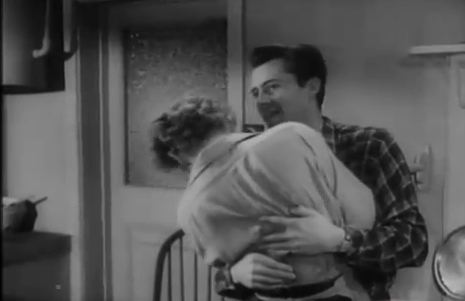
Alexis is surprised to see the Doc emerge from his office carrying Bogarde in his arms, taking him to his bedroom upstairs. The picture of father and son, or Pygmalion with a new Galatea.

We know from the fact of his subduing Dirk Bogarde at the beginning of the movie, which happens off camera, that Knox is a physically powerful man. Bogarde still bears the bruise on his twisted wrist. His first chastisement from Papa. When we see Knox carry Bogarde, it strikes us that not once in this movie has Knox ever taken Alexis in his arms.

We see there is a triangle here, not with the lab assistant, though she’s still in the ballgame. Alexis has lost her lover to her husband. They spend father-son fishing trips from which she is excluded.

She anticipates their homecoming excitedly, but only Doc comes home, and only because he remembered he has a paper to write. He did not come home to be with her, and Bogarde is distancing himself because he now thinks the Doc is a swell guy, and he feels guilty about luring his wife into cheating on him. She is more lonely now than she ever was before Bogarde came into their lives.

The Doc just gets more and more interesting. How much does he really know about their relationship? He declares Bogarde is cured. He confesses how hard his job has been, that as a therapist he is not supposed to show fear, dislike, or jealousy.

“Jealousy?” Alexis asks. Is she flattered that he might be jealous of Bogarde’s time with her? Or is she worried that he knows about her passion for Bogarde?

He suggests that he and Alexis should go on a vacation together. Earlier she would have jumped at the chance, but now she doesn’t want to leave Bogarde and she can’t tell the Doc that. What power over her does he have that she simply cannot ask him for a divorce? She becomes secretive and paranoid. She finds Bogarde at the inn where he is staying now and begs him to come back. “You’ve never seen me really angry. I warn you, you don’t know what I’m capable of.” It’s not a threat, it’s an intriguing, whimpered confession and is one of those elements in the script that gets dropped in but never explained.

But Bogarde is firm in breaking up with her because he just can’t hurt the Doc anymore. When he returns to their house to pack up his things, she finally rages at the humiliation to which he’s subjected her.

“You’re not going to give me notice like a waitress.” In her torment she has bit the back of her hand until it bleeds, finds the blood on her mouth. She’s gone over the edge. She staggers to the Doc, inferring that Bogarde became violent. Goads him into doing something about it, demanding some emotional response from him.  Doc goes for his handy dandy handgun in the desk drawer to avenge his wife.

Lab assistant tries to stop him (my heavens, this woman is always skulking around), but we hear the sound of a shot, and Alexis, shattered,

“You killed him?” she asks when Doc emerges from Bogarde’s room.

“That’s what you wanted, isn’t it?” The man of science. We see that it’s a trick. He never shot Bogarde. He wanted to jolt Alexis into confessing her feelings for him. How long has he suspected? This man never lets a chance pass to do an experiment, to “wind up people like little toys.” What must it be like to live with a man who turns every encounter with his wife into a psychotherapy session?

When Bogarde swooned to the floor, Knox cradled him in his arms. When his wife crumples to the floor in a sobbing, confused mess, he stands over her with probing questions and a shining light in his narrow eyes in what is probably the most cruel scene in the movie.  Doc is not a fiend, but his relentless clinical approach to everything has cruel repercussions.  They are both tragic.

Alexis bolts out of the house, now that she knows Bogarde has gone and there still might be a chance for her to catch him.

Finally…finally, we get some plot exposition from the lab assistant, who tries to keep Doc from going after her, “Let her go. It’s been wrong between you for years. You’ll never put it right.”

Whoa, about time, lady. Where were you in the first reel?

But what exactly do you mean? Riddles are pointless without solutions.

There’s a bit of a chase scene here, and the upshot is Alexis drives through what appears to be a circus billboard with a lunging tiger painted on it. She dies. Did I mention there would be spoilers?

I have a problem with the protagonist dying at the end of movies like this. Wages of sin and all, I know, but still, it smacks of laziness and the writer’s inability to find a resolution so it’s just more convenient to kill the character off.

We have no resolution for anybody, except that Bogarde intends to give himself up to Hugh Griffith to set things straight. But Doc expresses no emotion at the physical wreckage of his wife anymore than he did her emotional wreckage. Lab assistant, always prepared, remembers to grab his coat as they leave together for the chase scene. What is her story?

This is a film where the set decoration tells us much (or at least is supposed to) about the story and characters. We see that Alexis and Doc have twin beds in their room, but whenever she is in a bedroom with Bogarde it’s on a double bed. We get the message about Doc’s personality from his office. But the photos of Alexis all over the house are put there for what message?

In classic films I think we tend to know little about set designers, at least not as much as we know of costumers or cinematographers. In theatre they are immensely important because when it comes to deciphering a set, theatre audiences tend to be more sophisticated than film audiences. They know that everything on the set is there for a specific reason. The stage director hasn’t the luxury of a film director of soaking up a variety of images just by panning the camera. All he has to work with is this space.

Among classic film directors, I think Alfred Hitchcock was the most cognizant about this, the most theatrical, and obviously left his mark on every frame. You just know everything’s in the shot for a reason. Joseph Losey gives us as much as he can with “The Sleeping Tiger” in terms of imagery (including a couple of interesting mirror shots) -- again, which sometimes provoke more questions than answers, but some answers can only be provided in the script. And they aren’t there. We come to know all we need to about Dirk Bogarde, but the others in the original triangle -- Doc, Wife, and Lab Assistant -- are still beyond our reach.


The movie is one of a string of films made in this period about the mysteries of psychoanalysis, movies often lurid and fantastic, but in this case it’s interesting that psychology is used as the basis of a love triangle, and for manipulation. What Doc does is on purpose. What Bogarde does is on purpose. Only Alexis seems powerless, losing her grip on her emotions and on her thinking bit by bit until she destroys herself with her obsession.

As mentioned in Monday’s post, this movie is on YouTube here in a single file. Please go have a look, and when you’ve seen it, come back and tell me what you think. For once, we can all watch the same movie together. Pass the popcorn. And, as The Muppets say, no singing opera during the movie.

Related Products