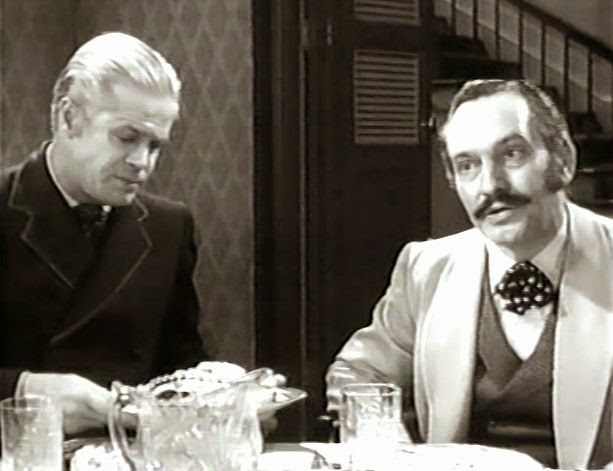
The film is currently not available for sale either in VHS or DVD,
and this is a shame. I think
it’s time to take a large battering ram to the Universal vault. Where are all those rampaging village idiots
with the flaming torches and pitchforks when you really need them? Off chasing Frankenstein's monster when they should be here. UPDATE: This film has been newly released on DVD in 2017!
Long post. Oh, stop crying and pull yourself together.
All three elements of acting, writing, and direction come
together so perfectly, so intensely that the movie stands as a remarkable work
of art—truly, and timeless.
The
screenplay by Vladimir Pozner is based on the Lillian Hellman stage play.
The story is of the Hubbard family, a prequel
to her
The Little Foxes, which had
been wildly successful both on Broadway and in the 1941 film starring Bette
Davis.
Another Part of the Forest takes us to the earlier years of the
three inscrutable Hubbard siblings and how they got to be that way.
The second element is the flawlessly creative and evocative
direction by Michael Gordon, which we’ll get into in a little bit.
It is, I think, the best filmed version of a
stage play I’ve ever seen, because it takes the intimacy and the dynamics of a
live stage setting and yet implements those tricks and nuances of film to make
it a kind of hybrid film-play.
Some
stage plays are filmed with a static camera and so we are left with what
appears to be an authentic image of the play, but it seems stiff on film.
Conversely, some stage plays are adapted to
film in such a manner that we forget they ever were on stage; the director
applies superfluous
action and settings that draws away from the intensity of the literary drama.
But in
Another Part of the Forest, we have a director who understands the subtleties of the finest
elements of film and stage, and combines them in a beautifully artistic
way.
The third basic element to the making of any great film, of
course, is the acting and here we have an ensemble cast who simply could not be
better.
We see on the opening title card
the unusual setting of the four main players all listed equally above the title
and they deserve it.
They are a well-oiled
team.
I wonder how long these scenes,
particularly the dining room scene, was rehearsed, because it looks for all
like they’ve been playing it on stage for months.
The story is set in 1880.
Fredric March plays Marcus Hubbard, patriarch
of this dysfunctional clan.
His
real-life wife, Florence Eldridge plays his wife Lavinia.
He is a storekeeper and up-and-coming
businessman in a sleepy southern town, and he has been branching out into
different investments that have been profitable for him.
He gives loans, he takes over mortgages, growing
his tiny economic empire.
He is a shrewd
and cunning man, and not at all likable.
He is rude and blunt, and openly displays his disdain for his customers,
his family, his community.
He is also something of a pariah in his town because of an
incident that happened fifteen years earlier during the Civil War. He was a merchant even then, and he was
accused of profiteering from the war by securing a supply of badly needed salt
and then charging high prices for it to a war-torn townspeople who couldn’t pay
for it. Marcus is proud, defiant, and
totally uncaring in a kind of Scrooge-like way about the needs of others. He is focused on his own advancement.
His wife, Lavinia, a soulful, gentle, frightened woman is
his whipping boy in the sense that she carries the burden of his guilt because
only she feels it.
But there is another
secret between them, and another secret in the town of a terrible betrayal that
occurred during the war leading to the ambush and massacre of several local
boys in the Confederate army, and it isn’t until the end of the movie that we
discover the traitor.
Fredric March is riveting. The character alone is intriguing. Marcus had
pulled himself up by his bootstraps, emerged from a hardscrabble boyhood through very hard work. When he was still a boy,
he took his first hard-earned dollar and bought a card at a lending library. While he was still a child in the fields and
driving a mule team, with what little free time he had he taught himself to
read and then he taught himself languages: French, Latin, Greek. He read the classics and he desired what he
saw in those classics: a sense of beauty and grace that was denied him in
shabby poverty. There is much to admire
in Marcus.
But like those ancient Greeks and their tales and fables, he
bears a fatal flaw, and that is his avarice.
Though he has a deep love of beauty and literature and music, there is a
very strong strain of the acquisitor in him, so much so that like all
acquisitors, his main joy is not in the appreciation, but in the simply possessing, the controlling. Fredric
March is stunning in this role, and we at turns can despise him, can feel sorry
for him, and yet also can admire him for his clear thinking. There is a certain nobility about him. If it weren’t for his weaknesses, he could be
a great man.
His three children are the sins he created and also the
burdens on his back.
Edmund O’Brien
plays Ben, the eldest, a man about thirty years old who is taking after his
father, inheriting his father’s intelligence, shrewdness, and acquisitive
acumen, and also his hardness of heart.
But he has something his father hasn’t, and that is a true sense of
graciousness.
It is a false graciousness
in many instances.
He is able to speak to
people, to make people like him, to ingratiate himself when he needs to, to
close a business deal, where his father is just rude.
Edmond O’Brien does not have his father’s
arrogance, but he is double the monster because, like his father, he has no
heart or feelings for others.
Any
display of affection or kindness is merely a tool he uses to get what he
wants.
The wheels are always
turning in that sneaky mind.
I think it is one of Edmond O’Brien’s best roles and he
commands most of the scenes he’s in. It
makes you wish he had done more leading man parts instead of character roles,
but in a role like Ben Hubbard he gets to do both, and he’s quite good.
The second son is Oscar, a weak-willed sniveling creep, who
has the position in this film as a kind of comic relief.
He’s played by Dan Duryea in whimsical
casting because Mr. Duryea earlier played Oscar’s son in the film
The Little Foxes.
Oscar’s son Leo in that film was very much
like his father is in this film.
Duryea does not have that sinister sneer he wears in other
villain roles.
Here he is helpless in
his petty self-absorption, and we can even feel sorry for him, particularly in
the luncheon scene when he says something stupid and his father makes a
sarcastic reply.
Duryea looks down, wearing
an expression of pain, because he knows he put his foot in his mouth
again.
He just can’t please his father, lacking shrewdness, and he
is the most despised by his father for his ignorance. Duryea is also an undisciplined hothead, much
more so than his father. He is easily
led, and by the end of the movie, Edmund O’Brien will do the leading.
The youngest sibling is Regina, played Ann Blyth.
Here she has one of her best roles and one of
her most complex and sinister, even to rival Veda Pierce.
In the movie
The Little Foxes, Regina is played in middle age by Bette
Davis.
Perhaps not so coincidentally,
Ann Blyth in this period of her career was being called a young Bette Davis.
Regina is attractive, sexy, and her moods rise and fall--coldness to her mother, a beguiling charm to those who can do most for her. She is shrewd and intelligent
like her elder brother and her father.
She also bears their flaw of avarice and the need for power, but she has
another need which neither father nor elder brother seem to share: she juggles
a strong sexual longing, where the other two men appeared to be asexual. They lust only for money.
John Dall plays Capt. John Bagtry, a man in his thirties who
left the best part of his life behind him in the Civil War.
He is the cousin of Miss Birdie Bagtry played
as a delicate flower by Betsy Blair.
Betsy and her mother still run the old plantation and are struggling
financially.
John lives there on charity,
not able or willing to contribute to his support.
He just loafs and dreams of the old days when
he was a gallant soldier.
When we first
see him, he is still in uniform, having attended a Confederate Day service.
He is the pathetic object of Ann Blyth’s
lust, and though John Dall is happy to let himself be captured for stolen
liaisons, he does not want to marry her.
He does not want to do anything but live in the past, and it takes a
while for her to see that.
Another sticky relationship she juggles is the one with her
father.
Fredric March has only one
weakness—and that is his daughter.
He
loves her more than his wife, more than his despised sons and his relationship
with her is somewhat incestuous.
Not
literally of course, but emotionally.
He
splurges on her and when he arranges to go for a walk with her, it looks for
all as if he is courting her. She refuses an invitation to spend the afternoon with her mother, who suddenly looks like a wallflower losing her beau to a more glamorous rival.
In one scene, several
boxes of dresses have arrived that she ordered from Chicago, and she takes them
out and shows them off to the family, like a child trying to make her brothers
jealous that her father is spending money on her.
She lifts one gown out of its box and goes to
sit on the arm of her father’s chair.
She spreads the skirt of the dress over her lap and over his, and he is
obviously delighted with her, and she knows this, and she’s using it.
She’s manipulating him, and in certain
scenes, seems to coyly dangle herself before him.
They are always “Darlin’” to each other.
But she’s playing with fire, as her older brother Edmond
O’Brien teasingly reminds her. She and
Mr. O’Brien walk up the stairs, a promenade-cum-plot exposition, while she gloats about her ability to control her
father and O’Brien suggests that one day she will be a forty-year-old woman and
will still be taking care of her father because he won’t let her go.
Edmond O’Brien is in the background, a calm look of command
on his face.
In the foreground, we see
Ann’s expression has turned from gloating to one of cold fear.
Staying with her father until she is forty is
just the thing she does not want, and knows that she must not let her father
get too great a control over her.
She
spends the better part of the movie walking a tightrope in her unnatural
relationship with her father.
She wants the pretty things he buys her, but she wants to be
in John Dall’s bed. Controlling him.
Late in the film, a climactic scene occurs when the
Bagtrys come to a train wreck of a party at the Hubbard’s house, along with a
floozy girlfriend Mr. Duryea has invited, played by Dona Drake, and we see a smashing of wills,
intentions, and the worst of these people come pouring out.
John Dall has a plan to take borrowed money and travel to
Brazil where they are having a revolution.
He wants to be a soldier again.
As
Betsy Blair explains, the “radicals” are trying to abolish slavery down there
and “ruin the country” and her cousin is going to fight for his “ideals” to
preserve slavery.
Fredric March is the only
courageous one in this polite bunch who dares to snub the "quality" folk and tell the once-and-future Confederate to his face that he's a jerk. But his reasons for doing so are only partly because of his admiration for the
vox populi of his heroes of Ancient Greece. Mainly, he just enjoys telling people off.
He is also jealous of the man who appears to have turned his daughter's head. He refuses to lose her to anyone.
Ann Blyth, in a profile view, stands silent during the
discussion while a leaden epiphany sneaks up on her, her eyes curiously roaming
on John Dall as her father berates him.
We see the truth is settling in that John Dall will never be anything
than what he is—a boy in his thirties who can’t give up playing the soldier, a
job that was never really more than an ego trip for him and if he were fighting
for as ideals, his ideals are pretty shabby.
And yet she wants him for the sexual hold he has over her, which she
imagines is reciprocal.
However, she gets another grim surprise that evening when
the floozy that Duryea invites also appears to know John Dall intimately.
Clearly, he is not as obsessed by Ann as she
is with him.
The intricate plot flip-flops constantly in the tricks the
siblings and father play on each other, like kids playing keep-away with
somebody’s hat on a schoolyard, only it is bits of information they toss around
and keep from each other, and tell lies instead. It is all a lovely, literate, shell game.
There is so much to admire in the staging of the film, in the camera blocking where characters in the background are as much as part of the intensity of the scene, and where mirror shots allow for a larger grouping.
March’s store is filled with goods and items and trinkets and you could
spend the whole movie just looking at everything.
There’s a comic scene where Dan Duryea, afraid that a lynch
mob might be after him for something he did, walks through the store and bangs
his head on a pair of men’s riding boots hanging from the ceiling.
He looks up and we see instantly it is like
an image of a man being hanged, and we see only his boots dangling from a
tree.
It’s sinister, but it’s also
funny.
Another fascinating sequence is where Duryea and his gang of
KKK friends chase down a Yankee visitor and beat him up.
There’s a scene where a horse rears and we
see the horse’s mouth open and his sharp teeth parted in a grimace.
Immediately we cut to the local saloon where
Duryea’s floozy girlfriend is dancing a can-can.
In a flirtatious toss of the head to her
audience, her teeth are parted in the same manner as the horse.
We cut back to the Yankee being dragged to
the ground, trampled in the forest of legs around him.
Then cut back to the can-can
where the floozy drops to the floor of the stage looking submissively at the
audience, tauntingly, seductively in the forest of legs of dancers around her.
The shots of the brutal beating and the dance
are erotic mixture of violence and pleasure.
The camera work flows beautifully from the very beginning of
the movie. There is a Confederate memorial
celebration where a speaker refers to an act of betrayal and he points to a far
hill to discuss an event of the past.
But the past becomes instantly the present, as the camera swoops to the
hill and we see Florence Eldridge hiding with a bouquet of flowers waiting to
place it at the memorial.
We hear a train whistle, and she looks over her shoulder at
a distant passing train and the camera swoops to the interior of the train and
there is her son, Edmond O’Brien. It is
so flawless and keeps the action moving wonderfully.
The costumes, the hair, the makeup, the men’s full sideburns
and muttonchops are historically accurate and not caricature. There is no cartoon campiness of the Old
South, here it is all very real and unblinking.
We see the mother has a good relationship with their
three black servants, especially with Coralee, played by Libby Taylor, who
finds small and clever ways of protecting Lavinia from her family’s meanness. In
the play, we are told that Mrs. Hubbard actually goes to the black church
because she feels more at home there.
She feels the congregation is more spiritual; besides, she is the wife
of Marcus Hubbard and so she is ostracized from the white townspeople, the "quality folk."
At the end of the film, Edmond O’Brien has wrested his
father’s business and fortune from him through blackmail.
Fredric March wants to run away with his
daughter, and tells her he will continue to find a way to provide for her.
But Ann Blyth has had enough of this cloying
“suitor."
She considers her options,
pouring herself a cup of coffee on the patio while Edmond O’Brien announces his
plans to invest his father’s money and make still more, that they will all be
rich.
Her father, beaten and begging her attention, asks her to pour him a cup of coffee too. In a priceless image of nasty
survival instinct, Ann Blyth, one eyebrow raised, walks away from her father
and sits down by her brother.
She gleefully agrees to let Mr. O’Brien plan
her marriage to his future business partner, Horace Gibbons.
She gives up her lust for the fleeing John Dall in exchange for a profitable, and loveless, marriage.
She, Edmond O’Brien and Dan Duryea will continue to squabble
and play tricks on each other the rest of their lives and become the people we
know from
The Little Foxes.
Part of our enjoyment of this film is knowing
where they ended up.
It’s difficult to pick out favorite scenes because they’re
all so very fine, and the dialogue crackles, especially when Fredric March rises
to sarcasm.
Then there is the delectable
cagy sparring between Edmond O’Brien and Ann Blyth.
Dressed in her new finery, showing it off for
O’Brien, she taunts him, “I just wanted to show you what you’ve been paying
for.
How do I look?”
He replies, “Bright and shiny, honey, like a new two-bit
piece.” A lovely backhanded compliment,
and we see the insult is not lost on her.
And when the Yankee carpetbagger, a guest at the Confederate
memorial ceremonies, responds with surprise, “In Boston, we stopped fighting
the war fifteen years ago.”
To which the old Confederate soldier, a town pillar,
replies, “You won it. You can afford to
forget.”
And I love Dan Duryea's nervous Woody Woodpecker laugh, that Fredric March even imitates at one point.
Today we have many sequels and prequels of films.
It’s become kind of a standard practice, but
it is not done for the storytelling—it is for the merchandising, and we know
that. Yeah, I’m looking at you “Star Wars 23.”
Another Part of the Forest was created by Lillian Hellman for the excitement
of discovering more about the characters, knowing with a writer's instinct that there really was more to the story she had left on the table.
This film was one of the first times a
prequel was created and some of the critics didn’t seem to know how to take a
prequel.
Lillian Hellman, unfortunately, did not really have any part
in the making of this film.
At this time,
she became blacklisted in Hollywood for her refusal to cooperate with the House
Un-American Activities Committee.
Lillian Hellman, who wrote the play
Watch on the Rhine, which Ann appeared in on Broadway as a child,
discussed here in our intro post, proved to be good luck again for Ann.
She shows again how adept she is at playing
complex women, not simply females who were dastardly.
Louella Parsons announced in December 1946 that Ann, “…that
marvelous child actress, who did so well in
Mildred Pierce,” had won the role of Regina.
It was a splendid opportunity for Ann Blyth to work as part of a
top-notch ensemble cast, and so demonstrate an ability to stand out among
them.
Syndicated columnist Dorothy
Manners wrote, “In spite of her tender years, she is one whale of an actress…When
Fredric and Florence March were here, they said they would like to do a show
with Ann on Broadway.
That’s real
praise, because the Marches do not usually like anything in Hollywood.”
The columnist Sue Chambers wrote, “Fredric March, who
doesn’t usually go overboard for the young and unsophisticated told me, ‘She’s
a great actress,’ when he was doing
Another Part of the Forest with Ann.”
Apparently March wanted her for his upcoming film
Jupiter’s Wife, but according to this columnist, William Powell
snagged her for
Mr. Peabody and the Mermaid
(For which she took time out from
Another Part of the Forest to fabricate the mermaid’s tale,
which we discussed here),
and Chambers commented, “How about all this for a girl who isn’t yet
twenty?”
I’ll go one more and say that, as regards her portrayal of
Regina Hubbard, if
Gone with the Wind
had not made it to the screen until 1949, instead of having been made ten years
earlier in 1939, Ann Blyth would have been a top contender for Scarlett.
Ann remarked of Fredric March and Florence Eldridge in a 2006 interview with Eddie Muller: "To watch both of them so impressed upon me. They were so good at what they did. He was terrific. It was just electric to be on the set even if I wasn't in a scene with him. He was wonderful."
Another Part of the Forest
was also made as a
Lux Radio Theater presentation, with Ann as the only cast
member from the film.
Walter Houston
played her father Marcus and Vincent Price played her brother Ben.
You can hear it here at the Internet Archive website. Unfortunately, the quality is a
bit muffled, but it will give you an idea of the story.
Later on in November 1948, Ann also re-teamed
on radio with Edmond O’Brien in the
Suspense
story “Muddy Track.”
The quality is quite good and you can listen to it here.
She plays a woman who is not all what she seems to be, and he is a man in
trouble and on the run.
At the end, the
announcer reminds us that she can now be seen in
Mr. Peabody and the Mermaid.
The copy of
Another Part of the Forest I managed to obtain was in poor condition, but I was lucky
to be able to find it at all.
This film
badly needs to be restored and released for sale, not only because it is
one of the best films of the era, but because it is an example of stellar American
playwriting of the twentieth century, and about distinctly American themes.
I
don’t know about the complex legal machinations involving the Universal vault
and what keeps so many Universal films, thereby of course, several Ann Blyth
films, from not being widely shown again, but I certainly hope that TCM is able
to use its influence and free these films from that stupid vault.
I still think a battering ram is a good option. SEE UPDATE ABOVE -- The film has been released on DVD! Saints be praised!
Come back next Thursday when we jump ahead to 1957, the year
Ann’s last three movies were released, all very different and showing, not
surprisingly, her versatility.
However,
her film career was winding down as good roles were getting harder to come by
for a 29-year old in an industry
that was changing.
Her second-to-last
film was
The Buster Keaton Story, the
last time she was paired on film with her first co-star and old friend, Donald
O’Connor.
**********************************
The Deseret (Salt
Lake City, Utah) News, syndicated
article by Dorothy Manners, February 4, 1949, p. F-3.
The Evening Class Blog, July 28, 2007, transcript of Eddie Muller's interview with Ann Blyth July 2006 at Castro Theater, San Francisco.
Milwaukee Journal,
syndicated article by Sue Chambers, February 29, 1948.
Milwaukee Sentinel,
syndicated article by Louella Parsons, December 27, 1946, p. 10.
*********************************
UPDATE: This series on Ann Blyth is now a book - ANN BLYTH: ACTRESS. SINGER. STAR. -
"Lynch’s book is organized and well-written – and has plenty of amusing observations – but when it comes to describing Blyth’s movies, Lynch’s writing sparkles." - Ruth Kerr, Silver Screenings
"Jacqueline T. Lynch creates a poignant and thoroughly-researched mosaic of memories of a fine, upstanding human being who also happens to be a legendary entertainer." - Deborah Thomas, Java's Journey
"One of the great strengths of Ann Blyth: Actress. Singer. Star. is that Lynch not only gives an excellent overview of Blyth's career -- she offers detailed analyses of each of Blyth's roles -- but she puts them in the context of the larger issues of the day."- Amanda Garrett, Old Hollywood Films
"Jacqueline's book will hopefully cause many more people to take a look at this multitalented woman whose career encompassed just about every possible aspect of 20th Century entertainment." - Laura Grieve, Laura's Miscellaneous Musings''
"Jacqueline T. Lynch’s Ann Blyth: Actress. Singer. Star. is an extremely well researched undertaking that is a must for all Blyth fans." - Annette Bochenek, Hometowns to Hollywood
Ann Blyth: Actress. Singer. Star.
by Jacqueline T. Lynch
The first book on the career of actress Ann Blyth. Multitalented and remarkably versatile, Blyth began on radio as a child, appeared on Broadway at the age of twelve in Lillian Hellman's Watch on the Rhine, and enjoyed a long and diverse career in films, theatre, television, and concerts. A sensitive dramatic actress, the youngest at the time to be nominated for her role in Mildred Pierce (1945), she also displayed a gift for comedy, and was especially endeared to fans for her expressive and exquisite lyric soprano, which was showcased in many film and stage musicals. Still a popular guest at film festivals, lovely Ms. Blyth remains a treasure of the Hollywood's golden age.
The eBook and paperback are available from Amazon and also available in eBook at:
You can also order it from my Etsy shop.
If you wish a signed copy, then email me at JacquelineTLynch@gmail.com and I'll get back to you with the details.