IMPRISON TRAITOR, PEDOPHILE, AND CONVICTED FELON TRUMP.
Showing posts with label Barbara Bel Geddes. Show all posts

Thursday, October 18, 2012

Caught - 1949


“Caught” (1949) is one of those movies that reminds us, deliciously so, that what the story is about is sometimes not as important as how it is told. After all, there are just so many different plots. Director Max Ophüls (or Opuls) achieves intimacy with his characters in small, very telling ways that in the hands of another director might be cliché, in a story that could have been very melodramatic.


The story is about false values and how we surrender to them. Illusions we create to trick ourselves. The movie is a morality play without getting preachy, because we can understand how lead actress Barbara Bel Geddes is lured into an unhappy situation. It could happen to anybody, and does, every day. For her, it is the goal of marrying a wealthy man. For others, it might be falling under the thumb of credit card debt or backstabbing fellow employees to get the corner office, any number of horrid scenarios in which basically good people lose themselves in the struggle for what we imagine is the good life.

Fans debate over whether it is true film noir. For my money, it is, and not just because of all those table-height shots (which are quite important to the telling of this story - more about that later). I would call it noir for more than the stark cinematography, but rather for the self-imposed sentence of doom the principle characters endure. Even the weak ending to the story, which seems some sort of compromise, does not negate that most of the film is a dark journey into wretchedness caused by the characters themselves.

The movie lulls us into the mindset of false values from very beginning. Over the opening credits, we see lush magazine ads from some high-tone publication. Ladies’ gowns, jewels. The camera pans back, and we see two young women, ogling the expensive merchandise, pretending what they would buy if they were rich. It’s a normal scene, people do this all the time. Nothing nefarious about two girls drooling over a picture of a mink coat, smoking their cigarettes on a chenille bedspread. The mink coat image is going to play a big part in this movie.

By the way, a mélange of spoilers ahead. Discreetly look away if this troubles you.

And this one is going to be long. Go long. I’ll hit you in the end zone.

Barbara Bel Geddes (what a great name) is a young carhop who wants to marry well. She is encouraged to do so by her roommate, played by Ruth Brady, who insists that Barbara must better herself and go to school. We might agree, but then we understand she means go to charm school. “Without a social education, you’re never going to meet a real man.”

Before we think charm school too frivolous, which in these days most people probably do, we need to recall that there once was a real emphasis on the social graces to getting ahead in society and in business. Not undeservedly so, (I wish a few more people today would go to charm school. I’m not talking about you. They know who they are. Maybe.), though this movie shows us the dark side of putting importance only on the appearance and not the substance of a human being.

Have a look here at one of my favorite blogs, Shopping Days in Retro Boston for a post on the charm and etiquette classes department stores offered for young ladies that were popular right up until the early 1970s. As blogger “Charles Boston” relates:

“Charm schools, etiquette classes or fashion guidance seminars were offered by most of the once great Boston stores. Beginning gently in the 1930’s R.H. White’s offered a short course from a visiting expert in the “field of charm” and then by the 1940’s Jordan Marsh began the Marsha Jordan Fashion Board (also called “fashion council” in some years) and Chandler’s began the Junior Charm School for young ladies.

The Jordan Marsh Marsha Jordan Contest phenomenon was a huge success for pre-teen and teenage girls and carried on well into the 1970’s.”

So Barbara Bel Geddes’ foray into the charm school run by Natalie Schafer (Mrs. Thurston Howell, III, to you), is nothing at which to snicker. Lessons in the social graces were considered to be ammunition for making your way in the world. Today...not so much.

Director Ophüls makes some interesting decisions. We see Miss Bel Geddes first in rolled up jeans, a girl dreaming of pretty things money can buy. Ruth Brady sits at their card table and figures out the finances. The folding card table that could be bought from any discount store is an image of their poverty and social level.

Tables seem to be of great importance in this movie. When we see the girls at charm school sitting at a table, enacting a practice scene of social introduction between ladies, we may not notice at first that the table, a sturdy wooden prop, is actually quite scratched and worn. It is an unmentioned, scruffy reality behind a sham presentation.  This rented office Natalie Schafer uses is a stark contrast to her elegant clothing and white gloved practice handshakes. Like Kathleen Freeman, the comic vocal coach in “Singin’ in the Rain” (1952), Miss Schafer exhorts the girls to “speak out, full tones.”

With her new education, Bel Geddes gets a job as a store model, wearing what else? A mink coat. Well-heeled ladies finger her garment, including Beaver’s mom, Barbara Billingsley.

Another customer eyes her goods. He’s Curt Bois, whom you may remember from “Casablanca” (1943) as the pickpocket, “Vultures, vultures everywhere.”

Here, he’s Robert Ryan’s slimy toady, who picks up girls for Ryan. Nice scene where Bel Geddes, who is onto Mr. Bois, opens her coat one side at a time at his request to see the lining. She reveals her figure, which was what he really wanted to see, and then he invites her to a party on Ryan’s yacht.

Her roommate, of course, urges her to go because Mr. Ryan is richer than rich, and that is their object. Miss Bel Geddes is reticent and replies, “I resent the whole setup.”

It’s the last bit of integrity we see from her for the rest of the film. She goes to the party, and though Ryan sweeps her away from it to do business in town, leaving her to fall asleep alone in his convertible, she links herself to this fellow and her own downfall quite willingly.

Robert Ryan is masterful in this movie. It could be such a mustache-twirling role, but instead of playing at villainy or going over the top as another actor might, Ryan attacks the character just as the character attacks life. He makes us believe that he is genuine. That is what is so frightening about his character. He believes in himself.

He’s handsome, rugged, educated, lives in a mansion, owns everything, and is supremely wealthy. We cannot really blame Bel Geddes for marrying this man when everybody from her roommate, and all of society is telling her she’s nuts if she doesn’t. The newspapers call her the carhop and emphasize how lucky she is. One headline quotes her proud mother saying she always knew her daughter would be a success. She’s the Cinderella girl.

When Ruth Brady visits her at her husband's mansion, she thrills at the fairyland wonder of being rich, and bellies up to the lifestyle like a pig at a trough.

Our Cro-Magnon ancestors would have understood. The female early human, just like a female animal, received only the strongest male, and became his prize. Despite the Renaissance notion of romantic love giving us a lot of lovely poetry, we see that for Barbara Bel Geddes, the 20th century harkens back, in its confounding commercialism, to those ancient days when “a real man” as Ruth Brady puts it, was the alpha male.


Robert Ryan is a terrific alpha male, with something skewed that the director lets us in on right away. Shortly after he and Barbara meet, we see him visiting his psychiatrist. They have a sparring relationship. Ryan is impatient, irritated, annoyed with the doctor’s assessment of Ryan as a man who likes to have his own way, to the childish extent of developing psychosomatic illness if he does not. Ryan believes his angina attacks are because of a bad heart. The psychiatrist, played with wonderful world-weary frankness by Art Smith, tells him he only gets these attacks if he doesn’t get his way. Like a spoiled child’s tantrum. Ryan is paranoid about his money to the extent, as the doc says, of never wanting to marry because he believes a woman would only be after his money.

Ryan, in a child’s you’re-not-the-boss-of-me mode, picks up the phone and calls his toady to get that girl -- he cannot recall her last name -- and make arrangements for quickie wedding in Yuma. There, he showed that doctor a thing or two.

The idea might seem ridiculous, but the scene is quite chilling. We see at once what lengths Ryan will go to not to be topped. He has no feelings for Barbara Bel Geddes, except to use her.

As his wife, her life becomes a series of insults, humiliation, and psychological abuse. He tests her loyalty by making her stay up until the wee hours of the morning to act as hostess for his impromptu business meetings. She is bejeweled and coiffed, and wearing gowns, and that coveted mink, but she is a prisoner in a cage. Her only companion is Bois, who is his master’s stooge. Bois, irritating and concerned only with his own self-preservation, expresses no sympathy for her, only wheedles her into doing what the boss wants. But the boss is never pleased.

Ryan works his mind games on her and makes her feel unworthy. In another interesting table scene, the camera is level with the pool table in one of cavernous rooms in his mansion. She sits bewildered, overtired, on a low stool while he conducts a miserable tirade of insults and accusations in a cool, firm voice. He is as authoritative as he would be in a business meeting. The only thing that betrays his sociopathic obsession is the way he continuously rolls billiard balls on the table, grasping them one by one, tightly, and then firmly shoving them across to carom off the sides. In other scenes, he will clench his fists as he talks, as if trying to suppress an obsessive tic. (Though the story is based on a novel by Libbie Block, screenwriter Arthur Laurents and the director flavored the character with personality traits of Howard Hughes.)

We might well wonder why on earth she doesn’t leave Ryan, clearly a bully and master of manipulation. That answer is supplied later on in the film by James Mason. He plays a doctor in a struggling practice on the lower east side of New York. He will eventually tell her that she married Ryan for the security, the goods, the money and not because she loved him. She tells herself, and others, that she loves him, but she is fooling herself. She does not want to feel guilty or admit that she is wrong.

This is another noir element to the film. Bel Geddes may be a victim, but she’s hardly honest. She is a golddigger.  James Mason is the hero who will rescue her, but he’s no knight in shining armor for all his ministering to poor patients as a pediatrician. In one scene, a child nearly dies because he has ignored important symptoms. But he accepts his mistake and learns from it.

Miss Bel Geddes walks away from Robert Ryan and takes a job as the receptionist in the office shared by Mason and the terrific Frank Ferguson, who is an obstetrician. Ferguson is one of those fellows who we may recognize in bit parts in a zillion TV shows and movies. I wonder if this was his largest role? He is my favorite character in the movie. He stumbles in and out of his office, vest unbuttoned, kindly and patient, but always exhausted. Because he delivers babies at all hours, he takes odd moments in the office to shine his shoes, or shave himself. There’s something really quite endearing about his character.

Bel Geddes, who never pursued anything of worth, or put any effort into it, is a lousy receptionist and Mason bawls her out. But his criticism is not like Ryan’s. He does not diminish or humiliate her. Rather, he calls her out on flaws that she’s smart enough to fix if she weren’t so lazy. Mason is exasperated with her mink coat and foolish sense of values. Even the nurse, when Bel Geddes applies for the job asks her, “I hope you’re looking for work and not a husband.”

In the mindset of the times, one can hardly blame her suspicions.

Or blame Bel Geddes if she was just looking for a doctor husband.

Bel Geddes is lost, and vulnerable. Robert Ryan shows up at her shabby one-room apartment, contrite. The only thing more humiliating than him berating her is him feeling sorry for her living conditions, with the noisy L track outside her window. We see, too, that she has reverted to using a card table for her meals and to practice her typing. The most gallant thing Ryan ever does in this movie is help her to fold it up.

When he asks her out, she slips her hand into the closet covered only by a drab curtain, and pulls out her mink coat.

Next is the morning after scene. She’s in their bed in the mansion, one strap of her negligee artfully slipped down off her shoulders as the toady Bois wakes her. Ryan wants her up and at ‘em in an hour. He and his business colleagues are touring his plants across the country. She has to come along for appearances.

She’s had it. She goes back to her reception work for the doctors, and really applies herself this time, taking shorthand lessons, studying medical terminology and office procedures. She’s finally making good.

But we are not entirely surprised when she comes into the office early to greet Frank Ferguson just back from a late-night call. It occurs to us when she timidly taps on his door…he’s an obstetrician.

The last night of passion with Ryan has resulted in pregnancy. We know she’s pregnant by the way she steps out from behind the screen and buttons her blouse; we know it before the test results have come back.

Her dilemma now is more than just carrying the child of a man she loathes. She also makes a friend in Mason. He sees her without a warm coat on a cold day (she has put aside her mink) and buys her a cloth coat. A touching moment of ironic gratitude when she accepts, as if he has given her diamonds.

They struggle through a crowded dance floor on their first date, and we see her laugh for the first time. On their first date, he proposes.

Habit and the force of what a commercial society has told her from puberty is too strong for Bel Geddes, and she goes back to Ryan, the alpha male, so that her baby can grow up with all the good things.


Possibly my favorite scene in the movie is when Mason and Ferguson are alone in their office late at night discussing Bel Geddes’ disappearance. Here is where the director steps in again and tells the story in an intimate, artful way. The camera settles on Ferguson, standing in his office doorway, laconically shaving himself with an electric razor, enjoying a quiet moment before the next medical call.

The camera slowly swings across the empty desk where Bel Geddes usually sits, over to the office doorway of James Mason. He leans against the doorframe, puzzling aloud why Barbara has left them. The camera goes quietly back and forth between them. On the corner of her desk are empty in-boxes for each doctor with his name on it.

Bel Geddes isn’t in this scene, yet she’s all over this scene in the image of the unoccupied desk. She fills the room.
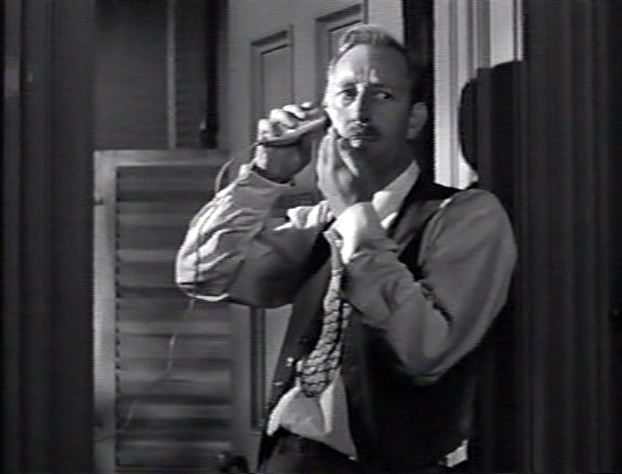
Neither doctor knows Bel Geddes, who used her maiden name with them, is the wife of the rich guy. Ferguson knows she’s pregnant, and assumes she's run off to conceal her pregnancy because she is an unmarried woman. His taciturn behavior is touching. He keeps her confidence and does not tell Mason what he knows. Today we might call it observing the HIPAA rules, but he’s just being ethical and gallant because that’s his nature.

When Mason tells him of their first date, Ferguson asks, carefully, if that was their only date. He wonders if Mason is the father.

Mason eventually finds his way to the mansion and confronts both Ryan and Bel Geddes. Torn, she plops on the running board of one of their many cars to think about the crisis. As we discussed in this previous post, there’s nothing quite so romantic as a running board.

Bel Geddes elects to stay with Ryan, and he continues to treat her badly, to the point of finally upsetting toady Curt Bois. We can imagine Bois has been with him for years, lured to a life of bitter, demeaning servitude to this rich horse’s ass because he’s just as guilty of greed. But when he sees this pregnant girl growing sicker and exhausted, he’s had enough. He quietly tells Ryan he wants to go back to being a head waiter. Ryan calls him a dirty parasite, and tells him to bring down his wife.

Bois quits, with the calm, soft utterance, “You know you’re a big man, but not big enough to destroy that girl.”

Today, he is a man.

And launches Ryan into one of his most serious faux angina attacks.

We may have forgotten that these attacks are not real, and when Bel Geddes, in a trance of indecision, looks right at the camera when she discovers Ryan lying under his pinball machine (boys and their toys), moaning for water, we might almost cheer when she leaves him there. Sort of like Bette Davis and the dying Herbert Marshall in “The Little Foxes” (1941).

Okay. Here’s the ending. Don’t get excited, it’s not that great.

Miss Bel Geddes, who does not look at all several months pregnant, goes into premature labor. The baby is stillborn. Mr. Mason rallies her with the exuberant message that now she is free from Ryan.

It’s a very strange way to the end the movie for several reasons. First, it gives that unsatisfying deus ex machina feel to it, that fate intervened and took away all their problems. Stories are more meaningful if the characters solve their own problems, even if imperfectly.

Second, it feels unsettling to have a baby being born dead as a cause for relief and even celebration. True, the pregnancy was unwanted and the father was most certainly intending to destroy both mother and child (which he did not believe was his anyway). Though regretting a pregnancy is human, to be glad the baby has died, as both Mason and Bel Geddes demonstrably are, may just make this another reason to call it noir. It’s a twist.

Third, if the child had lived it would have added to the conflict to the story and might have led to a more exciting and interesting ending. Her severance from Ryan would have taken more work, especially since he could have used his immense wealth to accuse Mason of being the father and ruined both him and Bel Geddes.

But, the movie has to end sometime, doesn’t it? I’d like to know how the novel ended. Novels have a lot more time to sort these things out.

There is a strong melodramatic element to the movie, or could be, but the smooth underplaying of Barbara Bel Geddes makes her a believable character. She may not exactly be a heroine or a victim, but she could be somebody you know. While it is uncomfortable watching Robert Ryan’s cruelty to her, the sureness of his acting is strong point to this movie. He’s a monster, but he’s also believable in a way many movie villains are not. He conveys that arrogant and even bitter disdain some holders of extreme wealth display to those whose incomes are inferior. Ironically, the only person who can dislodge him from his psychological king of the mountain game is himself and his paranoia.

Sly, quick moment to catch: when Bel Geddes steps out of Ferguson’s office after her gynecology examination, the nurse, just entering the office quips, “You don’t look it.”

Meaning she doesn’t look tired even after working late last night. It gives Bel Geddes a start. Paranoia has different levels.


Monday, February 18, 2008

Vertigo (1958)

“Vertigo” (1958) is called director Alfred Hitchcock’s masterpiece these days, but received criticism at its release. It might be coincidental to the original unpopularity that this is a film so rich in imagery it takes more than one viewing to catch everything. In a sense, you could say this is one of those classic films saved by television, VHS and DVD, where multiple viewings are possible. For years this film was unseen due to copyright restrictions.

Then again, it might not be coincidence that it takes many viewings to appreciate the film. That is the way with works of art. The first time seeing the film one is absorbed by the mystery. On subsequent viewings, one is diverted more by the colors and reflections, and the artistry of the film. A film with an abrupt, disjointed ending, it becomes on subsequent viewings less a suspense story and more a character study with unanswered questions. We are left not so much with an unresolved story, but a story with an ending of our choosing.

Any discussion of Alfred Hitchcock films invariably becomes an analysis of the psychosexual quirks of Hitchcock himself; of his use of blonde actresses both idealized and humiliated, of domineering mother figures, of mirror reflections and double images, of impotence. Perhaps no other director’s films takes on his own personality so intimately. I humbly confess to being ill-qualified to psychoanalyze the Master of Macabre, so I will keep this essay on his “masterpiece” to the qualities about it I find most arresting even after you’ve seen the film a few times.

James Stewart and Kim Novak give what are among the best performances of their careers. Mr. Stewart, able to play the good guy, with a wry comic delivery and a bit of goofy charm throughout his younger years, never lost this boyish appeal as he aged, but he also had the ability to play on man on the edge of sanity. Hitchcock used him in a few films probably for this reason. Underneath his “aw shucks” personality, Stewart could appear shockingly desperate and sickeningly afraid. It is used sparingly and has a far greater effect than the most violent scene played by a more brooding actor. It can be said that the creepiest part of the film is not the murder mystery, but the way Stewart’s personality changes as he become more obsessed with Kim Novak’s role as Judy, trying to remake her as Madeleine. His domination of her to the point of choosing her clothes is what we least expect from the average Joe with a fear of heights that we meet at the beginning of the film.

Kim Novak plays a person imitating another person, so her role is not exactly dual as it is layered. You don’t catch this on first viewing when you really think she is playing two people. It’s after you’ve seen the film again, knowing the ending, that one can really appreciate the depth of her fine performance.

The location shots in and around San Francisco, with sweeping rooftop views of the city and the bay, the iconic image of the Golden Gate Bridge, the sharp, steep hills, all create the texture of this film. It is a city of jagged fault lines. The music by Bernard Hermann, particularly with its Spanish suggestion of castanets is subtle and contemplative in the art museum, and during Stewart’s nightmare, becomes grotesquely exaggerated and frightening. It follows us in one variation or another all through the film, just as James Stewart tails Kim Novak.

One could make a game counting all the mirror reflections and shots in profile, and patterns of swirls and spirals. Beautiful Miss Novak looks especially striking in profile, and it is obviously reflective that we are never shown a full picture of who Madeleine is, who Judy is, because neither are as important as what James Stewart wants them to be.

We are also never told who Midge is. Played by Barbara Bel Geddes, Marjorie, with the less glamorous sounding nickname of Midge, is Stewart’s friend from college days. She appears in pastel sweaters and skirts, as if perennially the college girl. We are told they were once engaged, but their relationship now is more of camaraderie, and he teasingly refers to her mothering him. We get only a brief, concerned glance from Midge, and the suggestion that perhaps though it is she who broke off their engagement, she still loves him. When he climbs a stepstool to challenge his fear of heights, a disability which made him recently retire from the police force, he becomes dizzy and faint, and falls into her arms. Her embrace is indeed motherly, comforting, supporting.

We discover late in the film that Stewart’s fear of heights is why the murderer chose him as a ruse to set up his crime, but we see another aspect to Stewart’s character that makes him the perfect chump for the murderer’s scheme. Stewart, seeming emasculated by his vertigo, and appearing to keep an emotional distance from the old girlfriend who mothers him, is immediately attracted by Miss Novak’s vulnerability. Here is a person more lost and vulnerable than he is, and it is a boost to his ego that, at first hired to observe her, he soon becomes her protector.

We are teased throughout the film by red herrings. Kim Novak’s character of Madeleine at first seems to be the victim of possession by the ghost of a tragic ancestor. Then the ghost story appears to become one of the old movie cliché of hereditary insanity. Each of these story lines is gradually ruled out. Stewart, the cynical ex-cop, does not believe in demonic possession. After he falls in love with Madeleine, he also rules out insanity and substitutes a gentler diagnosis of her merely being obsessed with a sad family story, a lonely woman who needs reassurance and comforting.

We are never really shown the moment Stewart falls in love with Madeleine. In his apartment, when they both reach for a cup and their hands touch, the moment is erotic. In an earlier scene, Stewart’s character and Midge are chummily conversing in her studio apartment where she works at a drawing board as an illustrator of women’s undergarments. They examine a bra together like two children looking at a keen model airplane. There is a humorous lack of eroticism. (The blinds and configuration of her windows reminds me of “Rear Window”. He even asks her how her love life is, the same question Grace Kelly asks James Stewart in that film.)

Yet all it takes is his hand to touch Novak’s over a cup of coffee and the moment becomes electric. When he tells her his name is John Fergusson, she comments that it is “a good strong name.” Just this sentence helps him begin to shed the humiliation of his vertigo and his resentment at being mothered.

However, Stewart’s obsession must have started before this. When Madeleine, in her melancholy trance, leaps into San Francisco Bay in a suicide attempt, he rescues her. In the very next scene, he is back in his apartment. We are given a peek at her clothes hanging in the kitchen as if to dry, and then the camera pans over to through the open door of his bedroom, where Novak’s naked shoulder exposed from the blankets tells us on one sweeping movement he has chosen to take her home with him, undressed her while she was unconscious and most vulnerable.

We might have been given an intervening scene which would show his indecision as to what to do, a scene which showed him making this choice. Giving us a point at which he has fallen in love. But Hitchcock leads us on with a scene that is as sexy as it is senseless. A street-wise cop would not take a suicidal woman, unconscious and suffering from hypothermia back to his apartment, strip her naked and put her in his bed. One would assume he would know there might be legal ramifications to this.

It does not occur to him either to take her to her own home and back to her worried husband, or to a hospital. One might argue that in bringing her to his home he was attempting to protect his client with discretion. But Hitchcock never argues this. He just shows it to us and lets our own confusion be his toy. We do not realize that Stewart is being set up until much later.

When Miss Novak awakes, she remains enigmatic, with few words and minimal, if graceful movement. She slips on the robe he has left her, and sits down obediently on the cushions he has tossed on the floor for her. She does not glance around, wondering if a female on the premises removed her wet clothing, no wife or girlfriend, or housekeeper, no visiting old maid aunt. She seems to accept the situation and demurely thanks him. She apologizes for being a bother.

A later outing together walking among a dark and Wagnerian redwood forest deepens her dependence as she unburdens herself to him, and when the waves crash behind them and she begs him not to let her go, what else can he do but kiss her? We know by now he has completely forgotten about his client, her husband, and wants her for himself. Not only he is going to comfort her anxiety, he is now going to cure it, and brings her to the fateful scene at the mission.

When his vertigo prevents him stopping what appears to be her suicide, his guilt sends him on a psychedelic nightmare, which sends him to a sanitarium. There, even motherly Barbara Bel Geddes is unable to comfort him this time, and she walks down the long gray corridor in her long gray coat and out of the film. We never are told the beginning of their story together, and we are shown no goodbye. One wonders why it does not occur to Stewart that young women who hide behind enormous eyeglasses and wisecracks might also be concealing their vulnerability.

Many months pass, and when we next see James Stewart, he is roaming the familiar venues of 1950s San Francisco, still haunted by his lost love. He sees similarity to her in Judy, as Judy, a dark-haired shop girl stands for a moment, in profile of course, before him on the street. He follows her, and strikes up a friendship with this girl who though favors Madeleine, is not an exact replica. She dresses more colorfully, with a lack of Madeleine’s sophistication and taste. She speaks in a harder Midwest accent, not the cultured eastern finishing school, slightly English-sounding tones which Madeleine spoke. Judy wears her hair differently, wears heavier makeup. She is a more coarse person, and we may wonder what it is exactly about her that attracts James Stewart. Perhaps it is the same wistful sadness. It is one thing, besides the actress playing them, that the two characters have in common.

Miss Novak is particularly effective as the downtrodden Judy, so desperate to be loved by the man she duped, but helplessly fell in love with, that she agrees to let him make her over into the image of his lost love. Never is good guy Stewart so harsh and disgusting as when he whines, cajoles, and bullies her into her new clothes, stares at her feet in her new shoes like a man with a fetish, and orders that her brown hair be dyed blonde.

But when he sees his creation emerge and his expression shatters into a look of wonder, heartache and unspeakable joy, we are still sorry for him. The 360-degree shot of their climatic kiss was reportedly not trick photography with scenes of the fateful carriage house appearing suddenly in her drab hotel room, but an actual set on a turntable.

Mention should be made as well of the “vertigo affect” by cinematographer Robert Barks that will actually give you vertigo if you haven’t got it already. Robert A. Harris work on the 1996 restoration of this film is marvelous, and should also be noted.

At this point, Mr. Hitchcock does the unthinkable in a murder mystery and tells us the ending before the end of the movie. We see Judy and Madeleine are the same person, and that Stewart was a dupe to a murder arranged by his client. It is a striking moment when Stewart discovers this himself when he notices the necklace Judy wears is the same one in the infamous portrait that had mesmerized Madeleine. However, it may strike the audience as incongruous that so carefully planned a murder would be fouled by coincidence. That the murderer would have allowed Judy to keep both the famous gray suit and the necklace when the rest of his plan was so meticulous seems unlikely. That she would have remained in San Francisco and not be sent away after the crime seems unlikely. That she would have been recognized and pursued by James Stewart makes a wonderful tale of eerie fantasy, but it is based on mere chance which seems unlikely.

Most unlikely of all is when Judy leaps to her death at being startled by the approach of a nun when Stewart, having conquered his vertigo, angrily drags her up the bell tower. The murderer gets off free, and the cycle of death by falling, and guilt, is repeated.

It is a film with no beginning, as we come into it in the middle of a rooftop chase, and Stewart dangling from a drainpipe. It ends with the plot dangling. One can see why the critics and the audience in 1958 might have felt that the movie lacked a complete story and the end was missing.

But repeated viewings show us a different film. Like the paintings in the art museum Madeleine frequents, the film is a painting, not of the ghostly Carlotta or even a series of postcards of San Francisco, or cartoonish parody like the painting Midge does of herself as the portrait of Carlotta. The film might be a little bit of all those things, but it is also in and of itself, a painting.

Sometimes a painting will tell a story, but sometimes it will only suggest moods, meanings that might add up to many different stories. We when we look at paintings we are seeing color, and patterns, and brush strokes if we look really close. We may see different things each time we look at it. That’s what happens when you watch “Vertigo.” The ghost story that is really about insanity, that is really about love, that is really about obsession, that is really about vindication, that is really about a murder mystery where the murderer gets away, is a movie about all these things. The next time you see it, you may notice something else.

Related Products