IMPRISON TRAITOR, PEDOPHILE, AND CONVICTED FELON TRUMP.
Showing posts with label Franklin Roosevelt. Show all posts

Thursday, June 6, 2024

80th Anniversary of D-Day

Today is the 80th anniversary of D-Day, when the gallant gave all to defeat fascism, and in the bloody hours, gave hope and inspiration to the world with their bravery.  We can repay them only by honoring their sacrifice by defending democracy whenever and wherever it is threatened.  Every single time it is threatened.

Here is the speech and prayer offered by President Franklin D. Roosevelt on the radio that day, June 6, 1944.


Thursday, August 11, 2022

Confidence - 1933


Confidence (1933) stars Oswald the Lucky Rabbit, formerly of Disney but here in his Universal years.  Also featured are President Franklin D. Roosevelt (sans leg braces) and the Great Depression.  There's something really bold in black-and-white cartoons, daring and courageously surreal.

It's silly, poignant, and innocent, but the message of confidence is, while important, not really what got us through the Depression or what made this country great.

It's optimism.  Our forebears always looked to the future with optimism. Today we battle those consumed by its opposite: cynicism.  The cynics find no good in anything, certainly not in government by the people, and prefer to burn everything down.

I would imagine a cartoon is not going to solve that schism in today's society.  But I wish somebody would try.

It takes real guts to be optimistic when life is really rough, and your chickens are sick.

Friday, December 20, 2019

Lionel Barrymore - The Spirit of Christmas Past and Present


Lionel Barrymore was Ebenezer Scrooge for a generation.  For another generation, he became Mr. Potter, perhaps a deeper, more disturbed, and more modern Christmas villain.

In 20 years, he was absent only twice from playing Mr. Scrooge on the radio every Christmas Day; once because of tragedy, and once because of his great generosity.

He began the role on radio in 1933.  He admitted in his crusty fashion that he took the job because radio work paid well, but according to author Hollis Alpert in his biography of the three Barrymore sibling actors: “But it was customary for Lionel to mask the sentimental side of his nature.  Not only did he like Dickens as a writer, but he harbored hopes that Scrooge’s transformation might spark a few good or noble impulses among his hearers.”

In 1936, however, his fortitude was tried and his sentimental side nearly destroyed him.  His wife Irene, to whom he was deeply devoted, died on Christmas Eve. His brother John Barrymore stayed up with him that night to comfort him, and then he took Lionel’s place the next day at the microphone to play Scrooge.  The annual radio event was done live.  Lionel attended Christmas Mass, then collapsed from grief and spent several weeks in isolation at a sanitarium.

It was a horrible end to a bad year.  It was in this year that Lionel broke his hip at home while leaning on a metal drafting board on which he was working, pursuing his other interest and talents as an artist.  The board was heavy, and toppled over, and Lionel fell.  His recovery period was long and painful, but though he managed to walk again with a limp and with a cane, it would be the beginning of his handicap that would eventually put him in a wheelchair for the rest of his life. 

He worried most about his career, expecting this would end it.  MGM studio head Louis B. Mayer, whose reputation for ruthlessness is the stuff of legend, was truly kind and magnanimous to Lionel Barrymore, keeping him on the payroll when the accounting department questioned it, and found him work in movies simply as a wheelchair-bound character, first in the Dr. Kildare series, and then in a number of other major films. Not only did Lionel’s career not end, it actually thrived and he arguably became the most famous and successful wheelchair-bound person in the U.S., especially when we consider the irony that most Americans in the 1930s were not aware how dependent President Franklin Delano Roosevelt was on his wheelchair.

In 1938, Lionel Barrymore had the second accident that was to put him in a wheelchair for good this time.  Once again, Louis B. Mayer came to his rescue and promised that the screen version he intended to make of A Christmas Carol would star Lionel as Scrooge as soon as Lionel was able to do the picture.

Lionel knew there would be no recovery this time.  He also had a generous streak behind his famous crusty exterior, and suggested that MGM go ahead and make the movie on schedule but with Reginald Owen in the role.  Lionel made himself available on set to coach Owen.  To help promote both the film and Owen in the role, Lionel insisted Reginald Owen do the Christmas radio broadcast as Scrooge that year.

The following year, 1939, Lionel was back at the mic for A Christmas Carol and would continue this annual role for the remainder of his life.  He died in November 1954.  


Today, Christmas for classic film fans is more to be identified with Lionel Barrymore in another role:  the evil Mr. Potter in It’s a Wonderful Life (1946).  Unlike Scrooge, Mr. Potter never had an epiphany or change of heart.  Interestingly, author Hollis Alpert’s book, The Barrymores, which is a wonderful collection of research and stories of John, Ethel, and Lionel Barrymore, was published in 1964, long before the annual Christmastime television broadcasts of It’s a Wonderful Life, so the author was just as ignorant as Lionel was of his future importance to classic film fans as Mr. Potter.  The film does not even rate a mention. It was Mr. Potter, and not Mr. Scrooge, that became Lionel Barrymore’s Christmas legacy.

Scrooge embodied a Victorian Christmas, and Charles Dickens is often said to be the creator of the modern Christmas, but Mr. Potter, perhaps, is a figure much more symbolic of our 21st century era—cynical, greedy, unrepentant, and unpunished, reveling in his meanness and feeling that his very self-interestedness gives him actual omnipotence. It is a veil he dare not drop lest he lose his power.

George Bailey is the one with the epiphany in the movie, and if he does not vanquish Mr. Potter in the old movie fashion of destroying the villain, he does something through his epiphany which is perhaps more realistic—he renders Mr. Potter totally irrelevant. 
Becoming irrelevant is a deeper punishment to someone as power-hungry as Potter than even time in prison.  

Here’s wishing you all a very happy holiday season and in the happy new year to come, may all the villains become rendered irrelevant.

Listen here for Lionel Barrymore's final radio performance as Scrooge.


*********
Jacqueline T. Lynch is the author of Ann Blyth: Actress. Singer. Star. and Memories in Our Time - Hollywood Mirrors and Mimics the Twentieth Century. Her newspaper column on classic films, Silver Screen, Golden Memories is syndicated nationally.

Thursday, January 2, 2014

The Year of Ann Blyth - Intro to the Series


This post begins what, by default, I’m calling The Year of Ann Blyth—because I’m going to be writing about the career of actress Ann Blyth for pretty much the entire year. 

About as simpleminded as calling another blog about old movies Another Old Movie Blog.

I’m not terribly clever.

This is also going to be a series, by default, about acting in the 20th century. Actors, from the beginning of the trade, have struggled to find work, struggled in their performing to find fulfillment in self-expression, and then struggled to find the next job. The 20th century, for the first time in the history of theatre, exploded with new outlets for actors beyond the proscenium. “The theatre” became “the media”.

Movies, radio, television—our entertainment industry became America’s greatest export to the world, for better and for worse.  I want to examine this watershed century in the acting profession and the media through the career of one actress, and am particularly drawn to Ann Blyth for different reasons; including that she moved comfortably between the different media and excelled at each, and because long after she performed in her last movie she continued to work when it suited her, on television and most especially, the stage, including plays, musicals, concerts, night clubs and cabaret.  Throw in a few TV commercials, and you can see she tagged all the bases. 

And something else...something intangible and perhaps only evident when you stack her performances on a timeline: if you know Ann Blyth only through her frothy MGM musicals, you don't know Ann Blyth.  In dramas she has morphed into the epitome of hateful, sensual, heartbroken, and shamed.  If you know her only as the demon teen Veda in Mildred Pierce, you don't know Ann Blyth.  The same colossal greedy train wreck of a girl who spit invective at Joan Crawford and smacked her in the jaw also performed a night club act to enthusiastic crowds in Las Vegas, bringing them to tears with the sentimental "Auld Lang Syne" and sang at the California state fair.  If you only know her from The Helen Morgan Story or melodramas, you are missing her genuine gift for screwball comedy.  Sinking herself intellectually, just as much as emotionally into these roles, she swims against the powerful and unrelenting current of studio typecasting . 

The scene of her debut was radio variety and drama, the true child of the 20th century that, with few exceptions, became orphaned long before the century was over.  It trained her to use her voice, not only as a singer, but as a character.

As Gary Merrill’s character says in All about Eve: It’s all theatre.

This intro post to the series is going to take a while.  You might want to call in sick to work. 

Ann Blyth’s career is interesting for its length—she began at six years old on radio; for its diversity—she leapfrogged from radio to Broadway to Hollywood before she became an adult, then jumped into a variety of screen roles in that common struggle not to be typecast, and continued, during and after raising her family, to appear on television and the stage.  Along with her seemingly effortless versatility, most especially laudable is her ability to successfully keep in perspective her career and private life—yet nothing is simple about the way we weave our lives, particularly for someone who juggled so much even from a very young age.

Her ambition certainly, but also her self-discipline and work ethic, perhaps sense of responsibility to her mother, to directors, fellow performers, her husband and children, her faith--must have been enormous. 

Ann Blyth has been described in the press that always looks for catch phrases, slug lines and labels, as a devout Catholic, and she herself would credit her faith as being of major importance in her life.  Being labeled a Nice Girl by the press eager to call her something was probably better than getting tagged “The Oomph Girl” or “The Dynamite Girl”, which Ann Sheridan and Alexis Smith, respectively, hated, but I wonder if it may have sometimes been a detriment.  We’ll talk about that in a later post.  She has also been called reserved (to the point of driving some interviewers crazy over her reticence to speak ill of coworkers), serene, “the calmest person in Hollywood.”

Interviewer Clyde Gilmour of the Vancouver Sun wrote with humorous exasperation that Blyth, “is one of the sweetest gals any columnist could ever hope to talk with—and one of the most difficult to interview.  No matter what you ask her, all she does is smile and nod and chuckle and utter a series of gentle dove-like murmurs indicating her total satisfaction with every phase of human existence on this planet.”

That one cracked me up.

In her senior years, celebrated as a veteran of old Hollywood at benefits or being interviewed at film festivals, Ann Blyth is invariably described as elegant, classy, drawing awed remarks on her still stunning beauty.  Even more thought-provoking is her character and the career choices she’s made.

Ralph Waldo Emerson said, “The only person you are destined to become is the person you decide to be.”

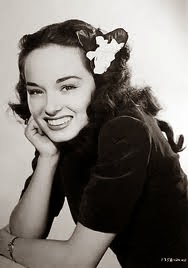
Look at the photo above, which is striking for its sweetness of attitude—we may notice the girl is quite pretty, but there is more to read in the glance she gives the camera.  A slight lowered tilt of the head, a calm, level gaze that invites as much as it withholds from the viewer.  She's studying us as much as we are studying her.  An actor’s audition headshot, or a publicity photo from her Broadway turn in Watch onthe Rhine?  I don’t know.  But you can see the girl in this photo, young Ann, is carefully tended. 

She was the gently-bred daughter of an Irish immigrant, a mother she adored.

For this year-long series, I’m not going to dwell on Ann Blyth’s personal life too deeply, rather touching upon her private life only as it bears upon her career.  Nor am I going to proceed in chronological order, for I want to present this series as snapshots of moments.  We’ll be leaping back and forth across the years like time travelers playing hopscotch.

But today we need to start at the beginning, if only for a foundation from which to leap first.   She was born in Mt. Kisco, New York in 1928, but never actually lived there.  Mrs. Blyth was visiting her sister at the time of Ann’s birth.  (Her name was Anne, but lost the ‘e’ on Anne when she went to Hollywood.  Ann remarked in an interview that her surname also once carried an 'e' on the end.  Perhaps for a previous generation?  Silent vowels are easily misplaced in transit if they are not firmly affixed.)  Ann grew up in a fourth-floor walkup by the river in the Lower East Side of Manhattan, a world narrowed to her mother and a sister who was some ten years her senior (her father left the family when she was still a child), and a few city blocks.  They struggled financially.  Her mother took in washing to make ends meet.  (One columnist would later write that Mrs. Blyth once worked for actor Joseph Cotten as a housekeeper.)

In an interview quoted by author Karen Burroughs Hannsberry in Femme Noir-Bad Girls of Film, Ann recalls a "rather meager" childhood:

The fact that my father left my mother with two daughters to raise is, of course, something many families and children have to face...My mother faced it, as indeed anyone who knew her and loved her felt she would.  And she always saw to it that my sister and I had enough to eat, and clean, pretty clothes on our backs--but I know that it wasn't easy for her.

Ann’s very early desire to sing and perform, and perhaps a precocious talent for both, led Mrs. Blyth to seek outlets for her daughter, which led to auditions and lessons, and soon, jobs.  Ann began singing and reciting on New York’s WJZ (on the NBC Blue Network) at six years old in the middle of the Depression.  She was one of the regular gang for several years on a children’s program called Coast to Coast on a Bus, where the bus "conductor" was Metropolitan Opera announcer Milton Cross...
“Coast-to Coast on a Bus—The White Rabbit Line jumps anywhere, anytime!”
It was a show to discover talented children. Future Metropolitan Opera star Risë Stevens appeared here, and other kids on the bus included Billy and Florence Halop, Billy and Bobby Mauch,Walter Tetley and Jackie Kelk.  They sang songs and hymns and recited poetry, and picked up guest “passengers” along the way.  Other shows she did were The Sunday Show, Our Barn, and Jean Hersholt's  Dr. Christian program.  (On the other network, little Beverly Sills, future opera star, was also doing a kids’ show.)  WJZ also gave us Little Orphan Annie, Amos n' Andy, and Death Valley Days

A teenage boy working as a pageboy in the same NBC building while little Ann was working at the microphone in one of the studios would meet her for the first time only many years later in California.  His name was James McNulty, her future husband.  Kismet, you might say.  (Yeah, we'll get to that movie down the road.)

Of these early years, Ann gives us a brief glimpse in an article syndicated in newspapers and published in a collection of stories of faith conquering adversity, edited by Dr. Norman Vincent Peale, and published as FaithMade Them Champions. (The chapter is posted at the SE Entertainment blog here.)

“Mother worked very hard and her tiny body wasn't nearly as big as her heart.”

Mrs. Blyth was Ann’s cheerful emotional rudder, her advisor, and her close companion.  It’s interesting that for someone who did not come from a show business background that Mrs. Blyth, with apparently no “stage mother” temperament, was still able to guide her daughter through a world that was strange to both of them.

From an interview with The New York Times in 1952: "Life was one big struggle then, but mother managed somehow to keep me in parochial school and later in professional school.  She provided me with singing and dramatic lessons besides."
Ann was given minor children’s roles with New York’s San Carlo Opera Company, in Carmen, Pagliacci, and LaBoheme, where she was introduced to the colorful and irresistibly larger than life storytelling world of opera.  She became a lifelong fan.  The opera company performed during these years at the Gallo Opera House on West 54th Street, and Ann’s world stretched a little wider, all the way uptown.  (The opera house later became the site of the disco era’s Studio 54 nightclub.)

She had some small parts in minor plays, along with her radio work, and actor, later agent, Richard Clayton, who knew Ann as far back as their New York casting days and appeared on different radio shows with her, recalled for interviewer Sue Chambers in 1954 how the stage mothers of other kids at auditions would look pityingly at Ann, “the quiet, skinny little girl effacing herself in the corner.  But when the time came to read for the part, the other kids didn’t have a chance.”

But there were other jobs she did not get, and the Depression rolled on while she attended parochial school, later dramatic and singing lessons at the Professional Children’s School (then at Broadway and 61st Street), and stood before the mic in the radio station.  

“When I tried for something better and failed, she would smile her wonderful warm smile, put a pert new feather in my hat, and together we'd go to St. Boniface's to pray.

‘Just have faith, my darling,’ she'd say cheerfully as we walked home in the fading light. ‘Something better will come.’  And it did.  It came so fast it was like riding a giant roller coaster clear to the top.  We two looked out over the whole world.”

Ann was called to the principal’s office at school.  Usually a heart-stopping moment for any kid.  Her fate was behind the door, literally.

Herman Shumlin and Lillian Hellman were there, asking if she would read for a part in Miss Hellman’s new play Watch on the Rhine.  Ann Blyth was 12 years old.


Watch on the Rhine Playbill, September 1941, author's collection.

She did not know anything about the famous producer-director or the famous playwright, but she passed the auditions and spent the next year at the Martin Beck Theatre on West 45th Street (renamed the Al Hirschfeld Theatre in 2003) as her world now included Broadway.  Any Broadway play would have been a feather in her cap and a terrific notch on her résumé, but Watch on the Rhine was a major theatre event and its illustrating the danger of foreign fascism on American soil in the home of one sheltered family made it one of the most meaningful productions of the era.  Brooks Atkinson’s review in The New York Times lauded the power of that play to glaringly reflect the current political climate which inspired it.

“Lillian Hellman has brought the awful truth close to home…Curious how much better she has done it than anybody else by forgetting the headlines and by avoiding the obvious approaches to the great news subject of today.”

Watch on the Rhine Playbill, September 1941, author's collection.

Cast members included Paul Lukas, Mady Christians, Lucile Watson, and George Coulouris.  (Lukas, Watson, and Coulouris would, of course, reprise their roles in the 1943 film.)  It was a monumental play, and if Ann, who turned 13 during its Broadway run, was not mature enough to fully appreciate the political message, she must certainly have been impressed by the prestige the production garnered.  Especially when she, along with other cast members, was invited to the White House to meet President Franklin Delano Roosevelt. 

She could also appreciate that, as author Hannsberry quotes, "It meant that for the first time in years, my mother wouldn't have to work so hard."
Postcard advertising the play, author collection.  Ann Blyth is in the top right photo.

Here are some photos of the production as published by Life magazine in April 1941.

Watch on the Rhine Playbill, September 1941, author's collection.


Watch on the Rhine Playbill, September 1941, author's collection.

The show closed in February 1942; afterward it toured for nine months across the country, and Ann joined the touring company.  It was during this period they gave a command performance for the President and had dinner at the White House.  She recalled for The New York Times in 1952, "I was so excited that I still can't tell anyone anything coherent about it.  I still have a souvenir, though, which the President gave me--a beautiful green match box which has a ship embossed upon it with FDR worked onto the boat."

At the age of 14, her world grew wider still with every train stop in towns and cities across the continent.  Finally, they played the Biltmore Theater in Los Angeles, where Henry Koster, a director for Universal, saw her and she was given a screen test.  By the time she performed with the touring company in San Francisco, Ann was signed to the Universal studio.

Gossip columnist Hedda Hopper spread the word in February 1943: "Henry Koster has little Ann Blyth...who was so good in Watch on the Rhine...when talking to her, he discovered she could also sing."

Her first four films, all released in 1944, were a series of small roles in B-musicals (which we’ll discuss in later posts), and then the big break when she was allowed to test for Mildred Pierce at the Warner Bros. studio.  (We’ll cover her role in that film, also, in a later post.) 

It was five days after wrapping this major film that Ann Blyth experienced an horrific event, and would spend her remaining teen years in a most heartbreaking series of personal challenges.

Her mother took Ann and some friends up to the Lake Arrowhead area in the San Bernardino Mountains to have a few days’ holiday in the snow in April 1945.  Ann was injured in a toboggan accident.  From her article on the incident in Faith Made Them Champions:

“One minute we were sailing down the hard-packed icy hillside like snow birds, then there was a crash and I fell on my back with a sickening thud.”

She was 16 years old.  She had fractured her spine.

“I didn't cry out.  The feeling was too big for that.  Involuntarily, from long habit, my spirit reached out for faith and halting prayers rose to my lips.” 

First newspaper reports called it a “near-fatal accident.” 

At the hospital, the doctors were grave; my back was broken.”

She was told she might not walk again.

“At first, I couldn't look at my mother.  When at last I raised my head, I was startled.  Those warm, hazel eyes under her crown of auburn hair were actually smiling.

‘Have faith, my darling,’ she said.  ‘You'll walk.’”

Ann spent several months flat on her back in a body cast.

“I concentrated on high school work, determined to graduate with my studio class.  But still there were those long periods of just lying down.  The busy, exciting world I had known faded away and my life slowed down to little things.”

It may be at this period that Ann learned her later-to-be-celebrated patient demeanor.  From a 1953 Miami News article she was: “…long noted as the most serene actress in town…”

“A visit with her is like taking a tranquilizer pill,” according to a producer interviewed for an article syndicated in the Miami News in 1957.

“Miss Blyth is a singularly soothing young lady to have around,” noted an article in The New York Times from 1952, that called her “serene and almost childlike.”

And something else, a faith in which she’d been trained since childhood began to evolve into a source of strength that would take her into adulthood.

“I found myself blessed, for a new sense of prayer began to unfold to me.  Now there were not the busy times of telling Him what I needed, but rather, times of listening communion, of gathering strength, when my human strength and courage seemed to ebb away.”

After seven months, she was freed from the body cast, put into a steel back brace from her neck to her lower back, and allowed to take a few steps.  She spent several months in and out of her wheelchair, in therapy (which included swimming in Joan Crawford’s pool) and finally did graduate with her studio school class in her wheelchair. 

Years later, her teacher at the Universal schoolhouse, Mrs. Gladys Hoene (pronounced "Haney"), was interviewed on what it was like to teach at the studio school by the syndicated columnist Bob Thomas, who noted that so many child stars had unhappy adult lives.  Mrs. Hoene agreed, having seen first-hand the pressures faced by child stars and the peculiar circumstance of playing roles “that are far apart from reality.  You can’t expect them to have a down-to-earth attitude toward life.”
Publicity still from Universal Studios in front of schoolhouse. 
I believe Ann is 2nd from right, with Sabu just to the right.  Can you name the others?

Mrs. Hoene was prompted to “tell tales out of school,” as it were, on her former students.  She recalled that, “When Ann and Donald O’Connor were put together, they could cut up,” but she put Ann, who was reportedly one of her favorite students, in a different category than the other kids who might grow to unhappy adults.

“I think the exception is Ann Blyth…I would stake everything I had on her chances of success.”

She was not speaking of career success.  Nor did Ann, apparently, regard career success as her only yardstick on happiness, though she certainly remained very keenly ambitious and loved to work.

“Now, at last, my life was again the same.  Only, not quite the same.  I found within me an immense gratitude for simple things.  An acute appreciation of all I might have lost, all the things I had accepted unconsciously before.”

There was a bright, shining moment during her convalescence when she was nominated for an Academy Award for Best Supporting Actress for MildredPierce (a heck of a get well card), and she attended the Oscars ceremony with her mother, a sublime evening of personal triumph they both shared.  The studio arranged for a special gown to be made for her which would hide her back brace.  The gown was pink, made of pre-war bengaline silk.

 Ann & Mrs.Blyth at Grauman's Chinese Theater, March 1946,
from a newsreel of the 1945 Oscars
What anguish Mrs. Blyth endured over Ann’s injury and long recovery anyone can only imagine, but the dark days were left behind by the renewed prospect of Ann’s return to good health and a bright future as a Hollywood actress. 

In April 1946, gossip columnist Louella Parsons remarked, "Ann is extremely ambitious.  Her career comes first in her life, and I think you'll see that she'll go far...I couldn't look at the sweet young face of Ann Blyth without feeling that she was something very special, and is not the ordinary girl.  She's well bred, quiet...."

This happy, hopeful time was cruelly brief, and in turn, eclipsed by another, greater tragedy.

Four months after the Oscars, over a month after Ann was finally allowed to remove the back brace for good, only a few weeks after her returning to work on a new movie, Mrs. Blyth died of cancer in July 1946. 

Ann was 17 years old, less than a month shy of her 18th birthday. 

Despite sympathy from those around us, grief is inevitably an agony faced alone, even for the very young.  The very depth of our mourning isolates us.  Fortunately, her mother’s sister and brother-in-law around this time gave up their home in Connecticut and moved out to California to help during the family crisis, and stayed.  As guardians and parent-figures her aunt and uncle thereafter had a huge supportive part in her life.  Ann dealt—forever after would deal—with the loss of her mother through the prism of her religious faith.

“There was an aching emptiness.  Until it came to me, almost in a revelation, that she had not left me.  She had prepared me for her going as she had prepared me for everything else I'd met in life.

Reaching out again for my faith came the assurance that she would be by my side in every good, beautiful, and true experience, wherever I might go; a part of every decision, every success and every happiness –for they all stemmed from her inspired teaching.  They would become the flowers of the mustard seed of faith she had placed in my heart.”

Now we jump ahead several decades.  Have a look below at the video taken at the Castro Theatre in San Francisco July 6, 2006 for a special screening of Mildred Pierce.  Miss Blyth is interviewed on stage by Eddie Muller.  She is 77 here, elegant, classy, gentle, stunningly beautiful, and delightfully funny.  She’s slaying her audience.  Note how effortlessly she launches into imitations of co-star Butterfly McQueen and director Michael Curtiz.  She's good with accents; we can imagine the first accent she ever learned to mimic as a child may have been her mother’s Irish brogue.  Her mother was Nan Lynch of Dublin.  (‘Tis a grand name, to be sure, but I’m sorry to say I have no reason to believe we are related.)

Note how, at the very end of the video, she is prompted to sing a line from Kismet’s “Baubles, Bangles and Beads” – the strength and loveliness of her voice, the almost startling power of it.  We have to marvel at the still prodigious talent of a lady who, we sense, as Emerson said, became the person she decided to be.


Consider as well that, unlike everyone else in that theater, Ann Blyth has just watched the screening of Mildred Pierce not as a favorite classic noir, but something more akin to a home movie of herself as a teenager only weeks before her life so shockingly changed.  The other actors on screen were all friends and colleagues—and all of them, down to little Jo Ann Marlowe who played her younger sister Kay, are all gone.  They are ghosts on the giant screen.  A thousand people in the theater have watched the intimacy of her, a solitary survivor, watching her own past.

The whole interview is not recorded on this video, but you can read a bit more of the conversation in a transcript of the interview at Michael Guillen’s blog The Evening Class.  Part 1 is here, and part 2 is here.

Come back next Thursday, and we’ll talk about Ann Blyth’s underwater adventure, which included a four-foot long fish tail with lead weights in it to make her sink, in Mr. Peabody and the Mermaid (1948).

 ________________________________________


Dunning, John. On the Air: The Encyclopedia of Old-Time Radio (NY: Oxford University Press, 1998), p. 162.
The Evening Class blog, July 28, 2007

The Film Daily, July 24, 1946, p. 2.

Hannsberry, Karen Burroughs.  Femme Noir - Bad Girls of Film (Jefferson, NC: McFarland & Co. Inc.) pp. 32-33.

Ladies Home Journal, article by Cynthia McAdoo Wheatland & Eileen Sharpe, "Young Hollywood at Home", February 1957, p. 104.
Life Magazine, April 14, 1941, pp. 81-84.

Los Angeles Times, July 23, 1946, p. A8; also August 12, 2013, article by Susan King.

Miami News June 26, 1953, p. 6A; November 23 1957, p. 10B
The Milwaukee Journal, syndicated article by Sue Chambers, May 1, 1954, p. 3

Muller, Eddie.  Interview on stage with Ann Blyth, Castro Theatre, San Francisco, July 6, 2006.
The New York Times, article by William Brownell, October 12, 1952, p. X5.

Peale, Dr. Norman Vincent, ed. Faith Made Them Champions (Guidepost Associates, Inc., 1954).

The Radio Annual, 1944, p. 732.

SE Entertainment blog, August 5, 2012.

Spokane Daily Chronicle, syndicated article by Dorothy Roe, July 29, 1955, p. 11.

St. Petersburg Times, syndicated article by Hedda Hopper, February 18, 1943; syndicated article by Louella Parsons April 21, 1946, p. 39.
The Tuscaloosa News, syndicated article by Bob Thomas, May 11, 1955, p 5.

Universal Studios Entertainment Tumblr site.

The Vancouver Sun, article by Clyde Gilmour, June 28, 1952, p. 45


UPDATE:  This series on Ann Blyth is now a book - ANN BLYTH: ACTRESS. SINGER. STAR. -

*********************
The audio book for Ann Blyth: Actress. Singer. Star. is now for sale on Audible.com, and on Amazon and iTunes.

Also in paperback and eBook from Amazon, CreateSpace, and my Etsy shop: LynchTwinsPublishing.


 "Lynch’s book is organized and well-written – and has plenty of amusing observations – but when it comes to describing Blyth’s movies, Lynch’s writing sparkles." - Ruth Kerr, Silver Screenings

"Jacqueline T. Lynch creates a poignant and thoroughly-researched mosaic of memories of a fine, upstanding human being who also happens to be a legendary entertainer." - Deborah Thomas, Java's Journey

"One of the great strengths of Ann Blyth: Actress. Singer. Star. is that Lynch not only gives an excellent overview of Blyth's career -- she offers detailed analyses of each of Blyth's roles -- but she puts them in the context of the larger issues of the day."- Amanda Garrett, Old Hollywood Films

"Jacqueline's book will hopefully cause many more people to take a look at this multitalented woman whose career encompassed just about every possible aspect of 20th Century entertainment." - Laura Grieve, Laura's Miscellaneous Musings''

"Jacqueline T. Lynch’s Ann Blyth: Actress. Singer. Star. is an extremely well researched undertaking that is a must for all Blyth fans." - Annette Bochenek, Hometowns to Hollywood


Ann Blyth: Actress. Singer. Star. 
by Jacqueline T. Lynch

The first book on the career of actress Ann Blyth. Multitalented and remarkably versatile, Blyth began on radio as a child, appeared on Broadway at the age of twelve in Lillian Hellman's Watch on the Rhine, and enjoyed a long and diverse career in films, theatre, television, and concerts. A sensitive dramatic actress, the youngest at the time to be nominated for her role in Mildred Pierce (1945), she also displayed a gift for comedy, and was especially endeared to fans for her expressive and exquisite lyric soprano, which was showcased in many film and stage musicals. Still a popular guest at film festivals, lovely Ms. Blyth remains a treasure of the Hollywood's golden age.


Monday, March 14, 2011

Clark Gable's Big Hands

One of the first things people do when visiting the stars’ handprints and footprints in cement out front of the (now) Mann’s Chinese Theater is to put their own hands in those famous indentations. It is especially tempting with Clark Gable’s because his paws were so large.

“To Sid who is a great guy,” he wrote into the cement. Sid, of course, refers to showman Sid Grauman, who owned the (then) Grauman’s Chinese Theater, among others. The date was January 20, 1937, the same day President Franklin Delano Roosevelt was being sworn into his second term of office and frankly announcing, “I see one third of our nation ill-housed, ill-clad, and ill-nourished.”

It was also the same day director W. S. Van Dyke, II got to put his hands in cement at Grauman’s as well. I don’t know if there was a tie-in (Van Dyke had directed Gable a few years previously in “Manhattan Melodrama”), or if this was just the chance way the scheduling came together. “One-take Woody” directed “After the Thin Man”, which had been released the previous month, and his “Personal Property” with Jean Harlow and Robert Taylor would be released in another two months. He turned them out like clockwork.

Gable’s next picture to be released would be “Parnell” in June, which in a way dovetails us into Thursday’s St. Patrick’s Day post. It won’t be “Parnell” this time, about the 19th century Irish politician, a role for which most people agree Gable was probably not the best choice. Instead, we’ll look at another film tackling Irish politics and “The Troubles” -- “Beloved Enemy” (1936).

For more on the Chinese Theater, have a look at this website.

Thursday, September 10, 2009

Civilian Conservation Corps Movie Fan


Above we have a photo of Priscilla Lane pasted on the inside cover of a young man’s footlocker. The footlocker was part of his equipment as a member of the Civilian Conservation Corps during the Great Depression. This particular footlocker is on exhibit at the Civilian Conservation Corps Museum in Stafford Springs, Connecticut. See my post on New England Travels for more on this museum.

It brings to mind something we discussed a month ago in this post about there being few old movies that dealt with the subject of polio. Not addressing the treatment of polio and the frantic search for a vaccine in the years in which it was so rampant and so frightening, to me is like cranking out a slew of movies during the early 1940s and hardly mentioning World War II.

Seeing the pretty young face of movie ingénue Priscilla Lane on the inside of this CCC boy’s footlocker brings another realization. I don’t believe I have seen the Civilian Conservation Corps even mentioned in a movie from the 1930s.

The film industry covered a lot that was topical back in the day, as we know, even if sometimes to gloss over issues. But to never bring up the CCC is amazing. President Franklin Delano Roosevelt initiated many programs during the Great Depression, and most were fairly controversial among Republicans in Congress, but we’ve all seen many films with the “blue eagle” logo of the NRA (National Recovery Act) plastered like an imprimatur on the end of the film. That the very controversial NRA was afterward nullified does not erase it from the history of American film of this period. Young people can still notice it, and ask what that meant.

Conversely, the CCC, though not supported by Republicans as much as by Democrats, nevertheless achieved a slight majority in favor even among Republicans. It was easily FDR’s most highly regarded program. If representing the CCC might seem too political for some studios, one would think that Warner Bros. at least would have a take on it, being more apt to present more gritty films during the Depression and stances supportive of the then current administration. They gave us “Wild Boys of the Road” (1933). There would have been a lot more wild boys of the road if not for the CCC.

The Civilian Conservation Corps put thousands of young men into thousands of outdoor camps to work in forestry, the establishing of state and national parks, conservation, public works projects, and even helped out communities during floods and fires. The money they earned that was sent home supported thousands of families during the bleakest years of the Depression and kept them from starving.

The boy who pasted Priscilla Lane’s picture in his footlocker is unknown to us. The only thing we know about him is he loved Priscilla Lane. He probably went to the movies on his pass to go to town. Maybe he went to see “Four Daughters” with Priscilla Lane, discussed here in this post.

If you know of any old movies where the CCC was depicted or even mentioned, please let us know. I’d love to know if there were any.

Monday, December 31, 2007

New Year's Eve at "Holiday Inn" (1942)

“Holiday Inn” (1942) gives us a brief New Year’s Eve scene, which though released during the first year of our involvement in World War II, gives us no indication of any war theme or trouble brewing for the new year.

Except for the Independence Day scene where a musical montage shows us fighting men, factory war production, Douglas MacArthur, and President Franklin Delano Roosevelt, most of this film is blissfully unaware of the war overseas, or gas rationing, food ration stamps and points. Among the inn’s guests, there is conspicuously not a uniform in sight.

The film begins on Christmas Eve, in what is evidently the year 1940, and there are actually three Christmas Eves that occur before the conclusion. In the New Year’s Eve scenes, which must be as 1941 turns into 1942, there is not a mention of the catastrophic Pearl Harbor bombing with brought us into the war only some three weeks previously to the donning of paper hats.

But paper hats there are galore in Bing Crosby’s new Holiday Inn which celebrates its grand opening in this New Year’s Eve party. There are a few tuxedos among the guests, a few furs, but most of the men are dressed in suits, and among the women there are even knit tops with skirts, as if the more austere war years have indeed made their presence known even if not openly discussed in the movie. Fred Astaire, who makes a drunken arrival after being left by his dance partner and fiancée, looks overdressed in his top hat, white tie and tails. The similar absence of elegant Easter finery in the Easter sequence of this film was discussed last April in this entry.

The New Year’s Eve scene begins with newspaper clippings that tell of the opening of the Inn, and Bing and Marjorie Reynolds sing “Come to Holiday Inn” to a full house.

If the traffic noise affects you
Like a squeaky violin,
Kick your cares down the stairs
And come to Holiday Inn.

The Inn’s cook, Mamie, played by Louise Beavers wears an enormous chef’s hat, and when her poker-faced kids are not taking part in the floor show dressed as Father Time and Baby New Year, they are shadowing her wherever she goes. Miss Beavers in real life did not like to cook, despite playing cooks and servants throughout her film career, and very prudently married a man who was a chef.

Bing and Marjorie, along with Mamie and the kids, and a few hired waitresses, hide out in the kitchen, help themselves to some food, and sing “Kissing the Old Year Out.” They do not actually kiss the old year out, in fact, nobody does. We hear the shouts of Happy New Year from the other room, and Bing and Marjorie get back out onto the dance floor, where everybody is dancing and Fred shows up a little drunk and despondent. When he dances with Marjorie, he decides she is his new dance partner and his new love. Bing and Fred spend the rest of the movie stealing her away from each other.

The drunken dance number Fred Astaire performs with Marjorie Reynolds is quite stunning in its athleticism. To continually stumble, wobble, and nearly collapse but not quite would likely take more energy than to do the dance properly. He does fall spectacularly on the floor at the end, perhaps helped by what is reported as his having taken several drinks of bourbon before each take of this number to help him play it convincingly.

No one says, “Don’t you know there’s a war on?” Everybody says “Happy New Year!”

Wednesday, July 4, 2007

Yankee Doodle Dandy (1942) - Part 2

The Fay Templeton number of “So, Long Mary” in the “Forty-Five Minutes from Broadway” scene is an excellent parody of small town American ambition for something bigger and better, and yet clinging to what is simple and familiar. Any song that can come up with a rhyme for “Schenectady” has my vote.

But in the “Grand Old Flag” number staged as part of Cohan’s “George Washington, Junior” musical, the film revs up to a colossal orgy of patriotic flag waving. The red, white and blue never looked so impressive in black and white. We have a chorus in Union Civil War uniforms, an appearance by the Boy Scouts, a tableau featuring Betsy Ross, the Spirit of ’76, and an African-American man singing “The Battle Hymn of the Republic” while slaves file past him and they pay tribute to a replica of the Lincoln Memorial. There is a poignant dignity in this last scene, without the hoopla of what came before, a helpless but earnest nod to a point on our timeline we cannot now change. It is unlike the cringe-worthy scene at the beginning of the film, when Cagney is led up the stairs at the White House by the black butler, played by Clinton Rosewood, who says he saw Cohan’s act many years ago when his then employer, President Theodore Roosevelt, or Mister Teddy as the butler calls him, gave him tickets for seats “in the gallery.”

There is perhaps at least one generation of young Americans who do not know that there was a time, particularly in certain parts of this nation, where African Americans were not allowed in theaters except in the segregated balcony seating, including when this film was made. This remark in the film may pass right by them unnoticed. More noticeable is the brief scene of the Four Cohans in blackface. It, too, is cringe-worthy and foolish, but to leave it out would be a lie. It is a realistic image of a long ago style of entertainment in American theater, which in this film is reviewed with remarkable detail.

Going back to the “Grand Old Flag” number, we are then presented with a Teddy Roosevelt look-alike leading a platoon of Spanish-American War soldiers, and a flock of workers, nurses, farmers, and an assortment of the Common Man gathering around some men about to load a cannon. If we did not figure it out before, we now know this movie is really about World War II. Released in 1942, this film gives us only a brief escape into the nostalgic past of American theater, but deftly slaps us back to consciousness. There is a war on outside the movie house, and when Walter Huston emerges in the final moments of the number dressed as Uncle Sam and Rosemary DeCamp as the Statue of Liberty, and there are more flags than we can count, we know that something more is expected of us. And it is not even the finale yet.

In the film World War I intrudes upon the life of George M. Cohan. He writes “Over There,” which became the anthem for American involvement in that war, and later in the film when he finishes telling his life story to FDR, the President gives him the medal for writing “Over There” and “A Grand Old Flag.” The faux FDR tells him “A man may give his life to his country in many different ways.” The film seems to expect the audience to give back something, too, now that we are at war, and the movie is over, and it is left to each of us to find the way to do it.

Just as important a message, and just as poignant, is when the two doctors confer outside the dying Cohan, Sr.’s room, reminiscing about the Four Cohans’ career. “I can’t help thinking a theatrical era is dying in there,” one says to the other. Their diagnosis is on the state of the theatre, and not the patient. Today there is a statue of George M. Cohan in Times Square. Mr. Cohan died five months after this film was released. He was ambitious, and he was flag waving, and he gave back something.

Tuesday, July 3, 2007

Yankee Doodle Dandy (1942) - Part 1

For Independence Day here in the U.S., today and tomorrow will be a nod to “Yankee Doodle Dandy” (1942) a fast-paced film that captures three American traits: unabashed and sentimental patriotism, a love of nostalgia, and consuming ambition. Perhaps they go hand-in-hand, but much of the nostalgia in this film is not so much about a past era of American patriotism, but rather a past era in this nation’s history of vaudeville and stock theatre.

James Cagney won his Academy Award for this film, a departure from his usual tough guys and gangsters, and is supported by Walter Huston (who received an Academy Award nomination) and Rosemary DeCamp as his parents, his real-life sister Jeanne Cagney as his sister Josie, and his real-life brother William is the film’s producer. As with most Hollywood biopics of the day, the life of song-and-dance man George M. Cohan is complimentary, avoiding controversy, and sometimes a bit light on the facts, including the omission of Cohan’s children or his first marriage, and including the fact that the medal President Franklin Delano Roosevelt presented Cohan in 1936 (not after we were involved in World War II as in the film), was a Congressional Gold Medal, not a Medal of Honor.

What is captured is a warm affection for Cohan’s place as a pioneer in American musical comedy. He did much to represent, and to appeal to, the common man in his shows, and the film is rife with fun and poignant montages of theater marquees of his plays. The hardscrabble life of the stock players in the late 19th and early 20th centuries that the theatrical Cohan family and many others endured is pictured in shots of luggage plastered with labels, gloomy boarding houses, forlorn train depots, and always another theater and another audience.

We see a lot of theater in this film. This is one of those musicals that realistically presents its musical numbers as re-creations of the Cohans’ act. Unlike other musicals of the day where people tend to burst into song for no reason and violins are heard mysteriously from heaven knows where, the songs here are performed as they would have been performed on stage for an audience. Director Michael Curtiz crams a great deal of material in this entertaining film. We see the backstages, the dressing rooms, we see the front of the house from over the shoulders of a woman, who like the woman playing Fay Templeton on stage, is dressed in the Belle Époque style. We see the footlights, and the backdrops, and if not all aspects of Cohan’s life are presented before us, surely the lure and the atmosphere of the theatre he loved are presented to us with loving detail.

Cagney’s vigorous, stiff and rather marionette-appearing style of tap dancing and his surprisingly Boston-intoned tenor show us that he was himself, like Cohan, a song and dance man in vaudeville before he ever pushed a grapefruit in anybody’s face on film. Seeing Walter Huston lead the Cohan family in their performing quartet is a joy. Cagney’s scene with Huston upon the death of George M. Cohan’s father is one of the most affecting either man ever filmed.

And then, of course, there is the compulsory flag waving. Fay Templeton, when approached by Cagney to appear in his new show, decries Cohan’s material as “loud, vulgar flag waving.” Her manager insists Cohan has captured the mood of the nation, “He’s the whole darned country squeezed into one pair of pants…George M. Cohan has invented the success story and every American loves it because it happens to be his own private dream….” These themes of ambition and pride and patriotism may well be intertwined and ingrained in us, for any immigrant’s arrival to this country is based on ambition. It is as basic to these immigrants as an idea of “freedom,” for the freedom to be ambitious is as dearly held as the freedom of religion or speech. We are perhaps the only nation on earth which has declared in writing, in our Declaration, the right to “the pursuit of happiness,” an idea which other cultures may find hedonistic or frivolous. To be sure, we can sometimes be both.

More tomorrow on “Yankee Doodle Dandy.”

Sponsored Link:
Yankee Doodle Dandy [DVD](1942) DVD

Thursday, March 22, 2007

Mrs. Miniver and Propaganda

Reviews of “Mrs. Miniver” almost always mention the word “propaganda” in the first line. I find this odd, since just about every film made during World War II that mentioned the war was propaganda of a sort. This includes films made not only by the United States, but by every nation with a film industry at the time.

Made after World War II began in Europe, but before the United States became involved, “Mrs. Miniver” was supportive of the Brits against the Nazis and included the stock characters of plucky but somewhat buffoonish under classes supporting the noble, good looking and well-lit upper classes, nothing unusual in films of the time. What was dangerous for the industry was the taking of sides.

Director William Wyler frankly stated his support for US involvement in the war and that making this film was his contribution to that effort. By the time the film was released, the United States was at war, with no further need for the industry, politicians or public to be squeamishly neutral. Perhaps what sealed “Mrs. Miniver” as propaganda for all time was the famous “Wilcoxon speech” penned reportedly by Wyler and Henry Wilcoxon, who played the vicar, who delivers the speech at the end of the film. The speech was championed by President Franklin Roosevelt, broadcast on radio, printed in magazines, used to define our mission. Winston Churchill lauded the film. Had the politicians not taken the film to their hearts, perhaps “Mrs. Miniver” would have come down to us only as a sentimental movie of the British home front, and not branded with that loaded title of “propaganda.”

If most English housewives did not apprehend Nazi soldiers in their kitchens like Mrs. Miniver did, there were still many homes on the European continent where such soldiers were equally unwelcome, but not so easily subdued. We sometimes forget today, and perhaps younger film buffs never realize, that the angst depicted in those films was real. Fear breeds chauvinism, which breeds propaganda. Any mention of war is apt to be viewed as political. Even documentaries can be slanted. But, these films were never intended to be documentaries, only stories reflective of their times.

These days the US has been at war for four years, and there are very few films out which address this situation, even in passing. The danger again, just as it was before we entered World War II, is appearing to take a political stance. By even mentioning it, we are seeming to take a viewpoint, which carries risk. It is easier to say nothing. One wonders what film buffs sixty years from now will learn about our era in a time when war fills the nightly news, but not the movie theaters.

Related Products