IMPRISON TRAITOR, PEDOPHILE, AND CONVICTED FELON TRUMP.
Showing posts with label William Frawley. Show all posts

Thursday, December 1, 2022

Lady on a Train (1945)


Lady on a Train
(1945) is the first in our Deanna Durbin Christmas movie twin-pack (come back next week), but though it has a noir title and features a murder mystery, it is decidedly not a noir movie, unlike Christmas Holiday of the previous year, which did not have a noir title but was noir as heck.

Got it?

Just to throw us another curveball, Deanna’s a blonde in this one.  How do they expect us to keep up?


This post is part of the countdown to Christmas coinciding with the launch of my newest book, 
Christmas in Classic Films.

Keeping up with Miss Durbin is a challenge for everyone in this movie, as she breezes through the screwball scenarios like the madcap heiress she is, and has a bit of comic relief to help her: the wonderfully befuddled Edward Everett Horton as the head of her father’s New York business office, “Haskell of the New York Office” as he proudly identifies himself. When Deanna arrives from California to spend Christmas with her aunt, whom we never see, Mr. Horton is charged with taking charge of her.  Fat chance.

The action charges off the blocks from the beginning: on a train pulling into Grand Central, Miss Durbin glances up from the mystery novel she is reading to see a murder committed in the window of one of the brick buildings that border the railroad line into the city.  When our old pal William Frawley, who plays the desk sergeant, gingerly decorating a tiny Christmas tree at the local station house, refuses to believe her, she tries to enlist the help of the writer of the mystery story she had been reading.  He is played by David Bruce, who had a minor role in Christmas Holiday.

Mr. Bruce is a little wacky himself, a self-absorbed, constantly distracted writer with a glib and perennially unimpressed secretary played by Jacqueline deWitt, and a jealous society dame fiancée played by Patricia Morison.


Following him to a newsreel theater (yes, there were such things), the pesky Miss Durbin suddenly discovers the identity of the man who was murdered—a wealthy scion who lived in seclusion on Long Island and is reported to have died by falling off a stepladder while decorating his Christmas tree.  (I know this isn’t a noir, but have you ever heard of anything so un-Christmas-y?)  Deanna knows this isn’t so; his body must have been dragged back to his mansion.  She is more determined than ever to follow the mystery, whether she gets anyone to help her or not.

Playing Nancy Drew, she sneaks out to the mansion, arriving in time for the reading of the will.  Elizabeth Patterson is the old auntie, the disapproving and controlling family matriarch. The family mistakes Deanna for a nightclub singer whom the rascally old man was dating, and are worried she’s there for her piece of the pie.  All are surprised that the nightclub singer has inherited everything.

Wonderfully goofy/smarmy Dan Duryea is one nephew and stalwart Ralph Bellamy is his brother.  There is sneaking around the house to explore for clues, a clever sight gag where she pretends to be a covered-up chair to escape groundskeeper Allen Jenkins, who is truly sinister in this movie.  She finds the old man’s slippers with blood on them, knowing he was killed wearing them.  A clue!  Proof she can show to the police!  She steals the slippers, but sinister George Coulouris, a nightclub owner who has caught on to her, sends Mr. Jenkins after her to get back those slippers.  Mr. Coulouris constantly carries around a limp white cat which he continually pets.  It doesn’t seem like an affectionate act; more like a nervous habit.

Wait a minute, time for a spot of Christmas.  There is a large tree in Miss Durbin’s hotel suite (a tree in everyone’s suite, apartment, mansion, office, etc.), and she sings “Silent Night” over the telephone to her father in California, a leisurely loving version while she is lying on her bed.  In the other room, Allen Jenkins is waiting to kill her for the slippers.


The movie is really a lot of fun, and it is stunning that the fast-paced screwball aspect of the plot is balanced by a very suspenseful mystery.  Danger lurks at every turn, and the tension ratchets up in odd moments.  We get a big laugh at a clever line, and then a bit of a fright.

Deanna gets trapped into pretending she’s actually the nightclub singer she said she was at the theme nightclub “The Circus.”  There is a clever bit with a two-way mirror which Durbin will later have to smash to escape.  Caught into performing when Dan Duryea shows up, along with the rest of his dour family, as well as the hapless befuddled writer and his snooty fiancée, Durbin sings, “Give Me a Little Kiss” in a low, sultry manner.  She teases and flirts with male customers, including the writer, boldly infuriating Patricia Morison.  Deanna almost accidently starts to fall for the writer, and he is stunned to find himself captivated by her. David Bruce is very likeable in the role and after a while, becomes her partner and protector in the search for the murderer, and he actually seems to be a pretty good detective, for a mystery writer.  He certainly gets beat up enough to be a real detective.

On Christmas Eve, among the nightclub hijinks there is a keepaway game with the slippers and the fast-moving plot stops long enough again for Deanna to sing “Night and Day,” this time in her upper register, unleashing a bit of her operatic chops.  Beautiful camera work lovingly follows her, and when she locks eyes with David Bruce, we know she is seducing him.  It’s not teasing now, she really wants this man.

Because her singing in this movie is at realistic moments, i.e., in a nightclub or to her father as a Christmas greeting over the phone, the film doesn’t have that launching-into-song-for-no-reason feeling of a musical.

We end up in the writer’s apartment, where Deanna is hiding out from the bad guys chasing her.  She is in his bed wearing his jammies, while he’s on the couch.  When Miss Durbin wakes, she fondly gazes at the snoring Mr. Bruce and asks his secretary, “Does he always snore like that?”

The secretary, deadpan, responds, “I am his secretary.” 

The ever-capable secretary serenely and with no end of humor attempts to cover for them when Haskell of the New York Office shows up.  She puts his robe over her clothes and says “Good morning, darling.”

That secretary’s a good egg.

It’s Christmas Day and after another melee, they end up in jail, but Dan Duryea bails her out.  Hmm, not sure that’s a good idea.  Is she safe with him?  Mr. Bellamy comes to bail her out, too. She sees a newsboy with the headlines showing the real nightclub singer was murdered.

Somebody in the old man’s family doesn’t want to share the inheritance. 

Duryea takes Durbin to the company warehouse—where the old man was murdered.  It occurs to her that he killed him.  Luckily, Ralph Bellamy shows up and they fight. Very cleverly, we are taken into the room where the murder was committed, the suspense builds and the screwball comedy is frittered away like a dying laugh.   A light shines from a suddenly passing train.

Deanna is in danger.  One of the brothers is the murderer, and she is trapped.  David Bruce finally shows up, almost bungles things, but luckily, has brought the police with him.

Cut to another train compartment, with Deanna reading another beloved mystery book, but this time, the writer is sitting across from her, in his jammies, wishing she would finish.  The soundtrack bleeding away from the rhythmic thunder of train wheels to a few cords of “The Wedding March” tells us they are married and on their honeymoon.  Impatient, he blurts out the name of the murderer to her, spoiling the story.  Her annoyance fades as the penny drops, and she rings for the porter to make up their berth.

Lady on a Train is not the acting challenge for Deanna Durbin that Christmas Holiday was the year before (which we're going to have a look at next week), but she gets to show that she was brilliant in comedy.  She clearly had a sense of the absurd. A strikingly beautiful young woman, with certainly a lovely singing voice, Durbin could have rested on those laurels alone, but fortunately for us, she, or someone at the studio, was willing to attempt more.

Christmastime was the setting of the story, but Christmas was not necessary to the telling of the story, which in turn, had no message of yuletide sentiment.  It was released in August 1945, so even cashing in as a Christmastime movie was not the point.  Beyond just about every room having a tree, we might not even remember it is Christmas Eve and Christmas Day.

Deanna Durbin doesn’t seem to recall it either; Haskell of the New York Office does her shopping for her.

***********

Come back next week for another tale with Deanna Durbin in Christmas Holiday (1944)!  It's a film noir Christmas.

************

Jacqueline T. Lynch is the author of Ann Blyth: Actress. Singer. Star. and Movies in Our Time - Hollywood Mirrors and Mimics the Twentieth Century and Hollywood Fights Fascism.  Her latest book is Christmas in Classic Films. TO JOIN HER READERS' GROUP - follow this link for a free book as a thank-you for joining.

Thursday, November 18, 2021

The Lemon Drop Kid - 1951 or "The Silver Bells Movie"


The Lemon Drop Kid
(1951) is primarily known for giving us the Christmas song “Silver Bells.”  It sometimes happens that songs from films become hits, but reportedly, the composers Jay Livingston and Ray Evans did not really expect the song to become a perennial favorite.  Somebody, perhaps with Damon Runyon smiling down on them from heaven, played a hunch and put the song during the opening credits, used it as a leitmotif in sentimental moments, and gave it the big production number that even today, in an enjoyable but otherwise unremarkable comedy, warms the heart and brings a great big smile.

The song’s first verse is sung by William Frawley, a New York City gangster dressed as a dubious street corner Santa Claus.  Bob Hope and Marilyn Maxwell take it from there (Bob also dressed as Santa), and they stroll the backlot city through gently falling snow, smoothly avoiding large automobiles as they cross streets with a throng of pedestrians.  It’s an idyllic New York City, and for a moment we believe, if not necessarily in Santa, then certainly in Damon Runyon’s world of comical and sentimental mobsters who are really nice underneath their bad English and bad habits.  Runyonesque is word for which most writers have to tip their Fedoras to Mr. Runyon; most of us do not get descriptive styles named for us.

The movie had also been filmed in 1934, and William Frawley has the distinction of being in both of them.  However, the 1934 version, which was actually co-written by Damon Runyon, bears little resemblance to the 1951 movie.  Both feature a racetrack tout stumbling over various schemes to come out on top, but the 1951 version is more upbeat.


Bob Hope flees a racetrack in sunny Florida to escape a mobster after him, and lands in his home turf of New York City, desperately looking for a way to raise cash to pay off the gangster by Christmas Eve, or he will be fitted for cement shoes.


His disgusted girlfriend, played by Marilyn Maxwell, does not have that kind of dough, but she helps him in a farce he has devised to save his bacon.  He gathers the forlorn elderly ladies of the neighborhood, led by homeless Jane Darwell as Nellie Thursday, and puts them in the mobster’s closed casino, calls it a home for elderly ladies, and gets a license to operate as a charity.  He gathers all the hoods and pickpockets and ne’er to wells in town and enlists them to stand on street corners as Santa and collect money, he says for the home – the boys owe a lot to the warmhearted Jane Darwell who’s always helping them out – but Bob really plans to turn the money over to the Florida gangster to save his own neck.  His rival in town, played by Lloyd Nolan, is his biggest obstacle to success.


We don’t really worry about Bob; he can take care of himself.  It’s hard to keep track of all his lies and tricks, but he manages to scrape by in the nick of time.  The dialogue is fast and witty.

I find myself craving lemon drops watching the movie, however, because Mr. Hope keeps  popping them, hence his moniker.


Another song in the movie is sung by Bob and Marilyn Maxwell as a lullaby to the old ladies, and its lyrics are quite clever and charming.  “It Doesn’t Cost a Dime to Dream,” is breezy, fun, and another great moment in the film.


But “Silver Bells” which has been recorded by pretty much everybody who can sing, has stood the test of time.  It is conjures a nostalgic image of window-shopping on a wintry street, of “the downtown” where we used to go for Christmas shopping, of “the city” when it was filled with friendly pedestrians, and the anticipation “soon it will be Christmas day” of the coming festivities.  Are they bells rung by street corner Santas?  Or church bells?  Or sleigh bells?  Or the little bells that used to ring over the door when you entered a shop?


The charm of the song is its simplicity, and it is perhaps the simple images in our memories of how we think about an old-fashioned Christmas that really makes the holiday for us.  An “old-fashioned Christmas” is what you make it; it can be images of Victorian England, or the 1930s and 1940s hometowns of our classic films, and these images sometimes we blend with memories of our own experiences in Christmases past: the 1950s, the 1960s, the 1970s, the 1980s…someday someone is going to be nostalgic about going to freestanding Walmart for Christmas, the way someone else today, right now even, is feeling nostalgic about going to a 1970s mall.  Silver Bells.  It’s Christmastime in the city.  Even if you’re nowhere near a crosswalk.

I wonder if anyone will ever write a lovely, nostalgic Christmas song about ordering presents from Amazon on your iPhone? 

********************

Jacqueline T. Lynch is the author of Ann Blyth: Actress. Singer. Star. and Memories in Our Time - Hollywood Mirrors and Mimics the Twentieth Century. Her newspaper column on classic films, Silver Screen, Golden Memories is syndicated nationally.  Her new book, a collection of posts from this blog - Hollywood Fights Fascism - is available here on Amazon.

Thursday, March 16, 2017

My Wild Irish Rose - 1947

My Wild Irish Rose (1947) is an example of post-World War II Hollywood nostalgia for simpler times, a rambling, ambitious entry in what I always felt should be its own separate genre—the musical about music composers.  It is artificial in the sense that it is cardboard cutout simplistic, yet beloved for its artifice, and is an unrelenting cutesy salute to the Irish. 

It is, in true Hollywood fashion, nothing more than a caricature of Irish Americans (Irish from Ireland, in some respects, have always felt that the Irish Americans were an odd caricature anyway), but that is just what Irish Americans are comfortable with, and so they seem happy enough with the garish cartoon.  Because this is a movie I recall from many a St. Patrick’s Day of my childhood, it carries, if not authenticity, then at least familiarity. I believe familiarity was all that the studios were aiming for when they made such movies, as homey as a hand-stitched sampler.

This is our first entry into a brief exploration over the next few weeks of that “genre”:  the musical about composers. 

Oddly enough, though My Wild Irish Rose purports to be a biography of composer and lyricist Chauncey Olcott, there is no recognition of his participation in the creation of many American pop songs of musical theatre in the late 1800s and early 1900s, and depicts him only as a singer/actor.  His partnership with composers Ernest Ball and George Graff are left out of the film.  Though star Dennis Morgan sings snippets of many songs associated with Olcott: “My Wild Irish Rose,” “Mother Machree,” “TooRa Loo Ra Loo Ral,” and “When Irish Eyes Are Smiling,” the movie does not inform us that Chauncey  Olcott had a hand in creating and publishing these songs.  Olcott has been elected into the American Composers Hall of Fame, but you’d never know it from this movie.  Upon his death, one of his pallbearers was the great man of Broadway himself, and in many respects his “American” counterpart, George M. Cohan.

Just what the movie does accomplish is a little hard to say, except for an historically accurate representation of the 19th century minstrel show (scenes which may cause acute disgust and embarrassment today, though I feel any such scene is valuable if historically accurate), and for showcasing Dennis Morgan’s lovely tenor singing voice.

But not everybody was charmed, even in 1947.  What we may have forgiven over the years, what the critics of the day were less likely to overlook. This is from The New York Times of December 25, 1947:

“To say that My Wild Irish Rose tells a story is a gross overstatement, and, even in this season of extraordinary benevolence, one cannot truthfully say that there is a recommendable spirit to the interminable song, dance and specialty interludes that fill out this picture.  As an Irish tenor, Mr. Morgan's singing will hold best with the tone-deaf, and that brogue he affects, and let's not overlook Alan Hale either in this regard, is—just call it murderous.  Indeed, the whole atmosphere of the film is so patronizing and professionally Irish in sentiment that it is downright embarrassing.”

Did the reviewer not find the minstrel affectations embarrassing?  Hmm.


I give the movie full marks if only for casting William Frawley as William J. Scanlan, the grand old man of nineteenth century Irish-themed operettas whom Chauncey Olcott was fated to replace.

And for giving our old friend Grady Sutton a brief role (we discussed Grady in this previous post).  And for casting dear Sara Allgood as Chauncey’s mother.  Trivia buffs may also note that Ruby Dandridge, the mother of Dorothy Dandridge, plays the maid of famed musical theatre star Lillian Russell; and little Kristen Morgan, Dennis Morgan’s real-life daughter, makes a brief appearance as a little girl to whom he sings on stage. 

We won’t discover too much about Chauncey Olcott’s life from this movie, but that should cease to be a surprise about any Hollywood biography.  What we have is John Chancellor Olcott of Buffalo, New York, who runs away from home and a job on a tug boat to make his fortune on the stage; gets involved with a traveling minstrel show; meets Andrea King, who plays Lillian Russell; falls in love with Arlene Dahl, whose da, Alan Hale, thinks he’s not good enough for his little girl.  George Tobias plays a Greek businessman who trails Dennis Morgan throughout the movie with malapropos babble.  George O’Brien is his body builder pal who beats up people who are mean to Dennis, and Ben Blue is his bumbling misfit pal.

Chauncey gets to New York, charms the Tenderloin, replaces the sickly William Frawley with an Irish accent even phonier than Frawley’s (which the movie notes with wry humor and is therefore the most honest thing about the tale).

We may smile over a scene set at Delmonico’s, and at Ruby Dandridge’s wondering how flowers can be “wired” to arrive at a dressing room “how  do they send flowers over telegraph wires?” and Lillian Russell doesn’t know, either.  I love all scenes set in theaters, the plush atmosphere, the palace-like settings, the communal nature from the box to the balcony.

Olcott’s great influence on American pop music before World War I would have made a better movie, and though the story is supposedly based on a book his widow wrote of his life, the thin romance spread across too many years and miles with Arlene Dahl (in her first featured movie role) is a weak story thread; he always seems to spend more time with George O’Brien and Ben Blue.  Dennis Morgan plays a man driven to sing, yet we rarely hear him finish a song in the endless array of montages.

It’s a Technicolor movie, but the predominant shade is green.  Irish-American green, as cartoonish as a box of Lucky Charms.  But that’s all it’s supposed to be.  That is what Americans have created of St. Patrick’s Day.

What should also be noted is the camaraderie, the blending of ethnic groups, the mutual kidding, even the foolish minstrelsy, displays a younger
America more comfortable with itself, more frankly acknowledging of its melting pot.  To be American was to be hyphenated because all save the descendants of native tribes were products of immigrant families.   It was okay to be an immigrant; it was worn like a badge of honor.  The point was they chose to be Americans, and in doing so, honoring we who were born here.

Chauncey Olcott and friend


You can have a listen to this rare audio of the real Chauncey here on YouTube.


Happy St. Patrick’s Day to all who celebrate it.
*********************
My scheduled talk at the Agawam Historical Association on Wednesday was changed to tonight at 7 p.m., due to the blizzard.

- I'll be speaking about my book on the Ames Manufacturing Company of Chicopee, Mass. and its importance during the Civil War for the Agawam Historical Association, at the Captain Leonard House, 663 Main Street, Agawam, Mass.  Free and open to the public, the time is 7 p.m.
​
Saturday, March 18, 2017 - I'll be speaking about Comedy and Tragedy on the Mountain at Blue Umbrella Books, 2 Main Street, Westfield, Mass., free and open to the public, 3 p.m.


The time:  1895 to 1965

Setting:  A wooden, barn-like summer playhouse…in an amusement park…on the top of a mountain…in a New England factory town

It was as unlikely a place as you will find for stage plays, but as much a part of the community as the stores and businesses and the red brick maze of factories and canals down below the mountain in the so-called “Flats” by the Connecticut River.  The place was Holyoke, Massachusetts.  For some seventy years live theatre created magic on the mountain above the city.


Though a small theater may seem like a world unto itself, it is not; not entirely.  It reflects its era and its location, that larger world outside its wooden walls; therefore this story is as much about Holyoke, the tri-city area of Holyoke-Chicopee-Springfield, and the Pioneer Valley of western Massachusetts, because this was the audience for the little playhouse on Mt. Tom.  If you are familiar with these towns, then you will find much in this book to jog your memories, for this is your story.

Comedy and Tragedy on the Mountain covers seventy years of live theatre on Mt. Tom, from vaudeville, operetta, WPA-sponsored shows in the Great Depression, and its heyday from 1941 to 1962 with a resident repertory company called The Valley Players.  In the early 1960s, two new incarnations: The Casino-in-the-Park, and finally, the Mt. Tom Playhouse with touring packaged shows featuring well-known stars from television and movies.  Many stars of stage and screen, and many newcomers who would one day become stars, performed over several decades on Mt. Tom.  Through interviews, newspaper reviews, and many photographs, you will relive their performances, and go backstage for personal experiences that were both comic and tragic, and enjoy again the excitement of opening night.

***

Speaking of opening nights, I'd like to extend best wishes to the two theatre companies that will be performing my play Sketching the Soul this month.  The first is the Hummingbird Theatre Company of Rochester, New York.  They open tonight, Thursday the 16th:


Hummingbird Theatre Company (formerly BART Productions) presents: Sketching the Soul


by Jacqueline Lynch 
Directed by Donald B. Bartalo


Thur. March 16th - 7:30pm
Fri. March 17th - 7:30pm
Sat. March 18th - 7:30pm
Sun. March 19th - 2:00pm
Thur. March 23rd - 7:30pm
Fri. March 24th - 7:30pm
Sat. March 25th - 7:30pm


Chelsea Logan is an artist struggling with the conflict between her growing celebrity and her Amish upbringing, which she left behind to pursue her ambition, and which she neglected to mention to Mike (her boyfriend), new friends and colleagues.

The past and present, celebrity and spiritually come to a head one frenetic weekend when her younger sister Sarah arrives unexpectedly. Chelsea must explain her sister, and the lifestyle she kept a secret, to Mike, an attorney struggling with his own ethical priorities, and to Maureen Nash an aggressive journalist who arrives with a photographer for an interview (during which Chelsea, with a rather un-Amish-like attitude, pummels the photographer into surrendering the film he has shot of Sarah!) Sarah and Mike together help Chelsea to accept and acknowledge the power of her Amish heritage and to move toward a future she had not expected.

CAST

CHELSEA LOGAN…………….……………Sara Bickweat Penner

MIKE GRIMALDI…………………………..Brian Tan

SARAH RICHTER………………………….Laura Thompson Pratt

NANCY………………………………………….Stephanie Sheak

MAUREEN NASH…………………………..Denise Bartalo

ARTHUR COAKLEY……………………….Joseph Barcia

Tickets are $12 in advance and $15.00 at the door. 

****************
The second group to perform this same play will be the Belhaven University Theatre Department in Jackson, Mississippi.  They run March 30th to April 1st, directed by Dr. Elissa Sartwell.

Cast
JAMES KENYON as Mike Grimaldi
LECI GRAY as Chelsea Logan
OLIVIA SIMMS as Nancy
RILEY PLEASANTS as Sarah Richter
RACHEL BROOME as Maureen Nash
MAC MITCHELL as Arthur Coakley

Production Staff & Crew
Director: Dr. Elissa Sartwell
Stage Manager: Frannie Maas
Scenic Design: Hannah Kenyon
Technical Director/Lighting Design: Michael Tobin
Costume & Hair/Makeup Design: Alice Bryant
Sound Design: Brittany Lyday
Props Master: Laina Faul
Dresser/Run Crew: Grace Reeves

Admission $10; Seniors/Students $5; Complimentary admission for Belhaven students, faculty, staff and their immediate families. Doors open 30 minutes prior to each performance. We hope that you will join us at the theatre! To reserve tickets for any Belhaven Theatre production, please call 601-965-7026 or email your request to boxoffice@belhaven.edu. Tickets may be purchased with cash or check.

My thanks and very best wishes to both companies.  Break a leg!

Thursday, July 14, 2011

Footsteps in the Dark - 1941


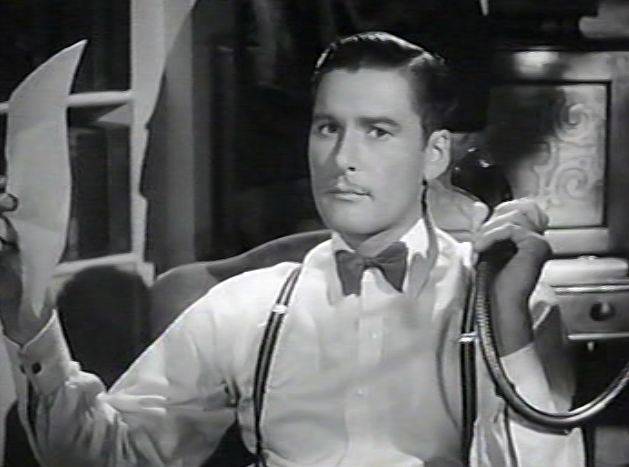
“Footsteps in the Dark” (1941) displays Errol Flynn’s ease and confidence in a comic role, and provides another showcase for his unique and unabashed charm. He carries the film, and is in practically every scene, which is good and bad. He is far and away never boring and delightful to watch; however, he’s got a great cast of character actors in supporting roles that don’t get to do too much.

Mr. Flynn plays a society blue-blood, an investment broker who lives with his lovely wife, Brenda Marshall, and his patrician mother-in-law, Lucile Watson. His relationship with both is good, and it’s particularly funny to watch him flatter his mother-in-law with comments that her new hairdo makes her look like a girl, practically every time he sees her. He does not seem insincere, just like a man who has the gift of making people happy, especially when their being happy makes things run smoother for him.

Except for the police inspector Alan Hale, and his sidekick detective, William Frawley. Unknown to his family, Flynn leads a double life. He writes murder mysteries on the side, and his latest is called “Footsteps in the Dark”, where we get the title of the film. In his book, he lambastes the very society set his mother-in-law so proudly represents, and so to keep peace in his home, he writes under a pseudonym.

He hangs out with the police to get story ideas and to help them solve their cases, because he is, of course, smarter than everybody. Especially William Frawley, who is the stupidest police detective in the universe.

Mr. Flynn’s closest relationship appears to be with Allen Jenkins, his chauffeur who also lives a double life as Flynn’s secretary. I love the scenes when Flynn leaves his brokerage office for lunch and heads out with Jenkins to a cozy suburban house he keeps for his writing space.


They peel off their suit coats, and Flynn dictates his story into a Dictaphone (have a look here at our previous post on movie Dictaphones and tape recorders), while Mr. Jenkins types out the manuscript. We see Jenkins with transcription earphones, but I can’t tell if there is also a foot pedal. I’d love to know more about the mechanical devices and method of transcription in the 1940s if anybody has any information.

I’ll leave the plot alone so as not to ruin the story, but Flynn encounters shapely but not overly talented burlesque queen Blondie White, played with trampy gusto by Lee Patrick (for whom he poses as a naïve, “aww-shucks, Ma’am” Texas oilman. Catch his funny attempt at an accent.)

Grant Mitchell plays the family attorney, about whom Flynn makes up outrageous stories of being romantically involved with the burlesque queen in order to cover up his own activities.

Roscoe Karns is a smarmy private detective Brenda Marshall hires to track her husband.

Ralph Bellamy, always reliable and believable in any situation, is a dentist, and there is one particular scene with he and Flynn, with Flynn in the dentist’s chair, that flits alternately between both comedy and tension. It’s almost hard to concentrate on the nuances of the scene, at least for us today, because at one point Bellamy joins his patient in a cigarette break, and companionably plunks an ashtray down on the instrument tray for them to use. Yuck.

We want to see more of these great character actors, but the movie is Flynn’s, and so we see them only through his brief interaction with each one of them in turn through the course of the movie. They really are wasted.

Another good scene: Brenda Marshall, having discovered Flynn’s preoccupation with Blondie White, goes to the burlesque theater herself to see what’s so special about her. We later find Miss Marshall play-acting a strip tease in front of her bedroom mirror to practice for her husband, when she is interrupted by the butler. It’s one of the few scenes without Flynn; the rest of the movie rests on his capable shoulders. However, because he is so capable and so charming, we know he’ll win the day and there is no real suspense, except for a scene at the very end.

The studio could have taken this further and made sequels, but this lightweight, breezy whodunit stands on its own.

Related Products