IMPRISON TRAITOR, PEDOPHILE, AND CONVICTED FELON TRUMP.
Showing posts with label television. Show all posts

Friday, March 20, 2026

Ward Cleaver's World War II heroism


Ward Cleaver sat sipping coffee with his wife, June, in their suburban kitchen and mentioned, “When I was in the Seabees, I got into a fight over a picture of Lana Turner.”  


It’s not something we expect of Ward, but little droplets of his life through the series, before he came The Man in the Gray Flannel Suit and his children’s go-to guy for getting them out of trouble, were fascinating.  More than his children realized, he was the epitome of the Greatest Generation and what happened to them after the war.


This is my entry into the 12th Annual Favourite TV Show Episode Blogathon, hosted by Terence over at his wonderful A Shroud of Thoughts blog.  I look forward to this blogathon every year because it gives me a chance to showcase performances by actors from classic films who took guest spots, or sometimes took their entire careers, over to the small screen.

Hugh Beaumont, who played Ward Cleaver, the father on Leave it to Beaver (1957-1963), was one such actor who began his film career in 1940 (we covered his role in The Blue Dahlia – 1946 here), and played a variety of supporting roles in big films, starring roles in B-movies, and lots of uncredited parts.  He was in his late forties when Leave it to Beaver gave him steady work, made him a household name, and for generations afterward, made him the number one dad on TV.


One of the most well-remembered shows of the era—largely because succeeding generations have grown up with reruns, featured Beaumont, Barbara Billingsley as his wife, June; Tony Dow played their older boy, Wally… “and Jerry Mathers as The Beaver.”  The show was well-written, often quite funny, and Jerry Mathers was probably one of the most natural child actors of the day.  The boys were average kids revealing the world of postwar childhood to their occasionally baffled elders, and each episode ended with some kind of lesson—but often not for the boys, rather, for their parents.  This represented a sea change in TV sitcoms and reflected the growing importance, and perhaps coddling, of The Baby Boomers.  (Though to be accurate, Wally, who was supposed to be 13 years old when the show started in 1957, would have been born during World War II, and therefore, technically not a Boomer.)

When television dawned in the living rooms of (some) American homes at the end of the 1940s and early 1950s, popular shows were geared more to the Greatest Generation, the ones who were buying the TV sets.  After a day of work, they would unwind with comic Milton Berle on The Texaco Star Theater, Jackie Gleason on The Honeymooners, or the brilliant, Your Shows of Shows with Sid Caesar, Carl Reiner, Imogene Coca, and a cast that couldn’t be beat.

These were mostly sketch comedies, but even The Honeymooners, which could be considered a sit-com, did not feature children in the cast.  These were shows for grownups, the stars were their contemporaries, and though kids could enjoy them, the shows did not spotlight their experience, their world.

As the fifties progressed, more family sit-coms appeared, but even Make Room for Daddy, centered more on star Danny Thomas than on his children.  One could say Robert Young of Father Knows Best, at least got equal time with his kids, mostly.  By the time Leave it to Beaver appeared in the fall of 1957, television began more and more to showcase, and to market to, the young Boomers.


Hence, we have Ward Cleaver, a likable, intelligent man with a likable intelligent wife, taking a backseat to the adventures of their kids. We don’t know much about Ward and June.  Hints drip out once in a while about her boarding school, his growing up on a farm, their meeting in college.  They have social engagements only once in a great while with friends they otherwise never discuss.  


The wonderful boor Fred Rutherford, who works in Ward’s office, is seen more as a pain in the neck than a friend. 

Even Beaver and Wally never seem to know much about their parents and are always surprised they had a life before the kids came along.  The Boomers usurped the Greatest Generation in part due to their parents’ doting on the kids, and also living in the moment after what were likely difficult childhoods in the Great Depression and the world blowing up when they came of age.  They were forward-looking people, who wanted orderly quiet now, and as a result, unless their children were persistent in asking about “the old days,” they might never know.


As a child, I liked the boys and their exploits—though it annoyed me that they were such terrific liars.  Nice boys, to be sure, but in each episode, they lied about something and thereby needing to be rescued by dad.  Unlike their parents, we got to meet all the kids’ friends (and most of them really funny).  Oddly, all the kids’ friends were backstabbers.  Truly, a strange dynamic at work here.  (Although all Larry Mondello would have to do would be to enter a room and I’d crack up.)


I was drawn more to the adults.  I even liked Fred Rutherford.  I liked Mrs. Rayburn, the principal.  I still do.  She’s one of my favorites on the show.

I especially liked Ward and June.  I think I felt sorry for him with his several reminisces of having a strict, somewhat mean-sounding father, and so he went over backwards to try to be lenient with his sons.  Ward actually resembled my father a little, though in personality was nothing like him.  They were both tall, lean, and had the same haircut.  My father served in the South Pacific during World War II, and so did Ward. 

Ward served in the U.S. Naval Construction Battalions, called “CB” or Seabees.  Formed in 1942, it supported Navy and Marines, and is now the U.S. Naval Construction Forces.

Ward’s mention of getting into a fight over a photo of Lana Turner was in season 6, episode 29, “Eddie's Sweater.” 

In “The Visiting Aunts” (December 18, 1958, season 2, episode 13),  Ward recollects wryly of Aunt Martha and her friend, whose husband is always referred to as “The General,” came to their wedding and was surprised that June was marrying a Seabee, as if that wasn’t good enough for an Army man.


In “The Perfect Father” (March 14, 1958, season 1, episode 22), Ward puts up basketball hoop over the garage for the boys.  He muses “I must have put up hundreds of those all over the South Pacific when I was in the Seabees.”  June teasingly responds, “I guess we all contributed to victory in our own way.”

June, we learn in “Mother’s Day Composition” (April 30, 1960, season 3, episode 31), volunteered at a USO during the war and served coffee and donuts. This was not quite as impressive as Beaver’s friend Richard’s mother, who was a WAC private, then a corporal, and eventually became a captain. In “Kite Day” (June 10, 1961, season 3, episode 37) we learn his father flew a P-38 in the war.  Beaver scoffs, “Ah, those are so old, they don’t even make models of them anymore.”

So much for past glory.  Even Eddie Haskel (Ken Osmond was great in this memorable role) suffered shame when in “Summer in Alaska” (May 9, 1963, Season 6, episode 33), Wally recalls that when they were kids, Eddie bragged that his father was a three-star general in the war, but they found out otherwise when they discovered Mr. Haskel’s air raid helmet in a closet, proving he was a civilian air raid warden during the war. 

During the war, anyone doing his bit was considered patriotic, but to the kids growing up later in peacetime, only the most heroic actions would be worth bragging about.  We come to “Beaver’s Hero” (April 9, 1959, season 2, episode 28), when the boys discover the secrets of their father’s wartime footlocker.


Mr. Willet (played by Wendell Holmes) is Beaver’s substitute teacher (Miss Landers is sick) and he tells the class about the world war. Wally asks The Beav, “Which world war?”

Beaver replies, “You mean there was a lot of them?”

“There’s two of them that I heard about.”

Beaver responds, “I think it was the one that President Eisenhower was in.”

“Yeah, that’s the one Dad was in, too.”

Beaver asks his mother, “Was Dad and Mr. Eisenhower in the same war?”

June says yes and Beaver replies, “It’s something having your father in the same war with the president.”

This, his ignorance, I found stretching credulity as a child, as those of us who had parents in World War II certainly knew about the war, because being only 20 or 25 years ago was still part of the social memory.  Also, we watched Combat when we were kids and took turns playing Vic Morrow and Rick Jason.  I can recall wearing plastic World War II-style helmets and throwing plastic grenades over a fence into a neighbor’s yard, and the bunch of us running to “hit the dirt” on someone else’s front lawn, covering our heads and making “ka-pow” noises.  When it was safe to stand, we had to climb over the fence into the neighbor’s yard to retrieve the plastic grenades.  Something which I never saw Vic Morrow or Rick Jason do, by the way.

So there were times I found Wally and Beav’s self-involved ignorance rather frustrating.  But, to continue…

Back in class, Judy Hensler (played by Jeri Weil), brags that her father was a hero who flew his own plane in World War II.  Gilbert’s uncle was a Marine sergeant who was “almost a general.”

(I like how the teacher calls the kids by their surnames and “ladies and gentlemen.”  I didn’t run into that until college.)

Beaver tells the kids his father was a hero, that he has a trunk in the garage full of guns and grenades, “and all kinds of stuff he took off of enemy guys.”  Judy accuses him of being a liar, which makes her very smart, because he is.


Wally and Beaver look at the trunk in the garage with the Seabees insignia. Their mascot emblem was a fighting bumblebee with a machinegun, a wrench, and a hammer.  Wally assumes the reason the bumblebee is carrying a hammer is so that if they “miss the guys with the gun, then they can hit him with a hammer.” There are photos of young June pasted on the lid of the footlocker, starlet photos of Barbara Billingsley.  Beaver has to be told that this is his mother and that she was ever that young.

He finds a T-square and thinks it’s a sword.  There is a tripod for surveying, that he thinks is the “bottom of some kind of machine gun,” and a transit, which Beaver thinks is a gun barrel.  With each item, Beaver spins a fantasy narrative, but Wally has his doubts, and Ward interrupts. He laughs at an old photo of himself the boys have dug out of the trunk.  He and a buddy, both bearded, are wearing grass skirts on some South Pacific island base and mugging for the camera.  My dad had a couple silly photos of his pals, too. He sent a grass skirt home to my mother.  I still have it. Generations have used it for costumes. My sister labeled the bag it’s in, “Mother’s Grass Skirt,” which, provocative-sounding, makes me laugh every time I see it.

“How many guys did you kill in the war, Dad?”  Beaver asks, finally getting to what is the meat of the matter for him.

Ward tells him he didn’t kill anyone. Explains the Seabees, and that his primary job was building airfields and bases.

Beaver wonders, disappointed, “Gee, Dad, was all you did in the war was see if the ground was level?”

Ward answers, with a somewhat weary tone in his voice, remembering, “I sure did a lot it, Beaver.  Acres and acres.”

Now Beaver has a dilemma; his friends will know he is a liar, and also find out that his dad was not a war hero, which is probably the bigger shame for him.  He tells Wally, “How was I supposed to know that all Dad did in the war was measure dirt.”

Mr. Willet calls and asks Beaver to bring his father’s war souvenirs to class, but not to bring anything dangerous.  “You’d better check with your father.”  Good idea.

To help cover for the Beav, Wally writes a false letter from Ward to June, dating it from the war period, to document his bravery, which is typically funny. It’s not the first phony note Wally has written for him.  “Dear Mom…”

“Wally, he calls her June.”

Wally writes Ward’s position from Wake Island, because he cannot spell Guadalcanal.  He writes how Ward captured 65 prisoners, and the general said, “Good goin’, Ward.”

Ultimately, Beaver decides not to use it and throws it away.  Ward finds the letter and calls Mr. Willet to explain, and the teacher, with great delicacy, decides to change the focus of the class to the Louisiana Purchase and move off World War II.  Nice guy.


Ward tells Beaver, “There were thousands of us in the service who weren’t heroes.”

Beaver answers, “Yeah, but a guy likes to think his father was.”

“Well, you see Beaver, they put a man where they thought he could do the best job.  Now, I was an engineer, so I could do a better job with tools than I could with guns.  There were lots of fellows in the Seabees who were heroes, but I just didn't happen to be one of them.”

Beaver responds, considerately, “You know, Dad, I’ll bet you were the best dirt leveler in the whole Seabees.”

I’ll bet he was, when he wasn’t hanging up basketball hoops for his bearded buddies.

Hugh Beaumont was actually a Methodist minister, who was a conscientious objector during World War II, and served as an Army medic.  As mentioned previously on this blog, Lew Ayres, who was also a conscientious objector, volunteered for the U.S. Army Medical Corps and served as a medic and chaplain’s aide in the South Pacific under fire, earning three battle stars. I don’t know if Beaumont served stateside or overseas. Even during the run of Leave it to Beaver, he served part-time in various churches as a lay minister.

Richard Deacon, our beloved Fred Rutherford, also served in the U.S. Army Medical Corps, and had studied medicine in college before turning to acting.


Too bad the school principal, Mrs. Rayburn wasn’t in this episode.  Doris Packer, who played her, served in the U.S. Women’s Army Corps, a WAC like Richard’s mother.  She entered as a private and reached the rank of Technical Sergeant.

The war touched everyone in that generation, in one way or another. Most of them put it aside pretty quickly and moved on, just as they'd put the Great Depression behind them, like Ward and June, in their comfortable suburban home, trying to make the kids' childhoods easier than theirs, and two boys who didn’t know how lucky they were.


Have a look at some other terrific posts in the 12th Annual Favourite TV Show Episode Blogathon over at A Shroud of Thoughts.

*******************************


My new non-fiction book, CHILDREN'S WARTIME ADVENTURE NOVELS - The Silent Generation's Vicarious Experience of World War II -- is now available in eBook here at Barnes & Noble, Apple, Kobo, and a wide variety of other online shops.

Or here from my Shopify store if you want to buy direct from me and avoid the big companies.

And it is here in eBook, paperback print, and hardcover, from Amazon.

It is also here in paperback from Ingram.

And here in hardcover from Ingram.

From Cherry Ames, to Meet the Malones, from Dave Dawson to Kitty Carter - Canteen Girl, the Silent Generation spent their childhood immersed in geopolitical events through the prism of their middle grade and young adult books.  From the home front to the battlefield, these books are a window on their world, and influenced their hard-working, conformity-loving generation. 

Buy this or any of my books online here at Bookshop.org.


Friday, March 21, 2025

Eve Arden in "Miss Aggie's Farewell Performance" on Ellery Queen


One of the joys of writing about classic films is occasionally exploring favorite stars’ performances on the small screen.  Eve Arden, veteran of stage and films, had also enjoyed a thriving career on radio as the beloved Our Miss Brooks.  In a guest appearance on Ellery Queen in the mid-1970s, she plays a pompous radio show star with panache.  It is a joy to watch her; too bad she dies early in the episode.  But it’s a mystery program and somebody’s got to be murdered. 


This is my entry into the 11th Annual Favourite TV Show Episode Blogathon hosted by Terence at his great A Shroud of Thoughts blog.  Have a look at the other lovely posts at thislink.

The episode “The Adventure of Miss Aggie’s Farewell Performance” stars Eve Arden as Miss Aggie, “beloved principal” of a small-town high school on a daytime soap opera.  Her role as principal is a promotion in job title and tribute to her longtime Connie Brooks character, who was a lowly high school English teacher.  Except for that carefully intoned, crystal voice, the characters are nothing alike.  Hapless Connie had a wry sense of humor, and the character of Miss Aggie is all hearts and flowers, though the actress playing her is a bit of a phony, full of venom and self-aggrandizement.  She rules the roost in the small radio studio, demanding and getting attention, favor, and tribute, if not affection from her cast, which includes Bert Parks playing the football coach, and Penelope Windust as the ingenue, of whom she is jealous.


In the middle of a broadcast, Eve sips water and begins to choke, and collapses, as the organist covers with a burst of incidental melody, as was common on radio, where in some shows it seemed every dramatic moment was punctuated by a blast on the Wurlitzer.  The shy, mousy organist is played sweetly by Bernice Colen, a common face on 1970s television.


Not dead yet, Eve Arden is taken to the hospital, where she lords it over the floor in her private room swamped with floral tributes from fans.  Reigning in her feathery bedjacket, she holds court for the press, and is especially pleased that Ellery Queen is on the case to investigate who poisoned her.  She is so used to acting a part, she asks him to call her by her character name, “Miss Aggie.”


Jim Hutton plays a bumbling but clever Ellery Queen and David Wayne is his crusty father, Inspector Richard Queen of the New York City Police.  The time period of the show is post-World War II in New York, with some foggy establishing shots of the Empire State Building and late-model cars driving past their brownstone where father and son share an apartment.  Ellery is a mystery writer, and the program, as fans will know, is inspired by the series of books and short stories written from 1929 through 1971 by the writing team of Frederic Dannay and Manfred Bennington Lee, who published under the pseudonym “Ellery Queen.”


The TV series lasted only one year, from the fall of 1975 through the spring of 1976, and it was probably my favorite show, or at least one of them, when I was entering my teen years.  I loved everything about it, from the saxophone wail of the jazzy theme, to the opening credits, to the accuracy of its period setting, to the parade of favorite classic film stars, and younger familiar TV character actors, that made it such a kick to watch.  I don’t know why it didn’t last longer, but it was terrific show.  It managed to carry off an irresistible blend of whimsical storytelling with sentimental nostalgia. 


It led to me reading the Ellery Queen books, and Agatha Christie, and eventually led to writing my own post-War II mystery series here are Barnes & Noble, or here at Amazon. Or here, directly from me.  Oh, come on.  All TV shows have commercials.


I really only had one complaint of the series, but it can be traced to the books and classic mysteries of this sort: the well-worn device of the victim leaving a dying clue.  Some of the episodes’ dying clues are little overreaching.  Personally, were I shot in my poofy bedjacket in my hospital room, I would not be trying to figure out how to create an elaborate clue to the identity of my killer that only Ellery Queen could solve.  I would be trying to attract the attention of a nurse, or even a janitor, somebody who could get me some help.  Or franticly making my peace with the Creator.  But then, I have never been very clever, not enough to spend my last breath devising an intricate clue.  


Eve Arden, does, indeed, succumb to a gunshot wound while in the hospital, and Ellery solves the case in such a roundabout way that we kind of forgot he was even investigating it.  His casual solutions also baffle and infuriate his rival, Simon Brimmer, who is a professional radio criminologist, desperately trying to get his ratings up and his sponsor dollars increased.  Simon is played by the wonderful John Hillerman, just as dapper and acerbic, with his ascot and cigarette holder, as his later role on Magnum P.I., for which most people probably remember him better.


Another feature to the program is that just before the final scene, and just before the commercial break before the final scene, Jim Hutton would break the fourth wall and speak directly to the TV viewers and review the clues and the suspects, and ask them if they had figured it out yet.  Try as I might during that commercial, I don’t think I ever got the answer right.


Also in the cast is Betty White, who plays Eve Arden’s agent.  John McGiver plays the show’s stern and stuffy sponsor.  It would be Mr. McGiver’s last role; he died of a heart attack in September 1975.  This program was broadcast a few weeks later on October 16, 1975.

The series is apparently now in public domain and you can watch it here at the Internet Archive.  Scroll down to the episode.

Please have a look at the other blogs participating in the 11th Annual Favorite TV Show Episode Blogathon hosted by Terrence at A Shroud of Thoughts.

 *******************************


My new non-fiction book, CHILDREN'S WARTIME ADVENTURE NOVELS - The Silent Generation's Vicarious Experience of World War II -- is now available in eBook here at Barnes & Noble, Apple, Kobo, and a wide variety of other online shops.

Or here from my Shopify store if you want to buy direct from me and avoid the big companies.

And it is here in eBook, paperback print, and hardcover, from Amazon.

From Cherry Ames, to Meet the Malones, from Dave Dawson to Kitty Carter - Canteen Girl, the Silent Generation spent their childhood immersed in geopolitical events through the prism of their middle grade and young adult books.  From the home front to the battlefield, these books are a window on their world, and influenced their hard-working, conformity-loving generation.

Friday, March 22, 2024

Beulah Bondi in "The Pony Cart" episode of THE WALTONS


Beulah Bondi in “The Pony Cart” episode of The Waltons, is “still on the top of her game,” or so recalled Judy Norton-Taylor, who played “Mary Ellen” in the popular family television drama.  It is a performance worth noting for that, and also because it was Miss Bondi’s very last role, and because she won an Emmy for it.


This is my entry in the 10th Annual Favourite TV Show Episode Blogathon hosted by Terence at A Shroud of Thoughts blog.  Have a look at the other great posts listed.

“The Pony Cart,” season 5, episode 10, broadcast December 2, 1976, is actually the second appearance of Beulah Bondi on the program, having introduced the character of Martha Corinne Walton two years earlier in season 3, an episode called “The Conflict,” broadcast September 12, 1974.  In that episode, Martha Corinne, who is the Grandfather Zeb’s (played by Will Geer) sister-in-law, having married his older brother Henry, is being forcibly removed from her home.  She lives in a cabin in the mountains.  She, her son Boone and her great-grandson and his wife have to leave the area when a new highway is to be built and the land has been taken by eminent domain. 


In “The Pony Cart,” it is summer 1937 and Martha Corinne comes to visit the Waltons, bringing with her some personal treasures as gifts to everyone.  At first she is a welcome guest, a part of their family history.  Indeed, she still dresses in old-fashioned ways including a bonnet when she goes outside.  She settles into family life, but soon proves to be an irritant for her outspoken opinions and suggestions, and everyone from Grandma Walton (played by Ellen Corby, with whom she appeared decades earlier in It’s a Wonderful Life) to some of the kids chafe under her strong, independent personality.  She pokes her nose into everyone’s business, and it is actually pretty funny, if it’s not your business.


Brother Ben, played by Eric Scott, is constructing a pony cart in the family’s sawmill, and Martha Corinne takes special interest in this; it is something like her, a time traveler from the past and gentler days.  In her time, they called it a shay.  She interferes here as well, telling him the best way to build it. 

Understanding she has worn out her welcome, she asks John-Boy, played by Richard Thomas, to take her back to her new home, but first to ride up to the remains of her old cabin and to visit her husband’s grave in the mountains.  On that trip, she remarks on what is the saddest prospect of all about growing old: “The sad thing is to see your kin and your friends go, one by one.  That’s the hardest part.”

She is teary-eyed upon standing on the ruins of her cabin, which she and her husband had built together in the late 1800s.

She has an attack of angina, and admits that being 90 years old, “I’m wore out.”  He wants to take her back to the Waltons’ house, but she refuses.  “I’ve got too much pride,” but agrees only when he promises not to tell anyone she is dying.

Back at the Waltons, where nobody is at first all that happy to see her again, they later relent and coddle her when John-Boy tells them the truth about Martha Corinne’s health.  She is furious.  “Now they’re all waitin’ for me to drop dead so they can pick me up before I hit the floor…I don’t want to be dead before I die.”


She is given the project of painting Ben’s pony cart, and fashions it into a lovely piece of folk art with stenciled flowers.  Ben gives her the first ride when it is finished, and along the road, she asks to be let out to stretch her legs near a patch of wildflowers.  As Ben pulls away, intending to circle around and come back, Martha Corinne is alone for the moment, blissful in the sunshine, picking flowers, when suddenly, another attack of angina, and bending over, she looks upward toward the sky, squinting, not exactly in distress, but rather a look of almost childlike curiosity.  There is a slow fadeout, and we know that Martha Corinne has passed away, peacefully enjoying her final earthly moment in nature.


I can still recall the first time I saw the episode and tearing up at this scene.  Having watched it again for this blogathon, it retains its power and delicacy.

What makes the episode especially interesting is that Martha Corinne is the focus of the entire episode.  The subplots that occur reflect her place in the story.  With exquisite respect to a veteran actress, the episode is given over to her, and Beulah Bondi has the strength and skill to command the entire episode; she is in nearly every scene.

At age 87, she won the Emmy for “Outstanding Lead Actress for a Single Appearance in a Drama or Comedy Series.”  Her last film had been in 1963, and had made only a handful of television guest appearances in between.  “The Pony Cart” and its resultant Emmy was a triumphant way for a marvelous actress to end her long career.  Miss Bondi passed away in 1981 at 92 years old.

Compare this performance with her devastating turn as the elderly woman parted from her husband in Make Way for Tomorrow (1937), which we discussed here. 

Here’s a clip of Beulah Bondi sweetly recalling her husband on their wedding day in the first episode, “The Conflict.”

Have a look here at Judy Norton-Taylor’s remembrance of and touching insights on “The Pony Cart” episode here on her YouTube channel devoted to The Waltons.

For more posts on great TV show episodes by some great bloggers, have a look here at the roster for the 10th Annual Favourite TV Show Episode Blogathon!

*******************


Our greatest gift from the Greatest Generation was freedom from fascism. Relive, and celebrate, how evil was faced, discussed, dramatized...and fought. Classic films were Hollywood's weapon.

Get your copy of my book Hollywood Fights Fascism here at Amazon in print or eBook, or FREE here for a limited time at Barnes & Noble, Apple, Kobo, and a variety of other online shops.

  ************

Jacqueline T. Lynch is the author of Ann Blyth: Actress. Singer. Star. and Movies in Our Time - Hollywood Mirrors and Mimics the Twentieth Century and Hollywood Fights Fascism and Christmas in Classic Films. TO JOIN HER READERS' GROUP - follow this link for a free book as a thank-you for joining.

Thursday, January 18, 2024

Requiescat in pace - Bill Hayes


Bill Hayes, longtime cast member of the daytime drama Days of Our Lives, passed away at 98 years of age.  Remarkably, fans of the show will note he worked right up until the end -- appearing at the annual Christmas episode with his wife and castmate Susan Seaforth Hayes (reportedly, they were introduced to each other by castmate Macdonald Carey).  (The program left broadcast television in 2022 but continues streaming on NBC's Internet "Peacock" channel.)

Mr. Hayes very kindly allowed me to interview him on Ann Blyth for my book, Ann Blyth: Actress. Singer. Star. in 2014.  (Has it really been ten years?)  He was charming, funny, and gracious.  I enjoyed talking with him very much and listening to his memories of his career in theatre and television.

He first appeared with Ann Blyth in the summer theatre production of Brigadoon in 1968 at the St. Louis Municipal Opera (MUNY), and in 1985 they appeared opposite each other in Song of Norway at the Long Beach Civil Opera.  In 1992, they formed a cabaret act and sang together at New York's exclusive Rainbow & Stars room atop Rockefeller Center and continued to play other dates across the country in the early 1990s.

His contribution to my book was invaluable, and I'll carry the warm memory of my chat with this dear man always.  My heartfelt condolences to his family and loved ones.  As Ann Blyth is still with us, this is, undoubtedly, her loss as well.

For more on Bill Hayes' long career, have a look at this article in The Hollywood Reporter.


*******************


Our greatest gift from the Greatest Generation was freedom from fascism. Relive, and celebrate, how evil was faced, discussed, dramatized...and fought. Classic films were the weapon.

Get your copy of Hollywood Fights Fascism here at Amazon in print or eBook, or here at Barnes & Noble, Apple, Kobo, and a variety of other online shops.

  ************

Jacqueline T. Lynch is the author of Ann Blyth: Actress. Singer. Star. and Movies in Our Time - Hollywood Mirrors and Mimics the Twentieth Century and Hollywood Fights Fascism and Christmas in Classic Films. TO JOIN HER READERS' GROUP - follow this link for a free book as a thank-you for joining.


Thursday, September 28, 2023

Cable TV kicks me to the curb

Vintage Radio & Communications Museum of Connecticut, 
Windsor, CT, photo by JT Lynch

The day has finally come when my cable television company has, in effect, announced, “Now I am become Death, the destroyer of worlds.”   

In other words, they are dropping Turner Classic Movies from my subscription, and if I want it back, I must pay another $12 per month to subscribe to another tier of "service."

My company is Spectrum, but this obviously is not an uncommon event and many of you have already experienced this disappointment, or perhaps have never even been offered TCM as part of your package.  I've enjoyed the channel for over twenty years, at least, and it has made a great difference in my life and in the writing of this blog.  I'll miss it very much.

I do intend at some point to "cut the cord," as they say and find my way to cheaper, possibly better, service.  But at present, that's not possible.  I care for my older sister at home who has a number of serious medical issues and she is used to her own favorite channels (she watches far more TV than I do), and changing to a completely different setup would be too disruptive and confusing for her.   I can live without TCM for a while; there are certainly other outlets to enjoy classic films, and like many of you, I have a number of favorites on DVD and VHS that I continue to enjoy.

But it is something of a milestone for me, that I cannot help but look upon with some wistful remembrance.

 ************

Jacqueline T. Lynch is the author of Ann Blyth: Actress. Singer. Star. and Movies in Our Time - Hollywood Mirrors and Mimics the Twentieth Century and Hollywood Fights Fascism.  Her latest book is Christmas in Classic Films. TO JOIN HER READERS' GROUP - follow this link for a free book as a thank-you for joining.

Thursday, May 18, 2023

Greer Garson on Father Knows Best - 1957


Greer Garson chews the scenery—all in fun, on a visit to the Anderson family in an episode of Father Knows Best.  Originally broadcast November 13, 1957, it's "Kathy's Big Chance."


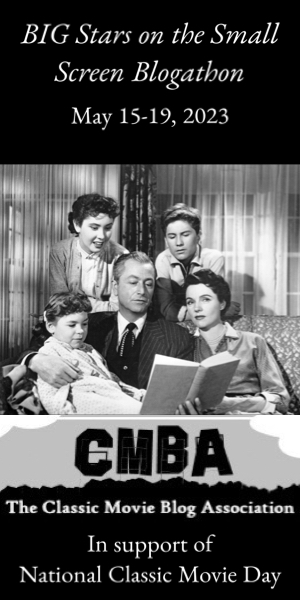
This is our entry for the Classic Movie Blog Association’s blogathon -- Big Stars on the Small Screen: In Support of National Classic Movie Day.  Have a look here for more great bloggers on the subject of classic film stars and television.

Though Miss Garson plays herself, touring in their Midwest town of Springfield to promote her latest film called “Rebel Lady,” the movie is fictional.  She never made such a film, but perhaps that gives her the freedom to act out such a comic and outlandish synopsis of the movie for the benefit of the Anderson’s youngest daughter.  A real movie she might be actually trying to promote would require more dignity.  Certainly, the studio heads would require it.  Greer throws dignity out the second-floor window of Kathy’s bedroom.


Kathy, or “Kitten” as her father calls her, played by Lauren Chapin, is the youngest of the three Anderson kids.  Billy Gray plays “Bud” the middle child, usually popping in and out of scenes with the funniest lines and the best comic timing.  


Elinor Donahue is the lovely eldest, Betty or “Princess” as Dad calls her.  Dad prefers nicknames (to the point where we may have forgotten that “Bud” is actually named for him—James Anderson, Jr.)  Miss Donahue, despite the trope of Big Sister Scorn she was forced to play in so many episodes, is probably one of the best “child” actresses in the enormous landscape of television families through the decades, who handled both dramatic and comedy scenes very well.


Mother is played by Jane Wyatt, who won three consecutive Emmy awards for her role as Margaret Anderson.  With her Eastern finishing school voice and manners, we may overlook that she is one of the most genuine of TV moms of the era in her relationship with husband and kids.  She gets mad and says so.  She is not always so understanding.  She even wears jeans and a sweatshirt once in a while.  She introduces herself to Greer Garson as “I’m the mother” but she’s a lot more than that on this show, if not this particular episode.

In an almost forerunner of what she would play on TV, Jane Wyatt starred as the mother of Ann Blyth in Our Very Own (1950) which we previously discussed here.


Robert Young plays Father, who actually began this role on radio in 1949, but the radio version of Jim Anderson was much more sarcastic and even mean, as radio tended to play in broader strokes for comedy.  When it moved to television, Mr. Young, who had a hand in production, wanted a warmer dad and a more loving family.  The show ran from 1954 to 1960, and became one of the iconic TV shows of an idealized suburban America in the 1950s.

Robert Young appeared with Greer Garson in That Forsyte Woman (1949), which we discussed in this previous post.  In that film, he is a prospective lover who ardently pursues Greer, but in this TV episode he only chases her for her autograph.  Young’s last film was made in 1954, and Greer Garson had also not made a film since 1954, though she had a few more in her, beginning with her turn as Eleanor Roosevelt in Sunrise at Campobello in 1960.  Until then, these two stars, like so many classic film stars and character actors, turned to the new medium of television for work.  They are middle-aged, but Young is the settled family man with the graying hair, and Greer is still glamorous, so much so that she mesmerizes the household, and is Kathy’s favorite actress.


Kathy must write an essay on the Civil War for school and has chosen to write on a new Civil War film starring Greer Garson called “Rebel Lady.”  She submits her essay to a contest, the prize for the several winners chosen is to visit Miss Garson in her hotel suite for cake and ice cream, and then accompany the famous actress to the theater to see the movie with her.


Kathy imagines what this will be like, and in her daydream, Greer Garson is dressed like a queen, complete with tiara, and their la-de-da dialogue Garson delivers with deadpan charm.   She tells Kathy, “You have such intellectual brains.”  Another actress gushing this would be cute, but spoken with Greer Garson’s regal intonation, it’s really funny.

Roused from her reverie, Kathy has a lot of work to put in on this essay, which is the most important essay anybody ever had to write.  She finishes it, sends it off, wins the prize, and then gets the measles.  Even in idyllic white middle-class suburbia, life dumps on you, apparently.

Measles, back in the day, could be a nuisance, or a sick-as-a-dog but you get over it illness, or serious complications, including death, usually from pneumonia.  Isolated populations with no immunity suffered cruelly, which an estimated 20 percent of people in the Hawaiian Islands in the 1850s and 40 percent in Fiji in 1875 killed by this sickness.  Millions of kids the world over died from measles every year, until vaccines were produced in the 1960s. 

We’re pretty sure Kathy will get over it, though.  She’ll probably be on the show next week.


Kathy, with nothing left to live for now that she can’t go to Greer Garson’s hotel room and eat ice cream and cake, sends dear old dad to her hotel to sign Kathy’s glamorous studio photo of Greer.  Dad, on the spot, reluctantly goes and stands in line with a bunch of clambering schoolgirls to get an autograph.  Supposedly, one of those kids is played by Kathy Garver, who later got to be older sister Cissy in Family Affair (1966-1971).  If you recognize her, let me know.

Just as he gets to the head of the line, Greer’s pen runs out of ink, and she is whisked away by her handlers.  Poor Jim Anderson has failed Kitten.  I love the line of the girl who, also denied an autograph, complains, “If that old man hadn’t hogged so much time.”  Robert Young has progressed from middle-age to old man.

Back in the sickroom, older sister Elinor Donahue aka Princess is trying to amuse the fretful Kathy with a game.  Kathy wants to know what’s taking Dad so long, and bitterly snaps, “Probably ran off with her.”  Another good line well delivered.  Yeah, there’s a few here and there even in a show with a rather too-sweet reputation.


Finally, Father returns, with Greer Garson herself in tow, and she compliments Kathy on her essay.  “It was so intellectual I could hardly understand part of it.”


Then, at Kathy’s request, she puts on a boffo performance of the entire movie in five minutes.  Flinging herself around the little girl’s bedroom, she mugs, she fires the opening salvo of the Civil War, she primps, she spies (her character is a spy for the Confederacy), she grabs the unsuspecting Bud, uses him for a prop as he unwittingly stands in for a Union sentry and later her husband, plants a lipstick smear on his forehead, to the gales of laughter from his parents, and finally, Greer delivers a message behind the lines to Stonewall Jackson, whom she also plays.


When it’s time for Greer to leave, Kathy says in sincere appreciation, “You’re such a good guy.”


Yeah, she is.

Remember to visit the other good guys blogging about Big Stars on the Small Screen here.


Notes:  "Migration and Disease" article Digital History site

            Fiji University National College of Medicine site.

 ************

Jacqueline T. Lynch is the author of Ann Blyth: Actress. Singer. Star. and Movies in Our Time - Hollywood Mirrors and Mimics the Twentieth Century and Hollywood Fights Fascism.  Her latest book is Christmas in Classic Films. TO JOIN HER READERS' GROUP - follow this link for a free book as a thank-you for joining.


Related Products