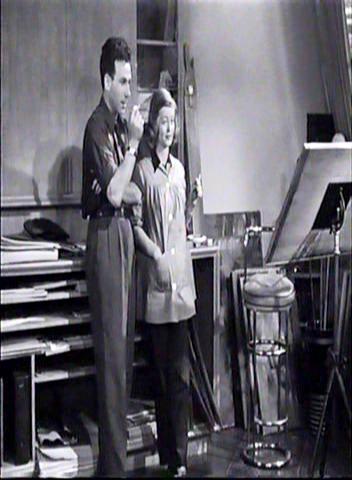
IMPRISON TRAITOR, PEDOPHILE, AND CONVICTED FELON TRUMP.
Showing posts with label Glenn Ford. Show all posts

Monday, March 12, 2012

Trial - 1955


This week we take on two films which examine (or in Hollywood fashion, exploit) the era of communist witch hunts. Trial (1955) and Storm Center (1956) were both made after the most threatening period had ended, yet still timidly take a tentative stance on the violation of civil liberties. They both seek to make us understand the plight of the innocent caught in a web of social repression. However, neither takes the bold and rather obvious step to point out that nobody was ever indicted in this country of being a communist -- despite the showmanship of the McCarthy hearings -- simply because to affiliate oneself with communism is not illegal in a nation that guarantees no discrimination based on creed.

That neither of these films could address that is itself a testament to the intimidating politcal climate.

Trial (1955) is a film that is both typical of that era, and yet a bold move into new territory. Many complex issues are raised, including bigotry, political extremism on both the right wing and the left. Personal commitment is challenged, and the very idea of justice. The movie raises many questions, but supplies few answers. In this sense, it seems more modern than many of the films of its day in its cynical approach.

This fence sitting may make the film seem unsatisfying to classic film fans who are accustomed to enjoying simple resolutions. Fans of modern films will likely see this movie as an example of 1950s stereotypes and melodrama. The melodrama, I think, is part of what is fascinating about this movie. One downfall to the film is that it has so much going on. Issues too difficult to solve are dropped for other issues.

Ironically, what makes the film resonate to the modern viewer is the conflict between the right wing and the left wing, still so strong today. There are messages here against left wing extremism and they may make a liberal democrat offended (the image that by merely belonging to a labor union one might be considered a communist). There are also messages against a right wing extremism that may make conservative republicans offended (the image that town fathers, the sheriff, and other representatives of the establishment are racist and bloodthirsty for the death of a young Mexican boy).

If one is to take from this movie any singular message, it might be that all extremism is bad. However, most of us whatever our political beliefs, do not regard ourselves as extremists. It’s always the other fellow. This movie dramatizes cartoonist Walt Kelly’s famous slogan from his Pogo comic strip: “We have met the enemy, and he is us.”

Trial begins with a very 1960s feel to it in the opening title sequence, crashing at us with a rapid cymbal beats, piano riff and timpani rumbling that makes us feel we are heading into 1960s political divide.

Rafael Campos is a young Mexican boy. He wanders to a Southern California beach at night crowded with people necking, drinking and generally having a good, illicit time. A sign says this is a private beach. Rafael later tell us that what this means is it is a restricted beach. These night-time beachgoers are all Caucasian.

After the first flush of the bebop theme music we hear Campos calling for help and the camera zeroes in on a young girl lying at his feet. The girl is dead. He is Mexican and he is not supposed to be here.

We cut to Glenn Ford, a law professor being booted out of his faculty position because he has no criminal trial experience. We are told that he has an excellent war record, four battle stars and a silver star. That, and his determined pacing and his pressured speech, and his perpetually pained expression tell us that he’s the hero of the peace.

He needs to get some criminal trial experience to keep his professor’s position. Arthur Kennedy, in one of his best smarmy roles (he would receive an Oscar nomination for this role, and would win a Golden Globe for it), decides to hire him. Kennedy is slick, street smart and goes ambulance chasing for young Rafael’s case.

Kennedy’s gal Friday is Dorothy McGuire. McGuire is an interesting choice for this role. She carries a pedigree of being a lady. Her soft spoken, well-modulated voice indicates, just as Glenn Ford’s clean cut World War II hero image, that she naturally is the heroine. She’s smart, ladylike, decent, and a little sexy. So, why is she working for a snake like Arthur Kennedy?

We soon learn that she and Mr. Kennedy have much in common.

Arthur Kennedy plays a complex character. We may see him first as an irascible fighter for justice, the kind of lawyer whose brusque manners put everyone off, but if he’s your lawyer you love him because you know he’ll fight to the death for you.

Then, when he approaches Katy Jurado, the accused boy’s mother, to take their case he puts on a show with a bit too much fake bravado. There is a glint in his eye and a fire his belly. He’s a showman. He slips the sheriff 20 bucks to let him in the jail to see the boy. Glenn Ford sees him pay the bribe, and in only the first of many of Glenn Ford’s patented worried grimaces of disgust we begin to see the chipping away of an American hero. We begin to see the compromise of conscience.

Arthur Kennedy grills the boy and even slaps him around a little in an ugly scene to get him to tell the truth. The boy is scared and confused. He explains that he knew he was not supposed to be on the restricted beach, but when he saw the girl coming up the stairs she recognized him from school and they struck up a conversation. He says she became friendly with him, talked to him, held his hand, placed his hand on her knee.  When he tried to kiss her and touch her, she pulled away from him and ran up a set of wooden steps. Then she collapsed and died.

Because the girl was underage when she died, after a possible assault, the charge against him is murder. It seems a very difficult case, and is made even more difficult and more interesting by the fact that the girl had been known to have a weak heart due to rheumatic fever, and had collapsed only the year before and required months of bed rest.

In this circumstance, is Rafael Campos guilty of murder or manslaughter, or innocent of any crime? This issue at the very heart of the case gets dropped very quickly in the movie. We move on to other issues that are so big they linger today. Society steps in and the sharks are circling.

The town has a very virulent anti-Mexican bias. Hence the restricted beach. People are up in arms already that the girl died at the feet of a Mexican boy who put his filthy paws on her. They want to hang him.

Arthur Kennedy wants Glenn Ford to take on the trial, while he himself raises public awareness of the trial and raises money for the defense. We are introduced to the prosecuting attorney played by John Hodiak. He is teased at being called Jack Armstrong - the All American Boy (old radio show, if you’re unfamiliar with that), but he gets a good line here, teasing Kennedy:

“I may be a native-born white Anglo-Saxon Protestant, but in my heart I like to think I’m as good an American as if I just stepped off the boat.” There is much contemplation on racial perspectives in this movie. Later at a rally, Katy Jurado will complain to Kennedy that the obvious choice of Mexican food so often at the fundraisers is milking her heritage a bit too much. She sarcastically relates that she often just has meat, potatoes and vegetables at home like any white person. Kennedy exploits the symbolism of Mexican cuisine.

Arthur Kennedy and Glenn Ford persuade the mother of the dead girl to hold a private funeral, because they fear a public exhibition will rally the bigots in town and turn the case into a circus. Her parents are obviously heartbroken, but her mother is a brave, conscientious woman, sees the ramifications, and agrees to a private funeral. At the funeral the next morning as the services conclude by the gravesite and the mourners are walking away, the town’s bigots come to make a show of it. They ostentatiously wear black armbands, make a speech and rally round the grave. It is an ugly, threatening scene, where the vigilantes bully the minister into presiding over a prayer of revenge invoked over the grave that announces they are, “…going to see to it that people live with their own kind the way it used to be.” There are members here of the Ku Klux Klan, and other white supremacists. They bark the word “Amen” in the same crude, bloodthirsty manner that other people once said, “Heil Hitler.”

Then we have a scene at the courthouse where crowds attack the door with a battering ram to take Rafael Campos out of his cell and hang him. But, the jovial sheriff, played by Robert Middleton, is persuaded that he will look like a great guy if he a makes them go away. After all, the kid is probably going to lose the trial anyway and be hung legally. Otherwise, he could care less.

Robert Middleton often played these kind of oily roles, and he is as much a type as Glenn Ford and Dorothy McGuire are types. The minute we see him we know he is a man whose palm has to be greased before he’ll do anything. I can’t help wondering if it would be a more interesting picture it Glenn Ford played the corrupt sheriff and Robert Middleton played the hero law professor.

The movie is essentially a story about hypocrisy, but it is also a story about there sometimes being no right answers. We know in life that is sometimes true, but this does not always make a satisfying movie. The movie jumps around quite a bit it, so it appears convoluted. The traditional love story gets thrown in, in a most untraditional way.

Working late one night, Mr. Ford takes his suitcase and says he does not even have a hotel room. There is an interesting shot of Miss McGuire standing in the doorway silhouetted in the darkness, telling him to come on. Is she going to find him a hotel room or is she taking him home? We’re not given the answer, except in the querulous expression on Glenn Ford’s face.

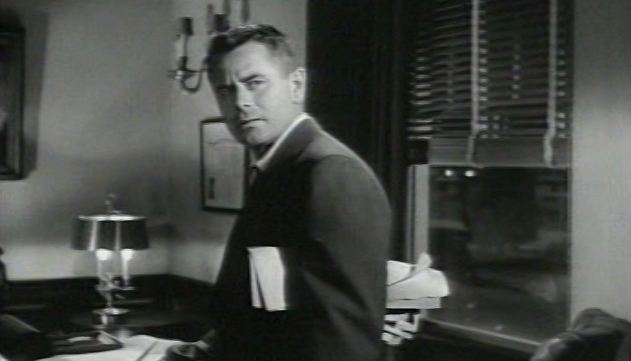


Arthur Kennedy offers Ford the use of his country cabin while the case is going on and Dorothy McGuire goes with him now to be his girl Friday.

At the cabin Ford works on his notes. He has trouble with an electric blanket, and Dorothy fixes it. She has experience with it. She has fixed it before for Arthur Kennedy. What else has she done for Arthur Kennedy?

“I used to help him. Used to. Not for over a year. Any questions?”

No, Ma’am, we don’t have any more questions. He kisses her, happy to take on both Kennedy’s trial and his old girlfriend. We are allowed to assume Ford and McGuire are sleeping together.

Suggestive as this may be for era, by far the boldest move taken by this movie is to have the role of the judge played by Juano Hernandez.  He is probably the first dark-skinned man to play a presiding judge in classic films. This opens up the question of bigotry one step further, but not from the bigoted whites in town as we might expect. A question on his impartiality is raised first by Rafael Campos, who overhears one of his jailers telling him that he is even more likely to be convicted by a black judge because a black judge will want to keep his job and impress the whites.

Glenn Ford will express his own doubts and suggest that he prefers not to have a black judge. Ford says, “I think you were selected so that after the conviction they can say, of course, the Mexican had a fair trial. Sure. He even had a Negro judge.” He is in profile saying his lines, so we are allowed to concentrate on Mr. Hernandez as the judge silently seethes next to him. The judge responds,

“I’m sure that you consider yourself completely without race prejudice, but you’d bar me from the bench in this trial because of the color of my skin.” He puts Ford put in his place.

But, I particularly like in gentler moments when the judge calls Glenn Ford, “boy,” the prerogative of an older man addressing a younger man. That simple line said in an affable manner probably made white supremacists in the audience choke, and I hope they did.

I also like the way Miss McGuire busily feeds Ford information during the trial like a catcher throwing signals to the pitcher. Too bad she’s not the lawyer, she’s the smartest person on Campos’ defense team.

Most of the movie is taken up simply trying to pick an impartial jury.

Another problem looms on the horizon. Glenn Ford is summoned to fly to Kennedy’s side to attend a rally in another part of the country. It is a fund-raising rally for Rafael Campos’ defense. In the auditorium, we see Kennedy approaching members of something called the “All Peoples Party Club” to raise collections. This is a communist front organization. Ford, with that squeamish expression on his face, protests to Kennedy that they should not be dealing with communists. Kennedy frankly tells him that money is money no matter who gives it and these people are willing to give it. Just as we had seen Kennedy slip the sheriff $20 early in the movie, we now see him making deals with organizers of communist groups and labor unions to split the money raised.

The rally is an impressive scene. It takes place in a public auditorium and is absolutely full to the rafters with extras. There are banners and songs, and it has the flavor of an old revival meeting. Glenn Ford is disgusted. When he tries to make a few statements in the microphone, Arthur Kennedy orders him cut off and it is almost like that scene in Meet John Doe (1941) discussed here, where Gary Cooper is silenced at the hands of fascists.

Then we see Kennedy work his magic with the crowd, a combination of Charles Foster Kane and Aimee Semple MacPherson. He tells the crowd to give their money, but tells them to not trust anybody. It is an anti-establishment shout, a forerunner of everything we will hear in the 1960s. We have another interesting shot of Glenn Ford slinking out of the arena in the bowels of the auditorium. Stylistically there are many fine camera shots in this movie.

Ford feels he has been duped, not only by the two-faced Kennedy but by McGuire. He wants to know just how deeply involved she is with communists. Apparently, her intimate relationship with Kennedy is no longer of interest in him. If it ever was.

She can be a woman of easy virtue, but her political beliefs are what taints her.

Dorothy McGuire next has a scene where she explains how she came to be involved with communists. She tells him that she drifted when she was in college. That she was “one of a thousand freshmen and I wanted to be different. And I found out they were clubs and meetings, and if went to them you were different. Suddenly people pointed you out and you became kind of campus curiosity… Suddenly you had friends who were going to change the world with you.”

It is a rather dishwater way to explain one’s move toward a new political perspective, even if for many it happened that way. Dorothy McGuire’s role, possibly simply because she was played by Dorothy McGuire the all-American girl type, was never meant to be a card-carrying communist. She is portrayed only as someone who was duped even as Glenn Ford has felt himself duped in this movie, who went astray and who regrets her actions.

She tells him that the communists dumped her. Because she was “…hopelessly bourgeois. They were right. I could never really accept the party line. The way it kept changing. Monday’s truth would be Tuesday’s lie.”

A great line, but the movie fails to consider the very irony that one of the biggest and most shameful actions of the McCarthy era is that people who had a minor role or even nothing to do with communism were painted with the same brush as the dictator Joseph Stalin. Stalin was unreachable to them, so they bullied and persecuted anybody at hand, usually for fame and profit. Indictments were slim in “un-American activities” trials; bribes were more common.

The movie moves on to the trial, after an arduous jury-picking process.

Mr. Ford questions the girl’s cardiologist about her weak heart. The doctor is played by Richard Gaines, who we saw before as the delightful bore in The More the Merrier (1943) as well as in Strange Bargain (1949) here. He can give no proof that her heart would not have given out anyway. A montage of witnesses testify. Glenn Ford intends to wrap up his defense quickly and not bring Rafael Campos to the stand because that would jeopardize the case, but Arthur Kennedy shows up to take over. He puts Rafael on the stand.

Meanwhile, a man stalking Ford turns out to be a Elisha Cook, Jr. in a minor role, who turns out to be a process server. It seems a local red baiter, a state congressman named Battle has subpoenaed Ford to testify before his own Un-American Activities Committee. Ford is really up to his ears in trouble now. Just by going to Arthur Kennedy’s communist rally he’s tainted himself.

We never get to see the character named Battle and that is a shame because it would be a much more courageous movie if this character were depicted. Today we might infer that Battle is meant to be an ersatz Joe McCarthy, and he is, but he really has a closer real life counterpart in a California State Senator named Jack Tenney. Tenney conducted anticommunist investigations in California in the 1940s and early 1950s. Among hundreds of people, the most famous entertainers he attacked were singer and actor Paul Robeson, and Edward G. Robinson. As is usual with these witch hunts not one single person in eight years of harassment resulted in one single indictment. It was a ploy to further his career, just as it was Joe McCarthy’s. Like Joe McCarthy, Tenney’s career petered out into oblivion eventually, but not until much harm was done.

Back to the trial and a very strange sort of grand finale. The jury finds Campos guilty of murder. The sentencing is put off until the next day. Glenn Ford decides to put an 11th hour bid to save the boy, runs off to the library (libraries feature big in our films this week, that haven of solutions -- I believe librarians are superheroes) and tries to find answers.

He addresses the court and raises an obscure ruling where Campos might, instead of being sentence to death, be committed to a juvenile offenders’ detention center for an undetermined period of time. Arthur Kennedy does not want young Rafael to be saved. He wants him to be hung as a martyr to the communist cause. He tries to scuttle Ford’s tactic.

We are never sure in this movie if Kennedy is a dedicated communist or whether he is just a flimflam man on the make for bucks. He attacks the judge with racist remarks, trying to make the judge angry, calling Hernandez a “handkerchief head” and an “Uncle Tom.” But, Judge Hernandez will not be baited.

In another switch, John Hodiak, the prosecuting attorney, agrees with Ford that sending Campos to the detention hall is the right thing to do. The judge so orders, and Campos is saved. Arthur Kennedy gets 30 days in jail for contempt of court.

We are also told that the red baiter Battle will drop his case against Glenn Ford because Ford is a fighter, and Battle only takes on fights he can win. A convenient end, and a cop-out.

This movie attempts a great deal, but if it were really bold it would have attempted it in the early 1950s or late 1940s when this movie is set. It would have featured Battle. Or more to the point, it would have answered one last question for us…

If Rafael Campos was really innocent, as we are made to believe he was, why is it right that he should go to a detention center, still having a criminal record to his name? The movie is not really about justice, but about expedience, and how sometimes we trade one for the other.

Come back Thursday for more fellow-travelers and red baiters, and libraries, in Storm Center (1956).


*********

Jacqueline T. Lynch is the author of Ann Blyth: Actress. Singer. Star. and Memories in Our Time - Hollywood Mirrors and Mimics the Twentieth Century. Her newspaper column on classic films, Silver Screen, Golden Memories is syndicated nationally.

Monday, July 12, 2010

A Stolen Life (1946)


“A Stolen Life” (1946) is one of those movies that does not seem to equal the sum total of its parts, but its parts are interesting. Break up the separate themes of this film and I suppose you could have at least three separate movies, so adventurous is the life of the unadventurous character Katie Bosworth, played by Bette Davis. She also plays Katie’s identical twin sister, Pat. Herein lies the main plot device that links the episodes in this film.

While I believe I can be objective and unprejudiced about most issues, I have to state right off that I detest “evil twin” stories. They are mind numbingly trite. I also find them insulting, preferring, like most twins, not to regard myself as a freak of nature.

It’s common to compare twins, to search out something that makes them different from the other. At best, it becomes a benign parlor game of visiting relatives marveling at different interests of the twins.

At worst, it becomes an onslaught of labeling each twin as the one who has better grades in school, which twin is more gifted athletically, which twin is actually better looking or at least has fewer flaws than the other twin. God help the twins if one, or even both of them, is handicapped. What God has put together, the world insidiously tries to pick apart.

In movies, there is a cruel assumption that one twin must have all the positive attributes and the other all the negative. I doubt writers and producers have any idea of the angst this causes in many twins who, if they are lucky, can laugh at the ridiculousness of such a theme, or if unlucky enough to be hit with insensitive comparisons, and self doubt, in real life, must be reminded yet again of the burden of being the “different” one in a society where movies tell them they are freaks automatically.

“A Stolen Life”, however, gives us a slightly more acceptable situation in that Pat is not really evil. She’s self-centered and shallow, but she’s not maniacal. Katie, too, is not exactly perfect. She is quite capable of wheedling her way into what she wants; it’s just that her wants are more simple and wholesome than Pat’s. Their relationship is not completely adversarial, and they seem to mostly live their lives apart. It could have been a film with more depth if it explored this more, as well as issues of co-dependency, instead of just hinging everything that happens to Katie based on her being the “good” twin.

What this film does have going for it is a whole lot of atmosphere, which I suspect is a draw for a lot of its fans. Taking place on an unnamed island off the Massachusetts coast, we get lots of majestic seascape, crashing waves on the rocky New England coastline, a lighthouse that figures prominently in the story, sailboats, a ship in a bottle, and a cozy cottage. Lobstah traps on the wh-a-a-a-h-f, ayuh.

The changeable sea can be dark and threatening at one moment, or gloriously beautiful and serene the next. It’s a great place to set a movie with moods and undercurrents. The isolation of the island can be a haven, or it can be a trap.

The other draw for this film is the remarkable technical achievement of filming Bette Davis as two people in the same scene. It’s done pretty well, and not overdone to the point of milking it. Most scenes have the two women separately, so we get used to thinking of them as different people. In the scenes where they are together, it is like electricity, a tantalizing achievement by the technical crew as well as Miss Davis.

The film starts with a map of New England, zeroing in on New Bedford, on Buzzard’s Bay. The Bay State has a lot of bays. I like movies with maps as much as I like movies with trains. Does it seem like Warner Bros. films have map graphics in them more than the other studios?

Bette Davis as Katie enters rushing from a taxi to meet the last steamer of the day leaving for “the island,” swinging her suitcases with the stickers on them. Not only are there lots of bays, there are lots of islands, but I guess since even a fictional name is not applied, we might infer she’s heading for Martha’s Vineyard. She’s supposed to reach there in two hours, so I don’t think it’s supposed to be Nantucket, which would be a bit longer journey.

Martha’s Vineyard is usually referred to by New Englanders as “The Vineyard.” It’s not a vineyard, it’s an island, but with so many islands, nobody would know what you mean if you said you were going to “the island”. I suspect Hollywood neither knew nor cared about this. And although there is a shot of her sailboat against some bluffs that look like a reasonable facsimile of the western part of Martha’s Vineyard called Gay Head or Aquinnah, the lighthouse in the movie (which is off a point called Dragon’s Head), does not resemble the real Gay Head/Aquinnah lighthouse). See my post on this lighthouse in my New England Travels blog for the real one.

So, right off we’re heading into a mix of fantasy and reality the way Bette heads right into the mysterious fogbank. I would love to know where some scenes in this film were shot. Some of the quaint New England seaport village stuff is obviously back lot, but there’s enough real coastline that teases us.

By the way, the airport scene was filmed at the actual Long Beach, California airport. Other movies were, too, and we’ll have more on that next week.

The lighthouse is particularly intriguing. Close-ups of its front door may be a partial replica built anywhere. Distant shots against a backdrop of glistening ocean could be a miniature model on a scaled down set. However, there are mid-range shots of Bette actually hopping off a boat, trotting up the dock up to the lighthouse, which makes me think at least some of this is an actual location. I’ve read somewhere that Laguna Beach, California was one filming location, but I’d love to know more detail on that. One of the other interesting aspects of this movie is how well they splice visuals together.

Katie, missing the ferry steamer, hitches a ride to “the island” from Glenn Ford, who is the lighthouse keeper’s assistant just about to leave the wharf with a motor launch full of supplies. On the way she sketches him, and we learn she is an artist, a woman who is sensitive and playful, yet down to earth.

Mr. Ford is handsome as can be here, a rugged but gentle and introspective chap who has forsaken a promising career as an engineer to work as Walter Brennan’s assistant at the lighthouse because of the simple life and freedom it offers. Mr. Brennan in his usual role of the comically crusty old codger doesn’t really have too much to do in this film, but he adds as much atmosphere as the lighthouse and the fog. His natural born eastern Mass. accent fits nicely with his role, no phony Yankee here.

For that matter, our Miss Davis hails from Lowell, Mass., so she seems to fit naturally among the all the pseudo New Englanders populating this faux community. We see her striding about in her casual trousers and flats, the wind tussling her hair carelessly, or in jeans and sneakers, and sweater, doing away with Hollywood glamour in this role. She seems pleasantly authentic, a woman/actress on her own turf.

With the lighthouse scenes, we might also muse on the film’s efforts to recapture a romantic past, or at least to ignore the realities of the present. We see painted above the door of Walter Brennan’s lighthouse “U.S. Lighthouse Service”. When this film was made in 1946, there was no U.S. Lighthouse Service. This government bureau was ended in 1939, capping an era throughout the 1920s and 1930s when more and more lighthouses were being automated, discontinuing the need for lighthouse keepers. In 1939, the U.S. Coast Guard took over the management of lighthouses. This post-war movie continues the romantic fantasy of the lonely intrepid lighthouse keeper, ignoring the possibility that Walter Brennan would have been downsized.

We are not given much back story on Katie and Pat, except that Charlie Ruggles is their cousin and their guardian. They are visiting him in a cottage on “the island” which he has rented for the summer. Mr. Ruggles is ever the delight in his films, with that finely drawn mixture of kindly bumbler and sharp-as-a-tack gentleman of the old school.

Katie relates that this is her first time to “the island”. However, she’s learned to sail somewhere, and she wastes no time taking out her sailboat to visit Walter Brennan at the lighthouse. She wants to paint his portrait and bribes him with a ship’s model he covets to do so, but it is a ploy so she can spend more time with Glenn Ford, with whom she has fallen in love.

(Small point here, but I like the way she handles the paintbrush, deftly rolling it in her fingers, changing her grip on it as she concentrates on the detail of her portrait of Mr. Brennan. It looks like she knows what she’s doing.)

We see that, far from being the perfect “good” twin, Katie can be cunning, duplicitous, and secretive, but we can also see that she has a very understanding heart. She earns our sympathy from the beginning with her confessions of loneliness and her quiet charm.

The movie pulls a nice trick on us by not revealing Katie has a twin until she enters her bedroom at the cottage after a date with Glenn Ford, to find her sister Pat lazily lounging in a chair. Pat peeks her head around to notice Katie in the foreground of the shot, still in the half shadow. Her voice is familiar. They chat companionably, and in another moment, Bette Davis walks over to the chair where her sister sits, turns on the lamp. GASP! There are two of her! Then she hands her twin a match so the sister can smoke a cigarette. One senses this shot was most gleefully done by everybody involved.

Notice however, that Katie does not light Pat’s cigarette, but reaches down to put the match in Pat’s hand, which rests on the arm of the chair. They are cleverly covering the joined exposures here. In another moment, Katie is in bed, and Pat flops on the other side to chat a bit more, seeming to pick at Katie’s sleeve as she speaks. Another good matching of exposures here. There’s not too much of this in the film, it would detract from the story, but it’s a lot of fun to watch.

Pat, we discover, is more worldly than Katie, more sophisticated, bored with “the island” and her wealthy friends in Hyannis on Cape Cod. Perhaps it is her boredom which leads her to make a play for Glenn Ford, tricking him into thinking she is Katie.

Mr. Ford is a good sport at first when he realizes he’s been fooled. Then decides it is Pat he really loves. Considering we are set up to believe he and Katie are meant for each other, and we are also set up to accept Pat as a self-centered man trap, it seems a bit of a stretch that his swell guy would fall for what seems so obviously artificial to us. But, fall he does, preferring as he says “the frosting” rather than the cake, as he also says most men will.

“Must you always let that sister of yours get ahead of you?” Charlie Ruggles demands of Katie, wanting her to fight for what she wants. She avoids being competitive with her twin (more could be made of this), but she determinedly side steps the bridal bouquet Pat later merrily tosses to her. We see Katie has a recalcitrant side.

Pat’s conquest of Mr. Ford happens rather swiftly at the local barn dance. New Englanders, you see, love square dancing. You can tell by how many Hollywood movies have New England square (sq-way-uh) dances in barns or at the town hall. We see it in “Christmas in Connecticut” (1945) (where we also see our penchant for riding in sleighs, see this previous blog post) and “Summer Stock” (1950), and so we have to have one here. A good old b-a-a-h-n dance. The other thing we do with b-a-a-h-ns is turn them into playhouses for the local summer stock company. Like in “Summer Stock”. Summer stock in New England is sometimes referred to as The Barn Circuit (or The Straw Hat Circuit).

In fact, our Bette Davis in real life got her start in such a barn at the Cape Playhouse on Cape Cod, where she was an usher before graduating to bit parts. Have a look here in my Tragedy and Comedy in New England blog. (Come to think of her, her hometown of Lowell now has a first-rate professional regional theatre, the Merrimack Repertory Theatre. She’d be pleased. Except it’s not in a barn. Uh, that’s b-a-a-h-n.)

By the way, Mr. Lippincott, who owns the b-a-a-h-n, is played by silent screen actor Monte Blue, according to the IMDb website. Other silent screen stars have uncredited roles as well, including Snub Pollard, who also shows up at the b-a-a-h-n dance. He appeared in eight movies in 1946, all in bit parts that must have kept him eating. Creighton Hale is also listed as an extra.

Pat sweeps Glenn Ford off his feet at the b-a-a-h-n dance, and they get married. Katie heads back to the family mansion in New York to brood and paint. She is not alone. Dane Clark shows up to brood and paint, and bully her with insults, which Kate takes with astonishing serenity.

Here is where we have a branching off of plot that could make a separate movie. Dane Clark is a starving artist of, we are told by him, great talent. His role is similar to John Garfield, the dismissive pianist in “Four Daughters” (1938), see this previous post, who was also poor and talented, with a really lousy attitude.

Mr. Clark, however, does not seem to have the same knack John Garfield had for drawing our sympathy. Clark’s character is without any humor about others or himself. His arrogant proletariat rudeness toward Katie makes her seem far more a doormat than she ever was when Pat stole her boyfriend. A person living in the shadow of a more glamorous or accomplished sibling is a common story, in the movies and in real life, but here we wobble uncertainly as to what is the cause of Katie’s malaise.

Dane Clark’s explanation is simple and cruel, “You two disliked each other from the time you were born. It’s a perfectly natural antagonism.” This presumptuous and ignorant conclusion is what drives most “evil twin” stories and is perhaps one of the other reasons I dislike them so much.

Mr. Clark, who seems to thrive on antagonism himself, criticizes her painting, making a further accusation, “I bet you’re not even a woman.”

When she asks him for clarification, he sneers like a little boy who has thrown a rock at a bird and delights in having hit it. “That always gets ‘em,” he says.

From the time Pat is said to have “frosting” to the time Mr. Clark indicates Katie is not a “ball of fire”, we are seemingly meant to infer that Katie’s reticence is more than just a meek acceptance of stolen boyfriends and angry artists. She may not be sexually experienced, which may explain Clark’s ridicule. She is hardly shy; it is she who pursues Glenn Ford, but she is not sexually aggressive in the way Pat is, and perhaps we are being told this is one of her flaws.

According to the Hollywood on Twins Playbook, if being oversexed is Pat’s character trait, then Katie must be afraid of sex, for as we seem to be told, tiresomely and yet again, that twins, individually, are not whole people, that only together they have all the attributes of a human being. Individually, they are only fragments of a person. When the egg in the womb splits their chances at ever being a complete person evaporates.

There’s probably a lot more dime store Freud in here that I’m missing, but you get the idea.

But, Katie, passive or not, seems to impart a kind of courage, a stoic survivor’s attitude, bearing up under Pat’s callousness, under Walter Brennan’s blustering, under Dane Clark’s insults, and even under Glenn Ford’s hideously thoughtless request that she help him pick out intimate apparel for Pat’s present on their birthday.

The older men in this film are more interesting than the younger men. Ford and Clark act like pinheads hijacked by their own insensitivity, who are either manipulating or being manipulated.

Katie seems to get some of her moxie back when she efficiently rebuffs Dane Clark’s rough advances. He actually looks crushed and his scowl departs for about two seconds. Unfortunately, she also declares herself a third-rate artist in comparison to his talent, and we must wonder if she is giving up her art because she cannot be the best.

Katie heads back to “the island”, unexpectedly finds Pat there also seeking refuge, and the twins companionably head to the wharf to go sailing, striding through town in their jeans like a Doublemint commercial. This is a long shot with Bette and a double. The split-screen close-up was done in the studio with rear-screen projection.

Pat has become outdoorsy like her sister, perhaps feels more than she actually expresses of her regret in marrying Glenn Ford, and they get caught in a storm. I realize this entire post has been a spoiler, as all my posts are, but if you don’t want to know what happens next, you’d better go down to the corner for a newspaper. Bring me back a candy bar, any kind.

Did they leave? I thought I heard the screen door slam. Okay. For those of you who have remained, I’m going to assume you know I’m going to tell you that one of them drowns. It’s Pat. Here’s where the plot splits again and could be the story for another entirely separate movie.

The scenes of the twins sailing in the storm are skillfully done, with Bette and a double alternately blocked by the swinging boom. She, and the double, had to film this scene separately as Pat, and as Katie, being battered by wind and soaked by waves. It’s all stitched together quite well, even more impressive when you realize it was filmed on a set.

Katie, who though distressed at the loss of her sister does not express anywhere near enough the realistic anguish of the situation, impulsively decides to say nothing when she is mistaken for Pat. Her rescuers think it was Katie who drowned. Katie plays along, thinking this is her chance for happiness being the wife of Glenn Ford.

(The scene with the beleaguered sailboat smashing against the rocks of the lighthouse ledge reminds me of “Portrait of Jennie” (1949). You wonder for a moment if Joseph Cotten and Jennifer Jones are going to scramble over the rocks.)

Assuming the identify of a deceased person is also not a new plot idea to film, but using identical twins makes an interesting twist because Katie now moves about incognito, disguised in plain sight. As such, she is comforted by Walter Brennan and others who tell her that her sister Katie was such a wonderful person. It’s like being at her own wake. Very eerie and emotional, and more could have been done with this.

Even Dane Clark displays his own belligerent sense of grief when he shows her that he has painted a portrait of Katie from memory.

Now, Katie must run an obstacle course of fitting into Pat’s life. The easiest part is making Pat’s dog, Mike, accept her even though Katie doesn’t smell like Pat. Mike is not fooled. Mike is the smartest character in this movie.

But, she gets around him with treats. Even Mike, it seems, can be bought.

However, Katie’s game of pretend comes crashing down on her head when irony akin to an O. Henry story slams her in the chops. Glenn Ford wants to divorce her because Pat has had affairs with other men. Katie runs back to safety of “the island”, where Charlie Ruggles figures out her secret, because he’s almost as smart as Mike. We are given one of those slapped-on happy endings because somebody must have noticed they were running out of film and it was time to end the movie.

It’s still a fun movie, for all the tangled plot threads, but especially for the technical achievements, and the atmosphere. It makes an attempt to carve out an old stock melodrama using film technology and good old film theatrics. But there’s a story missing in all this contrivance. It’s the twinship that never gets told, that Hollywood never seems to get a handle on.

And I’m not even going to mention the Carol Burnett parody.

For a look at the striking scene where Bette Davis meets up with herself, have a look below. (Don’t forget to scroll down to the bottom of the page and pause the music.)

Related Products