IMPRISON TRAITOR, PEDOPHILE, AND CONVICTED FELON TRUMP.
Showing posts with label Elsa Lanchester. Show all posts
Monday, June 21, 2010
Dreamboat - 1952
This week we have a couple of movies that illustrate that cusp of the television era, just before the so-called Golden Age of TV, when the new medium was searching for fodder to fill up the airways. Old movies filled the gap and made life easier for the network programmers. They were cheap, plentiful, and most had not been seen for a generation.
Today, we have “Dreamboat” (1952), in which Clifton Webb’s former past as a silent screen heartthrob comes back to haunt him. On Thursday, we’ll have a look at the “Hopalong Cassidy” phenomenon (through a generic replica, of course, copyrights being what they are), with “Callaway Went Thataway” (1951).
That these two films came one after the other, and dealing with the same subject matter, is some indication of the enormous impact TV was beginning to have, and how dependent it still was upon old movies to fill up hours of programming. Movies and TV have always been co-dependent. Most of us who are classic film buffs were introduced to these films on television, long before DVDs and video. We would not be film buffs without television. Evidently in the early 1950s, though Hollywood might have panicked about being challenged by television, there was still some sense of humor about their relationship with the new gadget.
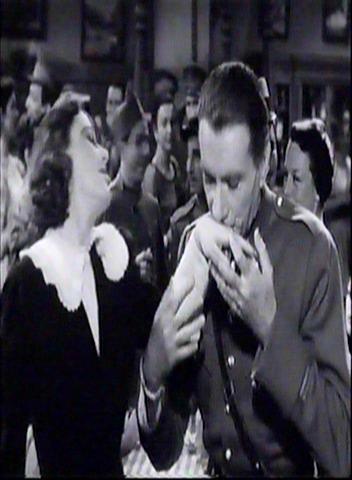
“Dreamboat” is a romp, as outrageous a vehicle for Clifton Webb and Ginger Rogers as the campy silent film clips we see of them together in the typical 1920s scenarios: a Zorro-like hero, a World War I ace, a Valentino-like hero, all shown on commercial television, commercials being the operative word. Ginger, now a Hollywood has-been, has a new job hosting these old silent movies and pushing the product, which in this case is perfume.
Clifton Webb is a college professor, intelligent, severe, whose extreme dignity makes him the butt of the campus jokesters. Mr. Webb’s dignity was a tool he used, or was made use of by others, in just about any film he was in. It made him alternately pathetic, heroic, sinister, or just plain foolish. It’s amazing how much mileage he got in his career with a withering glance and a sarcastic reply.
His daughter, played by Anne Francis, who we last saw as a teenager in the last few minutes of “Portrait of Jennie” (1948), is, in attitude, nearly a carbon copy of dad, except there is an added bit of shrewish impatience which threatens to stamp out any likeability in her. But this only helps to set up her eventual conversion.
Both father and daughter set out on a quest, for vindication, and though they don’t yet know it, for conversion to adapting to the big wide world they both disdain. That world, in part, is represented by television, which Miss Francis calls the “idiot’s delight.” She is reluctantly brought to a college party where the gang gathers to watch that program hosted by Ginger Rogers showing those old movies of hers with her former co-star, Clifton Webb. And push perfume during the commercials. One of the perfumes is called “My Five Sins.”
“Five?” Clifton Webb later asks, astonished.
The gang knows this simpering, overacting, sword carrying hero with the overdose of Brilliantine on his hair is their hated college professor, and they throw this revelation in young Miss Francis’ astonished face.
Pop, who tried to hide his former career, is equally abashed, and decides to go to New York where the TV program is produced to demand they take it off the air. Not only his dignity, but his job is on the line. The board is uneasy with an English professor with this kind of unsavory background, which seems to make a mockery of their prestige. Only the college president, played by the wonderful Elsa Lanchester, is willing to give Clifton Webb a break. She is a fan, and makes several awkward and athletic attempts to seduce him.
She asks the age-old question, asked so often in melodramas, “Has it ever occurred to you I’m also a woman?”
Off father and daughter go to New York, where he meets up again with his old co-star, the now much older Ginger Rogers. Miss Rogers sinks her teeth into what must have been a fun role as an over-the-top, manipulative, self-involved, has-been, who clings ferociously to any thread of her former career as a matinee idol.
While Rogers and Webb tangle with network executives, lawyers, and their own uncomfortable partnership, which we are made to understand was never as romantic as it appeared on screen, Webb’s daughter is shown around town, and his apartment, by a network underling, a very handsome and affable Jeffrey Hunter. She begins to experience life outside of museums and lecture halls, and likes it. We know she has become a woman of the world when she takes off her glasses.
Clifton Webb has a fun scene where he gets into a bar fight. Helpless to defend himself, he sees one of his old movies on the TV above the bar which shows him vigorously fighting off a gang of ruffians. So, he watches himself, gets a few pointers, and once again, beats the bad guys. Unfortunately for him, Elsa Lanchester pursues him to New York and he has a tougher time shaking her.
The dramatic climax takes place in court, with our old friend Ray Collins as the attorney defending the TV network in its right to show these old movies. Clifton Webb dismisses his own theatric attorney with my favorite line, “You overdid it. I’m not an unwed mother lost in a snowstorm.”
A TV set is put on the stand so that Mr. Webb may demonstrate to the court that TV is not, as Ray Collins would have us believe, an instrument of education, but rather a haven of idiocy. A couple of commercials are shown, typical of the day, that parody both the disingenuous message of commercials (something which has not changed through the decades), but also frank stupidity of the audience which the makers of these commercial must assume. The hair tonic with “Penetroleum” with ingredients like “cosmotron” may get us to laugh, but compare this with the more subtly sinister commercials in “A Face In the Crowd” (1957). That is a more cynical film, but this one, for all its silliness, is hardly naïve. We may get the feeling we are sliding inexorably toward “A Face in the Crowd”.
Mr. Webb wins his case, proving that the films have been altered to make him look foolish, but loses his college professor job when he spurns the scorned Miss Lanchester. She fires him in retaliation. This was the day when sexual harassment was an accepted mode of employee relations and job security.
Left without a career, Webb is not too downhearted, for as he gloats to the now also out of work Ginger Rogers, that Hollywood has come calling back for him. We see him finally in a clip of a new movie, where his dignity is abused for laughs, and three small children throw food at him. It’s a living.
Come back Thursday for another look at the movies-cum-TV era with “Callaway Went Thataway,” with Dorothy McGuire, Fred MacMurray, and Howard Keel.
Thursday, October 22, 2009
Bell, Book and Candle - 1958

Bell, Book and Candle (1958) begins its story on Christmas Eve, carries the plot a few months into the spring, and never really mentions Halloween, but since the story is about a witch, Halloween is never far from our minds.
Kim Novak plays the anthropology major-turned-dealer in native art who lives behind her shop in Greenwich Village. She is the witch, and James Stewart is the publisher she bewitches. Elsa Lanchester, as always, is hysterical as her mischievous and somewhat childlike aunt, also a witch. Jack Lemmon is her mischievous and somewhat sophomoric brother, a warlock. They gather occasionally at a seedy local nightclub to enjoy the company of other witches who are all living a kind of underground life, on the fringes of respectable society, never daring expose who they really are.
Another important supporting role goes to Pyewacket, Miss Novak’s cat. Particularly charming is the bond the two seem to have had. She looks quite comfortable handling him. He sprawls and hangs like a limp towel on her shoulder (mentioned in this previous post on other cat actors), and the way he stretches himself against her body, he certainly seems comfortable with her.Kim Novak may have taken him for a model for her role, with her slow, feline, graceful, deliberate movements, her penetrating gaze, her casual, low, lazy speech. She does not appear emotionally brittle as she does in her previous films mentioned here, Picnic and Strangers When We Meet, or Vertigo, in which she also started with James Stewart. Here, though her character is complicated and mysterious, she comes off as a much stronger, focused person.

But she is not without her troubles. Miss Novak is bored with her life and wistfully wonders what it would be like not to be a witch. We are told that witches cannot blush, or cry, or fall in love, and that if they ever did fall in love, they would lose their powers. Novak wonders what it would be like to be in love.
On Christmas Eve at the local witch dive, she confesses her Christmas depression (which might make her more human after all) and ruminates, “Don’t you ever wish we weren’t what we are -- that you could spend Christmas Eve in a little church listening to carols instead of bongo drums?”

She takes a fancy to upstairs neighbor James Stewart, and when she discovers that his fiancée is her old college nemesis, played razor sharp and elegant by Janice Rule, the kind of girl who led the clique and ostracized the losers, Miss Novak decides all’s fair in love and war. She goes after him.
As part of her plan, she casts a spell on an author that publisher Stewart wants to meet. That author, a charlatan investigating witchcraft, is played by the one-of-a-kind Ernie Kovacs, with his customary dizzy alcoholic logic. She casts a spell on Stewart, and one of the most memorable scenes is their Christmas morning adventure on the top of New York’s Flatiron Building. When he tosses his hat off the roof of the building, we watch is sublimely sail several stories until it slaps into the slush on Fifth Avenue.
Complications ensue when her brother Jack Lemmon decides he’s tired of being poor and starts to feed real information on witchcraft to Ernie Kovacs to cash in on his book that Stewart will publish. Novak nixes this project as too dangerous to their community, and Lemmon gets his revenge when Novak is forced to confess to Stewart that she is a witch and that she had cast a spell on him.

It takes a little convincing, but eventually the light dawns and Jimmy is horrified, angry, and humiliated (his reactions are very funny). He seeks a counter spell from another local witch, played with glorious self importance by Hermione Gingold.
But we have our happy ending when Kim Novak, in spite of herself, really has fallen in love and as a result, blushes, cries, and loses her powers. And her cat. Stewart decides he really is in love too, without the spell.
Taken from John van Druten’s stage play, much of the playful language teases us with the bewitching power of sex. Novak scolds Elsa Lanchester for the pranks she plays and forbids her to use her witchcraft because she cannot be “discreet.”
Jack Lemmon, she tells Stewart, uses his powers to enhance his love life. Elsa Lanchester tells Stewart that witches cannot fall in love, “Love is quite impossible. Not hot blood, though. Hot blood is quite allowed, but of course,” she lowers her eyes, “you know all about that.”
There are other playful remarks that gesture to the history of witchcraft (or rather, suspicion of witchcraft) in America. Elsa Lanchester confides to Stewart that both Novak and Lemmon were witch prodigies as children, “We lived in Massachusetts.”And, when Stewart, seeing that she has a confession to make and teasing her to just come out with it says, “Have you been engaging in un-American activities or something?”
To which Novak grimly replies, “No, I’d say very American. Early American.”
Obviously, this film was a huge inspiration for the successful television sitcom Bewitched which followed in the 1960s and early ‘70s. (Speaking of which, have a look here at this post on the Samantha statue in Salem, Mass. on my New England Travels blog.)
It’s interesting how many words we have to denote love that come from a mystical lexicon: bewitching, enchantment, magical, casting spells. Perhaps Stewart is right when he says, embracing Novak at last, “Who’s to say what magic is?”
*********
Jacqueline T. Lynch
is the author of Ann Blyth: Actress.
Singer. Star. and Memories
in Our Time - Hollywood Mirrors and Mimics the Twentieth Century. Her newspaper
column on classic films, Silver Screen, Golden Memories is syndicated
nationally.
Monday, December 22, 2008
The Bishop's Wife (1947)
In this season of Hanukkah and Christmas, though miracles are commemorated, they are seldom looked for anymore, or at least seldom recognized. “The Bishop’s Wife” (1947) presents the intriguing Christmas card type setting awash in post-war cynicism. Cary Grant is the suave and charming angel with the California tan, whose presence is by turns eerily threatening as it is comforting.
David Niven plays the Episcopalian bishop who has turned from parish vicar to corporate CEO in his drive to build a new cathedral. He matches Cary Grant perfectly in his comic timing, since the sight of a dignified man struggling to maintain his dignity under absurd circumstances is frequently hysterical. Niven’s scenes in the wealthy lady’s mansion with the wealthy lady’s expensive chair inexplicably stuck to his bottom are among his best. His embarrassment and distress grow acutely each time the butler makes an entrance.
An interesting aspect to the character is that maintaining his dignity has become more important to him than maintaining his faith, and both dignity and faith have been pushed aside for ambition as he obsesses so much over obtaining donations for his new cathedral. He is willing to sell out his principles to court the golden pocketbook of the always magnificent Gladys Cooper.
When she asks that the a depiction of St. George resemble her late husband in the new cathedral icon of St. George and the Dragon, Niven asks her quite seriously, “Who do you see as the dragon?”
Loretta Young plays his radiant wife, and though as appealing as ever, Miss Young hasn’t much to do in this film except enjoy Cary Grant’s company, which must have been easy.
The character actors, as always in any film, make this one come alive and by the end of the film seem like our extended family: Elsa Lanchester as the maid, whose precise intonation and crisp consonants alone endear her to me; James Gleason as Sylvester the cab driver, and the lovably crusty Monty Woolley as the professor of antiquities who claims to have no faith, but who keeps a Charlie Brown tree in his flat to remind him of his boyhood.
That’s the kind of faith a lot of people fall back on this season, not so much faith in a divine presence or in the miracles these holidays represent, but a comforting memory of childhood. “It gives me the illusion of peace on earth, good will to men,” Woolley tells Grant of his tree. A tree gives him this sensation, not faith, not hope, and it is not a real sensation of peace anyway, it is only to him, an illusion.
Mr. Grant’s penetrating gaze and implacable, insinuating smile are priceless, both funny and edgy. Though he enchants the ladies, his is a sly smile, not beatific. When Niven doubts Grant’s being an angel, Grant offers, “As you’re walking through the streets of the city, you may suddenly look into a strange face. It may be the face of a murderer. Or, it may be the face of an angel.”
It’s the kind of remark and delivery you might see in a Hitchcock film, so challenging and so chilling. Mr. Niven demands Mr. Grant perform miracles that he might believe in him, and Grant teasingly shames Niven, a bishop, for his lack of faith without the miracles.
As it is, his angel character does pull off a few party tricks as miracles in the film: Monty Woolley’s wine that never depletes, the instantly decorated Christmas tree, the skating party where Loretta Young and James Gleason could quit their jobs as cab driver and bishop’s wife and go join the Ice Capades. He can also make a typewriter type by itself without Dragon Naturally Speaking computer software.
The biggest miracle is one that Grant pulls off with the help of David Niven, giving Niven the push he needed to do the miracle himself, which is to give up his notion of erecting a cathedral that would only be a monument to wealth, and instead returning to his roots as a shepherd of his flock and helping the poor.
One needs two things to perform miracles it seems. One is the determination to do so. Second, is a sense of wonder. As we see with the professor, who Grant inspires to finish his lifelong work of writing a text on ancient history, a sense of wonder is fertile ground for miracles. Perhaps that’s why he, and many of us, prefer to use the holidays as an opportunity to re-live our childhoods. There is no greater sense of wonder felt than when one is a child. Miracles are possible then.
Grant’s last miracle is to un-bewitch Loretta Young, driving her back to her husband simply by forcing her to choose her husband’s love when Grant comes close to declaring his love for her. He has also, by this time, made Niven so jealous, that Niven is forced to fight for his wife, and their marriage is strengthened simply by deciding themselves that they want to be married to each other.
When Cary Grant bows out, gracefully, he bids goodbye to Niven and steps, surprisingly, into the camera instead of away from it. As if he is stepping right into us. It’s a nice effect, making the final, and inevitable, shot of Grant walking away in the snow a bit of a letdown. Ending with the previous shot would have been more powerful, if less poetic. But no one sees him but us, and none of these people whose lives he has touched will remember his presence among them. He wanders off to his next assignment, never to return lest he become too attached to these mortals. Are all angels so lonely?
Or do we project our loneliness onto them? In this season of miracles, the irony is that though we take such elaborate preparations this time of year to remind ourselves that they exist, we still have a hard time accepting that they do. How ironic that these Christmas movies often do not really remind us of a miracle of peace on earth, good will to men, as much as they do to remind us of our own cynicism.
Thursday, October 9, 2008
The Spiral Staircase ( 1945)
“The Spiral Staircase” (1945) gives us a suspense story with the archetypal “dark and stormy night”. Many suspense films since have taken a leaf out of the book of director Robert Siodmak and especially cinematographer Nicholas Musuraca, and used the devices they did, which now may seem almost cliché. Here every shadow and sinister nuance is fresh, and new, and like nothing that ever came before.
Dorothy McGuire is a servant in a New England household in the early 1900s, headed by a feisty invalid matriarch played by Ethel Barrymore. Miss Barrymore lives with her grown son, Gordon Oliver, and stepson, played by George Brent.
The film opens in a curtained-off room of a small village hotel where a silent movie is being shown. The determined matronly pianist grimly follows the action on screen with musical accompaniment. The camera pans to a rapt audience, no one more rapt than Dorothy McGuire, who is clearly deeply involved in the silent movie, clutching her hanky and suffering agonies with the heroine.
The camera leaves the audience and pans to an upstairs room in the hotel. A woman is spied upon from the dark recesses of her closet by a figure unseen except for the menacing gaze of one frightening eye. Next we see the woman as a victim from the perspective of this hidden killer. We still hear the accompanist’s piano rumbling ominous chords from the floor below. When the killer strangles the girl, the movie below concludes, and it is “the end” indeed.
We discover this is one of a string of murders, and that the victims are all young women with various afflictions.
When Miss McGuire walks back in the darkness to the enormous Victorian home where she works as a maid, the wind and rain kick up, and she hears the sound of footsteps following her. This, and when she fumbles with her house key and drops it in the mud are only two instances where suspense rises, even if nothing is really wrong. The idea of imminent danger is kept moving briskly along, like kids kicking a can down the street. We are continually tricked. There are even comic moments which continue the suspense, such as when the family cook played with humorous brandy-swilling buffoonery by sly Elsa Lanchester, tumbles in the dim hall. At first we are led to believe she may have been attacked, as Lanchester accuses with an outraged, “It was him!”
We see she has only tripped over the ever-recumbent bulldog, Carlton.
Another instance is at the entrance of Lanchester’s husband, handyman Rhys Williams, who enters from the storm suddenly when a door is opened for a guest to leave, and he is unexpectedly standing there on the porch, rain soaked and sinister-looking. Apparently, it is only another false alarm, this time. Maybe.
Williams later comforts McGuire during a cozy visit in the kitchen that being murdered is as rare as winning the lottery. “It’s never me. It’s never you. It’s always somebody else.” The director cleverly plays us between scenes where something could happen but doesn’t, and scenes where something happens before we realize the danger. Maybe it’s the lottery and maybe it’s more like roulette.
Dorothy McGuire’s character is repeatedly warned by others to be careful, as she is labeled, perhaps by them more than by herself, to be a prime candidate for the killer’s next victim, because the killer targets handicapped young women. McGuire is mute, the victim of past emotional trauma, rather than from a physical impairment. Her muteness makes the opening scene watching the silent movie especially poignant, where the pantomime on screen foreshadows McGuire’s world of pantomime to communicate.
The local young doctor, played by Kent Smith wants to help her recover her speech and pushes her to help herself, to get her to replay the trauma that left her mute, but she cannot face painful memories.
McGuire has a special, even occasionally playful, relationship with Ethel Barrymore, who prefers McGuire’s ministrations rather than the severe and much put upon nurse, played by Sara Allgood. Bullying Barrymore’s room is cluttered with hunting trophies. The feisty widow was a crack shot in her day, and she repeatedly warns McGuire to leave the house for her own safety, or else stay with her and sleep in her room, even at one point urging McGuire to hide under Miss Barrymore’s bed. As sick as this old lady with the frequent spells is, she feels quite capable of defending a much younger, stronger woman. We see that Miss McGuire, and her muteness, inspires protective feelings in most people, but apparent disgust in a killer who murders young women with imperfections.
Miss Barrymore’s concern is made greater, as we eventually come to realize, because she believes the killer is not only lurking in the neighborhood, but is actually in the house. We are given several broad hints that her charmingly insolent, gallivanting son Gordon Oliver has dubious morals and weaknesses that may include murder. He confesses that he likes to see women cry.
Stepson Mr. Brent, a workaholic professor, who keeps his secretary Rhonda Fleming busy typing on a clunky old typewriter the size of a Buick, seems to share his stepmother’s suspicions. At this point, with as many red herrings as suspicions, the foreshadowing warns us to be wary of everybody, from the pistol-packing constable to the pistol-packing Miss Barrymore, to Carlton the recumbent bulldog. As George Brent tells McGuire, “Don’t trust anyone.”
Central to the story is the house. The excellent ensemble cast seems to give us a tour of the house, breaking up into pairs for hushed discussions, and impatient lovers’ rendezvous, and bitter arguments in various different rooms, always interrupted at a scene’s climax by unwanted intruders.
A magnificent set, it has many levels and the camera follows McGuire, taking us the audience from room to room, almost like the eye of the killer. The spiral staircase of the title is an iron circular stairway, ugly utilitarian back stairs meant for servants, quite unlike the imposing staircase with the carved wooden banister in the front hall. The spiral staircase leads from the main floor of the house down to the kitchen, and then continues down to a lower cellar level, which is very creepy. People lose their candles down there and get lost in the dark.
Even just the hollow plunking sound of the actors ascending and descending the iron steps echoing in the bare, unadorned stairwell is evocative, as lonely and creepy a sound as the wind and rain outside.
The house is heavily ornamented with Victorian drapery, dark wainscoting, parquet wood floors, elaborate gaslight sconces, elegant chandeliers and miles of carpeting. The walls stretching to high ceilings close in on us with busy wallpaper and dour portraits. Dramatic for its overwhelming sense of a grand age in decline, it is as if the house represents the moral decay of the dwindling dysfunctional family limping along into the decadent present.
We see an interesting contrast in the daydream McGuire imagines of her wedding to the young doctor, which occurs, of course, in the house, the central place to the story. In her daydream sequence the house seems alive again, swarming with guests, and vibrant, lighter, and there are baskets of flowers festooning every corner. One might imagine this is how the house appeared in earlier times, before the old widow lost her husband and her enthusiasm for life, before her son and stepson became the kind of weak men she despises.
A large full-length mirror on the landing of the front stairs gives Dorothy McGuire an opportunity to appraise herself, to see herself as others see her. She silently moves her lips, works her jaw in a pose to see how she would look if she spoke as effortlessly as others do, all the people she envies for their eloquence. Suddenly we are aware through a subtle shift in the camera perspective that she is being watched. In another instant, it is apparent to us that it is the killer who is watching her, that we are looking over the killer’s shoulder, who is looking over hers. So smoothly do these moments of tension occur that they are upon us before we realize.
The last half hour of the film is the most suspenseful. The killer is loose in house and aggressively stalks her. The constable shows up unexpectedly but leaves before she can alert him. Her desperate attempts to attract his attention from an upper floor window bring the film to a dramatic crescendo, and when her last hope for aid is gone, we see there is nothing to stop the killer from getting her.
Now she charges all through the house, upstairs and downstairs, like an Olympic sprinter. The final showdown happens on the spiral staircase, and we learn that neither the mute Miss McGuire, nor the invalid Miss Barrymore, is as helpless as they seem.
Dorothy McGuire does recover her voice, first with a scream, and then with a choking call for help on that new-fangled telephone box. How nice for her that she gets to talk to an operator who is a real person, and not a recorded voice message telling her to press certain buttons for more options. That always makes me want to murder somebody.
An interesting version of this film was produced on radio by Screen Director’s Playhouse with Dorothy McGuire reprising her role. Of course, since this was radio, a mute actress will not do, so McGuire was allowed to speak the private thoughts of her character. This actually worked out pretty well, giving us deeper knowledge of her feelings and her past. The childhood trauma that left her mute was also devastatingly dramatized, and with radio word-pictures we are allowed to imagine an horrific scene fully played out. Her trauma is only briefly discussed in the film.
Also added to the radio version was the Bible passage from the Song of Solomon which McGuire’s character relates to the exquisite beauty of speech and how being able to speak to the doctor, whom she loves, would allow her to express not only her desire for him, but convey her deep wish to be desired, and not just pitied.
“My beloved spoke and said unto me
Arise my love, my fair one
And come away with me.
For lo, the winter is past
The rain is over and gone…
… let me hear thy voice,
for sweet is thy voice….”
This is not included in the film. The radio version also reminds us of the irony that an actress with such a lovely speaking voice is playing a mute.
We don’t get quite as much insight into McGuire’s psyche in the film as we do in the radio version, despite her engaging movie portrayal of the mute young woman. We do get that beautiful house, though. You can’t duplicate Musuraca’s cinematography, and that nightmare labyrinth house, on radio. It is one of those instances where the house becomes like another character in the movie.
Have a listen here for the Screen Director’s Playhouse version of “The Spiral Staircase”.
Subscribe to:
Posts (Atom)