IMPRISON TRAITOR, PEDOPHILE, AND CONVICTED FELON TRUMP.
Showing posts with label Stella Dallas. Show all posts

Monday, May 3, 2010

Trains in the Movies


This Saturday, May 8th, is the 3rd annual National Train Day, so to celebrate we cast a nod to the importance train travel has had in old movies. As you probably know, the Golden Age of Hollywood was also the era in which most people moved about the country by train.


Bette Davis, impatient to see her bosom buddy Miriam Hopkins, leaps from the train before it comes to a complete stop.  For more on Old Acquaintance (1943), have a look here.


When James Cagney pursues Priscilla Lane, he does it on the train.  For more on "The Roaring Twenties" (1939), have a look here.


When Harold Lloyd goes to  college, he arrives on the train.  For more on "The Freshman" (1925), have a look here.


Whether it's Alan Hale and Barbara Stanwyck behaving in an unseemly manner on a train in "Stella Dallas" (1937), or Barabara Stanwyck and Fred MacMurray throwing her dead husband's body off one in "Double Indemnity" (1944), trains are so much a part of classic film because they were so much a part of American life up until the late 1950s and early 1960s when a network of highways and a generation of muscle cars made them quaint and anachronistic, if not exactly obsolete.  They have never been obsolete.  For many reasons environmental, political, and logistical, passenger train travel may one day grow to be as important as ever in many areas of the country. 

The movies found them irresistable from the start.  Here is "The Great Train Robbery" (1903). 

For more on National Train Day and the history of train travel in the US, have a look at these websites.

Thursday, December 17, 2009

More Movie Christmas Trees

As a follow-up to last year’s look at some movie Christmas trees, here are a few more to deck the halls.


“Peyton Place” (1957), discussed in this post, shows how fun Christmas can be with Hope Lange and her little brother until abusive stepfather Arthur Kennedy shows up and spoils the afternoon. Not only that, the tree gets knocked over (gasp!). And Arthur gets knocked off. But hey, pass the eggnog.


In “Bell, Book, and Candle” (1958), discussed in this post, we see perhaps the ultimate in artificial Christmas trees, a kind of tree-inspired metal sculpture around which some witches switch presents, which is fun for witches.


Here in “Stella Dallas” (1937), we get the old fashioned traditional enormous tree with visiting papa John Boles and daughter Anne Shirley sharing a brief happy moment in another traditional dysfunctional family.


That’s what Christmas is all about, Charlie Brown, making the best of it. And being grateful for the socks and underwear. Or, whatever is it those witches are giving each other.

Thursday, November 26, 2009

Roast Turkey Recipe


On this most American feast of feasts, there are inevitably questions, concerns, if not downright panic over how to properly prepare a Thanksgiving Dinner.

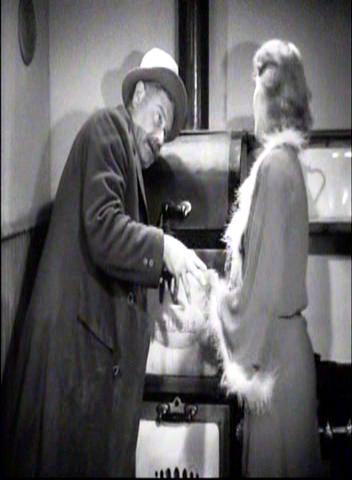
As an aid to our readers, I will elicit the help of two well-known chefs, Barbara Stanwyck, and Alan Hale, who, from “Stella Dallas” (1937), demonstrate for us the proper way to cook a turkey.

Pay attention. Take notes.

First: choose one extremely large turkey that has been hanging in the window of the butcher shop by its feet. Always buy a bird with the feet still on it. That’s how you know you have a good one. Never buy a bird that has been sealed in plastic. They don’t cook as well as an unwrapped turkey that you carry in your arms. This way, bits of fiber from your woolen coat sleeves stick to the skin of the turkey, and they taste good roasted.


Second: Wrestle with the turkey (minimum of two people needed for this step) for a few minutes to loosen the giblets inside.


Third: Shove it into an oven. Never mind stuffing it. Never mind putting it in a roasting pan. Those tactics are for amateurs. Real professional chefs never use roasting pans.


Fourth: Wrestle with the bird some more, taking it in and out of the oven several times before you finally close the oven door. This does nothing to affect the taste of the turkey, but you work up an appetite.


Finally: Close the oven door, leaving the feet exposed. As Mr. Hale remarks, “Of course, the feet don’t get very well done, but then I never cared for feet anyway.”

Try it today, and let me know how your Thanksgiving Dinner turns out.

Now, I’m off to wrestle with my turkey. Must fetch sports bra from the roasting pan.

Happy Thanksgiving.

Monday, July 16, 2007

Barbara Stanwyck - 100th Anniversary

Today is the 100th anniversary of the birth of Barbara Stanwyck. The body of her work is impressive. She was one of the best actresses of her day, sometimes called the greatest actress who never won an Oscar. Granted an honorary Oscar toward the end of her life (at the time she still had yet to perform in the television miniseries “The Thorn Birds” which would garner her a third Emmy), Stanwyck lived a very private life. Orphaned at a young age, learning her trade as a chorus girl in the seamy atmosphere of clubs and vaudeville, the intelligent and intuitive Brooklyn born Ruby Stevens eventually became a hit actress on Broadway, was the highest earning film actress of 1944, and worked well into her 70s on television. Her career spanned many media, and she adjusted to each.

She played an enormous range of roles. No other actress of her day played as many varied types. Few other actresses of her day could lose themselves in a role as she did.

Iconic actress of the period, including Katharine Hepburn, Bette Davis, and Joan Crawford leaped off the screen and commanded attention, and a great deal of publicity when they were off screen. As fine actresses as they were, one rarely can watch their films without being able to forget it is Hepburn or Davis or Crawford. They assumed their roles; they did not lose their own strong personalities in them. Barbara Stanwyck, on the other hand, never played the same person twice. Even her string of fallen women were different from each other.

Phyllis Dietrichson of “Double Indemnity” was nothing like Stella Dallas. The precocious sexpot of “Baby Face” is light-years away from Elizabeth Lane in “Christmas in Connecticut,” who was nothing like Sugarpuss O’Shea in “Ball of Fire.” Miss Stanwyck was lauded by her peers as hardworking and affable, a favorite with directors, but where the intensity came from that shot forth from her as Lulu in “Forbidden” or Florence Fallon in “The Miracle Woman” is still unknown to us. She came to screwball comedy late, but made it her own. Her villains were realistically evil, not cartoons of evil, so much so that they even earned our understanding. She came to westerns late, and that became a favorite genre. She came to television, when as an older woman film parts were more scarce, and made it her medium. She clearly adapted, and learned along the way.

Miss Stanwyck is especially fun to watch in ensemble scenes. She works well with other actors, seeming to enjoy the give and take of the process, where some other stars of the day were more given to posturing and not sharing the spotlight if they could help it. She was quick with a quip, quick on the trigger, and quick to learn.

She appeared different from her peers, even in the way she would handle the smallest scenes. In “Meet John Doe” her younger sisters come upon her working at her typewriter, and wanting her to play with them, tip her chair over and dump her on the floor. One of them attempts a headstand on her abdomen. I’d like to see anybody try that with Joan Crawford. And live.

In “Forbidden” she bathes her toddler, played by Myrna Fresholt (talk about your natural actresses) who continues to babble over Stanwyk’s dialogue, so Stanwyck, with humor and gentleness ad libs her own dialogue to fit what the child is doing. This happens again in the scene in the car with Adolphe Menjou and the child sitting between them, babbling during their tense scene.

Much of “Stella Dallas” is a revelation, and has been discussed on this blog before (see entry May 17, 2007). There is much to discuss about Miss Stanwyck’s work, but none of it can be summed up easily. She was enormously versatile, herself a work in progress. It is hard to imagine anybody else playing the roles she played, and yet, it is irresistible to imagine her in roles that were played by others. Taking nothing away from either Gloria Swanson or Bette Davis who were excellent respectively in “Sunset Blvd.” and “All About Eve,” what would Stanwyck have done with those roles?

She had never been directed by William Wyler. What would it have been like for her, who was one of those best-on-the-first-take actresses, to have worked with “forty-take Wyler?” What kind of partnership would that have been?

This is the conundrum of Barbara Stanwyck’s film career. Even though she opened herself up and showed extraordinary emotional depth, there is the feeling that there is still more, that her personal intensity, and talent for making us believe, is endless. No matter how many times you’ve watched the film.

Sponsored link:
Barbara Stanwyck Movies

Thursday, May 17, 2007

Stella Dallas (1937)


Stella Dallas
(1937) is one of the reasons why Barbara Stanwyck was one of the best actresses of her generation. It demonstrates not only her believability in a role, but a dedication to her character that seems to outstrip her contemporaries. Often labeled a “tearjerker,” the film really does not get tear jerking until the end when Stella is faced with a decision about her daughter’s future. Most of the film is an interesting commentary on class structure and about being true to oneself.

Stella’s New England mill town and her family’s dingy company house is presented with stark realism. She becomes smitten by Stephen Dallas, who works in the factory office, the son of a disgraced millionaire who had committed suicide due to the failing of his business. Stella knows very well that Dallas has no money and has severed his ties to rich society. All she wants from him is what attracts her about him: his kindliness, his manners. She wants to be with him, she says, because what is good and fine about him may rub off on her in time. Her early scenes with John Boles, who plays Stephen Dallas, are sweet and earnest. Stella is clearly not a gold-digger, just a girl with a soft heart afraid to grow up hard in hard surroundings. 

Boles encourages her to be herself, that it really isn’t good manners to pretend to be something you’re not, and that high society is really dull. Dallas had previously broken off an engagement to be married, and Stella brings warmth and fun back into his lonely life. They start their life together, but after their daughter is born a rift begins that will tear them apart. Stella’s campaign of self-improvement ends when her daughter, Laurel, is born, and from then on puts all her energy and interest in the child. 

Boles’ character grows dismayed when he sees the change and becomes embarrassed by Stella’s behavior. She has grown loud, coarse and common. When Boles is promoted to run the New York office of the firm, Stella refuses to go with him, no longer interested in society, wealth or finery, or Boles. She just wants to raise her baby by herself. At this point, the film could turn into a story of a smothering, domineering mother living her life through her child, but the film never skirts into that territory. Both parents are kind to the child and respectful of each other, never playing Laurel off on the other parent. As a result, Laurel, played very sweetly by Anne Shirley, grows up to be an unaffected young lady, with her mother’s spirit and her father’s gentleness and elegance. 

Alan Hale has a particularly wonderful part as Stella’s low-brow buddy, and his drunk scene with the turkey at Christmas is some of his best work, funny and sad at the same time. He is abashed when he realizes his untimely appearance has messed up a reunion between Stella and her husband. Bole’s look of bewildered helplessness whenever Hale is around goes a long way to explaining who both men are and how they fit into Stella’s life. 

What makes Miss Stanwyck’s work in this film so fascinating is her intimate, clinging scenes with Anne Shirley that illustrate their co-dependence, and also her willingness to look frumpy. Screens stars of Hollywood’s “Golden Age” were sometimes willing to play the bad girl, but that bad girl was inevitably glamorous. Stanwyck went where no major star would go at that time: into unflattering clothes and gaudy jewelry, and body padding to make her appear heavier as she entered middle age. 

Stella is not aging well, including her bad dye job with a brief but meaningful scene where after she and Laurel have words, and Laurel makes repentant overtures by silently coloring her mother’s dark roots for her while Stanwyck sneaks a forlorn look at herself in the mirror. Stanwyck invites the audience to laugh at her, dares them to deride her, and yet because of the astonishing honesty of the performance, we cannot really laugh because she is too real. 

When Laurel’s friends mock Stella, and Stella overhears, it is a loss of innocence for them both. Laurel has sometimes been frustrated with her mother, but never before embarrassed by her. Stanwyck sees for the first time what must have embarrassed her husband so many years ago. Now, the film becomes a tearjerker when Stella must make choices, which she makes with clarity and resolve. At last, Stanwyck has that famous final shot, what some have called the best fadeout in motion picture history, as she beams triumphantly at the result of the choice she has made. 

   ********************

Jacqueline T. Lynch is the author of Ann Blyth: Actress. Singer. Star. and Memories in Our Time - Hollywood Mirrors and Mimics the Twentieth Century. Her newspaper column on classic films, Silver Screen, Golden Memories is syndicated nationally.  Her new book, a collection of posts from this blog - Hollywood Fights Fascism - is available here on Amazon.

Wednesday, May 16, 2007

Alan Hale, Sr.

Alan Hale, Sr. has been called one of the busiest character actors in Hollywood, with 235 films under his belt. He began in 1911 with “The Cowboy and the Lady” and though he appeared in many westerns, he also played in films adapted from classics by Dickens, Bronte, Twain, and Ibsen.

In 1934 he played in “Of Human Bondage,” “The Scarlet Letter,” and “Great Expectations” in just that year alone. He was the boorish Klaas Poole who mimicked Barbara Stanwyck’s appreciation of the sight of a field of cabbages in “So Big,” and played her bumbling, hapless best pal and unsuccessful suitor in “Stella Dallas.” Another featured role was in “Santa Fe Trail” with Errol Flynn, and he made 12 films with Flynn.

One film with Flynn which stands out is “Robin Hood” (1938), in which Hale plays Little John. Mr. Hale seemed to have owned the part of Little John, having played him in two other films as well: “Robin Hood” (1922) and “Rogues of Sherwood Forest” (1950), which was to be his last film before he died.

Part of Warner Brothers famous merry band of stock actors, Hale was big, barrel-chested and seized each small role with the gusto of a star.

Related Products