IMPRISON TRAITOR, PEDOPHILE, AND CONVICTED FELON TRUMP.
Showing posts with label Ben Murphy. Show all posts

Thursday, June 19, 2014

Ann Blyth's TV Appearances -- 1950s and 1960s


Television would come to have the strongest impact on popular history and cultural memory in the United States among all media in the twentieth century.  Though Ann Blyth did less television than radio or stage work, nevertheless her varied sporadic appearances through four decades included something like 20 featured guest roles in dramas and comedies, but an additional 80 or so appearances in talk shows, panel shows, musical variety, game shows, telethon spots,(not including commercials) etc., that allowed her to sing or otherwise publicize either her current professional projects, or involvement in charities.  TV became the place for getting the word out, for reminding the public, and the producers, one was still in the game.

Ann Blyth was still in the game after her last film was released in 1957, but on her own terms around the needs of her family, and appeared in a wide range of shows and genres that illustrated the growing force and changing nature of television.  TV would provide the widest range of employment opportunities for actors and writers, though still, paradoxically, make obsolete what was popular in one year by the crushing steamroll effect of a constant search for the new fad. 

We’ll cover the 1950s and 1960s today, time enough for TV to burst on the scene with enthusiasm, a certain idealism and naiveté, then to slide into a routine maturity by the end of the 1960s that strove less for innovation and drifted into clichéd scenarios before the 1970s and 1980s ramped up the energy again with shows exploring controversial subject matter, and technology allowing shows to leave the confinement of the studio.

Ann Blyth made a few early forays into taped, syndicated television programs such as Christopher Closeup, a Catholic show on which she would make many appearances over the years, and The Ken Murray Show in 1952, on which she made a cameo along with Lorraine Day, and Les Paul and Mary Ford.  Her real splash into the new medium came with a live dramatization of “A Place in the Sun” on Lux Video Theater in January 1954.  It was a risky, but wonderfully exciting way to establish her presence in the new medium.

Ann was 25 years old, married less than a year, and expecting her first child in June.  Her role was the part that Elizabeth Taylor played in the 1951 film.  Interestingly, the critics were dismissive of the challenge of live TV, in an era when many shows were performed live, and more focused on how much better the show would have been had it not been done live.

Columnist John Crosby felt that since the story had to be cut to under an hour, it was considerably watered down, though marveled that time was the only element to be restricted, as this was “one of the most lavish and expensive in the history of live television.  Produced in CBS’ Television City in Hollywood, it boasted 67 actors with 17 sets which is about three times as many as those used in most TV dramas.  Even the climactic scene when the rowboat tips over in a mountain lake was done live by some sort of camera trickery.”  But he adds, “which, frankly, wasn’t very convincing.”

It’s encouraging that television, in such a few short years, has taken such vast strides in overcoming the physical limitations of live staging.  I just hope, though, that the producers don’t get so wrapped up in technical perfection, don’t get so immersed in the scenery, that they ignore the writers and the actors, something which is quite likely to happen in Hollywood.

An interesting and rather prescient observation.  He nearly forgot to mention the actors himself, but noted that John Derek, who played the Montgomery Clift role, was “stone-faced” and that Ann Blyth “was very pretty and fashionably husky-voiced and breathless.”  The cast included Raymond Burr, Marilyn Erskine played the doomed girl, and, to move the plot along, narrated by Ronald Reagan, who as we saw in last week’s post, would reunite with Ann in the next decade on Wagon Train.

Syndicated columnist Erskine Johnson railed at the technological glitches in the program, feeling that the show:

…was another great argument for telefilm.  Stars Ann Blyth, John Derek and Marilyn Erskine did their best, but a cast of unseen technicians changed the title to “A Noise in the Studio.”
There was a man’s shadow bigger than King Kong on a mansion exterior; voices behind intimate scenes; more shadows; a meaningless shot of a stage curtain; a flash of Ronald Reagan caught off guard before a commercial, and constant behind the camera noise that sounded like the story was being acted out in a pool hall.

From a starring dramatic role, Ann deftly switched to the actor’s alternate use for TV: self promotion.  She had garnered a spot on the Academy Awards telecast in March 1954, singing the nominated song “Secret Love,” her pregnancy at the time generating discussion if not controversy, which we discussed in this previous post.

By the end of that year, having delivered her child, did more film work, was a hit singing in Las Vegas, which we also discussed in the above post, Ann proved herself as versatile as she was busy.  She continued a very hectic year with an appearance on her brother-in-law’s TV show.  He was Dennis Day.
Long a fixture on Jack Benny’s radio show, Mr. Day also had his own radio show, and branched out into TV with a kind of situation-variety on NBC.  He plays himself, and Ann plays herself, as his real-life sister-in-law.  Her husband, his brother, Dr. James McNulty, makes a cameo.  The plot of this episode has Dennis causing problems when trying to finagle them into vacationing in Sun Valley, unaware they each have alternate, and conflicting, vacation plans.  Interestingly, a young Johnny Carson has a minor uncredited role as an expectant father.  Don’t know if this episode is preserved in any form.

Guest singing through the decade occurred on Ed Sullivan, Dinah Shore, Perry Como, Jack Paar, Steve Allen, and Tennessee Ernie Ford.  Sometimes, as in the case of one Perry Como Show appearance, she had to work around her pregnancies.  She had to cancel her October 1957 stint on this show as she was expecting her third child (her baby daughter was born in December), and her doctor advised that working on the show would be too exciting—to which at least one critic did not miss the comic beat and responded, “Perry Como?  Exciting?”

One of the loveliest examples of her TV work occurred on the Bell Telephone Hour in 1959, one of those magnificent showcases of art and culture we rarely see on TV anymore except maybe occasionally during PBS pledge breaks.  This episode featured a varied collection of artists on the American music scene including soprano Eileen Farrell, violinist Isaac Stern, and jazz pianist Joe Bushkin.  Ann Blyth and Howard Keel, whom we discussed  in Kismet here (We'll get to Rose Marie next month), appeared together in a skit that was a tribute to musical theatre.  They played a romantic couple separated, then reunited, told through songs taken from musicals.  This was also an early color program—still in an era when most people did not have color TVs.  

The skit takes place on a minimalist set.  First Howard Keel sings “Oh, What a Beautiful Mornin’” from Oklahoma, surrounded by townspeople who are also the resident troupe of dancers.  Along with actors and writers, early TV gave a lot of work to a lot of dancers.  They are in a small town, but in Mr. Keel’s self-satisfied baritone rejoicing, he does not see trouble on the horizon.  His best girl, Ann Blyth, is headed to the big city, writing him a note to break off with him, singing “Deep in My Heart” from The Student Prince.  Crushed, he grips the letter singing, “This Nearly Was Mine,” from South Pacific.  Next we see Ann, forlorn in her rooming house wistfully gazing at her love’s photo and singing, “Someone to Watch Over Me” from Oh, Kay! The chorus and “S’Wonderful” telescopes time, and we have Howard Keel waiting at the train depot for Ann’s return, where they joyously reunite with “They Say that Falling in Love is Wonderful” from Annie Get Your Gun.  Lifting these songs from different musicals is a neat way of creating this microcosm musical show and is a great example of how musicals move the plot along through song. 

What I especially like in this sequence is that it was done live, and so this is a great opportunity, for those of us who have never enjoyed it, to see Ann Blyth as she would have performed in her musical stage shows.  We see her musical range (including the final hat tip of the high C she nails at the end), her meticulous control and really impressive vocal power.  This is not pre-recorded and pre-mixed singing (though the show was obviously filmed).  Most happily, itis actually available on DVD.  It was put out on a collection of Howard Keel’s Bell Telephone Hour appearances by VAI, here at this website.

Adrian M. Slifka editor for the Youngstown Vindicator noted that this “colorcast” was an “impeccable production with something for every musical taste….the 15-minute opening segment, in which Howard Keel and Ann Blyth sang tunes from hit musicals, got the program off to a solid start.

This was one of the most beautiful colorcasts I have seen in recent weeks.  All of the settings and costumes for the Keel-Blyth duet contributed to an eye-appealing panorama of sparkling pastels.”

This was one of the finest TV hours of music and song this year.  I hope you didn’t miss it.”

We’ve noted in various previous posts that the western series Wagon Train afforded Ann Blyth several opportunities for performing drama and comedy, and I’ve covered those shows separately because they allowed the guest to really star, while the regulars took supporting roles in many episodes.  Unfortunately, neither westerns nor musical variety of this nature have a place on television today (except for “reality” style singing and dance contests).  If the above reviewer for “A Place in the Sun” was worried about the diminishing importance of actors and writers on TV, he may have indeed predicted the era of reality television.

We mentioned in this earlier post on “The Year Joan Crawford Won the Oscar” that Ann Blyth turned down the opportunity to join the cast of Saints and Sinners as a regular.  A few years earlier in 1957, it was reported that Earl Holliman and Ann were considered for a new TV series based on Claudia and David, a film we covered here.  Other opportunities came along for series work, but Ann was wary to accept them and to have to commit herself to the long hours for months on end, which would have seriously eroded her time with her family.

Another type of program that seems to have gone the way of westerns and musical variety is the anthology show.  One of the most famous, The Twilight Zone, featured a wide array of stars in intense dramas.  Many of you have commented on the Ann Blyth episode, which I won’t cover today, but rest assured, it’s on the docket for this October.

Another anthology show was The June Allyson Show-DuPont Show, which one reviewer lauded “has become gutsy” with new episodes such as “Suspected,”  broadcast December 28, 1959, in which, according to the Pittsburgh Press, “Ann Blyth, a public stenographer, is in a hotel room, evading the clutches of an amorous business man.  She runs away but leaves some incriminating evidence…when the man is stabbed…and a drunken witness swears Ann was the girl who cut up the man.  Well-done. There are good scenes of Ann in jail, facing the prospects of a lifelong lease…” 

The Milwaukee Sentinel, however, felt that “sweet little Ann Blyth seems completely miscast.”  See our previous post on “What’s a Nice Girl Like Ann Blyth Doing in a Place Like this?”

“Your previewer found himself kind of wishing she’d been found guilty.”

Wittily dissing the star is a critic’s best tool to avoid working hard at actually writing analytically.  But as for his revealing the outcome of the story—hah, and you thought I give out spoilers.

By the next decade, TV had settled into a smooth pattern of following trends rather than setting them, and stars who adapted were the ones to survive, at least until the next big fad.  Ann’s career had shifted to stage musicals by the 1960s, so television was less a substitute for film work than it was a change of pace from her singing roles. 

She made two appearances on the whimsical detective series Burke’s Law starring Gene Barry. Both are fun and utterly goofy sides of sweet little Ann Blyth that should make any future critic dispense with typecasting her in their reviews.

In the “Who Killed Andy Zygmunt?” episode broadcast March 13, 1964, which satirizes the world of modern art and pokes fun at avant garde artists—one such artist has been murdered—Ann plays another beatnik style artist whose specialty is spray painting her live models with different colors and having them roll around on a canvas spread on the floor.   She is a suspect in the murder, and replies to the investigator, “Hey, man, can’t you see I’m busy working here?...you wouldn’t have buzzed Toulouse-Lautrec when he was fast sketching the lovely Jane Avril?” She grins at the detective, “Your perceptivity just knocks me out, soldier.”

We learn she is a junkie, hooked on previously prescribed painkillers.  To keep herself supplied, she forges doctors’ signatures on prescription cards.  The victim knew this and was blackmailing her.  However, Ann is not the only suspect, and collection of similar kooks includes Aldo Ray as a dog groomer, Macdonald Carey, Jack Weston, and Tab Hunter all as free-spirited weirdos who could have murdered the dead man.  Gene Barry, star of the show, will tell us who did it after the last commercial.

In the show’s second season, Ann returns in “Who Killed Mother Goose”, broadcast January 13, 1965, playing a children’s TV show host, a cheesy, super-cheerful story-telling Miss Muffet type, who, once the cameras stop rolling, deflates into a bitter, sarcastic, hard-as-nails ex-B-movie actress who’s clinging to her job like grim death. She's not at all sorry that Mother Goose, a rival children’s book author, soon to host her own show, has been murdered.

Ann has an alcoholic elf as her sidekick, who gets a face full of black power explosions whenever he misbehaves.  It’s like all the Simpsons episodes of Krusty the Klown that ever were.

Gene Barry enters her TV studio and questions her while the "magic cartoon" is rolling:

“Would you like to see my magic badge?”

“I guess you’re here about Mother Goose?”

“Yeah, somebody closed the book on her.”

“I’m glad the old witch is dead.  Somebody finally handed her a poisoned apple.”  She invites the detective for a magic martini.

This unabashedly playful episode with its black humor also features Lola Albright, George Hamilton as a very convincing beatnik poet, Jan Murray, and a delightfully obtuse Walter Pidgeon.  Burke's Law can be seen sometimes in re-runs, and the first season is available on DVD.

Ann’s 1960s TV appearances concluded with a very different detective series and a much more dour and traditional role.  In The Name of the Game, episode titled “Swingers Only,” broadcast January 10, 1969, Ann plays the hurt wife of a sports writer who’s been cheating on her.  He is played by Robert Lansing, who appeared with Ann in the above-mentioned Saints and Sinners episode.  His girlfriend on the side has been murdered, and he is a prime suspect.  His friend, magazine editor, Robert Stack, tries to ferret out the story and the real murderer.  


Also along as Mr. Stack’s assistant is a young Ben Murphy, who later played Ann's husband on the Murder She Wrote episode we discussed here.

Jack Klugman also appears in this episode, and Ann will reunite with him in two future episodes of Klugman’s Quincy M.E. series in the late 1970s and early 1980s.

Robert Lansing’s portrayal “Maybe I’m just a middle-aged sports writer trying to be young again,” is sullen, self-pitying, and not terribly sympathetic.  Her scene with him at a park above Los Angeles, where they arrive after miles and miles of silence on the entangled freeways, reminds me, with their positioning around a tree, of the final scene of Our Very Own (1950), discussed here, where she seals her happy future with Farley Granger.  The difference here being the tree is an obstacle to the couple’s physical togetherness, and the scene with its cold and bitter dialogue leaves us without much hope for their relationship.

“Dear God, it makes me sick to admit it, but I do want to know why,” she says of his affair.

More appealing is Ann’s scene with Robert Stack, also outdoors in a park, but the natural setting here, with her son playing close by, is gentler, warmer, and could even be romantic if Stack’s character were not already married.  His close attention to her seems not only the sign of a good investigator, but also carries a wistful feeling of longing.

He gets to the bottom of the case, and though there are many action scenes, both Robert Lansing, as a prisoner in jail, and Ann Blyth, as the wife who must deal with her husband’s philandering, are passive roles.  She complains to Robert Stack of her husband, “When I look at him all I see is failure, mine.”

It is interesting that his response is more feminist than hers, “If you’re going to break with him, okay.  But don’t pack his guilt and call it yours.”  The Name of the Game in can still be seen in re-runs.

Four years earlier, Ann appeared on an episode of the Kraft Suspense Theater called “Jungle of Fear,” broadcast April 22, 1965.  It is a departure from the hipper Burke’s Law and The Name of the Game, and even the reviewer felt bound to point out it was “Crammed with familiar gimmicks, clichés, etc., but an effective suspense story nonetheless…you’ll probably enjoy this one if you can forgive it for being old fashioned.”

This was long before the 1970s era of nostalgia-themed shows.  Spies, swingers, and social causes and all things mod were the engine that drove 1960s television. “Jungle of Fear” is pleasingly quaint, a wild west story not in the wild west without any Wild,Wild West gadgets.  The time is 1850 and the place is Panama.  Robert Fuller, who we last saw with Ann in the Wagon Train episode of “The Fort Pierce Story,” noted above, plays a saloon keeper and maker of deals in this jungle outpost populated by people traveling to California in the backwash of the gold rush.  This was before the Panama Canal was built, of course, so if they wanted to avoid a long sea voyage around South America, the next best option was to cross over land at the isthmus, where it would still take five days to journey through treacherous territory jealously guarded by Indians, and then take a clipper on the Pacific side of Panama to California.

It’s all very similar in feeling to Casablanca and Rick’s café.  Robert Fuller spars with the territory’s authority figure, played by Robert Loggia, and must deal with all kinds of people coming to his gambling parlor and saloon to arrange passage for them.  Most are escaping something.

Ann Blyth is a widow with a young boy.  She and her son are Chinese, and they are headed back to China because her son is the new emperor upon the death of her husband.  Tailing her is a suave and sinister Richard Anderson, with whom Ann appeared in The Student Prince, which we’ll get to next month.  He is an American mercenary, hired by usurpers to the throne to kill the boy.

The role allows Ann a character part, utilizing her skill with accents—her speech is simple, not heavily stereotyped, but with precise and careful intonation suggesting an educated noblewoman who has been in the U.S. many years supervising the American education of her son.  Her small, delicate steps carry the suggestion of foot binding typical of an upper class Chinese woman of that period.

She appeals to Robert Fuller to help her get back to China, and Mr. Fuller engages in knife fights, fistfights, shell games about where to hide her and the kid, and finally, a suspenseful showdown on a rope bridge over a muddy jungle river.

For me, nothing says adventure in a jungle like a rope bridge.  (“Oh, a rope bridge!” the blogger claps her hands like a happy little girl.  I would like one for Christmas.)

There is also a brief moment of romance when Robert Fuller reminds Ann with a kiss that she is not only the young emperor’s regent, she is “also a woman.”

In the last scene where she is boarding the clipper to take her and her son away to their home in China, she has changed from peasant clothing to her court finery, and the headpiece reminds me of her garb in The Golden Horde (1951).  We’ll get to that down the road.  The "Jungle of Fear" episode of Kraft Suspense Theater is, I think, still up on YouTube.


The final shot of the great sailing ship is a perfect segue into our post next week, also featuring escaping royalty, sailing ships, and the year of 1850—The World in His Arms (1952), as sensual and romantic a movie you will ever see that also happens to have seal clubbing in it.  That’s hard to do, really.

See you next Thursday, same time, same blog.


Now roll credits, and a word from our sponsor.

***********************
Austin Daily Herald, October 26, 1957.

Deseret (Salt Lake City) News, January 28, 1954, p. 4C.

Miami News, September 17, 1957, p. 5B, column by Hedda Hopper.

Milwaukee Sentinel, December 28, 1959, p. 8.

Park City Daily News (Bowling Green, KY), November 4, 1957.

Pittsburgh Press, December 27, 1959, p. 35.

Portsmouth (Ohio) Times, March 4, 1959 p. 8.

The Spencer (Iowa) Daily Reporter, February 9, 1954, p. 3.

St. Joseph (Missouri) News-Press, April 22, 1965, p. 6C.

St. Petersburg (Florida) Times, February 5, 1954, p. 40, column by John Crosby.

Youngstown (Ohio) Vindicator – March 5, 1959
************************
THANK YOU....to the following folks whose aid in gathering material for this series has been invaluable:  EBH; Kevin Deany of Kevin's Movie Corner; Gerry Szymski of Westmont Movie Classics, Westmont, Illinois; and Ivan G. Shreve, Jr. of Thrilling Days of Yesteryear.

***************************
UPDATE:  This series on Ann Blyth is now a book - ANN BLYTH: ACTRESS. SINGER. STAR. -

*********************
The audio book for Ann Blyth: Actress. Singer. Star. is now for sale on Audible.com, and on Amazon and iTunes.

Also in paperback and eBook from Amazon, CreateSpace, and my Etsy shop: LynchTwinsPublishing.


 "Lynch’s book is organized and well-written – and has plenty of amusing observations – but when it comes to describing Blyth’s movies, Lynch’s writing sparkles." - Ruth Kerr, Silver Screenings

"Jacqueline T. Lynch creates a poignant and thoroughly-researched mosaic of memories of a fine, upstanding human being who also happens to be a legendary entertainer." - Deborah Thomas, Java's Journey

"One of the great strengths of Ann Blyth: Actress. Singer. Star. is that Lynch not only gives an excellent overview of Blyth's career -- she offers detailed analyses of each of Blyth's roles -- but she puts them in the context of the larger issues of the day."- Amanda Garrett, Old Hollywood Films

"Jacqueline's book will hopefully cause many more people to take a look at this multitalented woman whose career encompassed just about every possible aspect of 20th Century entertainment." - Laura Grieve, Laura's Miscellaneous Musings''

"Jacqueline T. Lynch’s Ann Blyth: Actress. Singer. Star. is an extremely well researched undertaking that is a must for all Blyth fans." - Annette Bochenek, Hometowns to Hollywood


Ann Blyth: Actress. Singer. Star. 
by Jacqueline T. Lynch

The first book on the career of actress Ann Blyth. Multitalented and remarkably versatile, Blyth began on radio as a child, appeared on Broadway at the age of twelve in Lillian Hellman's Watch on the Rhine, and enjoyed a long and diverse career in films, theatre, television, and concerts. A sensitive dramatic actress, the youngest at the time to be nominated for her role in Mildred Pierce (1945), she also displayed a gift for comedy, and was especially endeared to fans for her expressive and exquisite lyric soprano, which was showcased in many film and stage musicals. Still a popular guest at film festivals, lovely Ms. Blyth remains a treasure of the Hollywood's golden age.


Thursday, February 20, 2014

Murder She Wrote - "Reflections of the Mind" - 1985


In an episode of MurderShe Wrote, Ann Blyth got to go nuts, stab her husband with scissors, and be accused of murder.  It must have been a swell gig.  Certainly, it was a deviation from the good girl image we discussed in our last post, here.  (As were two murder mystery episodes of Quincy, M.E. that we’ll discuss down the road.)  Not that there weren’t opportunities for more wholesome assignments in the 1970s and 1980s for an actress who had more range than her wholesome reputation seemed to indicate, but wholesomeness trailed her like a long shadow. 

The makers of Hostess snack cakes made good use of that image in a series of television commercials.  Have a look below for these commercials now on YouTube:


There is a collection of Ann Blyth’s Hostess Cupcakes commercials in the Library of Congress.  I don’t know…that just makes me smile.  And crave Crumb Cakes. 

Becoming a television spokesperson for Hostess may have been only a lark for Ann, especially as it gave her a chance to work with some of her children in front of the camera, but she did have her weather eye out for TV roles, even if she was selective.  In an interview with syndicated columnist Vernon Scott in 1976 she remarked,

“Rather than just appear on television for the sake of it, as many do,” she said, “I’d rather wait for things that appeal to me.”

One role she apparently would have liked was a part as Amelia Earhart’s mother in the 1976 NBC-TV movie Amelia, based on the life of aviatrix Amelia Earhart, played by Susan Clark.  Miss Blyth was 48 years old at the time, but according to columnist Marilyn Beck, was not chosen because she looked too young to be the mother of a grown daughter.  We should all have such a problem.  She lost out to Jane Wyatt, then 64 years old, who had once played Ann’s mother in One of Our Own (1950), which we’ll discuss later in the year.

By 1985, the year she did the Murder She Wrote episode, Ann Blyth was still active in a long stage career, performing the role of the Countess in Song of Norway in March at the Long Beach (California) Convention Center for the Long Beach Civic Light Opera.  She played opposite Bill Hayes, with whom she had appeared in Brigadoon in 1968 in St. Louis, would later team in a series of musical variety cabaret performances. 

Just before the show opened, in the decade after she lost the role of Amelia Earhart’s mother for looking too young, Los Angeles Times columnist Jack Hawn remarked, interviewing her at the Brown Derby restaurant, “At 57, she verily glowed.”

The Murder She Wrote episode, called “Reflections of the Mind”, was telecast November 2, 1985, the sixth episode of the second season of what would become a long-running and much beloved series, due mainly to the talent and likeability of its star, Angela Lansbury as the intrepid mystery writer, Jessica Fletcher.

The show would be a reunion of sorts: between Ann and Martin Milner, who played the sheriff in this episode who accuses her of murder, and who appeared with Ann in the above-mentioned One of Our Own as her sister’s boyfriend.

Ben Murphy, who plays Ann’s younger second husband (14 years her junior in real life), was also a regular in the late  TV 1960s show The Name of the Game when Ann did a guest star role on that series in an episode called “Swingers Only” in 1969.

Most especially enjoyable to fans was the matchup of Ann and Angela, who four decades earlier were both nominated in the same Best Supporting Actress category for the 1945 Oscars.  Ann, 17 years old, had been nominated for Mildred Pierce, which we discussed here.  Miss Lansbury, 20 years old, was nominated for The Picture of Dorian Gray.  Both lost out to veteran actress Anne Revere.

A fond and teasing reference to their earlier careers must be the framed photograph we see at the very beginning of the episode of a young Ann and Angela standing together before what appears to be a microphone.  The occasion is clearly not the Oscars, but if anyone knows of any radio show they did together, I’d love to know about it.  It looks like early 1950s to me.  I haven’t been able any to track any information about that photo yet, but I’ll let you know if I do.
This comes from the fun fan blog The Definitive Guide to Murder She Wrote.

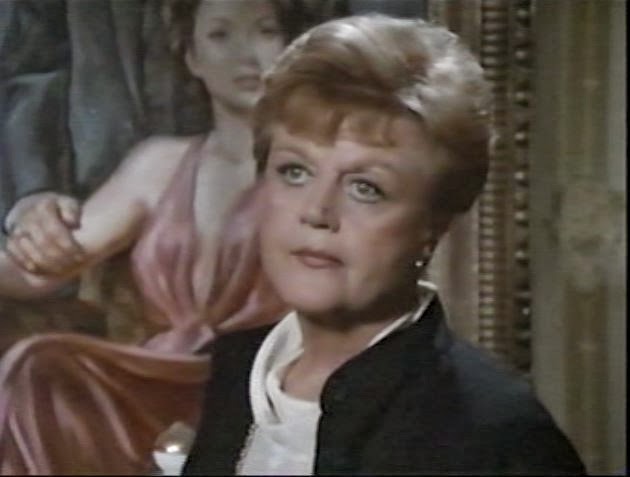
Speaking of intriguing images, there’s a large oil painting in one of the rooms of the mansion (the setting of the story is the home of Ann’s character, who is wealthy).  The painting depicts a young and glamorous Ann lounging seductively in a chair in a long gown with the figure of a man standing behind her.  I’d love to know more about that painting.

The episode starts with a slow pan across family photos, including the pic of Ann and Angela in younger days, and then we see Ann lying on her bed, having nodded off reading one of Jessica Fletcher’s books.  Ann plays Francesca Lodge, a really rich lady in Ohio with a grown daughter and a younger second husband.  She and Jessica are old pals from days gone by.  For those of you familiar with the series, you know that Jessica has friends and family all over the country, all over the world, and they are frequently murdered, have committed murder, or were somewhere on the premises when a murder was committed. 

It’s not really a good idea to be a friend of Jessica Fletcher’s because of this.  But Ann is, so you know there’s going to be a murder.

Ann is troubled lately with forgetfulness, delusions, and seems to be haunted by images and reminders of her late first husband.  She is especially plagued by a music box he had given her years before, that plays unexpectedly by itself.  We hear it, too, so perhaps she’s not really nuts, maybe somebody is driving her nuts, “gaslighting” her, as it were.

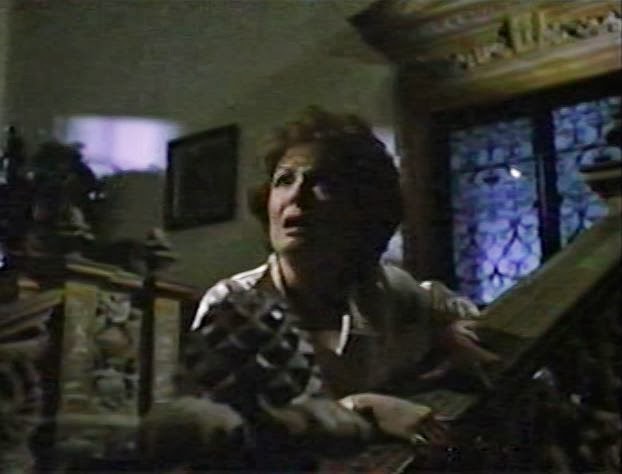
Still, she flips out during a thunderstorm, hears things, sees things, and when her second husband, Ben Murphy arrives home, she attacks him with a pair of scissors.  A manic fit of hysteria is always a good way to start an episode, and we see Ann is in fine form, tearing around the house, staggering down a palatial staircase, and swiping at Ben Murphy like a nervous Zorro.  Anyone who can slap Joan Crawford and send her sprawling down a few stairs is certainly going to be pretty handy with a pair of scissors.

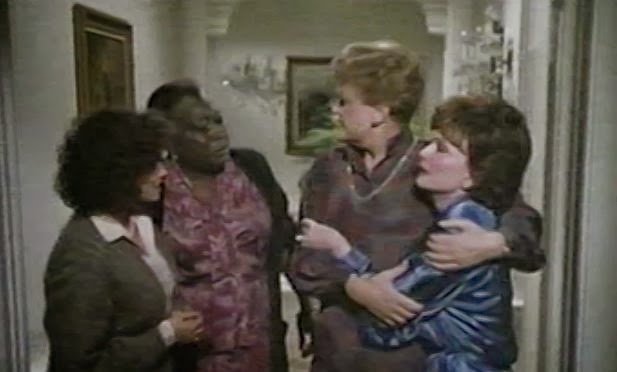
Ann ends up in the psychiatric ward of the city hospital, where Jessica, who has been summoned (you always go to writers for help), arrives at her private hospital room and offers sisterly comfort.

Ann is released (because even Jack the Ripper would be released into the custody of Jessica Fletcher), and Jessica bunks at Ann’s house while we settle into story. 

Mysterious reminders of her first husband continue to terrorize Ann, whose screams rouse Jessica into action.  Funny how on TV people roused in the middle of the night always look perfect in attractive robes. I’d stagger into the hall, disheveled  and  far less articulate than Jessica Fletcher in ascertaining the problem at hand.  My interrogation would be more like, “Huh?  Wha…mmpfh...z-z-z-z-z.”

But I digress.


Ben Murphy runs his wife’s family business, and it turns out his secretary is also his mistress.  There’s a lot of suspicious characters around, including that secretary; Ann’s grown daughter who is a former drug user and runaway; a creepy gardener who keeps peering into windows; and the family doctor with the in-your-face manner of a creepy child’s party clown.  The aloof housekeeper played by Esther Rolle also seems suspicious—I still don’t get how the switcheroo with the dead canary could be done so quickly. 

The only two people we trust are Angela Lansbury and Martin Milner as the sheriff.  I love Martin Milner.  He’s been on Murder She Wrote a handful of times as different characters.  The innocent open-faced boy we saw in Life with Father (1947) here, and I Want You (1951) which we discussed here, grew into a frank and confident and no-nonsense guy you’d want on your side.  You can almost smell the Old Spice.

I’ll not give away the details, this being a mystery, but it’s a treat to watch Miss Lansbury and Miss Blyth together as a couple of pros who grew up in the business.  Ann Blyth here is fragile, high strung, at the breaking point.  Regrettably, the climax occurs when she is out of the room.  Our last image of her is back in the psychiatric ward screaming at that weird doctor.

It’s the last time we saw her play a character on television.  Only in her late fifties, she seems too young not to have done more TV, but it had already been an over 50-year career for this woman who started as a child of six.  Nor was the career over, for there would be more live appearances on stage doing what she started out doing as a six-year-old child: singing.

We’ll take that up another time.  Come back next Thursday when we jump back to 1948 and one of Ann’s finest performances as a dramatic actress, playing the sultry and devious young Regina in Lillian Hellman’s Another Part of the Forest.


*******************
The Definitive Guide to Murder She Wrote blog.

Karr Collection Television Commercials, Library of Congress. http://www.loc.gov/rr/mopic/findaid/karr/karr16.html

Los Angeles Times, February 28, 1985, article by Jack Hawn.

The Milwaukee Journal, January 27, 1976, syndicated article by Vernon Scott p. GS1, also April 12, 1976, syndicated article by Marilyn Beck, p. 3.

*********************

UPDATE:  This series on Ann Blyth is now a book - ANN BLYTH: ACTRESS. SINGER. STAR. -

*********************
The audio book for Ann Blyth: Actress. Singer. Star. is now for sale on Audible.com, and on Amazon and iTunes.

Also in paperback and eBook from Amazon, CreateSpace, and my Etsy shop: LynchTwinsPublishing.


 "Lynch’s book is organized and well-written – and has plenty of amusing observations – but when it comes to describing Blyth’s movies, Lynch’s writing sparkles." - Ruth Kerr, Silver Screenings

"Jacqueline T. Lynch creates a poignant and thoroughly-researched mosaic of memories of a fine, upstanding human being who also happens to be a legendary entertainer." - Deborah Thomas, Java's Journey

"One of the great strengths of Ann Blyth: Actress. Singer. Star. is that Lynch not only gives an excellent overview of Blyth's career -- she offers detailed analyses of each of Blyth's roles -- but she puts them in the context of the larger issues of the day."- Amanda Garrett, Old Hollywood Films

"Jacqueline's book will hopefully cause many more people to take a look at this multitalented woman whose career encompassed just about every possible aspect of 20th Century entertainment." - Laura Grieve, Laura's Miscellaneous Musings''

"Jacqueline T. Lynch’s Ann Blyth: Actress. Singer. Star. is an extremely well researched undertaking that is a must for all Blyth fans." - Annette Bochenek, Hometowns to Hollywood


Ann Blyth: Actress. Singer. Star. 
by Jacqueline T. Lynch

The first book on the career of actress Ann Blyth. Multitalented and remarkably versatile, Blyth began on radio as a child, appeared on Broadway at the age of twelve in Lillian Hellman's Watch on the Rhine, and enjoyed a long and diverse career in films, theatre, television, and concerts. A sensitive dramatic actress, the youngest at the time to be nominated for her role in Mildred Pierce (1945), she also displayed a gift for comedy, and was especially endeared to fans for her expressive and exquisite lyric soprano, which was showcased in many film and stage musicals. Still a popular guest at film festivals, lovely Ms. Blyth remains a treasure of the Hollywood's golden age.


Related Products