IMPRISON TRAITOR, PEDOPHILE, AND CONVICTED FELON TRUMP.
Showing posts with label This is Your Life. Show all posts

Thursday, March 6, 2014

The Buster Keaton Story - 1957


The Buster KeatonStory (1957), is a film made perhaps too soon, and which many fans of Buster Keaton would agree should never have been made at all.  It is an example of one of the most unrealistic biographies produced by Hollywood, bearing very little fact in the story.  But it is an interesting attempt at trying to portray the life of a giant of the early days of the film industry in an era where that giant, Buster Keaton, was only just beginning to be rediscovered by a new generation.

The bright spots of this story are Donald O’Connor, who plays Buster Keaton and Ann Blyth, who is a fictional character, a sort of composite of his wives.  She has a fictional name and a fictional back story.

The film began shooting in June 1956, a very busy year for Ann, who was 27 years old when this film was made, but, incongruously, her film career was actually winding down.  There would be only one more year after this.
In March 1956 she appeared as a guest on the Perry Como television show, and in May, she appeared on The Ed Sullivan Show, Mother’s Day, May 13, 1956 as a recipient of Sullivan’s Mother of the Year Awards (along with fellow recipients Betty Grable, Deborah Kerr, Betty Hutton, Rosemary Clooney and June Allyson).  A bevy of beautiful moms.


By August, it was reported that she had to cancel a singing engagement at the Sahara Hotel in Las Vegas, slated for September, because MGM, to which she was under contract at the time, ordered her back to start another film as soon as The Buster Keaton Story for Paramount was finished up. 

Her work in The BusterKeaton Story was understated and solid, but apart from the acrobatic final scene, which we’ll get to, seemed not much of a challenge.  From The Schenectady Gazette in an article by Louise Boyka from May 1957: “Attractive Ann Blyth does much to keep up the caliber of the film with her high quality acting and personal appeal." 

But Ann’s sincerity could not help the basic faults of this film, which suffered a loss of credibility through the clumsy handling of the film’s producers
With so much fictional in this movie about such a remarkable figure in film history, viewing it will quickly become an exercise in frustration.  This is not the place to go looking for the truth about Buster Keaton.  There are documentaries, such as the excellent Buster Keaton - A Hard Act to Follow (currently here on YouTube), but the best source on Buster Keaton’s genius are his own films.  Happily, many have been restored and make up some of the finest comedies made of the silent era.  That he was an exceptionally talented man, and brilliant, though down-to-earth storyteller cannot be denied, but The Buster Keaton Story ignores his genius and slides into lazy cliché.  We have the beginning of the down and out vaudevillians trudging through the snow to the theatrical boardinghouse where Buster is fighting for food as a child in a scene which we will later recognize from one of his movies. 

Though the film does lean heavily on Buster’s drinking to supply the drama and the tension, it does not really go into the reasons for his drinking.  In the movie, we are told that sound films have destroyed the silent era, and have left him without a job.  We even have a reference to John Gilbert’s professional demise because his voice was no friend to the microphone, a myth which has been proven false, but which is one of the clichés that the film perpetuates.

Written by Sidney Sheldon and Richard Smith, produced by them, and directed by Sheldon, the main fault of this movie is the script.  It is rife with clichés and so full of inaccuracies that the embarrassment Buster Keaton apparently felt at its premiere and the critical hammering the film received, giving both the careers of Ann Blyth and Donald O’Connor a black eye, is really the fault of the script and the production.  The direction was lackluster. 

And I can’t help but wonder what Peter Lorre was doing in this film as a belittling director.  It was a role that could have been played by anyone, so much so that it feels odd to have a man of such strong screen presence and a notable history of quirky roles play it.

Cecil B. DeMille has a cameo playing himself, and Jackie Coogan plays the silent star Elmer Case, but I think that’s it for the greats of the silent era.  Richard Anderson, an actor I’ve always liked, has the thankless role of the boring nice man who doesn’t get the girl.

Buster’s real-life parents also get bit roles.

Rhonda Fleming has a fun and flashy role as a snobby starlet, complete with liveried chauffer and hounds on a leash.  She turns Buster’s head for a while. 

Donald O’Connor’s work in the film, despite the material, is good.  He handles the drama with subtle intensity, and most especially the physicality of Buster Keaton, very well.  Mr. O’Connor is an old vaudevillian himself, and when he speaks of Buster’s childhood on the road, we can imagine he knows all about that.  He was a vaudevillian from his childhood.

He performs and re-creates a few of Buster’s famous stunts for indeed, most of Buster’s gags were actually stunts and I can think of no other dancer, no other actor who could have played Buster Keaton as well as Donald O’Connor.  He was the most acrobatic young dancer/actor in Hollywood at the time, able to do things neither Gene Kelly nor Fred Astaire could ever do.  It is this kind of athleticism needed to portray Buster Keaton, who was sublimely athletic.

Buster Keaton served as a technical advisor on the film and in her book on her husband, Buster KeatonRemembered, Eleanor Keaton writes, “For eight weeks Buster helped Donald with the comedy sequences, and he had wonderful time working with him.  However, the finished film  The Buster Keaton Story was awful.”  On the particularly difficult illusion of diving through the brick wall from Sherlock Jr, she writes, “Donald did an admirable job executing this risky stunt...  It was a very dangerous stunt.”

There are two elements of Buster Keaton’s real life that would’ve made a very interesting movie had that movie been made.  When it comes to his drinking, Buster Keaton was spurred on by two great heartbreaks.  One was the fact that his studio, The Buster Keaton Studio, set up for him by producer Joseph Schenck, whose sister-in-law, Natalie Talmadge, Buster Keaton married, was taken from Buster because he had a tendency to go over budget on his elaborate films.  Buster was put under the thumb of producers and writers writing gags for him, and when he came to work for MGM, his creativity was stifled and he became frustrated.  He was paired on screen with larger-than-life lovable motor-mouth Jimmy Durante.  Buster was now a second banana, and miserable.

The second great sadness of Buster’s life was his first marriage to Natalie Talmadge, with whom he had two sons.  Talmadge was a spendthrift who went through Buster’s money and quickly lost all affection for him.  When they divorced, she refused to allow her sons to see him, and even changed their surname to her maiden name.  She bore such a hatred for Buster the rest of her life that she refused to allow his name mentioned in her presence.

At the time The BusterKeaton Story was made, both Natalie Talmadge and MGM were still alive and had lawyers and would’ve come down hard on this film if it had come anywhere close to vilifying them.  So we have no mention of Buster’s first wife and unhappy marriage, and we have no mention of MGM.  The studio he works for is lamely called Famous Studio and the bad guys are sound pictures.

There is a scene in the movie where Ann Blyth’s character, a casting director for Famous Studio (kudos to the film for placing a woman in a position of responsibility and authority, which was common in the early days of film), falls in love with Buster, who barely knows she’s alive.  After one of his drunken benders, she bails him out of jail and marries him when he is too drunk to realize it.  The scene seems far-fetched, but it does have some basis to reality.  Buster’s second wife, a nurse at the sanitarium where he was being treated for alcoholism, actually did marry him under similar circumstances, and Buster would later remark that he could not remember the ceremony.

The greatest part of Ann Blyth’s fictional character resembles Buster Keaton’s third wife, a young Hollywood dancer named Eleanor Norris and with whom he was happily married for twenty-six years until his death in 1966.  Eleanor was a supportive and stable influence on the real Buster Keaton and Ann Blyth’s stoic endurance of Buster’s foibles, her understanding and kindness make her more Eleanor-like than any of his other relationships, but she is not really Eleanor. 
The real Buster and the real Eleanor Keaton on This is Your Life.

Donald O’Connor was able to match Buster’s quirky difficult social interaction with people that made him sometimes come off as rude, and mimicked his physical jerks quite well.  You can spot the little tricks of habit throughout the film.

There are two particularly fine scenes between Ann Blyth and Donald O’Connor.  One is when he has reverted to drinking after his latest failure, and she struggles to guide him to the couch, where he flops, mumbling about episodes from his past.  She kneels beside him, trying to soothe him, and they talk over each other, their words overlapping in a heartbreaking inability to reach each other.

The truest and most delightful part of the film comes at the very end when Buster decides to revive his vaudeville act where he is free to create.  He does not make much money, but he is overjoyed to be making people laugh.  Ann Blyth is standing in the wings, and he grabs her impulsively and pulls her on stage with him to re-create a famous skit that he has performed many times, and with which she is familiar.  His real-life third wife Eleanor also performed such skits with Buster in later years in Europe and on television.

This skit performed in pantomime is Buster’s true medium.  They play a husband and wife who arrive home in the wee hours of the morning after celebrating too much on New Year’s Eve.  They are both a bit tipsy and exhausted.  They prepare to go to bed, but as Buster’s fumbles and hurts himself on a chest of drawers, Ann wearily stretches out on the floor and falls asleep. Donald as Buster discovers her there and through a series of acrobatics, physics and applied geometry has to get her into bed while she is completely unconscious.  He has to move her dead weight.
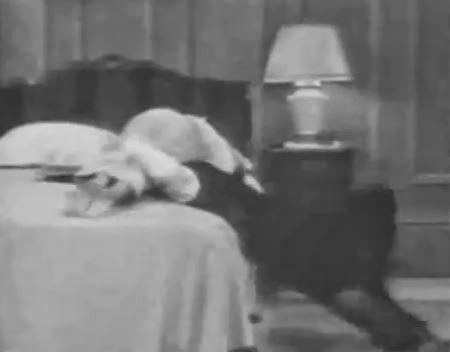
It is a funny skit and, for me, the only laugh out loud moments of the movie.  I can imagine Donald and Ann working through the scenario in rehearsals.  They must’ve been laughing their heads off.  Especially funny is one moment where he holds her in his arms and is trying to figure out a way to get her on the bed such that her head goes with the pillows and her feet go in the proper direction, but he can’t figure out how to do it.  So he sits down on the bed and attempts to throw her over his head, hoping she will land in the right position, but he doesn’t toss her high enough and she flops right on his neck, strangling him. 
When he extricates himself and stands, she lies limply over his shoulder like a towel.  It’s very well done and really requires a great deal of athleticism from both of them.

The film did make money and earned $50,000 for Buster Keaton as technical advisor, with which he and his wife were able to buy a comfortable home.  Moreover, it brought more notice to this great artist’s place in film history, and those are two things for which we as film fans can be happy.  Watching this to learn more about the real Buster Keaton’s life or work is fruitless. 

However, for those fans of Ann Blyth and Donald O’Connor, watch it simply for their last pairing on film.  They work well together.  They look like old friends who understand each other and it is a very pleasant thing to see them when you remember Ann got her start in film in a series of four musicals for Universal and Donald O’Connor was her first co-star.  We’ll talk about them down the road.
Here they are six years earlier at the premiere of Harvey in 1950, taken from a newsreel of the event.
And just because I like it, here's a clip from 12 years earlier of their duet from Chip Off the Old Block  (1944):


Our friend Robby Cress notes some location shooting from this film at his Dear Old Hollywood post.


On April 3, 1957, Buster was surprised by Ralph Edwards and the merciless This is Your Life show, in which Donald O’Connor appeared, dressed in his Buster outfit, to wish him well.  The program was part of the film’s publicity efforts.  Watch it here onYouTube, but jump to 24:00 minutes because it is the second half of the video.  The first half belongs to Laurel and Hardy. (We mentioned Ann Blyth’s turn as honoree/victim of This is Your Life two years later in 1959 in this previous post.)

Come back next Thursday when we travel back to 1949 and a trip to Ireland with Ann, Bing Crosby, and Barry Fitzgerald in Top o’ the Morning.

**************
Buster Keaton A Hard Act to Follow (Thames Television, 1987)

Keaton, Eleanor, and Jeffrey Vance. Buster Keaton Remembered (NY: Harry N. Abrams, Inc. Publishers) 2001, p. 38

Schenectady Gazette, May 17, 1957, article by Louise Boyka, p. 19.

This is Your Life, Ralph Edwards Productions, April 3, 1957

The Warsaw (Indiana) Times-Union, August 3, 1956, syndicated article by Harrison Carroll, p. 5.

*****************************

This week marks the seventh anniversary of Another Old Movie Blog.  Thank you so much for the pleasure of your company.

UPDATE:  This series on Ann Blyth is now a book - ANN BLYTH: ACTRESS. SINGER. STAR. -

*********************
The audio book for Ann Blyth: Actress. Singer. Star. is now for sale on Audible.com, and on Amazon and iTunes.

Also in paperback and eBook from Amazon, CreateSpace, and my Etsy shop: LynchTwinsPublishing.


 "Lynch’s book is organized and well-written – and has plenty of amusing observations – but when it comes to describing Blyth’s movies, Lynch’s writing sparkles." - Ruth Kerr, Silver Screenings

"Jacqueline T. Lynch creates a poignant and thoroughly-researched mosaic of memories of a fine, upstanding human being who also happens to be a legendary entertainer." - Deborah Thomas, Java's Journey

"One of the great strengths of Ann Blyth: Actress. Singer. Star. is that Lynch not only gives an excellent overview of Blyth's career -- she offers detailed analyses of each of Blyth's roles -- but she puts them in the context of the larger issues of the day."- Amanda Garrett, Old Hollywood Films

"Jacqueline's book will hopefully cause many more people to take a look at this multitalented woman whose career encompassed just about every possible aspect of 20th Century entertainment." - Laura Grieve, Laura's Miscellaneous Musings''

"Jacqueline T. Lynch’s Ann Blyth: Actress. Singer. Star. is an extremely well researched undertaking that is a must for all Blyth fans." - Annette Bochenek, Hometowns to Hollywood


Ann Blyth: Actress. Singer. Star. 
by Jacqueline T. Lynch

The first book on the career of actress Ann Blyth. Multitalented and remarkably versatile, Blyth began on radio as a child, appeared on Broadway at the age of twelve in Lillian Hellman's Watch on the Rhine, and enjoyed a long and diverse career in films, theatre, television, and concerts. A sensitive dramatic actress, the youngest at the time to be nominated for her role in Mildred Pierce (1945), she also displayed a gift for comedy, and was especially endeared to fans for her expressive and exquisite lyric soprano, which was showcased in many film and stage musicals. Still a popular guest at film festivals, lovely Ms. Blyth remains a treasure of the Hollywood's golden age.


The eBook and paperback are available from Amazon and CreateSpace, which is the printer.  You can also order it from my Etsy shop. 

If you wish a signed copy, then email me at JacquelineTLynch@gmail.com and I'll get back to you with the details.

Thursday, January 16, 2014

Wagon Train - "The Jenny Tannen Story" & This is Your Life - 1959


It is delightful to be reminded that even on the small screen, in a written-to-formula family-friendly 1950s western—there can be great performances.

“The Jenny Tannen Story” was the first of five episodes in which Ann Blyth appeared on the TV Western WagonTrain.  Here she plays two roles: a cold, aloof middle-aged woman and the spirited estranged daughter who crosses the continent to meet her.  There’s a lot in this episode for Ann to do, including sing, and it’s easy to see why she chose this script among previous others for this show that she’d refused.  Though her last movie, The Helen Morgan Story (1957), was released about a year and a half before this Wagon Train episode was filmed, she apparently felt no need to rush into any project, but continued to be choosy about her properties. 

She also had her third baby in the meantime, so she was a bit busy.

Long post.  Please do not read this on your iPads while you are driving.

She could not have known then that The Helen Morgan Story would be the last film she’d ever make—she certainly intended to make more—but at this time there coincidentally occurred an interesting period of reflection on her career in April 1959 when she was in the middle of filming this Wagon Train episode.  She was 30 years old, had made 32 films, worked since she was six years old, and already had a handful of guest appearances under her belt in the new medium of television.  She was about to have another TV appearance, unwittingly, as the honoree/victim of This is Your Life.

What must it be like for a mere 30-year old to look back upon her life and career, when one is normally just beginning?  That alone is a poignant irony, as if foreshadowing the end of her film career.

Presented April 1, 1959, host Ralph Edwards surprised Ann at St. Joseph’s Hospital in Los Angeles where she had expected to film a TV plea for the hospital’s annual fund drive.  The Ralph Edwards stunt was really supposed to have occurred a week earlier, but Ann foiled Mr. Edward’s program by getting sick.

Part of the notoriety of This is Your Life was the surprise element.  Just about all the honorees were surprised; most were gracious about it, but not everyone was happy to be center stage in what many critics believed to be a maudlin circus and an invasion of privacy.  Some actually did enjoy the experience.  I don’t know where Ann Blyth fits in that mob, but it’s funny that she managed to trip up snoopy Ralph Edwards and put a lot of people to a lot of trouble when a virus laid her low.

She began filming “The Jenny Tannen Story” on March 24th, and the next day got sick.  Considering it was a wagon train in the nineteenth century, she’s lucky it didn’t turn out to be cholera or typhoid or the ague. 

Ralph Edwards scrambled to show a repeat on TV that he had in the can and put off the Ann Blyth episode, stalling her husband, who was in on the surprise, and all the guests who were supposed to show up and recall Ann’s life, which included some relatives who’d come over from Ireland.  This included a bagpipe-playing uncle, who disturbed the other guests at the Hollywood Roosevelt Hotel with his constant practicing, in his room and in the lobby.  If you think bagpipes are loud in a parade, you should hear them in the next room.

“His incessant practicing kept the hostelry’s complaint desk busy for a whole week,” reported syndicated columnist Hal Humphrey.

According to a syndicated article by Buck Herzog, “It was rather a hectic week for people around Hollywood.”

Possibly nobody was more nerve-wracked than Ann’s husband, Dr. James McNulty, whose job was to fetch her from her long day at the studio and her covered wagon and deliver her to St. Joseph’s on time, still keeping it a secret.  She had volunteered to help many charities—even as a very young woman she was noted for devoting a huge part of her life to benefits—so one more request was not unusual, but she was bushed.  Her energy was low after a five-day virus, and she likely wanted to save herself for tomorrow's shoot.

According to Mr. Humphrey, Dr. McNulty pushed her, “You can’t let the Sisters down.  They’re expecting you.”

To which she is reported as replying, “Will they put that on my epitaph?”  Her sense of duty prevailed, and when she arrived and was shocked by Ralph Edwards and that bloody album in his arm, “My mouth fell open and stayed there.”

This was April 1st.  Unfortunately, I’ve not seen the episode, but the This is Your Life official website lists the following guests:

Dennis Day, who was her brother-in-law (we’ll get back to Mr. Day down the road).  Mrs. Gertrude Gonzales was a childhood friend who reported on the occasion when Ann was severely injured in the toboggan accident, which we discussed here in our intro post.  Gladys Hoene was her teacher at the Universal school, whom we also discussed in our intro post.  David Immerman was an artist who revealed a portrait of Ann and her (at the time) three children, and the children were also presented on the show.  Teresa Lynch, her cousin from Ireland who at the time was helping to care for Ann's children, and Miss Lynch’s father, Thomas Dill Lynch, who was the notorious bagpipe player from Ireland.  Dressed in his kilt, he played on the show.

Madge Tucker Miller was the producer of Coast to Coast on a Bus, the radio show which gave Ann her start, and which we discussed in our intro post.  Ann’s beloved Uncle Pat and Aunt Catherine (Cis) Tobin, who came to live with her after the death of her mother, also mentioned in the intro post, were guests.  The party was rounded out by Ann’s longtime pal, fellow actress Jane Withers.

I don’t know how long they kept her up that night with all the hoopla, but the next day she was back at work on WagonTrain.  The Hal Humphrey article noted that she wanted to work more often, but that she was careful about her scripts.

“I don’t want to be just part of the background.  I want something to do.”  She remarked that she liked “The Jenny TannenStory” script because it gave her more substance, “When Louis B. Mayer ran things at MGM, he saw to it that the scripts were tailored more for women.  But now movies and TV turn out mostly stories about men.”

It would be a complaint voiced by many actresses over the next few decades.

But “The Jenny Tannen Story” is hers from fade in to fade out.  It was the final episode of season two, broadcast June 24, 1959.

We begin with a weird and ominous prologue.  We hear Ann’s trained lyric soprano soaring on the last line of “I Dreamt I Dwelt in Marble Halls”, and see a lady performer on stage in a long shot, thrilling a packed San Francisco concert hall.  She is Jenny Tannen.  Next, we see Ann Blyth as Jenny from the back, standing atop a staircase, the toast of the town, with a champagne glass extended, returning a toast to her gentlemen admirers.  Too tipsy, or a sudden spell, she tumbles down the staircase.  Unconscious at the bottom, face-down, we see a man attempting to help her, and we see the dark blood when he pulls his hand away from her hidden face.  She has fallen on the champagne glass.

(By the way, I don’t know if this was used on purpose by the writer of the episode, Kathleen Hite, who had numerous TV credits to her name, including several Gunsmoke and The Waltons episodes, but there’s an old theatre superstition about the song, “I Dreamt I Dwelt in Marble Halls,” which is from the opera The Bohemian Girl, written in 1843 by William Michael Balfe, lyrics by Alfred Bunn.  It is bad luck to sing this song in a theater unless you’re presenting it in that opera.  Poor Jenny Tannen was singing it alone as a concert piece.  She should have known better.  Fool.)

Cut to ten years later, and the wagon train, led by Major Ward Bond, stops at a watering hole.  There, we are greeted by another lilting song about “The Good Old Golden West” in the less operatic but still fulsome soprano of a playful young woman cheerfully drawing water by a river where the wagon train has stopped to rest.  Ann plays a double role as Phoebe, who is on her own, crossing the country to get to San Francisco to find her mother, Jenny Tannen, whom she has never seen.  She’s working as a “hired girl” for a family, earning her passage.  She’s the picture of loveliness, happy, optimistic, unafraid, and with that kerchief on her head, she looks like Cinderella.  You expect woodland creatures to come up to her and do her chores.

Phoebe has some bad luck, too, right off the bat, when she tumbles from the wagon and conks her head on a rock.  Ward Bond, the wagon master, rushes over, and in a nice reprise of grim images, we see blood from the back on her head smeared on his dirty old leather gauntlet.

Because she has nobody to look after her, and because he’s the star, Ward Bond takes her to a doctor in a nearby town.  She’s conscious, but suffering headaches and her vision is blurry.  Blackouts come and go.  Doc tells Ward Bond that there’s pressure in her skull and she’s going to go blind pretty soon.

Mr. Bond, and Gabby Hayes School of Sidekicks graduate Frank McGrath leave the wagon train and take Phoebe to San Francisco pronto so she can see her mother while she can still see.  Nobody’s told Phoebe about the diagnosis.

Ward Bond has a little trouble locating the now reclusive Jenny Tannen in the big city—she’s removed herself from society after her tumble down the stairs ten years ago—but he finally locates her big old Victorian house here on the back lot.  (We must have seen this house in dozens of other shows and movies, but I’m drawing a blank right now.  Let me know if you recognize it.) 

The wonderful character actor Ian Wolfe plays the properly dismissive butler whom Ward Bond manhandles to get in to see Jenny.  Jenny, holding court by herself in a dim parlor, consents to see him.  If only to save the butler’s life.

Now, this scene that plays out between Jenny Tannen and Ward Bond is, I’m sure, why Ann Blyth took this gig.  It’s terrific.  The writing is crisp and biting.  Brava, Kathleen Hite, also director Christian Nyby for setting up some intriguing shots and knowing when to let it play.

As Jenny Tannen, Ann is suspicious, sarcastic, cold and bitter, and deeply controlled.  Her hair is piled on her head and tinged with gray, the picture of an independent nineteenth century woman of a certain age, who has created walls around herself.  It is interesting that her daughter is meant to be perhaps in her late teens or early twenties and Ann Blyth, at 30 years old in real life, is smack between the ages of the fictional characters she plays.  The reach in either direction is easy for her.  The daughter’s voice is high and soft; the mother’s falls at a lower register, with a dry rustiness to it that suggests a person who does not converse much.  In manner and speech, you can easily believe them to be two different actresses.


I think it was your friend and mine Laura of Laura’s Miscellaneous Musings last year in a post comment who remarked that Ann Blyth’s voice changes from movie to movie.  It has since occurred to me that, apart from her radio training, perhaps in the same way a trained singer is able to change keys while singing, so she might also be able to change the key of her speaking voice.  It’s not something I think we run into that much with classic film stars, who were utilized by their respective studios to promote the brand of their own stardom, largely through gimmick.  Barbara Stanwyck, or Bette Davis, or Humphrey Bogart, for instance, or Katharine Hepburn—you can close your eyes while the movie is on and still know who the actors and actresses are.  You can’t, necessarily, with Ann Blyth.  Here she has three distinct voices: Phoebe, Jenny, and Jenny as a younger woman.

Ward Bond, pleased as punch that he found Phoebe’s mother, is abashed when she displays disinterest.  She refuses to see her daughter.  She sits in profile in the dim room, rolling her glance at him out of one stern eye. 

“I have only the barest recollection of having been a mother.”  She married young, unhappily, and ran away from her severe and controlling husband shortly after the child was born.  “Please, Major, please don’t ask me to manufacture an emotion I can’t feel.”

Her control is paramount to the power of the scene.  She never teeters into mawkish or overblown emotionality.  She keeps herself tightly reigned in, and we can easily believe that this is a woman who recalls her pregnancy and former life—and having abandoned her daughter—with complete disgust.

“We were very poor when we married, but that would have been bearable if there had been any love in our marriage.”  She throws him a dagger of a look, “There was none.”  She speaks these lines as one sickened.  Kathleen Hite must have pleased to hear her lines nailed with such eloquent matter-of-fact distaste. 

Ann seethes, throwing Ward Bond’s own shock in his face, “When I could feel no more shame of wanting a little joy in life, I left him and the child I had not wanted to bear him.”  Her voice rises and falls, grows threatening, taunting, and confessional.

Ward, exasperated because he wants his happy ending and he wants it now, blurts out to her that her daughter is going blind.  Jenny remains adamant that she will not see her, but in a businesslike way offers money and to put her in touch with doctors.  Her only bit of drama, a slice of her former showmanship, is to part the drapes and let a shaft of light in so that Ward Bond, and we, can see her facial scars.  This is what happens when you fall face downward on a champagne glass.  She does not want pity, her voice is sarcastic.  “I think we can spare Phoebe the sight of her mother.” 

Back at the hotel, Frank McGrath has decided Phoebe needs a night on the town, so he and Ward go out to buy her a gown.  Reminds me of when Henry Higgins and Col. Pickering are dressing Eliza Doolittle.  Ward is decidedly awkward about all this fashion stuff, but Frank has exquisite taste.  When next we see Phoebe resplendent in her gown, sophisticated with bare shoulders and her hair up, she is the belle of the ball.  Ward Bond and Miss Blyth waltz, while Ann sings “Tomorrow is Just a Day Away” (which your friend and mine, Caftan Woman can sing just as well, I’m sure.)

Ward Bond and Frank McGrath are wearing tuxes.  They clean up good.


Ward Bond has decided he’s not going to tell Phoebe he met her mother, but somebody in the ballroom remarks on the similarity between mother and daughter, and tells Phoebe where to find Jenny Tannen.  Cat’s out of the bag now.


By the time Ann and Ward are at the great lady’s house once more, awaiting the crusty butler to open the door, Ann’s not feeling too well.  Her eyesight’s fading fast, and it’s just occurred to her that maybe mom doesn’t want to see her and this was a dumb idea.  When she blacks out again, Ward has to carry her in and set her down on the sofa in the dim parlor.  When she comes to, she’s blind.  She was never told that it was going to come to this, but now she knows, and she’s panicking.

I really like Ward Bond in this episode, his craggy tenderness for the young woman, his fatherly gentleness with her.  Navigating this girl’s illness and her reunion with her mother has been worse on his nerves than any danger he’s faced in the Wild West.


Ward calms her down as her mother steps into the room.  Perceiving the situation, Jenny feels bold enough to risk a glance over the back of the sofa to look at her daughter.  We have a convenient placement of objects and furniture in the room to allow for both to be in the shot, but by now, we may very well have forgotten it’s the same actress.  The gimmick isn’t important to the story.


Phoebe’s heart sinks when she realizes the game is really up.  She never should have tried to see her mother, and she’s never going to see her anyway.  “I guess she just doesn’t love me, Major.  She never did.  I guess I had to come and be in her house to face up to it.  It’s better that I found out before I saw her, don’t you think?”  She’s is equally afraid of being a burden as she is afraid of how she will manage alone now that she is blind.


The real drama comes from her mother though, staring blankly at the girl with only the slightest flicker of emotion across her stony expression.  She’s coming face to face with the past she tried to run away from, and its horror crumbles into dust before her.  The bitterness and disgust of a loveless marriage, a pregnancy and child she did not want, are gone.  All that remains of what was so horrible in her memory is just a helpless young woman who is a complete stranger to her.

There is no hearts-and-flowers burst of love for the girl—something much more intriguing and realistic—a sense of relief in letting go of the past, and a clean slate with curiosity for the future that this girl may represent for her.

Jenny could have extended a hand to her—she’s close enough now to touch her and make her presence known—but resists, partly in caution, but also as if respecting the girl’s pride to not be pitied for her blindness even as her own pride would not let the world see her facial scars.

Their ultimate happy reunion—and of course there’s going to be one—happens at the hospital after the inevitable successful operation, for which Phoebe’s head did not need to be shaved and she requires no bandages.  Only once do we have a Patty Duke Show split-screen effect at the end, and I suspect this was due more to an obligatory demonstration, and reminder to the audience, that they were watching one actress in two roles.

The end seems a bit of an anticlimax, and ironically, might have been more powerful with a less immediate acceptance of each other.  Still, their reunion is what Ward Bond wants and so do we.  We may guess what mother and daughter have to look forward to now they have become a family.  What would Ann Blyth have to look forward to in her career now that This is Your Life decided she had reached a plateau at only 30 years old?

Having made her last movie, unknown to anyone at that time, a sort of plateau was reached, ironically and regrettably.

We will move ahead to what happened beyond this plateau--plenty did, an entirely new facet of her career, in fact--but not yet.  Come back next Thursday when we jump back to the spring of 1948: 19-year-old Ann demonstrates her versatility of voice performing in a stellar example of radio drama at its finest—Studio One and a gothic tale of suspense in “The Angelic Avengers”.

This Wagon Train episode of "The Jenny Tannen Story" may still be up at YouTube in two parts.  Part one is here. 
___________________________________________________ 

James Joyce Quarterly, Vol. 2, No. 2 (Winter 1965), p. 134.
Milwaukee Sentinel, syndicated article by Buck Herzog, April 21, 1959.

Opie, Iona and Moria Tatem, eds. A Dictionary of Superstitions (Oxford University Press, 2005), p. 397.
Radford, Edwin and Mona August Radford.  The Encyclopedia of Superstitions (NY: Metro Books) p. 241

This is Your Life Official Website.

Toledo Blade, syndicated article by Hal Humphrey, June 22, 1959.
*********************
The audio book for Ann Blyth: Actress. Singer. Star. is now for sale on Audible.com, and on Amazon and iTunes.

Also in paperback and eBook from Amazon, CreateSpace, and my Etsy shop: LynchTwinsPublishing.


Related Products