IMPRISON TRAITOR, PEDOPHILE, AND CONVICTED FELON TRUMP.
Showing posts with label Warren William. Show all posts

Monday, April 28, 2025

Employees' Entrance (1933)


Employees’ Entrance
(1933) is a study of cutthroat capitalism and the depravity that can sometimes exude from a ruthless employer.  If the Great Depression was no time to be out of a job, it could also be a stressful time to actually have one. So many hoops to jump through for the boss, and not one of them safe.


The boss is Warren William, who we last saw as the villainous employer in Skyscraper Souls (1932) here, made the previous year.  The two roles are not exactly the same, however, Mr. William might be headed for typecasting by this point.  In Employee’s Entrance, he is the manager of a large New York City department store, and his character, despite the vigor of his scenes, is less interesting than in the previous movie.  The banker of Skyscraper Souls was smooth, seductive, and devious in a psychological way.  In Employee’s Entrance, the department store manager is just a mean guy.  He takes delight in pushing up the sales numbers any way he can, including removing the deadwood in the office by firing longtime employees at whim.  His sexual pursuit of female employees is more a game of conquest than desire—he dislikes women and distrusts them.


Movies that take place in department stores are always fun, they give us a world unto themselves, a world that, in large measure, no longer exists in many towns.  But this story presents the store with less a sense of showcasing the marvel of American commerce and more a sense of dread for the corruption we do not see when we shop.


The movie begins with a montage of sales figures, always climbing through the 1920s, that decade of wonderful nonsense and consumerism, under the helm of Warren William’s successful regime, but then falling during the early years of the 1930s.  It is now 1933 and we are at rock bottom, and he has to work hard to pull a rabbit out of a hat.  We don’t feel sorry for him; he feels no compassion for his workers.  He tells his board of directors, who dislike him and want to replace him, that “There’s no room for sympathy,” and that to be successful, one must, “smash or be smashed.”


He does that immediately with a vendor, a manufacturer of menswear played by Frank Reicher.  Mr. Reicher tells him the order for coats will be delayed because he is having labor issues, but Warren William walks all over him, canceling the order to punish him. It will ruin Mr. Reicher and put him out of business.


Later on, Mr. William will toss out longtime employee Charles Sellon, a man who, probably like the actor, is in his mid-60s and will not be able to find employment anywhere else.  He will leap to his death from store’s fifth floor.  Waren William will remark, “When a man outlives his usefulness, he ought to jump out of a window.”

Another older employee getting the ax is Edward McWade, whom you may remember as Joe the linotype operator who gets the ax, along with most of the newspaper staff, in Meet John Doe (1941). There’s something more unbearably tragic about an older worker left without any hope of self-support, and it is this reason that Social Security was established by President Franklin D. Roosevelt in 1935.  The first recipient was sent a check in 1940, for $22.54, which was enough to rent a cheap room for a month.  Mr. McWade and Mr. Sellon, in the movie, were seven years away from any such benefit, and with little hope of finding a job when there were so many younger people, unless they had family to take care of them or a local or state almshouse had a cot for them, would be living under bridges until they died.


Ruth Donnelly plays Warren William’s secretary, who always enters with a stricken expression as if embarrassed and horrified at the behavior of her boss, and seems particularly sorrowful at the firing of Mr. Sellon.  She knows the cruel odds.  Miss Donnelly had been in films since the silents of the ‘teens, and had no such worries about work herself in the Depression.  A dependable character actress, she appeared in 15 films and shorts just in 1933 alone.


We have Alice White in a flashy role as hard-bitten yet kittenish Polly, a woman who works in the store and has been trying for some time to turn Warren William into her sugar daddy, but Warren is too smart for her.  He brutishly puts her down, and directs her, quite seriously, to turn her attentions to the ineffectual and somewhat befuddled member of the board left in charge in the owner’s absence to monitor Warren William’s cutthroat operation.  He wants Miss White to divert the old gent to get him out of his hair, she, getting well paid for this mission, turns her little girl flirtations onto Albert Gran, who is reticent at first as if he doesn’t know what to do with her, but then succumbs to her charms.  Scene-stealing Alice is a delight to watch.  The Depression-era tune, “Million Dollar Baby” is heard in the background.


One employee that Warren William can count on is our favorite, Wallace Ford, who also had a minor role in Skyscraper Souls.  Here his role is much larger as the up-and-coming assistant who comes up with clever marketing ideas.  He is given an office next to Warren William, and his fortunes are looking up.

We don’t know if Wallace Ford would, in the course of his burgeoning career, turn into another Warren William.  He may be headed that way, if not for a young woman who’s looking for a job.


Enter Loretta Young.  Warren William, inspecting his store, discovers Miss Young spending the night like a squatter in the store’s “model home.”  She does not know Mr. William is the big boss when she flippantly invites him to her “home” and confesses she has sneaked in to camp out and apply for a job in the morning.  He seems interested in her, amused at her ingenuity, much as he seemed interested in Wallace Ford for his marketing ideas, and knowing she has not eaten, invites her to dine.

Warren William has his way with her, gives her a job as a model in the women’s clothing department, and apparently has no further interest.  As he tells Wallace Ford, “This is no job for a married man,” and “Love ‘em and leave ‘em.”


But Wallace Ford meets Loretta Young and they date in secret, and then marry in secret.

Frank Reicher, the menswear manufacturer whom Warren William ruined is back, working in the store’s shipping department, but he is not bowed.  He openly hates Warren and is learning to be hard and ruthless, which impresses Mr. William, who hands him a $5,000 check to start his own business to partner with him, but Mr. Reicher rips it up in his face.  Spite is preferable to any business dealings with Warren William.

Interestingly, a stock of new toys crosses Mr. William’s desk and he examines them, noting that the “made in Germany” stickers might not sell well and he suggests putting on “made in Japan” instead.  “They’ll sell better.”  While it’s true Germany had moved over to the dark side in 1933, Japan’s imperialist machinations were not yet bold enough for Warren William to predict the future.


The climax of the story hits during an annual employees’’ welfare association ball held in the store after closing.  Warren William has no interest in partying with employees or their welfare, but he notes Loretta Young, a little tipsy after a fight with her husband, Wallace Ford, and helps her to get drunk, encourages her to go to his apartment in an upper floor and lie down.  Stupidly, she does.  He follows, and rapes her.

We do not see the crime, of course, but it is implicit since she has stated she hates him after her first encounter with him (which she never told Wallace Ford about), and she is in no condition to consent, and we already know he is not one for charm, only taking what he wants.

Wallace Ford has had too much to drink at the party as well, and wakes up literally under a table the next day, feeling terrible about his fight with his wife and wanting to make up with her. 

She leaves him a note that she is leaving but does not explain why.  She is shamed.  Warren William wants her to come to him and offers her a promotion, but is blunt that he will not marry her.  He wants a mistress.  She blurts out that she is already married to Wallace Ford.


Cue Warren William to tell Alice White to shift her attentions from Albert Gran to Wallace Ford to get him away from Loretta Young, but Miss White, a good egg, refuses.  He offers her $150 per week, and she turns him down.  Disgruntled, he asks her where she got her principles.

“I saved a couple out of the Crash.”

Great line.  Alice White has moxie. “Why don’t you go keep your nose out of other people’s lives before somebody smacks you down.”

He fires her, but she remarks that Albert Gran will not fire her “not as long as I can play chess.”

Eventually, Wallace Ford will stand up to Warren William, too, though Loretta Young will take poison to attempt suicide.  She’ll recover, and they will start over.

Frank Reicher, meanwhile, after Wallace Ford quits, has become Warren William’s new assistant, but will never kowtow to him.  “If I get the chance, I’m going to break you,” he tells Mr. William.  Success in business seems to be a Faustian endeavor.


The movies of the 1930s seem sometimes astonishingly frank about this, perhaps because the business world let so many people down, but the class war that seems ever on the brink never really materializes beyond guerrilla ridiculing of their betters by the working stiffs.  At least they were working.

   *******************************


My new non-fiction book, CHILDREN'S WARTIME ADVENTURE NOVELS - The Silent Generation's Vicarious Experience of World War II -- is now available in eBook here at Barnes & Noble, Apple, Kobo, and a wide variety of other online shops.

Or here from my Shopify store if you want to buy direct from me and avoid the big companies.

And it is here in eBook, paperback print, and hardcover, from Amazon.

From Cherry Ames, to Meet the Malones, from Dave Dawson to Kitty Carter - Canteen Girl, the Silent Generation spent their childhood immersed in geopolitical events through the prism of their middle grade and young adult books.  From the home front to the battlefield, these books are a window on their world, and influenced their hard-working, conformity-loving generation.


Thursday, April 10, 2025

Skyscraper Souls (1932)


Skyscraper Souls
(1932) is an example of the ironic sense of fun teased out of terrible times—a hallmark of enduring the Great Depression—and the audacious bemusement over immorality that contributed to the adoption of The Code. 


A rift in the timeline of cinematic history was torn, and movies like Skyscraper Souls were afterward deemed Pre-Code, not merely to suggest they were of a lesser standard but that they were emblematic of an era of don’t-give-a-damn long before Clark Gable was ever given official, one-time-only, permission to utter the phrase.

We were on our way down in 1932, a few years after the 1929 Wall Street Crash, and not yet hit rock bottom, but we could see which way we were headed.  It made many people fearful and others, especially filmmakers, fearless.  The setting is a New York City skyscraper, notably a bit taller than the only other building rivaling its height—the real-life Empire State Building, which was finished the previous year.  


The fictional building is owned by Seacoast Bank, which is owned by Warren William, whose financial buccaneering life is centered on this massive monument to his investment prowess.  His sexual prowess is another thread to the tale.

In this huge building are many businesses, and the several minor roles comprised of fellow financiers and the massive support system to their lives including clerks, secretaries, waiters, and elevator operators, make up the cast of characters.  We don’t get to know all of them well, most are given only a thumbnail sketch, but we know them because for the most part, they are us, the little guys.  Some ride the coattails of the big shots, others are gullible enough to think that emulating them will make themselves big shots, too.  There is comedy in the mix, and tragedy.


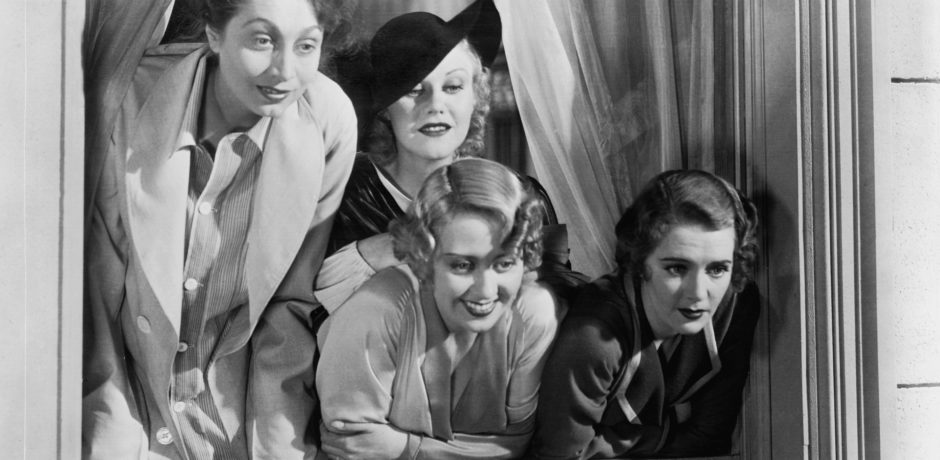
The story centers on Maureen O’Sullivan, only two years into her Hollywood career and already this was her 12th movie (she had even made one Tarzan film by this time—and will be forever remembered as Jane).  She plays the secretary to the assistant of Warren William.  The assistant is Verree Teasdale, herself only a few years in Hollywood and her 7th film.  She is intelligent, polished, runs her department with efficient and no-nonsense authority, clearly Mr. William’s trusted right-hand man.  She has a somewhat motherly relationship with Maureen O’Sullivan, whose family she knew, and so she has taken a protective interest in the young woman, alone in the wicked city.  Heaven may protect the working girl, but not if she doesn’t want to be protected, and this is the case with Miss O’Sullivan.


Her boss, Warren William, has designs on her.  First, he must dispense with her self-appointed chaperone, Miss Teasdale.  Verree Teasdale is his current mistress.

By the way, if you’re new to this blog, there are going to be so many spoilers it will make your head spin, so discreetly look away if you don’t want the sordid details and your innocence shattered.


Warren William, tall, so handsome, with sudden surprising dimples and a twinkle in his eyes, reminds one of John Barrymore, but there is even something more suave and impressive.  A charming seducer, unrelenting in the chase, but not so lustful as rather being amused by life, as if it is one big joke.  Eventually, we will see that his charm disguises a deep and arrogant lack of empathy for others, and that winning is everything no matter what it takes.

This is one of the surprises in the movie and of the Pre-Code era, in that a character who is essentially a villain can be so likable.  He is not the only one who shows more than one flaw, and yet we can forgive the flaws because everyone here is human.  We may not, by the end of the movie, wish to associate with any of these people, but cannot be angered or repulsed by them, because they are just people in the rat race.  If the big building is a monument, it is also a trap.


We get our first lesson in flawed character when we see that Warren William, who also has an apartment in the building, shares breakfast with his right-hand…mistress.  Verree Teasdale sits across from him in a negligee, chuckling that she will be late for work and need to make excuses, while Mr. William, in his robe, shares companionable conversation in front of a sheer curtain which does not hide the bed in the background.  The scene is deftly accomplished with a wink and a nod to the audience. 


Warren William is, however, married to Hedda Hopper, who breezes into his office later on for a fill-up on her allowance.  They also have a happy relationship, but it is much more open and honest than the one he has with Verree Teasdale.  Hedda Hopper knows he has relationships with other women and laughs at him, and takes his money, and they part as good friends.  She knows, as she will explain much later in the movie to Miss Teasdale, that Mr. William is not the sort of man who can be tied down, and he will not divorce her because she is his convenient excuse to never get caught in a real marriage.  He can always say his wife will never give him a divorce.

This is what he tells Teasdale, and she accepts the arrangement, until a chance meeting with Hedda Hopper compels her to ask why she will not give Warren a divorce so that she can marry him.  Hedda schools her on the reality of their marriage arrangement, and Teasdale is shocked. 


But there is more gnawing at her.  Warren William has, in the meantime, taken a liking to Maureen O’Sullivan, luring her to his apartment during a party where he (and his silly drunken pal played by George Barbier) plies her with champagne to get her drunk.  A few scenes later, we see she has accepted the post as his new mistress.  This is not a case of an honest girl led astray by love.  She doesn’t particularly love him, but he is charming, fun, and…rich.

It's the Great Depression, Charlie Brown, and everybody in the building is in survival mode.


It’s why she is reticent to marry her new beau, played by Norman Foster, who is a teller in Warren William’s bank on a lower floor.  He is a fast-talking wiseacre with a habit of bumping into people, store displays, and generally bumbling his way through the magnificent Art Deco lobby of the building.  He is pushy in the manner of early 1930s film boyfriends, to the point where we can understand Maureen O’Sullivan’s annoyance with him.  Especially when he does the particularly creepy ploy of calling the security guard to bring her to him so he can find out her name and address under the guise of investigating a theft.  Why she suddenly thinks he’s cute and wants to date him is a mystery to any sensible person, but it is necessary for the plot, so we accept it.  Why she holds out marrying him is largely due to his $50 per week salary (which was actually pretty good), and his $1,800 in the bank.  It’s not enough to live on. Millions of others were living on far less, but they are not Maureen O'Sullivan.

Warren William offers furs, jewels, money, and a trip on his yacht.  She’s raring to go.


We meet one of my favorites, Wallace Ford, as another working stiff in the building, who, in vying for the attention of Helen Coburn, will join a frantic mob at the stockbroker’s office, also conveniently in the building, to attempt to make a killing.  Money is everything, and for these folks, the sure path to love.


But not to Jean Hersholt, a mild-mannered jeweler who is trying to woo Anita Page, a street-wise woman of easy virtue, also desperate for cash.  In the movie’s most touching scene, she confesses to him her sordid past, and he says he knows but does not care, and she is moved and shamefacedly asks for a dollar so she can buy something to eat.  Later, we are told they are on their honeymoon.  There seems to be such need and open honesty between them, that we cannot help but believe they are the only ones in the movie who will succeed in finding contentment.

But even they are touched by scandal when Wallace Ford, who has lost a bundle on the market, sneaks into Jean Hersholt’s open jeweler’s vault but gets caught there when Hersholt, who does not know he’s there, shuts and locks the door.  Helen Coburn knows he’s stuck in there, she was helping to create a diversion so he could sneak in.  She was going to share the loot with him.  In a story of scamps and miscreants, she, a minor character, pulls off the most venial act by walking away and knowingly letting Wallace Ford suffocate in the vault overnight because she does not want to be implicated.  We see her afterward parasitically attaching herself to a new prospective suitor.

It is not the only death.  But we’ll get to that in a minute.

Warren William, pressed by his associates as well as his business rivals, is in danger of losing his bank and his building.  He smoothly cuts out his associates and makes a backdoor deal with George Barbier.  It’s a fun series of shots where they talk business first thing in the morning—to recover from a night of drinking—in the fitness center in the bowels of the building.  They talk furtively in the gymnasium, in the steam room, get massages by rough masseurs, and swim together in a large pool, floating on their backs and finalizing their verbal pact to create a merger.  To really capitalize on their new arrangement, they will launch a stock market scheme that was once called “painting the tape.”  They will send the bank stock soaring, and then dump it, shorting the market.  Warren William’s character actually reminds one of Jesse Livermore, in his piratical market maneuverings and his sexual appetite, but I don’t know if he was patterned on Livermore or only a type.


Later that day, Verree Teasdale, still working on the problem of keeping Warren William away from Maureen O’Sullivan, takes Norman Foster to lunch in the grand restaurant on an upper floor and urges him to continue his relationship with Maureen.  When he complains that she will not marry him because of his lack of wealth, Miss Teasdale gives him the tip about putting his cash into the Seacoast stock.  Thrilled, he rushes down to the broker’s and buys shares.  Wallace Ford observes him, and copies him, doing the same.  Jean Hersholt, normally reticent about stock speculation, also joins in, and a crowd of people clamor at the broker’s to get their Seacoast shares as the stock rises and rises throughout the afternoon.  It is a fury of greed and high hopes for a high life and dreams coming true.

Then the nightmare.  Warren William skillfully pulls out, the stock tumbles, and so do the life savings of many a little guy. "More margin!" is the old familiar cry.  We see Norman Foster sobbing into a handful of tickertape.

The next day, Wallace Ford, left with nothing, dies in Jean Hersholt’s jeweler’s vault he has attempted to rob.

Anita Page confesses her sins to Jean Hersholt, who cares nothing about his stock losses and everything about her.

Maureen O’Sullivan, blithely jumping over to Warren William’s caresses and enormous wealth, increased by the merger and the stock swindle, plans her new life as a pampered mistress.

In Mr. William’s case, it is also out with the old and in with the new.  We see him tell his manager to arrange for a house in New England for Teasdale and to pension her off.  She’s retiring, he says.

When Miss Teasdale becomes aware of her forced “retirement,” especially with Mr. William’s cold explanation, “A man needs youth.  Without it, life is stale, meaningless.”

She tells him to give up Maureen O’Sullivan or she will kill him.  He laughs at her, and she takes the pistol from his desk and shoots him.  Is it out of hurt and jealousy or is she really just protecting Maureen?  Both, I expect.

But he seems not seriously hurt; he is shocked, chuckles, takes the gun from her when she apologizes, and sits in a chair.  When his manager enters, he does perhaps the only unselfish act in his life when he says it was all an accident, that he shot himself when he dropped the gun.  The manager runs to get help, and Mr. William takes his handkerchief and wipes her fingerprints off.

Then he slumps over, collapses to the floor, and dies.


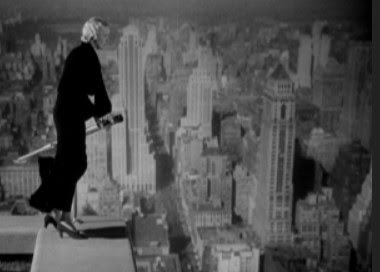
Verree Teasdale, in shock, goes to the roof of his magnificent building, stands precariously on the ledge, and allows herself to fall into oblivion.

In a previous scene, Warren William boasts of the grand accomplishment in life this skyscraper means to him.  “A million men sweated to build it.  I hate to tell you how many men dropped off these girders when it was being built, but it was worth it.”

We have barely enough time to catch our breath when the next scene is many months later, snow is falling softly in the city, and Hedda Hopper breezes by again, happily concluding a deal to sell the building and carry on with her immensely privileged life.


Maureen O’Sullivan chases Norman Foster for a second chance, and after some pouting, he agrees.  His fifty bucks a week salary is good enough now.  They are so shallow, we have a hard time caring about them.  Sometimes the very rich and the very poor have a lot in common if all they value is money.

  *******************************


My new non-fiction book, CHILDREN'S WARTIME ADVENTURE NOVELS - The Silent Generation's Vicarious Experience of World War II -- is now available in eBook here at Barnes & Noble, Apple, Kobo, and a wide variety of other online shops.

Or here from my Shopify store if you want to buy direct from me and avoid the big companies.

And it is here in eBook, paperback print, and hardcover, from Amazon.

From Cherry Ames, to Meet the Malones, from Dave Dawson to Kitty Carter - Canteen Girl, the Silent Generation spent their childhood immersed in geopolitical events through the prism of their middle grade and young adult books.  From the home front to the battlefield, these books are a window on their world, and influenced their hard-working, conformity-loving generation.

Thursday, May 14, 2009

The Secret Bride (1934)


The Secret Bride (1934) plants Barbara Stanwyck as a governor’s daughter who elopes with the charming, square-jawed do-gooder district attorney, played by Warren William. When Papa Governor is implicated in a murder, Miss Stanwyck and Mr. William must keep their elopement a secret so as not to show conflict of interest during the investigation, until justice is served.

The film does not equal the sum total of its parts, but its parts are pretty interesting. Directed by William Dieterle and made in the first year the Code went into strict enforcement, there is no sexy exploitation of the situation. There is not even a mention that the marriage has yet to be consummated; both William and Stanwyck seem more eager to play Nancy Drew and find the murderer than they are to start their honeymoon. With films such as “Baby Face” behind her and a reputation for more daring material, clearly Barbara Stanwyck’s wings have been clipped.


That leaves it to Glenda Farrell as Warren William’s smart-mouthed secretary with the sassy name of Hazel Normandie to provide the spice. Alas, she too becomes a victim when she is fingered for the crime, and gets interrogated by the coppers. She wins for my favorite line: Asked what were her relations with Mr. Breeden, she responds, “My relations didn’t like him. Especially Uncle Charlie.”

By far, the most intriguing aspect to this film is the surprisingly terrific performance by Grant Mitchell as an aide to the murdered financier. A character actor who appeared in films in bit parts as reverends, district attorneys, bankers, senators, Mr. Mitchell also played the kindly guy in a sweater welcoming the beleaguered Joad family to the nice clean New Deal campground at the end of “The Grapes of Wrath” (1939).

Grant Mitchell had been a lawyer before he quit that profession for the bright lights of Broadway, and was about 60 years old when he appeared in “The Secret Bride.” Here he plays a man stressed out, caught between powerful forces, and treated like a gofer. Indeed, we see him as little more than a harassed minion until the end of the film when we see he has a much more pivotal role in the mystery. The tension he carries and he creates is something marvelous. His strong performance is genuine, a refreshing contrast to the somewhat stiff performances by others in the film, including by the leads. The climatic scene of the film is all his, but that he carries each scene he is in throughout the film, no matter how brief his appearance in some of those scenes, is the wonder.

Lots of fun stuff like newspaper headlines, running presses, a surly prison matron, and a shot of Miss Stanwyck typing. She is, as was mentioned in this previous blog post, the silver screen’s most prolific typist.

As for zeitgeist elements, I particularly like the way the bank teller fills out the deposit slip himself, not the customer, and he does it with pen and ink. Also, there is an interesting scene in the jury room where the jurors vote guilty or not guilty by placing either a black or white marble in the draw of a wooden box. I don’t think I’ve seen this before. If anyone can enlighten us on this custom, please do.

The film ends with the NRA logo, though we need no reminders through this thoroughly “contemporary” film that it is 1934, where there is no past and no future, only the dreary present to endure. With a little more finesse, one could imagine what kind of film noir this would make if it were made 15 years later. There are certain nourish elements, like flashbacks, close-ups from interesting angles, shadows, everything but the feeling of being trapped in the jaws of fate. The mood here remains, as it did for most Depression-era films, decidedly upbeat.

Monday, February 4, 2008

Gold Diggers of 1933


Gold Diggers of 1933
(1933) is kind of a shock to the system. A quintessential “Depression” movie, it actually aspires to be a Depression movie with no claim to be anything else, an in-your-face comment on current events.

The film begins with a barrage of blonde chorus girls singing “We’re in the Money,” in a frenzy of fantasy that must have been fascinating to moviegoers in 1933, the depths of the Great Depression. When you consider that many of those moviegoers had to scrimp for the purchase price of the ticket, probably anywhere from 10 cents to 25 cents depending on where they saw it, whether it was an evening performance or matinee, the sight of women swathed in gold coins placed in strategic places on their bodies must have been nothing short of obscene. Not in a sexual manner (though there is plenty of naughtiness in the movie as well), but obscene in the way you don’t eat a three-course dinner in front of a starving man. It’s cruel.

Choreographer Busby Berkeley, with his customary surreal and eye-popping musical scenarios, gave the crowd more than 10 cents' worth of fantasy, but there is a strange dichotomy between fantasy and cold, hard reality in this film. Warner Bros., as always, had a bead on the grim reality of the 1930s and fixed its reputation on socially relevant films. Gold Diggers of 1933 is a cross between a socially relevant film and lemon meringue.

Joan Blondell stars as the tough-talking chorus girl. Aline MacMahon and Ruby Keeler are her pals, and Ginger Rogers has a featured role, opening the film in the “We’re in the Money” number. The bit where she sings a chorus in pig Latin was put in, as she notes in her autobiography, Ginger, My Story (Harper Collins, 1991), by producer Darryl F. Zanuck after he heard her clowning around with the song and doing a verse in pig Latin during a rehearsal.


The girls are thrown out of work when the Broadway show they are in is shut down by creditors because Ned Sparks, the producer/director, can’t pay the bills. We see the girls struggling in their run-down apartment, stealing milk from the neighbors, and when they hear a rumor that a new show is going to be cast, they pool their clothes for one good outfit for Joan Blondell to wear to go check it out. When she calls them to relay the good news that a new show is on and they might all get jobs, she is crying on the phone. It is one of those real moments that breaks through all the wisecracks and reminds us, more that it does the audience of the day, that this was the Depression. Nostalgia buffs need to remember that for many people it was a nasty time to be alive. Or, as when one of the chorines complains of their hard luck, Ginger Rogers comes back with the world-weary remark, “The Depression, dearie.”

Dick Powell plays a young composer who lives in the apartment across the way. He is sweet on Ruby Keeler. He is also a wealthy playboy in disguise, so he comes up with the money to fund the new show. The show, as Ned Sparks envisions it, is going to be about the Depression, and featuring a number about “the forgotten man,” a 1930s euphemism for unemployed World War veterans. Sparks crows about his inspiration, “Men marching, marching…jobs… JOBS! Gee, don’t it get ya?”

It must have got everybody.

The rehearsals for the new show carry the fun of the typical backstage world the movies occasionally give us a glimpse of, just to remind us that there is hard work behind the magic.

We have some character actors who have very brief time on screen but give the film its quirky personality. Clarence Nordstrom plays the middle-aged “male juvenile” of the show, (we see him as well in the “Shuffle Off to Buffalo” number in 42nd Street) whose sudden attack of lumbago forces Dick Powell into the starring role on stage. Nobody seems to have lumbago anymore. It went the way of “the ague” and “the vapors,” I think.

It is another hard slap reminder that the wolf is at the door when, as Dick Powell first refuses to go on stage, Aline MacMahon chastises him with the information that all the cast will be out of work again, and perhaps some of the starving actresses will “have to do things I wouldn’t want on my conscience.” It brings the wealthy playboy to hard reality, and us, too.

Billy Barty plays the naughty “baby” in the strange “Pettin’ in the Park” park number. Sterling Holloway, future “Winnie the Pooh” voice among other roles, plays a delivery man, and ever dependable, ever-present Charles Lane has a brief spot as a reporter. Mr. Lane played curmudgeonly types in just about every film ever made in Hollywood and most TV shows in the 1950s through the 1990s. When he died at 102 years old, he was still working.

Warren William plays Dick Powell’s older brother, who tries to get Powell away from the clutches of Ruby Keeler, whom he sees as a gold digger. He views all actresses as gold diggers, and in his scheme to separate them, he unwittingly falls for Joan Blondell. He is a stuffed shirt, who grows more likable if only for his helplessness among the streetwise gold diggers, with family retainer Guy Kibbee in tow.

Ruby Keeler undoubtedly appeared very cute and sweet on screen, but her questionable range of talent made her no match for Joan Blondell. Particularly in the striking “Forgotten Man” number, Miss Blondell displays such intensity and commanding screen presence that is it surprising she did not enjoy a longer career as a leading lady, always cast in second leads. Perhaps Hollywood already enjoyed an embarras de richesse when it came to tough-talking blondes and felt it didn’t need another one.

We see a few pre-Code influences in the “Pettin’ in the Park” number with its undressing chorines drenched by rain pouring down on the multi-level “park” set that goes through different seasons.


“The Shadow Waltz” number, where even Ruby Keeler sports blonde finger waves, is typical Busby Berkeley fare, with overhead kaleidoscope shots of the girls in dresses with corkscrew hoops that spring and bounce as they play violins that are eerily lit by neon tubing. One wonders about the expense and the possible safety issues.

The film concludes abruptly with “The Forgotten Man” number, a stark street set where Joan Blondell speaks the first verse of this song about downtrodden World War vets. Only the year before, a “bonus army” of vets were routed by the Army with General Douglas MacArthur at its head and burned out for camping in protest in Washington, D.C., over the issue of their service bonuses.

“Remember my forgotten man.
You put a rifle in his hand.
You sent him far away.
You shouted hip hooray.
But look at him today.”

Etta Moten takes a verse in her rich contralto as the camera pans across the poverty-beaten wives of the jobless forgotten men. Miss Moten made only three films in Hollywood, all in this same year of 1933, but went on to a long career on stage and as a radio journalist. She is reported to be the first African-American performer to be invited to the White House, when the Roosevelts hosted her.

Much of this song is pantomimed, with many extras dressed as World War soldiers marching off to the war jubilantly, crowds waving. The rain beats down on them as they continue to march, now wounded, with a defeated attitude, home from the war, then shuffling in civilian clothes in a breadline with hollow eyes and bleak faces.

When a cop tries to roust a homeless guy sleeping on the sidewalk, Joan Blondell wordlessly comes to his rescue by turning over his coat lapel showing his Medal of Honor, and gives the cop a glare that would kill.

To us today this is a reminder that the Great Depression was not all waltzing with neon-lit violins and romantic fantasies. In 1933, they already knew that. Perhaps Warner Bros. felt the public wanted affirmation of their problems, some legitimacy granted their desperation.

The movie ends, or just slams shut, on this dour note, the complete opposite of how it began with “In the Money.” Both musical numbers are stunning, especially in that they show opposite sides of the “coin.”

   ********************

Jacqueline T. Lynch is the author of Ann Blyth: Actress. Singer. Star. and Memories in Our Time - Hollywood Mirrors and Mimics the Twentieth Century. Her newspaper column on classic films, Silver Screen, Golden Memories is syndicated nationally.  Her new book, a collection of posts from this blog - Hollywood Fights Fascism - is available here on Amazon.

Related Products