IMPRISON TRAITOR, PEDOPHILE, AND CONVICTED FELON TRUMP.
Showing posts with label Louis Calhern. Show all posts

Thursday, July 17, 2014

The Student Prince - 1954


The Student Prince (1954) began production in an atmosphere of controversy, and its reputation remains mired in an ironic history.  Today we may recall the film as the one Mario Lanza walked out on, that his voice was used for the musical numbers and lip-synched by his newbie replacement, Edmund Purdom.  There’s a lot more to this prim operetta—the one that happened off-stage, I mean, and it is the story of a dying studio system clutching at its waning power, a suicidal career move, and most especially, a perceived museum piece of old-fashioned entertainment that didn’t belong in the 1950s.

What most people seem to forget is that the Broadway musical on which the movie is based, which came to the Jolson’s 59th Street theater in 1924, was the smash hit of the 1920s, playing a then record 608 performances, running over a year and a half.  The turn-of-the twentieth century fairy tale of the prince and the barmaid may not have belonged in the Jazz Age, either, its quaint Gemütilichkeit a contradiction to the Roaring Twenties, yet it still packed them in and was wildly successful.

We may wonder with a smile if it was just because the Prohibition-era audiences got a charge out of the rollicking “Drink!  Drink!  Drink!” number. 


And it was revived on Broadway in 1931, and in 1943.

The story was based on a play and novel written around the turn of the twentieth century, which made it current events at the time, but by 1924 on Broadway, and then in 1927 when Hollywood took the property and turned it into a silent operetta (no smirking) with Norma Shearer and Ramon Novarro, it was a slice of zeitgeist that charmed a faster-paced society.

What happened to all the excitement and goodwill by 1954? 

It seemed to walk out the door with Mario.


Last week we discussed The Great Caruso (1951) that made a star out of Mario Lanza, and gave Ann Blyth her first crack at a big screen musical for MGM.  Caruso enjoyed great financial success, which the studio hoped to repeat in The Student Prince, whose score by Sigmund Romberg, lyrics by Dorothy Donnelly, were well known and, at least in the 1920s, considered a sure hit.

Ann Blyth was not the first choice for Kathie the barmaid,who hoists steins of beer at her uncle’s inn. 


According to author Armando Cesari in Mario Lanza: An American Tragedy, Jane Powell was originally considered for the role, but her pregnancy would have been too far along by the time of shooting and was replaced by Miss Blyth, who, in 1952 when the film was slated to be made, was still unmarried.  By the time the movie actually went into production, toward the end of 1953 and beginning of 1954, Ann was married and expecting her first child, such that now the studio needed to push forward the shooting to accommodate her.  (MGM had also tried to get Deanna Durbin out of retirement, but you couldn’t have pried Miss Durbin out of her comfy shell with a crowbar.)

Ann Blyth, by the way, for the only time in her screen career appears as a blonde in this movie.  I don’t know why.  It’s not distracting; she looks fine, but it’s just something of an affectation that doesn’t seem necessary.

In between all this was when the fireworks happened that affected the production of this musical and stamped its troubled legacy ever after.

In June 1952, Mario Lanza clashed with director Curtis Bernhardt on the first day of rehearsals and walked out.  Other actors who had worked with Bernhardt in the past had expressed a dislike of his brusque manner, but Lanza’s request that the studio replace him with Richard Thorpe, who directed Caruso, was rejected by MGM head Dore Schary and producer Joe Pasternak.  A compromise was reached on Mario’s various artistic complaints, including a few new songs, and in the next month, July, Mario came back and did the pre-production musical recordings.  According to author Mr. Cesari:

…to the amazement of everyone he recorded most of the numbers from the score in single takes.

Then Mr. Lanza, whose mercurial temperament and thin skin made him unable to accept criticism and was vulnerable to stress, suffered a personal trauma when unexpected financial troubles came down hard on him.  According to the author, he suffered from nervous tension and accordingly, did not use good judgment when it came to his artistic differences with the director, and in his stubborn noncompliance with studio orders. Unable to take frustration, he just walked out again.  There have always been rumors about Lanza’s having gained too much weight and was dismissed from The Student Prince for that, but he was fit at the time of rehearsals and his real troubles with weight gain and dangerous crash dieting happened afterwards, at least in part as a reaction to the stress of his troubles with MGM.  His troubles compounded when the studio sued him for walking out. 

Movie production was canceled in September 1952.  The studio sued Lanza, and the lawsuit took over the news, and lives of many.  In October, Ann was interviewed by William Brownell for the New York Times:

“We were all disappointed to miss making this picture,” she commented.  “Mr. Lanza and I had so much fun making The Great Caruso, and I’m sure nobody thought anything would go wrong with this one.  He seemed to be in good spirits and satisfied with everything.  We had already finished all the pre-production musical recordings and were all set to film the story portion.

“I feel so sorry for all the others connected with the picture—the technicians, the supporting players, the musicians and dancers.  We waited around on the set for over a week, but Mr. Lanza didn’t appear.  Finally they told us that the picture wouldn’t be made and everyone was thrown out of work.  But I actually feel most sorry for Mr. Lanza.  If only we could help him some way…”

Her strikingly sympathetic words might almost be taken for a portent on the eventual end of Mario Lanza’s career and his life—which happened sooner than anyone could have imagined.  He died in 1959 at 38 years old of a heart attack and other health issues.  He was born in 1921, the same year Caruso died, and was considered to be his heir as the world’s greatest tenor, or would have been, according to varied opinions, if he had lived longer, or lived a more disciplined life, trained harder, had forsaken Hollywood for the opera world...or just not walked out on The Student Prince.  

The last was apparently his own opinion.  According to author Mr. Cesari:

During the last period of his life, Lanza would confess, “I now admit the biggest mistake I ever made was to walk out of Metro.”

But he left behind his voice. 

We’ll get to that in a minute.


Ann Blyth was still contracted to Universal-International at this time, and neither they, nor she, were willing to just let the grass grow under her feet in the meantime.  Buoyed by the success of The Great Caruso, she continued her voice training and performed at local venues whenever possible.  Syndicated columnist Gene Handsaker noted in June 1952:

Little Ann Blyth has more singing volume than I thought.  Annie recently sang five songs before the Greater Los Angeles Press Club.  When she turned away from the mike, to face part of her audience, she proved that her voice is as strong as it is beautiful.

But apparently, Universal still had no intention of casting her in musicals, for the remainder of her time with them was spent in the drama The World in His Arms (1952), which we covered here, and the comedy Sally and Saint Anne (1952), which we covered here.  Two more dramas, One Minute to Zero and All the Brothers Were Valiant, which we’ll cover down the road, were made before the clock ran out on her Universal contract and she moseyed over to MGM and her next musical, Rose Marie (1954), which we’ll talk about next week.

With Rose Marie and The Student Prince, as well as a biopic of their composer, Sigmund Romberg, Deepin My Heart starring José Ferrer, 1954 must have been The Year of Sigmund Romberg.  We’ll have to cover Deep in My Heart sometime.

In May 1953, MGM offered a compromise that would let them proceed with making the musical—without Lanza, that would also end their lawsuit against him.  Their proposal: for Mario to let them use the vocal soundtrack he already recorded in return for their dropping the suit.  Lanza, still stunned that the studio did not seem to want him back, and under mounting debt, could not withstand a prolonged court case, agreed.

Film production finally continued (ironically under director Richard Thorpe, whom Lanza wanted from the beginning).  Lanza was replaced by English newcomer Edmund Purdom, as The Student Prince became one of Hollywood’s most infamous voice-dubbing controversies.  Another would be Ann’s singing being dubbed by Gogi Grant in The Helen Morgan Story (1957).  We’ll get to that down the road.

Here’s the trailer:


Ann’s singing here is lovely, and she continues to display a vocal agility (even more pronounced in RoseMarie, which was filmed before this) that had not been evident through the songs offered her in any movie in which she had ever sung.  While it’s true she continued to train and develop her voice such that she was a much better singer in 1954 than she was in 1944 when she started in her first Universal B-musical (see our previous post on Chip off the Old Block here), but it is also true that operetta, this supposedly antiquated (by pop 1954 standards) allowed us to experience the depth and fullness of her singing ability in a way a popular musical would not.  Ann Blyth could sing popular musicals and pop songs, even saloon songs (I’m looking at you “Oceania Roll”), but banging out the crisp high notes on the rousing “Come Boys” number, or facing off toe-to-toe with the great tenor Mario Lanza (and cheek-to-cheek on screen with Edmund Purdom) in “Deep in My Heart” are marvelous demonstrations of her vocal range and agility, and moments of musical bliss. 

Here’s a look at “Deep in My Heart”:


As Brian Kellow in his 2002 Opera News article remarks:

One of the best things about her singing is its no-frills emotional directness.

I would suggest this is also one of the best things about her acting.

However, our old friend Bosley Crowther of the New York Times (it seems one of my great pleasures in life is disagreeing with Bosley Crowther) reported in his review:

…natty little Ann Blyth does her own singing, they tell us—and does it quite nicely, too.  Of course, is a bit fragile for a barmaid and a bit on the prim and proper site.

Here I have to once again, disagree about the “fragile.”  Have a look at the way Ann hoists three full liter-size beer steins in each hand as she sings “Come Boys,” serving them to thirsty, singing male students and picking up more by the handful from passing trays, all the while climbing over benches, tables, and patrons.  It’s like an Olympic event.  That little woman must have had a vise-like grip.  I’ll bet if she shook hands with Arnold Schwarzenegger, she’d make him cry like a little girl.


We have a very charming account of what it was like to perform in this scene from one of those students, by the name of Ralph:

I was in constant awe working so closely with this charming, beautiful, friendly actress.  She treated all of us as equals, joking, talking and enjoying our company as we enjoyed hers.  To this day I can recall the good feelings on that set just because Ann Blyth made it that way.

Please head over to Ralph’s blog here for more on his experience as an extra in The Student Prince.

The movie features Louis Calhern as the king, who must marry off his grandson, played by Edmund Purdom, in an arranged marriage to a wealthy princess (played by Betta St. John) to save his kingdom because they’re broke.  Mr. Purdom, handsome, haughty, but lacking in personality, is something of a jerk.  Who wants to marry a poor jerk?  A rich jerk, maybe, but not a poor one.  He has only his charms to recommend him, and he’s low on charm.

Edmund Gwenn, who played Ann’s grandpa in Sally and Saint Anne, is the kindly old professor and mentor to Purdom, who suggests that the lad be sent off to college with the commoners so he can learn about life and how not to be a jerk.  With his mustache and muttonchops, Mr. Gwenn looks a little like Emperor Franz Josef.  It’s a good look on him.


John Williams, a favorite and whom we last saw with Ann here as the prosecuting attorney in A Woman’sVengeance (1948) has a comic role as the disapproving, snippy chamberlain who goes with Mr. Purdom to college and acts like his babysitter.  His dignity is assaulted in practically every scene.

Richard Anderson, another favorite, and who we last saw as Ann’s beau in The Buster Keaton Story(1957) here, plays one of the students who befriends Purdom and encourages him to binge drink as a form of social interaction.


Edmund Purdom drinks copiously, meets Ann, and through the course of a rocky courtship, falls in love and learns not to be quite such a jerk.  He also learns, to his regret, what it means to be king.

I like the scene where a disgruntled chef chases him out of his kitchen with a meat cleaver.  I don’t know who plays the chef, but I love his rolling R’s German accent.  Since the cartoon-watching days of my early childhood, I've always had a love of scenes where somebody chases somebody else with a meat cleaver.  That's not something I would tell everybody, so don't let that get around.  It sounds worse than it is. 

S. Z. "Cuddles" Sakall plays Ann's uncle, the innkeeper with his customary middle European loving fretfulness.


Purdom performs well in his “singing” scenes, having prepared diligently for several weeks for the role.  He may not have had the screen magnetism of Mario Lanza—and one cannot hear Lanza’s voice without wondering how he might have appeared in the film—but Purdom is handsome and if this were really his singing voice we’d be talking about a major new star.


But it wasn’t his singing voice, and that, for perhaps the first time in the history of Hollywood, where dubbing went on all the time since the advent of sound pictures but nobody made a big deal out of it, was what dragged down this movie and possibly Purdom’s start in Hollywood.  He went on to other films, in fact, his next was a rematch with Ann in the historical drama The King’s Thief (1955), which we’ll get to down the road.  He was a talented actor, a beautiful speaker, but having lip-synched to one of the most famous voices of the era, despite that role seeming, as it should have been, a tremendous career opportunity, only tarnished his image as a second-string weak imitation.  Purdom deserved better, and so did the movie.


The film also carried the image of a poor substitute, inferior goods.  The reviews were mixed, with some positive, such as this one from Howard Pearson in his syndicated column from May 1954:

Before the song is half-way through, audiences will not be conscious that Purdom is not singing.  The work of blending his lip movements to the Lanza’s voice has been well-nigh perfect…Also, Purdom is so handsome and personable, it’s a certainty audiences won’t care that he isn’t singing…”

With Mario Lanza’s great big, fat screen credit, nobody was allowed to forget it was him singing.

That first song is “Summertime in Heidelberg,” a sweet tune he sings in a duet with Ann Blyth, which she starts, seated at a piano, with shy and hesitant wistfulness.  No “opera singing” here, it’s as gentle as a lullaby.  He picks up the tune and takes it over.  The image is like a metaphor for the movie: her guiding the newcomer Purdom into the spotlight with his first song on screen, and Lanza’s voice, the ghost that wouldn’t go away, taking over not only Purdom’s credibility, but the taking over the rest of the song from Ann while she sits in the foreground in silence. For my part, though Mr. Lanza’s voice is always a pleasure, I would prefer to have less Lanza and more Blyth.  He again has the lion’s share of the music.

Here’s a look at “Summertime in Heidelberg”:


Other reviews were more dismissive, suggesting the genre of operetta had had its day.  Perhaps, in the new era of filming on location, the studio soundstage “village” seemed artificial, but is totally in keeping with the theatrical mode of operetta.  To have made it more “realistic” would have been to cut its artistry off at the knees. 

In an interview with Lance Erikson Ghulam for Classic Images in 1995, Ann recalled:

In some ways, I thought it was photographed beautifully and had some great character actors.  I still feel that Edmund Purdom did a marvelous job…Certainly, if [Mario] had been in the movie, things would have been quite different.  So much had been written about his problems with the studio that I think everyone was waiting to pounce on the movie.


If Mario Lanza’s arrogance was punished by his cutting off his nose to spite his face, then MGM’s arrogance in cherry picking the voice of one major star and assigning it to a newcomer—quite publically as if to prove a point that stars were replaceable—had an effect as well.  The film did middling at the box office, but the record album of Lanza’s recordings was a smash.  It became Mario Lanza’s best selling LP, hisfirst gold album.

That LP, just as the movie, also leaves a legacy of contractual misfortune.  Ann Blyth’s vocals were done by Gale Sherwood, because Ann did not have a contract with RCA, the producer of the album.

Two weeks before The Student Prince premiered, Ann's first child was born, beginning a new and very happy chapter in her personal life.  Professionally, with the coming autumn, she would continue her career in what would come to be one of its most satisfying facets: singing in concert on stage.  Her Las Vegas act is described in this previous post.

Come back next Thursday when we discuss Rose Marie, a lavish production featuring Ann as the feisty backwoods waif, Howard Keel as her Mountie guardian, and Fernando Lamas as the wily trapper in a tuneful, and heartbreaking, romantic triangle.  The triangle was haunted, however, by another duo.


Posted by Jacqueline T. Lynch at Another Old Movie Blog.

*****************************
Cesari, Armando.  Mario Lanza: An American Tragedy (Baskerville Publishers, Inc.) pp.164, 166, p. 173

Classic Images, February 1995, “Ann Blyth: Ann of a Thousand Smiles” by Lance Erickson Ghulam, p.20.

Daytona Beach Morning Journal, June 3, 1952, p. 4 “Hollywood Report” syndicated column by Gene Handsaker.

Deseret News (Salt Lake City), May 8, 1954, syndicated by Howard Pearson, p. B 3.

Milwaukee Journal, May 2, 1954, “It Pays to Be Good” by Sue Chambers.

New York Times, October 12, 1952, article by William Brownell, p. x5; June 16, 1954, review by Bosley Crowther, p. 18

Opera News, August 2002, article by Brian Kellow, pp. 38-44.

******************************
THANK YOU....to the following folks whose aid in gathering material for this series has been invaluable:  EBH; Kevin Deany of Kevin's Movie Corner; Gerry Szymski of Westmont Movie Classics, Westmont, Illinois; and Ivan G. Shreve, Jr. of Thrilling Days of Yesteryear.

***************************
TRIVIA QUESTION:  I've recently been contacted by someone who wants to know if the piano player in Dillinger (1945-see post here) is the boogie-woogie artist Albert Ammons. Please leave comment or drop me a line if you know.
****************************
UPDATE:  This series on Ann Blyth is now a book - ANN BLYTH: ACTRESS. SINGER. STAR. -

*********************
The audio book for Ann Blyth: Actress. Singer. Star. is now for sale on Audible.com, and on Amazon and iTunes.

Also in paperback and eBook from Amazon, CreateSpace, and my Etsy shop: LynchTwinsPublishing.


 "Lynch’s book is organized and well-written – and has plenty of amusing observations – but when it comes to describing Blyth’s movies, Lynch’s writing sparkles." - Ruth Kerr, Silver Screenings

"Jacqueline T. Lynch creates a poignant and thoroughly-researched mosaic of memories of a fine, upstanding human being who also happens to be a legendary entertainer." - Deborah Thomas, Java's Journey

"One of the great strengths of Ann Blyth: Actress. Singer. Star. is that Lynch not only gives an excellent overview of Blyth's career -- she offers detailed analyses of each of Blyth's roles -- but she puts them in the context of the larger issues of the day."- Amanda Garrett, Old Hollywood Films

"Jacqueline's book will hopefully cause many more people to take a look at this multitalented woman whose career encompassed just about every possible aspect of 20th Century entertainment." - Laura Grieve, Laura's Miscellaneous Musings''

"Jacqueline T. Lynch’s Ann Blyth: Actress. Singer. Star. is an extremely well researched undertaking that is a must for all Blyth fans." - Annette Bochenek, Hometowns to Hollywood


Ann Blyth: Actress. Singer. Star. 
by Jacqueline T. Lynch

The first book on the career of actress Ann Blyth. Multitalented and remarkably versatile, Blyth began on radio as a child, appeared on Broadway at the age of twelve in Lillian Hellman's Watch on the Rhine, and enjoyed a long and diverse career in films, theatre, television, and concerts. A sensitive dramatic actress, the youngest at the time to be nominated for her role in Mildred Pierce (1945), she also displayed a gift for comedy, and was especially endeared to fans for her expressive and exquisite lyric soprano, which was showcased in many film and stage musicals. Still a popular guest at film festivals, lovely Ms. Blyth remains a treasure of the Hollywood's golden age.


***************************

A new collection of essays, some old, some new, from this blog titled Movies in Our Time: Hollywood Mimics and Mirrors the 20th Century is now out eBook, and in paperback here.

Monday, September 6, 2010

Executive Suite - 1954

We mark Labor Day in the U.S. today with a look at Executive Suite (1954). It’s not just a retro look, but an echo from America’s mighty industrial past that drifts with some uncomfortable resonance today.

Robert Wise is the director, and we start from the first moments of the film with bold credits flying toward the audience while an ominous sounding bell tolls…for whom? For everybody, it seems. Maybe even us.

The bell sits in the tower above the executive suite of the title, in a downtown stone monument of a building that serves as the corporate office of a furniture company. We are not yet in the days of suburban industrial parks. We are downtown where the action is.

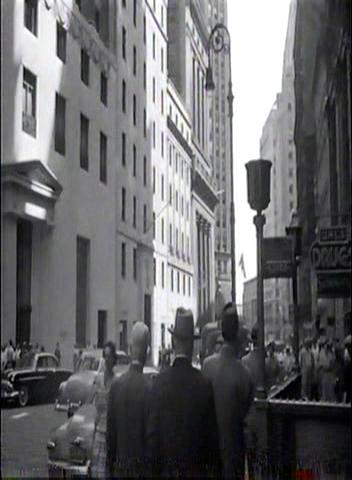
The action starts right off with the unseen CEO leaving his New York branch building at the end of the workday on a Friday. His perspective is the camera’s perspective. We see who sees him, who makes eye contact and who does not, as he leaves the world over which he is king.

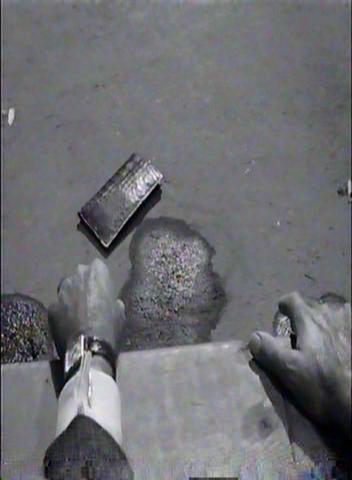
Then he hails a cab out on the sidewalk and crumples to the ground, dying instantly of a heart attack. We see, through the camera and his eyes, the swirling buildings, and the clear sky above

Looking down upon him from an upper floor is our old friend Louis Calhern, (whom we last saw as the rogue here in The Man With the Cloak) an executive in the firm, who, sensing an opportunity, sells a chunk of company stock he cannot cover. It doesn’t matter, because he knows that when the news gets out of the Big Boss’s death, the stock will plummet.

Once it does, he can buy it back for next to nothing. In the weeks to come, the stock will rise. He will make a tidy profit.

His cheap sell-out scheme lays out before us the message of the film. We get there, by and by.

It is fun to see Mr. Calhern’s meltdown when the Big Boss, whose wallet was stolen by a passer by when the ambulance arrives, is taken to the city morgue as a John Doe, and wrecks the timing on Calhern’s game.

Such is the behind-the-scenes maneuvering of the board of officers on this company, and there will be much jockeying for position to see who gets voted to be the new Big Boss. It is survival not of the fittest, but of the least principled.

Among the likely candidates is Dean Jagger, one of the old boys who helped build the company, but who is now regarded as too old to take the helm. Likewise Walter Pidgeon, the longtime partner of the Big Boss, who resents not having been named as second in command a long time ago.

Paul Douglas is the hail-fellow-well-met head of sales, who settles deals on the golf course and a bribe of a bottle of scotch. It is the charming façade of a spineless company man. His mistress, and secretary, played by feisty Shelly Winters provides the ego boost he needs, along with other comforts. Until he lets her down, and she shows more pride and mettle than he has.

Fredric March is a standout in this film as the smarmy numbers cruncher, who worms his way into other’s private affairs to get information to use against them. It is a magnificent performance, a virtuoso of snideness, ingratiating artificiality, and backstabbing. We see his grim confidence behind his sneer. We see his resentful insecurity when his wiping his sweaty palms with his handkerchief.

There is William Holden, as the Bright Young Man, who works in product development and represents the idealism that the Big Boss and his partners once had, but have abandoned in the lure of making an even bigger profit.

Holden’s supportive wife is played by June Allyson, who maintains their junior executive suburban home with its Mid-Century modern furniture (see this previous post on Strangers When We Meet for more examples of that), and raises their all-American boy, played by young Tim Considine.

I wonder if the furniture in his ultra modern house was made by his own company, and if it’s the good stuff or the cheap knock-off stuff, and if he got a discount?

Check out Walter Pidgeon’s home and we get an eyeful of traditional furniture, a nice contrast that tells us a lot about these two men, their perspectives and their eras. Furniture is not just set dressing in this movie. Look at the medieval design of the woodwork in the executive suite. The stained glass windows behind Holden during his big speech make him seem like an evangelist.

Finally, we have Barbara Stanwyck as the heiress whose father founded the company. Until recently it seems, she was also the mistress of the Big Boss. She is depressed and vulnerable in the aftermath of the death of the powerful man who rejected her, selfishly indifferent to what affect his death will have on the company.

Rounding out the cast we have Nina Foch, who as private secretary to the Big Boss, is the major domo of the Executive Suite, making sure meetings run smoothly, privy to all the secrets and keeping her mouth shut.

It’s an engrossing film, character-driven (which we get from the start when each main character is “introduced” to us when Nina Foch knocks on their office doors to remind them of a big meeting. Thus, we see their character names on their doors and identify their faces).

They all have their own agenda. Mr. Holden pouts because his latest product development test got messed up. The Big Boss, who once promised him free reign to improve their furniture, let the ball drop and fell under the spell of business ideology such as Fredric March’s character, Mr. Shaw, where profits are to be doled out to stockholders and not reinvested in the company.

Holden complains, “Improve the profits but never the product. That’s Shaw’s philosophy,” he says of Mr. March. “To him, the whole company’s just a curve on a chart.”

Dean Jagger, a hands-on man like William Holden, who helped start the company, resents Holden’s supposed “golden boy” (so to speak) position with the Big Boss. Mr. Jagger practically invented furniture, he seems to say, “And I didn’t need the boy wonders and the slide rule experts to show me how.” (See this previous post for our discussion on slide rules. My gosh, there’s a link for everything in the post.)

Mr. Jagger is so fed up, he is planning on retiring, and let the company crumble. I love Holden’s admiring smile across the boardroom table when Jagger says he is taking a weekend trip to sail on his boat and eat Maryland crab. It’s a small touch but says volumes about mutual appreciation and comradeship that can exist in companies as well as enmity.

Fredric March tails Paul Douglas to the airport (see this previous post on the Long Beach Airport), to humiliate him by catching him in a tryst with Shelley Winters.

Walter Pidgeon’s wife complains that he has been living in the Big Boss’s shadow, and urges him to make a play for the top job.

A great scene with Mr. Pidgeon, in an attempt to do just this by returning to the office to draft public announcements on the Big Boss’s death and funeral arrangements, discovers the presumptuous Fredric March already there and handling everything himself with a condescending air.

They argue details, but March has clearly assumed control. Walter Pidgeon, ever the gentleman from the old school, is aghast that Mr. March does not intend to close the factory out of respect for the deceased.

Time is money.

Suddenly the plot shifts from what will happen to these board members, to what will happen to the company.

To save it from the nefarious clutches of Fredric March and his ilk, Holden, the reluctant hero, must convince Walter Pidgeon to anoint him heir. Holden must dicker and pontificate in the boardroom in a tense scene to shake them up and win their confidence, rather like a politician. And he must shame Barbara Stanwyck, who holds a controlling vote, into dropping her self pity for two seconds to consider the lives of others and the legacy of this furniture company that bears her family name.

Mr. Holden is worried about the product, and about the workers. When he leaves the plant at the end of the day, after the whistle has blown, an army of laborers files out the gates with him. We see he is a man of the people. He knows many of them by name. Note the American flag in the background, over his head like a halo. This symbol as well as the workers crowding at his elbow already seems to anoint him.

The workers are worried the plant will shut down now that the Big Boss is gone and things are so unsettled. Some complain about the junk furniture they manufacture, a far cry from the good old days when they were proud of their product.

“Why did he allow it?” one disgusted laborer asks Holden, and then the other pivotal question, “Where do we go from here?”

Holden has no answers. But we know where they went. We’ve already arrived.

Have a look at this link to a New York Times story from July about the Harley-Davidson motorcycle manufacturer enjoying soaring profits, more than triple from a year ago. Reaping the profits, specifically, are the shareholders. The workers reap pink slips. Around 1,500 people will be let go by the end of this year. As the article notes, many other manufacturing firms reaping profits this year did so by trimming the fat, which in business terms always seems to mean people, and do not intend to use their profits to rehire anytime soon.

It’s endemic, this cutting the fat. Check out those self-service checkout lines in grocery stores, the ATM in the bank lobby while two tellers work in a bank that has eight empty teller windows, even the new self-service checkout stands in libraries. Cuts down on the need for librarians to check out your books. All for your convenience isn’t it? Yours or theirs?

So much convenience and so few jobs.

“Convenient!” Mr. Pidgeon blasts Mr. March, “That’s always been your attitude…to make everything as convenient as possible for yourself!”

It is interesting, and somewhat astonishing, to note that what we might lament as the failure of industry in this country and corporate greed today had roots as far back as 1954, specifically the notion that the product will become inferior and the jobs will be lost if the only object is profit for the shareholders.

We were enjoying one of the most energetic and profitable business booms of all time in the early 1950s. But here in this film, we see the veneer crack a little. In industry and in the cheap line of furniture this company has been making, shaving off quality to bolster the bottom line.

The climax of the film is a boardroom showdown between factions, intentions, and ideals. Where Nina Foch, by the way, takes notes in shorthand. Is shorthand taught anymore? I suspect it has gone the way of the dial telephone and antimacassars.

William Holden gets thrust to the top of the heap when he decides to take the responsibility to point out how lousy things have been run in the company. He assumes a leadership role by doing this, thereby anointing himself.

While we listen to his words, our minds may wander a little bit from the plot to what is going on in our own lives.

Fredric March spells it out succinctly, “I believe that a company is answerable first and last to its stockholders.”

Mr. Pidgeon protests, “I get it. Manufacturing and selling don’t count anymore.”

Mr. Holden agrees with Pidgeon, “Sometimes you have to use your profits for the good of the company, not paying them all out in dividends to impress the stockholders with your management record.”

Mr. March contends, with a nod to the brooding Miss Stanwyck at his elbow, that the Big Boss ran things that way. Holden comes back with a remark that seems to speak directly to us.

“He was wrong, the way a lot of people are wrong these days, grabbing for the quick and easy, the sure thing. That’s just a lack of faith in the future.”

His soliloquy about let’s run a better company starts to sound like Mickey Rooney exhorting the gang to put on a show, and some of his remarks might sound just as naïve to us. Holden talks about putting out a line of product that “has beauty and function and value.” Yeah, right.

He talks about workers on the line who prefer to take a pay cut to post to other jobs in the company, just to avoid working on the really cheap crap they’ve been making because it damages their pride.

He tells Barbara Stanwyck that they must put out product that she will be proud to bear her family name.

Do we still have that kind of pride? Willing to take a pay cut to avoid demeaning ourselves? As for pride in family names on companies, in a world where most of our big corporations are acronyms or just a meaningless jumble of vowels and consonants arising from many names over the course of many takeovers, do we really know what company we’re dealing with when we buy that item?

Though the movie ends on a hopeful note (except for Fredric March, whose sickened expression after losing the presidency of the company is priceless), we may not be able to help brooding on the old lady laborer, who walks out of the factory with the swarm of other workers after punching out, to ask William Holden about their future. They know the company is in trouble.

“Everything’s going to be all right, isn’t it?” She asks.

“Don’t you worry about it,” he tells her with a comforting smile.

“But you weren’t here in ’33, you don’t know how it was…”

I wonder, do we know now?

William Holden only guessed at catastrophe for the company and the nation in a booming 1954 when the net dividend for the stockholders was starting to become the benchmark for the health of the company, not the quality of its goods or services, not how many people it employed or if those employees were able to earn a sufficient living.

This is what makes this film fascinating. It can speak to us through a span of more than five decades and still be relevant, yet not relevant because of any timeless quality of human behavior…relevant because its subject is so ironically and unexpectedly topical.

Topical despite that they were in a boom, and we are…where we are, where we were headed back then with decades of deregulation in our future, and industrial flight to overseas plants to improve the net dividend for the stockholders.

By the way, happy Labor Day.


*********
Jacqueline T. Lynch is the author of Ann Blyth: Actress. Singer. Star. and Memories in Our Time - Hollywood Mirrors and Mimics the Twentieth Century. Her newspaper column on classic films, Silver Screen, Golden Memories is syndicated nationally.  Her new book, a collection of posts from this blog - Hollywood Fights Fascism - is available here on Amazon.

Monday, August 9, 2010

The Man with the Cloak - 1951


The Man with a Cloak (1951) is a deft melding of equal parts historical drama and film noir. Set in New York City in 1848, we follow the cloak-(literally) and-dagger schemes of a wealthy, aged, and dying rapscallion played with superb aplomb by Louis Calhern, and the sycophantic but secretly devious household staff.

Joe De Santis plays his thuggish-looking butler with the threat of violence beneath a thin veneer of servitude. Margaret Wycherly is the comically frumpy, ineffectual but surprisingly knowing cook and housekeeper. Barbara Stanwyck, yes, Barbara Stanwyck, is Louis Calhern’s hostess and most prized possession. She is a former actress whom Mr. Calhern has collected, now reduced to playing the role of devoted dogsbody to a man she despises. All three are tired of playing the waiting game for their exasperating master to die, and are plotting to hurry him along to his final reward.

Enter Leslie Caron, in her second film after An American in Paris, with her wide waif’s eyes and determination to appeal to Louis Calhern for his financial support. She has just arrived from Paris, where her lover, who is Calhern’s grandson, leads a revolt against the current Orleans monarchy to establish the Second Republic. Grandpa Calhern, however is on the opposite political side, having fought for the Emperor, escaping to the United States when Napoleon was ousted. He has been estranged from his grandson, but his heart is softening as he realizes he has little time to live.

And Calhern, still the rogue, is captivated with Mademoiselle Caron, which drives Miss Stanwyck up a tree.

On the outskirts of this mélange, but soon to be an integral part, is Joseph Cotten, the man with the cloak. Though he gives his name to the affable bartender played by Jim Backus, we nevertheless come to understand early in the film that he is a man of mystery, and that this is likely not his real name.

In this film, Mr. Cotten plays a real historical figure. We get a few clues throughout the movie about his identity, but his name, finally revealed at the very end of the movie when his signature is scrawled on an I.O.U., may still come as a poignant surprise.

The movie’s film noir aspects include a score by David Raksin that at some points sounds almost like it would belong with a 1950 police drama. However, Raksin also wrote the 19th century-flavored tune “Another Yesterday” which Barbara Stanwyck sings. It’s her own voice, low and with limited range, but very smoothly and pleasantly done. Mr. Raksin also wrote the tune “Laura” for the other famous detective drama, so he’s no stranger to mood pieces.  We discussed his work in this previous post on The Next Voice You Hear (1950).

The bulk of the 19th century is carried on the shoulders of costumer Walter Plunkett. The costumes and sets seem both spot-on for the period.

The mood of Dickensian grimness and 20th century noir is woven together as well in the damp nights on cobblestone streets lit by gaslight, the layers of deception, the bungled plot that results in not one dead body but two, and a very crisp and literate script that concludes with a surprisingly wordless and violent fight scene.

Perhaps the signature of film noir is represented in this costume drama in the character played by Joseph Cotten, who is the original anti-hero, the man down on his luck, a slave to drink, who roams with bitter failure on his back, his own worst enemy, and yet who with cunning and cynical savvy, becomes Leslie Caron’s knight in shining armor.

Leslie Caron, however is not the typical damsel in distress. Here she plays a courageous young woman who is Cotten’s intellectual equal and together they solve a few riddles before the game is done. Mademoiselle Caron, in this and in many of her films, seems to exude a unique serenity, a confidence and sureness despite her youth that results in her characters looking completely natural. There is no staginess, despite the precision of her speech and her movement.

Mr. Cotten’s relationship with her is not romantic, nor is it particularly fatherly, but there is a comfortable confidentiality to their scenes together.

Another fine aspect of this film is that it manages to be an ensemble piece. Jim Backus, as the philosopher bartender, who remarks, “Some men leave good will. Other just a will,” is as important to the plot as the brutish butler, and as important as Miss Stanwyck, who with her customary professionalism, seems content to be a team player. She also has the guts to play a woman of a certain age with fading charms, who desperately uses everything left in her arsenal.

To be sure, however, she takes center stage easily when sparks fly in her scenes with Joseph Cotten, when the tension builds and the stakes are higher. They size each other up like they are about to have a knife fight instead of kiss. Stanwyck is as still and cold as a statue, playing the grand lady and every inch a woman of another era. One can see early shades of her Victoria Barkley character from The Big Valley television series here, only evil. And no horse. But, boy howdy (as Heath would say), she can descend a staircase with the best of them.

Cotten remarks of Louis Calhern, “He was a roué in the grand manner. A connoisseur of wine, women, and wit. Now he’s an ancient ruin with one arm paralyzed and one foot in the grave.” Cotten, who sees through just about everybody, makes cutting, sarcastic remarks, but is a foremost gentleman who after each dig mumbles a perfunctory, “Forgive me” in between sips of wine.

One of my favorites is when he brushes by the hateful butler and murmurs, “Try to get the murder out of your face.”

While Joseph Cotten and Leslie Caron are attempting to protect the old man’s life against his murderous household servants, the old man pulls a fast one on everybody, writes a new will, and then attempts to end his life with poison.

In the grand manner of a horror tale, the poison is consumed accidentally by another, while Calhern, silenced by another stroke, must watch helplessly.

In the end, the reluctant hero solves the riddles, and the Parisian waif may return home triumphant, and the household staff…they receive a most ironic and fitting legacy from their master.

Thursday, March 18, 2010

Rich Girls - Part 1 - The Trouble with Father

In The Heiress (1949) and Invitation (1951), we have two motherless young women whose wealthy fathers betray them emotionally. Each is romantically pursued for her fortune. Each must come of age under extreme duress and pass through a kind of trial by fire to reach a sense of empowerment. For one, even that final achievement is sad because she does not find what the other has been serendipitously gifted: a husband who loves her.

Before we entwine these two films together, we need to yank them apart. The Heiress (and I must make mention, once again, of the wicked Carol Burnett parody which always comes to mind when I watch this film, alluded to in this post) was originally a stage play, which was originally from the Henry James novel Washington Square. Our view of the setting of this Gilded Age story is fairly authentic, in sets, costumes, and hairstyles because of this, and since this is a post-World War II film, we may marvel at the similarities from one century to another in depiction of an otherwise undesirable woman’s chances for marriage (her highest hope for success as a woman) being based on her wealth.

Olivia de Havilland is superb as the intelligent and sensible, but shy and awkward daughter of a sarcastic and self-superior father, played by Sir Ralph Richardson. (Though Wendy Hiller played Olivia’s part on stage, and I would have loved to have seen her, too.) Richardson dominates her in a subtle swordplay of mind games couched in deferential Victorian manners so much that, like his daughter, we may not catch on until well into the film the depth of his dislike of her.

Montgomery Clift plays her suitor, just as coyly manipulative and so earnest and charming in his manner to her, we likewise may not realize his insincerity until well into his plot to marry her for her money. Father has suspected from the beginning, though, but rather than run the blackguard off straight away, he plays cat and mouse with Clift, with his daughter, and in a skillful interrogation scene with Clift’s sister, to demonstrate that anyone in his right mind would not want his loser daughter for a wife. Any man wanting to marry his daughter must be marrying her for her money, because in her father’s mind she is totally worthless in all other respects.

This arrogant father cannot simply forbid his daughter to marry a man of whom he does not approve; he must humiliate her as well, for her own good.

Like most films adapted from stage plays, the setting, mainly confined to rooms in their Washington Square townhouse in New York City, is intimate. There is nowhere to run, so conflict must be faced within a confined space. Characters are crisply drawn, with a precise orderliness to the plot. I love that about film scripts from stage plays.

Miriam Hopkins plays Miss de Havilland’s fluttery, superficial aunt with her trademark irresistibly self-serving coyness. Montgomery Clift could charm the birds from the trees in his humorous, affable romantic approach to the painfully socially backward de Havilland. He does not strike us first as a scoundrel, but rather as the answer to her needs, and we may take Mr. Richardson for an ogre in his disapproval, until the seismic shift in plot occurs and we see that he is proved right about Clift.

Some fun scenes include the athletic polka Miss de Havilland suffers through with an energetic older gentleman, and another when Montgomery Clift deposits himself at her spinet and sings “Plasir d’amour.” It’s a bit rocky, but we have to give him high marks for performing it himself.

When Mr. Clift leaves his gloves behind, de Havilland places her hand atop his glove, in what must be a more socially safe expression of her desire for him.

William Wyler is the director, and here as in many of his films where he is often called a director without a particular trademark style, lets the story tell itself in its own milieu, which is stagecraft. Only rarely do we see the camera butting in to tell its version of the story, such as a great shot of de Havilland climbing the steep, seemingly endless staircase towards us, stunned and utterly miserable, after she realizes Clift has abandoned her. The scene is repeated at the end of the film when she trudges up the stairs after having refused him, older, wiser, wealthier after the death of her father, in a white Paris gown, looking resolute if not exactly triumphant.

There indeed is no triumph for Miss de Havilland, who spends much of film being treated with so little sensitivity that it could not be more cruel if she had been beaten with a stick. Her neediness and its being rebuffed is heartbreaking. When she anxiously asks her father to be nice to her suitor and pleads, “It will not be immodest in you to praise me a little,” his harsh pragmatism responds to Hopkins, “How is it possible to protect such a willing victim?”

She is a willing victim, and grows more willing and more desperate when she at last realizes her father’s disgust with her. It takes more than his usual finesse at sarcasm to make it clear to her that Clift is the wrong boy for her. Losing patience with her devotion to Clift, he impresses bluntly upon de Havilland her unworthiness, and that her only attraction is her inheritance.

Humiliated, she at last learns a hard lesson in her father’s disdain for her, but does not yet understand he was right about Clift. Agreeing to elope with him, she ecstatically murmurs the wondrous phrase, “My husband!” and seems to melt into his neck in a stolen moment in the rain-splashed mews, never sensing Clift’s newfound hesitation to be married now that she has told him Father is disinheriting her.

It is left to Aunt Miriam Hopkins to splash a little more ice cold water in her face with the remonstrance, mourning the news that de Havilland told Mr. Clift about the disinheritance.

“Why were you not more clever?” Humiliated, once again, by the knowledge that everyone holds the same opinion of her unworthiness to be married, including her favorite aunt.

Spending a long night by the door with her luggage, waiting for him to elope with her, Miss de Havilland miserably realizes Clift has abandoned her, now that Father’s money does not come with her.

But, Father dies suddenly, and she inherits after all. In their final face-off, she throws his contempt back in his face, “Since you couldn’t love me, you should have let someone else try.”

She is immune to flattery or persuasion for the rest of her life, and when Clift finally returns, she coldly dismisses him with a trick played on his vanity.

“Can you be so cruel?” Aunt Miriam Hopkins, who always had a soft spot for the ne’er do well, asks her now uber-empowered niece.

In one of the best lines, de Havilland explains the meaning of life to us, “Yes, I can be very cruel. I have been taught by masters.”

It is interesting that the film Invitation (1952), reflecting American society one hundred years after the period depicted in The Heiress has so similar an attitude towards the failure of a woman to be marriageable and the ability of her father’s fortune to make up for that.

Two hundred years previously, the always money-conscious Jane Austen in her novel Emma, gives us a wealthy heroine with no intention to wed, because she does not need to in order to keep her elevated place in society. As she merrily philosophizes to her friend, “I have none of the usual inducements of women to marry. Were I to fall in love, indeed, it would be a different thing!”

“But still, you will be an old maid! and that’s so dreadful!”

Emma counters, “…it is only poverty that makes celibacy contemptible to a generous public! A single woman, with a very narrow income, must be a ridiculous, disagreeable old maid! The proper sport of boys and girls, but a single woman, of good fortune, is always respectable.”

A comic and sardonic stance, but one that would have struck horror in the hearts of Victorians, and perhaps in the post-World War II era when certain affectations of Victorianism remained, like the ignominy of being unmarriageable.

The rich girl in Invitation is Dorothy McGuire, who shares de Havilland’s mild demeanor, and her social reticence if not her actual awkwardness. Her father, the much more loving and doting Louis Calhern, also, however betrays his daughter in an unusual twist in this lush movie soap opera.

Miss McGuire, though not without friends among her breezy social set, is somewhat distanced from them by a mysterious heart condition she has suffered since childhood. They run around her father’s lawn party in tennis shorts, while she reads with a blankie over her lap. Mr. Calhern’s anguish over her loneliness is a sharp contrast to Ralph Richardson’s callous attitude in The Heiress, yet Calhern manages to be just as devious, and just as hurtful, when he uses his wealth to attract a suitor for her.

Another aspect the two films share is the presence of the ever-reliable Ray Collins, who plays de Havilland’s uncle, and the family friend and doctor of Calhern and McGuire. Like most old movie doctors, he diagnoses an incurable disease for McGuire and will not tell her what it is, but does a lot of hand holding and smiling.

Miss McGuire, it has been determined, has one year to live. Among her friends is Van Johnson, on whom she has an unspoken crush. Van is a pleasant, kindly, but unsuccessful young man, perhaps not too dissimilar from Montgomery Clift in his charm, his lack of prospects for wealth, but Van is far less clever and far more lazy to do anything about it. In steps Mr. Calhern, who buys Van Johnson for his daughter. One wonders what kind of story would play out if Ralph Richardson had bought the ambitious Montgomery Clift for Olivia de Havilland.

Interestingly, Calhern is just as disapproving of Johnson as Richardson is of Clift. He tells Van bluntly that he is not the person he would pick for a son-in-law. But instead of withholding his wealth, like Richardson does, to make Van go away, he dangles it in front of him as bait to marry his dying daughter.

The story is told through overlapping flashbacks common to the film noir of the era, and probably would make a good murder mystery, except nobody is murdered. Ruth Roman, however, who plays McGuire’s former friend and now rival for Van, is deliciously vindictive, with such glossy venom one expects a murder any minute, but that’s not Ruth’s style. She’s like a spider spinning her web, and her long-range plans are predicated with the knowledge that McGuire will die anyway. We referred to Miss Roman’s scene fingering Van’s slide rule in this previous post.

McGuire, acknowledging to her father her unmarriageability, like Jane Austen’s Emma, seems to come to comfortable terms with it.

“I don’t mind the fact that I’m going to be a spinster at all…I’m going to be a spinster, Father, all my life, but there’s an awful lot to be said for it.” Her outlook is admirable; it is her father who is bothered by it because above all, he perceives her loneliness.

But when Van Johnson proposes, she is humbly dumbfounded at what he could possibly see in her. She gushes with near hysterical emotion to her rattled father, “That means I’m not so -- that means I can be a woman and have a home! Father, somebody loves me!”

Putting aside whatever feminist cringeworthiness we may have for this outburst, it’s a genuinely affecting moment, made real by her humility and her until now unspoken desire to be loved. After the marriage, in a quiet conversation with her father, she acknowledges “the excitement of knowing from a lifetime of having been sort of pitied and left out of things, this morning I poured a second cup of coffee for a husband of my own.”

But her unknown enemy now is time, and how little she has left. Will somebody, like the evil Ruth Roman spill the beans and ruin her happiness by telling her that not only is she going to drop dead one of these days, but her husband does not really love her; he was only purchased, leased if you will, for her remaining year of life?

Yes, as a matter of fact, that is what happens. McGuire finds out over the span of one awful afternoon which sends her rushing to the encyclopedia to read about her condition, and putting two-and-two together to finally realize than Van Johnson, who is the love of her life, came with the fur coats, the house, and the other presents her father gave her.

Dorothy McGuire goes off the wall for a little while in some good scenes where she blasts both her father and her husband, and then, almost catatonic, retreats into herself while she watches Van Johnson with something colder than hatred in her expressive eyes as he tries to explain himself. It’s a great range of emotion, and she plays it well, reaching into the depths of this deceived woman’s psyche without chewing the scenery of their faux-New England renovated farmhouse. At times her words are thick with tears, at other times, steel enters her trademark well-modulated voice and it goes flat and hard.

“Is Dan on a weekly salary, or did you get him for a fat fee?” she asks Pop, skewering poor Louis Calhern over the phone.

Speaking of film noir techniques, there’s an interesting shot where she goes to the picture window, and looks out at an image of herself kissing her husband goodbye as he drives off to work. Not sure if it’s rear-screen projection, but it’s a nice touch, and she makes it go away by drawing the curtains.

Barbara Billingsley Alert: The Beaver’s mom plays Louis Calhern’s secretary.

One weakness of the film seems to be Van Johnson’s weakness. We are told, and are prepared to believe, that he is a nice guy, but flighty and without much backbone. The trouble is, when it comes time for us to believe he loves her, as the film wants us to do, we can only accept it as a fact because he’s Van Johnson, and Van Johnson is such a swell guy. But neither the script, nor Mr. Johnson, ever gives us the reason to believe he has inadvertently fallen in love with his wife; we must accept it on faith.

So must she, at this point, with little proof otherwise. It would have been a stronger film if we could see him grow to love her, need her, desire her, not just be on solicitous tenterhooks over her health because he knows she is going to die.

A happy ending gets tacked onto the film when we are treated with a brief scene reprising her kissing him off to work in the springtime which infers that the mystery movie operation she had to cure her heart ailment worked, and she will live for many years with a husband who loves her, in this faux-New England junior executive house with the odd wooden bridge over the pond that must be a real pain to clear snow off of in the winter. Nobody in Hollywood thinks of things like that.

Although, I must say, I do like the way their gardener asks McGuire if he can mulch their autumn leaves and not burn them. Good for the garden, he says. Very eco-friendly, this movie.

The second part of this series continues here when we see that sometimes the girls who are married for their money are also murdered for their money.

Related Products