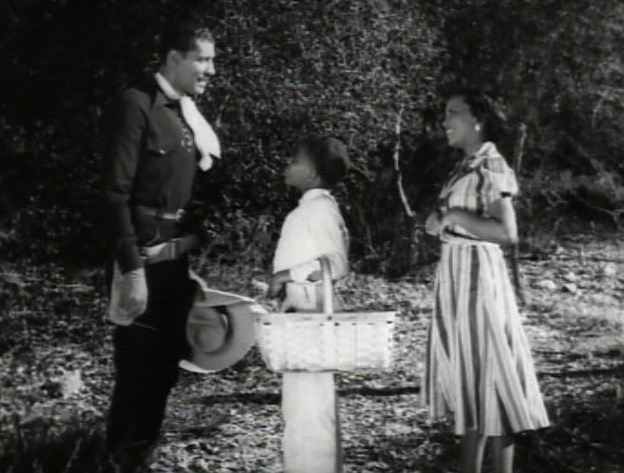
Birthright (1938) would have astonished and enlightened white moviegoers, but unfortunately, it was produced for a segregated audience, for Black patrons in movie houses that catered to them. Just as I mentioned in this previous post on Two-Gun Man from Harlem, made in the same year, one wonders that if such “race films” were seen by white audiences in the 1930s, the Civil Rights movement might not have been delayed so long.

There is a rawness to Birthright that strips away at the stereotyped depiction of African Americans in mainstream Hollywood films, where Black actors are seen only briefly and always in uncomplicated roles, their motives and their feelings unexplored. The characters in Birthright and their problems are many-layered, where success is measured in the ability to cope rather than to triumph.

A recent Harvard graduate, who is a Black man played by Carman Newsome, returns to his small town in Tennessee with the intention to open an educational academy for young Black students, to lift their circumstances and opportunities in life. He is thwarted by a white man who swindles him, and even by the African American community who have so long been kept down that they resist and mock his efforts. Mr. Newsome reminds one a little of William Powell in appearance, very handsome, with his tall, slender build, his homburg hat and his pencil-thin mustache. What he lacks, however, is the wry and playful savviness of Powell’s usual characters. Newsome’s Peter Siner is quiet, mannerly, but amazingly naïve about the social climate in his old hometown that makes him such an easy mark for white swindlers and untrusting Blacks in the “darktown” neighborhood.

But his dogged determination is admirable, and his seemingly innocent demeanor allows the audience to see the difference an education in the North has made for him. When he and his buddy, Tump Pack, played by Alec Lovejoy, are engaged in conversation with a white man, his friend—who continues to wear his World War I Army uniform—removes his hat and his physical posture becomes somewhat stooped, subservient, making himself pleasant and agreeable to the white man. Newsome, however, without any belligerence or protest of this behavior, quite obliviously remains standing erect, looking down upon the white man, and keeps his homburg on his head. He speaks with all, no matter their skin color, as an equal—though in fact, his education should make him their superior.

Ethel Moses plays Cissie, Alec Lovejoy’s girlfriend, who gets into trouble by stealing her employer’s broach and by refusing the advances of her employer’s son, and is arrested by the bullying sheriff. Through the course of the movie, Newsome and Ethel Moses fall in love, are pursued by Lovejoy, who ultimately is killed by the sheriff (in his attempt to rescue Ethel from the sheriff, the old soldier hears battle sounds and prepares to go "over the top," a poignant scene of a man who cannot let go of the most meaningful time of his life) who is killed by someone else. Newsome is hired by one of the town’s wealthiest citizens to edit his book, who will die himself and leave his fortune and property to Newsome to build his school.
The film is directed by Oscar Micheaux, who also co-produced
and co-wrote the movie, which is a remake of his 1924 version. That movie is considered lost, and it is
interesting that both Alec Lovejoy and Carman Newsome are listed as being in
that original cast, though in minor roles.

Though the acting is mostly stilted—except by the irate servant of the wealthy man who hires Newsome—irate because she does not want to serve breakfast to another Negro. She’s a volcano of disgust, for he is, “Just as much spook as I am.”

Her reaction is only one aspect of the film that seems shocking for the day—the open illustration of racism and racial tensions, not only between Blacks and whites, but among the Black community that is divisive. Some of the dialogue is crude. A white man who says, “You can’t educate a Negro” more honestly attacks racism than the average mainstream movie that depicts a Black servant as dimwitted.

The wealthy man who hires Newsome and treats him well, still makes the insulting plea for Newsome to not marry Ethel Moses. “You don’t want to marry a Negro…let your seed whither in your loins. It’s better that way.”

Miss Moses, distraught, tells Newsome, “They have no feelings for a colored girl, Peter. No, not a speck. When one of us even walks down the street they whistle and say all kind of things out loud just as if we weren’t there at all…we just colored women. They make you feel naked.”

When the sheriff comes to arrest her after an informant tails her, who is another Black man, the sheriff calls him “a black baboon.”

Skin color is commented on by the Blacks and used for insult and disparagement among themselves, and the whites are open in their condescension and racism. When Newsome’s mother is dying, a white doctor refuses to help unless he is given ten dollars up-front.

The movie is missing its first 20 minutes, and the restored version summarizes the early sequences. It is not a polished movie, there is certainly nothing of Hollywood glamour here (and a few scenes in a nightclub are diverting but detract from the plot), but is notable in that its unselfconscious ugly frankness would have been daring in a mainstream movie theater of the day. It also features, unlike mainstream Hollywood films of the day, a fully integrated cast. It would have opened the eyes of white audiences who were little exposed to the Black experience. It might have opened some hearts as well.
Wishing you a contemplative and celebratory Black History Month.
*******************************
Jacqueline T. Lynch is the author of Ann Blyth: Actress. Singer. Star. and Movies in Our Time - Hollywood Mirrors and Mimics the Twentieth Century and Hollywood Fights Fascism and Christmas in Classic Films. TO JOIN HER READERS' GROUP - follow this link for a free book as a thank-you for joining.

My new non-fiction book, CHILDREN'S WARTIME ADVENTURE NOVELS - The Silent Generation's Vicarious Experience of World War II -- is now available in eBook here at Barnes & Noble, Apple, Kobo, and a wide variety of other online shops.
And it is here in eBook, paperback print, and hardcover, from Amazon.
From Cherry Ames, to Meet the Malones, from Dave Dawson to Kitty Carter - Canteen Girl, the Silent Generation spent their childhood immersed in geopolitical events through the prism of their middle grade and young adult books. From the home front to the battlefield, these books are a window on their world, and influenced their hard-working, conformity-loving generation.