IMPRISON TRAITOR, PEDOPHILE, AND CONVICTED FELON TRUMP.
Showing posts with label Ann Dvorak. Show all posts

Thursday, May 29, 2025

Massacre (1934)


Massacre
(1934) is a bold standoff against treatment and societal views of the modern Native American, as well as the industry that brought us westerns with little appetite for treating Indians as nothing more than stereotypes…and targets.

It manages, however, to be more than just a message film, for the story involves a lot of action, a fast-moving story line, and cool deliberation on the part of Joe Thunderhorse, a man whose two-fisted approach to life brings him away from the reservation so long that Sioux culture and its modern problems mean little to him.  He’s out for himself and very successful at it.  What brings him back to his tribe is a shock, and he brings the audience with him.


Richard Barthelmess, one of my favorites, is very good in this strong role.  He manages, as does his character, to straddle the world of hardscrabble make-a-buck early 1930s and the ancient culture into which he was born but left at a young age to make his way in the world.  For him, it is not just the “white man’s world,” it is his world.  He walks with authority, like the son of a chief, like a guy who wears his self-confidence as if it were a bullet-proof vest. He generally has a great time, but he is not afraid to challenge anyone.


We first meet him in Indian garb riding a horse in a procession at a wild west show at the Chicago World’s Fair of 1933, and the theme of the fair, “Century of Progress” is only part of the irony facing the audience when, sinking into the story, we immediately begin to consider the plight of the Native American in twentieth-century America.  Where is their progress?  


Barthelmess is the star of the show, and his pictures on programs bring in a lot of money to the stock company, run by Robert Barratt, a kind of Wild Bill Hickok knockoff.  Barthelmess does trick riding, fancy shooting at targets, and makes the girls swoon, particularly Claire Dodd, a wealthy sophisticate who has designs on him. 


Barthelmess earns the princely sum of $300 per week, and demands for $400 and will get it.  He has a valet played by Clarence Muse.  No jovial Indian sidekick, his manservant is Black, but seems more a pal than a lackey.  He calls Barthelmess “Chief” like everyone else does, not “Boss.”   Our first surprise is when the monosyllabic “Chief” rides out of the stadium, goes to the manager’s tent where his valet removes the wig with the long braids, and reveals a modern Joe, who changes into a suit and speaks English fluently.  We see he has only been playing a part.  He is suddenly almost like a cross between Clark Gable’s masculine polish and James Cagney’s Bowery toughness.  He smokes, he chews gum (sometimes at the same time), and strides out to his own sporty automobile with his name and picture emblazoned on the doors.  The ten-gallon hat he wears is so large and ostentatious, it probably really does hold ten gallons.


I like the shot of Mr. Muse's face in the obverse side of the hand mirror he holds for Barthelmess.


Mr. Barthelmess amuses himself with the adoration of the females in the crowd, and has a shallow romantic relationship with Claire Dodd.  It is interesting that while Hollywood would not stoop to his having a white manservant, he is allowed to have a white lady friend.  Their kiss, a long and seductive encounter between two races in America at that time we might consider to be a daring image.  Was it allowed because the audience was already familiar with the long career of Richard Barthelmess and knew he was not really Sioux, or is it because Claire Dodd is playing a coolly unsympathetic woman who collects men and marries on a whim?  We have to question her emotional and mental stability when, as Barthelmess arrives for a cocktail party at her mansion, she brings him to a room that is filled with Indian regalia and artifacts.  He looks at the objects, interested, as if he is on a museum tour, and will later confess that he realized at that moment he has gotten so far afield from his native roots that the significance of the pieces were lost on him and needed to be explained to him.


But it is her fascination with the objects and collecting them, the way she has collected men, that says a great deal about her.  She is not a historian, an anthropologist, or a scholar; she has created a fantasy revolving around Joe Thunderhorse that is more sexual desire than cultural interest.  She clings to him and murmurs her image of him as a wild, “red man” and she would like to be his “squaw.” 

This movie seems to straddle, perhaps knowingly, the conflicting images, tropes, of the Indian as a savage and as a noble and beautiful child of nature.  Joe Thunderhorse is neither, he’s a just guy. 


Massacre
, like some of the previous movies covered (Heat Lightning, Employees’ Entrance), is a First National film, and we may reliably count on a frank, sometimes stark, socially conscious message.  The Vitaphone Orchestra and the opening credits with the cameo portraits of the principal players might momentarily distract us at the old moviehouse like a doily on a scratched tabletop, but we know what we’re getting underneath.  It’s wonderful, gritty honesty.

Spoilers at this point, naturally.


Barthelmess gets word that his father, still back on the reservation, is dying and is asking for him.  So he takes Clarence Muse with him and drives his outlandish auto out to the reservation, which he left when he was still a boy.  The government agent at the time he was there, played by Henry O’Neill, who is now working in Washington, D.C., sent him to the Haskell Institute, where he learned skills to make his way in the world.  But Barthelmess returns to a desolate landscape he had almost forgotten, and which seems to have gotten worse in the years since he’d left.  Even Clarence Muse notices and remarks, “White folks don’t give the Indian much of a break.”


The reservation is now run by unscrupulous managers.  There is Dudley Digges, the agent in charge, whose side hustle is graft and more graft.


Frank McGlynn, Sr., is the arrogant, posturing, bloviating missionary.  His funeral service for Joe’s father is all phony hype and brings no comfort to the family.  Joe will afterward insist on a Sioux ritual that is far more spiritual and sincere.  As Barthelmess looks to the night sky, he seems to truly mourn for his father, and perhaps for his people.


Sidney Toler, several years before his longtime gig as the kindly inspector Charlie Chan, plays the smarmy undertaker, whose crimes against the Sioux involve not only fraud and graft, but rape.


When Barthelmess arrives at the agent’s office on the reservation, he is all curiosity and impatience, and has no idea what corruption he has before him.  A poised, beautiful young officer worker, played by Ann Dvorak, catches his immediate attention.  She is Sioux also, and when she answers him in perfect English, he smiles in recognition and asks if she, too, had been sent to the Haskell Institute.  She was, but she came home to make a life on the reservation, and in her small way, to make a difference.  We don’t learn much about her character or her family, but she will prove invaluable to Barthelmess in helping him navigate this complicated world on the reservation.

The Haskell Institute, a real-life Indian school, was founded in 1884, and like many such boarding institutions, created an often harsh and even cruel environment for the Indian children who attended.  It grew into a land-grant college now known as Haskell Indian Native University, where some 140 Indian and native Alaskan nations are represented in its student body.  In February of this year, 2025, budget cuts as a result of the whims of the traitor felon currently residing in the White House have forced the lay-off of one-quarter of the staff.

Barthelmess renews acquaintance with his younger brother and sister, and cousins, but bristles at what he has observed in their miserable lives under the authority of the local agent.  He is not shy about complaining or throwing a punch or two, and Ann Dvorak warns him that he could be arrested and confined to the reservation and never be allowed to leave again.


He is enraged to discover that the unscrupulous undertaker, Sidney Toler, has raped his 15-year-old sister, Jennie, played by Agnes Narcha.  Lovely Miss Narcha plays the tragic role well, but has few lines and this was apparently one of only two movies she made.

Barthelmess hops in his car to go hunt down Toler, and we know he means business because he has bought the lariat off a cowboy on a horse in town.  Barthelmess speeds away, catches up to Toler’s car in one of a few car chases in this film, and lassos him from behind, yanking him out of the car and then dragging him along the dusty road, finally unleashing his inert, battered body.  He is unconscious and rolls to the side of the road, where Barthelmess leaves him.


Barthelmess is put on trial on the reservation in a kangaroo court, with three illiterate and docile Indians as judges to convict him.  Ann Dvorak sneaks him the key to the jail cell, and he and Clarence Muse drive off, away from the reservation. Cleverly, when the cop cars begin to chase his unmistakable auto down the highway, it is Mr. Muse they catch, wearing the ten-gallon hat as a disguise.  Barthelmess has taken Muse’s flat cap and hops a freight. 


Finally, he makes it to Washington, D.C., where he hopes to bring his plight to his old mentor, the former agent on the reservation, played by Henry O’Neill.  As he leaves the freight yard, we see the Capitol Dome in the distance over the top of an old wooden fence, and the familiar Blue Eagle of the NRA poster plastered on it.  President Franklin D. Roosevelt’s National Recovery Administration was established the year before, in 1933, and was a popular start to the New Deal among distressed workers.  Participation in the NRA among businessowners was voluntary, and in part involved agreeing to establish a minimum wage between 20 and 45 cents per hour, to limit the work week from between 35 to 40 hours, and to abolish child labor.  In 1935, the U.S. Supreme Court declared it unconstitutional. However, some of its features remained and were carried forward in other progressive legislation in those years. 


Barthelmess makes contact with Henry O’Neill, who sympathizes and takes his side when he is accused of the murder of Sidney Toler.  O’Neill acknowledges his fight for the Sioux has always been an uphill battle.  “Every move I make is blocked by the same organized group that have been bleeding the Indians for years…water power, oil rights, cattle ranges…whatever the Indian happens to own, they manage to get away from them through control of public opinion and legislation….”

O’Neill invites him to state his case in a congressional committee meeting.  Barthelmess explains life on the reservation in strong language when one of the committee members notes that Indians were granted American citizenship in the 1920s during the Calvin Coolidge administration in return for their services during World War I. 

Yes, they weren’t citizens until…the 1920s.

Barthelmess responds, “The Indian a citizen?  That’s funny.  He hasn’t any constitutional rights.  He can’t even hire a lawyer without the agent’s consent.  Oh, he’s given the right to live…on a wasteland.  He’s allowed the right to worship, but if he remembers that the Indian once had a religion of his own, he gets a beating for it.  He’s given the right to love, but a white man can violate an Indian girl and get away with it…You used to shoot the Indian down.  Now you cheat him and starve him and kill him off by dirt and disease.  It’s a massacre any way you tell it.”


These are strong words that probably a lot in the movie audience had never heard before or considered.  He is rewarded with applause, but taken back to the reservation to stand trial for murder.  Wallis Clark plays his lawyer, and they garner massive attention with headlines and crowds when the train pulls into the nearest town to the reservation. 


But Jennie, his sister, is missing.  She has been kidnapped to keep her from testifying about her rape.  With his usual fearless and no-nonsense manner, Barthelmess tracks her down, not afraid to use his fists or tell off anybody.  There is a buildup of suspenseful twists and turns right through to the end of the movie, with mob violence, where Barthelmess must keep his own people in check before they burn down the courthouse. 


The quiet ending of him standing on a cliff, surveying the wide reservation lands is another surprise, for he was shot down in an earlier scene.  Ann Dvorak joins him with a telegram giving him the appointment, should he choose to accept, of being the reservation’s new agent.  He remarks, “Just think of all the time I wasted shooting glass balls and signing autographs.  This is a real job.”


He and Ann will have, we assume, a happier future together, but not an easy one.  It is a satisfying ending, seeing how they are satisfied.

There appear to have been at least a few actual Native Americans in the cast in very small roles.  It would be interesting to find out what people from the native tribal nations thought of this movie, if any of them had been able to see it at the time in 1934. 

You can see it now on YouTube.

  *******************************


My new non-fiction book, CHILDREN'S WARTIME ADVENTURE NOVELS - The Silent Generation's Vicarious Experience of World War II -- is now available in eBook here at Barnes & Noble, Apple, Kobo, and a wide variety of other online shops.

Or here from my Shopify store if you want to buy direct from me and avoid the big companies.

And it is here in eBook, paperback print, and hardcover, from Amazon.

It is also here in paperback from Ingram.

And here in hardcover from Ingram.

From Cherry Ames, to Meet the Malones, from Dave Dawson to Kitty Carter - Canteen Girl, the Silent Generation spent their childhood immersed in geopolitical events through the prism of their middle grade and young adult books.  From the home front to the battlefield, these books are a window on their world, and influenced their hard-working, conformity-loving generation. 


Thursday, May 15, 2025

Heat Lightning - 1934


Heat Lightning
(1934) is a study of independence and need, remorse and recklessness, and a profound yet subtle quest for redemption.  It is both gritty and yet surprisingly lyrical.  Aline MacMahon has one of her best roles as the dour, protective older sister running a desert truck stop.  The movie is not all hers, but all the characters moving around her like satellites never detract and sometimes don’t even complement her life that much—she is a true loner in heart and mind.  She seems to brush most of them off like flies. We will learn she didn’t start out that way.


This is my entry in the Classic Movie Blog Association’s “Cry Me a River: Tearjerkers Blogathon.”  I hope you’ll have a look at the other great participatingblogs.

As with really great movies, the setting is as much a character in the story as the actors, and director Mervyn LeRoy certainly knows this.  Here we have a weather-beaten diner with a ramshackle car repair garage and a gas pump out front.  There are a few cabins that comprise a small “auto court” of the day.  We are in the Mojave Desert, and just as traveler Jane Darwell remarks when she and her hapless husband, Edgar Kennedy, suffer car trouble and see the roadside café up ahead, “It’ll probably turn out to be a mirage.”


We may well imagine that motorists (or those pushing their enormous cars like Edgar Kennedy), will see the run-down road stop as a welcome respite.  All around them under the big sky is vast, dusty, and with nothing but a long, hot ribbon of highway leading them away from trouble, they hope.


Jane Darwell is the audience proxy when she discovers with surprise that the auto mechanic in the rough clothes is a woman.  She proudly remarks to her bumbling husband, “Only goes to show a woman can do anything she puts her mind to,” as the movie flashes a brief feminist message, though movies of the 1930s, tearjerkers or not, tended to show strong women more than films did in later decades when they mostly seemed to be reduced to victims or vamps.  Life is more complicated than that, and women are more complicated than that, and this is a lesson Aline MacMahon would like to teach to her younger sister, played by Ann Dvorak, but Aline has too many scars to be a graceful teacher.


Another carload of comic characters are the two young ladies boldly off to Hollywood and the middle-aged stranger who gives them a ride.  Played by Muriel Evans and Joan Dennett, they mostly manage to keep Harry C. Bradley diverted from pawing them, but they suffer his dull if smarmy company because it is a free ride.


Another comic trio that pops in but stays overnight are two wealthy divorcees just having left Reno, played by Glenda Farrell and the wonderful Ruth Donnelly (with the silly tongue-twisting name “Mrs. Ashton-Ashley”).  They bicker, insult each other, and make their chauffeur’s life miserable.  He is played by the reliable regular guy Frank McHugh, who has had just about enough of them. 

But lest we mistake this moody film for a comedy, we see early on that the oasis in the desert is not all relief and restoration, where one can guzzle Cokes and eat barbecued sandwiches while Aline MacMahon fixes your car.


Aline’s kid sister, Ann Dvorak, is champing at the bit.  She’s ready for adventure and romance and she’s not going to get it tucked away in this remote desert.  Aline’s contented refuge is Ann’s prison, and there is tension between them when Aline refuses to allow Ann to go to a dance in town with a ne’er-do-well young man, played by Theodore Newton.  He is older than she is, moves in fast company, and Aline knows that Ann would be getting in over her head.

Ann makes plans to sneak out at night and meet the guy down the road.

“You never had any emotions, you never had any fun!” Ann tells her.  But there’s more to Aline than meets the eye.


Enter two strangers, stopping for lunch and a cold beer.  They are city fellows, in suits and Fedoras, and one of them, played by Preston Foster, is friendly, easygoing and searching the place with the keen eyes of someone who knows how to case a joint.  His partner, Lyle Talbot, is less interested and would prefer they got back on the road.

We will learn, drip-by-drip, that they escaped from prison, robbed a bank in Salt Lake City and in the process, Mr. Foster shot to death a couple of cashiers.  He is cool as a cucumber, but Mr. Talbot is increasingly nerve-racked over their deed and the suspense of escape.


Preston Foster sees Aline MacMahon emerge from the garage in her overalls, work shirt, and bandana.  She stops short, stunned to see him.

Ahh, they know each other.

“What are you doing out here?” he asks.

“Making an honest living.  Something you wouldn’t know anything about,” she replies.  They not only know each other, they have a romantic past and it is the reason Miss MacMahon has self-exiled to the Mojave Desert.  Back in Tulsa, Oklahoma, in the old days, she was a party girl, and Preston’s girl, and he done her wrong.


Ann Dvorak knows nothing about those days, and Aline wants to keep it that way.  We see that Aline’s admirable self-reliance and rigid work ethic might be penance, as much as a do-over.

Preston Foster takes a sly, calculated interest in rekindling their relationship, but perhaps not so much for love as for what use she can be to him.

When it becomes known that the flighty Ruth Donnelly and Glenda Farrell are traveling with some pretty hefty jewels, Mr. Foster sees his chance to bankroll his and Lyle Talbot’s escape.


But Aline, thinking only that he is pursuing her for herself, brushes him off.  “I’m happy here.  I know what living is about here.  I wouldn’t leave for anything.”  Though Aline gets some strong dialogue, she really doesn’t need it.  With her soulful eyes and quiet intensity, she commands every scene she’s in.  She could attract our attention by just tying her shoes.  “I left you and that whole rotten life.  Don’t you think I’m the same woman who used to eat out of your hand, because I’m not.  I’m a whole lot wiser.” 

Maybe.

Ann Dvorak is curious about her big sister’s relationship with Foster, but Dvorak is more preoccupied with the coming nightfall and her date with the bounder.


Night falls, and the men delay leaving, to Talbot’s increasing anxiety, particularly when the sheriff pops in to see if anybody heard anything of the escaping criminals.  The desert may cool off a bit, but heat lightning flashes in the distance.  A happy Mexican family camps out, and when a rancher from nearby shows up, played by Willard Robertson, who would be Aline’s suitor if she let him, we see another side to Aline MacMahon. She dresses up for the first time in probably many months, and entertains the two men interested in her, sitting outside in the night breeze, while her sister is away.  She is not flirtatious, but she is womanly and letting her beaus see that they each have competition.

Late that evening, when all is quiet, Ann Dvorak’s date brings her back, drops her off down the road. She is clearly infatuated with him, and he appears bored with her, and we might assume that he has taken his pleasure and now wants nothing to do with her.

She sneaks back into the rooms she shares with her sister behind the diner and catches Preston Foster sneaking out of Aline MacMahon’s bedroom.  Aha!  Ann smirks slightly.  It is a revelation about her stern, puritanical older sister.  Reportedly, this scene also got the film bad marks from the National Legion of Decency.

Having left Aline, Foster now purposefully goes to work on the safe with Lyle Talbot.  The safe in the diner is where Donnelly’s and Farrell’s jewels were put for the night.

Aline goes to Ann’s room, knowing that she sneaked out, and the sisters fight, and Ann throws Aline’s tryst with Preston Foster in her face.  But Ann is not triumphant over her sister's apparent hypocrisy; she is devastated, for as Aline begins to surmise, Ann is now, also, “a whole lot wiser.”


Aline, knowing the torture of resisting a man she really wants, tenderly embraces her sister, strokes her hair, understanding that her sister has also been ill-used by a man this night.  As she puts her crying sister to bed, and kisses her shoulder, she hears noise from the diner. 

Foster and Talbot are having trouble with the safe, and Foster is having trouble with Talbot.  Lyle doesn’t want to stay any longer and doesn’t want to do any more harm, but Foster is adamant. 

“You get that safe open. I didn't spend all that time with the dame for nothing.”

Uh-oh.


Miss MacMahon enters, with a gun, and shoots Foster.  After he drops, after a moment, she goes to him, her hair loose and long out of the familiar bandana.  She is quiet, shocked, and his last words, “I had it coming.”

Talbot asks, “What about me?”

She lets him go.

When others come at the sound of the shot, she wearily brushes them off, telling them she shot at a rat.


In the morning, when the guests leave and Ann is back to work in the garage, rancher Willard Robertson returns, concerned for her.  She shows him the body and asks him to take care of it, to tell the sheriff.

He tenuously asks if Foster meant anything to her.  She is honest and says he did, once.

He offers, somewhat cruelly, “Must be a big help sometimes being like you, Olga, not having any feeling.”

“I wouldn’t know, Everett.”

A newcomer arrives, like so many others, pleased at finding the diner and garage and auto court and says, “This place is sure a lifesaver, lady.”

She agrees it’s a pretty quiet life.


The Hollywood studio system of the day gave us plenty of froth and fluff, but was extraordinary in its ability to turn out so many quiet stories of powerful substance, and describing what life was like during the Great Depression in so many, many ways.

Please have a look at the other blogs posting in the Classic Movie Blog Association’s “Cry Me a River: Tearjerkers Blogathon” here.

  *******************************


My new non-fiction book, CHILDREN'S WARTIME ADVENTURE NOVELS - The Silent Generation's Vicarious Experience of World War II -- is now available in eBook here at Barnes & Noble, Apple, Kobo, and a wide variety of other online shops.

Or here from my Shopify store if you want to buy direct from me and avoid the big companies.

And it is here in eBook, paperback print, and hardcover, from Amazon.

From Cherry Ames, to Meet the Malones, from Dave Dawson to Kitty Carter - Canteen Girl, the Silent Generation spent their childhood immersed in geopolitical events through the prism of their middle grade and young adult books.  From the home front to the battlefield, these books are a window on their world, and influenced their hard-working, conformity-loving generation. 


Thursday, September 20, 2018

The 1930s - Then and Now - #3 - Wild Boys of the Road (1933) and Girls of the Road (1940)


Wild Boys of the Road (1933) and Girls of the Road (1940) are vivid portrayals of the youthful perspective on the worst years of the Great Depression. The teens and the young adults facing the national economic crisis probably understood little of its causes and were helpless to change the course of the deeply troubled economy.  While feeling the same brunt of the calamity as their fearful parents, this generation that President Franklin Delano Roosevelt would later say “has a rendezvous with destiny” when World War II began could still show resilience and optimism that their elders no longer possessed.


Wild Boys of the Road, directed by William Wellman, is a message film, as many films during the Great Depression with “the times” as its topic inevitably had to be, but the story is well told, vigorous, and without the preaching nature, except for perhaps the last ten minutes, as a film like Our Daily Bread (1933) which we discussed last week here and which was made in the same year.

Wellman was a master at shooting stories full of dramatic action, and this pretty simple tale of teens following the well-worn, desperate trail of hoboes to find work because they cannot find jobs in their own town, has moments that are fiercely compelling.

The start of the movie couldn’t be more deceptive. Frankie Darro has the lead as Eddie and Edwin Phillips plays his best pal Tommy. They are a couple of high school sophomores going to a dance. Their girlfriends are giggly and sweet and inconsequential to the story and we lose them at the beginning of the picture. Somehow, they don’t belong to the rest of what’s going to happen to Frankie Darro and Edwin, and by the end of the picture we can’t imagine these boys ever going back to those girls. They indeed have traveled a long way and they will never be who they were when they were just a couple of kids going to a high school dance.

It is an evening of white trousers and dark coats and ties, of tentatively waltzing to “The Shadow Waltz” (a hit that year in Gold Diggers of 1933 discussed here, and it’s fun to note the string of songs played in the background in this movie, including “Pettin’ in the Park” at the dance, and “We’re in the Money.”)

Darro drives an old broken-down jalopy with witty sayings and phrases on it, just as apparently all his friends do, and though his romance with his girl is innocent we can see by the verbiage on the car that he is the all-American boy, with the hormone-driven predatory attitude for high school girls. This makes his later empathetic relationship with Dorothy Coonan, a hobo girl they meet on the top of a boxcar, all the more poignant.

Note the box of Lux soap in the storeroom at the high school.

These early scenes could be right out of one of the Andy Hardy movies, and after the high school frolics when we are told that Phillips must find work because his widowed mother has only a roomer in their home for income, and Darro learns his father has just lost his job, we might think Andy Hardy is going to rush to the rescue and put on a show or collect bottles or do something to help his folks.

Grant Mitchell, his dad, acknowledges with brave humiliation that as a middle-aged man it’s going to be very difficult for him to get hired again. Darro shows sensitive concern and we have a long sequence where he manfully sells his beloved jalopy for $22 and gives the money to his dad. It’s a nice thing to do, and Darro is not an aw-gee-shucks kind of actor; he is actually quite a good, sublimely subtle dramatic actor who understands the intimacy of the camera (as well he should, having been in silents since a small boy) and we believe him. There is something a little bit more Dead End Kids about him than Andy Hardy, but even though he is fearless and smart mouthed, he is still an innocent.

A couple of months go by and Phillips has not found work, and neither has Darro’s dad. Phillips decides that he’s going to head for the open road because it will be one less mouth for his mother to worry about and she can manage for herself on the money from the roomer.

Darro comes to the same conclusion, that it is futile to find a job in this town and both boys quit school.

They really don’t know what they’re getting into, of course, and so it really starts as a boy’s own adventure. They bring a bag of sandwiches and a hop a freight. Their first rough encounter is with another teen hobo who hauls off and slugs Darro, who is amazed and somewhat appalled to discover that the bloody nose was given him by a girl, named Sally. It’s a funny bit when he tries to continue a conversation with her and he keeps his arm up to guard himself because she’s a very good fighter.


Sally, played by freckle-faced Dorothy Coonan has left home as well. (About six months after this film was released, Miss Coonan would marry Director Wellman, some twenty years her senior, would leave her film career and become the mother of seven.) Her mother has died and she has decided to go live with her single aunt in Chicago so that, like Edwin Phillips, there will be one less mouth to feed at home.

It sounds like kind of a maudlin phrase, “one less mouth to feed,” but it was an extremely common sentiment not just during the Great Depression but certainly before that in the many ages of destitute families and not enough food to go around. Many older children were put to work early or simply just put out of the house.

So many teen boys joined Roosevelt’s Civilian Conservation Corps for just that reason, to save resources at home and not be a burden.  My father did.

The duo becomes a trio and there is something very goodhearted and tender in the way that Darro and Phillips relate to Dorothy Coonan. We have seen Darro’s high school girlfriend and his girl-chasing sentiments painted on his jalopy, but his reaction to Dorothy is sometimes protective and at other times a genuine equal partnership, and we sense that he cares about her and needs her as much as he does Edwin Phillips. It is a friendship without sexism and they have an odd mixture of the sense of responsibility of adults and the innocence of children.


They arrive in Chicago and Sally’s aunt, played by the wonderful and versatile Minna Gombell, welcomes them into her apartment and feeds them a very large chocolate cake about the size of North Dakota. There is a player piano in the apartment playing some kind of bluesy tune, which is a signal to us that all is not right; and indeed, there is a man and a woman sitting at a table drinking. While the kids are in the kitchen chowing down, the cops raid the place and take the three grown-ups off. The kids beat it out the window. Apparently, Auntie is involved with a pretty rough crowd even if she seems very nice.

They are back on the road and the longer they travel, the more hoboes they meet:  Young people like themselves, older men, other girls all dressed to disguise themselves as boys for safety, African-American kids, and always in every train yard a crowd of mean railroad cops with clubs.


We get our moment of pre-Code salaciousness when one girl hobo played by Ann Hovey, tarries alone in a boxcar at a fire to dry her sweater. She pulls it off and sits in her bra to warm by the fire, when a brakeman played by Ward Bond sees her and he gets fresh. When the kids later come back for her they see her disheveled, terrified, and we discover without so many words that Ward Bond has raped her. “He put his hand over my mouth so I couldn’t scream!”

As we know, this line and this situation is the least “dated” thing about this movie. It’s happened before, it’s happening now. Perhaps we have become too cynical about hearing those words, having heard them for generations.

But the young hoboes are angry and shocked enough so that when Ward Bond reappears, they beat him up and they even shove him off the moving train.

Another freight yard and more cops. The adventure is wearing thin and soon it will become dangerous. As they scatter away from the police, Edwin Phillips runs and sickeningly smacks his face into a sign. Dazed, he stumbles and falls on a railroad track. He is barely able to crawl away from an oncoming train, but not before it plows over his leg.


The kids fetch a local doctor, who amputates the leg right there in the hobo jungle.  That may be a little hard to believe, but Phillips and Darro cry together, and that makes it real.

We next see another hobo jungle and Phillips with a crutch. He can’t hop freights very well anymore and he suggests splitting up and letting the other two try their luck. They won’t part from him. Darro even breaks into a medical supply store and steals an artificial leg for Phillips, but it is not the right size and it is useless. More cops come to flush out the hobo jungle, this time literally with water hoses.


The map tells us they eventually make it to New York City and another hobo camp in a garbage dump. I don’t suppose it’s the same garbage dump that William Powell lived in when he was a “forgotten man” in My Man Godfrey (1933) in the same year, and which we discussed here, but the hobo dumps certainly were crowded those days.

Their luck is about to change. Darro is offered a job operating an elevator in the city, at $12 a week, and it is touching that he plans to keep the trio, his little family, together. He says that they will go to a cheap rooming house and rent two rooms – very chivalrous of him – and they will find Dorothy Coonan a job doing housework and Phillips doing a job selling newspapers. They are thrilled, the three of them. Hope has returned and they are joyful.  There is only one drawback: Darro will need a new alpaca jacket as part of his work uniform and it will cost him at least three dollars to get one. He goes panhandling and mistakenly gets involved in the robbery of a movie theater. Kind of neat that a James Cagney movie is actually playing on screen when the melee breaks out.

A cop finally nabs the three of them and they get taken to juvenile court. It looks like the end of the road.


A kindly judge played by Robert Barratt allows Darro to explain himself, and Darro gets a nice dramatic bit where he spews out his hopelessness, his anger and cynicism about the system and we think this young man does not have an optimistic bone in his body anymore. He is almost looking forward going to jail because it can’t be any worse than being on the street.

The judge promises help to the three of them. He will place Coonan in a nice home where she will do housework in exchange for her board, he will make sure Darro gets his elevator job, and he acknowledges that Phillips will be a little harder to help but that he will do something. When the kids are taken away after the judge has dismissed the charges, the judge looks at a portrait photo on his desk of a round-faced well-fed son named Billy and he thinks to himself, there but for the grace of God goes my kid.


The idea of “there but for the grace of God goes my kid,” also occurs to Howard Hickman in Girls of the Road (1940), who plays the governor of an unnamed state. It’s made seven years later, but though the employment rate has improved, the Great Depression still has its tentacles wrapped around the country. The governor’s daughter, who is also his secretary, is played by Ann Dvorak , whom we last saw in the first film of this series, Gentlemen Are Born (1934). They have just heard some statistics about teenage girls taking to the open road looking for jobs or being kicked out of their own homes, girls from 14 to 24 years old who are runaways. The movie starts with headlines and speeding cars and a collage of scenes where we see girls in perilous situations, which mostly involve being lured away by creepy men and being sexually compromised. Or murdered.

Ann Dvorak, who is a college girl, dresses with chic sophistication, and has a responsible and curious nature, wants to know how they can help these girls who live on the road. The girls are destitute, but they are treated as criminals. As she is typing up the report for her father, she suddenly changes her mind and types a farewell note to him. She is going on the road undercover.

It’s probably not a terribly challenging role for someone of the caliber of Ann Dvorak, but she has an authority on camera, she commands attention in her scenes, and it is a chance for her to look beautiful and confident.

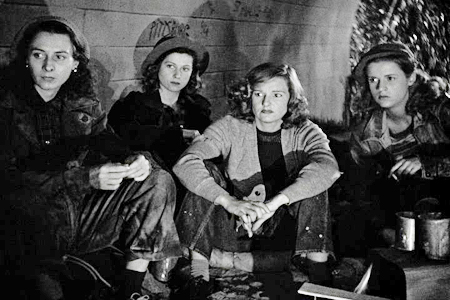
Standing on the roadside all dressed up and wearing a snappy beret, (see our previous post on movie berets here), her first few minutes of life as a hobo are her first encounter with a leering guy who picks her up in his car when she thumbs on the highway.  He immediately puts his move on her. She immediately escapes and is observed by the cynical Helen Mack, a gum-chewing girl hobo with a backpack, typically, dressed like a young man, who takes her to a cluster of girl hoboes huddled in a shack with a fire.

One girl, played by Marjorie Cooley, pitifully carries a dress box with her wedding dress as she is going to be married next Tuesday and is traveling to the city where her fiancé is working.

Jerry, played Ann Doran, is a bit of a thief, stealing from the other girls whenever she can. Lording over all of them is the sinister and malevolent Lola Lane. Cops show up before long and drive them out, they are taken to jail and hosed down after a mini riot over food.


Ann Dvorak and Helen Mack develop a friendship and they look out for each other, though Mack is slow to trust anyone. Ann Dvorak earns Mack’s respect first when she faces off with a sheriff, with her knowledge of the Bill of Rights, and gets him to back down. Mack responds, “The Bill of Rights, when they wrote that they didn’t have paved highways and girls walking on them.”

Mack also sheds some knowledge about what it is like to live on the road and she is, in a sense, Ann Dvorak’s mentor. She says when a man loses a job he can still get along and that with a shave he can get another one, “a girl can’t.”

Though we may note that many of these girls look pretty well made-up for people who’ve been on the road for months, Helen Mack’s wry philosophy is a shorthand way of looking at difficulties that women had versus men on the road and that it was, indeed, more difficult for them. A woman who is unkempt is likely to be more judged and assumed less fit for the limited job opportunities open to her at that time than a man would be. Moreover, there is a very real, and undiscussed, subject of how does one cope with menstruation? Without sanitary supplies, or the means to buy them, a young woman might be unable to work certain days of the month and might miss opportunities because of it.


They move from freight yard to hobo jungle and back again and all the while Ann Dvorak broods, watches, and interrogates her fellow female hoboes. At one point, cops force them to get on a train to get out of the county—nobody wants to be responsible for them. Helen Mack doesn’t want to get on the train; she is tired of life on the road and just wants to stay put. As the train slowly pulls in and looms over them, its boxcars are teaming with forlorn men not allowed to get off, but forced to keep moving.

Helen Mack gets into a shoving match with a cop and inadvertently pushes him off the train. He’s fine, but Helen and Ann both leap from the train and head for the woods. Helen Mack suggests they separate but Ann Dvorak won’t let her fend for herself.


They hitch a ride on top of the truck and end up at an auto court and truck stop. Because Ann has $200, she pays for a cabin for them for the night and for one night they have baths and food and a place to sleep and things are looking up until Ann Doran arrives, having stolen Marjorie Cooley’s wedding dress. They take the dress back, but let her stay. But during the night Miss Doran takes off with everything they have and they really are on the skids now.

They eventually arrive at yet another hobo jungle, all-female, run by Lola Lane on a small lake.

We are introduced to new girls; one of them says she is the eldest of seven and just like Edwin Phillips in Wild Boys of the Road, she has left home so that there will be one less mouth to feed. She does not panhandle but she is learning to work in a beauty parlor and gets work from town to town, hoping one day she can settle down.

Mack makes a retort, “Send it in care of Lincoln Highway, U.S.A.”  The Lincoln Highway was one of the first paved major transcontinental routes, opened in 1913, a historic road that, like Route 66, fell on hard times and seemed to express the desperation of a nation during the Depression. Immortalized in songs, films, novels, and a board game, The Lincoln Highway expressed the vigor and optimism of public works of an earlier age.


The girls are fractious and though they try to pool their resources, they fight with each other and grow more dismal in their hopelessness. A trucker tries to help them; he has found Marjorie Cooley dazed and not seeming to know where she is, and he brings her to the hobo camp instead of the hospital because he’s afraid the cops would think that he ran over her.

Marjorie Cooley dies in camp and they bury her and hold an awkward funeral. Her epitaph carved in a wooden sign says “Irene. Died on the road.”

Reminds one of Grandpa Joad who died on the road in The Grapes of Wrath (1939) and they put his name in a small box and put it in his jacket, in case he was ever to be found.

How many bodies were there that died “on the road?”

They lay wildflowers at her grave and Lola Lane, shrugging off her bad girl image, starts a plaintive chorus of Swing Low, Sweet Chariot. They all join in and it is a long, slow, lulling sound until it is broken up by police sirens getting closer.


The cops raid again, but this time the governor of the state, Ann Dvorak’s dad, is with them because Ann has finally been traced to this place. Like the judge in Wild Boys of the Road, he is appalled by the condition of these women’s lives and he makes a vague promise to help. At the end of the film, a government-run camp is being constructed for the women where they are told they can rest and plan to start over and find courage.

It seems like a contrived ending, tacked on because we like happy endings, but government programs were certainly the saving grace of the Great Depression. That era is something so far back in our dim memory that many people today likely have no concept of how important it was that the government seemed to care. It was spending on public works and on social programs that saved the country during those bleak and frightening years. It is also hard for us to imagine a world where social programs and safety nets were brand-new and were untried. We may well imagine how despised they were by the more well-off in this country because we know how earnestly and savagely they are trying to remove them today.

Though government-funded public works projects were important tools to revive the economy and put people work, most of the food relief programs were actually privately run and not subsided by the government—and malnutrition was a leading factor in the rejection rate of around 45 percent of prospective Army recruits during World War II.  They had grown up during hard times.  The healthiest of the recruits were former Civilian Conservation Corps boys.

It’s one of the apocryphal stories of the Great Depression that a teacher in one government health study had told a sick-looking little girl to go home and have something to eat, to which the child replied, “I can’t. It’s my sister’s turn to eat.”

They’ve been called The Greatest Generation, those kids, the ones who had the rendezvous with destiny. Fortunately, the films of that era caught a glimpse of that, lest we forget.


**************

The lack of affordable housing and the devastation that medical expenses can have for struggling families is another Depression-era story that has relevance today. Come back next Thursday for One Third of the Nation (1939) with Sylvia Sidney.

*************

*****************


Related Products