IMPRISON TRAITOR, PEDOPHILE, AND CONVICTED FELON TRUMP.
Showing posts with label Wendell Corey. Show all posts

Thursday, January 10, 2019

Ten Classic Film Actors and Actresses from Your State


Dear Edna May Oliver, a formidable talent, and clearly fearless and unrepentant in her poses, is one of my favorite Massachusetts girls.

How about a game to start off the new year?  Name any 10 actors and actress from your state (or country, or Canadian province as the case may be).  Either list them in the comments below, or post them to your own blogs and come back and give me the link to your post so I can share it here.

I'm from Massachusetts, so here's my picks from my home state:

Edna May Oliver
Bette Davis
Eleanor Powell
Thelma Todd
Agnes Moorehead
Charles Bickford
Wendell Corey
Charles Farrell
Jack Lemmon
Lewis Stone

*******************
Here's a roster from New Jersey over at Kate Gabrielle's place. 

A team of greats from Missouri over at Terence's A Shroud of Thoughts blog.

Here at Hamlette's Soliloquy you'll find a top-notch gang from Iowa.

Update:  So far we have...
Massachusetts
New Jersey
West Virginia
Georgia
New York
(and specifically, Queens, and NYC)
Ontario, Canada
Kansas
Missouri
Alaska
Iowa

So far that's 9 U.S. states, and 1 Canadian province.  Keep them coming!


Thursday, June 8, 2017

The Search - 1948


The Search (1948) is tenderly filmed.  The plot of the story carries the weight of the world and the eternal suffering of children during war, but lifts our hearts, though they may be breaking, as if on wings of angels.  Those angels are UNRRA (United Nations Relief and Rehabilitation) workers, and a young GI, and even us, if we have taken this movie to heart and take something away from it.

This is the fourth post in our series on how Hollywood depicted children during World War II.  This time, we leave the well-fed American kids behind, and step back to Europe in the aftermath of war.  It is said that the first casualty of war is truth.  The final byproduct is refugees. 

We encounter a small boy, one of the millions of refugees after World War II who have been released from concentration camps.  He is brought with nameless others to an UNRRA central tracing bureau to be processed and, if possible, reunited with relatives searching for them.  The movie takes on documentary-like qualities as we follow the children upon their arrival, sleeping in a boxcar on top of each other, ragged, sallow, starving, and sick—and terrified of the UNRRA personnel in uniform.  It is how they began their journey to the concentration camps; it is how the war ends for them.

Aline MacMahon, one of Hollywood’s finest and most valuable players, is in charge and interviews the kids in many languages.  Ivan Jandl plays Karel, a boy who was separated from his mother at Auschwitz.  His father and sister are dead.  He does not speak, only automatically repeats, “Ich weiss nicht,” (I don’t know) to answers put to him.  He is like a zombie, wooden, haunted, and barely able to function.  He also suffers from amnesia from the trauma of the concentration camp.  His number is tattooed on his arm.

In a moment of panic, he and another boy escape and wander the ruins of this German city.  Attempting to cross a river, the other boy drowns.  Though director Fred Zinnemann crafts a gentle telling of the story, it is nevertheless unblinking in its frank observations of the tragedies we witness.  Karel loses only his knitted cap in the water, and when that is recovered by UNRAA staff, they believe him to have drowned as well.

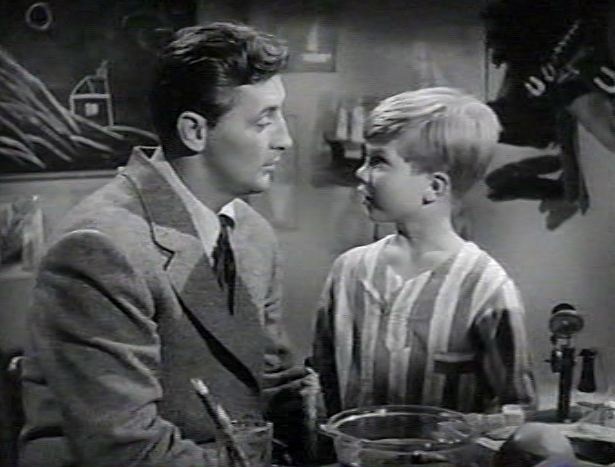
Alone now, Karel wanders aimlessly, until he meets Montgomery Clift, an Army engineer, part of the army of occupation.  Clift feeds him, takes him back to the building he shares billeting with Wendell Corey.  In days to come, the boy is cleaned, dressed in new clothes, and Clift teaches him English by naming objects in pictures torn from magazines.  Karel seems contented, but he still cannot emotionally or by memory connect with his past.  Clift wants to take him back to America.

That involves tremendous red tape. 
Eventually, he will take him to the UNRAA camp to help facilitate his adoption of Karel, whom he calls Jim.  This was Montgomery Clift’s first film, and he is a marvel of natural and riveting screen presence.  Many of his joking remarks and responses to the boy seem ad libbed and he has a wonderful off-the-cuff and in the moment delivery.  He is a lighthearted young man, quick with a funny quip, but the deeper he becomes involved with the boy the more sober he becomes.  (And his character may remind us of his role in The Big Lift-1950, which we covered here.) When he tries to form a plan to get the boy to the U.S., Wendell Corey counters that it is impractical and the rules impeding this are necessary: “We’d have all of Europe in America if we didn’t have those rules.”

Clift responds, “So what?”

“You’re the one who used to make cracks about those filthy DP’s, remember?”

“I did?"

“Yes, you did.  Not so very long ago, either.”

Clift answers, “Well, now I’ve learned something.”

Indeed he has, and we still struggle with that argument today.

Mr. Clift has a nice, easy rapport with the Ivan Jandl, who was from Czechoslovakia and only made a handful of films.  He is a splendid interpreter of this role: unaffected, natural, and perhaps wise beyond his years in his intuitive relationship with the camera.  It is also a wise choice on the part of director Zinnemann to follow the boy with long scenes of no dialogue.  We see deeper into the child’s world if we are allowed to adopt his mindset and we can do this more easily if we take on his silent observation of the world around him.

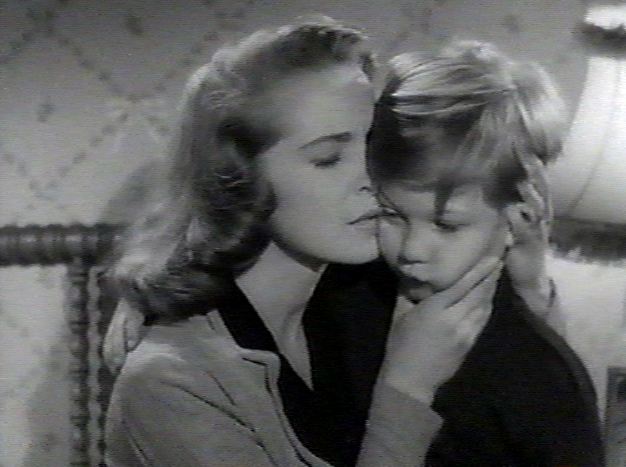
One of the most affecting scenes in the movie is when Wendell Corey’s wife and young son arrive to share their housing.  Clift will be rotated back to the U.S. very soon, but Corey will be part of the army of occupation for a while yet.  Karel observes Corey’s son interacting with his mother.  At one point, the son cries and the mother comforts him.  This triggers a long dormant memory in Karel.  He asks Clift, “What is a mother?”  Charmingly inventive, Clift points to one of the magazine photos thumbtacked on the wall of their room that he has used to teach the boy English.  It is a photo of a long-eared funny-looking bloodhound sitting next to a smaller pup.  Presumably, he has used this photo to teach the boy the word “dog.”  Now Clift points to the bigger dog and says, “This is the mother.”  Then to the puppy, “This is the child.”

Karel chews on this a while, and grows distressed. Looking at the photo, his expression becomes pained, and he struggles with a scene that remains in his mind of a woman who had been with him in the camp.  As he sits and almost like an automaton, draws lines on a paper, he suddenly remembers the pattern of the chain link fence in the camp.  Earlier in the film, we are given a flashback scene of when his mother was taken from him, separated into a different camp.  She calls to him, and kisses him through the small opening in the chain link fence.

It all comes back to Karel now, and he sobs, and he demands that Clift help him find his mother.  “Where is my mother?  I have a mother.  I know I have a mother.  Where is she?”  Clift believes Karel’s mother is dead, and tries to distract him with talk of going to America.  Karel is angry, and sneaks out in the night.

We follow him again across the ruins of war-torn Germany, until eventually; Clift finds him and takes him to the UNRRA camp where he hopes to begin the paperwork of adopting Karel.

Earlier in the film, we are shown that Karel’s mother, played by celebrated opera singer Jarmila Novotna, whom we also saw here in The Great Caruso (1951), has survived and is searching for him.  In a nail-biting series of circumstances, they continually miss each other.  Aline MacMahon helps to put together clues, and we are given the gift of finally seeing mother and son reunited.  I don’t know if we could take this movie if that didn’t happen.

The Search is really a very simple story, simply filmed, about very complicated geopolitical issues, and that is the wonder of it.  It allows us to see a large picture on a very small scale and connect with it in a personal way.  The movie was filmed, at least in part, in Europe so the location shooting is stark and genuine.  We do not have the optimistic and jingoistic approach of helping children in wartime as we saw in The Piped Piper.  We were still fighting the war then.  We are in the aftermath now, where at least as far as the mind of a child refugee is concerned, the world is borderless, without nationalities or allegiances—but it is not free.  It is a nightmarish maze of confusing obstacles.  Every grownup who displays compassion is a monumental hero.  

Come back next Thursday when we finish our series with a look at another March of Time short subject, a world away and back to America with the dawn of a new age—not the nuclear age, but the Teen Age.

Our previous posts in this series are:


*********************
The audio book for Ann Blyth: Actress. Singer. Star. is now for sale on Audible.com, and on Amazon and iTunes.

Also in paperback and eBook from Amazon, CreateSpace, and my Etsy shop: LynchTwinsPublishing.


Monday, September 26, 2011

Any Number Can Play - 1949


"Any Number Can Play" (1949) is a spot-the-character-actor festival.  Shown recently on TCM, I came in late, after the opening credits, and knowing nothing about the film, I had a ball picking out character actors I knew or thought I knew.

The leads, to be sure, are enough of a draw.  Clark Gable is a the owner of a gambling house, who spends too much time at work, and whose attacks of angina point to stress and serious heart trouble if he doesn't take it easy. 

Alexis Smith is his wife, who has grown lonelier through the years in his absence, and especially now that her son is almost grown.   Darryl Hickman plays their boy, who is angry at his father for being absent, being the town notorious clip joint owner, and for wanting him to fight other kids when he has no desire to punch anybody. 

There seems to be a lot of emphasis on Gable's disappointment in his son's lack of a brawling gene (there is a toy model of two boxers in a ring on Gable's desk), and his resentment at being resented.

There's not a lot of action; it's a quiet movie, an interesting study of a man not only feeling his age but feeling his mortality, along with a lot of brief side glimpses at the desperation of addicted gamblers and the nature of life as being one big gamble.

This is our post-War Gable, older and looking it, but still with that incredible magnetism.  When he walks through the crowded gambling salon, he's the only person you watch.

Unfortunately Alexis Smith doesn't get to stretch her acting muscles much in this film, except for one very lovely scene.  Gable rumages among the junk in the cellar of their mansion looking for a set of old fishing flies for a long-postponed vacation his doctor says he should take or else.  Alexis leads him off to a side room in the cellar she has fixed up for herself.  She calls it a memory room.

It is a small hideway, a looking almost like a camping cottage.  There are a few pieces of mismatched old furnature, a phonograph, a baby's wooden highchair, and an old double bed that had been theirs in the small apartment they had when they were first married.  All the items are from the early years of their marriage, including the box of fishing flies Gable wants.


He is astonished, and she explains in a low, almost whispered voice that she misses the days when they were together more, when he was just starting out in business, and when they shared all their thoughts and experiences.  Her pain and her disapointment, and her frustration at having to be the linchpin between her estranged husband and son, are mitigated only by her great love for this man.  He flops on the lumpy mattress and she joins him, still whispering between kisses, a very touching seduction scene (We can only suppose she's keeping one foot on the floor).   She is more impressive in this scene than Gable, whose normal tone of speaking voice seems almost a shout compared to her softer tones, and he looks uncomfortable.  He's the rogue of younger days, chasing women in between wisecracks, and does not seem to like being seduced.

However his later scene with Mary Astor, as an old flame who still pines for him, is more profound and shows Gable as lonely as his wife.  One interesting thing about this movie is that, despite Gable's obvious magnestim before the camera, he must also have slipped the cameraman a buck or two because in several scenes he is shown facing the camera and we see only the back of the person talking to him.  This happens most glaringly with Mary Astor, who plays much of their one scene together with her back to us.  Mary Astor, of all people.

Knowing nothing about this film, and missing the opening credits, Mary Astor pulling on the arm of a slot machine was only one happy surprise.  The rest of the movie  became an Easter egg hunt for familiar faces.


Frank Morgan has a great role as an aggressive gambler, a rival and enemy to Gable, who intends to clean him out.  Morgan is a far cry from his normal jovial roles.  He's menacing, snide, sarcastic, but ultimately respecting Gable for playing the game of life as hard as he does.  Mr. Morgan died only two months after "Any Number Can Play" was released.

Leon Ames is the doctor who tells Gable to cut out bad habits (including work) or he's a goner.  Lewis Stone plays the town drunk, who borrows money from Gable, and loses everything at poker.  If you had no idea Judge Hardy could act, have a look at this movie.

Wendell Corey plays Gable's no-account brother-in-law (married to sis Audrey Totter, who doesn't get much to do expect drink and look bitter).  Mr. Corey is a smarmy weakling, who works at Gable's gambling house and is skimming money for himself.  He's gotten in trouble with a couple of hoods.  William Conrad is one of them.  ("Hey!  William Conrad!" she shouts to the TV like a happy idiot.)

Marjorie Rambeau is the town rich lady with an earthy love of gambling.   Edgar Buchanan is one of the patrons, but I don't think he had any lines.  We just see him looking tense at the poker table from time to time.  ("Hey!  It's Edgar Buchanan!")

Caleb Peterson is the simple-minded bar guy, who we sense is another one of Gable's charity cases.  We caught a brief glimpse of Mr. Peterson as the African-American veteran who helped move the heavy plane engine at  the beginning of "The Best Years of Our Lives."

That's William Edmunds as the men's room attendant - remember Mr. Martini from "It's a Wonderful Life"?


That photo in Gable's office of his son as a little boy  -that's not a young Darryl Hickman.  That's a young Scotty Becket.  You recognize him right off, and it threw me.  I spent the rest of the movie wondering when Scotty Becket would show up

Barbara Billingsly is supposed to be a gambler, too, but I didn't see her anywhere.  Instead, I saw a couple people who weren't there.  I thought I recognized one fellow as Leon Belasco, and another as Regis Toomey, at least from profile - but IMDb doesn't list them in the credits. 

I got so hung up on hunting for character actors at that point, I was starting to see things.


Thursday, December 23, 2010

"Holiday Affair" - 1949

“Holiday Affair” (1949) could almost be an extension of the “war stories” series we did a couple weeks ago, with its examination of a war widow still fighting the good fight on the home front. The trouble is, the war’s over and she cannot make herself move on.

Janet Leigh plays the single mother of little Timmy, played with all-American boy golly gosh sweetness by young Gordon Gebert. Master Gebert has a cute line when, given a present he especially wanted, replies, “I’m so happy if I was a dog, my tail would be wagging.” It’s something a six-year would say.

A war widow, Janet Leigh still keeps the lamp in the window by subconsciously, and sometimes consciously, raising her boy to be a replacement for his father, and by not allowing a new husband and father a place in her heart.

Not that Wendell Corey isn’t trying. He plays her attorney beau, a steady, nice guy with an easy, intelligent manner who waits patiently for her to accept his marriage proposal, washes the dishes with her, and meanwhile works hard at being Timmy’s pal. Timmy is ambivalent, for his mother is raising him to be, like her, self sufficient and needing nobody but each other.

Enter Robert Mitchum, just as good at being a charming sweetie as he is being a sadistic scary guy. Who’d have thought? He and Miss Leigh cross paths in a department store, and continue to cross paths throughout the movie in situations both coincidental and contrived. He wins Timmy over first with his playfulness and man-to-man camaraderie, but Janet Leigh is more resilient. He has to hammer home some painful truths to her before she allows the war to be finally over.

I like the scene where Mitchum and Corey ruminate on how it doesn’t seem to snow as much as when they were kids, and how Corey muses it might have something to do with the atom bomb.

As we mentioned in our last post on “The Shop Around the Corner”, we’re looking at a commercial Christmas in these posts. What had been a cozy and quaint 1930s gift shop on a snowy Budapest side street in that movie becomes a bustling downtown post-war department store here. The kind of scene for which many old movie buffs are, in these days of mega malls and online shopping, nostalgic for, despite how the inconvenient dressing up and taking a cab downtown would seem today.

We love this old stuff, but I wonder if we have the guts and stamina, and patience for it?

Particularly clever is the use of electric trains, the iconic Holy Grail of Christmas presents, and also a foreshadowing of a cross-country train trip Mr. Mitchum intends to take to start his life over.

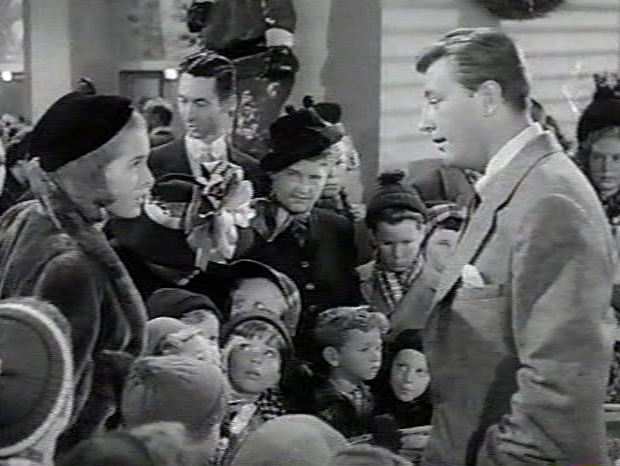
When the opening credits roll, we are shown a train barreling by, and as the camera pans back from the countryside, we see that it is nothing more than a toy electric train setup in a store toy department. Robert Mitchum takes center stage, part Pied Piper and part pitchman, as he demonstrates the marvelous toy trains to the rapt audience of kids. He is a salesman here, a hero to his young customers, a bane to the suspicious floorwalker who keeps an eye on him.

Janet Leigh buys a train, but not for her little boy who would kill for one. She is a comparison shopper incognito, a kind of commercial spy who investigates prices, quality of merchandise, buys trains and then returns them. Mr. Mitchum is on to her, but when he fails to report her to the manager, his floorwalker nemesis turns him in, and he’s fired. Out of job at Christmas.

His dream is to travel to California and work at a boat building business, but he needs the dough to get there. Still, he buys Timmy the train he won’t otherwise get for Christmas, and puts himself next in line behind Wendell Corey for Janet Leigh’s hand in marriage. If she can just realize the fact that she’s free to marry.

A couple of good scenes are the Christmas dinner with Janet Leigh’s in-laws, a kindly elderly couple, played by Esther Dale and Griff Barnett, doting on the grandson who reminds them so much of their deceased son. Wendell Corey and Robert Mitchum also have seats at the table, and for a while it’s very pleasant how these grownups behave so grown up, suppressing their own angst and desires for the sake of Christmas.


They give toasts, and when it’s Mr. Mitchum’s turn, he frankly states his case, in lawyer-like fashion, to the lady and her lawyer that he wants to marry her. Rarely has a personal confrontation come off as so classy.

It’s also a punch in the gut for Wendell Corey to have to sit through it, for Janet Leigh who fears it, and for her in-laws, who gamely suffer the logical discussion of who is better to be their grandson’s next father, a replacement for their son.

Another good scene is when Mitchum calmly blasts her between the eyes with self knowledge at its most uncomfortable, of what she is doing to herself and her son by not letting go of her widowhood.


Likewise when Wendell Corey breaks off with her, acknowledging to her what he has known for some time, she just doesn’t love him. It’s killing him, but he faces it stoically. Neither men try to beat each other’s time; they just want the facts which Janet Leigh is too frightened, or guilty to face.

Just before the end credits roll, we see a real train trip and watch Robert Mitchum take off on his new life adventure, but not alone. Just as at the beginning, the camera pulls back and the train cleverly becomes a toy again on a new train setup with tiny palm trees of his California destination. It’s like “Holiday Affair Meets Gumby.”

By the way, this film was released on Christmas Eve, 1949. In this previous post, we covered how most Christmas-themed movies were not released during the holiday at all.

Thanks for shopping with me this week. And for carrying the packages. You can put them down, now. For those who celebrate Christmas, I wish you a peaceful and pleasant holiday.

For all readers of this blog, I have a gift (should you choose to accept it, as they used to say on “Mission Impossible”). For today only you can order my novel “Meet Me in Nuthatch” FREE from Smashwords. This is an ebook, which can be downloaded to any ebook reader in different formats, and can also be downloaded to your computer and read on your computer without needing any Kindle or Nook or other ereader. When you go through the checkout, put in this coupon code: JQ29S -- and your book will be free.

Merry Christmas.

Thursday, April 10, 2008

The File on Thelma Jordon (1950)

“Maybe I’m just a dame and didn’t know it.” Okay, okay, let’s just get that line out of the way right now so we can discuss “The File on Thelma Jordon” (1950). I recall Walter Matthau’s quoting that line during what I think was the AFI Tribute to Barbara Stanwyck back in 1987 (why don’t they ever show those things again?), to which he said something about being surprised Wendell Corey could have that affect on a woman.

We spend the first half of the film believing Miss Stanwyck is not just a dame, and the second half of the film not really sure, and the last bit of it knowing for sure, but still fascinated that that’s not all she is. The film noir master Robert Siodmak directed this interesting, if at times uneven story with interesting and off balance characters. Barbara Stanwyck plays the protective niece of the town rich lady, who comes to the police station to report attempted robberies. She mistakes assistant DA Wendell Corey for the police inspector, and begins a relationship with him that is the core of the film and the engine of the plot.

Mr. Corey begins the film drunk, resentfully unburdening himself to his pal the inspector about his overbearing father-in-law and his wife being a daddy’s girl. He suggests that his father-in-law, a retired judge, even got him his job with the DA’s office. He is trapped and humiliated by his family ties, which we need to remember if only to keep ourselves from writing off his character as a self-pitying jerk, a bad husband and father, whose neglect of his mousey wife borders on cruelty, and who flirts with the first woman he meets. His pal calls him a dog, and so far we have no reason to doubt it.

The charwoman who silently screws up her face in annoyance at Corey, who keeps her from doing her work, is Mary Gordon, a character actor in close to 300 films, many of them charwomen and landladies. Her eloquent look of disgust is priceless. She has no lines; she doesn’t need any. You many remember her from several “Sherlock Holmes” movies where she played Mrs. Hudson.

All Miss Stanwyck says is “Excuse me” in a doorway and her entrance is stunning, demonstrating her remarkable command of the screen. Her character is likeable and sassy, deflecting his flirtations in a non-judgmental and deft, even comic manner. Their first scene together, because Corey is such a cute and funny drunk, might make us think we are in the early stages of a romantic comedy, not usually how film noir starts out.

He is a playful pest, and to get rid of him, she agrees to have a drink with him, which later results in some front seat passion in her big old sedan with the wood trim and elaborate luggage rack on top, and the famous line about not knowing she was just a dame.

It’s only 1950, but we are worlds away from her Ann Mitchell character discussed last week in “Meet John Doe,” who likewise is sassy and affable and hard as nails with few illusions, willing to cheat a little to get what she wants. Ann has ideals and struggles through the course of the movie to find them again. Comparisons are usually made to the Phyllis Dietrichson character in “Double Indemnity,” but Phyllis leaves us no doubt from the very beginning of the film that she is as evil as the day is long. Her role as Thelma Jordon is really in between these two other types, but what is intriguing is that at first we really don’t know what she is. Her line delivery is cleverly ambiguous.

Wendell Corey is comparable to the Fred MacMurray character in “Double Indemnity” in that they are both as much willing accomplices as dupes in the intrigue to come, and both risk a great deal, but Corey’s character also walks a line between victim and victimizer. MacMurray is careening towards trouble from the beginning of the film, but Corey perhaps not so. He does not seem as easily taken in. Maybe because he doesn’t really know what he wants. His vacillating in his personal life makes us undecided as to whether to believe him.

But this is 1950, we are out of the 1940s, out of the era of easily identifiable good people and bad people, and this is one of the sublime aspects of film noir: everybody’s got a little of both in them.

The next morning, Miss Stanwyck parks in front of Corey’s office in her wood-paneled family car with an enormous sheep dog sharing the front seat, charming and friendly, though we recognize that she is now chasing Corey. His greeting is typical morning after hangover awkward embarrassment. With grace and good humor, she senses his discomfort and lets him off the hook, “My crystal ball was right. You’re married.” But it is said without bitterness or challenge, seemingly willing to let their kissing the night before just be one of those things.

Setting him free is what makes him her slave. His wife takes the kids to shore for the summer, and Corey takes Stanwyck out for drinks and the story of her life. She relates a pathetic job history of being a hotel hostess, with self-depreciating humor but with a tinge of sadness about always being “on the outside looking in.” Weeks pass, their affair continues, yet they continue to be the two most unhappy people in town, ducking in dark shadows to avoid being seen. When Tony shows up, a domineering man from her past, her coolness towards him does not tip us off that they may be partners in crime, only that a thug has her in his power. She confesses to Corey she was once married, which, though he is married himself, makes him shocked and jealous.

When her old aunt, with whom she has a brief homey, cute scene reading aloud to her in a very loud voice, is murdered, the plot is stepped up, and the two characters seem also to solidify rather than to unravel. Stanwyck calls Corey to the aunt’s mansion because she has found the body, and in a fast-paced and rather madcap scene, he tries to undo the damage she did by messing with the crime scene, barking at her to put back her fingerprints where she has rubbed them off. The more tampering they do with the crime scene, the more they mess it up and finally are interrupted by the butler, who sees a man (who happens to be Corey) running from the house.

Corey’s wife confronts him about having an affair, and he appears annoyed but without guilt, cold even in the face of her begging him not to leave when he is summoned by the police to the crime scene.

Stanwyck is accused of the murder. We begin to see another face of Stanwyck’s character when she begs Corey to protect her. More responsive to Stanwyck than to his wife, he pays for her defense, and by turn of events, becomes the prosecuting attorney.

Stanwyck’s own attorney is crafty and indifferent to her innocence or guilt, “I don’t want to know. That’s how I work.”

While Wendell Corey shows us an example of how to throw a trial on purpose, Miss Stanwyck refuses to tell who the unknown man was running from the house, Mr. X. They cover for each other, but Corey believes in her innocence, or at least like her attorney, he doesn’t want to know. He manipulates the jury, and but we are never sure if Stanwyck is manipulating him, so subtle is her performance.

There is an unusual procession when the jury returns from deliberation, where Stanwyck is brought from the adjacent jail to the courthouse for the verdict. She leads the way down the halls, down stairs, outside, across the street with a policewoman behind her, a couple of male cops. No handcuffs, no prison jumpsuit; she leads like a queen. The journalists and public throng the sidewalks, and finally she is joined by her attorney who escorts her, like a prince consort, into the courtroom.

Found innocent, we see her next packing in the mansion, with the thug Tony back because she has inherited auntie’s money. It is not until the very end of the film we learn for certain that she is part of a scam, but by now she has also really fallen in love with Corey, and so confesses this all to him freely when he arrives at the mansion, that he was the fall guy.

“You must have known,” she tells him, “You didn’t want to know.”

He didn’t want to know. Except for his brilliant and energetic manipulation of the trial to get her free, his main sin has been one of apathy, over the truth, over his marriage, over his career.

Stanwyck, hardly apathetic, shows us what not to do with a dashboard cigarette lighter, which apparently in the wrong hands is even more dangerous in traffic accidents than the use of cell phones. But such a shadowy, subtle film evidently is not allowed to merely end with a shadowy, subtle ending. The standard-issue deathbed confession (where, despite being in a car wreck, Miss Stanwyck looks as if she’s just been made up by Wally Westmore), brings the film down to a slushy tearjerker. Stanwyck bitterly complains of the good and the bad always struggling within her, and wonders on her hospital gurney, “You don’t suppose they could just let half of me die?”

And Corey, his career in law over, his marriage over, walks away better off than Fred MacMurray. Had her character lived, one may believe Stanwyck might have changed her life. One senses Corey’s character will not.

“The File on Thelma Jordon” will be shown this weekend on TCM, so here’s a chance to have a look if you’ve not yet seen it.

Related Products