IMPRISON TRAITOR, PEDOPHILE, AND CONVICTED FELON TRUMP.
Showing posts with label Hayden Rorke. Show all posts

Thursday, January 24, 2013

Parrish - 1961


Parrish (1961) proves that Hollywood can fabricate a lush soap opera story anywhere, under any conditions.  All you need is beautiful leads, nasty villains, and a Big Idea that the characters can exploit and then be destroyed by, or overcome.
This movie has an incongruous edge to it because probably most people not familiar with the Connecticut River Valley of western New England know that tobacco growing was a huge part of our agriculture here at one time, going back to the 1600s.  It was a very important crop, and a big engine in our economy.  Less so today.  For those of us living in the Connecticut River Valley, it is incongruous that Hollywood would turn it into a place of greedy land barons, nubile female field hands of questionable virtue, and Troy Donahue.

Long post.  Get a sandwich.
The Connecticut River Valley is my home, and so this movie has special significance for me just because so much of it was filmed on location, and the sites are familiar to me.  I had family and friends who worked on tobacco farms, and one friend in particular, now sadly no longer with us, claimed he made his film debut in Parrish.  He was just a teenage kid working on the farm where the final scenes of the movie were shot.  He recalled that he and a bunch of other kids were pulled from work and told to race across the fields. Lots of locals were in the movie.  I’m afraid I don’t recognize him in the long shots of running kids, and I doubt he could have recognized himself, but it gives me a warm feeling to know he was there.

 
In my neck of the woods, this is what barns look like.  Tobacco barns and curing sheds stand sentinel on the valley floor, fewer than there once were, but ghosts of former times. 

 Sunderland, Mass., photo by JT Lynch
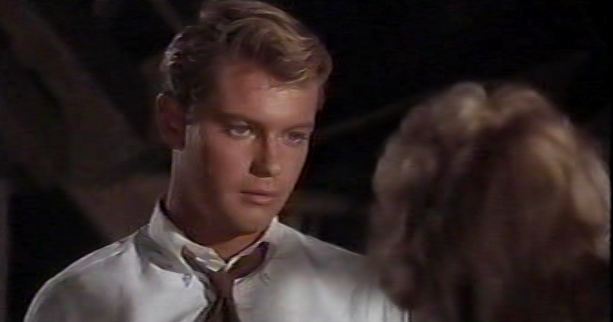
Troy Donahue, who always looked good in red, travels with his mother, Claudette Colbert, from Boston to the tobacco farm of Dean Jagger just north of Hartford, Connecticut.  Mr. Jagger is a gentleman farmer, whose family farm, and its lovely Georgian house, has been here for ages.  His daughter, however, is no lady, played by Diane McBain with an industrial strength pout.
 
Miss Colbert is hired to help with Miss McBain’s coming out, in debutante-speak, and be a steadying influence for the rebellious young motherless woman. 

 
Donahue and Miss Colbert are seen first crossing a river on a ferry.  They are supposed to be in the Boston area, but this is clearly the ferry across the Connecticut River down by East Haddam.  You can even see the Gillette Castle across the river in the distance on the bluff in the photo below.  Have a look here for photos of the ferry crossing site on my essay about the Gillette Castle here on my New England Travels blog.  And here is another post on the other ferry on the Connecticut River joining Rocky Hill and Glastonbury.  It is the oldest river ferry in the US.

 
They fly from Boston to Hartford, which cracks me up.  (Look at it on a map.  They’re an inch and a half away from each other.)  I imagine the director thought that this would give him an opportunity to show the massive white tents of the Shade tobacco fields to their best advantage, and give the plane’s pilot a chance to narrate the view, thereby giving the audience a brief intro on the location and story background.

 
This movie is based on the novel, Parrish, by Mildred Savage.  It was her first of three novels and became a best seller.  I know she is a Connecticut native (and died only a couple years ago), but I don’t know what her connection was to the tobacco growers of the Connecticut River Valley.  Her book is rich in detail about the process of growing tobacco, about the economic realities, and labor problems, and history of this unique agriculture.  This area is one of the few places in the world able to produce quality Shade tobacco, which is used for the outer wrapper of cigars.  How a Wellesley-educated girl knew about the nuts and bolts of this world is something I have yet to learn, but I’d love to know more about her experience.

 
The book, like the novel, is largely a coming of age story about a young man named Parrish who must strike out on his own and deal with what he sees are the challenges and hypocrisies of life.  In a New York Times article by Eugene Archer (June 5, 1960), Mildred Savage, who visited the filming location stated, “I wanted to show an affirmative hero who may be confused because of his youth and sex troubles but is still masculine, unaffected, and optimistic—able to get ahead on his own two feet.  The idea of setting the story in this tobacco industry came last.  It seemed sensible to put a vigorous healthy young man to work in the soil.”

 
Her description pretty much defines Troy Donahue for us.  Never a great actor, but here he’s awkward, sincere, bewildered—just what he should be.  I find him very touching in the scene where he defends his decision to escort Connie Stevens, pregnant by the loutish son of the tobacco baron Karl Malden, to a harvest fair. 
“If some person needs a little bit of kindness, that’s no good.  That’s immoral.  That’s a disgrace to the great world we live in.”  The baritone ripple of indignation is boyishly brave, and if he seems naïve, it’s because he’s supposed to be. 
 
 
But other aspects of Mildred Savage’s book are not brought out in the movie. For instance, there is the young character who talks of unfair labor practices and unions.  There is another character named Tom Holden, who in the movie is played by Hayden Rorke in a brief scene.  He is at the party celebrating Karl Malden’s marriage to Claudette Colbert, and he defends her against the disparaging remarks of Malden’s son, played by Hampton Fancher.  Rorke’s defense is gallant and gentlemanly, but that’s all we get from Tom Holden.
In the book, he is a mouthpiece for progressive ideals.  His family has been raising tobacco for generations here.  He tells Judd Raike, the character played by Karl Malden, who is a newcomer to the Valley and new money, “It never bothers me to pay a good foreman a good wage...He’s worth it.”
But Raike, who is Snidley Whiplash, responds, “A man…is worth exactly as much as his nearest replacement.” 
His son, wanting to impress him, echoes his father, “It’s a crime what labor’s getting an hour these days.  Common labor.”

 
We don’t get these issues in the movie, and it only flirts with other issues about conformity and the hypocrisy of society.  We also don’t get as close a look at Mr. Fancher’s browbeaten wife, who figures more prominently in the novel.  We get more about the Jamaican workers in the novel.  In the movie they are seen from a distance.

 
Parrish likes the Connie Stevens character and her family (her brother-in-law in the movie is played by our old pal, Dub Taylor with delightful aplomb) because they are unfettered by social rules and self-consciousness.  They are easy and hail-fellow-well-met.  Connie is a tramp.  It is possible this is what Troy likes best about her.

 
In a scene that squeezes out every drop of eroticism you can get in a bottle of calamine lotion, Connie dabs Troy’s back gently with the lotion to soothe his tobacco poisoning rash. 
(When she shows him his room in her family’s ramshackle house, we hear the musical intro to A Summer Place, but director Delmer Daves coyly saves us from the rest of the song.)
Later, after the birth of her child out of wedlock, a fact that infuriates and shocks the locals, Parrish is compassionate and understanding.  However, what finally disappoints him is when Connie and her family accept a bribe from the absent father, for letting him remain anonymous.  He will not help raise the child nor contribute to its support, and not acknowledge his relationship to the child.  That’s okay with Connie and the gang, because they’ve got a new refrigerator and a TV set.  It’s like they’ve won the lottery.
Parrish sees that even these independent common folk have a price and can be bought, and that’s when he takes a step back from them.  It’s in the book, but not the movie.
Another thing that comes out more clearly in the book is the similar duplicity and opportunism of Parrish’s mother.  Claudette Colbert plays her like a ladylike member of the garden club, smooth talking and demure, and so she is in the book as well, but she’s also gently manipulative, of Parrish, of her employer played by Dean Jagger in the movie, and eventually of her husband.

 
She marries Judd Raike, played by Mr. Malden in the movie, because he’s filthy stinking rich.  She wants more than anything for Parrish to get ahead in life, and she sees he’s too cussed stubborn and independent to care about getting ahead, at least on her terms.  She has perceived that Judd’s sons are no-account fools, and that Judd will need an heir to take over his tobacco kingdom one day.  She sets her sights on the job for her boy.  Claudette has a brief scene where she stands up to her husband’s nasty remarks about her son, but that never happens in the book.  She’s just as phony as Connie Stevens and her family.  Just on a larger scale.

 
 As far as I know, there were never any tobacco barons in the Connecticut River Valley.  Most farms were small, family owned, and other farms were larger commercial farms owned by faceless corporations.  One guy gobbling up other farms like taking pieces on a chess board is as good a catalyst to tell the story of Parrish’s coming of age as any.  A story needs conflict, and especially conflict of a personal nature, conflict with a face.  That is the purpose in the novel for the character of Judd Raike, and he is as fiendish a guy as you will ever encounter between the covers of a book.
The author deftly depicts him as a man so clever, so moody, so tricky in his passive-aggressive challenges to his family and employees that he is actually one of the most vivid, most real people in the story.  He’s a bit frightening.

 
In the movie, however, Malden is given a script that shows only Raike’s anger, and none of his subtle machinations.  Malden has the thankless task of being nothing but an enraged cartoon of a man.  The character, and the actor, deserve better.  I suspect this was the director’s shorthand, like the plane flight over the valley.
Critic Bosley Crowther in the New York Times (May 5, 1961), is unusually accurate and eloquent in his wry review.
“Who would have ever imagined that growing tobacco in Connecticut would be as socially involved and emotionally exhausting as it is made to appear…”
Who, indeed?

 
He calls it a “status-conscious story,” where the locations and people are “over-dressed and artificial…They are all more or less absurd extensions of some kind of slicked-up social image or cliché.”
Well played, Bosley.

I suppose the biggest acting challenge, and most successfully done, was by Sharon Hugueny, who plays Karl Malden’s daughter.  She ages from her early teens to her early 20s in this movie, and proves to be the most sensible person in it.

 
I have a soft spot for Dean Jagger in his quiet, stubborn role as mentor to Troy Donahue.

 
Other faces to pick out are Hope Summers, who played Hattie for a while on The Rifleman, and Madeleine Sherwood, a lusty young field hand, who did lots and lots of TV and played Mother Superior on The Flying Nun.  I still think of her as Mother Superior and the field hand with the bare midriff shocked my delicate sensibilities. 


Carroll O’Connor is the fire chief, and wouldn’t you know it?  Bess Flowers is a party guest.  You can’t put out a plate of hors d'oeuvres without her showing up.

 
We get a shot of Mystic Seaport, and Troy and Claudette strolling on the whaler Charles W. Morgan.  More on Mystic here at my New England Travels blog, with the whaler in the background of these photos.  I, too, have strolled the deck of the Charles W. Morgan and took the wheel, pretending to be Captain Ahab.  Well, pretending to be Gregory Peck pretending to be Captain Ahab.

 
I’m not sure where the hotel on the shore is supposed to be.  Old Saybrook, I think, or Madison?  Maybe somebody can clear that up for me.  I wonder if it could be someplace they shot in California.  Also the church where two weddings take place, somewhere in the Valley.  What church is that?

 
We also get a brief glimpse of the submarine base at New London, which family and friends of mine have passed through as well.  About the only place I haven’t a connection with in this movie is the scene where Parrish, aboard the nuclear sub USS Nautilus (Correction:  I have since been informed that this is actually the USS Skate), spears the ice at the North Pole.

 
(The Nautilus is still down in New London, on display for visitors, and I may feature that on New England Travels sometime or other.)
In the novel, to get away from his troubles, Parrish joins the Navy, but since the book is set in the late 1940s and early 1950s, he is sent to the waters around Korea and he and his mates fear what might happen if the Korean War involves them.
The movie strips us of that conflict and instead makes Parrish’s naval service a footnote, but still a fun peek at popular culture of the early 1960s.

 
There are grand parties, and grand tantrums, but most appealing are the scenes that focus on smaller images that become intimate: the young shoots of tobacco growing; we watch them climb and reach their full height.  The fields in all seasons, the muddy spring, the fallow autumn, the snow, the lush summer.  Dean Jaggers’ colonial furniture in his farmhouse, against the rich colors of the walls compared to the modern furniture, the pastels in Karl Malden’s showy Hartford mansion.

 
Those red sweaters of Troy’s.

 
And the final shot where Troy and Sharon Hugueny sew up a gap in the tent over his tobacco field.  We see an aerial shot, with just their two heads poking out of a massive field of white cloth.  They look like the submarine surfacing at the North Pole.

 
Parrish is not a great movie, but it is valuable if only for the scenes it preserves of my backyard.  The histrionic soap stuff I can live without.  But give me shots of my ain countrie, and I’m happy.

 
Have a look here at Moira Finnie’s post at The Skeins on Parrish, which I love, especially for remarks like this:
“As filmmakers sought to push the envelope on what was acceptable fare for general cinematic consumption, movie audiences were shifting dramatically from a substantially adult market to one that had the maturity of the average prurient thirteen-year-old. This movie reflects that trend.”
This is perhaps the greatest flaw in this film and other Troy Donahue flicks of the period (I’m looking at you A Summer Place and Susan Slade).  It shucks the social relevance of the novel for the frothy, the shallow, and the gloss.  That's what sells...if you're selling to a thirteen-year-old.  Or someone with the mind of one.
For more on tobacco growing in the Connecticut River Valley, including the remarks of Martin Luther King, Jr., who worked on a tobacco farm here when he was 15 years old, have a look here at my New England Travels blog this week.

*************************************

Come back next Thursday for The Woman in White (1948) with Sydney Greenstreet, Alexis Smith, Eleanor Parker, and Gig Young.  A Victorian mystery based on the classic novel by Wilkie Collins.  Rich in atmosphere, unlike Parrish, the evocative locations in this movie are all backlot and soundstage.  But you'd swear you were there.  See you next week.

************

Jacqueline T. Lynch is the author of Ann Blyth: Actress. Singer. Star. and Movies in Our Time - Hollywood Mirrors and Mimics the Twentieth Century and Hollywood Fights Fascism.  Her latest book is Christmas in Classic Films. TO JOIN HER READERS' GROUP - follow this link for a free book as a thank-you for joining.


Thursday, February 9, 2012

This Happy Feeling - 1958


“This Happy Feeling” (1958) is a slight comedy, but viewed from a certain perspective, reflects a watershed in the careers of some its cast. The most curious aspect of a screen actor’s career must be that weird immortality granted by one’s image preserved on film. As much a curse as it is a blessing: most actors have a film or two they’d like to forget. Would they look back in hindsight upon this pleasant, though weak film with a sense of wonderment about what happened next in their careers and their lives?


The answer to Monday’s picture trivia about the trio taking the stage bow are: Troy Donahue, Curt Jürgens, and Alexis Smith. This curtain call happens at the end of the movie.

The movie may be slight, but this post is still going to be long. You should have left in the first paragraph. Now it would be just too socially awkward to leave.

Curt Jürgens and Alexis Smith are veterans of the New York stage, and casual lovers. We begin with Mr. Jürgens meeting Miss Smith for lunch at a fashionable New York City restaurant, where he spies young Mr. Donahue, an up and coming actor, mobbed by fans. This sets up the simple message of the film: a generation gap. The old usurped by the young, both professionally in the theatre at this time, and personally.

Mr. Jürgens has given up the stage for a quieter life breeding horses on his Connecticut farm, much to the consternation of Alexis Smith and agent Hayden Rorke. Rorke began his film career, as more than a few men of his generation did, as an extra in “This Is the Army” -- have a look at this previous post. You may remember him as the Colonel in “I Dream of Jeannie” on TV in the late 1960s.

Rorke and Miss Smith try to entice Jürgens with new play in which he will portray Troy Donahue’s father. Talk about salt on a wound.

Rorke and Smith down their cocktails anxiously when Jürgens asks about his part in the play.

Debbie Reynolds is the star of the movie. Even so, and even with the company of Troy Donahue and a very handsome (and very natural actor) John Saxon, the generation gap of this movie is told mainly through the viewpoint of Curt Jürgens, which is unexpected, considering this is a Debbie Reynolds vehicle. He is at times curmudgeonly, at times displays a more virile screen image than the younger men. He has some very intelligent lines to say about the matter of aging.

I also find the presence of Alexis Smith, and Mary Astor as John Saxon’s mother, punctuates the generation gap message in this movie in ways that went far beyond the script, and I think, the intention of the director. The four principal ladies of “This Happy Feeling” tell a lot about Hollywood and the aging process. More about that later.

The director, and writer of the screenplay, is Blake Edwards, long before his fame from the series of “Pink Panther” movies. He’s given us a script (based on a stage play) that has many good lines, but some conflict happens off screen, which only weakens the story, and there are many moments where dramatic intensity builds only to fizzle out. They refer to the playwright by name, but we never meet her. There are also a lot of one-sided phone conversations, which can be a problem. The movie was shot in CinemaScope. Some nice angles, but also some sloppy shots with actors obstructed by table lamps.  Few closeups, which is maddening.  Closeups didn't always look good in CinemaScope. 

In this shot, you see Alexis Smith and Mary Astor seated at a café table outdoors, and the center of our attention is the pole between them holding up the umbrella. A composition problem not entirely due to pan and scan -- though the print I’ve seen, and these screen caps, are from a “pan and scan”, and that really does account for some of the awkward images, obviously not the director’s or cinematographer’s fault. I’d like to see what it looks like reissued in letterbox. Don’t know if that will ever happen. I don’t think it’s on DVD.

I think CinemaScope was more wide perspective than we needed for a movie that takes place mostly in bedrooms.

Speaking of bedrooms, this movie seems like one big pajama party. Curt in his jammies.

Debbie in Curt’s jammies (see our post here on Women in Men’s Jammies).

John Saxon talking on the phone in his own jammies.

Debbie in her own jammies, later on a nightgown.

Okay. Enough stalling. Here’s the plot. (“Now with 10% more spoilers!”)

Debbie, a receptionist for a dentist, is taken to a house party by her boss, played by Joe Flynn. (Like Hayden Rorke noted above, a 1960s TV military man -- you probably best remember him as Captain Binghamton on “McHale’s Navy”.) He’s had too much to drink and starts to paw her in the library. This is one of those movie sets where a living room looks as large as a museum gallery.

John Saxon, a strapping lad, is also a guest at this party. He lives down the street. He comes to Debbie’s rescue when she asks him to drive her to the train station so she can go back home to Brooklyn.

I like how he refers to the train not as “the train”, but as “The Hartford, New Haven and New York”. Grand old railroad. You see the logo on the side of the passenger car in another scene when Curt Jürgens takes her to the train. This part, at least, must have been filmed in Connecticut.

It is pouring rain, and when Saxon suggests she get out of her wet clothes, she goes berserk, jumps out of the car, runs around screaming, falls in a brook, and ends up a couple doors down at Curt Jürgens’ place.

“You are staining my beautiful carpet as no dog would dare to stain it!” He also suggests she get out of her wet clothes, and she goes berserk some more. Eventually, she is calmed by brandy, and spends the night in his guest room.

He invites her to become his secretary and live here at his horse farm. Her living at the farm is the talk of the neighborhood. We are told. We never actually see scenes of malicious gossip, so it doesn’t really have as much punch as it should. Debbie Reynolds begins the movie in such a shrill, overly dramatic way that she seems only annoying and we lose sympathy for her. She has to fight to get it back, but since the generation gap story is told from Jürgens’ viewpoint, he really becomes more sympathetic than she.

Jürgens and Saxon, who are neighbors, have a nice father-son relationship that becomes adversarial when they both pursue Miss Reynolds.

Continually hammered at both as an actor and as a man about his age, he begins to consider the idea of the pretty, young Miss Reynolds as a romantic partner. She has a crush on him, so it wouldn’t take much to woo her. However, at the 11th hour, Curt decides that the whole thing is inappropriate, and he discourages her from any romantic notions with a cute scene wherein he recites lines from a play he has done. She has no idea that his “goodbye” is a well-rehearsed performance.

So pleased with his success, after he leaves her he takes a ceremonious actor’s bow, and seems to hear applause in his imagination. We want to pat him on the back, too.

He decides to return to the theatre and play Troy Donahue’s father. That he leaves Debbie Reynolds to John Saxon and goes back to the worldly Alexis Smith is probably the best thing about this movie. So many films of the late 1950s give us the rather icky scenario of aging Hollywood actors paired with ingénues, and it seems for a while it’s going to happen again here. A pleasant surprise.

A few good scenes:

When Curt Jürgens dismisses the new generation Method actors, he spits invective, “I just don’t dig it.”

He complains, “The theatre has changed…This is the age of dirty T-shirts and motorcycle jackets. It’s a whole new breed of cat. An entirely new set of requirements. If you don’t know Method or the intricacies of a new role, psycho-schizoid personality, and how to mumble, slouch, and pick your nose, you haven’t got a chance.”

(I’ve long wanted to do a post on actors from Hollywood’s Golden Age working in 1960s films, but I’m still gathering suspects. Maybe later on this year.)

Estelle Winwood plays Mr. Jürgens’ housekeeper, who wanders around slightly intoxicated, cigarette dangling from her mouth. A seagull, which she has mistakenly shot, follows her around with slavish devotion. He frequently eavesdrops on the conversations of the other actors.

Lots of pretty stuff to look at. Cocktail parties with squared-off handkerchiefs in the breast pocket. Smoking jackets, and breakfast on the terrace. A black tie country club dance. (Where one of those Connecticut clubwomen who talks between clenched teeth in that supposedly upper crust manner compliments Jürgens’ rhumba as “wicked”. Good Massachusetts girl than I am, I must correct this line. It should be “wicked good”.)

A running gag on Jürgens throwing out his back. Miss Winwood vigorously employs some torturous chiropractic maneuvers to cure him (while he is in his jammies), which leads to a reference to the Mau Mau Rebellion going on in Kenya at that time. I was pleased, as I always am, to find a topical reference in the movie -- but I was disappointed they did not cut to a shot of the Mau Mau rebels talking on telephones, wearing Curt Jürgens’ pajamas. Felt like I was led down the garden path on that one.

Jürgens’ home, even though placed in Connecticut does not, for once, look like a Hollywood version of a cutesy “colonial farmhouse.” There are some equestrian trophies around the place, but it’s mostly modern furnishings and architecture.  It looks like a 1960s TV sitcom home.  I love his great, big, burgundy convertible. Anybody know what model car this is? John Saxon calls it a “$10,000 buggy.”

A good shot is when Alexis Smith opens the door to leave Jürgens’ house, and the seagull pops in. I wonder how many times this had to be done in order for her to say her line “On a day like this, why aren’t you at the beach?” while he waddles around her and hits his mark directly in the foreground. Good timing. Pros, both of them.

As they await their curtain call, Alexis Smith invites Jürgens to a private “bacchanalia” at her apartment after the show. He accepts with a pat to her bum just as the curtain opens. Then they become different people, both more humble and more superior, taking their bows with all the dignity due to an actor on stage.  Even Estelle Winwood instantly assumes that pretend dignity when taking a bow -- caught onstage trying to retrieve her wandering gull.

Now to the real-life generation gap, though perhaps not a gap as much as a series of cracks that eventually swallows careers. Unless one can leap over them.

According to the American Film Institute website, this movie was shot from September to November 1957, released in June 1958. Debbie Reynolds was pregnant during the filming, her son born February 1958. One may assume it was a good time for her, a new baby, a flourishing film career, her song “Tammy” from the film of the year before, “Tammy and the Bachelor” soared up the charts as the number one hit.

By the end of 1958, however, she and her husband, Eddie Fisher would separate. They divorced the next year over his affair with Elizabeth Taylor, all conducted in a most painfully public manner.

She had played ingénues for years. Twenty-five at the time of this movie, she was probably too old to continue convincing us of her innocence. In the movie, she coyly asks Jürgens to guess her age. He needles her by suggesting she is 30, or 32.

“It’s a lie!” she bristles. Kiss of death, to be sure.

"Seems odd to note that Debbie Reynolds in 'This Happy Feeling" will be supported by such veteran actresses as Mary Astor, Alexis Smith and Estelle Winwood..." wrote columnist Danton Walker just before the film's release (Reading Eagle April 11, 1958).

Alexis Smith, some 11 years her senior, but still only 36 during “This Happy Feeling”, is plunged prematurely into that awkward abyss between starring roles and character roles. However, as was typical with Miss Smith, she outshines the lead, and makes her handful of minutes in this movie count. When Debbie Reynolds becomes smitten with Curt, Alexis assumes the jealous other woman part, but her jealously is tinged with bemusement. Her sexuality is adult, and classy. She is more playful than competitive, and always far more riveting.

She has a brief scene on the phone, talking to Jürgens (not the Mau Mau rebels, dang). She tries to entice him to come to her apartment.

“I built a fire and I’m sort of glowing,” a purr wrapped around a giggle, lying on throw pillows strewn before the fireplace. She’s a volcano in color-coordinated chiffon neck scarves. Ice princess? I should say not.

Another scene where she meets Debbie for the first time: Debbie, in Jürgens’ pajamas (of course), is greeted archly, with suspicion by Alexis, seated on the couch. When the interaction between them becomes more prickly, Alexis stands, unfolding herself to her full height, towering over the petite Miss Reynolds.

It’s a comical image, (I wonder if more funny than the director intended?) but though Debbie looks her usual adorable self in oversized pajamas, striving for dignity among these sarcastic theatre types, she really loses out in the contest. Alexis, just by standing up, looks superior, emotionally, psychologically, and physically. Positioned between Jürgens and Smith, Debbie Reynolds seems like a little girl, their daughter, and represents more a problem child than a romantic rival.

Another funny Smith scene, for its unexpectedness, takes place at an equestrian competition. (How Reynolds could fail to notice dashing John Saxon in those riding clothes is beyond me. A fine broth of a boy.) Debbie sees Alexis standing among the audience, and politely nods to her.

The camera cuts to Alexis sticking her tongue out at Debbie. So much for classy, but it’s a hoot.

Alexis’ next turn at bat on screen would be an even smaller role in “The Young Philadelphians” the following year. She would not return to the movies until the 1970s, after a stint on Broadway made her a star again. Wait for it….see this previous post.

Though Curt Jürgens owns this film, we might say it did more for the career of another gentleman not even in the movie. This is Craig Stevens, the husband of Alexis Smith. He visited her on set, and met director Blake Edwards. When Edwards cast his hit TV show that debuted in 1958, “Peter Gunn”, he offered Mr. Stevens the lead role as the suave private eye. It lifted Stevens’ B-movie career out of the doldrums.

Troy Donahue, the heartthrob in this movie, has no lines. He’s just an ornament to represent the New Actor. His career was definitely on the ascendant; his day would come. Soon.

Debbie Reynolds made only one film in the 1970s, as the voice of Charlotte in the animated feature “Charlotte’s Web” (1973). However, like Alexis, she also had some good luck with Broadway. The fading 25-year old ingénue and the fading 36-year-old actress in her prime of 1957 would come to have more in common professionally than either realized at the time. So it is -- with either carefully, or clumsily-woven acting careers -- it doesn’t matter. The clock ticks on.

Mary Astor, who won the Best Supporting Actress Oscar in 1941, is the most poignant example of the generation gap played out by the ladies of “This Happy Feeling.” She was 51 when this movie was filmed, but seems like a dowager in her brief scenes. In her day, she had played both ingénue and sexy mature other woman; now looking older than her years, heavier, and somewhat lost among the smart alecks around her. Estelle Winwood, her senior by 23 years, creates a bigger bang.

Miss Astor was busier these days writing. In 1959, she published her autobiography, “My Story”, which frankly discussed her tumultuous private life, though not a lot about her career. She made that one telling, now famous, observation:

“There are five stages in the life of an actor: Who's Mary Astor? Get me Mary Astor. Get me a Mary Astor Type. Get me a young Mary Astor. Who's Mary Astor?”

Along with her autobiography, she penned several novels. In 1971, the year Alexis Smith conquered Broadway in the musical, “Follies”, Mary Astor published her second volume of memoirs, "A Life On Film". 

Who's Mary Astor?  She more than answered the question.

In that same year, she went to the Motion Picture & Television Country House, a retirement home for members of the film and television industry. She was 65 years old, frail from a heart condition. She spent the rest of her life there.

Estelle Winwood, who played oddballs more often than not, broke the mold in real life, too. After a stage career on London’s West End, she began in films in her 50s, and was 74 years old at the time of this movie. She was still making movies in the 1970s. She died in 1984 at 101 years old.

It’s good to have an anomaly from time to time. It keeps the usual familiar statistics about loss of appeal, loss of prestige, loss of health, loss of earning power as we age at arms’ length. Where they belong.

Then again, as someone who spent “This Happy Feeling” being trailed by a seagull, Miss Winwood, like a lot of screen actors, may have felt that immortality was for the birds.

Related Products