IMPRISON TRAITOR, PEDOPHILE, AND CONVICTED FELON TRUMP.
Showing posts with label Margaret O'Brien. Show all posts

Thursday, October 30, 2025

Halloween in "Meet Me in St. Louis"


Meet Me in St. Louis
(1944) celebrates Halloween in a manner that probably had not been done before in movies, or even since.  Here, it is a time for children’s mischief and pranks, but the treats are a holiday spread for the entire family, a cozy home-party with no costumes or gory decorations. 

The movie takes us through an entire year of a family living in St. Louis, Missouri, from the summer of 1903 through the spring of 1904, and the four seasons each make up an “act” in the story.  The summer begins with anticipation for the building of the fairgrounds for next year’s St. Louis World’s Fair – or as little Margaret O’Brien grandly announces, “The Louisiana Purchase Exposition.”

The Technicolor musical is a lovely feast for both the eyes and ears, and parties and special events are opportunities to move the plot along in song.  Christmas, famously, is the winter portion of the movie and the climax of the story, where Judy Garland, the second-oldest daughter and middle child of five kids, croons the touching and sweetly sad, “Have Yourself a Merry Little Christmas” to console Margaret O’Brien over the dismal prospect of the family moving away from St. Louis.

Spring is the shortest act, where the loose ends of the tale are tied up and we have our happy ending strolling through the magnificent grounds of the World’s Fair.  Before all that, however, we have an autumn interlude, which is a big chunk of the movie.

Judy has barely made an inroad to her romance with Tom Drake, “The Boy Next Door,” and the older brother, played by Henry H. Daniels, Jr., isn’t even in this segment because he’s away at college. Most of the segment focuses on the two little girls, Margaret O’Brien and Joan Carroll, who dress in costumes that came out of a rag bag and join neighbor kids on the street, who are piling scraps of wood and furniture on a bonfire in the road.  They break up into commando units to play pranks on neighbors. 


Mother Mary Astor, as her girls are getting ready to join the fun, reminds them that a neighbor lady has folded up a hammock and set it aside for the kids to “steal,” but would they please return it when they’re done.  This tells us that Halloween is intended to be more mock hooliganism than the actual thing—at least until young Margaret and Joan make a thrilling escape from a policeman after an attempt to derail a trolley.


Even before that surprising finale to the evening, we might raise our eyebrows at the idea that Margaret must prove her courage to the other kids by marching up to a feared, forbidding neighbor about whom they tell gross rumors of being a wifebeater and killer of cats, and throw a handful of flour into his face, screaming that she hates him (Grandpa Henry Davenport has advised her to wet the flour first, that way it will stick better). This is to break a banshee spell.  She does the job, albeit trembling all the way, and he, nonplussed, wipes the flour off his face as if he knows it’s just a Halloween thing not to take seriously, like the lady who allows her hammock to be stolen as long as she gets it back.  Margaret becomes a hero to the other kids, and her assault on a neighbor is apparently a rite of passage.


More concerning to today’s parents might be the sight of small children burning half the crates and small tables in the neighborhood in a huge bonfire in the road, unsupervised, if not unsanctioned. 

I can remember in the dim recesses of my childhood watching my father burn autumn leaves in the road by the curb, and also in a large rusty metal barrel, taller than me, meant for that purpose.  But it’s nothing I or my friends would have been allowed to do ourselves.

Halloween, despite the modern decorations meant to induce horror, has become a much tamer thing for children.


And apparently, far less civilized and mature for the adults (compared to today).  We see the family in the movie sitting down to a table with cake and apples, and the bounty of the season, for it seems more a celebration of harvest and autumn as a completion of another phase in the year.  As family maid and cook, Marjorie Main, blithely announces as she sits down with the family to enjoy her own piece of cake, “Well, here it is Halloween, and we’re all another year older.”


Just as we settle into a cozy Victorian parlor scene, chaos erupts.  Margaret O’Brien returns with a bloody lip and a tale of being attacked by Tom Drake.  Judy runs next door to belt Tom.  We assume this will not help their romance. A doctor is summoned (for Margaret, not Tom), and Margaret receives a few stitches, is tucked into bed with treats and made a fuss over—enjoying her invalidism immensely. Joan Carroll returns and excitedly tells Margaret what she missed when she left the fun—that the dummy “body” the kids placed on the trolley nearly derailed it, and they had to run from the constable.  Tom Drake had saved the girls from the police by hiding them down an alley, but they scoff at his interference.  As Margaret notes with a superior air, “As if anybody ever pays attention to girls!”

But a worse calamity suddenly befalls when Papa Leon Ames returns home, triumphant with the news that he is being promoted at his law firm and the family will be moving to New York.

Goes over like a lead balloon, and the family gives him the cold shoulder, from Grandpa down to little Margaret, and one by one, upset, they leave the parlor. 


Mom Mary Astor repairs the damage by soothing Pop, sitting down at the piano and playing the Nacio Herb Brown and Arthur Freed tune “You and I.”  I don’t know if she’s really playing on the track, but you can see for yourself her “playing” is confident and realistic—as Mary Astor was a trained pianist herself.  Pop drifts towards the piano, putting down his cake, and wistfully begins to sing, but the sweet duet is dubbed, however.


One by one, the family all return to the parlor, resume the cake-eating, drawn by the sound and the comforting scene of their parents’ fine example of “life goes on.”  The family unit is all that matters.


The Halloween scene had moments of treats and tricks, and serves to put proper perspective on life’s challenges.  It’s easy to fight off pretend goblins and make-believe doom; it’s a lot scarier to face moving away from your comfortable house, your friends, and everything familiar to be forced into the great unknown.

*******************************


My new non-fiction book, CHILDREN'S WARTIME ADVENTURE NOVELS - The Silent Generation's Vicarious Experience of World War II -- is now available in eBook here at Barnes & Noble, Apple, Kobo, and a wide variety of other online shops.

Or here from my Shopify store if you want to buy direct from me and avoid the big companies.

And it is here in eBook, paperback print, and hardcover, from Amazon.

It is also here in paperback from Ingram.

And here in hardcover from Ingram.

From Cherry Ames, to Meet the Malones, from Dave Dawson to Kitty Carter - Canteen Girl, the Silent Generation spent their childhood immersed in geopolitical events through the prism of their middle grade and young adult books.  From the home front to the battlefield, these books are a window on their world, and influenced their hard-working, conformity-loving generation. 


Thursday, November 23, 2023

Our Vines Have Tender Grapes - 1945


Our Vines Have Tender Grapes
(1945) brings scenes of Christmas simplicity on the prairie as Edward G. Robinson and Agnes Moorehead raise Margaret O’Brien with kindly, homespun gentleness.

Told mostly through episodes of Margaret O’Brien’s adventures on the farm, slight as they are, the movie shows us a life where minor, everyday occurrences have a dreamlike, magical quality to them, but Christmas, a time which for many of us stands out on the calendar as an extraordinary opportunity to overindulge in eating, drinking, spending, and desperate measures of wish fulfillment, conversely, becomes quite lovely for its very ordinary and mundane pleasures.

Here, we have young Margaret at church, intoning the story of The Nativity with breathy narration and childlike authority. She stands before the altar, and if she does not exactly have a halo, she is backed by the icon image of Christ, who certainly does. She says that Mary discovers a light shining around the head of the Baby, and that Joseph points out that Mary has one, too. She describes the sensations of the Miracle in the pastoral setting by the shepherds; she is growing up on a farm, so she knows all about sheep and stables. She finishes almost abruptly with, “and the Baby cried.”  It is almost a sense of foreboding as much as wonder. She is a child who, when she confesses at the beginning of the movie that she wants to be a WAC, cannot remember a time of peace before World War II.

The other scene, even more appealing, I think, if certainly less ethereal, is the Christmas morning opening of the presents, where Miss Moorehead and Mr. Robinson seem quite relaxed and comfortable on hard wooden chairs before the tree, and Margaret, on the floor, hands out the gifts. There are precisely three, one for each of them. Papa gets a new jackknife, Ma gets a lovely decorative oil lamp, and the little girl gets a new dress. All are very pleased and gushing as if they’d been opening expensive presents for hours.

They are happier than if they had been. I love the look of anticipation on Agnes Moorehead’s face as she watches her child open her present. She fidgets a little, shifts position, and it is natural and as un-staged-looking as you can get. Robinson, who, despite his gangster past in other films, bears a mild, pleasant, always half-amused look behind his voluminous mustache. He is a father who, if he cannot be benevolent in material gifts, most certainly makes up for it with a benevolence of attention on his daughter.

We should all be so happy, and grateful, at Christmas.

And may I wish all Americans a very Happy Thanksgiving!  The Christmas season may start with tomorrow's frantic sales, but for today, let us all bask in the peace of family, friends, and a second piece of pie.

*******************

Get your copy of CHRISTMAS IN CLASSIC FILMS here at Amazon in print or eBook...

...and here at Barnes & Noble, Apple, Kobo, and a variety of other online stores.

  ************

Jacqueline T. Lynch is the author of Ann Blyth: Actress. Singer. Star. and Movies in Our Time - Hollywood Mirrors and Mimics the Twentieth Century and Hollywood Fights Fascism and Christmas in Classic Films. TO JOIN HER READERS' GROUP - follow this link for a free book as a thank-you for joining.

Thursday, April 15, 2021

Interview with David C. Tucker on his book: S. SYLVAN SIMON, MOVIEMAKER


Last week we discussed author David C. Tucker’s new book:  S. Sylvan Simon, Moviemaker – Adventures with Lucy, Red Skelton and Harry Cohn in the Golden Age of Hollywood.  Have a look at that review here.  Today I’m pleased to continue the discussion with an interview with Mr. Tucker….

JTL:  In your preface you describe discovering S. Sylvan Simon's credits years ago as a fan of Lucille Ball and The Fuller Brush Girl. How did you come to explore the possibility that Simon might be a person whose career you'd like to learn more about and write about in a book?

DCT: In many of the books I’ve read about Lucille Ball, it seemed as if her prowess with physical comedy went completely unnoticed in Hollywood prior to I Love Lucy. As I said in my book, Jess Oppenheimer deserves a huge portion of credit for making My Favorite Husband a hit radio show, and giving her the showcase of a lifetime on TV. But when you look at films like Her Husband’s Affairs, Miss Grant Takes Richmond, and especially The Fuller Brush Girl, all of which Simon either produced or directed, and all of which preceded I Love Lucy, it’s abundantly clear that he recognized quite clearly what she did best. When you add to that the fact that he directed some of Red Skelton’s best films, and also collaborated with Abbott and Costello, this is someone whose mastery of comedy is undeniable. I initially started the project unsure whether I could uncover enough material to give Simon the tribute he deserved, since so much time had passed. But the material just kept coming, and it reinforced my belief that this was a story that should be told.

JTL:  I admire the thoroughness of your research regarding the many details of his filmography and also the aspects of his career that are often given short shrift by entertainment biographers: regional theatre, radio, etc. I was very interested in reading about the collections of short plays he wrote for youngsters. What were the particular challenges of research on Simon and how did you meet them?

DCT:  Thank you! I knew going in that it would be difficult to find people who had known him personally, nearly sixty years after his death. But I persisted, and was able to interview not only several former child actors who’d appeared in his movies, but also people like his 98-year-old nephew.  

            The single biggest break, of course, was when his family provided me access to the leather-bound scripts of the films he directed. They often had notes in the margins, pages showing dialogue changes, on-set photographs, and sometimes memorabilia. There was a hilarious series of notes from his friend Chuck Granucci, a prop master, making mock complaints about life on the set. I was also fortunate to be in touch with the daughters of character actor Arthur Space, and consult his extensive letters and diaries that talked about working with Simon, whom he had known since they were both affiliated with a theatrical troupe before their Hollywood days. Another lucky break was locating a man who had copies of the newsletters from a summer camp where Simon attended as a boy, and where he later worked as a faculty member.

JTL:  It is fortunate that Simon's children are still connected in different ways to the film industry and contributed to your project.  How did you approach them?

DCT:  When I began seeking information on Mr. Simon, I quickly became aware that his daughter, Susan Granger, was a published movie reviewer, and that her brother, Stephen, had written a book about his own Hollywood experiences. That made it fairly easy to contact them both, and they agreed without hesitation to contribute to my project. With both of them so supportive, willing not only to give me interviews but point me toward other people, the project became much more feasible. I particularly admired the fact that Susan, with whom I worked the most, never tried to control what I published, but as a writer herself understood that I needed to go wherever my research led.

JTL:  It must have been a great thrill to interview by phone Jane Powell, Margaret O'Brien, and Arlene Dahl. What was that experience like?

DCT:  That was very exciting, as was interviewing Terry Moore, still a newcomer when she appeared in Simon’s film Son of Lassie. Margaret O’Brien has an amazing memory for those films she made as a little girl, and really made me feel as if I had been there when Bad Bascomb was filmed. She was later kind enough to tell me that she enjoyed the book, learned a good bit about Simon’s career, and intended to keep it in her personal library.

JTL:  It was evidently a great loss to the film industry for Mr. Simon to have died suddenly so young at 41 years old.  You movingly describe Frank Sinatra's and Lucille Ball's gratitude toward him for his contribution to their careers. Could you recount that here?

DCT:  In the last few weeks of his life, Simon had James Jones, author of From Here to Eternity, as a houseguest, working on adapting the book to the movie screen. Though he didn’t live to see it to fruition, Simon envisioned Sinatra as Maggio, and threatened to quit his job at Columbia when Harry Cohn overruled him. As most people know, Ava Gardner later took up the challenge of getting Sinatra the job, but he never forgot that it had been Simon’s idea, and expressed his gratitude to Stephen Simon years later. Similarly, Lucille Ball knew she owed a debt to Simon, who was not only a personal friend but truly a mentor in terms of encouraging and developing her flair for comedy. Even years after his death, she told people so, often getting teary when the subject came up.

JTL:   Is there a particular pleasure for you in pursuing a topic not covered by other entertainment biographers, plowing new ground, so to speak, rather than covering more well-known subjects?

DCT:  Absolutely. I’ve always liked Joan Crawford, for example, but there have already been so many books about her. As a fan, I’d buy a book expecting to get fresh information, not a rehash of what’s already out there. My publisher, McFarland and Company, has been very generous about supporting my wish to write about the topics that interest me most. And I enjoy doing original research, and bringing readers information they haven’t seen before.

JTL:  Aline MacMahon is a favorite of mine and I was interested to learn in your book of her family connection to S. Sylvan Simon. Any plans to follow the thread and write a book on her?

DCT:  It’s definitely something I’ve considered. She’s another one who becomes more difficult to research as time passes, but I was able to draw on letters she wrote to her husband, Clarence Stein, a well-known architect. Naturally I concentrated on the material pertaining to Sylvan Simon and the movie they made together, Tish. But she and Mr. Stein were often apart during their marriage, pursuing their individual careers, and they wrote to each other faithfully. 

JTL:   You write that Simon's family felt that the great stress of his work contributed to his early death.  Can you speculate what his goals, and his legacy might have been had he had taken over Harry Cohn's position at Columbia?

DCT:  When Simon became Cohn’s second-in-command at Columbia, the movie industry was running scared, feeling the looming threat of television becoming the dominant entertainment medium. Columbia’s long-profitable B-movie series and comedy shorts were falling by the wayside, and no one was entirely sure how to get viewers to leave the house and buy a movie ticket. I think Simon had a keen sense for how to do that, and would have kept the studio in the black while making some of the movies he wanted to make. Though Simon was quite capable of handling war movies, murder mysteries, and pretty much anything else, he did have an enduring love for comedy, and I think you would have seen that reflected in Columbia’s output.

Final thoughts from author David C. Tucker:

            I love doing a project that combines library and archival research, genealogy, newspaper files, and personal interviews, but I also make it a point to view as much of the subject’s work as I can. So if you’ll excuse me, I’m off to watch another movie. Thanks to you, Jacqueline, and your readers for plowing through this!

            *******

S. Sylvan Simon, Moviemaker – Adventures with Lucy, Red Skelton and Harry Cohn in the Golden Age of Hollywood is available at the publisher’s website, McFarland, here.  It is also available here at Amazon, as well as a variety of other online shops.

Have a look here for links to some of David C. Tucker’s previous books on movie and television notables:

Gale Storm: A Biography and Career Record

Martha Raye: Film and Television Clown

Eve Arden: A Chronicle of All Film, Television, Radio and Stage, Performances

Shirley Booth: A Biography and Career Record

Joan Davis: America’s Queen of Film, Radio and Television Comedy

Lost Laughs of ‘50s and ‘60s Television

Pine-Thomas Productions: A History and Filmography

Have a look here at David C. Tucker’s blog.

Thursday, October 26, 2017

Phantom of the Opera - 1943


Phantom of the Opera (1943) is a musical, a Technicolor feast for the eyes. There is a horror story in here, too, but it is cloaked in understanding and the eerie hindsight that dreams dashed can be a pervasive kind of horror.

Between the Phantom’s woes, portrayed with much more sensitivity than Lon Chaney’s infamous ghoul in the silent 1925 version, and the young soprano Susanna Foster’s real-life sorrows – there is enough pathos to make this movie a poignant ode to dreams that died.

The movie, more musical than monster, seems an homage to the world of operatic music than to the original nineteenth century penny-dreadful novel, though it was perhaps a smart move not to attempt to re-create the original classic silent story "note-for-note," as it were. We are given something extra, treated to the powerful baritone of Nelson Eddy and the beauty of Marta. Other “operatic” performances are not taken from operas, but are adapted works from Chopin and Tchaikovsky.


The Paris Opera of the late nineteenth century is the familiar setting for the tale, but there are differences in this movie – Nelson Eddy stars as the opera company’s baritone and Edgar Barrier plays Raoul, the local police inspector. Both men are romantic rivals for the hand of Susanna Foster, who plays Christine DuBois, a talented member of the opera chorus. The gents try to woo her, and Susanna enjoys their attention. Another man loves her and works to further her career – Claude Rains.


Mr. Rains is the Phantom of the piece – and there is no mystery about his identity. When we first meet him, he is not hiding in the shadows. He is in the orchestra pit playing the violin, a mild-mannered, middle-aged musician employee of the opera house. His encounters with Susanna are shy and awkward, and she gives him no thought other than he is a polite but odd old man. The Phantom is not a ghoul here, but a sad soul, and he breaks our hearts from the beginning. We discussed the original Phantom and the 2004 movie based on Andrew Lloyd Webber’s long-running stage musical in this previous post. We observed that the presentation of the Phantom had changed because of our evolution, not his:

      Perhaps a good deal of this transformation of the Phantom in our popular culture has simply to do with ugliness. Gerard Butler’s Phantom is a man with what looks like a few old burn scars on part of one side of his face. Nothing we can’t live with, even though he vainly keeps it covered. Lon Chaney’s face is a rotting, putrid skull. It gives us nightmares. The original book was written in the days when ugly was synonymous with evil, at least as far as storytelling was concerned. Chaney’s film was made, similarly, when the representation of evil was done mainly through an image of ugliness. We still have film monsters who are ugly to be sure, but they are evil and ugly, not evil because they are ugly. There was not a whole lot of sensitivity towards people with mental or physical handicaps in those days, when desperate parents were still leaving deformed children with carnivals. There wouldn’t be any empathy left over either for folks who were less than beautiful. In the code of old Hollywood, the heroes and heroines were beautiful, and the sidekicks and villains were not.

Today we have a bit different take on evil, on beauty, and on empathizing with those who appear different, and that perhaps is one of the reasons why the Phantom has changed. He needs to be repackaged in order to be sold. It would be difficult to film the same 1925 story and present it to a 21st century audience, with the same simplistic judgments. The Phantom’s evil as represented today is more psychological, and more a problem of society because he has been treated so shamefully. Instead of nightmares, he gives us second thoughts.


Universal was known for monster movies as being its specialty, but it also produced a large number, even more than MGM, of what could be termed teen musicals. It is from their stable of talent they drew Susanna Foster and began to groom her as one of their biggest stars. As such, Susanna had a featured role in Bowery to Broadway (1944), which we discussed here, with another youngster who was to replace Susanna as Universal’s leading songstress – Ann Blyth.

The 1943 Phantom is a kind of missing link between the two incarnations of silent ghoul and Lloyd Webber’s lavish musical.


The camera pans from Claude Rains playing violin with the orchestra in the pit, and pulls back to encompass a grand opera house interior, with every seat occupied by the well-to-do in their gowns, tuxedos, and jewels, in every box and loge. We finally pull back to the very end of the farthest rafters, the cheap seats, to reveal the enormous opulent glass chandelier. This, of course, has a prominent place in the story and the shot is breathtaking for its dual use as eye candy and premonition of things to come. It is more so a premonition because by 1943, though the original Phantom, while it may not have been as familiar to that generation, nevertheless had reached legend such that people knew the story they were about to see, or they thought they did.

There are flickering candles in every desk candelabra and overhead ceiling chandelier in every office, in every parlor and boudoir, casting shadows, and reflecting a warm glow. The film moves at a leisurely pace and we sink ourselves into its environment, from cold, gray streets, to actors adjusting costumes behind the flats backstage, to the grand but artificial sets on stage.

Claude rains plays Erique. He is a longtime employee of the opera house orchestra, but is fired because his playing has become slack, to which he attributes his hands and fingers becoming stiff. He may be one of the first people in classic films to be fired for a repetitive motion injury. But poor Erique has no workers’ compensation to fall back on. He is, worse still to any employer, getting old.

He is crushed by being dismissed, and wanders in a daze back to his one-room garret. We see he is living a poverty-stricken life, though his employer and others assume he must have a lot of money in savings from his 20-year career. However, we next see that he has spent his savings on a very expensive endeavor that is both a kindness and a fantasy. He has been anonymously paying for singing lessons for Susanna Foster, who does not know her benefactor. She has been studying with the Maestro – that’s our old friend Leo Carrillo, for three years.

Claude Rains also writes music, and he has an ace in the hole, a manuscript of a concerto he has been writing for years. He intends to have it published, thereby solving his money problem. However, the publishing house stalls him, treats him badly, and when he perceives that they are going to steal his work, in an angry rage he confronts the publisher, who is in conference with his lady friend. They are amusing themselves with his hobby of etching photos on steel plates with acid.  Nothing says love in the afternoon like etching photos on steel plates with acid. Rains attacks the publisher and strangles him to death, and the lady friend grabs the acid and tosses it in Rains’ face.

Whimpering in pain, Rains staggers out of the office and through a maze of rain-washed streets. He is hunted by the police. He takes refuge, of course, in the city sewers that lead to the bowels of the opera house – and we have our Phantom.

He steals his trademark mask and cape from the opera house costume department. It is a rather stylish sea-green mask with eerily arched brows painted on it. He steals supplies from the opera house and lives there and continues to support Susanna Foster’s career, mainly by trying to oust the pompous Diva with threats of violence. Something in his gentle, befuddled personality has slipped askew – he is more cunning, more sinister, and will do anything to get what he wants – and now he wants Susanna, no longer content to love her from afar.


Claude Rains has become strangely athletic and acrobatic in his rope climbing and rafter leaping, and that rakish forelock that drapes over his mask adds a cavalier touch.

Look for Hume Cronyn as one of the police inspector’s men who chase the Phantom through the opera house and try to lay traps for him.


Susanna Foster, at the center of the piece, is a delicate figure, but despite being the focus of the film—even more than the Phantom in this version—she seems not to have a strong screen presence here, though perhaps the role of Christine is too passive to appreciate Foster's abilities as an actress. She was known for having the ability to reach the note B above high C in her vocal range; and the film presents her beautifully, exhibiting this tremendous gift.  Perhaps this information was difficult for audiences who were not opera fans to appreciate, despite the Universal publicity department’s attempt to market it.  Phantom of the Opera was her most important film, her fifth film. She began in Hollywood in 1939 at the age of 12 years old in The Victor Herbert Story, and her path went from MGM, which never used her, to Paramount; to Universal, where they had a robust youth unit whose most famous star at the time was Deanna Durbin.


Reportedly, Susanna was brought on to keep Durbin “in her place,” giving the studio the ability to threaten to replace Durbin with another soprano if she did not conform to their demands of her. Durbin turned down the Phantom script and Susanna inherited the role. She only did a handful of films in her career. In 1945, Universal granted her wish to study opera and tour overseas, which she did, but then she decided to quit the movies.

She confessed to never being very ambitious and felt overwhelmed by the Hollywood machine, but she must really have been made of stronger stuff, for Susanna coped with more than her share of burdens. She grew up with alcoholic, abusive parents, but supported them and two younger sisters while she was still a child herself. When she returned from Europe and her movie contract was over, she reportedly gathered her resources, including selling her fur coat, to rescue and raise her two younger sisters and make a home for them. She eventually married baritone Wilbur Evans, but that union was unhappy. They did some stage work together, but when they divorced, though he was an absent father, he apparently demanded as part of the divorce decree that she not take their two sons more than 100 miles away from New York, thereby ending her attempts to have a comeback in film. She took work in New York City as a receptionist and did what she could with office jobs to support her two sons, with no help from her controlling ex-husband. Years later, she returned to the West Coast, and for a time, was homeless and living in her car.

According to author Bernard F. Dick in City of Dreams: The Making and Remaking of Universal Pictures (The University Press of Kentucky, 1997, p. 125), he notes that in 1989, Jane Withers and Margaret O’Brien learned that Susanna Foster was living in her car and “they came to her aid.”

Most poignantly, The Phantom of the Opera had begun an amazing new incarnation through Andrew Lloyd Webber’s blockbuster stage musical. At that time that Jane Withers and Margaret O’Brien were financially helping Susanna, Lloyd Webber’s Phantom was playing in Los Angeles. According to Mr. Dick, the two ladies “made it possible for her to see it.”

She had been the first singing Christine in a time when the Phantom began to appear less ghoulish to us and more troubled, more sad. For the first time, we saw his side of the story.

Susanna had a story, too. In her final years, her son (one had predeceased her) moved her back to the East Coast and was able to place her in nursing home care. She died in 2009 at the age of 84 at the Lillian Booth Actors Home in Englewood, New Jersey.

No horror story for the blog for this Halloween. At least, not the kind you were expecting.

Thursday, May 25, 2017

On the Sunny Side (1942) and You, John Jones! (1943)


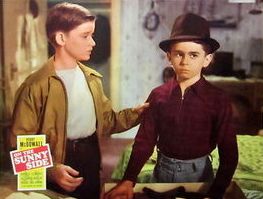
On the Sunny Side (1942) and You, John Jones! (1943) give us a look at the wartime experience of children, as the movies viewed it, during World War II, particularly acknowledging how fortunate American children were compared to their counterparts in war zones.  We were encouraged to be both grateful as well as compassionate.  If there was also sometimes a sense of pride thrown into the mix, well, genuine humility is unfortunately not always our strong suit as a nation.  Still, we might imagine that much of the pride in our relative safety was borne of overwhelming relief.

This is our second entry in our series on childhood during World War II.  Roddy McDowall, whom we saw last week in The Pied Piper (1942), stars as well in On the Sunny Side, made in the same year.  Roddy had made a great impression on audiences in How Green Was My Valley (1941), and became one of the most recognizable, certainly one of the youngest, members of Hollywood’s “British Colony.”  He, his mother, and sister left Great Britain in 1940, an era when Dunkirk, the Blitzkrieg, and what appeared to be imminent invasion by the Nazis brought many Brits to the conclusion that London was no longer safe for their children.  Roddy knew something about the role he was going to play next.


In On the Sunny Side, Master Roddy is an English boy sent to live with a family in the United States for the duration of the war.  In the company of a group of other child evacuees, all traveling without their parents, he arrives on a ship to New York, bound for the Midwest home of husband and wife Donald Douglas and Katharine Alexander, and their boy played by Freddie Mercer, who is nearly the same age as Roddy.  Their parents were acquainted from a previous trip to England, good enough friends to be trusted with the care of their child.  His father is an RAF officer, and his mother is played by Jill Esmond, who also played his mum in The Pied Piper.  Jane Darwell is their housekeeper.

Much of the story is a fairly routine plot of a boy in strange surroundings who makes friends and becomes part of the family/community.  Freddie Mercer lets Roddy into his gang, which, with a clubhouse in the woods that is an old abandoned bus, seems a lot like the kids from the Our Gang series, but less scruffy, and not as funny.  Indeed, they are a rather serious and doleful group of youngsters, but the grownups writing and producing this story are perhaps projecting their own seriousness on the nice American squeaky clean world they’ve set up for the kids.  But, like the Our Gang kids, they even have a bully to fear: Stanley Clements, whose tough wise-guy talk made him the leader of the pack in Going My Way (1945) and in future Bowery Boys films.   Ann Todd plays a classmate who, like most of the girls in the class, fancies gallant Roddy.  A guy with an English accent can really clean up in this town.


The climax occurs when Freddie gets fed up with everybody’s fussing over the new kid, so much so that he becomes jealous and wants to run away from home.  Freddie, who came to Hollywood on his singing talents as a noted symphony and choir soloist, also had a bit part in Going My Way.  Here he’s funny as he sputters about the tea-drinking English kid ruining his life, but he draws our sympathy, and Roddy’s.


Though the grownups are firmly in charge, the story is really presented from the viewpoint of the kids, and they have the most screen time.  Though we might wish for a deeper story less focused on report cards, bullies, and gosh-gee-whiz dialogue, it is true that the prosaic troubles faced by the kids in the story really do reflect what’s important to children.  The adults may be reading the war headlines, but the kids—at least in the U.S.—are more driven by the realities of their world of making friends, doing chores, and worrying about what others think of them.  We might note that the boys’ teaming up and eventually conquering the bully is a parallel to the U.S. and Britain teaming up to fight the fascists.


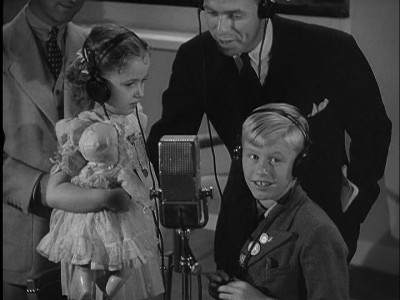
The movie does give us a few quite poignant scenes that hit on the broader crisis: The British kids on board ship, gathering at the rail to watch the Statue of Liberty slide by as they enter New York.  Roddy’s panic and nightmares when he hears a police siren, as it reminds him of the air raid sirens and emergency vehicles of the Blitz back home.  Most especially, the scene where a group of British kids are gathered in a New York radio studio, Roddy among them, to speak to their parents in a London studio via short wave.  The anxiety on the faces of the separate shots of kids and parents, their hesitancy to be too personal on the radio, their brave front of trying to give cheerful messages, and the cruel brevity of the time they are allowed create an image of both tenderness and anguish.  Tears are fought back.  Roddy, who even from a very young age was so good working before a camera, shows a myriad of feelings with the just the slight flickering of expressions on his face, in his lovely dark eyes.  He is nervous, then he warms up and excitedly tells his mother about his new life and friends, comically using American expressions he has learned that he must translate to her.  When his time is up, he realizes he has forgotten to use the notes he made beforehand of all the things he really wanted to say.


The evacuation of children from the London area had them seeking refuge in other parts of the U.K., in many dominion nations, including Canada, and also in the U.S., and involved children of every class.  Vera Brittain, noted British writer whose memoir of World War I, Testament of Youth, perhaps is more well known, at least in this country, than her other works, sent her two children away from their London home to stay with friends in Minnesota during the war.  Her son John was twelve at the time, the age of the boys in On the Sunny Side, and her daughter Shirley (a future member of Parliament), was not quite ten years old.

In excerpts from her diary, published as Wartime Chronicle – Vera Brittain’s Diary1939-1945, Brittain notes that the decision to send her children was a difficult one, “There seemed no right decision to be made, whichever course I took would involve bitter regrets.”

Her children left from Liverpool after Dunkirk, just missing the start of the Blitzkrieg and bombing of London by a matter of weeks.  They remained in the U.S. for three years, coming home, separately, in 1943.  She writes in her diary of the anguish of not receiving letters, then receiving them and learning her son has grown taller than she, and they are changing, experiencing new adventures in summer camp and in school where the curriculum is different.  Missing birthdays and Christmas.  At one point, Vera Brittain notes that her husband urged her to go to the movies to take her mind off their troubles.

“G. persuaded me to go to the new Disney film Dumbo, but it depressed me very much by reminding me of the children.”

Her children became teenagers while they were away.  Their mother drilling in firefighting practice to help after the bombing raids.  “One of the odd incongruities of this war to think that John—who must now be a fairly vigorous boy on the verge of 15—is safely in America while his middle-aged mother scrambles round in trousers fighting fires (or learning to).”

She remarks of her son’s return, “I did not recognize him, but it will take time to get to know him again.”  Her daughter arrived home, after a delay in the Atlantic due to perilous naval battle action, near the end of the year.  (Brittain’s husband, who was a university lecturer, had traveled to the U.S. for a part-year post and on returning, was on a ship that was actually torpedoed.  Twenty died, but he and some others made it to lifeboats and were afterwards picked up by a freighter and returned to England.)

When the family was reunited, a visit to Grandmother brings a comic conclusion to the adventure:

“Children uproarious over tea, Mother blames their manners on America.”


The children who remained in war zones with no avenue of safety were the subject of You, John Jones! (1943) a short subject about ten minutes long, directed by Mervyn LeRoy, starring James Cagney as an All-American dad who works as a supervisor in an airplane factory during the war, and also does his bit at night as a volunteer air raid warden.  Ann Sothern plays his wife, and their daughter is Margaret O’Brien.  When he arrives home from work, little Margaret is practicing her speech for an elocution contest, soberly delivering President Abraham Lincoln’s Gettysburg Address while perched on the living room window seat.  There are politicians who can’t deliver a speech as well as Margaret.  Perhaps they never “stumped” on a window seat.

Cagney leaves for his night watch, dressed in his trench coat with the Civil Defense armband and his helmet.  He sits on a park bench for a little plane spotting and considers how lucky he is to be living in a land where he is not likely to see an enemy bomber tonight.  The omniscient narrator, presumably his conscience, and ours, addresses Cagney (or John Jones), reminding him that if they were in other lands, his little Margaret, “Your baby, John Jones, your baby!” would be in danger.

Then we have a montage of scenes of Margaret as an English girl in the Blitz; as a Greek girl, her leg amputated, trudging with an amputation along a line of refugees; of a girl from Yugoslavia sobbing over a dead mother; from “Australasia” – quite a stunning image of Margaret looking hollow-eyed and shell shocked, then as the camera pans back, we see she is a prisoner of war behind barbed wire.  Margaret, as a Russian girl, lies dead in the ruins of a bombed out house.

To perhaps remind us not only of our good fortune in being spared these experiences in our own country (with the exception of the Americans of Japanese descent being held behind barbed wire in concentration camps), we are reminded, too, of the debt we owe our allies who are carrying the brunt of the war.  The narrator remarks, “If conquered people collaborated, your side couldn’t win this cruel war—did I say your side?  Our side.”

Then an attack occurs, but Cagney realizes it is only a dream.  (Sleeping on duty!)  He returns home, and Margaret finishes her speech with earnest, one may say almost fanatical delivery.   You can have a look at You, John Jones! here.


Kids here in the U.S. may have largely been spared the scenes little Margaret faced, but they were not without trauma caused by the war.  Come back next Thursday when we discuss the March of Time documentary Youth in Crisis (1943), and the Youth Runs Wild (1944) starring Bonita Granville.
**********
Wartime Chronicle - Vera Brittain's Diary 1939-1945, eds. Alan Bishop & Y. Aleksandra Bennett, Victor Gollancz Ltd, 1989.
*********************
The audio book for Ann Blyth: Actress. Singer. Star. is now for sale on Audible.com, and on Amazon and iTunes.

Also in paperback and eBook from Amazon, CreateSpace, and my Etsy shop: LynchTwinsPublishing.


Related Products