IMPRISON TRAITOR, PEDOPHILE, AND CONVICTED FELON TRUMP.
Showing posts with label Leon Ames. Show all posts

Thursday, October 30, 2025

Halloween in "Meet Me in St. Louis"


Meet Me in St. Louis
(1944) celebrates Halloween in a manner that probably had not been done before in movies, or even since.  Here, it is a time for children’s mischief and pranks, but the treats are a holiday spread for the entire family, a cozy home-party with no costumes or gory decorations. 

The movie takes us through an entire year of a family living in St. Louis, Missouri, from the summer of 1903 through the spring of 1904, and the four seasons each make up an “act” in the story.  The summer begins with anticipation for the building of the fairgrounds for next year’s St. Louis World’s Fair – or as little Margaret O’Brien grandly announces, “The Louisiana Purchase Exposition.”

The Technicolor musical is a lovely feast for both the eyes and ears, and parties and special events are opportunities to move the plot along in song.  Christmas, famously, is the winter portion of the movie and the climax of the story, where Judy Garland, the second-oldest daughter and middle child of five kids, croons the touching and sweetly sad, “Have Yourself a Merry Little Christmas” to console Margaret O’Brien over the dismal prospect of the family moving away from St. Louis.

Spring is the shortest act, where the loose ends of the tale are tied up and we have our happy ending strolling through the magnificent grounds of the World’s Fair.  Before all that, however, we have an autumn interlude, which is a big chunk of the movie.

Judy has barely made an inroad to her romance with Tom Drake, “The Boy Next Door,” and the older brother, played by Henry H. Daniels, Jr., isn’t even in this segment because he’s away at college. Most of the segment focuses on the two little girls, Margaret O’Brien and Joan Carroll, who dress in costumes that came out of a rag bag and join neighbor kids on the street, who are piling scraps of wood and furniture on a bonfire in the road.  They break up into commando units to play pranks on neighbors. 


Mother Mary Astor, as her girls are getting ready to join the fun, reminds them that a neighbor lady has folded up a hammock and set it aside for the kids to “steal,” but would they please return it when they’re done.  This tells us that Halloween is intended to be more mock hooliganism than the actual thing—at least until young Margaret and Joan make a thrilling escape from a policeman after an attempt to derail a trolley.


Even before that surprising finale to the evening, we might raise our eyebrows at the idea that Margaret must prove her courage to the other kids by marching up to a feared, forbidding neighbor about whom they tell gross rumors of being a wifebeater and killer of cats, and throw a handful of flour into his face, screaming that she hates him (Grandpa Henry Davenport has advised her to wet the flour first, that way it will stick better). This is to break a banshee spell.  She does the job, albeit trembling all the way, and he, nonplussed, wipes the flour off his face as if he knows it’s just a Halloween thing not to take seriously, like the lady who allows her hammock to be stolen as long as she gets it back.  Margaret becomes a hero to the other kids, and her assault on a neighbor is apparently a rite of passage.


More concerning to today’s parents might be the sight of small children burning half the crates and small tables in the neighborhood in a huge bonfire in the road, unsupervised, if not unsanctioned. 

I can remember in the dim recesses of my childhood watching my father burn autumn leaves in the road by the curb, and also in a large rusty metal barrel, taller than me, meant for that purpose.  But it’s nothing I or my friends would have been allowed to do ourselves.

Halloween, despite the modern decorations meant to induce horror, has become a much tamer thing for children.


And apparently, far less civilized and mature for the adults (compared to today).  We see the family in the movie sitting down to a table with cake and apples, and the bounty of the season, for it seems more a celebration of harvest and autumn as a completion of another phase in the year.  As family maid and cook, Marjorie Main, blithely announces as she sits down with the family to enjoy her own piece of cake, “Well, here it is Halloween, and we’re all another year older.”


Just as we settle into a cozy Victorian parlor scene, chaos erupts.  Margaret O’Brien returns with a bloody lip and a tale of being attacked by Tom Drake.  Judy runs next door to belt Tom.  We assume this will not help their romance. A doctor is summoned (for Margaret, not Tom), and Margaret receives a few stitches, is tucked into bed with treats and made a fuss over—enjoying her invalidism immensely. Joan Carroll returns and excitedly tells Margaret what she missed when she left the fun—that the dummy “body” the kids placed on the trolley nearly derailed it, and they had to run from the constable.  Tom Drake had saved the girls from the police by hiding them down an alley, but they scoff at his interference.  As Margaret notes with a superior air, “As if anybody ever pays attention to girls!”

But a worse calamity suddenly befalls when Papa Leon Ames returns home, triumphant with the news that he is being promoted at his law firm and the family will be moving to New York.

Goes over like a lead balloon, and the family gives him the cold shoulder, from Grandpa down to little Margaret, and one by one, upset, they leave the parlor. 


Mom Mary Astor repairs the damage by soothing Pop, sitting down at the piano and playing the Nacio Herb Brown and Arthur Freed tune “You and I.”  I don’t know if she’s really playing on the track, but you can see for yourself her “playing” is confident and realistic—as Mary Astor was a trained pianist herself.  Pop drifts towards the piano, putting down his cake, and wistfully begins to sing, but the sweet duet is dubbed, however.


One by one, the family all return to the parlor, resume the cake-eating, drawn by the sound and the comforting scene of their parents’ fine example of “life goes on.”  The family unit is all that matters.


The Halloween scene had moments of treats and tricks, and serves to put proper perspective on life’s challenges.  It’s easy to fight off pretend goblins and make-believe doom; it’s a lot scarier to face moving away from your comfortable house, your friends, and everything familiar to be forced into the great unknown.

*******************************


My new non-fiction book, CHILDREN'S WARTIME ADVENTURE NOVELS - The Silent Generation's Vicarious Experience of World War II -- is now available in eBook here at Barnes & Noble, Apple, Kobo, and a wide variety of other online shops.

Or here from my Shopify store if you want to buy direct from me and avoid the big companies.

And it is here in eBook, paperback print, and hardcover, from Amazon.

It is also here in paperback from Ingram.

And here in hardcover from Ingram.

From Cherry Ames, to Meet the Malones, from Dave Dawson to Kitty Carter - Canteen Girl, the Silent Generation spent their childhood immersed in geopolitical events through the prism of their middle grade and young adult books.  From the home front to the battlefield, these books are a window on their world, and influenced their hard-working, conformity-loving generation. 


Thursday, December 20, 2012

Lady in the Lake - 1947


“Lady in the Lake” (1947) uses playful images of Christmas in that clever brand of sarcasm used by only the best private eyes.  And Robert Montgomery.
This is our second installment of A Very Gumshoe Christmas, and we take up where “Alias Boston Blackie” on Monday left off…from B-movie to classic noir.  The loner detective grows up, and grows cynical.  Christmas throws us off the trail from the start, but never Philip Marlowe.
There will be no plot spoilers, just a few impressions of an unusual and daring film. 
“Lady in the Lake” is famous foremost for its unique first-person camera view, and for discussions back and forth by fans for decades on how effective it is or isn’t.  Obviously, the camera has some limitations—for one, it does not accurately imitate the peripheral vision of the human eye.  Some scenes may seem slow or unintentionally comical to the modern viewer as the actors play directly to the camera.  But this wild experimentation is exactly what deserves our respect in an industry where “copycat” is the usual art form and risks are rare. 


Robert Montgomery, who we last saw here in “Night Must Fall”(1937) makes his official directorial debut with this movie, and also stars.  However, as he is playing the lead, detective Philip Marlowe, we see all the action from his viewpoint, but only see him a few times in the course of the film when he happens to look in a mirror. 


On another occasion, his shadow on a wall as he is talking with Audrey Totter is his stand-in.
This may make the film frustrating for Robert Montgomery fans who want to see him (the film was not a box office hit in part for this reason), but true fans of Mr. Montgomery should appreciate his ingenuity in crafting this film.


Audrey Totter, who we last saw here in “Tension” (1949), plays a complex role of a magazine editor who hires Montgomery to find the missing wife of her publisher boss, played by Leon Ames.  Miss Totter should have gotten some kind of prize for playing probably 99 percent of her work in this movie directly to the camera.  That is a workout, and she is a lot of fun to watch; at turns scowling, flirting, pleading, and seducing.  (Today is Miss Totter's 94th or 95th birthday - not sure of the year of birth.  According to IMDb website she is residing at the Motion Picture and Television Hospital in California.  A very happy birthday to a terrific and fondly remembered actress.)


Lloyd Nolan is excellent as a tough cop.  He’s great in whatever he does, and I actually would have loved to have seen him take the lead and play Marlowe in this movie.  His down-and-dirty growl of a voice.
 
Tom Tully is the world-weary police chief.  Jayne Meadows is a standout as a mercurial, almost manic, woman who knows a lot more than she lets on. 
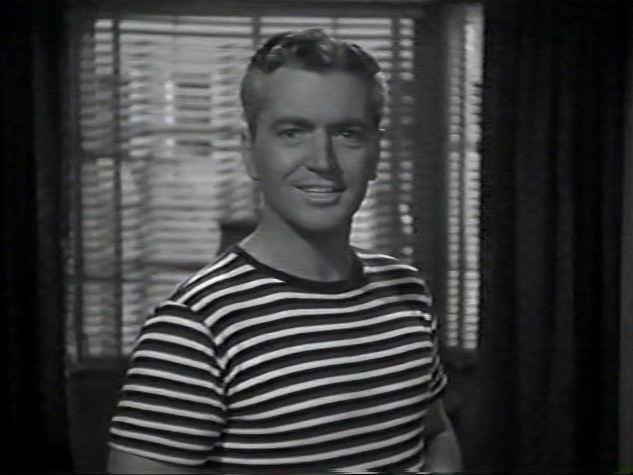
Dick Simmons is a smooth and deceptively friendly gigolo.  You can tell he's a gigolo by the striped jersey.
There are some lines tossed around that would make for a great movie no matter how it was filmed.  Audrey Totter, whose magazines are of the sensationalist pulp variety, complains to an underling that a new magazine cover design needs more gore. "Not enough gore."
Montgomery, recovering from being slugged by the Southern “gentleman” Dick Simmons remarks, “At least he had the decency to hit me above the Mason-Dixon line.”
And Lloyd Nolan’s remark, “How does it feel dying in the middle of someone else’s dirty love affair?”  I love that line.
Despite the restriction of actors playing directly to the camera, there are flashes of remarkable electricity to their performances, moments akin to a stage actor’s reactions.  Some of their responses and facial actions look almost improvisational. 
Because we are the camera’s eye, we see everything Montgomery sees.  Some of this gimmick is playful and funny, as when Montgomery’s leering glance follows Totter’s curvaceous secretary around the room, and with a sharp, somewhat jealous interjection by Totter, our attention is swiftly brought back to the mollified Miss Totter behind her desk.
Sometimes the gimmick is quite eerie, as when we discover bullet holes in a glass shower door, we approach and open the door, and our gaze rests upon bullet-gouged porcelain tiles in the shower stall, falling down upon the naked corpse crumpled on the floor.


Or when Montgomery, injured after a car wreck, crawls (and so do we), hand over hand, across a road to a phone booth that seems a mile away.
 
We are stared at.  We are flirted with.  We are punched in the face. We kiss Audrey Totter.  She serves us a highball. We notice a hundred different clues, and sometimes, as when Montgomery lifts a phone receiver to his mouth and talks, we look at nothing, like at the corner of a table, just as we would absently look at nothing while we are concentrating on a voice in our ear.
All this would be enough to make a fun and very different movie, but set during Christmastime, the director uses images of Christmas in a very cavalier and smart aleck way. 
 
 
We begin with the opening credits, which are title cards designed to look like Christmas cards.  Images of Wise Men, and holly, Santa, poinsettia, all the iconic graphics and over them, a medley of Christmas carols in uplifting choral arrangements that may make us think we are about to watch a heartwarming tale of love and repentance.  In a way, maybe, but it’s a crooked road to repentance.
 
 
As the credits finish and the Christmas carols end, the last title card reveals a handgun.  We were had.  Trust nobody.
We start three days before Christmas.  Robert Montgomery takes on a missing person job, that soon turns into a murder investigation.  All along the journey, though he is a man without family and evidently has no Christmas plans, the yuletide follows close on his heels, a shadow of irony.
We knock on doors and are faced with Christmas wreaths.  He remarks to the gigolo Simmons, “I like your tan.  It’s very Christmassy.”
We intrude upon an office Christmas party, where a reserved and gentlemanly Leon Ames hands out gifts to his employees. 


In a scene with Audrey Totter, Montgomery confronts her with conflicting evidence.  He demands she own up to secrets, and when he has found a gun that was used to murder, he hands it to her gift-wrapped as a gruesome present.  She plays the scene framed close to a desktop Christmas tree.  Christmas stays in the tense scene like a mocking clown.


Leon Ames takes him aside and want to hire him, too.  He nervously picks at the tinsel on the branch of a Christmas tree that juts out from the side of the frame.  Christmas is pushy, demands attention and will not be left out.
 
When we are arrested and interrogated by Tom Tully, Mr. Tully is interrupted by a phone call from home.  It is his little daughter, who wants Daddy to come home and help her put up her stocking.  With quick, wary glances to us, he indulgently listens to his daughter’s prattle, even helping her through her recitation of “T’was the Night Before Christmas.”  It is offbeat, funny, and very surreal.
I like the scene where, trying to escape Lloyd Nolan hovering in the police station hall, we duck into the press room and find a “journalist” lying on the table, speaking “pillow talk” into the phone to his lady friend, a Racing Form by his head. 
After a beating, a car wreck, and a belly full of people lying to him, Montgomery is saved by Audrey Totter, who responds to his emergency call and brings him, unconscious, to her apartment.   She gives him a Christmas present: a robe she had bought for another man.  Like earlier false clues that went nowhere, even the gift to him is not a gift to him.  Marlowe’s world is made up of lies.
 
On Christmas Day, they listen to “A Christmas Carol” on the radio, which was an annual event back in the day, though it doesn’t sound like Lionel Barrymore, and we blow streams of cigarette smoke as we regard Audrey Totter lying contentedly on the living room couch, her eyes drinking us in, across from where we are sitting. 

When the program ends, she snaps off the radio and resumes, as if picking up in mid-sentence, the tale of her hardscrabble life.  Only Scrooge could have interrupted her.  She asks Montgomery what he did last Christmas Eve.  He spent it in a bar.  She spent it in a nightclub.  This Christmas is an improvement, or should be if they weren't so depressed.  Christmas offers redemption, but you have to trust it.  These two lonely people have some serious trust issues.
I was a bit surprised at the can of pork and beans on the kitchen counter.  I would have thought Audrey Totter was decidedly not a pork and beans person.
Montgomery has one task left, and, spying his quarry window-shopping at a Christmas-decorated window, we have a final, very dramatic scene leading to the conclusion of the case.  The movie, like detective Philip Marlowe, is flawed, but has guts.  Teasing us with Christmas images in an otherwise grim movie is an irresistibly smartass thing to do.


Monday, March 26, 2012

Let's Do It Again - 1953


“Let’s Do It Again” (1953) gives us a last look at a frivolous musical comedienne Jane Wyman before a long stretch of more “soapy” roles. To be sure, she had her serious talents already explored in her Oscar-winning performance in “Johnny Belinda” (1946), and “The Lost Weekend” (1945) with Ray Milland, with whom she’s teamed again in this movie.

It’s a different matter to take on a frothy role after one is already established; we see her character is not like the old ditzy chorus girls she used to play when she was younger. Her dignity, partly due to age and party due to simply paying her dues, helps her stand out in this otherwise lightweight movie.

I'll bet your house parties look like this.  I know mine do.   

The film will be inevitably compared (unfavorably) with the original comedy “The Awful Truth” (1937) with Cary Grant, Irene Dunne, and Ralph Bellamy. Most remakes, a lot of us would agree, are disappointing. I wouldn’t look at this as a do-over, though. It’s just another take on a scenario, only with music and set in a 1950s bubble bath. Step right up here, we got your modern furniture, we got your off-the-shoulder gowns. You say you want opera gloves? Sister, we got opera gloves.

Ray Milland is a Broadway composer who, much to the chagrin of his wife, Jane Wyman, spends much of his time on the town carousing without her. She is a former musical star who retired to be a wife. She attempts to make him jealous with a tall tale about staying out all night with his rival composer, played by Tom Helmore. When Milland balks at her story about spending the night with Mr. Helmore in a motel, she, completely unruffled, comforts him, “Darling, don’t look so worried. It was approved by the auto club.”

She plays the scene well, and we see Wyman has not lost her flare for comedy. As their fight moves briskly to the bedroom, she does a does a modest striptease, a few cheesecake poses, singing and never spoiling her perfect makeup in the shower.

Ray Milland gets a few funny bits, especially one later on in the film with Helmore as they discover they have the wrong hats, but for the most part it’s Miss Wyman’s movie. She sings, she dances (Milland is dubbed), and looks great.  Her best scene, when she tries to win him back after he dumps her for another lady, is when she crashes a party for his fiancée and her parents. She pretends to be Milland’s sister, a world-traveling chanteuse and anthropologist.

Her performance in this scene is terrific, purposefully over-the-top, and a 180-degree turn from the prim, pouting neglected wife. Her suddenly low, husky voice announces for us a bawdy extrovert, sexually charged, and swinging a long cigarette holder like a drum majorette with a baton. She greets her “brothers” Ray Milland and Leon Ames with a sensual kiss on the mouth, and asks Leon, “The thing been giving you any trouble lately?” Her slang-infused repartee is hysterical.

Then, with little provocation, she launches into a song and “interpretive” dance taught her (and sung earlier) by nightclub singer Valerie Bettis. Wyman refers to it as the Zambezi Puberty Ritual. Here it is below.

Please remember to scroll down to the bottom of the page and mute the music so you can hear the video.


Aldo Ray is a rich uranium miner from Alaska who has long had a crush on Miss Wyman back in her performing days. He is cute here, a clean-cut boy, a country bumpkin who can do a mean mamba dance, and who romances Wyman in anticipation of their honeymoon, “this time next month we’ll be moose hunting."

Aldo Ray, with his whiskey-rasp of a voice had better roles ahead of him, but was one of those actors who never seemed to get real breaks. Here’s a great commentary on his work over at Where Danger Lives.

Mary Treen plays the maid (of course), one of Hollywood’s most stalwart supporting actresses, who still did occasional TV roles in her later years. Have a look here at this earlier post on Mary Treen.

Trivia for you younger folks: with the advent of mp3, the term of a music “album” is probably used less these days, last used for CDs, but it came from the days -- as we see when Jane Wyman plays a record -- when 78rpm records were issued in an album set. That is, a bound book with five or six sleeves to hold as many records. In this case, Miss Wyman holds an album of several song hits by popular singer Dick Haymes. Broadway cast albums (I think “Oklahoma” was the first to be issued) held the entire show, two songs per record, several records for a whole show, in the many sleeves of a rather heavy photo album-type bound book.

You think mp3 revolutionized the industry? You have no idea what 33 1/3 long-playing records did for the industry (especially as regards classical music). Long playing (LPs) were introduced to the general market in 1948, and according to this article from Billboard magazine (August 2, 1952), the year before “Let’s Do It Again” was released, they (along with 45’s) had accounted for half the sales -- 78s were still hanging in there.  Only for a couple more years.


Here’s a cast album from the Broadway hit “Brigadoon” in 78rpm (the paperboard album long since has fallen apart after moldering in someone’s cellar for decades) and also in LP. Would we have the patience today to wait for “side 10” to hit the spindle?


One last look at Jane Wyman’s musical talent, and off-the-shoulder gown, and opera gloves.

Monday, September 26, 2011

Any Number Can Play - 1949


"Any Number Can Play" (1949) is a spot-the-character-actor festival.  Shown recently on TCM, I came in late, after the opening credits, and knowing nothing about the film, I had a ball picking out character actors I knew or thought I knew.

The leads, to be sure, are enough of a draw.  Clark Gable is a the owner of a gambling house, who spends too much time at work, and whose attacks of angina point to stress and serious heart trouble if he doesn't take it easy. 

Alexis Smith is his wife, who has grown lonelier through the years in his absence, and especially now that her son is almost grown.   Darryl Hickman plays their boy, who is angry at his father for being absent, being the town notorious clip joint owner, and for wanting him to fight other kids when he has no desire to punch anybody. 

There seems to be a lot of emphasis on Gable's disappointment in his son's lack of a brawling gene (there is a toy model of two boxers in a ring on Gable's desk), and his resentment at being resented.

There's not a lot of action; it's a quiet movie, an interesting study of a man not only feeling his age but feeling his mortality, along with a lot of brief side glimpses at the desperation of addicted gamblers and the nature of life as being one big gamble.

This is our post-War Gable, older and looking it, but still with that incredible magnetism.  When he walks through the crowded gambling salon, he's the only person you watch.

Unfortunately Alexis Smith doesn't get to stretch her acting muscles much in this film, except for one very lovely scene.  Gable rumages among the junk in the cellar of their mansion looking for a set of old fishing flies for a long-postponed vacation his doctor says he should take or else.  Alexis leads him off to a side room in the cellar she has fixed up for herself.  She calls it a memory room.

It is a small hideway, a looking almost like a camping cottage.  There are a few pieces of mismatched old furnature, a phonograph, a baby's wooden highchair, and an old double bed that had been theirs in the small apartment they had when they were first married.  All the items are from the early years of their marriage, including the box of fishing flies Gable wants.


He is astonished, and she explains in a low, almost whispered voice that she misses the days when they were together more, when he was just starting out in business, and when they shared all their thoughts and experiences.  Her pain and her disapointment, and her frustration at having to be the linchpin between her estranged husband and son, are mitigated only by her great love for this man.  He flops on the lumpy mattress and she joins him, still whispering between kisses, a very touching seduction scene (We can only suppose she's keeping one foot on the floor).   She is more impressive in this scene than Gable, whose normal tone of speaking voice seems almost a shout compared to her softer tones, and he looks uncomfortable.  He's the rogue of younger days, chasing women in between wisecracks, and does not seem to like being seduced.

However his later scene with Mary Astor, as an old flame who still pines for him, is more profound and shows Gable as lonely as his wife.  One interesting thing about this movie is that, despite Gable's obvious magnestim before the camera, he must also have slipped the cameraman a buck or two because in several scenes he is shown facing the camera and we see only the back of the person talking to him.  This happens most glaringly with Mary Astor, who plays much of their one scene together with her back to us.  Mary Astor, of all people.

Knowing nothing about this film, and missing the opening credits, Mary Astor pulling on the arm of a slot machine was only one happy surprise.  The rest of the movie  became an Easter egg hunt for familiar faces.


Frank Morgan has a great role as an aggressive gambler, a rival and enemy to Gable, who intends to clean him out.  Morgan is a far cry from his normal jovial roles.  He's menacing, snide, sarcastic, but ultimately respecting Gable for playing the game of life as hard as he does.  Mr. Morgan died only two months after "Any Number Can Play" was released.

Leon Ames is the doctor who tells Gable to cut out bad habits (including work) or he's a goner.  Lewis Stone plays the town drunk, who borrows money from Gable, and loses everything at poker.  If you had no idea Judge Hardy could act, have a look at this movie.

Wendell Corey plays Gable's no-account brother-in-law (married to sis Audrey Totter, who doesn't get much to do expect drink and look bitter).  Mr. Corey is a smarmy weakling, who works at Gable's gambling house and is skimming money for himself.  He's gotten in trouble with a couple of hoods.  William Conrad is one of them.  ("Hey!  William Conrad!" she shouts to the TV like a happy idiot.)

Marjorie Rambeau is the town rich lady with an earthy love of gambling.   Edgar Buchanan is one of the patrons, but I don't think he had any lines.  We just see him looking tense at the poker table from time to time.  ("Hey!  It's Edgar Buchanan!")

Caleb Peterson is the simple-minded bar guy, who we sense is another one of Gable's charity cases.  We caught a brief glimpse of Mr. Peterson as the African-American veteran who helped move the heavy plane engine at  the beginning of "The Best Years of Our Lives."

That's William Edmunds as the men's room attendant - remember Mr. Martini from "It's a Wonderful Life"?


That photo in Gable's office of his son as a little boy  -that's not a young Darryl Hickman.  That's a young Scotty Becket.  You recognize him right off, and it threw me.  I spent the rest of the movie wondering when Scotty Becket would show up

Barbara Billingsly is supposed to be a gambler, too, but I didn't see her anywhere.  Instead, I saw a couple people who weren't there.  I thought I recognized one fellow as Leon Belasco, and another as Regis Toomey, at least from profile - but IMDb doesn't list them in the credits. 

I got so hung up on hunting for character actors at that point, I was starting to see things.


Related Products