IMPRISON TRAITOR, PEDOPHILE, AND CONVICTED FELON TRUMP.
Showing posts with label Howard Da Silva. Show all posts

Thursday, April 18, 2019

The Blue Dahlia (1946)


The Blue Dahlia (1946) is a story of betrayal. Alan Ladd is a returning war vet in this film noir who arrives in Los Angeles fresh off the bus with his two war buddies, played by Hugh Beaumont and William Bendix. Ladd is the hero of the piece, if one can term the chief protagonist of a film noir a hero, but his pals are as important to rounding out his character and even driving the plot.


Ladd is not so much an homme fatale in this film as would be, say, Howard Da Silva, who plays a charming and venial nightclub owner, because Da Silva is the only person in the film with the mystique, not just the brutish quality, of evil. Ladd is more a victim who plods his way blindly through a web of betrayal until by the end of the movie, we really don’t see him as much a hero as just the last man standing. But the studio banked on his mystique when paired with Veronica Lake, who is not so much a femme fatale here as another survivor on a dark journey, though perhaps better equipped by nature for survival.

The three war buddies part company early in the film and we are not given the indication that they will see much of each other in postwar life, though Hugh Beaumont and William Bendix will be joined at the hip because Bendix has suffered a serious head wound which has left him fresh out of the VA hospital with headaches, confusion, and memory loss. Hugh Beaumont, the steadier, responsible, quiet member of the group has taken it upon himself to take charge of Bendix and be his keeper. It is a thankless job as any caretaker can tell you, and just why he feels a sense of responsibility towards Bendix we are never told but it is probably the only example of self-sacrifice in a movie that is so rife with betrayal.

The only other example of altruism is perhaps found in the character played by Veronica Lake, who meets Alan Ladd when he is in trouble.  She is, we assume, attracted to him but keeps at a levelheaded distance partly because she is still entangled with a mobster husband and partly because Alan Ladd wants it that way. It is a kind of sacrifice. Later, she will confront Howard Da Silva, her mobster husband from whom she is estranged, for Ladd’s sake.

Veronica Lake does not get much screen time but she will represent Alan Ladd's future, we, again, assume, as the movie ends on a happier note that it began, which is certainly not the norm for film noir

The movie begins on a truly, inexplicably sad note. The Three Amigos enter the postwar world with a sense of apprehension. This was common to veterans; we see this in other movies including The Best Years of Our Lives (1946), which we've covered in several blog posts, and Till the End of Time (1946), which we will cover some time, but these fellows do not articulate the reasons for their sense of doom. Hugh Beaumont has a reason to feel glum, perhaps he foresees a rough road of responsibility for William Bendix and his medical troubles and is stealing himself for a life as his guardian. Bendix, with a hair-trigger temper to boot, is tough to manage. Of the three former Navy flyers, he alone continues to wear his bomber jacket. The other men are dressed in suits they somehow managed to find in the postwar clothing shortage.

When they park themselves at a bar for a parting drink, Bendix remarks to Ladd, "Lucky stiff, at least you've got a wife to come home to." And we see Hugh Beaumont try to discreetly shut him up, something Beaumont will have to do several times during this movie. There is some secret we don’t know.

Alan Ladd says only "Here's to what was." And when they part, Hugh Beaumont, apparently the watchman for all of them (no wonder he became Beaver’s dad), asks Ladd, "Don't you think you ought to call her before you go home?"

Alan Ladd remarks with a mysterious, defeated smile, "Maybe."


It is a foreshadowing that Alan Ladd's home life is not all that it should be.  We have a great deal of foreshadowing this movie, it is like bread crumbs scattered in the forest and it helps us to keep our trail, it helps us to find our way. It is a writer's device to point to whom he wants us to trust and not to trust. There are no red herrings here or tricks, but it will take you until the end of the movie to find out who the real murderer is. There are several plausible witnesses because there is just so much betrayal. The writer is Raymond Chandler, which is as fine a pedigree a film noir movie could get.

Alan Ladd goes to his wife's home, a swank hotel and bungalow complex that seems perhaps a bit more than his allotment checks could have paid for and he stumbles upon a late afternoon cocktail party in her apartment. The alcohol is flowing, someone is playing “Accentuate the Positive” on a piano and people are dressed to the nines, people with dubious integrity, seemingly without a care in the postwar world.

We receive more telegraphing of clues when Alan Ladd goes to the desk clerk and asks for his wife's apartment and we see the bellhops and the desk clerk exchange arch expressions as if they did not know that his wife was married and we may assume that she has been carrying on with others. Alan Ladd knows nothing of this and walks into the party. His wife, played by Doris Dowling in her fourth film, is completely surprised, prickly, jittery, not knowing how to welcome him, especially when she has her lover in the apartment, Howard Da Silva.


Da Silva is as smooth and articulate a bad guy as ever graced a film noir. He runs a local nightclub called the Blue Dahlia and his calling card is to present guests and lady loves with massive arrangements of the large blue flowers. When Alan Ladd from behind a door sees his wife with her arms around Da Silva, kissing him, Ladd interrupts and slaps Da Silva across the mouth. Da Silva graciously backs down and leaves. We will later discover, as he discusses with his partner in his club, that he is perfectly willing to let Alan Ladd's wife return to her husband because he is tired of her.

It’s easy to get tired of the demanding, constantly angry, constantly drinking Doris Dowling. She taunts Alan Ladd for striking Howard Da Silva, "You’re a hero. A hero can get away with anything."

There is an inference of self-entitlement which would still go against the grain of the newly postwar country. Ladd, who plays scenes with a great deal of control and an appropriate sense of weariness, retreats to the bedroom where he has only just begun to unpack and he sees two photos in a double frame.  One is his service photo and on the other is a portrait of their deceased son, Dickie. Dickie died while still a baby. He contemplates the photo; she had never sent him one.
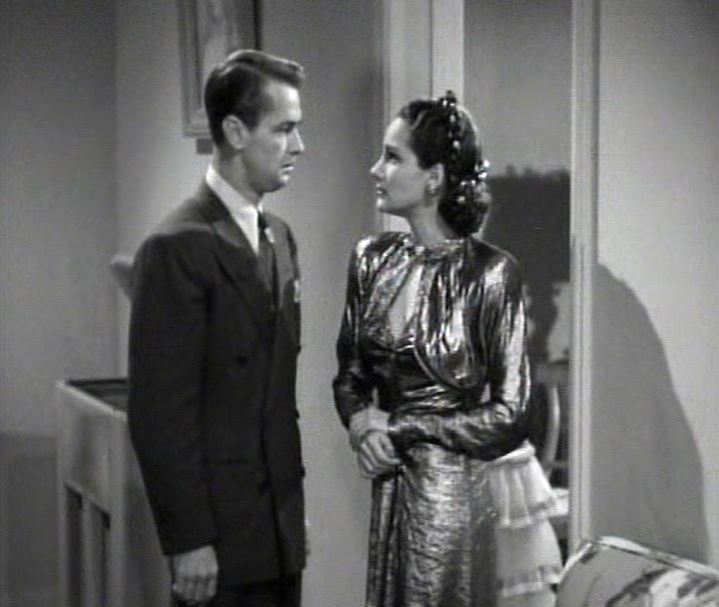
When the guests leave, hustled out, they are alone and Ladd tries to get her to put down her drink, which seems to be attached her hand, so that they can talk. Her fit of temper returns and she announces in a flippant manner that she is her own woman, that she can do what she wants and see who she wants. He becomes angry and she replies I could tell you something that would hurt you plenty. She regrets immediately saying it but he presses her and in another fit of temper she confesses that their son did not die of diphtheria as she had written to him but that he was killed in a car crash. She had brought the baby to a party because she did not want to stay home; she was drunk and wrecked the car and Dickie died.

Ladd needs no more info. He takes the photos and prepares to leave her for good, but for one moment he pulls out his service revolver and she thinks he's going to kill her but he says that she is not worth it and he tosses it to the couch and he leaves in the pouring film noir Los Angeles rain.

The story is told with a great deal of cutting back and forth between different characters and action occurring simultaneously that is fast-paced and this is what makes the movie successful. There are only so many ways you can tell a story, even something as complicated and intriguing as a murder mystery, but for film noir it is not so much the story but how stylistically it is told that makes the genre unique and memorable.

We have a reference to the postwar housing shortage when Bendix phones and relates that he and Beaumont scored an apartment ahead of nineteen other guys because it is Beaumont’s old apartment and the landlady liked him. See?  Having good manners and being responsible pays off.

Doris Dowling will later phone Bendix at their new flat and confess Ladd has walked out on her. Why this bothers her is unknown, as she seemed pretty well through with Ladd, but Bendix, who is emotional and impulsive, leaves in the rain and shows up at her swank hotel and bungalow complex to talk with her, and waits in the bar.  She is there, but neither knows who the other is or that they had just spoken to each other on the phone, and we have the beginnings of a pickup.

The rain continues to pound down, and during the evening, Bendix, as well as Da Silva will show up at Dowling’s apartment.  The house detective played by Will Wright is always lurking around, spying on the action, so we know what he knows.

It is more foreshadowing, for when a murder has been committed, we see there are several suspects, but the only thing we're sure of is that it wasn't Alan Llad because when he left, she was still alive.

William Bendix eventually returns home to the apartment he shares with Hugh Beaumont, soaked to the skin from the rain, dazed, clearly troubled and doesn't remember much of what he's done in the past couple of hours.

Meanwhile Alan Ladd hitchhikes and gets picked up by Veronica Lake. We get a little bit of foreshadowing about Veronica Lake, too. Her portrait is at Howard Da Silva's nightclub and we are told that the they split up not because of a woman but because she didn't like his shady dealings, and Da Silva’s the partner confesses that she's evidently a wonderful woman and both agree that she is far too good for Howard Da Silva. So by the time we meet Veronica Lake we are already disposed to understand she is no gun moll. She is true blue and maybe this is the first bit of good luck Alan Ladd runs across. However, there is no romance. They say goodbye, they meet again, they say goodbye, and both discover separately that the police are after Ladd for murder.

The movie is successful at keeping us off balance and what is going to happen and who was going to end up with who. We only know for sure that Alan Ladd is not a murderer and that Veronica Lake is a nice person. As Hugh Beaumont says of him, "Whatever's the right thing to do, Johnny'll do it."

Alan Ladd's journey through this movie is pretty much based on how other people react to him. His wife does not want a life with him. When he discovers is wanted by the police, he runs into a couple of petty thieves who take him to a flophouse to hide out for a fee and they stab him in the back as does the fellow who runs the flophouse played by Howard Freeman. Freeman betrays Ladd by going through his belongings and asks for shakedown money to hide him from the cops.

Will Wright keeps coming back and he shakes down everybody he can: Howard Da Silva, William Bendix and Hugh Beaumont.  Everybody betrays everybody:  When Howard Da Silva's partner and another thug kidnap Alan Ladd, beat him up and take him to a cabin in the woods, the bad guys betray each other. Interestingly, Doris Dowling provides an ironic bit of wifely fealty by writing on the back of the portrait of their baby some secret info about Howard Da Silva (betraying her lover posthumously, quite a parlor trick).

Alan Ladd has seen enough by half of the movie that when he runs into Veronica Lake again, he confesses his suspicion of her and how "your timing’s good." She tells him "you'll have to trust me." But, of course, he can't he can't trust anybody, not in this movie.

Alan Ladd, in one sense, is even betrayed by his old buddies. He goes to their apartment and they want to hide him. Bendix wants to take it on the lam with Ladd, and Beaumont, who was an attorney before the war, suggests turning himself in. Alan Ladd is shocked to realize both his buddies think he actually did commit murder. He is angered by that sense of betrayal. How could they know him so well and yet think he would stoop to murder?!

The loose ends come together when the police captain, played by Tom Powers, interrogates all and sundry at Da Silva’s office in his night club. Bendix recalls the events he had forgotten on the rainy night of his blackout, and now he thinks he’s the murderer. Will Wright is suspected because he was always lurking around, he had opportunity – though motive is never made clear to us.

At the movie’s beginning, Mr. Wright takes a role similar to many he held over his long career – a cantankerous and possibly shifty coot, but as the movie progresses, we see it is the role of a lifetime for him. He is treated as over the hill and past his prime by the cops and others, a has-been from the word go, but we are told he is 57 years old and for those of us in that neighborhood, it is a bit stinging to think that could have been seen as over the hill, especially since he looks much older. In real life, Mr. Wright was actually 52 years old at the time. Ouch.

Alan Ladd returns, performs an irrelevant party trick to clear William Bendix from the charge of murder, and we realize the cops have already cleared Ladd and found their man.  I’ll give you a break for once and not spoil it, but it’s hardly a shock.
 

We're not sure what's going to happen with Alan Ladd and Veronica Lake. They meet warily one last time by her convertible waiting to say goodbye again (check out the B gasoline ration sticker and our previous post on the subject here), and the only signpost we are given that it might not be goodbye permanently this time is because William Bendix and Hugh Beaumont, who are waiting for him, give up and walk away to the nearest bar. Alan Ladd may or may not catch up with them later.


Neither Alan Ladd nor Veronica Lake may be ready for a relationship at this time but unlike most film noir movies, this movie ends with the hope of a new life of something better. Much has been written about Lake’s and Ladd's screen partnership and I actually preferred them in other roles in other movies. I think Veronica Lake was brilliant in Sullivan's Travels (1941) and in I Married a Witch (1942), discussed here, and So Proudly We Hail (1943) here.  I think Alan Ladd was brilliant in Shane (1951), discussed here. I don't think they reached their full potential with each other.

I wouldn't say they were a case of being mismatched, it isn't that. They were interesting to watch as a pair but I think the reticence their characters showed each other in this movie is something of a metaphor for their ability to connect with each other as actors. Their meetings were always intriguing, their goodbyes were less than dramatic. Film noir had a way of making the main characters somehow distant and inaccessible and mystery was part of the genre. We weren't really supposed to know them that well. They weren't supposed to be people with whom we could feel entirely comfortable. Alan Ladd, with all his ambivalence and aloofness came to be well-known as a film noir hero.  Like the character he plays in this movie, Ladd was more or less thrown into it and stuck with it and he had to endure it until something else came along.

The most burdened person, and most unexplained and therefore mysterious, in The Blue Dahlia, for my money, is Hugh Beaumont. There should have been a Veronica Lake for him.

Be sure to check out the other terrific blogs and their entries in the Classic Movie Blog Association blogathon: Femme/Homme Fatales of Film Noir.  

*********


Wednesday, July 4, 2018

1776 - 1976 - 2026?


At the end of the school year in about 1974 or 1975, I can remember an assembly in junior high school that was meant as an end-of-the-year treat for us kids to get us out of the hot, stuffy classrooms that were not air-conditioned and move us into the gym/auditorium that was also not air-conditioned. A movie projector was wheeled in on one of those old typical public school audiovisual carts and a screen was pulled down over the stage. We were treated to a movie that day. It was 1776 (1972).

We have mentioned on this blog before the 1970s being a decade almost peculiarly devoted to nostalgia. It was the era where we saw a revival of sorts in culture and entertainment, a nod to Hollywood's heyday. Many of Hollywood's stars at that time were still with us, indeed, were still working, and were able to share with us and enjoy the images of their youth which at the time they may have thought doomed to obscurity. But thanks to television and the new videocassettes on the horizon and much memorabilia sold in the meantime, the 1970s became an era where we rediscovered the past and reveled in it. It was the era of That's Entertainment (1974), and young people such as myself were able to not only to learn about the 1920s and 30s and 40s but actually to identify with those eras even in the face of the impending disco craze.


Independence Hall, Philadelphia, JT Lynch photo.

But 1974 or 1975 was still too early for disco. What it was, however, was an interesting watershed where, bit by bit, we began to be aware that the bicentennial of our nation was close at hand. I think we warmed to it slowly but once we saw the party on the horizon we became immersed in the Bicentennial. Perhaps it was the horrific experience of all the upheaval and violence and disappointment and, indeed, revolution of the 1960s that put us in a different frame of mind where we might welcome a more noble, and perhaps scrubbed-up, past.

Suddenly there were novels written about the colonial period, and towns across the United States began to discover their own history and prepare for a historical presentation, even if the celebration was nothing more than fireworks on July 4, 1976. This is not to say that we looked backward with the effect of Disney-fying our past.  Rather, there was a lot of re-examination of many unpleasant aspects of our history, which we faced, I think, nobly, humbly, and learned a great deal from it.

Somewhere in there, a musical called 1776 embodied pretty much all of that era – the interest in nostalgia, the sincere desire to investigate our national roots good and bad, as an opportunity to revel in the joyous knowledge that our democracy was once the greatest experiment of mankind and the most successful and in many ways an uplifting boon to mankind from many nations.  It demonstrated how slim the margin was between success and failure of that experiment.


The play was first performed on Broadway in 1969, when the upheaval of the 1960s was barely out of the rearview mirror. It opened on March 16th of that year at the 46th Street Theater in New York, now called the Richard Rogers Theatre. It depicts, of course, the story of the delegates fighting over the Declaration of Independence preparatory to its writing and signing and adoption in July 1776. There are various historical inaccuracies in the show, but, of course, this is a musical; indeed, it is even a musical comedy though its more somber moments are revelatory, so it should not be looked upon as a documentary. It was never intended to be.

The movie was made in 1972 and, happily, some of the Broadway originals made it to the screen such as William Daniels as John Adams, Howard Da Silva as Benjamin Franklin, Ken Howard as Thomas Jefferson, and John Callum as Edward Rutledge. In the film a very young Blythe Danner plays Martha Jefferson (the role had been originated by Betty Buckley on stage in her Broadway debut). 

As an old movie fan, I take particular delight in seeing Howard Da Silva as Franklin.  Da Silva certainly had his troubles up against the Blacklist and the worst days of the 1950s, so it is especially fun to connect the sneering gangster from The Blue Dahlia (1946) to singing as the jovial, avuncular if naughty Ben Franklin. It is also a very special delight to see Ray Middleton in the smaller role of Thomas McKean, the Scotts delegate from Delaware. We discussed his work in this post on I Dream of Jeanie (1952) where he played the minstrel showman Edwin P. Christy in his booming baritone voice.

Though I love all the sly playfulness in the script and the delightful songs, my favorite among the musical numbers are “Molasses to Rum to Slaves” sung by John Callum as he points out that the evil of slavery is not just something borne of the South but that was aided and abetted by the northern colonies who engaged in the infamous Triangle Trade. It is a very honest and majestic song, even if it is uncomfortable for many of us to hear. It is an excellent way to teach history, I think because it is simple and it is vivid and it gives one a slice, just a taste of all the complications and human emotions that went behind the history.

I'm also very fond of the song called “Cool Considerate Men” which describes the conservatives in Congress not wanting to rock the boat, indeed, many of whom did not really want independence because they were afraid they would lose everything they owned. This song, although it illustrates the beginnings of a split that existed from the very beginning in terms of North and South and propertied men and unpropertied men, the aristocrats versus the rabble—it is not really accurate to say there was a Left and Right in the United States at the time of Revolution. That came much later.


The Liberty Bell and Independence Hall, JT Lynch photo.


The interesting thing about this song in the musical is that it reflects the era of the 1970s when this musical crawled out of the mosaic of our modern times and remains with us today. According to producer Jack Warner (speaking of Hollywood’s heyday, this would be one of the last films in which Warner was involved), President Richard Nixon requested to have that particular song that was in the stage play removed from the film because he thought it an insult to modern-day Conservatives. Warner, who was Nixon's pal, agreed to do it even though the director Peter Hunt, who also directed the stage play, refused. Warner took the song out in postproduction behind Hunt’s back, and he apparently also wanted to have the song cut out from the original negative of the film but the film editor saved the day and kept it safe. According to the Los Angeles Times of September 7, 2001, it was only decades later that this particular song was restored to the film.

When the Broadway musical was slated to be presented at the White House in 1970 for the pleasure of President Richard Nixon, it was likewise requested that the producers cut that song from the show.  They denied the request.

This is the power of history, the power to make it, shape it, the power to deny it and forget it. History never dies because its consequences are always with us. We may say that the left versus right fight represented in the song Cool Considerate Men was not accurate to July 1776 but it most certainly was accurate during the Bicentennial and the play was really about the Bicentennial after all, wasn't it?

And so there in the stuffy junior high auditorium we watched 1776 and our teachers explained to us who the characters were, and I can remember one teacher telling us to spot the redheaded man singing because that was Thomas Jefferson and he had red hair. Caesar Rodney’s facial skin cancer was explained to us. I can remember the clatter of the film projector. I can even remember a sense of discomfort from the teachers and a sense of wonder from the students that we were allowed to see some of the more risqué aspects of the film. To be sure what was risqué in 1975 is not anymore.

We did not need too much explanation about the Revolutionary War because, after all, we were in Massachusetts where we are spoon-fed on the Revolution, the colonial period, where fife and drum corps abound, and in those days, there was a certain smugness in the aftermath of the Watergate scandal that The Commonwealth was the only state in the union that did not vote for Nixon.  We wore T-shirts and had bumper stickers on our cars that said, “Don’t Blame Me, I’m From Massachusetts.”


Independence Hall interior, photo by JT Lynch.


We began celebrating the Bicentennial well before 1976 with many events, such as the recreation of dragging Colonel Henry Knox’s canon from Fort Ticonderoga in New York across the length of the Bay State to Bunker Hill—a miserable job in the winter back in 1775, and even in 1975 on the now-paved Route 20 (which we still call The King’s Highway as often as The Boston Post Road for some perverse reason.)

It was a good time to be young, in the warm lushness of summer when Freedom, to us, meant freedom from school.

Where has that enthusiasm for sentimental American history gone?


For that matter, where has all that old colonial furniture gone?  I don’t think you can even find it in flea markets these days, but everything was colonial reproductions. Everything was colonial. Everything had red, white and blue bunting, including a package of cupcakes.  The Bicentennial was on our money, coins and paper bills (including the short-lived new $2 bill).  It was stamped on our toys, license plates, clothing. I can remember carved eagle plaques on the wall and flags with the thirteen stars hanging from houses.

In 2026, just eight years away, we will be celebrating the 250th anniversary of the Declaration of Independence. We are due for another party. Our enthusiasm for the bicentennial may have been borne from the despair and disillusionment from the late 60s and the early 70s culminating with the Nixon scandal of Watergate, the Pentagon Papers, Vietnam, the vice president being indicted for tax fraud—you name it, there was plenty of corruption to choose from. The Bicentennial gave us a chance to reboot, although the term was not used then.

Will we get another opportunity to rejuvenate and restore ourselves, to look back and to look forward with hope at our 250th celebration? Will there be a celebration? 

Will anybody revive that colonial furniture?

I remember the Bicentennial, the celebrations, the fireworks and the feeling on July 5th as the sulfur from the fireworks still hung in the air, of a sense of needing to move on and clean up after the party and continue on our journey as a nation. Will, just as in the aftermath of Nixon, will a new celebration of our founding as a nation remove the stain, the shame, and bad taste of the Trump years?  To be sure, this nation has suffered crises in many generations, and the threat to our democracy is as serious now because democracy is really a fragile thing that depends on us. The cool considerate men (and women) in Congress are just as self-righteous and just as good as feathering their own nests now as they were in 1976 or 1776.

Eight years away. We have work to do. Pride in our country is not something we deserve as a birthright. It is something we must continually earn.


Massachusetts where John Adams had to "sit down", photo by JT Lynch.

Many decades after the Bicentennial, I went to Philadelphia to see Independence Hall, to pick out where John Adams and my Massachusetts contingent sat.  Having grown up with the musical, it was a running gag on that trip that my brother, John, and I sang under our breath, “Sit DOWN, John!”  In another nod to the Hollywood’s heyday, by which I mean the dependence on the studio setting—that movie was filmed entirely on the back lot, probably one of the last to be filmed so.  No location shooting.


One of the most stirring scenes in 1776, in the film and in the stage musical, was at the very end when they are signing the Declaration and then freeze in the positions not unlike the old John Trumbull painting of the event.  It’s a stunning effect.  The characters immediately become history.  They become the image of the ideal we hold.  We must also take our places in the image of the ideal we hold. If our citizenship requires no effort from us, has no place in our collective memory, then it will have no meaning for our children and grandchildren.  Let’s save our country from being sold out to the highest bidder—foreign or domestic.  We can start this November.  Celebrations take a lot of planning.  By 2026, we might be able to restore our democratic principles.

In eight years, we can maybe revive some colonial furniture, too.

As William Daniel sang when he portrayed John Adams, "Is anybody there?"

The blogger waits for the post rider with news from the front.  JT Lynch photo.

Thursday, August 11, 2016

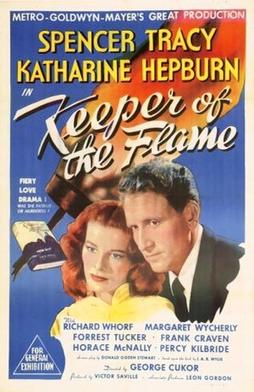
Keeper of the Flame - 1942


Keeper of the Flame (1942) is a daring examination of the existence of fascism in this country. We had come late to the fight against fascism in Europe, and in wartime it was easy to identify those monsters.  But this movie takes a hard look at American fascism. We were not safe from it then; we are not safe from it now.  However, Hollywood, that fantasy factory that brought us so many upbeat, escapist movies prettied up by the Production Code, could still be remarkably vigilant when it came to the depiction of American ideals on screen—when they were being maintained and when they were not.

This is the fourth film in our series on the treatment of fascism in classic films.  We’ve already discussed the foreign-born variety in The Mortal Storm (1940), Address Unknown (1944), and then our home-grown variety among racist thugs in Storm Warning (1951).  Today we take up a film that tackles the notion that the bad guys aren’t always the ones in the propaganda posters, and that fascism often comes to us from the minds, and wallets, of rich and powerful people.  Evil in our midst is always a tricky subject. The audience does not like being preached to; the studio does not like being accused of taking a partisan political position, in order to protect its bottom line.  It was reported that studio head Louis B. Mayer was not happy with this film, feeling it equated fascism with wealth.

But Keeper of the Flame, directed by George Cuckor, brilliantly transcends that with an eerie mystery story, a moody and atmospheric setting, and stellar acting. It is an early example of film noir.


Spencer Tracy stars as a reporter, a foreign correspondent just back from Europe where things have become too hot for him to remain. Though we had many terrific political correspondents back in that era, for me he brings to mind William L. Shirer, whose Berlin Diary was published soon after Mr. Shirer left his political beat in Germany when things got too hot for him. His voice was one of the earliest to warn a complacent America on the danger of Adolf Hitler’s powers of seduction.

This post also serves as our entry into the TCM Summer Under the Stars blogathon, hosted by Kristen Lopez at Journeys in Classic Film. Today is Spencer Tracy day on Turner Classic Movies, and though Keeper of the Flame is not on the roster, this move is a great example of his cool, understated acting, and of how Tracy, however troubled he was in private life, or what private demons he fought ( or didn't fight), embodied the image of the decent American. He was quiet, cool, contemplative, intellectual in a sort of masculine regular-guy way. He could be wry, sarcastic, but his characters were basically humble, even if he didn't take any guff from anybody.

It was as if he could see straight through any situation and see the truth of it.

But in this movie, he has a little trouble getting down to the truth.  Keeper of the Flame is probably my favorite in the Tracy-Hepburn partnership.

Yes, Kate’s in this one, too, and I think it is one of Katharine Hepburn’s best roles, though many feel she is too passive a character here. I like her work in this film for its hesitancy, its reserve. We are used to seeing her bounding through a set like a gazelle. In an unusual twist, she commands our attention by trying to avoid it. We don't know if she's stuffy, haughty, reclusive, or just deeply hurt.  She’s photographed beautifully here, and her grieving widow is, like Tracy, played in an understated manner that complements her enigmatic character.

The cinematography is splendid, and the telling of the story reminds one of Citizen Kane (1941).  We begin with screaming headlines and the sudden, shocking death of Robert Forrester, a much-beloved national figure, as his car plunges into a ravine one stormy night. We don’t know much about him, but bit by bit through the film the layers are peeled away and we have a better picture of him through the people that knew him best: his employees, his household staff, his mother, and his wife—Katharine Hepburn.  Even the great man’s home, a large, remote, wooded estate, is reminiscent of the “Shangri-La” of Charles Foster Kane.  Yet, there are even darker tones here, and it is not just the stormy weather.

Spencer Tracy comes to the nearby town where the great man lived where tributes are being paid, and a flurry of reporters are trying to beat each other’s time to get inside scoops, spinning flowery prose on the loss to the country.  The funeral is witnessed by thousands. Tracy, a great admirer of the great man, is also here to pay his respects.  He is not here to write any stories; he has had enough of politics in Europe.  He’s back home in the U.S. for the first time in years, and he’s looking forward to kicking back and relaxing.

His reporter colleagues include a competitive Stephen McNally, who we’ve covered in previous villain roles, but here he was in his first year of film acting, in, amazingly, his 11th bit part of 1942.

Especially delightful is Audrey Christie as a wisecracking “girl reporter,” who teases the Production Code by helping out Tracy, who needs a room, by inferring to the desk clerk at the local hotel that she and Tracy are married.  The flippancy of the reporters adds a lot of fizz and sparkle to the early part of the movie and throws us off the scent.  We might be prepared to think we are entering a romantic comedy, but very soon, and quite unexpectedly, a mystery pops up.

It is entirely due to Tracy’s powers of observation. In all the throng watching the funeral procession, he is most curious about a young boy, clinging to a lamppost to get a better view, sobbing over the death of the great man.  Tracy comforts him, befriends him, and soon finds himself roaming around the great man’s estate because the boy has found a secret entrance for him.

The boy, very well played by Darryl Hickman, is the son of the great man’s gatekeeper, played by Howard Da Silva.  He is making himself sick over a sense of guilt because he did not warn the deceased that the bridge was out, which led to the great man’s auto crash. Soon, Tracy finds himself on a hunt for some truth—but he doesn’t know what. He only senses that there is a greater story going on, one that he is reluctant to cover, but that he cannot ignore.


Through the mysterious, rather bitter, remarks of the gatekeeper, through a bizarre stolen interview with the great man’s vague mother, played by Margaret Wycherly, and through the careful wall put up by the grieving widow, Tracy slowly finds himself smack in the middle of a huge conspiracy. The great man may have been murdered. At least, that’s what his mother thinks. “Men like Robert aren’t killed by accident. They’re stabbed in the back.”  She doesn’t like her daughter-in-law at all.

Now Tracy is compelled to ferret out the truth he can no longer ignore, not just because he is a reporter and that’s his job, but because he admired this man so deeply, that it is a matter of honor to avenge his death by bringing the murderer to justice.

But his mother also drops another odd remark: “Big people have big houses and little people work for them.”  It turns out to mean a lot more.

Clues point to the grieving widow.

Spoiler time.  Go get yourself a snack if you don’t want to hear.  But if you’re going to stay and listen, then pour yourself a stiff drink.

Kate knew the bridge was washed out that night.  She could have warned her husband.  She chose not to.

Tracy, who has been falling for her a little bit, impressed and almost transferring his hero worship from the deceased to his valiant widow, is gobsmacked and disgusted. He’s only too happy to turn over this venomous—but wait. There’s more.

It doesn’t come out all at once, that’s the brilliance of this film.  Like Tracy, we must become observant searchers of the truth.  We cannot just sit back and be entertained with a mystery story, we are obligated to participate, to assemble the jagged puzzle pieces in our mind and come to terms with what we cannot possibly believe.


Kate unwillingly, as one sickened, relates to Tracy her realization in the early years of her marriage her discovery of her husband’s populist fascism. “They didn’t call it fascism.  They painted it red, white, and blue and called it Americanism.”

His supporters were private individuals who wanted power, but couldn’t get it democratically.  The campaign was a tapestry of hates. Hates for Jews, for city dwellers, for Catholics, for blacks, which appealed to the Ku Klux Klan.

“What was really shocking to me was the complete cyniscm of the plan. Each of the groups was simply to be used until its usefulness was exhausted.”  Again, as we mentioned earlier in this series, the cannibalistic nature of fascism that attacks its own.

“In the end, all the poor little people who never knew what the purpose they were lending themselves would be in the same chains.”

Tracy, coming to terms with the shock of this news about his hero, merely whispers his name, “Robert Forrester.”

Miss Hepburn adds, like a whimper, “He envied the dictators.”

Tracy whispers again, in horror, “Robert Forrester.”  His hero.

Hepburn’s further revulsion intimates a greater, more personal horror for her in her humiliating marriage, where she was, “A poor creature who couldn’t give him sons.” It’s a long speech, which she delivers delicately, with levels of awe and shame.

When she failed to warn her husband of the collapsed bridge, it was a moment’s decision. His paid saboteurs were waiting for his cue to begin the plan of taking over the government. His chief lackey and henchman is his oily and conniving secretary, played by Richard Whorf, who is terrific in the role.


Also look for Percy Kilbride as a laconic cab driver, and Forrest Tucker as Kate’s ne’er do well cousin in an excellent supporting cast.

“Now he’s in your hands,” she tells Tracy.  The great man’s legacy, as well as the weakness of a great society to be exposed is a terrible crisis. She tried to keep his murder secret not to protect herself, but to protect the country from tumbling off into the ravine, too, in its blind devotion to a con artist.

Tracy counters, “People are not children. Sometimes they act like children when you get them scared or confused, but down in their hearts they know and they’re not afraid. They want the truth, and they can take it.”

It is a speech for the ages, and the hope on which I pin the outcome of the coming presidential election and the millions of Trump supporters who are apparently blind to his lack of integrity, his lack of intelligence, and the evil of the man.  Are they, too, lacking in integrity and intelligence?  Are they, too, evil?  I don’t know.  Like Hepburn, I, too, am horrified at the danger my country is in.  But like Tracy, I have hope in the basic decency of the American people, and I feel that courage is needed now more than ever to face the crisis.

Hollywood faced this issue unblinkingly with a fictional character. (We see another treatment in director Frank Capra’s Meet John Doe, covered previously here.) Movies today ignore the elephant in the room.

It ain’t over ‘til it’s over.  The evil henchmen step in to salvage the planned takeover of the government, and Tracy and Hepburn are trapped by fire, shot at, and one is them is murdered.  The ending gives us a comforting bit of flag-waving as the bad guys are exposed and the country is safe now that it knows the truth.

But our country knows the truth, and yet it is not safe. There are too many who do not care about the truth.  Fascism is too appealing to them.

Hitler would have been right at home at the Republican National Convention. It would have been a bizarre, but strangely comforting, homecoming for him. Trump campaign signs hammered into American front lawns would have made him smile.

Come back next week when we wrap up this series with Burt Lancaster and Kirk Douglas in a frightening and fascinating treatment of a planned military coup in Seven Days in May (1964) here. 


****************


My audio book version of Ann Blyth: Actress. Singer. Star., narrated by Toni Lewis, is now for sale on Audible.com, and on Amazon and iTunes.
 

Related Products