IMPRISON TRAITOR, PEDOPHILE, AND CONVICTED FELON TRUMP.
Showing posts with label Sig Ruman. Show all posts

Thursday, May 30, 2019

Only Angels Have Wings - 1939 repost


Only Angels Have Wings (1939) is a quintessential film of 1939, I would suggest for two reasons. First, its “boys’ own adventure” type story of a band of mail flyers in South America would be the end of the Depression era adventures, the last bit of intrigue in a far away land before World War II, a more gruesome adventure which would turn very young real-life fliers into men under horrific circumstances and in which many were killed -- not because the luck of the draw or the stern mistress of fate as in this movie, but because an enemy nation just as well equipped and just as determined, destroyed them. The aimless flyers in Only Angels Have Wings haven’t any such worries. They are not responsible for a nation’s freedom. They can’t even be responsible for themselves. Somewhere out there in the tropical mist, we are on the cusp of a more treacherous world, a more grown-up world. One gets the feeling Cary Grant is trying to hold it off as long as possible.

The second element that makes this movie such a prime example of 1939 is the presence of character actor Thomas Mitchell, who played in five of the top movies that golden year, all winners. Besides this one, he was in The Hunchback of Notre Dame (which we covered here), Gone with the Wind (which we covered here), Mr. Smith Goes to Washington (which we covered here), and Stagecoach, for which he won the Oscar for Best Supporting Actor. It’s not a 1939 film without Thomas Mitchell.


For classic movie buffs, 1939 has always been regarded as the banner year, when the Hollywood movie factories churned out on their assembly lines a greater than usual number of excellent films. This post is part of the Classic Movie Blog Association “Classic Films of 1939 Blogathon” which runs from May 15th through the 17th. Have a look here at the website for a listing of bloggers and their 1939 films. Looks like a lot of great reading.

In this essay, I’d like to look at Only Angels Have Wings through the prism of 1939 and not so much about what we know about that year, but what we may have forgotten about it. The biggest thing we often forget is that we’re watching current events. This film marks the end of a timeline in an era, though I rather imagine director Howard Hawks, himself a former flier, would not have recognized that when he made it. It had only been some 12 years previous to the making of this movie that Charles A. Lindbergh, “Lucky Lindy” flew the first non-stop solo flight across the Atlantic Ocean. That generation of seat-of-the-pants fliers like Lindy and Amelia Earhart, the Granville Brothers, and Bessie Coleman, were still part of the American popular culture; though some of them had already been killed in their daring exploits, their fame had not yet flown into history. These were still the days when airplane flight brought out the press and the newsreels cameras, where records made for huge headlines and parades. Most people alive in 1939 could remember a time when there were no airplanes.

A week or so after Only Angels Have Wings premiered in May 1939, an unusually large number of the original cast, including Cary Grant, Jean Arthur, Richard Barthelmess, Rita Hayworth, and Thomas Mitchell, and even some original actors in very minor roles, appeared in a radio script version broadcast by Lux Radio Theater. Have a listen to the show here, now in public domain, at the Internet Archive site. Scroll down the year 1939 until you get to May 29th.

Between the 2nd and 3rd acts, the show’s producer and host, Cecil B. DeMille, interviewed on radio hookup from New York City the captain of the Yankee Clipper that had just that week made headlines by inaugurating the first commercial airline service from the United States to Europe. This was not a movie stunt, this was real life. The four propeller engine plane held a crew of 14 and could carry 74 passengers, and the mail. The captain announced, “That means we have at last conquered the Atlantic.” The flight took 25 hours.

Here is a newsreel of the event (Remember to scroll down to the bottom of the page to mute the music so you can hear the video):


The world suddenly got smaller, and inter-continental travel got easier (if you consider a 25-hour flight in a propeller plane easy). Only Angels Have Wings, is a product of this world where pilots were regarded as daredevils and pioneers, not yet corporate executives or administrators.


There is an inherent comic book feel to this movie, though again, I’m sure Mr. Hawks did not intend that. Consider how the pilots wear their holstered side arms below the belts of their high-waisted pants, their cuffs rolled up to show their boots. Black leather jackets with faded World War I insignia, and broad-brimmed straw hats to suggest a rakishness that is permissible in a area of law by mutual consent, opportunities built on enormous risks, too much liquor and a few carefully chosen (by the director, at least) women. Except for these last two points, we might be watching a film version of the popular comic strips Terry and the Pirates or Smilin’ Jack.


Here in this world of rattan shades and bamboo furniture, tropical birds and strumming guitars, Cary Grant is boss of a fledging airline running mail from a small port city of Barranca (you know you want to say it. Go ahead: “Calling Barranca, calling Barranca!”) to villages and mining camps far up the Andes. We are in South America, and the only premonition we get of the war to come is the Latin American music, which will have a huge impact beginning in the next year when after war broke out in Europe, we strengthened military and commercial ties with Latin America. The samba and the rumba were not far behind.


Jean Arthur stumbles into Barranca off a tramp steamer one tropical night that delivers a handful of passengers, and cargo, and mail for the plane. She is a piano player, who has left her last troupe of entertainers in Panama. She’s on her own, as free, or as lost, as the men she encounters in the base camp run by Dutchy, played by Sig Ruman. Most of the action of the film takes place in his bar/restaurant/hotel/air field. It is almost like Rick’s CafĂ© Americain in Casablanca (which we discussed here) only without the Nazis, or the refugees.


Casablanca, despite being almost entirely confined to Rick’s, gives us a closer look, and better acquaintance with the local setting and people. Only Angels Have Wings gives us only a brief look at the locals, when Jean Arthur enters another saloon that seems to cater only to them, and enjoys, and sings along with, vibrant Spanish music and dance. She is courageous enough to explore and appreciate. Cary Grant and his boys only buy drinks for, and we assume, sleep with, local girls from time to time. They don’t bother with the local culture too much. Their clubhouse is an island unto itself. An American 1939 fantasy.


Two happy go lucky fliers chat up Jean and bring her to their clubhouse for drinks and steaks, and take turns flirting with her. One, played by a young Noah Beery, Jr., is sent by the boss, Cary Grant, on a late night mail run, but there is bad weather and he returns in a risky landing. The film is barely ten minutes old and we have a ghastly crash while Grant, Miss Arthur, and Grant’s best pal, Thomas Mitchell look on, horrified.


Jean Arthur, sassy and street smart, is crushed by this tragedy, and finds herself equally exasperated with, and attracted to, flippant Cary Grant. In matters of everyday living she is in firm control and nobody’s fool, but in love…she is utterly helpless.

Mr. Grant plays the cynical, smart aleck leader. It would be interesting to have seen Humphrey Bogart in the role, to have his calm stoicism play against a jittery Jean Arthur. He would have given the character a soulfulness, a back story of pain and hard luck just in his glance. Bogie always walks in the door with his own back story, the way some actors might show up for auditions with their own costumes. Despite his veneer of danger, he has a code of honor, while Cary Grant has no such nobility. He is really a condescending rogue. He sizes up Jean Arthur with the taunting remark, “Chorus girl?”

But Cary Grant, as handsome as it gets and just coming off his hero-adventurer stint in Gunga Din (1939) is right for the role in his charm, his boyish devil-may-care attitude, and especially his under-the-surface neediness. There is an inkling of brittleness to his bravado that is intriguing. He talks a great game of fatalistic acceptance of risk and death, but he clings to Thomas Mitchell as his chief emotional burden and his greatest friendship, for whom he takes heartsick responsibility and from whom he receives love and understanding he gets from no one else…until Jean Arthur comes along.

She is the lone woman who infiltrates the boys’ clubhouse. She says “Down the hatch” when she drinks her bourbon with Noah Beery, Jr. and Allyn Joslyn (for more on Allyn Joslyn, have a look at Caftan Woman’s recent post here), but she’s still a lady. She bristles at being passed along, and at being taken for granted. Eventually, she starts to blend in with the boys, after Cary Grant has shaken her, physically as well as emotionally, bawling her out for bawling the boys out when they display no mourning over the death of the flyer Joe Souther.

“Who’s Joe?” they scoff.

In a sweet bit of consoling, which is reprised later in the film, Victor Kilian, who plays the radio operator “Sparks,” confesses he got the same treatment when he was a newbie. Jean unburdens herself to the gentle, sad-faced Mr. Kilian,

“You know, all my life I’ve hated funerals. The fuss and bother never brings anybody back and it just spoils remembering them as they really are. And when I see people actually facing it that way, I act like a sap.”

She remembers the pain of her father’s sudden, violent death. She is alone in the world and so she grabs onto life with both hands, traveling by herself, not fearing to explore, or expose herself to emotional commitment. She is braver than Mr. Grant in this respect.

To make amends for her “unmanly” outburst of grief at Joe’s death, she wanders back into the bar and interrupts a jam session at the piano, taking over the keys herself, and banging out Sophie Tucker’s old theme song “Some of These Days.” Jean Arthur actually looks like she’s playing the piano here; she fakes it well. Most stars tinkling the ivories for a film role usually looked like they are mixing meatloaf with their hands.

Here’s the clip:


“Who’s Joe?” Grant tests her.

“Never heard of him.”

Later, alone at the piano as the bar empties out, she begins the leaden strains of “Lebestraum,” but catches herself before she gets too maudlin. Joe’s personal effects are brought in, only a handful of trinkets, and Cary Grant, per their ritual, allows anyone to take what they want. He offers the trinkets to Jean, and she takes a watch, the most expensive thing.

“You’ve got a good eye,” Grant sneers at her, insinuating that she is just a gold-digging chorus girl after all.

She gives him a look of disgust and mutters in a low voice, just short of growl, “Say, somebody must have given you an awful beating once.” It’s as good a putdown as anybody ever gave to Grant, and as truthful. He begins to change his opinion of her, for her honest challenge, and because she immediately gives the gift to the local girl who grieves the most for Joe. Grant is rebuffed, and impressed.

Miss Arthur is not far from the mark when she suggests someone has treated him badly. We get his version of a former love who tried to ground him with her possessiveness. It is also a warning to Jean not to try to do the same. He invites her to his room, and she accepts, but then he steers her out the door back to the boat. It’s a teasing game, and he blinks first. But when the fog clears and he must take the next mail plane out, he grabs her in a hasty kiss, and she is hooked. We know this, because she’s still there when he returns in the morning.

He irritably puts her off again, and she questions her own mixed up feelings and lack of judgment, “I don’t know whether this is me or another fella.”

Only Jean Arthur could say a line like that and be believed, just like she’s probably the only actress who can use interjections like “Hey!” “Say!”, “Gee whiz!” and “Jeepers” and have it sound profound.

There’s nobody that does that uncomfortable, “caught in the act” look quite like Jean.

But Grant is chafing over this clingy female, and the fear of commitment, and he demands she take the next boat, which won’t come until next week because, “Yes, they have no bananas” as Thomas Mitchell points out. Grant stomps away, and Jean is embarrassed and crestfallen.

“I’ve never quite made such a chump of myself.” Fortunately, Grant’s buddy becomes her buddy and he comforts her. Too bad she didn’t fall in love with Thomas Mitchell. (During the Lux Radio Theater broadcast of “Only Angels Have Wings,” Mr. DeMille thanked Jean Arthur and Thomas Mitchell for taking a week off from their current filming of Mr. Smith Goes to Washington to do the radio show.)

The movie shifts gears and we have the introduction of Richard Barthelmess, last seen here in Heroes for Sale (1933), as a new flier with a fake name and a mysterious past. Rita Hayworth is his pretty young wife. She doesn’t know that years before he piloted a plane that was going down in flames, and he bailed out, leaving his mechanic on board to die. Ever since then he has been shunned by other fliers.

He doesn’t know that she is Cary Grant’s former lover.


The subplots of this movie keep the pace moving nicely. Another subplot is Thomas Mitchell’s fading eyesight, which prompts Cary Grant to ground him. Mitchell is noble about it, accepting, and Cary Grant is torn up. His booting a chair across the room is his only expression of emotion about how badly he feels.

The mechanic who died in Richard Barthelmess’ plane was Thomas Mitchell’s younger brother. When Mr. Barthelmess is found out, he is shunned here, again, by these pilots, as he always is wherever he goes from job to job. He withstands Cary Grant’s barbs with stoic, self-deprecating sarcasm, but Grant offers him a few dangerous jobs one else will take to earn his boat passage out of here. Including flying nitroglycerin, which he drops on condors.

Barthelmess is great in this role, a man doomed by his own guilt, haunted and too self-punishing even to look for redemption. We look in his expressive dark eyes and maybe we recall the The Dawn Patrol (1933) and other hero roles not so many years ago, but seemingly a lifetime for this now middle-aged man.


Another element is keeping up the pace is the constant and subtle shifts into humor. There are glib remarks and pratfalls. The proud Spanish-speaking company doctor, played by Lucio Villegas, who Barthelmess is ordered to fly up to a mining camp to treat an injured man is insulted by the suggestion that it might be too dangerous, and spouts a soliloquy from Shakespeare about courage while Grant tries to placate him and shut him up.


Another element is the periodic flying scenes that take us breathlessly up the mountain passes and across rugged terrain in a craft that looks like to be little more than a wood crate with wings. The aerial photography is spectacular. Though some of it is models, it’s all breathtaking action. At one point, Barthelmess must take off from a narrow cliff with not enough room to taxi, so he taxis the plane right off the ledge and picks up the wind currents on the drop, like a kite, in a stomach-turning descent.


It is these successful daring tasks and precise flying that earns Barthelmess Grant’s grudging respect. Eventually, however, Rita Hayworth (Judy, Judy, Judy) wants to know why her husband is always treated like dirt. She is still in the dark about his past. We have a reunion scene between the former lovers Hayworth and Grant, but we can see that there are no more sparks between them. Miss Hayworth is in love with her husband, and Mr. Grant is just as fed up with her as when she tried to tame him.


It would have been more interesting, I think, to have Grant and Hayworth still attracted to each other, then the foursome would really be caught in a dilemma; each would be forced into making decisions about their lives instead of just letting things happen.  Perhaps Howard Hawks felt he had enough subplots.

More humor when Grant catches the stumbling Jean Arthur eavesdropping on their conversation, and Jean slowly starts to enter the picture again, waiting out a nail-biting test flight of Grant’s that has her getting sick to her stomach. Again, comforted with kind words and a Bromo-Seltzer from Thomas Mitchell. She confides again her love of Grant to him.


“I know I’m a fool, but I can’t do anything about it,” she whimpers. She recognizes, and envies, Mitchell’s close relationship with Grant.

“You love him, don’t you, Kid?”

“Yes, I guess I do.”


“Why can’t I love him the way you do, sneer when he tries to kill himself, be proud when he doesn’t? Why couldn’t I be there to meet him when he got back? What do you do when he doesn’t come back when you expect him to?”

Mitchell’s tortured expression and body English tells us there’s been many a time he got sick with worry over Grant. “I go nuts.”


Another comic, but sexy scene is when Jean Arthur sneaks into Grant’s room so she can use his bathtub. Grant enters, and they bristle and irritate, and flirt, and laugh. Rita pops in, and a terrific jealous exchange between her and Jean:

“Maybe I’d better go,” Jean offers.

“No, please don’t,” Rita replies, with raised eyebrows and an arch expression.

“I really didn’t intend to.”


But Rita is not really jealous, she’s affirmed that she loves her husband and will let the past go.

Another comic bit when Grant sees Arthur limping and he picks her up in his arms. She tells him she’s not hurt, she just broke the heel of her shoe.

“Imagine,” she says, “Losing one heel right after another.” They kiss, and she promises there will be no tying him down or asking him to give up flying.

“You don’t have to be afraid of me anymore.” What a line, as comforting as it is accusing. The screenwriter gives her more gold,

“There’s nothing I can do about it, I just love you. That’s all. I feel the same way about you the Kid does.”

It’s an honest assessment of his relationship with Thomas Mitchell, who puts a coat over Grant’s shoulders on a chilly night, brings him coffee and worries that he doesn’t get enough sleep, lights his cigarettes. (Everybody seems to light Grant’s cigarettes in this movie.) He does what he can do for his chum, then he wanders into the background. It’s the kind of relationship with which Grant is comfortable, and the only kind he can accept from Jean.

He’s still not a committing kind of guy, but something happens to open up a place on Grant’s dance card.

Yeah, a great big old cast-iron spoiler here. Read on at your peril.

Another flight must be undertaken to meet a needed contract, but the only ones who can take this assignment are Barthelmess and Mitchell. Destiny takes a hand, and the man with the guilt, and the man with the hatred for the guilty party who got his kid brother killed are riding the skies together.

The plane runs into trouble, a fire on board, and they crash, but Barthelmess will not bail out this time. With superb flying, he brings the plane to the ground. He is badly burned, but Thomas Mitchell is fatally injured.


Afterwards, the fliers welcome Barthelmess into the fraternity and place a drink in his bandaged hands. Manuel Alvarez Maciste plays guitar and sings a sad Spanish tune that soothes and laments at the same time. Mitchell’s personal effects are laid out on the bar in a handkerchief. This time, Cary Grant does not cynically offer the goods to anyone. He takes the small bundle to his room to be alone with them.

It’s different with Mitchell. Nobody’s going to say, “Who’s the Kid?” at his death. Mr. Grant’s manly code of Ă©lan in the face of death does not extend to his dearest friend. Maybe he’s a hypocrite. Maybe he’s human. The men who call him “Papa” because he is their leader in their tight-knit male hierarchy will not see him cry, but Jean does.

Another smoothly comic bit when Jean, antsy and pacing outside Grant’s office just before she leaves for the boat meets with Victor Kilian again, who whispers to her,

“Aren’t you going to say goodbye to him? I think you ought to.”

Jean, surprised, clinging to hope, “You do?”

“I think he’d want you to.”

“You sure? I don’t mind doing it if you say so.”

“I do say so.”

“You do?”

With Kilian’s blessing, she enters Grant’s office, mumbling defensively that Kilian wanted her to.

It runs that knife edge between silliness and deeply touching.

She practically begs Grant to ask her to stay, but he vacillates. He wants her to stay, because he needs somebody. He’s just about to say something, when we hear from the radio once more:

“Calling Barranca! Calling Barranca!”

The weather clears, and there is one last chance to make their contract, so Grant scrambles to his plane. This time Jean’s plea has a disgusted, angry tone.

“I’m hard to get Geoff. All you have to do is ask me.”

He can’t, but he suggests they flip a coin, and it is not until after he leaves that she realizes it is Thomas Mitchell’s two-headed coin.

It’s the closest he can come to asking her to stay, and she does. We may wonder if she’s getting the short end of the stick staying with a man so emotionally close, or so proud, or so hurt, or so juvenile he cannot comfort her with a simple “I love you.” Maybe it’s because he doesn’t. If he’s inscrutable to Jean, he is to us as well.

But this is not a world of commitments, because commitment suggests the possibility of a future, and in Barranca we are only concerned with the here and now. There will be many hasty commitments made, clung to, and perhaps regretted during the war that will follow in only a few more months.

Does anybody else feel sorry for the guy in the mountain lookout post, all by himself through the entire movie? Played by Don “Red” Barry, poor “Tex” never gets any company, except his mule.

Only Angels Have Wings made such an impression of movie audiences of the day that “Calling Barranca!” was a punch line for a while. A few cartoons used the gag, including Tex Avery’s Ceiling Hero (1940) and Saddle Silly (1941).


Perhaps some of you will remember the early 1980s TV show Tales of the Gold Monkey starring Stephen Collins. That was inspired by Only Angels Have Wings.

The banner year of 1939 gave us movies that were escapist in many ways, but inevitably truthful about who we were, and what we imagined about the world. Please have a look at the many other blogs participating in this blogathon. Special thanks to Becky of “Classic Becky’s Brain Food” and Page of “My Love of Old Hollywood” for organizing the fun.

*******
Jacqueline T. Lynch is the author of Ann Blyth: Actress. Singer. Star. and Memories in Our Time - Hollywood Mirrors and Mimics the Twentieth Century. Her newspaper column on classic films, Silver Screen, Golden Memories is syndicated nationally.  Her new book, a collection of posts from this blog - Hollywood Fights Fascism - is available here on Amazon.

Thursday, June 26, 2014

The World In His Arms - 1952

The World in His Arms (1952) is unabashedly, unexpectedly sensual, often boisterous and sometimes savage, but over all, romantic.  It manages to be all this without really teasing the Production Code, which is the miracle of it.  The movie stands on all familiar conventions of adventure stories and of romance stories--in this case, the romantic triangle.  But in this film, the triangle is made up of two leads with exciting screen chemistry--and their director, whose thumbprint is on every frame, bringing the characters close to us, keeping it intimate.

It is, on its surface, a swashbuckling sea picture—and indeed, its seagoing action scenes, including a race between two schooners, is among the most thrilling and best ever filmed—but director Raoul Walsh’s creative rendering makes this movie appeal to both fans of action/adventure movies and fans of romance stories.  His celebrated skill in framing shots and selective editing-as-you-go filmmaking makes this a fast-paced movie where no sensation lingers too long, but where one experience after another hits us like a fresh and stinging and exhilarating sea spray.  Like any good storyteller, he knew what buttons to push.

Ann Blyth was 23 years old when she appeared in this film as an escaping Russian countess—escape sets the scene for many Walsh movies.  Handsome Gregory Peck is a New England sea captain, a rascal transplanted to the Pacific coast where he runs between Alaska, where he and his crew harvest seal pelts, and San Francisco, where he sells them and spends his money on saloon girls like Andrea King, whom we saw as Ann’s human rival in Mr. Peabody and the Mermaid (1948), discussed here.  Miss King seems to have recovered from being bitten in the leg by Ann in that film, because she walks okay and even dances a little.

But we don’t see too much of the saloon gals, for very soon Ann Blyth invades Mr. Peck’s manly world of fistfights and clubbing seals as a damsel in distress, escaping from a forced marriage to Carl Esmond, whom we saw here as the Nazi head officer in Resisting Enemy Interrogation (1944).  Even though he’s a Russian Prince, he’s still a Nazi here, calculating, viciously cruel, and unable to rid himself of his Prussian bearing and German accent.


Raoul Walsh’s damsels in distress are never really so helpless that they don’t take an active part in their own salvation.  Ann’s Countess Marina has strong survival instincts, brains, courage, and a sense of responsibility to her few faithful retainers.  She goes after Gregory Peck as the best hope for her to get herself and her staff to Sitka, Alaska (which I think was not called Sitka, but New Archangel at this time period) and the Russian colony headed by her uncle, played by Sig Ruman, who we last saw here in Only Angels Have Wings (1939).  Also unable to handle a Russian accent, and cozy enough to resemble a figure from an operetta, Mr. Ruman is not her best choice for refuge, as we will see.  Carl Esmond has everybody in his power. 

Mr. Peck has an adversarial relationship with the Russians.  He is their chief competitor in the sealing business, and they regard him as a pirate encroaching on their territory in Alaska waters.  The movie takes place in 1850, when the Russians had already had a strong foothold in Alaska for more than a century.  Though Peck has no love for the Russians, Miss Blyth, at first pretending to be one of Andrea King’s saloon girls to attract him, soon becomes his whole world as he loses his heart, and nearly loses his ship and his life. 

About the only thing bogging this film down a little is the sporadic brawling that seems to start with little provocation.  Peck and his men become more interesting when their bravado, and their enjoyment of a good fight, is directed to a sense of purpose—the final rescue scene is quite exciting.

John McIntire, who keeps popping up as a favorite in this series on Ann Blyth, is Gregory Peck’s right-hand man, wry, comic, Bible-quoting, with Shakespearian delivery.  At one point he whacks Gregory Peck on the skull with a belaying pin, purely in the name of friendship.  It's a guy thing.

Bill Radovich is Ogeechuck, a barrel-chested native, chief pilot, and a cross between a barroom bouncer and Curly Howard. 

Anthony Quinn plays the captain of a rival schooner, a loud, boisterous thief who steals cargo, shanghais crews, whose playful exchanges with Peck sometimes end up with one or both of them getting hit on the head with a belaying pin.  It is such an obnoxious character, one can imagine Quinn might have had a lot of fun playing him.

Eugenie Leontovich has a small role as Ann’s chaperone and lady in waiting, and has the distinction of speaking with the most authentic Russian accent in this film.  No wonder, this esteemed stage actress grew up in Imperial Russia and escaped the Revolution when she fled to Paris.  Other members of her family, loyal to the Czar, were not so lucky.  She has a cute bit when, appalled by the odor of Bill Radovich, who has a habit of keeping fish in the hood and pockets of his coat, and whom she is constantly shooing away, turns up as her hero at the end of the movie.  He and the rest of Gregory Peck’s men disguise themselves as Russian Orthodox priests during an attempt to rescue Ann Blyth.  Madame Leontovich recognizes Mr. Radovich by his smell, is greatly relieved that help is at hand, and there is a twinkle in her eye when he winks at her.

Gregory Gay is Ann's loyal adviser and trustee, who is terrorized by teasing saloon girls.

Hans Conreid stands out as a harried hotelier who must endure the chaos Gregory Peck’s gang brings to his fancy hotel.

A few favorite scenes:  The schooner race between rivals Peck and Quinn, with fabulous cinematography by Russell Metty.  Rear screen projection is used sparingly, most of this is the real thing and it feels like we’re on board.

Ann Blyth, the well-bred and refined countess, educated in London and Paris, tries to copy the showy dress and common manners of the saloon girls because she thinks that’s the kind of woman Gregory Peck wants.  She never throws herself at him, rather merely dangles herself in his presence.  The throwing goes to Anthony Quinn, who picks her up roughly and smothers her with unwelcome kisses, and when Peck demands her release, Quinn tosses Miss Blyth to him.

Catch her expression when she lands in Peck’s arms.  Her surprise and discomfort has melted into coy pleasure. 

The scene on the hill above San Francisco, after they have spent an evening on the town together, and he loosens her hair from its tight bun.  Hairdo undoing may be an image corresponding to a woman’s undoing, but it’s also one of the most romantic gestures in storytelling.  You may already know she’s standing on a box for their kissing scene.  Ann frequently had to stand on a box for romantic scenes as many of her partners were quite tall.  She might not have had a career without that box.

Another sublimely romantic scene is when Gregory Peck takes her aboard his moored ship to show her around.  The ship is called The Pilgrim of Salem.  He is originally from Salem, Massachusetts, though his friends and enemies alike here on the Barbary Coast call him The Boston Man.

She puts her hands on the ship’s wheel and says, "She's lovely." 

He puts his hands atop hers, “And she always obeys me.”

“Perhaps because she likes the touch of your hand,” she replies, looking down with satisfaction at his hand covering hers. 

“She ought to; I’m in love with her.”

Modern films with love scenes showing two people writhing in bed are not more erotic than this scene under the night stars, so astonishing in its simplicity and effectiveness.

Most especially lending a mood of almost unbearable longing is the theme song, composed by longtime Universal Studio score composer Frank Skinner that sounds like an old Russian folk tune, sweeping and mournful and heartbreakingly beautiful.  It serves as the leitmotif of the film that resurrects the lovers’ passion in pivotal moments, and conjures the pain of hoping against all hope.

In one scene, Mr. Peck takes Miss Blyth to a restaurant run by Russian ex-pats, where she requests the song from a strolling violinist and hums to it, explaining its words.  She gets to speak a little Russian in the movie.  In the Cold War environment in which this film was made (more on that in a bit), there is a romantic nostalgia for the Imperialist Russia, yet equating the harshness of the regime to modern Soviet totalitarianism.  They are the villains, until they join the Americans and become “good Yankees” themselves.  They are all a microcosm of the world on this coast.  The Aleut native, McIntire the Nova Scotian, Peck the New Englander, Quinn is Portuguese, and Irish, Chinese, and Russians abound. 

In this movie, Peck has a business maneuver afoot to buy Russian Alaska for several millions, exploit its riches and boot out Russian control.  That would happen 17 years after this movie takes place, with or without Gregory Peck.  We may muse that when the movie was released in 1952, Alaska was still a territory, it's riches still barely exploited, and was not a state until 1959.

Peck’s seal harvesting business, incidentally, is strangely handled in this movie.  The scenes with the seals on the beach is rear-screen projection, and no clubbing of the seals is actually seen.  John McIntire gives a young seaman a lesson on conservation—the Russians are decimating the seal population by not carefully culling the herds of only the “bachelors” and instead taking all the female seals and cubs.  We see the men of the schooner land on the beach and herd seals, clubs in hand.  Next, we see them back on board, neatly stacking the skinned pelts.  The brutality of the killing is never seen.  I’m not sure if Raoul Walsh pulled a punch here, or if the studio just got squeamish.  It’s as if the seals, like in a cartoon, just unzipped their pelts, relieved to be rid of the hot fur coat, and walked away.

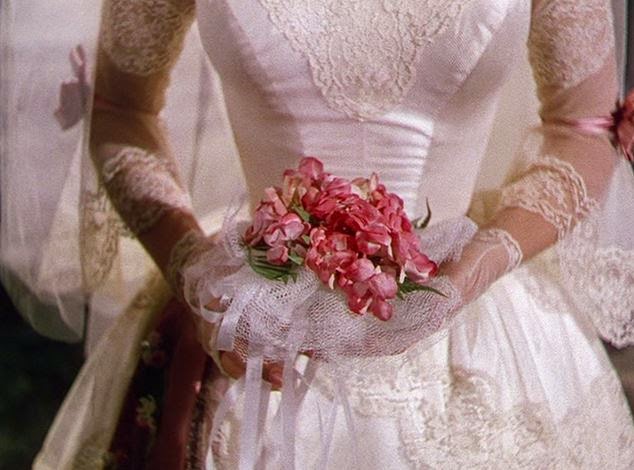
The romance between Peck and Ann Blyth really is a threesome, for we sense the strong presence of director Raoul Walsh in their scenes.  Despite his lusty testosterone-driven fights with belaying pins (I gotta get me one of them, so handy), his scenes with Ann Blyth are delicate and deep.  This shot of her bridal bouquet held at her waist as she, reluctant and heartbroken, is dressing for her marriage to Carl Esmond (she agrees to marry him to save Peck and his crew) is surprising.  A close-up on the flowers at her corseted waist, then pulled back to see the whole dress.  There is a feminine sensibility to this scene that I find touching, though I wonder if Mr. Walsh would balk at that.

In no scenes is she “taken” by Gregory Peck in abrupt embraces or rough kisses as we might see in other films where the damsel in distress is really just a prop, despite Peck's attitude of wild and lusty freedom to do pretty much what he wants.  Their attraction is mutual and they woo each other with patience and determination. There are too many obstacles for them to simply fall in love.  One senses the director’s appreciation not simply for Marina's sensuality, but for the actress playing her, perhaps expressed as well here by columnist Gene Handsaker who was allowed to watch a bit of the filming:

“Lord, what an actress!” the carpenter beside me breathed almost reverently.  We’d just watched Ann Blyth, as a Russian countess of long ago, burst into a dungeon full of chained men.
She rushes up to Gregory Peck, one of the prisoners, and swears that she still loves him.  She embraces him.  Her face is away from the camera, but there are tears, real tears, in her eyes.

Then she gets good news that will free Peck.  Annie rushes back up the dungeon steps, her back to the camera.  But from where the carpenter and I are watching, we can see her grinning excitedly at this wholly imaginary good news.

All of a sudden I remember a definition I once heard: Good acting is not acting at all.  It’s being…

The director often accused by actors of being difficult to work for was remembered more kindly by Ann Blyth in her interview with Eddie Muller (who called her remarks “generous”) on stage at the Castro Theatre in San Francisco in 2006, the transcript of which is quoted at The Evening Class blog (see below).

He was just a wonderful character, a devil-may-care kind of fellow.  He knew what he wanted and he was very short in his direction and if he didn't get it he'd just say, "Cut, let's try that again."  There wasn't too much "do it again."  He just had a wonderful way of getting the work done.  No fuss about it.

This estimation of Walsh may be more than just being “generous” or her customary habit of not badmouthing coworkers, but we could assume reflected her own serious approach to her work before the camera.  In a radio interview with host Casper Citron at WOR in New York City, November 1992, Ann noted:

I think you can work a scene to death.  I really do think that sometimes the first or second take …if you’ve rehearsed well and if the people you’re working with interact well with you, it seems to me that you should be able to do pretty much all that you can do, certainly within four takes—because they’re going to be covered from different angles as well.  So, you really do get other chances…Indeed, if an actor doesn’t come well-prepared, then I think many times it doesn’t matter who the director is.

…You have to know pretty much how you want to approach a role, and certainly to have input from a good director is most important. But you have to be prepared.

…I’ve always felt strongly about the roles that I’ve done and I’ve always felt that when I went to the set that I was going to be so prepared so that whatever the director decided to do, I would certainly have a say in how to approach a role.

There were other elements that might have given Walsh and Ann common ground: they were both Irish Catholics and both native New Yorkers.  Bryan Forbes, who plays the young seaman recalled in Raoul Walsh: the True Adventures of Hollywood’s Legendary Director by Marilyn Ann Moss that Walsh--the buddy of such tough guys as Humphrey Bogart, Errol Flynn, James Cagney, and John Wayne--put a fine box on the set of TheWorld in His Arms.  “Anyone who swore in …the demure Ann Blyth’s presence…had to put money in it.”

One scene which shows Walsh’ judiciousness is when Gregory Peck is captured by Carl Desmond, who orders him to be whipped.  Peck’s shirt is torn open at the back, and the resident torturer (every bad guy has one), starts the job of whipping Peck, but the camera quickly shifts to Ann Blyth’s reaction.  Obviously, Mr. Peck is not really going to be tortured on camera; that is not possible, so the best option to show the cruelty of the moment is to show the reaction of one who is our proxy in the experience.  Ann’s tragic face is enough to make us feel the horror because she feels it.  We don’t really need to see Peck flayed alive.

This is a primary difference in the approach of drama between theatre and film.  Theatre is unselfconscious about using illusion to tell the story, whereas filmmakers are more self conscious about illusion and prefer to straightjacket the audience’s experience in what has come to be accepted as “reality,” though there is nothing real about film reality.  Here Walsh relies with admirable confidence on Ann’s ability to carry the message of the scene without needing to resort to the sadistic and, in the end, unrealistic, image of Peck bleeding, flinching and wincing over an experience that is not really happening.

The last scene in the film is one of its most passionate, where Ann stands at the ship’s wheel, steering the sleek schooner into the twilight while Gregory Peck stands behind her, his hands covering hers.  Anthony Quinn is about to ask for his cut of Alaska, but John McIntire wisely says that Peck is not interested in Alaska at the moment, "not while he has the world in his arms.”  And we see that Ann Blyth is not just a damsel in distress or prop, but a fellow adventurer, and a woman deserving to be his whole world.

Raoul Walsh is in the scene too.  He frames them against the darkening sky, with the wind billowing against the long elaborate skirt of the wedding dress for her aborted wedding to the bad guy.  That heartbreaking, gorgeous Russian theme song swoops down upon us, sad and lovely and ecstatic.  They are more than smiling, they are grinning, all alone in each other’s company despite having a ship full of his crew, Anthony Quinn and his crew, Ann’s faithful servants, and a seal named Louise. 

Ann says something. We can’t hear because that gorgeous music is making us tear up, and Peck leans in close to her, because, apparently, he didn't hear it either.  She repeats, and he laughs, and she laughs.  It is a joyous moment showing their enjoyment of each other, and so much more sensuous than the clichĂ©d fadeout kiss.

It looks quite impromptu and natural.  She could have said, “You’re on my foot,” or “I brought a peanut butter sandwich for lunch.”  We don’t know, and it’s best left to our imagination.

I cannot believe that glorious tune was not released as a single, with lyrics.

In July 1952 The World in His Arms had its premiere at several military bases in Alaska, the outpost where the Cold War brought nuclear adversaries toe to toe.  Ann toured at these bases making personal appearances and performing.

At one base, two shows were scheduled, but not all the servicemen could be accommodated, so a third show, beginning at midnight, was held for them.  According to Kaspar Monahan of the Pittsburgh Post-Gazette, the performers…

…proceeded to put on their best performance of this tour….But the next day, Ann Blyth and her fellow performers were so tired they could hardly walk to the mess hall for their breakfast.

Alice Hughes of the Reading Eagle reported that the press and entertainers traveled by military transport planes from base to base, and that, “We were given instructions on how to put on the harness and the folded parachute in case of a need to jump.”  The group of 75 including 23 entertainers, included Joyce Holden, Jeanne Cooper, Lori Nelson, Claudette Thornton, Audrey Goetz, male crooner Robert Monnet, comic Buddy Hackett, and Palmer Lee and Kathleen Hughes, both of whom we last saw with Ann in Sally and St. Anne, discussed here.

The bases ranged from the far-flung desolate Adak Island to the Arctic Circle.  “Annie, as we came to call Miss Blyth,” reported Howard Pearson for the Deseret News Magazine (Salt Lake City) sang for audiences ranging from 30 men to over 4,000. 

Clyde Gilmour of the Vancouver Sun was disposed to forgive her for not dishing gossip on the folks back in Hollywood. 

…her guileless and sunny honesty and her lack of theatrical razzle-dazzle are almost legendary in a profession that includes more than its share of strutting poseurs and egomaniacs…has been mesmerizing everybody right and left with her radiant smile and her mellow Irish voice.

Ann Blyth had hoped upon her return to Hollywood to begin The Student Prince in a greatly anticipated rematch with Mario Lanza, with whom she had starred in The Great Caruso, but this was not to be—at least not yet, and not with Mario Lanza.  More on that next month.

Have look here for other reviews of The World in His Arms I've enjoyed very much by our friends Laura of Laura’s Miscellaneous Musings and Kevin Deany of Kevin’s Movie Corner.

The movie is fortunately available on DVD, in a transfer really stunning for it's gorgeous colors and sharp cinematography.  Really a beautiful, beautiful-looking film.

The World in His Arms was one of the last films she made under her seven-year contract for Universal-International.  Come back next Thursday when we turn back the clock to 1944, when a 15-year-old Ann Blyth made her first two movies under that contract, Chip off the Old Block and The Merry Monahans.


This year-long series on Ann Blyth’s career has reached the halfway point.  I’ve enjoyed working on these posts more than I can tell you.  Several of you have asked about the possibility of turning this series into a book.  I’ve decided to proceed with that, to be available sometime next year.

Diana and Constance Metzinger over at Silver Scenes are hosting an MGM Blogathon June 26-29, and have graciously asked me to re-post my essay on Mrs. Miniver.  That will be up this Sunday, the 29th.

See you next Thursday for more Ann Blyth.

*********************

Daytona Beach Morning Journal November 9, 1951, syndicated column by Gene Handsaker.

Deseret News Magazine, (Salt Lake City) August 31, 1952, pp. 16-17, article by Howard Pearson.
          

Moss, Marilyn Ann.  Raoul Walsh: The True Adventures of Hollywood’s Legendary Director (University Press of Kentucky, 2011).

Pittsburgh Post-Gazette, July 2, 1952, p. 16, “Time Hangs Heavy for Servicement on Bleak Adak Island.”

Reading (Pennsylvania) Eagle, June 28, 1952, article by Alice Hughes, p. 5.

The Spokesman Review (Idaho), May 30, 1952, p. 3.

St. Joseph (Missouri) News-Press, December 16, 1951, syndicated column by Louella Parsons, p. 4D.


WOR (New York City) radio interview with Ann Blyth, Bill Hayes, and host Casper Citron, November 14, 1992.  
************************
THANK YOU....to the following folks whose aid in gathering material for this series has been invaluable:  EBH; Kevin Deany of Kevin's Movie Corner; Gerry Szymski of Westmont Movie Classics, Westmont, Illinois; and Ivan G. Shreve, Jr. of Thrilling Days of Yesteryear.

***************************
UPDATE:  This series on Ann Blyth is now a book - ANN BLYTH: ACTRESS. SINGER. STAR. -

*********************
The audio book for Ann Blyth: Actress. Singer. Star. is now for sale on Audible.com, and on Amazon and iTunes.

Also in paperback and eBook from Amazon, CreateSpace, and my Etsy shop: LynchTwinsPublishing.


 "Lynch’s book is organized and well-written – and has plenty of amusing observations – but when it comes to describing Blyth’s movies, Lynch’s writing sparkles." - Ruth Kerr, Silver Screenings

"Jacqueline T. Lynch creates a poignant and thoroughly-researched mosaic of memories of a fine, upstanding human being who also happens to be a legendary entertainer." - Deborah Thomas, Java's Journey

"One of the great strengths of Ann Blyth: Actress. Singer. Star. is that Lynch not only gives an excellent overview of Blyth's career -- she offers detailed analyses of each of Blyth's roles -- but she puts them in the context of the larger issues of the day."- Amanda Garrett, Old Hollywood Films

"Jacqueline's book will hopefully cause many more people to take a look at this multitalented woman whose career encompassed just about every possible aspect of 20th Century entertainment." - Laura Grieve, Laura's Miscellaneous Musings''

"Jacqueline T. Lynch’s Ann Blyth: Actress. Singer. Star. is an extremely well researched undertaking that is a must for all Blyth fans." - Annette Bochenek, Hometowns to Hollywood


Ann Blyth: Actress. Singer. Star. 
by Jacqueline T. Lynch

The first book on the career of actress Ann Blyth. Multitalented and remarkably versatile, Blyth began on radio as a child, appeared on Broadway at the age of twelve in Lillian Hellman's Watch on the Rhine, and enjoyed a long and diverse career in films, theatre, television, and concerts. A sensitive dramatic actress, the youngest at the time to be nominated for her role in Mildred Pierce (1945), she also displayed a gift for comedy, and was especially endeared to fans for her expressive and exquisite lyric soprano, which was showcased in many film and stage musicals. Still a popular guest at film festivals, lovely Ms. Blyth remains a treasure of the Hollywood's golden age.


Related Products